CopyrightÓ2010 by the Genetics Society of America DOI: 10.1534/genetics.110.114256
The Nucleosome Remodeling Factor
ISWI
Functionally Interacts With
an Evolutionarily Conserved Network of Cellular Factors
Walter Arancio,*
,†Maria C. Onorati,
†Giosalba Burgio,
†Marianna Collesano,
†Antonia M. R. Ingrassia,
†Swonild I. Genovese,
†Manolis Fanto
‡and Davide F. V. Corona*
,†,§,1*Dipartimento di Scienze Biochimiche,§Dipartimento di Biologia Cellulare e dello Sviluppo,†Istituto Telethon Dulbecco, Universita’ degli Studi di Palermo, 90128 Palermo, Italy and‡Istituto Telethon Dulbecco, Dipartimento di Biotecnologie,
San Raffaele Scientific Institute, 20132 Milan, Italy Manuscript received January 15, 2010 Accepted for publication March 1, 2010
ABSTRACT
ISWI is an evolutionarily conserved ATP-dependent chromatin remodeling factor playing central roles in DNA replication, RNA transcription, and chromosome organization. The variety of biological functions dependent on ISWI suggests that its activity could be highly regulated. Our group has previously isolated and characterized new cellular activities that positively regulate ISWI inDrosophila melanogaster. To identify factors that antagonize ISWI activity we developed a novelin vivoeye-based assay to screen for genetic suppressors ofISWI. Our screen revealed thatISWIinteracts with an evolutionarily conserved network of cellular and nuclear factors that escaped previous genetic and biochemical analyses.
T
HE eukaryotic cell has evolved regulatory mecha-nisms to induce structural changes to chromatin in response to environmental and cellular stimuli. Chromatin covalent modifiers catalyze specific post-translational modifications of the histones’ amino- and carboxy-terminal tails (Kouzarides2007), while chro-matin remodeling complexes use the energy of ATP hydrolysis to change nucleosome positions or to incor-porate histone variants into chromatin (Eberharter and Becker2004; Saha et al.2006). These chromatin modifications, occurring without a change in DNA sequence, set different chromatin functional states and constitute the epigenetic marks of our genome (Imhof 2006; Martin and Zhang 2007; Sala and Corona 2009). Although it is expected that a cross talk should exist between ATP-dependent remodelers and covalent modifiers of chromatin, little is known about how these activities are coordinated and integrated with each other in complex chromatin signaling pathways (Strahland Allis2000; Jenuweinand Allis2001).ISWI is the catalytic subunit of several ATP-dependent chromatin remodeling complexes, highly conserved during evolution and essential for cell viability (Corona and Tamkun 2004). ISWI-containing complexes play central roles in DNA replication, gene expression, and chromosome organization (Dirscherland Krebs2004).
ISWI uses the energy of ATP hydrolysis to catalyze nu-cleosome spacing and sliding reactions (Corona and Tamkun 2004). In Drosophila, loss of ISWI function causes global transcription defects and leads to dramatic alterations in higher-order chromatin structure, including the apparent decondensation of both mitotic and in-terphase chromosomes (Deuring et al. 2000; Corona et al. 2007). Recent findings indicate that ISWI controls chromosome compactionin vivo, in part through its abil-ity to promote the association of the linker histone H1 with chromatin (Coronaet al.2007; Siriacoet al.2009).
In vitroandin vivostudies carried out in several model organisms have also shown the involvement of ISWI-containing complexes in a variety of nuclear functions including telomere silencing, stem cell self-renewal, neural morphogenesis, and epigenetic reprogramming occurring during nuclear transfer in animal cloning (Dirscherland Krebs2004; Xiand Xie2005; Parrish et al. 2006). Inactivation of ISWI also interferes with theraspathway (Andersenet al.2006), and loss ofISWI function seems to be associated with a subset of mela-notic tumors and the human multisystemic disease Williams–Beuren syndrome (Mellor2006).
The variety of functions associated with ISWI is prob-ably connected to the ability of other cellular and nu-clear factors to regulate its ATP-dependent chromatin remodeling activity (Coronaet al.2002; Ferreiraet al. 2007; Hoganand Varga-Weisz2007). Due to the broad spectrum of functions played by ISWIin vivo, it is likely that chromatin factors, nuclear enzymatic activities, and a variety of histone modifications may influence its activity in vivo. To identify new regulators of ISWI function, we developed an eye-based assay to identify Supporting information is available online athttp://www.genetics.org/
cgi/content/full/genetics.110.114256/DC1.
1Corresponding author:Universita’ degli Studi di Palermo and Istituto Telethon Dulbecco, Dipartimento di Biologia Cellulare e dello Sviluppo, Viale delle Scienze, Edificio 16, 90128 Palermo, Italy.
E-mail: [email protected].
ISWI genetic interactors in the higher eukaryote Dro-sophila melanogaster(Coronaet al. 2004). Loss ofISWI function, by eye-specific misexpression of the dominant negative alleleISWIK159R, produces catalytically inactive ISWI that is incorporated into native complexes, giving rise to rough and reduced eye phenotypes in otherwise healthy flies (Deuringet al.2000; Burgioet al.2008). In a previous study, we used this in vivo eye assay to conduct an unbiased genetic screen for mutations in genes that dominantly modify phenotypes resulting from the misexpression ofISWIK159R
in the eye (Burgio et al.2008).
The screen produced the first genetic interaction map for the ATP-dependent chromatin remodeler ISWI in a higher eukaryote (Burgioet al. 2008). The characterization of the network of factors we isolated revealed unanticipated roles for ISWI in the cell as well as novel mechanisms by which its activity could be regulated (Burgioet al.2008). Interestingly, one class of mutants isolated in the ISWIK159R screen included chromatin components and nuclear enzymatic activities that could regulate ISWI function by covalently modify-ing chromatin factors or ISWI itself (Burgioet al.2008; Salaet al.2008). The biochemical characterization of the genetic interactions recovered between ISWIK159R and genes encoding for chromatin covalent modifiers, established that eye-based genetic screens in flies could be a powerful tool for thein vivodissection of chromatin-remodeling signaling pathways occurring in the nucleus (Corona et al. 2004; Armstrong et al. 2005; Burgio et al. 2008; Sala and Corona 2009). Moreover, the ISWIK159R screen established that ISWI function could be modulatedin vivoby a variety of cellular factors that have escaped previous biochemical analyses (Burgio et al.2008).
The nonsaturatingISWIK159RF1screen was designed to specifically isolate enhancers ofISWI(Burgioet al. 2008). To identify novel factors working in antagonism with ISWI, we developed a newin vivoassay that allowed us to screen for genetic suppressors of eye phenotypes caused by true loss-of-function ISWI alleles. We took advantage of the Ey-Gal4, UAS-Flip (EGUF) approach to produce flies with eyes composed exclusively of mitotic clones that have lost ISWIfunction (Stowers and Schwarz 1999). Loss of ISWI in the eye caused reduced rough eyes, eye color variegation, and loss of cell identity. We employed the ISWI-EGUF eye pheno-types to set up a dominant modifier screen to isolate factors antagonizing ISWI activity in vivo. Employing classic gene network bioinformatics analysis, we com-bined the results of our screen with those obtained in two others screens conducted in Drosophila and in Caenorhabditis elegans, where anISWIallele and its worm ortholog were isolated (Andersenet al.2006; Parrish et al.2006). The combination of genetic and bioinfor-matics approaches employed resulted in the identifica-tion of an evoluidentifica-tionarily conserved network of modifiers
ofISWIeye phenotypes, which included several poten-tial antagonists ofISWIfunction. Our analysis revealed new roles for ISWI in cell cycle progression as well as unanticipated mechanisms by which its activity could be regulated, shedding new light into the evolutionarily conserved physiological function of ISWI family mem-bers in cell cycle regulation.
MATERIALS AND METHODS
Drosophila stocks and genetic crosses:Flies were raised at 25°on K12 medium (Genoveseand Corona2007). Unless otherwise stated, strains were obtained from Bloomington, Szeged, and Drosophila Genetic Resource Center Stock Centers and are described in FlyBase (http://www.flybase.org). ISWI-EGUF eye characterization: The EGUF approach (Stowers and Schwarz 1999) was employed to obtain, by mitotic recombination, flies with eyes entirely composed of homozygous wild-type,ISWI2, brm2, andkis1clones (ISWI-EGUF). The control wild-typeEGUFadultsFRT42D,1/FRT42D, GMR-hid; EGUF/1were obtained by crossingyw; P{neoFRT}42D males with yw; P{neoFRT}42D,GMR-hid2R,CL2R,y1
/CyO; EGUF virgins. ISWI-EGUF adults FRT42D, ISWI2/FRT42D, GMR-hid; EGUF/1were obtained by crossing yw; P{neoFRT}42D,ISWI2,sp/ SM5,Cy,sp males withyw; P{neoFRT}42D,GMR-hid2R,CL2R,y1
/ CyO; EGUFvirgins.ISWI-EGUFadults bearing a copy of wild-type ISWI (Deuring et al. 2000), FRT42D, ISWI2/FRT42D, GMR-hid; ISWI1
/EGUF were obtained by crossing yw; P{neoFRT}42D,ISWI2,sp/1;P{w1
,ISWI1
}/1 males with yw; P{neoFRT}42D,GMR-hid2R,CL2R,y1
/CyO;EGUF virgins. ISWI-EGUFadults bearing a copy of the enzymatic inactiveISWIK159R (Deuring et al. 2000), FRT42D, ISWI2/FRT42D, GMR-hid; ISWIK159R/EGUF were obtained by crossing yw;P{neoFRT}42-D,ISWI2,sp/1;P{w1
,ISWIK159R}/1males withyw; P{neoFRT}42D, GMR-hid2R,CL2R,y1
/CyO;EGUF virgins. brm-EGUF adults EGUF/1; FRT79B, brm2/FRT79B, GMR-hid were obtained by crossing yw; P{neoFRT}79B,brm2/TM6,Hu,Tb males with yw; EGUF/CyO; P{neoFRT}79B,GMR-hid3R,CL3R,y1/TM3,Sbvirgins. kis-EGUF adults FRT40A, kis1/FRT40A, GMR-hid; 1/EGUF were obtained by crossingyw; P{neoFRT}40A,kis1/CyOmales withyw; P{neoFRT}40A,GMR-hid2L,CL2L,y1
/CyO; EGUFvirgins. ISWI-EGUFadults bearing a copy of theacf1[1]allele (Fyodorov et al.2004), FRT42D, ISWI2/FRT42D, GMR-hid; acf1[1]/EGUF were obtained by crossing yw; P{neoFRT}42D,ISWI2,sp/1; acf1[1]/1males withyw; P{neoFRT}42D,GMR-hid2R,CL2R,y1
/ CyO;EGUF virgins. ISWI-EGUF adults bearing a copy of the E(bx)Nurf301-2allele (Badenhorstet al.2002),FRT42D, ISWI2/ FRT42D, GMR-hid; E(bx)Nurf301–2/EGUFwere obtained by cross-ing yw; P{neoFRT}42D,ISWI2,sp/1; E(bx)Nurf301-2/1 males with yw; P{neoFRT}42D,GMR-hid2R,CL2R,y1
/CyO; EGUFvirgins. ISWI-EGUF PiggyBac genetic screen: New PiggyBac in-sertions were generatad by crossing small batches of 20 pHer{3xP3-ECFP,atub-piggyBacK10} jumpstarter males with 20 yw,pBac{3xP3-EYFP,p-tTA-K10}; P{neoFRT}42D,ISWI2,sp/ CyO mutator bearing virgins. In the F1, males yw,pBac{3xP3-EYFP,p-tTA-K10}; P{neoFRT}42D,ISWI2 ,sp/pHer{3xP3-ECFP,a-tub-piggyBacK10} carrying the ISWI2 allele and both mutator andjumpstarterelements, recognizable by the double CFP/YFP eye fluorescence and the absence of the Cy marker, were crossed with isogenicw1118virgins. In the F2, single malesw1118; P{neoFRT}42D,ISWI2,sp/pBac{3xP3-EYFP,p-tTA-K10}if the mu-tator hopped on the second chromosome or w1118; P{neo-FRT}42D,ISWI2,sp/1; pBac{3xP3-EYFP,p-tTA-K10}/1 } if the mutatorhopped on the third chromosome, recognizable by the presence of the YFP and absence of the CFP eye fluorescence, were crossed with yw; P{neoFRT}42D,GMR-hid2R,CL2R,y1
/CyO;
EGUFvirgins. In the F3, males and females P{neoFRT}42D,GMR-hid2R,CL2R,y1
/P{neoFRT}42D,ISWI2 ,pBac{3xP3-EYFP,p-tTA-K10},sp; EGUF/1for second chromosomemutatorinsertions andP{neoFRT}42D,GMR-hid2R,CL2R,y1
/P{neoFRT}42D,ISWI2,sp; EGUF/pBac{3xP3-EYFP,p-tTA-K10}for third chromosomemutator insertions were scored for their ability to dominantly modify (enhance or suppress)ISWI-EGUFeye phenotypes. Flies carrying only oneFRT42Dsite linked with theGMR-hidtransgene could be easily recognized because they cannot undergo eye-specific mitotic recombination, thus generating slightly pigmented adult eyes without ommatidia (Figure 2A) (Stowersand Schwarz 1999). Interactingmutatorinsertions were retested and balanced on both chromosomes. The PiggyBac mutatorline pBac{3xP3-EYFP, p-tTA-K10}(Hornet al.2003), containing the tetracycline transactivator gene (tTA) instead of the yeast GAL4 transactivator, was employed to avoid interference with theEGUFsystem.
ISWI-EGUF EP genetic screen: TheEP collection on the third chromosome (Rorth et al.1998) was tested by cross-ing males carrycross-ing a balanced or unbalanced EP insertion with yw; P{neoFRT}42D,ISWI2,sp/CyO virgins. In the F
1, yw; P{neoFRT}42D,ISWI2,sp/1;EP/1 males, recognizable by the loss of the Cy and EP balancer markers, were crossed with yw; P{neoFRT}42D,GMR-hid2R,CL2R,y1
/CyO; EGUF virgins. In the F2, male and female yw; P{neoFRT}42D,ISWI2,sp/ P{neoFRT}42D,GMR-hid2R,CL2R,y1
; EGUF/EP were scored for their ability to dominantly modify (enhance or suppress) ISWI-EGUFeye phenotypes.
ISWI-EGUF genetic screen scoring system:TheISWI-EGUF eye phenotypes are highly penetrant (100%;n¼ 1000) and show a very low expressivity (, 15% of progeny show phenotypes less or more severe than the standardISWI-EGUF eye phenotypes;n¼1000). Nevertheless, both the PiggyBac and the EPISWI-EGUFscreens were conducted in F3and F2, respectively (see Figure 2), to increase the chance to identify trueISWI-EGUFmodifiers. APiggyBacor anEPinsertion was considered an Enhancer of ISWI [En(ISWI)] if.50% of the experimental class showed an eye with a more severe pheno-type (reduced eye size and increased roughness), when compared to the controlISWI-EGUFeye. APiggyBacor anEP insertion was considered a Suppressor of ISWI [Su(ISWI)] if .50% of the experimental class showed an eye with a less severe phenotype (increased eye size and reduced roughness), when compared to the controlISWI-EGUFeye.PiggyBacandEP insertions giving in the experimental class bothEn(ISWI)and Su(ISWI)were termed bimodal,Bi(ISWI).
ISWI-EGUFsecondary screens:To eliminate falseISWI-EGUF interactors, distinct secondary screens were conducted on the basis of the type of insertions (PiggyBac vs. EPtransposons), the chromosome arm hit (2L, 2R, 3L, or 3R), and the type of interaction class scored (enhancer vs. suppressor). PiggyBac En(ISWI)’s mapping the 2L, 3L, and 3R chromosomes were tested for their inability to cause eye defects in the absence of an FRT42D, ISWI2chromosome (supporting information, File S1 andFigure S4).PiggyBac En(ISWI)andSu(ISWI)mapping the 2R chromosome, because of the presence of the FRT42D sites, produce eyes with the 2R chromosome in homozygosis. Therefore, false En(ISWI)’s were eliminated because they failed to enhance ISWI-EGUF eyes in the presence of an ectopic copy of the wild-type ISWI1
transgene (Figure S4). On the other hand, falseSu(ISWI)’s were identified by their inability to suppressISWI-EGUFeyes in the presence of an extra copy of theGMR-hidtransgene not linked to theFRT42D recombination site (Figure S4). Finally, En(ISWI) and Su(ISWI) isolated with the EP screen were eliminated for their failure to enhance or suppressISWI-EGUFeye phenotypes in the absence of theFRT42D, ISWI2chromosome (Figure S4).
iPCR and candidate allele analysis:We mappedISWI-EGUF modifiers to 99 potential protein-coding loci (Table S1),
combining iPCR data available in FlyBase (www.flybase.org) for the EP interacting insertions with the iPCR sequencing data we generated for the PiggyBac interactors, using standard protocols (www.fruitfly.org/about/methods/inverse.pcr.html). SomeISWI-EGUFmodifiers (i.e.,mbf1,ttk,eff,stg, andcpo) were validated by testing other alleles of these genes, available from public stock centers, using the genetic screen scheme used for testing EP insertions. Mutations in genes corresponding to ‘‘neuronal morphogenesis,’’ ‘‘multiple cell fate,’’ and ‘‘connect-ing’’ nodes were obtained from public stock centers and tested for their ability to interact in theISWI-EGUFeye assay, using the genetic screen scheme used for testing EP insertions, and in the ISWIK159Reye assay according to Burgioet al.(2008).
Bioinformatic and cell cycle analyses: For the BioGrid analysis (Breitkreutzet al.2008), eachEn(ISWI),Su(ISWI), and Bi(ISWI) ISWI-EGUF interaction was associated with a single gene on the basis of the insertion DNA sequence data available in FlyBase (www.flybase.org) and the iPCR analysis we conducted on the PiggyBac insertions. The gene ontology data and all the genetic and physical interactions existing between the ISWI-EGUF modifiers were obtained from the BioGrid website (www.thebiogrid.org) and were represented in a graphical format using the Osprey software (Breitkreutz et al.2003) (http://biodata.mshri.on.ca/osprey/servlet/Index). For Gene Ontology (GO) analysis the FatiGO data mining tool (Al-Shahrouret al.2007) and the latest gene annotation and Gene Ontology provided by FlyBase were used. TheC. elegans genes isolated in the multiple cell fate screening (Andersenet al. 2006) were converted to fly orthologs using the WormBase database (www.wormbase.org).
For the GO analysis the gene annotation and the Gene Ontology provided by FlyBase were used with Ontologizer (www.ohloh.net/p/ontologizer) to determine overrepre-sented GO terms. The parent–child method of Ontologizer, which takes into account the parent–child relationships of the GO hierarchy, was applied and the P-values were adjusted using Westfall–Young single-step multiple testing correction. A corrected P-value threshold of 0.1 was used as a cutoff for reporting significant matches. To compute statistical signifi-cance of the frequencies of GO-component terms hyper-geometric distributions were calculated on the basis of the occurrence of the indicated terms and corrected for multiple testing by the Bonferroni correction method.
Cell cycle profiles from imaginal discs and brain cells were obtained according to Collesanoand Corona(2007), using a BD FACSCanto flow cytometer (BD Biosciences), with a laser wavelength set at 488 nm (6000 events were recorded for each cell cycle profile). Cell cycle profiles were quantitatively analyzed using the ModFit software. Homozygous ISWI2, wunPBacF48andISWI2, caspPBacG75abrains and total imaginal discs used for the cell cycle analysis were dissected from third instar larvae, obtained from stocks balanced with the T(2:3),CyO, Tbbalancer and selected for the absence of the Tb marker. Imaginal eye discs subjected to cell cycle analysis were obtained by crossing ISWI2; eyGAL4/T(2:3), CyO, Tb virgins with ISWI2; eyGAL4/T(2:3), CyO, Tb orISWI2; effEP3627/T(2:3), CyO, TborISWI2; ttkEP3314/T(2:3), CyO, TborISWI2; mbf1EP3684/ T(2:3), CyO, Tbmales.
RESULTS AND DISCUSSION
Anin vivoassay to identify factors antagonizing ISWI activity:Suppressors ofISWIfunction are a very impor-tant class of genes to identify, as they may give us a complete picture of factors regulating chromatin re-modeling reactions in vivo. We previously showed that
the misexpression ofISWIK159Rin the eye-antennal discs caused defects that could be enhanced by null alleles of ISWI, indicating thatISWIK159Reye phenotypes resulted from the specific reduction ofISWIfunction in the eye. However, due to the conditions used (cross temperature and choice of Gal4 driver), we generated mild eye phenotypes that probably prevented us from identifying suppressors ofISWIK159R
(Burgio et al. 2008). On the other hand, we could not formally exclude that the misexpression of ISWIK159R
might also have had some unspecific dominant effects that compromised eye de-velopment, preventing us from recovering suppressors ofISWIK159R(Burgio
et al.2008).
Because of the limitations derived from the previous eye assay and the potential interfering effect of the dominant negative allele ISWIK159R, we decided to de-velop a newin vivoeye assay. To isolate an antagonist of ISWI function we generated flies with eyes composed exclusively of clones that had lostISWIactivity using the EGUF approach (Stowers and Schwarz 1999). The EGUF method uses the eye-specific eyGAL4 driver in combination with theUAS-FLPtransgene to express the site-specific recombinase FLP in mitotically active eye precursor cells. When homologous chromosomes
con-taining FRT’s recombination sites are present in these cells, FLP-mediated site-specific mitotic recombination occurs. Since one of the two FRT recombination sites is distally linked with the dominant photoreceptor cell lethal transgeneGMR-hid, after mitotic recombination all photoreceptor cells bearing one or two copies of GMR-hidwill die because of the eye-specific expression of the cell death genehidduring metamorphosis. Thus, this technique allows the generation of adult eyes that are homozygous for a specific mutation in an otherwise heterozygous adult fly (Stowersand Schwarz1999).
Using theEGUFapproach we generated flies with eyes homozygous for theISWI2null allele (compare Figure 1A with 1B) (Deuringet al.2000). Loss ofISWIin the eye by theEGUFapproach caused reduced rough eyes, eye color variegation, and loss of cell identity (ISWI-EGUFeye phenotype) (compare Figure 1B). The ISWI-EGUF eye phenotypes are specifically caused by the mitotic recombination of theISWI2allele occurring in the developing eye-antennal discs (Figure S1) and are characterized by defects in the retina structure consist-ing of the loss of ommatidia boundaries and orientation and a reduced number of photoreceptors (Figure 1B andFigure S2). Indeed, some photoreceptors appear to Figure1.—Loss ofISWIfunction by theEGUFapproach causes specific eye phenotypes. Drosophila adult eyes obtained with the EGUFmitotic clonal approach (Stowersand Schwarz1999) bear in homozygosis a wild-type 2R chromosome (A), anISWI2allele (B), anISWI2allele in the presence of one extra copy of the wild-typeISWI1gene (C), or a copy of
ISWIK159Rdefective in its ATPase activity (D), abrm2(E) orkis1allele (F), anISWI2allele in the presence of one copy ofacf1[1](G), orE(bx)Nurf301-2(H) alleles. The white arrowhead indicates the eye color variegation, while the black arrowhead indicates loss of cell identity defects in which bristles grow in eye territories normally occupied by photoreceptors. TheISWI-EGUFeye phenotype is caused by the progressive depletion, during eye development, of the ISWI mRNA/protein pool present before mitotic recombination inISWI2heterozygous mother cells. As a consequence, ISWI progressive loss of activity during eye development, occurring after mitotic recombination, could be accelerated by loss of factors positively regulating its activity, likeacf1andE(bx), thus explaining the enhancement of ISWI-EGUFeye defects we observe. On the other hand, the presence of an extra copy of the wild-typeISWI1
gene can complement eye defects caused by the recombination-dependentISWIgenetic loss.
undergo a process of degeneration probably contribut-ing to the observed ommatidia loss in the ISWI-EGUF adult eye (Figure S2).
TheISWI-EGUF eye phenotypes are very specific for the loss ofISWIactivity since they can be fully suppressed by an ectopic copy of wild-typeISWI1
(Deuring et al. 2000), under the control of its natural promoter (Figure 1C), but not by a copy ofISWIK159R
(Deuringet al.2000) defective in its ATPase activity (Figure 1D). These data strongly suggest that the ISWI-EGUF eye defects are specifically caused by the loss of ISWI enzymatic activity and thatISWI-EGUFeye phenotypes could be in princi-ple suppressed. Interestingly, we observed that loss of the brm chromatin remodeling factor, the Drosophila ortholog of the yeast SWI2/SNF2 protein, and kis, another ATP-dependent chromatin remodeling factor (Becker and Horz 2002), results in eye phenotypes distinct from ISWI-EGUF (compare Figure 1B with 1E and 1F), highlighting the specificity of theISWI-EGUF phenotype. Remarkably, mutations in acf1 and E(bx), two genes encoding for known physical interactors of ISWI (Badenhorstet al.2002; Corona and Tamkun 2004; Fyodorov et al. 2004), enhance ISWI-EGUF eye defects (compare Figure 1B with 1G and 1H), further indicating that theISWI-EGUFphenotypes are specific for loss ofISWIactivity and that they could also be used to recover dominant enhancers.
Previous work has shown that individuals that are homozygous for theISWI2allele survive until late larval development, due to the high maternal contribution of ISWI (Corona et al. 2007; Burgio et al. 2008). In-terestingly, loss ofISWIfunction in very late developing larvae (21 days) also caused global polytene chromo-some condensation defects (Figure S3), highly reminis-cent of chromosome condensation defects observed when misexpressing ISWIK159R (Corona et al. 2007; Burgioet al.2008). Therefore, we reasoned that similar chromatin organization defects inISWI2
null cells in the eye discs could also directly or indirectly contribute to the observedISWI-EGUFeye defects, thus facilitating the genetic isolation of factors antagonizing ISWI chroma-tin remodeling activity.
A genetic screen for suppressors of ISWI: We de-cided to exploit theISWI-EGUFeye phenotypes as an in vivoassay to conduct a dominant modifier genetic screen to isolate factors suppressingISWIactivity. The rationale of this screen was that mutations in genes that dominantly modify ISWI-EGUF eye phenotypes are likely to encode for regulators or effectors ofISWI functionin vivo. To circumvent the known limitations of P-element-based mutagenesis (i.e., preference to integrate into hotspots) we decided to use a PiggyBac-based insertional mutagenesis approach (Hacker et al. 2003). To identify and stably establish novel insertion lines without the need of balancers, we used two independent and distinguishable fluorescent markers to track a PiggyBacmutatorline (marked with
YFP) and ajumpstarter(marked with CFP), carrying a source of PiggyBac transposase (Figure 2A) (Hacker et al.2003). Since each strain can be followed indepen-dently by fluorescence of adult fly eyes (Figure 2A), we did not use balancer chromosomes to track new inser-tions during the screening process. In particular, the dominant YFP fluorescence was used as a visible marker to identify novel insertions in both larval and adult stages, thus facilitating stock keeping. Furthermore, the Piggy-Bac transposon insertions also marked the mutated gene, thus helping us in mapping and cloning the mutations of interest.
To identify potential loss-of-function interactions suppressing ISWI-EGUF eye phenotypes, we screened 2000 newly generated insertions of the transposable mutator element PiggyBac (Figure 2, A and B) (Hacker et al.2003). After crossing thejumpstarterand themutator lines, flies carrying both elements as well as the FRT42D, ISWI2chromosome were identified on the basis of the eye-specific CFP and YFP fluorescence and the absence of the CyO balancer (Figure 2, A and B). In the next generation, the CFP-marked jumpstarter was crossed out to allow the stable inheritance of the YFP-marked autosomal insertion (Figure 2, A and B). Finally, males carrying second and third chromosome stable PiggyBac insertions were crossed with theEGUFline to score for ISWI interactions (Figure 2, A and B). In a second complementary approach, we screened potential gain-of-function interactions using the EP collection on the third chromosome that may lead to the GAL4-dependent overexpression of the gene downstream the insertion site (Rorthet al.1998) (Figure 2C). All PiggyBac and EP interacting lines were retested and rescreened in specific secondary screens to eliminate false positives (Figure S4).
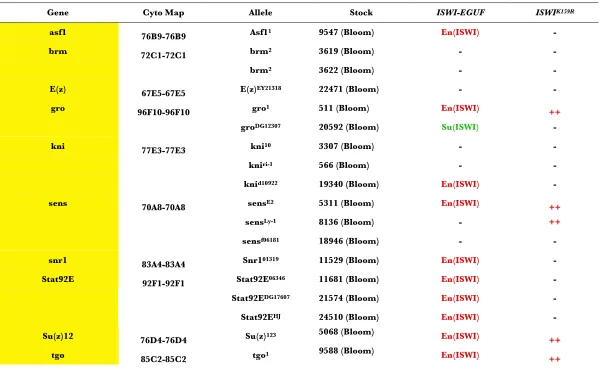
Combining iPCR data for the EP interacting inser-tions available on FlyBase with iPCR sequencing data we generated for the PiggyBac interactors, we mapped ISWI-EGUFmodifiers to 99 potential protein-coding loci (Table S1, A and B). We found 21 PiggyBac (1% of total insertions screened) and 78 EP (8% of total inser-tions screened) interactors (Table S1, A and B). Our scoring strategy defined three different classes of modifiers of ISWI-EGUF eye phenotypes: enhancers, En(ISWI), suppressors,Su(ISWI), and few mutations giv-ing a bimodal population comprisgiv-ing both enhancers and suppressors in the same progeny that we called Bi(ISWI)(Figure 3A andTable S1, A and B). One easy way to explain the bimodal type of interaction is that we scored two independent mutations, one enhancing and the other suppressing, coming from the same EP line tested. Indeed, for the bimodal interactions we isolated we confirmed that the presence of two independent mutations (probably arising from a second nonanno-tated segregating independent insertion or lesion) were likely responsible for the bimodal genetic interaction initially scored (Table S1C).
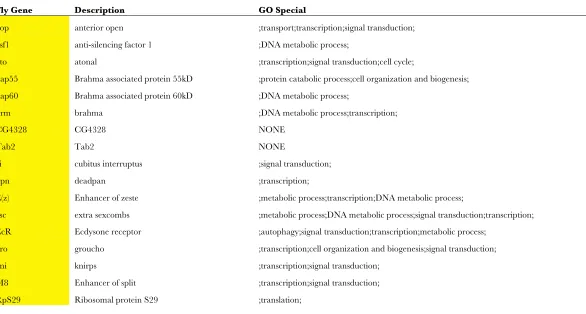
To understand the biological processes regulated by the ISWI-EGUF modifiers we isolated, we conducted a GO analysis employing the latest protein annotations available on FlyBase. Our GO analysis revealed thatISWI interacts with a network of cellular and nuclear factors involved in a variety of biological functions not pre-viously linked with known ISWI activities (Figure 3B).
Furthermore, to gain an integrated view of the interaction network potentially existing between the genes isolated in our screen, we annotated the known genetic and physical interactions existing among the ISWI-EGUF modifiers with the help of the BioGrid database, containing the information of all known physical and genetic interactions reported for a variety of model organisms, includingD. melanogaster(http:// www.thebiogrid.org). Our analysis revealed that some of theISWI-EGUFmodifiers are known to interact with each other, forming small interaction networks,
empha-sizing the functional correlation existing between some of the factors isolated in our screen (Figure 3).
Finally we compared the list ofISWI-EGUFmodifiers we recovered with the one we obtained with our pre-vious ISWIK159R
eye assay (Burgio et al. 2008). This analysis revealed that the two screens resulted in the isolation of a number of common modifiers (25%; Figure 3C, Table S1 B, and Figure S5). However, the ISWI-EGUFscreen allowed us also to isolate cellular and nuclear factors that have escaped from our previous ISWIK159Rgenetic approach, including severalSu(ISWI)’s (Figure 3C andTable S1B).
ISWI interacts with factors antagonizing its activity
in vivo:One of the main goals of theISWI-EGUFscreen was to isolate factors encoding activities that could antagonize ISWI function in vivo. Our genetic screen resulted in the isolation of several modifiers of ISWI-EGUFeye phenotypes behaving as suppressors (Figure Figure2.—ISWI-EGUFgenetic screen strategy. (A) The use of distinguishable fluorescent transformation markers in the adult eyes allows us to follow the mutator (YFP) and the jumpstarter (CFP) elements independently. (B and C) Crossing scheme for the identification of newPiggyBac mutator(B) and third chromosomeEPinsertions (C) dominantly modifyingISWI-EGUF eye phenotypes. For both thePiggyBac mutator and theEP screen, in the absence of mitotic recombination, the presence of the GMR-hidtransgene generates adult eyes without ommatidia but slightly pigmented (Stowersand Schwarz1999), allowing their unambiguous distinction from the mitotic recombinant experimental class. The presence ofw1-marked EP insertions allowed the scoring of the mitotic recombinant experimental class in the EP screen. Mut,mutator; Jump,jumpstarter.
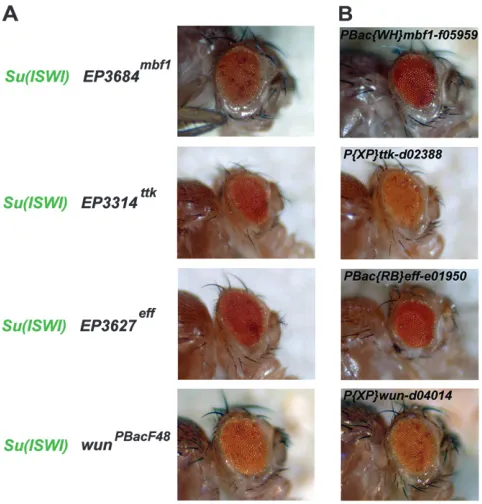
3A andTable S1). As expected, someISWIsuppressors are associated with enzymatic activities regulating chro-matin function liketrx,E(Pc), the ADP-ribose poly-merasetankyrase, and the class I ubiquitin-conjugating (E2) enzymeeffete(eff) (Figures 3A and 4A). Indeed,eff is thought to play essential roles in telomere function (Cenciet al.2005). Eff biochemically interacts with the zinc-finger transcriptional repressor encoded by the tramtrackgene (ttk) (Badenhorstet al.1996; Tanget al. 1997), whose mutations also suppress ISWI-EGUF eye phenotypes (Figures 3A and 4A). Another gene that suppresses the ISWI-EGUF eye is multiprotein bridging factor 1(mbf1) (Figures 3A and 4A). Mbf1 is a highly con-served protein in archaea and eukaryotes (deKoning et al.2009) that allows cells to maintain adequate activity of the cell proliferation transcription factor AP-1 under oxidative stress (Jindraet al.2004). Interestingly, Mbf1
also enhances transcription by forming a bridge be-tween distinct regulatory DNA-binding proteins and the TATA-box-binding protein (TBP) (deKoninget al. 2009). Moreover, Mbf1 is predicted to have a methyl-CpG binding domain (inferred from sequence similar-ity with UniProtKB: Q9Z2E1) that would in principle allow the selective binding of methylated cytosine/ guanine DNA, potentially linking ISWI activity with DNA methylation in flies. To validate the specificity of some of the genetic interactions identified, we tested whether other alleles ofttk,eff, andmbf1also behaved asSu(ISWI)’s. Indeed, some of the alleles tested forttk, eff, andmbf1suppressISWI-EGUFeye phenotypes (Fig-ure 4B).
ISWI interacts with an evolutionarily conserved network of cellular factors:In at least two other screens independently conducted in flies and worms ISWIwas Figure3.—ISWIgenetically interacts with a wide range of cellular components. The 99 potential protein-coding loci corre-sponding toISWI-EGUFdominant modifiers are clustered in concentric circles as nodes, colored according to their interaction class (A), current gene ontology (GO) categories, as indicated in the key (B), and their intersection withISWIinteractors isolated in theISWIK159Rscreen (Burgioet al.2008) (C). The edges represent known physical and genetic interactions identified with the experimental system indicated in the key.
picked up as a genetic interactor. An RNA interference screen identifiedISWIas one of the factors involved in the proper morphogenesis of Drosophila sensory neu-ron dendrites (Parrishet al.2006). In another genetic screen for factors regulating the expression of vulval cell fates in C. elegans, mutations in ISW-1, the worm ortholog of flyISWI, suppressed the multivulva pheno-type caused by the hyperactivation of the Ras pathway (Andersenet al.2006).
To gain some insights into the evolutionarily con-served network of regulation of ISWI we decided to identify known functional connections existing between genes scored in the four differentISWI-based genetic screens (ISWIK159R,ISWI-EGUF, the fly neuronal morpho-genesis, and the worm multiple cell fate screens). We used the BioGrid to search for known genetic or physical interactions existing between the genes identi-fied in the fly neuronal morphogenesis and the worm multiple cell fate screens and the modifier genes we picked in both the ISWI-EGUF and the ISWIK159R eye screens (Andersenet al.2006; Parrishet al.2006; Burgio et al.2008). Our analysis identified 1 big (93 nodes) and 12 small networks comprisingISWIgenetic interactors isolated in the four different genetic screens analyzed (Figure 5A, Figure S6, and Table S2, A–D). Next, to verify whether the 12 small networks (compris-ing a total of 33 nodes with a network size rang(compris-ing from 2
to 5 nodes) were functionally related to each other, we again queried the BioGrid to search for factors bridging any of the genes belonging to the 12 networks. In-terestingly, this analysis identified 41 connecting nodes linking the 33 genes included in the 12 small networks, defining a second big network (Figure 5B,Figure S6, andTable S2E). The bioinformatic analysis allowed us to predict thatISWIgenetically and physically interacted with a series of factors, in part shared among the four different genetic screens analyzed (purple, yellow, green, and blue nodes in Figure 5) and in part novel (red nodes in Figure 5), that may have escaped ISWI-based screens.
To verify whether the predicted interacting nodes were trueISWI genetic interactors, we tested multiple alleles for each of the neuronal morphogenesis and the worm multiple cell fate screens and the connecting nodes, for their ability to interact in theISWI-EGUFor the ISWIK159R eye assays. Remarkably, alleles of genes corresponding to 63% of the neuronal morphogenesis, 90% of the multiple cell fate, and 50% of the connecting nodes genetically interacted with at least one of the ISWI-EGUForISWIK159R
eye assays (Figure 5C andTable S3). Our data strongly indicate that the nucleosome remodeling factor ISWI functionally interacts with an evolutionarily conserved network of cellular factors, predicted by the gene network analysis we conducted.
Loss of ISWI causes cell cycle defects that can be suppressed bySu(ISWI)’s: A GO analysis on the evolu-tionarily conserved network of ISWI interactors sug-gested a significant enrichment of regulators of cell cycle and signal transduction (i.e.,Stg,Abl,Rbf1,E2F, and Ras85D) (Figure 5 and Table S2). In particular, an analysis conducted with Ontologizer (to quantify GO terms representation) showed thatcell cycle regulationis an overrepresented category within the combined interacting nodes shown in Figure 5 (P-value ¼0.03;
Table S2). Loss of ISWI activity has been linked to different aspect of cell cycle regulation connected, for example, to the development of melanotic tumors (Mellor 2006), the regulation of the germline stem cell self-renewal, and the Rb pathway (Dirscherl and Krebs 2004; Xi and Xie 2005; Parrish et al. 2006). Moreover, our data show that loss of ISWI in the eye-antennal discs causes an eye phenotype characterized by patches of ommatidia that are missing, disorganized, dedifferentiated, or variegated (Figure 1B andFigure S2; Burgio et al. 2008), suggesting a possible role for ISWI in cell viability and the control of differentiation. To directly test whether loss ofISWIcauses cell cycle defects, we analyzed isolated cell populations from imaginal discs and larval brains, obtained ex vivo from wild-type (w1118
) and ISWI mutant larvae using a new method we recently developed (Collesano and Corona 2007). We decided to analyze imaginal discs because they contain highly proliferating cells and also because we conducted the two ISWI screens in Figure4.—Loss ofISWIfunction in the eye can be
domi-nantly suppressed by mutations inmbf1,ttk,eff, andwun. (A) Eye phenotypes resulting from an eye homozygous forISWI2 (ISWI-EGUFeye) carrying anEPinsertion mapping thembf1, ttk, andeffgenes or aPiggyBacinsertion in thewungene. (B) To validate the genetic interactions we scored, other alleles mappingmbf1,ttk,eff, andwunwere tested in theISWI-EGUF eye assay.
eye-antennal imaginal discs. However, we also extended our analysis to brain tissues to test potential ISWI cell cycle defects also in highly differentiating cells (Collesanoand Corona 2007). Isolated cell popula-tions were directly analyzed by flow cytometry and cell cycle profiles were subjected to quantification (Figure S7) (Collesanoand Corona2007).
Our analysis revealed significant differences in cell cycle profiles between wild-type andISWImutant larvae. Loss ofISWIin total imaginal or in eye imaginal discs caused a marked decrease of both G1and G2/M peaks as well as a dramatic increase of the pre-G1peak (red and
purple arrows in Figure 6, B and C; Figure S7, E and G). We reasoned that the increase in the pre-G1peak reflects DNA fragmentation due to cell death likely caused by a G1or G2/M block caused byISWI mutant disc defects (i.e., alterations in chromosome condensa-tion, replicacondensa-tion, or gene expression). Interestingly, the pre-G1defect is specific for proliferating ISWI mutant discs and it is not detected inISWImutant differentiat-ing brain cells that are a mixture of differentiated and cycling cells, with a significant contribution of cells in G1 (Figure 6A andFigure S7C). On the other hand,ISWI mutant brain cells show a reproducible approximately Figure5.—Evolutionarily conserved network of regulation ofISWI. BioGrid analysis is shown of known genetic and physical interactions existing between the genes identified in the fly ‘‘neuronal morphogenesis’’ and the worm ‘‘multiple cell fate’’ screens and the modifier genes we picked in both theISWI-EGUFand theISWIK159Reye screens (Andersenet al.2006; Parrishet al.2006; Burgioet al.2008). Our analysis predicted (A) 1 big and (B) 12 small interaction networks comprisingISWIgenetic interactors isolated in the four different genetic screens analyzed, linked by ‘‘connecting’’ nodes corresponding to interactors not isolated in previousISWIrelated screens. The big network comprises 93 nodes while the 12 small networks are constituted of 33 original nodes and 41 connecting new nodes. (C) Alleles of genes corresponding to 63% of the neuronal morphogenesis, 90% of the multiple cell fate, and 50% of the connecting nodes genetically interacted with theISWI-EGUFor theISWIK159Reye assays. These interaction frequencies are much greater than the frequencies ofISWIinteraction we normally get with eye-based screens (usually in the1–11% range), suggesting that the gene network analysis we conducted increased our ability to predictISWIinteractors. The edges represent known physical and genetic interactions identified with the experimental system indicated in the key. ISWI-EGUForISWIK159Rinteracting genes are highlighted in boldface type and have a bigger node size.
twofold increase in the G2/M cell population and a shorter S phase when compared to wild type (green and blue arrows in Figure 6A and Figure S7 B), probably reflecting a G2/M block or a faster S phase [as previously shown in SL2 cells silenced for the ISWI regulator Acf1 (Fyodorovet al.2004)].
Our cell cycle analysis suggests that highly proliferat-ing cells tend to be more sensitive to loss ofISWIactivity while differentiating cells resistISWIloss by shortening the S phase and accumulating in G2/M. To check ifISWI cell cycle defects could be suppressed by some of the Su(ISWI)’s we identified in the ISWI-EGUF screen, we conducted the same analysis on doubleISWI, Su(ISWI) mutants that survived to third instar larval stage, where brains and imaginal discs could be dissected. For these reasons, we limited our cell cycle analysis to the EP lines: effEP3627
, ttkEP3314
, mbf1EP3684
, and the newly generated PiggyBac insertion wunPBacF48
, a gene encoding for a lipid phosphate phosphatase guiding germ cell migra-tion (Table S1A and Figure 4). As an internal positive control to evaluate the level of cell cycle suppression we
could get in the doubleISWI, Su(ISWI)mutant discs and brains, we also included in our analysis an allele ofcasp (caspPBacG75a
), a false positiveSu(ISWI)we isolated in our ISWI-EGUFscreen. Thecaspgene encodes for a homolog of the mammalian Fas-associating factor 1, an apoptotic signaling factor that acts downstream of the Fas signal transduction pathway. Due to its role in promoting apo-ptosis, loss ofcaspis expected to suppress cell death and cell cycle defects linked to apoptotic signaling present in ISWImutant cells.
Indeed, the false positiveSu(ISWI) caspPBacG75amutant suppressed the shortening of the S phase observed in ISWI mutant brain cells (Figure 6A andFigure S7 B). Interestingly, wunPBacF48 Su(ISWI) also suppressed the ISWI S-phase defect (Figure 6A and Figure S7 B); however, bothcaspPBacG75aandwunPBacF48failed to suppress theISWIG2/M increase observed in differentiating brain cells (Figure 6A andFigure S7B). These results indicate that the specific S-phase shortening and the G2/M increase observed in brain cells are very likely indepen-dent noncoupledISWIdefects.
Figure6.—Cytofluorimetric analysis ofISWImutant cells. Cell populations derivedex vivofrom wild-type and ISWI mutant neuroblasts (A) and total imaginal (B) and eye-antennal imaginal (C) discs were analyzed by flow cytometry.ISWIimaginal disc cells showed a significant decrease of G1and G2/M peaks (red arrows) and an increase in the pre-G1peak (purple arrow). On the other hand, when compared to their wild-type counterpart,ISWImutant neuroblasts showed a small but reproducible increase in the G2/M peak (green arrow) and a faster S phase (blue arrow). These cell cycle defects can be in part or completely suppressed by some of theSu(ISWI)’s we isolated.
Interestingly, wunPBacF48 and
caspPBacG75a can also sup-pressISWIpre-G1defects observed in imaginal disc cells (Figure S7, D and E) and restore a cell cycle profile similar to wild type (Figure 6B). Remarkably, while the Su(ISWI)EP lineseffEP3627and
ttkEP3314in the presence of the eyGAL4 driver weakly suppress eye disc-specificISWI pre-G1 and G1–G2/M defects, the mbf1EP3684
Su(ISWI) strongly suppresses these defects (Figure S7, F and G; Figure 6C).
Concluding remarks:TheISWI-EGUFscreen allowed us to isolate newISWIgenetic interactors that increased our understanding of the complex network of factors regulating ISWI nuclear signaling pathways. The ISWI-EGUF screen revealed that ISWI interacts with an evolutionarily conserved network of cellular and nu-clear factors that escaped previous genetic and bio-chemical analyses, indicating the participation of ISWI in a variety of biological processes not linked to date with known ISWI functions. Moreover, the combination of gene network bioinformatics tools with classic fly genetics approaches has been instrumental to isolate some of the factors that might have been missed in the not saturating ISWI-based screens. The unexpected functional interactions we found between ISWI and factors playing central roles in cell cycle regulation have a high potential to shed light on the mechanistic aspects of cell cycle progression directly or indirectly regulated by ISWI and more generally by chromatin remodelers. Although the molecular basis of the genetic antagonism existing between ISWIand the variety of modifiers we identified will need further characterization and many of the isolated modifiers may act indirectly (i.e., by regulating the perdurance, the expression, or regula-tors of ISWI), we believe that the network of ISWI enhancers and suppressors we isolated represents an invaluable selected cohort of genes that could be potentially assayed in any biological process where an ISWI-dependent functional assay is available.
We thank Szeged for the EP line collection and the Bloomington Stock Center and the Drosophila Genetics Resource Center for the Drosophila strains used in this work. We are very grateful to Hudo Haecker for providing the PiggyBacmutator andjumpstarter lines used in this work. We also thank Paul Badenhorst for theE(bx)Nurf301-2
allele; Dmitry Fyodorov for the acf1[1]allele; and John Tamkun for the anti-ISWI antibody and the ISWI1, ISWIK159R, brm2, and
kis1alleles provided for this work. Finally, we also thank Jennifer
Armstrong, Salvo Feo, Gianni Cenci, Lucia Piacentini, and Sergio Pimpinelli for their precious feedback and comments on the manu-script and Aldo Di Leonardo for his support in the use of the ModFit software. A special thank you also goes to S. Rosalia, G. Bruno, and N. Tesla for their inspiring visions of our work. W.A. was supported by a Telethon Fellowship, M.C.O. by a contract for Young Researcher sponsored by Fondo per gli Investimenti della Ricerca di Base-Ministero Universita` e Ricerca (FIRB-MIUR), and G.B. by a Fonda-zione Italiana per la Ricerca sul Cancro-AssociaFonda-zione Italiana per la Ricerca sul Cancro (FIRC-AIRC) Fellowship. This work was sup-ported by grants from Fondazione Telethon (TCP03009), Giovanni Armenise, Harvard Foundation, FIRB-MIUR (RBIN04N4KB), Hu-man Frontier Science Program (CDA026/2004), AIRC, and Com-pagnia San Paolo to D.F.V.C.
LITERATURE CITED
Al-Shahrour, F., P. Minguez, J. Ta´ rraga, I. Medina, E. Allozaet al., 2007 FatiGO1: a functional profiling tool for genomic data. Integration of functional annotation, regulatory motifs and in-teraction data with microarray experiments. Nucleic Acids Res.
35:W91–W96.
Andersen, E. C., X. Luand H. R. Horvitz, 2006 C. elegans ISWI and NURF301 antagonize an Rb-like pathway in the determina-tion of multiple cell fates. Development133:2695–2704. Armstrong, J. A., A. S. Sperling, R. Deuring, L. Manning, S. L.
Moseleyet al., 2005 Genetic screens for enhancers of brahma reveal functional interactions between the BRM chromatin-remodeling complex and the delta-notch signal transduction pathway in Drosophila. Genetics170:1761–1774.
Badenhorst, P., S. Harrisonand A. Travers, 1996 End of the line? Tramtrack and cell fate determination in Drosophila. Genes Cells1:707–716.
Badenhorst, P., M. Voas, I. Rebay and C. Wu, 2002 Biological functions of the ISWI chromatin remodeling complex NURF. Genes Dev.16:3186–3198.
Becker, P. B., and W. Horz, 2002 ATP-dependent nucleosome re-modeling. Annu. Rev. Biochem.71:247–273.
Breitkreutz, B. J., C. Starkand M. Tyers, 2003 Osprey: a network visualization system. Genome Biol.4:R22.
Breitkreutz, B. J., C. Stark, T. Reguly, L. Boucher, A. Breitkreutz
et al., 2008 The BioGRID Interaction Database: 2008 update. Nu-cleic Acids Res.36:D637–D640.
Burgio, G., G. LaRocca, A. Sala, W. Arancio, D. DiGesuet al., 2008 Genetic identification of a network of factors that func-tionally interact with the nucleosome remodeling ATPase ISWI. PLoS Genet.4:e1000089.
Cenci, G., L. Ciapponiand M. Gatti, 2005 The mechanism of telo-mere protection: a comparison between Drosophila and hu-mans. Chromosoma114:135–145.
Collesano, M., and D. F. Corona, 2007 Flow cytometry and karyo-type analysis of D. melanogaster eye disc cells. Fly (Austin)1:
242–244.
Corona, D. F., and J. W. Tamkun, 2004 Multiple roles for ISWI in transcription, chromosome organization and DNA replication. Biochim. Biophys. Acta1677:113–119.
Corona, D. F., C. R. Clapier, P. B. Becker and J. W. Tamkun, 2002 Modulation of ISWI function by site-specific histone acet-ylation. EMBO Rep.3:242–247.
Corona, D. F., J. A. Armstrongand J. W. Tamkun, 2004 Genetic and cytological analysis of Drosophila chromatin-remodeling fac-tors. Methods Enzymol.377:70–85.
Corona, D. F., G. Siriaco, J. A. Armstrong, N. Snarskaya, S. A. McClymontet al., 2007 ISWI regulates higher-order chroma-tin structure and histone H1 assembly in vivo. PLoS Biol.5:e232. deKoning, B., F. Blombach, H. Wu, S. J. Brounsand J.van der Oost, 2009 Role of multiprotein bridging factor 1 in archaea: Bridging the domains? Biochem. Soc. Trans.37:52–57. Deuring, R., L. Fanti, J. A. Armstrong, M. Sarte, O. Papoulas
et al., 2000 The ISWI chromatin-remodeling protein is required for gene expression and the maintenance of higher order chro-matin structure in vivo. Mol. Cell5:355–365.
Dirscherl, S. S., and J. E. Krebs, 2004 Functional diversity of ISWI complexes. Biochem. Cell. Biol.82:482–489.
Eberharter, A., and P. B. Becker, 2004 ATP-dependent nucleosome remodelling: factors and functions. J. Cell Sci.117:3707–3711. Ferreira, R., A. Eberharter, T. Bonaldi, M. Chioda, A. Imhofet al.,
2007 Site-specific acetylation of ISWI by GCN5. BMC Mol. Biol.
8:73.
Fyodorov, D. V., M. D. Blower, G. H. Karpenand J. T. Kadonaga, 2004 Acf1 confers unique activities to ACF/CHRAC and pro-motes the formation rather than disruption of chromatin in vivo. Genes Dev.18:170–183.
Genovese, S., and D. F. V. Corona, 2007 A New Medium to Grow Live Insects. European Patent: MI2007A001420/8145 PTIT. Hacker, U., S. Nystedt, M. P. Barmchi, C. Hornand E. A. Wimmer,
2003 PiggyBac-based insertional mutagenesis in the presence of stably integrated P elements in Drosophila. Proc. Natl. Acad. Sci. USA100:7720–7725.
Hogan, C., and P. Varga-Weisz, 2007 The regulation of ATP-dependent nucleosome remodelling factors. Mutat. Res.618:41–51.
Horn, C., N. Offen, S. Nystedt, U. Hacker and E. A. Wimmer, 2003 PiggyBac-based insertional mutagenesis and enhancer de-tection as a tool for functional insect genomics. Genetics163:
647–661.
Imhof, A., 2006 Epigenetic regulators and histone modification. Brief. Funct. Genomic Proteomic5:222–227.
Jenuwein, T., and C. D. Allis, 2001 Translating the histone code. Science293:1074–1080.
Jindra, M., I. Gaziova, M. Uhlirova, M. Okabe, Y. Hiromiet al., 2004 Coactivator MBF1 preserves the redox-dependent AP-1 activity during oxidative stress in Drosophila. EMBO J. 23:
3538–3547.
Kouzarides, T., 2007 Chromatin modifications and their function. Cell128:693–705.
Martin, C., and Y. Zhang, 2007 Mechanisms of epigenetic inheri-tance. Curr. Opin. Cell Biol.19:266–272.
Mellor, J., 2006 Imitation switch complexes. Ernst Schering Res. Found. Workshop57:61–87.
Parrish, J. Z., M. D. Kim, L. Y. Janand Y. N. Jan, 2006 Genome-wide analyses identify transcription factors required for proper mor-phogenesis of Drosophila sensory neuron dendrites. Genes Dev.20:820–835.
Rorth, P., K. Szabo, A. Bailey, T. Laverty, J. Rehmet al., 1998 Sys-tematic gain-of-function genetics in Drosophila. Development
125:1049–1057.
Saha, A., J. Wittmeyerand B. R. Cairns, 2006 Chromatin remod-elling: the industrial revolution of DNA around histones. Nat. Rev. Mol. Cell. Biol.7:437–447.
Sala, A., and D. F. Corona, 2009 Poly-ADP-ribose (PAR) as an epi-genetic flag. Epiepi-genetics4:287–290.
Sala, A., G. LaRocca, G. Burgio, E. Kotova, D. DiGesuet al., 2008 The nucleosome-remodeling ATPase ISWI is regulated by poly-ADP-ribosylation. PLoS Biol.6:e252.
Siriaco, G., R. Deuring, M. Chioda, P. B. Beckerand J. W. Tamkun, 2009 Drosophila ISWI regulates the association of histone H1 with interphase chromosomes in vivo. Genetics182:661–669. Stowers, R. S., and T. L. Schwarz, 1999 A genetic method for
gen-erating Drosophila eyes composed exclusively of mitotic clones of a single genotype. Genetics152:1631–1639.
Strahl, B. D., and C. D. Allis, 2000 The language of covalent his-tone modifications. Nature403:41–45.
Tang, A. H., T. P. Neufeld, E. Kwanand G. M. Rubin, 1997 PHYL acts to down-regulate TTK88, a transcriptional repressor of neuronal cell fates, by a SINA-dependent mechanism. Cell90:
459–467.
Xi, R., and T. Xie, 2005 Stem cell self-renewal controlled by chroma-tin remodeling factors. Science310:1487–1489.
Communicating editor: J. Tamkun
Supporting Information
http://www.genetics.org/cgi/content/full/genetics.109.114256/DC1
The Nucleosome Remodeling Factor ISWI Functionally Interacts
With an Evolutionarily Conserved Network of Cellular Factors
Walter Arancio, Maria C. Onorati, Giosalba Burgio, Marianna Collesano,
Antonia M. R. Ingrassia, Swonild I. Genovese, Manolis Fanto
and Davide F. V. Corona
W. Arancio et al.
2 SI
FILE S1
SUPPORTING MATERIALS AND METHODS
Salivary gland chromosomes cytology. Polytene chromosome structure analysis, on ISWI1/ISWI221 days old male salivary
gland nuclei, was conducted by crossing w/Y; ISWI1, Bc/ SM5, Cy males to y w; ISWI2/T(2:3) CyO;TM6B, Tb virgin females at
18°C. 21 days old ISWI1/ISWI2 trans-heterozygous male larvae were recognized by their yellow mouth hooks, the presence of the
dominant Bc marker and the absence of the Tb marker. Polytene chromosome preparations and DAPI stainings were conducted
according to previously published protocols (CORONA et al. 2004).
Eye imaginal discs Analysis. Immunofluorescence on GFPnls-marked ISWI2/ISWI2 homozygous eye disc nuclei were
conducted in larvae obtained by crossing males from the FIG line (FRT42D, ISWI, GFP), generated by classic recombination
(XU and RUBIN 1993): w/Y; P{neoFRT}42D,ISWI2, P{Ubi-GFP(S65T)nls}/CyO with yw;
P{neoFRT}42D,GMR-hid2R,CL2R,y+/CyO; EGUF virgins. Heterozygous and homozygous GFPnls-marked wild type eye disc nuclei were obtained from
yw; P{neoFRT}42D, P{Ubi-GFP(S65T)nls}/CyO larvae or from larvae obtained by crossing yw; P{neoFRT}42D,
P{Ubi-GFP(S65T)nls}/CyO males with yw; P{neoFRT}42D,GMR-hid2R,CL2R,y+/CyO; EGUF virgins, respectively. Double
immunofluorescence on eye-antennal imaginal discs with anti-ISWI (DEURING et al. 2000) and anti-GFP (Abcam #5450)
antibodies were conducted according to standard protocols (SULLIVAN et al. 2000).
Adult eyes histology: Retina from ISWI-EGUF adults FRT42D, ISWI2 / FRT42D, GMR-hid; EGUF/+ were sectioned,
W. Arancio et al. 3 SI
FIGURE S1.–Adult eye structures and double immunostaining, with anti-ISWI (red) and anti-GFP (green), of eye-antennal
imaginal discs derived from FRT42D, GFPnls / CyO (A,B), FRT42D, GFPnls/FRT42D, GMR-hid, CL2R; EGUF/+ (C,D) and
FRT42D, ISWI2, GFPnls/FRT42D, GMR-hid, CL2R; EGUF/+ larvae (E,F). The GFPnls allele produces an ubiquitously expressed
nuclear localized GFP. Arrowhead indicates small dying clones with only one copy of GFPnls. Eye discs where ey-GAL4, UAS-Flp
(EGUF) induced mitotic recombination and GMR-hid expression has occurred showed a near complete loss of ISWI signal and a homogenous GFP staining (E & F), suggesting that ISWI-EGUF eyes are very likely composed exclusively of homozygous ISWI2
W. Arancio et al. 4 SI
FIGURE S2.–Ommatidia organization is visualized by tangential sections through wild type (A) or ISWI-EGUF eyes (B). Loss of ISWI function in the adult eyes causes defects in the retina structure associated with loss of ommatidia boundaries and
W. Arancio et al. 5 SI
FIGURE S3.–Wild type male polytene chromosomes (A). Loss of ISWI activity not only causes defects on the male X
chromosome organization in 14 days old 3rd instar larvae (B) but also extensive polytene chromosome condensation defects in the
autosomes, when ISWI2 homozygous larvae are allowed to age for 21 days (C). The arrows point to the male X chromosome,
W. Arancio et al. 6 SI
W. Arancio et al. 7 SI
FIGURE S5.–The GFP expression in eye-antennal discs (A, B) and salivary glands nuclei (C, D) in ISWI-EGUF and ISWIK159R
W. Arancio et al. 8 SI
FIGURE S6.–Listed are the 12 small networks comprising ISWI genetic interactors isolated in the four different genetic screens
analyzed: “Neuronal Morphogenesis”, the worm “Multiple Cell Fate”, the ISWI-EGUF and ISWIK159R eye screens (ANDERSEN et
W. Arancio et al. 9 SI
FIGURE S7.–Representative example of the quantitative analysis done with the ModFit software on different cell cycle phases
W. Arancio et al. 10 SI
TABLE S1
ISWI-EGUF screening data
(A) ISWI dominant modifiers have been mapped to specific gene loci combining iPCR sequencing data we generated for the PiggyBac interactors with mapping data available on
Flybase (www.flybase.org) for the EP interacting insertions. (B) ISWI-EGUF genetic interaction classes [ Su(ISWI), En(ISWI), Bi(ISWI) ] and the intersection with the ISWIK159R screen
are shown in separate columns for every gene locus listed. If the same gene was picked in the ISWI-EGUF and ISWIK159R screens, the details of the EP insertion and strength of
interaction (+, ++, +++) identified in the ISWIK159R is reported. When the EP identified in the ISWI-EGUF and ISWIK159R is identical it is highlighted in light blue. The data from this
table have been used to generate the graphs shown in Figure 3. Interestingly, few genes that in the ISWIK159R screen were isolated as enhancers were instead scored as Su(ISWI) in the
ISWI-EGUF screen. In particular, 4 of the mutations that enhanced ISWIK159R and suppressed ISWI-EGUF eye phenotypes corresponded to different EP’s insertions (Table S1). On
the other hand, we also found 7 EP’s enhancing ISWIK159R while suppressing ISWI-EGUF eye phenotypes. These genetic interaction differences are unlikely to be explained by
differences in the expressivity of the eyGAL4 drivers used in the ISWIK159R and ISWI-EGUF screens (Figure S5), and are probably due to the differences in the nature of the two ISWI
alleles employed to generate the eye-defects used for the two different genetic screens (interfering misexpressing dominant negative ISWIK159R allele versus recessive lethal ISWI2 allele
in homozygosis). (C) The ISWI-EGUF screen resulted in the isolation of few mutations that produced both enhancement and suppression of ISWI-EGUF eye phenotypes in the same
progeny, that we called Bi(ISWI) or bimodal. In particular, we recovered 7 bimodal interactions only in the EP but not in the PiggyBac screen. We tested other misexpression allele
available on Flybase for the 7 Bi(ISWI) gene loci we isolated. None of new alleles corresponding the 7 Bi(ISWI) gene loci tested gave a bimodal interaction (see ‘Other Alleles’
column). Males FRT42D, ISWI2 / FRT42D, GMR-hid; EGUF/Bi(ISWI) giving a bimodal interactions and behaving as En(ISWI) when re-crossed with FRT42D, GMR-hid / CyO;
EGUF/EGUF females kept giving En(ISWI), while Su(ISWI) kept giving Su(ISWI) (see ‘Re-Cross’ column). The EP lines corresponding to the 7 Bi(ISWI) where out-crossed with the
wild type isogenic w1118 line and independent males carrying the EP (marked with the w+) and control males with white eyes were re-tested in the ISWI-EGUF assay (see ‘Out-Cross’
Column). Combining the ‘Other Allele’ and ‘Out-Cross’ data we can clearly conclude that the EP3115 maps a Su(ISWI), the EP3176 an En(ISWI), the EP3400 a Su(ISWI), the
EP3608 an En(ISWI), while we cannot conclusively say much about EP3011, EP3239 and EP3651, probably because the two lesions were too close and did not segregate (n =
W. Arancio et al. 11 SI
A
MUTATION GENE CHR ISWI-EGUF ISWIK159R iPCR DATA
PBacE10 PK61C 3 En(ISWI) NNNNNNNNNNNNNNNCNNTTNANANNNGAGAGCAATATTTCNA
GAATGCATGCGTCAATTTTACGCAGANTNNNNNNNNGNGTTAA TAAATAAATAATTAATGGGCGGNGCATTCNAAATGNAAAAGAAA ACGCAAATAGCTTGCCCACTCGCGGCAATAACGGAACCGTGAC TTGCAAATCGGTGAAATGAATAGGATATGCATAACTGTTTTTTC GAAAGACCTGCAAATAATTCAAGAAAGTTCCAGAAATACCCAAA TTTAATAGCTATCCAACATTAGGGTGACAATAACGNGTTTCAAC AGATGCAATATATACGCAAAATCAAAGAAAAACAANCNAAACCC GTNNNANNCTNATNATNTAAANAANAATNCNNNANCNTNNNNN NNNNGNTAA
PBacE24 CG4294 2R En(ISWI) NNNNNNTNTNNCGCTNTTNNGNNNAGAGAGNNNATTTCAAGAA
TGCATGCGTCAATTTTACGCAGACTATCTTTCTAGGGTTAAATT CGCAGTTTTGACTTGTGGTTTCTGAACTGCTGAGGTAGCCTTA TCGTTGGTCATAGGGGAACTTGTTGTACTGCCTAGGTCTTTCT TGGCTGGGTTGTTTACAATATTCGCCGTGCTTAACGATGCATT GTTTTTCGGCGTTGGCTTATCAACAGTAGGCGCCTTGCTTTTG GCAACAGGAGCAGCAGTCTTGGCCCTATATATGGATCCAATTG CAATGATCATCATGACAGATCTGACAATGTTCAGTGCAGAGACT CGGCTACGCCTCGTGGACTTTGAAGTTGACCAACAATGTTTAT TCTTACCTCTAATAGTCCTCTGTGGCAAGGTCANN
PBacF48 wun 2R Su(ISWI) NNNNNNNNNNNNTTTCNNGGGTTATGGCAGCGAATTTTGAATT
AGACAGGGCGAAGAAGTCGCTGACAGATTTCCCTGGGCGGAAT TACTTTATGATCCACAATTGAGACCCCGCACACGTTCGCCTGTC ACTGGGAAATCTTATCGACGGCTTAGTCGTATCATAAGTCAATA GGGAGGGTCTCTATGACGTTTTTACCCCCAAGAAGATAGTGCC GCAGCACTTAGGGCCTATGGCATTATTGTACGGAATGATAAACA TTGCCTGCATAAATTCTTTTATTATATACAGCCATAATGTCAGT AGCAAGGGAGAAAAGGTTCAAAGTCGCAAAAAATTTATGAGAAA CCTTTACATGAGCCTGACGTCATCGTTTATGCGTAAGCGTTTA GAAGCTCCTACTTTGAAGAGATATTTGCGCGATAATATCTCTAA TATTTTGCCAAATGAAGTGCCTGGTACNTCAGATGACAGTACT GAANAGCCAGTAATGAAAAAACGTACTTACTGTACTTACTGCCC CTCTAAAATAAGGNGAAAGGCNNNNGNATNNNGNNANNNATGN NNNNNNTNNNTCNGNNNNNANCNNCCNANNNNN
PBacF57 CG11652 3 En(ISWI) NNNNNNNNNNNNNNTTCNNGGGTTAACNTAGTGGTAACATTTG
W. Arancio et al. 12 SI
CNNNNNNNNTNNNNNNTTATTNANTTACTGNCCCTNNNNNNN NNTATNNNN
PBacF60 stg 3 En(ISWI) NNNNNNNTTNACGTACGTCNNAATATGATTATCTTTCTAGGGT
TAAAGACACACGGTCCATCGTGTAGAGTGCTACCTGTGAATGG ATCTCTGTGGCTGGAAGCTTTGCTCATTTAACGACATTGGCGT CTACGTCTGCAGAACACAAAGGAGCCACGCCCCCTCCACGACC GCCCATCCCGCCGGTGCGGCGATCATATGACTGCGGCCTATGG CATTATTGTACGGAATGATAAACATTGCCTGCATAAATTCTTTT ATTATATACAGCCATAATGTCAGTAGCAAGGGAGAAAAGGTTCA AAGTCGCAAAAAATTTATGAGAAACCTTTACATGAGCCTGACGT CATCGTTTATGCGTAAGCGTTTAGAAGCTCCTACTTTGAAGAGA TATTTGCGCGATAATATCTCTAATATTTTGCCAAATGAAGTGCC TGGTACATCAGATGACAGTACTGAAGAGCCAGTAATGAAAAAAC GTACTTACTGTACTTACTGCCCCTCTAAAATAAGGCGAAAGGCA AATGCATCGTGCAAAAAATGCAAAAAAGTTATTTGTCGAGAGCA TAATATTGATATGTGCCAAAGTTGTTTCTGACTGACTNNN
PBacG00 slif 3 En(ISWI) NNNNNNNTNACGTACGTCNNAATATGATTATCTTTCTAGGGTT
AAGGTATACAATTTCTATTTCTTTGTTACTATTGGTTCTAAAGT CTGTCATAGAATTCGTTAACTAAGAACTTGACCTTCAGAGACCA TCTGGGCAACAGCAGTCAGAATAATATCCGTCAATTAAAGTTGT TTTAGACGCAAATAGCACGACTAGTCTCTCTCGTTAATTACTGA CTAGCCCAGCGACTAACCCATGCCAGCTTTCATTAATTTACCCG TATGCATTTGAGCAATATAAAGACGCTTCCGCATCGCACCCCGC ACAAAAGCGCGATAATATCTCTAATATTTTGCCAAATGAAGTGC CTGGTACATCAGATGACAGTACTGAAGAGCCAGTAATGAAAAAA CGTACTTACTGTACTTACTGCCCCTCTAAAATAAGGCGAAAGGC AAATGCATCGTGCAAAAAATGCAAAAAAGTTATTTGTCGAGAGC ATAATATTGATATGTGCCAAAGTTGTTTCTGACTNACTANNNN
PBacG36alfa CG14508 3 En(ISWI) NNNNNNNNNNNNNNNTCNAGGNNNNNANACATATCGATCGAAT
GNACTTAAAAGCTCTGCTAAACTATNTGGAAAANATCTAAGCCC CTCTCCCTTGTGTAAGNAGTATTAANNAAGNNNGNTNNNGGNN NNNNNNNNNANGCNGGANGNTTNNNNANNNNNNNNNCNNNNN NCNTNNNNNNCNGNTNCNCTCNCCNNNNNNCTTANNNNNGAT TCNNNNNANANNGNNTNNGNNNNNNNNCNNTNCCNNNNNNNN NNNNNNNNNNNNANAAAANNNNNNNNACNNCNNCNNTNNNNA ANNNNCNNNNNNNCCNTTATNNNNNCNNNNNNNNNNTNNNNN ANNNNNNNNNNCATACCCNTCNNNNNNNTNNNANNNNNNNNN NNNNCTANCNNNNANCANAANCNNNANACTNNNANNNNNCTNN NTNCTN
PBacG80 CG15128 2R Su(ISWI) NNNNNNNTNACGTACGTCNNAATATGATTATCTTTCTAGGGTT
W. Arancio et al. 13 SI
TTAATAACACTTTAACACTTACTTTATCAAGTTGTACACAATACT CATTTTAAGAGCGTGAAAACGATACCCATTAGAATTTTGGCAAG GTCTACATCGCAAAACTAGTGAATACAAGAAGCCAAAATGACGT CGATTGTGGAGATGCCAAGGGCAAATTTAGAGGAGGCCTATGG CATTATTGTACGGAATGATAAACATTGCCTGCATAAATTCTTTT ATTATATACAGCCATAATGTCAGTAGCAAGGGAGAAAAGGTTCA AAGTCGCAAAAAATTTATGAGAAACCTTTACNTGAGCCTGACGT CATCGTTTATGCGTAAGCGTTTAGAAGCTCCTACTTTNNANANA TATTTGCGCGATNATATCTCNAANATTNNGCCAAATGANNTGN NCTGGNNNNTCANATNAN
PBacG92 Cpr31A / Pen 2L En(ISWI) NNNNNNNNNNACGTACGTCNNAATATGATTATCTTTCTAGGGT
TAATAATTAATTTACCACATTAATTNAGCGGATTACTTCTCAAA GAATCGAAAAACAAACAATTGAAAAAGGGACTAAATCGATTGGC AGCAATCATCTCTAAAAAAAATTTTGTTTATTTCTGACAACCGC ATATAAACAAAATGAAAAGAGCATTAACCGGAAATATCTGCGCA TTTATTGCATTATTACTGATAATCGGGAGATTAAATGGTATTAG TGCAATGATAACATATTTGCAAGCAAAAAAAAANANACAATCAA ATTTTATATTTATAGATAGACAGATAAAATCNNTNCCTTTTATT ANCCNNTTAANTNTTGATTTANGNGGNTATTTTTTGTCTTANN NNATATGGATANAGCTTTACATTTNANNNCATATTNGNTGANT NANNNNNAANNNANNNNNNNNNNNNNNNNANNNNNNNNGANN NNG
PBacG97 CG7420 2L En(ISWI) NNNNNNTTNACGTACGTCNNAATATGATTATCTTTCTAGGGTT
AATTTACTTTTCCAGTTGCACCCCAACTCTTTTACAACTGCCAC CAGTGAAATTGTGCGGCGCGATAATATCTCTAATATTTTGCCAA ATGAAGTGCCTGGTACATCAGATGACAGTACTGAAGAGCCAGT AATGAAAAAACGTACTTACTGTACTTACTGCCCCTCTAAAATAA GGCGAAAGGCAAATGCATCGTGCAAAAAATGCAAAAAAGTTATT TGTCGAGAGCATAATATTGATATGTGCCAAAGTTGTTTCTGACT GNNNNNNNNNNNNNNAAAANNNNNNNNNNNNNNANCNNANAN NAAAAAANANNNNNNNNGNNNNNNNANNNN
PBacK17 CG11844 3 En(ISWI) NNNNNNNNNNNNNNNNNNNNNNNNANNANTATCTTTCTAGGG
TTAATAAAATTGCAACACCTTCAAAATAGTTTAAATTTGTTATAC ATTTTTAAGGTATAACTTTTCCTAAATTATTGTAAATATACATAT ATGGTTTATTTAAGGCTGTAAATTATCAAATCCCTTTTCAAAAA CCAACCATTGTTCAGAAAATATAAATTATATATTTTAATTTTTAC AGATATATACTGATATTGAACCGGNAACTATCNATTGTNNNANT GNANTTANNNNANAAACN
PBacK18 CG3092 2R En(ISWI) NNNNNNNNNNNANNGNACGTNNNNNNATGATTATCTTTCTAGG
GTTAAAGGGCAATCGAACTTCTGGCCCAGTTCTTTAAACTTTAA AGCATGTGTTCNTTTAAATCANTGNCNTGGGCACCCAAATCNA TTGNCAT
PBacL45 CG9287 2L En(ISWI) NNNNNNNNNNCTTTCTAGGGTTNNNTTTATGCTTCTAAACCTG
W. Arancio et al. 14 SI
CAGATGACAGTACTGAAGAGCCAGTAATGAAAAAACGTACTTAC TGTACTTACTGCCCCTCTAAAATAAGGCGAAAGGCAAATGCATC GTGCNAAAAATGNAAAAANNTNNNNNNNCNNNNNNNNNNNNNN NNNNNNNNNCNNNNNNNNNTGCNATANNNNATGCNANTTGNN NNCTCNNTGANNCNNNNNNNNNNNNNNNNNNNNTTGCNCCCT CTGGNATTCCTCAGGNCNTGCCNGTTTGANCNTCNCTGAAAAC CCNNNCNNNGAATCACNTGGNGCTGATGNAGNNGNCTTGNNC CGCNNCGNCGGTGGCCGGGTCCACCCTGTNNAATTTCNTTGN NANNANNACNGACCCCCGNCTGCTGANTNNNNNNANNNNN
PBacL68 Gap1 3 En(ISWI) NNNNNNNNNNNCTTTCNNGGGTTACGGNNTTTTGCAGGTAAA
GAGGGTAAACATGAACCACAAAGNCNNNCNAATGAAATGAAGG TAANAAGGTGACAGCTAATTTNNNNNNACNACCCGATAATCNA NGGAAGTGCNTNACTTTCGTTCTTCNNTCNNCGCGATAATATC NCTNNTATTTNGNNNNNTGANNNGNNGNNNACNTCNNATGAC NNNNNNGNNNNNNNNTANNNNNNNNNNNNNNNNNNTNNNNNN TCNNNNCNNNNNNNNANNNNGANNNNNNNCNGNTNNNNNCNN NNNNNNNCNAANNNNCNNCNNNGNNNGNANNGNNTNCGCNNN NCNNGNNNNNNCNNNNGNNNNNNNNNNNNNNCNNCNTNNCNN NNNNNNNNNNAAANNNNNNNNNNNNNNNNNNNNTTTNNCNCN CNNNNNNNNNGNCNNCNNCNNCNNNNNNNNNNNNNNNNNNNN NNNNCNNNCNNNNNNTNNNANNTTCNTNNNNNNNNNNNN
PBacL78 CG17593 2L En(ISWI) NNNNNNNNNNNNNNNNNNNNNNNNNNNNNNNNATGATTATCT
TTCTAGGGTTAAATGTCCTAAAACTTTTCACACTAATTAAGAAA AAAAAACTAGGTTAAATGGTTAGTGTGCCAGTCGCGTGCAGAT TGAAGAATAAAACGCGTTAGTGCCTTTTAGTTTGAATGCNATTC GGTATTCCNANNNANCACACNCTTGTTAAATGNTTTNNNNNNN NTTNTTTTANTTTNTANNNATTNNNTTCN
PBacM04alfa E2f 3 En(ISWI) NNNNNNNNTTACGTACGTNNCAATANGATTATCTTTCTAGGGT
TAAATATTTATAGAATTAGTATAANNNNTTAAAAAAAACAAAACA ATAAACTTCAAAGAAGTGTCNNNNTCGACTTCCATTAAACACCC ATACATTTTTCCTTAAAAGGCGCGATAATATCTCTAATATTTTG CCAAATGAAGTGCCTGGTACATCAGATGACAGTACTGAAGAGC CAGTAATGAAAAAACGTACTTACTGTACTTACTGCCCCTCTAAA ATAAGGCGAAAGGCAAATGCATCGTGCAAAAAATGCAAAAAAGT TATTTGTCGAGAGCATAATATTGATATGTGCCAAAGTTGTTTCT GACTGACTANNNNNNNNANNNNNNNNANNNNNNNNNNCNNNN NNNNNNNCNNCNNNNNNNNNNNNNNAAAATANNNNNNAAAAA NN
PBacN13 RpL40 /
CG15425
2L En(ISWI) NNNNNNNNNNNNNNNNNNNNCNNAATATGATTATCTTTCTAGG
W. Arancio et al. 15 SI
CAAGTTTGGGGATGTCTGCTAACCGCCGCGCGATAATATCTCT AATATTTTGCCAAATGAAGTGCCTGGTACATCAGATGACAGTAC TGAAGAGCCAGTAATGAAAAAACGTACTTACTGNACTTACTGCC CCTCTAAAATAAGGCGAAAGGNAANTNNNNNNTGCAAANNNNG NNNNNNNNNNANNNGTCCAGANCNTAANTTTGNNNNGNGCCA AAAANTNN
PBacN16 CG17732 3 En(ISWI) NNNNNNNTTNACGTACGTCNNAATATNATTATCTTTCTAGGGT
TAATGTCCGTAGTTTCGGGATCATGGNNGNCTTCNTTGGATTT TGGATAACATGCCTCCTTCATTTTCTTANCCACGTATCGAGGAC GACCCGAACCGATCGGAAATTTCAGCATTCGGAGATGGTACTC ACGATTCTTGGCGTATCTAGTCAGTGTCCTTGTGCGCGATAAT ATCTCTAATATTTTGCCAAATGAAGTGCCTGGTACATCAGATGA CAGTACTGAAGAGCCAGTAATGAAAAAACGTACTTACTGNNCTT ACTGNCNCTNNNNNNTAANGN
PBacN43 CG12862 2R En(ISWI) NNNNNNNNNNNNNNNNNNNNNNNNNNNNNNTATGATTATCTT
TCTAGGGTTAATAAACTCTCGCCGACGCTTCGCACAGGGCTTA TGTCCTGAAAGGCGTCCTTTAATTCATTTTCCATGCACACACAC TAGCACACACATAGTCGGACTAAAAAAACAGCGGAANANGATTA AAAACTACTTTAATATATCNTCNTTGTCNCTCCTGCGAGCCGCG NANGAGANCNNGANGNGNATGGNN
PBacO02 E(Pc) 2R Su(ISWI) NNNNNNNNNNNNNNNCNTNNNNNNNNNNNANCTTTCNNNNNN
NNNNNTTTTTNGTGCAGTNNGCANNNNNNNNNNNNNCTGTCA GAGCTGNNNNNGCCATTTAAGANNNNNNNNNNNNNNNNNNNN ATGCNGACAAGGTAGNNNNNGNNACNNNNNNNTNNNNNTNNN GCNTGNGTTTTNNNNNNNNCAAANANNN
PBacO68 chn 2R En(ISWI) _NNNNNNNNNNNNNNTACGTNNNANTANNNTTATCTTTCTAGG