Swelling Potential of Different Expansive Soil
Placed At Different Dry Density and Initial
Water Content by Constant Volume Method
Kinjal Rank1, Dr.Jitendra Mehta2, Jaydeep Bhandari3
Assistant Professor, Department of Civil Engineering, VVP Engineering College, Rajkot, Gujarat, India1
Associate Professor, Department of Civil Engineering, VVP Engineering College, Rajkot, Gujarat, India2
Assistant Professor, Department of Civil Engineering, VVP Engineering College, Rajkot, Gujarat, India3
ABSTRACT:Expansive or swelling soils exist in many part of the world. Such common soils in Australia, India and South Africa. Show excessive volume changes with increase in water content. Results of this volume increase expansive soil apply pressure to the structures located or buried in these regions. In this paper study of swelling behaviour of expansive clay is investigate using Constant Volume method. The tests will be carried out on a number of samples obtained from different part of Saurashtra region Rajkot, Bhavnagar, Jamnagar, Ameli. The remolded samples are prepared having different initial dry densities with different initial water contents used to study the effect of these variable parameters on the swelling pressure. It is observed that swell pressures increases with increasing initial dry density and they decrease with increasing initial water content.
KEYWORDS:Expansive Soils, Swelling Pressure, Dry Density, Moulding Water Content.
I. INTRODUCTION
Some of the partially saturated clayey soil are very sensitive to variation in water content and show excessive volume changes, such soil are classified as expansive soil and exist on many part of the world. Many places of India, Africa, Australia, Israel, and South America are covered with such soil. Expansive soils are worldwide problem faced by civil engineer. It is extended nearly one-fifth of our country, chiefly in the states of Maharashtra, Gujarat, Madhya Pradesh, Uttar Pradesh, Rajasthan, Karnataka, Andhra Pradesh and Tamil Naidu. Expansive soils also call black cotton soil.
The swelling phenomena is considered as one of the most serious challenge which the foundation engineer faces, because of the potential danger of unpredictable upward movements of structures founded on such soils.
Any structure located on expansive clay may be subjected to large magnitudes of pressures due to development of swelling pressure when moisture content of clay increases. When moisture content of clay decrease settlement problem create in structure due to differential settlement structure became damage .We can reduce economical loss by evaluating swelling characteristic of soil before starting the construction of important structure. Considerable amount of work has already been done in understanding the behaviour of expansive soils. The parent materials associated with expansive soils are either basic igneous rocks or sedimentary rocks. Basic igneous rocks, it is formed by decomposition of feldspar and pyroxene and in sedimentary rocks , it is a constituent of rock itself in any case most expansive soils are rich in montmorillonite clay mineral.
II.RELATEDWORK
Absorption of water by clays leads to expansion. From the mineralogical standpoint, the magnitude of expansion depends upon the kind and amount of clay minerals present, their Exchangeable ions, electrolyte content of aqueous phase, and the internal structure. Deformational behavior of clay, under changes of moisture content and stress, is therefore a complex function of both the physic chemical and the effective strength characteristics of clay.
There are many correlations that are useful in identifying potentially expansive soils. It may also be possible to identify them visually. Visual indications include (Wayne et al. 1984):
1. Wide and deep shrinkage cracks occurring during dry periods. 2. Soil is rock-hard when dry, but very sticky and soft when wet. 3. Damages on the surrounding structures due to expansion of soils.
III.METHODOLOGY
3.1 Introduction
The purpose of this experimental study is to evaluate swelling potential of clayey soil and to investigate the pressure induced. And also investigate the effects of initial water content and initial dry density on swelling. Swell tests are carried out constant volume method. To investigate the effects of initial water content and initial dry density, a wide range of water content and densities are used for the tests program.
3.2 Material Investigated
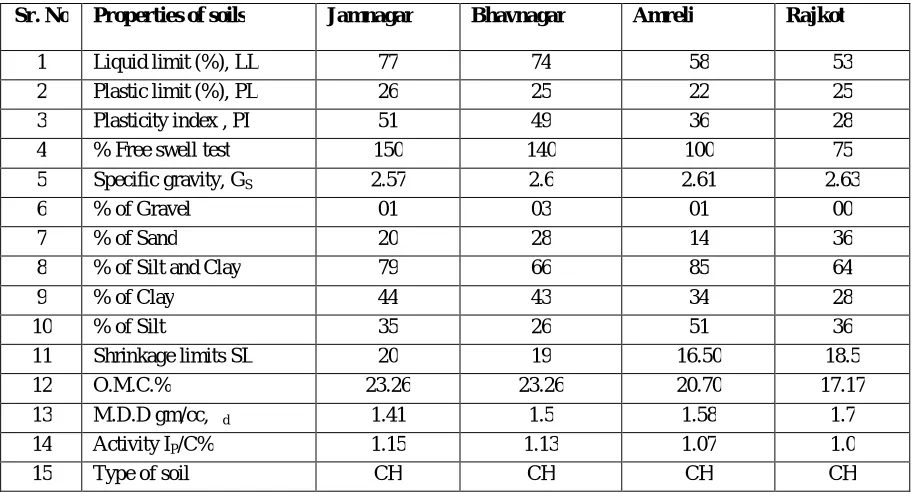
Material investigated: The clayey soil samples used in these studies are collect from different part of Saurashtra region Jamnagar (Sample No-1), Bhavnagar (Sample No-2), Amreli (Sample No-3), Rajkot (Sample No-4). The soil sample is plastic clay. The soil is classified as CH soil according to Unified Soil Classification System. Index properties is shown in Table 1.
Table 1: Index Properties Clayey of Soils
Sr. No Properties of soils Jamnagar Bhavnagar Amreli Rajkot
1 Liquid limit (%), LL 77 74 58 53
2 Plastic limit (%), PL 26 25 22 25
3 Plasticity index , PI 51 49 36 28
4 % Free swell test 150 140 100 75
5 Specific gravity, GS 2.57 2.6 2.61 2.63
6 % of Gravel 01 03 01 00
7 % of Sand 20 28 14 36
8 % of Silt and Clay 79 66 85 64
9 % of Clay 44 43 34 28
10 % of Silt 35 26 51 36
11 Shrinkage limits SL 20 19 16.50 18.5
12 O.M.C.% 23.26 23.26 20.70 17.17
13 M.D.D gm/cc, γd 1.41 1.5 1.58 1.7
14 Activity IP/C% 1.15 1.13 1.07 1.0
3.3 Constant volume Method 3.3.1 General
Total 36 No. constant volume swell tests were carried out on four types soils-CH at various dry density and water content, to study swelling behaviour of expansive soils, 9 no of tests at 90 %, 95%, and 100% of M.D.D and water content 5 %, 10 %, O.M.C are carried out for four types soil.
3.3.2 Apparatus
1. Specimen Diameter: The specimen shall be 60 mm in diameter (specimens of diameters 50, 70 and 100 mm
may also be used in special case)
2. Specimen Thickness: The specimen shall be at least 20 mm thick in all cases. However, the thickness shall not
be less than 10 times the maximum diameter of the grain in the soil specimen. The diameter to thickness ratio shall be a minimum of 3.The specimen shall be at least 20 mm thick in all cases. However, the thickness shall not be less than 10 times the maximum diameter of the grain in the soil specimen. The diameter to thickness ratio shall be a minimum of 3.
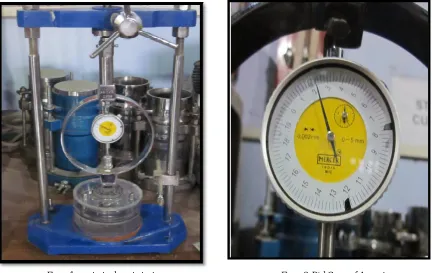
Figure 1. constant volume test set up Figure 2. Dial Gauge of Apparatus
3. Porous Stones: The stones shall be of silicon carbide or aluminium oxide and of medium grade. It shall have a
high permeability compared to that of the soil being tested. The diameter of the top stone shall be 0.2 to 0.5 mm less than the internal diameter of the ring. The thickness of the stone shall be a minimum of 15 mm. The top stone shall be loaded through a corrosion-resistant plate of sufficient rigidity and of minimum thickness 10 mm to prevent breakage of the stone. The loading plate &all have suitable holes for free drainage of water.
4. Dial gauge: Accurate to 0.002 mm with a traverse of at least 10 mm.
5. Soil Trimming Tools: Fine wire-saw, knife, spatula, etc. for trimming sample to fit into the inside diameter of the Constant volume ring with minimum disturbances.
6. Oven: Thermostatically controlled oven with interior of non-corroding material to maintain the temperature between 105 and 110°C.
3.4 Preparation of specimen
1. First of all volume of the consolidation ring is determined.
2. 90%, 95%, 100% of maximum dry density obtained from standard Procter test is multiplied with volume of the consolidation ring to obtain the soil to be taken for testing.
3. The oven dried soil was mixed with water and it was rubbed thoroughly until a uniform colour is obtained. 4. The wet soil is now compacted in the consolidation ring itself in such a way that it occupies all the space in the
ring.
3.4.1 Assembly of apparatus
The specimen ring with the specimen shall be kept between two porous stones saturated in boiling water providing a filter paper between the soil specimen and the porous stone. The loading block shall then position centrally on the top of the porous stone.
This assembly shall then be placed on the platen of the loading unit as shown in Fig. 3 the load measuring proving ring tip attached to the load frame shall be placed in contact with the consolidation cell without any eccentricity. A direct strain measuring dial gauge shall be fitted to the cell. The specimen shall be inundated with distilled water and allowed to swell.
Figure 3.specimen of constant volume apparatus
3.5 Procedure
The initial reading of the proving ring shall be noted. The swelling of the specimen with increasing volume shall be obtained in the strain measuring load gauge. To keep the specimen at constant volume, the platen shall be so adjusted that the dial gauge always shows the original reading. This adjustment shall be done at every 0.1 mm of swell or earlier. The duration of test some as Consolidometer test .The assembly shall then be dismantled and the soil specimen extracted from the specimen ring to determine final moisture content in accordance IS-2720(Part II).
3.6 Calculation
The difference between the final and initial dial readings of the proving ring gives total load in terms of division which when multiplied by the calibration factor gives the total load. This when divided by the cross-sectional area of the soil specimen gives the swell pressure expressed in kN/m2 (kgf/cm2).
Swelling pressure in = ((Final dial reading-Initial dial reading)/ Area of the specimen) × Calibration factor of proving ring.
Table 2. Test Results of Constant Volume Method
90% of MDD 95% of MDD 100% of MDD
Jamnagar Swell pre. kg/cm2 Swell pre. kg/cm2 Swell pre. kg/cm2
OMC 0.65 0.7 0.79
10 % 0.78 0.78 0.87
5 % 0.78 0.84 0.98
3.6.1 Effect of Initial Water Content
Swelling mechanism depends on the amount of water absorbed by the soil mass. As the initial water content increases, for specimens having the same dry unit weight, the initial degree of saturation will also increase and the affinity of soil to absorb water will decrease. It follows that the amount of water absorbed for complete saturation will become smaller, and consequently the amount of swelling will decrease as the initial water content increases (El. Sohby and Rabba, 1981). As the absorbed water is decreased for the same initial dry density the interparticle forces developed during swelling will become smaller. This in turn will be resulted in smaller swell pressures.
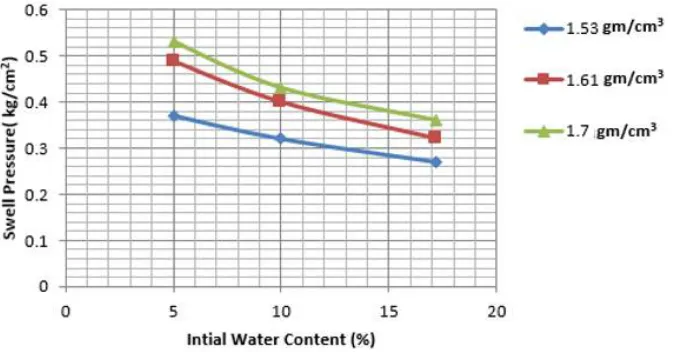
Swelling pressure decreases as the initial water content increases in Constant Volume method for all soil types which are used in this study.
Fig 4. shows relationship between swelling pressure and initial water content for different initial dry densities for Constant Volume method and sample No. 4 Rajkot.
Figure 4. Relationship between the swelling pressure and the initial water content for different initial dry densities by Constant Volume Method
3.6.2 Effect of Initial Dry Density
Swelling pressure in both method Constant volume results of interparticle forces developed during swelling as a result of water absorption. As density increases, volume of voids decreased, water particle has smaller volume to move. During Water absorption in to soil media water practical has to apply more force to the surrounding soil particles
OMC 0.64 0.6 0.78
10 % 0.69 0.75 0.83
5 % 0.75 0.83 0.95
Amreli
OMC 0.39 0.45 0.5
10 % 0.4 0.48 0.55
5 % 0.43 0.5 0.63
Rajkot
OMC 0.27 0.32 0.36
10 % 0.32 0.4 0.43
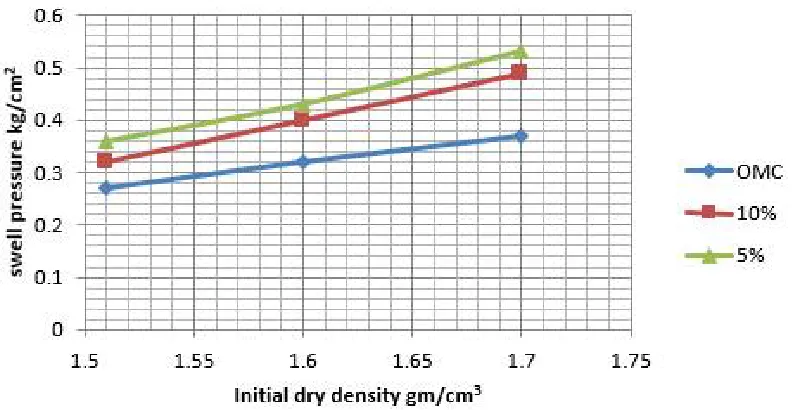
to achieve the complete saturation for higher initial dry densities. The swelling pressure increases as the initial dry density increases for all soil types which are used in this study.
The swelling pressure increases as the initial dry density increases. Figure 5 shows relationship between the swelling pressure and the initial dry density for different initial water contents and Constant volume method used for sample No. 4 Rajkot.
3.6.3 Rate of Development Of Swell Pressures
When a compacted soil specimen is exposed to water, time is required for the movement of water into the specimen under the hydraulic gradient set up by the negative water pressure within the soil relative to free water i.e., the soil suction. The amount of swell that occurs within a given period of time depends on the quantity of water that enters the soil; thus, the rate of swell is proportional to the hydraulic gradient and the conductivity. These quantities, in turn, are influenced by the soil structure or by the treatment during compaction.
Figure 5.Relationship between the vertical swelling pressure and the initial dry density for different initial water contents. (Constant volume Method) sample No.4.
It is found that rate of development o swell pressures for a compacted specimen is different. Figure 6 shows development of swell pressures in time respectively for initial water content of 17.17 % (OMC) and for three different initial dry densities.
Figure 6. Swell pressures in time for initial water content of 17.17 %( OMC) and for tree different initial dry densities
IV.DISCUSSIONOFTESTRESULTS
During constant volume swell tests it has been found that both initial dry density and initial water contents affecton swelling pressure. Swell pressure is function of density.
V.CONCLUSION
The paper aimed at investigating the effect of insitu dry density and insitu moisture content on swelling potential of expansive soils obtained from location Jamnagar, Bhavnagar, Amreli, Rajkot. The following observations are made.
1. It was observed that significant effect of swelling pressure with the change of dry density and water content of the soil.
2. With increased dry density, swelling pressure increases for all soil types. 3. With decrease initial water content, swelling pressure increases for all soil types.
VI.FUTURESCOPE
Swelling of soil creates a serious problem for foundation design of structure, which may lead to catastrophic failure of structure as whole here in this thesis, the swelling potential of soil for few locations is evaluated based on dry density and water content further work on the same thesis can be carried out as follows.
1. The effect of seating load on the swelling potential of the soil can be studied to assess the performance of foundation.
2. The same work can be carried out for more location, so that map can be prepared for such type of soils.
3. Further, new and innovative measure can be developed to place the foundation on such type of soil and same
can be evaluated experimentally.
REFERENCES
[1] Al-mhaidib, Abdullah I. "Swelling Behaviour of Expansive Shales from the Middle Region of Saudi Arabia", Geotechnical and Geological Engineering Vol.16, pp. 291-307, 1999.
[2] Basma, Adnan A."Prediction of Expansion Degree for Natural Compacted Clays", Geotechnical Testing Journal, Vol.16, No.4, pp. 542-549, December 1993.
[4] Brackley, I.J.A., "A Model of Unsaturated Clay Structure and its Application to Swell Behaviour", Proc. of 6th Regional Conf. For Africa on Soil Mech. And Found. Engrg., Durban, South Africa, pp.71-79. 1975
[5] Brackley, I.J.A., "Swell Under Load",Proc. of 6th Regional Conf. For Africa on Soil Mech. And Found. Engg., Durban, SouthAfrica, pp. 65-70,1975.
[6] Katti, R.K. "Search for Solutions to Problems in Black Cotton Soils", Indian Geotechnical Journal, LG.S. Vol. 9, No.1,1979 [7] Skempton, A.W., "The colloidal activityof clays", Proc. 3rd Int. Conf. on S.M. &F.E.,Zurich, Vol.1, pp 57-61, 1953.
[8] Rees, S.W. And Thomas, H.R.,“Simulating seasonal ground movement in unsaturated clay”, Jrl. of Geotech. Engg., ASCE ,Vol.119, pp 1127-1143,1993.
[9] Jennings, Snethen, D.R., "Characterization of expansive soil using soil suction data", Proc. 4th Int. Conf. on Expansive Soils, Vol.1, pp 54-75,1980