ISSN(Online): 2319-8753 ISSN (Print) : 2347-6710
I
nternational
J
ournal of
I
nnovative
R
esearch in
S
cience,
E
ngineering and
T
echnology
(An ISO 3297: 2007 Certified Organization)
Vol. 5, Issue 6, June 2016
Replacement of Base Oil into the Vegetable
Neem Oil Based Metal Working Fluid in
Machining Application of Ferrous Metals
Santhosh K1, Manikandan G2, Magesh Kumar M3
PG Scholar, Dept. of EVS,Adhiparasakthi Engineering College, Melmaruvathur, Tamilnadu, India1&3
Asst. Prof, Dept. of Chemical Engg, Adhiparasakthi Engineering College, Melmaruvathur, Tamilnadu, India2
ABSTRACT: The increasing attention to the environmental and health impacts of industrial activities by governmental regulations and by the growing awareness level in the society is forcing industrialists to reduce the use of mineral oil-based metalworking fluids as cutting fluid. Cutting fluids have been used extensively in metal cutting operations for the last 200 years. In the beginning, cutting fluids consisted of simple oils applied with brushes to lubricate and cool the machine tool. As cutting operations became more severe, cutting fluid formulations became more complex. There are now several types of cutting fluids in the market and the most common types can be broadly categorized as cutting oils or water-miscible fluids.
In This Project, the applicability of vegetable Neem oil-based metalworking fluids in machining of ferrous metals has to be taken. The advantages of metalworking fluids and its performances with respect to the cutting force, surface finish of work piece, tool wear and temperature at the cutting zone have been investigated. It has been reported in various literature that metalworking fluids, which are basically vegetable oil-based such as castor oil, palm oil, soybean oil, rapeseed oil, jatropa oil, sunflower oil etc,. Could be an environmentally friendly mode of machining with similar performance obtained using mineral oil-based metalworking fluids.
We have try to Use Vaccum Blending (or) mixing reactor in a closed system For example – Normal Heating and Blending Temperature of Neem oil up to 70 °c instead of using Vaccum means – Reduce the temperature up to 40°c. If the Temperature controlled means automatically odor not be evolved. And another benefit of using Vaccum, since it is bio product contains AZADIRACHTIN (natural chemical) Antibacterial activity. If the maintaining the low temperature 40°c AZADIRACHTIN cannot be degraded and also originality of the product. The neem cutting oil reduced the flank wear by about 72% and 56% as compared to dry turning and Base oil cutting respectively, while the soluble oil reduced the flank wear by 36% as compared to dry turning. Therefore, the neem seed oil is not only suitable for cutting fluid, but it is more effective as a cutting fluid than the soluble oil as a cutting fluid.
KEYWORDS: Neem oil, Vaccum Blending Unit, Cutting fluids, Azadirachtin, Vegetable oil, base oil, lubricant
I. INTRODUCTION
Conventional mineral oil based lubricants are extremely harmful for the biosphere when they get into the environment. Due to their poor degradability mineral oils remain in the eco systems for a long time. Even in case of high dilutions there will be a fatal eco-toxicological effect. High sums which have to be spent for the elimination of damages clearly show that economy and ecology today have the same priority.
ISSN(Online): 2319-8753 ISSN (Print) : 2347-6710
I
nternational
J
ournal of
I
nnovative
R
esearch in
S
cience,
E
ngineering and
T
echnology
(An ISO 3297: 2007 Certified Organization)
Vol. 5, Issue 6, June 2016
lubricants require further additives to impart other characteristics of a non-Tribological nature, such as oxidation resistance, corrosion protection, and detergency. Most metalworking lubricants, vegetable-based and petroleum-based, are compounded or modified to achieve these requirements. Several methods are available to modify these oil lubricants. The important and most commonly used methods are sulfurization and phosphate modification.
The growing demand for biodegradable materials has opened an avenue for using vegetable oils as an alternative to petroleum-based polymeric materials. Soy-based products constitute a major portion of US agricultural products. Soybean oil, widely used as a food material, has the potential to be used as a renewable resource in place of petroleum-based materials. Major disadvantages of vegetable oils are inadequate oxidative stability and problems associated with use in high or low temperature applications. The poor oxidative stability is typically due to the rapid reactions occurring at the double bond in the oil molecules.
Reactions like free radical oxidation, hydrogen abstraction, addition reaction, fragmentation, rearrangement, dis-proportionating reaction, and polymerization can reduce oxidative stability. These problems can be mitigated by the structural modification of vegetable oil by chemical reactions. Research conducted in our laboratory has shown that soy flour and soybean oil can replace petroleum-based polymer and polyurethane materials. To alleviate the problem of oxidative instability, ozone and sculpture modification were also conducted in our laboratory. Vegetable oil-based emulsions were also a part of recent research to produce stable emulsions to use as metalworking fluids and in other applications. Most attention has been given to vegetable oil-based emulsions, and few references are available on these emulsions as metalworking fluids. In the present study, we investigated vegetable oil emulsions containing modified and unmodified soybean oil. The use of vegetable oil in metalworking applications may alleviate problems faced by workers, such as skin cancer and inhalation of toxic mists in the work environments. This will also help to add value to a farm commodity, such as soy oil and other similar vegetable-based oils.
This Project deals with the development of a vegetable-based emulsion that can be used in the metalworking industry to replace partially or completely the commonly used petroleum-based emulsions. Vegetable oils have good lubricating ability and have been used for the formulation of rolling emulsions. However, certain limitations prevent their wide use in lubrication applications. They are easily hydrolyzed, and a thin layer is often formed on finished products. The objective of this study was formulation of vegetable oil emulsions, to replace synthetic esters commonly used as metalworking fluids.
This paper describes a method for the formulation of vegetable oil-in-water emulsions. These emulsions were prepared using various surfactants, and the stability of these emulsions was tested by varying the amount of surfactants. The effects of different surfactants used to produce emulsions with regular and modified soybean oil are discussed. The properties of these emulsions were tested by chemical and physical methods for stability and application as a metalworking fluid. Phase diagrams were created to determine the effect of oil, water, and surfactant ratios in the formation of emulsion. Cryo-SEM was used to probe the phase boundary and the bubble size.
ISSN(Online): 2319-8753 ISSN (Print) : 2347-6710
I
nternational
J
ournal of
I
nnovative
R
esearch in
S
cience,
E
ngineering and
T
echnology
(An ISO 3297: 2007 Certified Organization)
Vol. 5, Issue 6, June 2016
Table 1.1Physical properties of Neem oil and their Sources
Bio lubricants have many valuable and useful Physicochemical properties. They offer technical advantages unlike those of typical petroleum-based lubricants. Biolubricants have high lubricity, high VI, high flash point andLow evaporative losses. Overall, vegetable oil-based bio lubricants exhibit several excellent proper- ties compared with mineral oils. Table 3 shows the comparative analysis result of properties of vegetable oils.
The Viscosity index indicates changes in viscosity with changes in temperature. A high VI indicates small changes in temperature; whereas a low VI indicates high changes in temperature. Vegetable oil-based bio lubricants have higher VI than mineral oils, which ensures that bio lubricants remain effective even at high temperatures by maintaining the thickness of the oil film. Hence, bio lubricants are suitable for a wide temperature range.
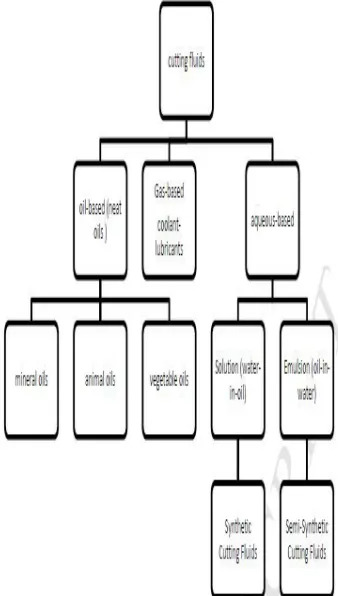
Figure 1.1 Classifications of Cutting Fluids Physical Properties Results
Kinematic viscosity@40°C
(cSt) 68.03
Kinematic
viscosity@100°C (cSt) 10.14
Total acid value(moth) 23.00
ISSN(Online): 2319-8753 ISSN (Print) : 2347-6710
I
nternational
J
ournal of
I
nnovative
R
esearch in
S
cience,
E
ngineering and
T
echnology
(An ISO 3297: 2007 Certified Organization)
Vol. 5, Issue 6, June 2016
An oil based lubricant (also called neat oils) is derived from mineral, animal, vegetable, and synthetic oils. Mineral oils (petroleum based) are the major type due to their desirable lubricating characteristics. These cutting fluids usually contain some additives to enhance their applications. For instance, the characteristics of naphthenic mineral oils and paraffinic mineral oils are usually enhanced through the addition of fatty lubricants, extreme pressure additive, odorants, thickness modifiers, and polar additives. Mineral-based lubricants are used to lubricate the tool-chip interface and consequently minimize the friction and friction induced heat at the cutting zone. As a result, low cutting forces are required to reduce the crater wear on the tool rake face. Besides, it is useful in lubricating the moving parts of the machine tool, as it prevents corrosion on the machined surface and machine tool. The advantages of neat oil lubricants are that they are excellent in lubrication, anti-seizure, and corrosion resistance. However, their main disadvantage is the high flammability as they are good in lubrication but poor in coolant. As a result, their characteristics become poor when machining in higher load and temperatures, resulting in mist and smoke. Hence, neat oil lubricants are used principally for low-speed operations where temperature rise is not significant. Chemical additives such as sulfur, chlorine, and phosphorous are always added in neat oil lubricants to form a thin solid salt layer on the hot and clean metal surfaces. This extreme pressure (EP) film reduces the friction between chip and tool in metal cutting effectively.
1.3.3Aqueous-based Cutting Fluids
Usually, the aqueous-based products are provided in a concentrated form which must be mixed with water to the desired concentration prior to use. Once this aqueous-based product is mixed with water, the “emulsifiable” form an emulsion, while the “soluble” type forms a solution. The emulsion is formed by blending oil (usually mineral oil) in water with an emulsifying agent at a typical ratio of water to oil 30:1. The function of emulsifiers is to disperse the oil in water in order to form a stable oil-in-water emulsion. Stability of emulsion is the most vital property of soluble oils. The presence of water makes emulsions superior in cooling, while the presence of oil reduces the tendency of water to cause oxidation. Similarly, extreme pressure additives are used in this cutting fluid under extreme pressure conditions. The emulsion is recommended to be used in high speeds and low pressures operations where the temperature rise is significant.
The advantages of emulsions are that it has no fire hazard and lower rate of oil misting. Besides, the cost is reduced since it can be diluted with water. However, infestation by micro-organisms such as bacteria, yeasts, and fungi is the weakness of emulsions due to the high amount of water. The presence of bacteria causes separation in the emulsions. As a consequence, this uncontrolled growth of microbial may lead to corrosion, poor lubricating properties, and aesthetically unpleasant results. According to Klocke and Kuchle 2011, to provide a remedy to the unpleasant results about 0.15 % biocides can be added to the emulsion. Nevertheless, according to Kuram et al. 2013, antimicrobials and biocides are able to maintain the efficiency of cutting fluids but harmful to the operators because formaldehyde releases biocides which are potential carcinogenic.
Synthetic cutting fluid which is made of chemical with additives and diluted in water is free from mineral oil. They tend to have a clear, watery appearance, while dye may be added to make a clear green or yellow liquid. Synthetic cutting fluid forms transparent solutions and provides good visibility of the cutting operation. The addition of organic and inorganic chemical solutions in synthetics cutting fluid provides water softening, corrosion resistance, lubrication, reduction of surface tension and blending. Synthetic cutting fluid is a good coolant but it provides insufficient lubrication compared to other cutting fluids due to lack of oiliness. As a result, they are particularly used for low force operations where cooling is a primary requirement.
Semi-synthetic fluids are chemical emulsion, which contain mineral oil diluted in water with some additives to reduce the size of oil particles making it more effective lubricant. The only difference between synthetic and semi-synthetic fluids is that there is no oil present in semi-synthetic cutting fluid. Semi-semi-synthetic fluids contain mineral oils of concentration varying between 10 % and 50 %, proving more lubrication than synthetic oils. Both the synthetic and semi-synthetic fluids show good cooling property as they have a low corrosion rate with low vulnerability for bacteria growth, lead to a decrease in irritation to the skin and odor.
ISSN(Online): 2319-8753 ISSN (Print) : 2347-6710
I
nternational
J
ournal of
I
nnovative
R
esearch in
S
cience,
E
ngineering and
T
echnology
(An ISO 3297: 2007 Certified Organization)
Vol. 5, Issue 6, June 2016
factors must be considered as the cooling ability of a coolant. They are the ability of dissipating the heat and capability of reducing friction.
Due to the toxic effect of cutting fluids, the environmental factors associated with machining become an emerging problematic aspect in recent years. It is reported around 80 % of all occupational infections of the operators were due to skin contact with cutting fluids. This is because the complexity in the composition of cutting fluids may be an irritant or allergenic, even if the raw materials are safe. The International Agency for Research on Cancer (IARC) reported that petroleum-based cutting fluids which contain heterocyclic and polyaromatic ringsis carcinogenic and exposure to it could result in occupational skin cancer. Owing to these hazardous substances, toxic and less biodegradability cutting fluids causes lots of techno-environmental problems and serious health problems like lung cancer, respiratory diseases, dermatological and genetic diseases
Besides, the bacterial growth in the cutting fluids significantly leads to the Presence of microbial masses and particularly end toxin at the shop floor atmosphere.Thus, biocides additive are added in order to control the bacterial growth in thecutting fluids. However, discharging the cutting fluids containing biocides couldaffect the natural decomposition process and some municipalities forbidden thedisposal of biocides into the sewage systems. Many of the available biocides are alsofound to release formaldehyde, which is a possible carcinogen.
Sometimes, chlorinated paraffin is used as additives in cutting fluids becauseof the advantageous properties such as chemical stability, viscosity, flame resistance,low acute toxicity. Nevertheless, cutting fluids containingchloroparaffin as extreme pressure additives are no longer legal to be used in future.This is because chlorinated paraffin in extreme pressure cutting fluid changes todioxin by heat and pressure and could lead to chlorine acne. Besides, disposal ofcutting fluids containing chlorinate is only allowed to be burned in specialincineration sites since the toxic dioxins can lead to uncontrolled burning. Therefore,it is classified as hazardous waste to human life as well as to the environment. Additionally, cutting fluids containing chlorine additives are notsuitable in machining titanium alloys as it can cause corrosion on the machined surface. Moreover, cutting fluids that vaporized and atomizeddue to high pressure and temperature in machining operations, resulting in formationof cutting fluid mist. Mist, fumes, smoke and odors generated by cutting fluidsespecially with chemical additives such as sulfur, chlorine, phosphorus, hydrocarbonsand biocides can cause skin reactions and respiratory problems as well.
II. MATERIALS AND METHODS
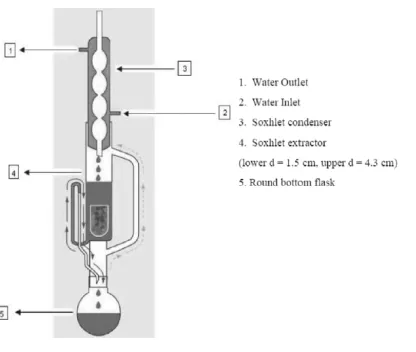
The seeds were grinded into fine particles and 60gms of the grinded seed was taken and a thimble was made. The soxhlet extraction method is best regarding higher percentage yield 320 ml of n-hexane is added to thimble from above. A soxhlet apparatus is only required when the desired compound has limited solubility in a solvent, and the impurity is insoluble in that solvent. Crushed neem seeds are used for extraction of oil by using soxhlet extractor apparatus depicted
Table 3.1Extraction of Neem oil by Neem seeds
Fatty Acids % age
Oleic acid 45.7
Politic acid 19.4
Stearic acid 18.3
Linoleic acid 14.4
ISSN(Online): 2319-8753 ISSN (Print) : 2347-6710
I
nternational
J
ournal of
I
nnovative
R
esearch in
S
cience,
E
ngineering and
T
echnology
(An ISO 3297: 2007 Certified Organization)
Vol. 5, Issue 6, June 2016
Table: 3. 2Chemical Analysis of Neem oil
SI.No Properties Characteristics
1 Color Yellowish green
2 Odor Pungent
3 Specific gravity at 15°c .0926 – 0.942
4 Refractive Index 1.470-1.477
5 Iodine Value 89-98
6 Acid Value 44mg KOH/gm of Oil
7 Sap Value 191 - 202
It is an alcoholoysis reaction in which one alcohol displaces another alcohol from an ester. To 75gm of ethyl hexanol 1.4 gm of sodium was added until clear solution was obtained. 100gm of refined oil was added to the above solution and refluxed at 180 c for a period of 30hr. the product obtained was transesterified ethyl hexyl ester of neem oil (18) which was percolated through fuller’s earth to obtain yellow colored liquid. The oil was studied for its physic-chemical properties which is given in
Figure 3.1 Soxhlet Extractor for extraction of oil Neem crushed seeds
Ethyl Hexyl Ester of Neem Oil: To 100gm of transesterified ethyl hexyl ester of neem oil, 100gm of hexane and 1.6 gm of nickel catalyst was suspended in a reactor. In reactor hydrogen was passed at 200psi at 120°c for 45 minutes to obtain partially hydrogenated product. Contents were filtered to remove catalyst amount solvent was distilled off to obtain straw yellowish liquid. Hence partially hydrogenated transesterified ethyl hexyl ester of neem oil was obtained. Physico chemical properties of partially hydrogenated neem oil were compared with transesterified neem oil.
ISSN(Online): 2319-8753 ISSN (Print) : 2347-6710
I
nternational
J
ournal of
I
nnovative
R
esearch in
S
cience,
E
ngineering and
T
echnology
(An ISO 3297: 2007 Certified Organization)
Vol. 5, Issue 6, June 2016
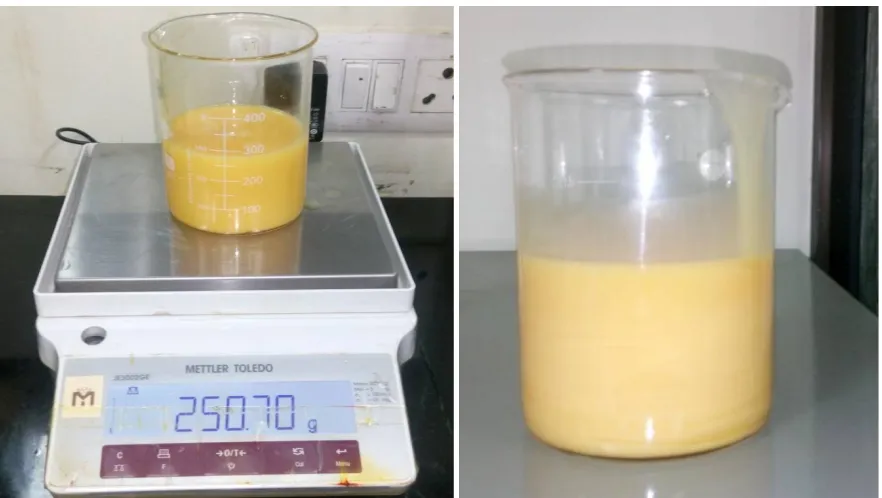
Figure 3.2 Hazy appearances 1
Figure 3.3 Hazy appearances 2
ISSN(Online): 2319-8753 ISSN (Print) : 2347-6710
I
nternational
J
ournal of
I
nnovative
R
esearch in
S
cience,
E
ngineering and
T
echnology
(An ISO 3297: 2007 Certified Organization)
Vol. 5, Issue 6, June 2016
requirements. The blended product is then filtered and transferred to storage tanks from where it is taken to the filling station and packed in containers or barreles.the entire process can be carried out in a basic manually operated plant or automated plc. Controlled plants the lube oils are manufactured to API or other required specifications.
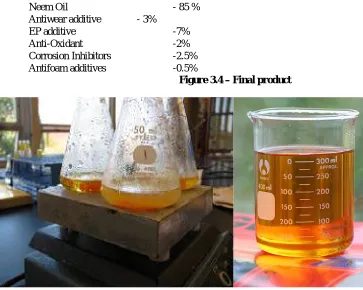
Neem Oil - 85 %
Antiwear additive - 3%
EP additive -7%
Anti-Oxidant -2%
Corrosion Inhibitors -2.5%
Antifoam additives -0.5%
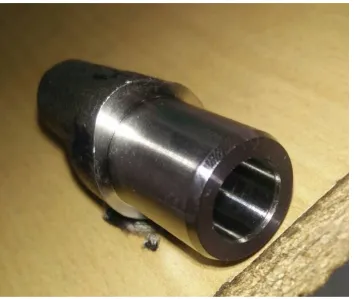
Figure 3.4 – Final product
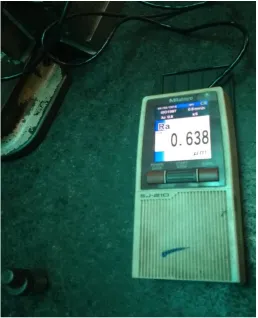
The equipment used in this study is: Centre Lathe Machine model XL 400, Uncoated Carbide Inserts Tool SNMG 120408-QM H13A (ISO designation) were clamped onto a tool holder for turning operation. Surface roughness tester ISR-16 type, and a digital dernier caliper were used to measure the surface roughness and the tool wear values respectively.
ISSN(Online): 2319-8753 ISSN (Print) : 2347-6710
I
nternational
J
ournal of
I
nnovative
R
esearch in
S
cience,
E
ngineering and
T
echnology
(An ISO 3297: 2007 Certified Organization)
Vol. 5, Issue 6, June 2016
Figure 3.5 - Lathe Machining
ISSN(Online): 2319-8753 ISSN (Print) : 2347-6710
I
nternational
J
ournal of
I
nnovative
R
esearch in
S
cience,
E
ngineering and
T
echnology
(An ISO 3297: 2007 Certified Organization)
Vol. 5, Issue 6, June 2016
Figure 3.7 - Surface Roughness Meter
III. RESULTS AND DISCUSSION
Vegetable oils were found to be promising alternative for mineral based oils due to their environmental friendly characteristics. These were utilized to develop biodegradable lubricants for various industrial applications. The trend was extended to formulate environmental friendly metal working fluids. The review is made in two approaches, one based on the desirable properties of vegetable oil as metal working fluid and other on the performance of these oils for various cutting and forming operations. Most of the studies found, were on soybean, sunflower and rapeseed oils. Finally, the review revealed that the vegetable oils have large scope to utilize them as metal working fluids. The researchers in the authors’ group engaged in the study of stability and Tribological behavior of Pongamia pinnata and neem oils as metal cutting and forming fluids.
ISSN(Online): 2319-8753 ISSN (Print) : 2347-6710
I
nternational
J
ournal of
I
nnovative
R
esearch in
S
cience,
E
ngineering and
T
echnology
(An ISO 3297: 2007 Certified Organization)
Vol. 5, Issue 6, June 2016
Inference: The above graph is plotted between Oil temperature and its corresponding viscosity and density. It is clearly seen that the viscosity decrease as the temperature increases, so as the density. The variation is linear in nature given by the r2 value of 0.9723. For the cutting oil to perform it has to have a viscosity index in the range of 130 to 200 and for our neem based cutting oil it is found to be 160, which is in the optimum range.
INFERENCE: In the above graph we have the relation between the various cutting speed and it corresponding temperature and the feed rate. It is seen that, when the feed rate increase the cutting speed and hence the temperature increases. This is given by the linearity in the variation who’s r2 values is 0.9861, basically neem oil having higher viscosity index compared a regular base oil, thereby the cutting temperature is well within the desired range of less than 600 C, and also we have the expected cutting performance as that of the base oil.
INFERENCE: The above graph is plotted between cutting speed and the corresponding tool wear observed. Tool wear is a property which is not desired, the lower the value better is the performance of our cutting oil. Now, the tool wear is a factor which depends on the type of material being cut and the nature, shape of the job work. In our experiment we have ASTM D -2266 standards,which was subjected to a highest cutting speed of 110 mm/min, which has given us a tool wear of 0.42 mm which is considerably less compared to petroleum based base oil.
y = -0.860x + 94.53 R² = 0.972
0.82 0.84 0.86 0.88 0.9 0 20 40 60 80
0 50Temperature C100 150
D e n si ty g /c c V is co si ty C st
Oil Viscosity …
y = 10.26x - 399 R² = 0.986
0.1 0.15 0.2 0 200 400 600 800
0 50 100 150
Fe e d r at e m m /r e v T em p e ra tu re C
Cutting Speed m/min C… 0 0.1 0.2 0.3 0.4 0.5
10 60 110
To o l w e ar m m
ISSN(Online): 2319-8753 ISSN (Print) : 2347-6710
I
nternational
J
ournal of
I
nnovative
R
esearch in
S
cience,
E
ngineering and
T
echnology
(An ISO 3297: 2007 Certified Organization)
Vol. 5, Issue 6, June 2016
INFERENCE: The above graph is plotted between Feed rate of the material and the corresponding surface roughness. Surface roughness is not desired once a job is cut, the duty of the cutting oil is not only aid in cutting but also, provide a smooth surface finish at the areas of cut. This is expressed in terms of ‘Ra - Value’. In the above graph for a minimum feed rate of 0.12 mm/min we have achieved lowest surface roughness of 0.5 Ra and for maximum feed rate of 0.28 mm/min the highest observed surface roughness is just 4.5 Ra. On scale of smooth we see that 0.12 Ra is as that of a mirror smooth finish.
OPTIMIZATION Regression Equation
Tool Wear Flank wear = 1.636 + 0.1200 Cutting Speed - 75.2 Feed Rate + 0.001495 Cutting Speed*Cutting Speed + 735 Feed Rate*Feed Rate -2.130 Cutting Speed*Feed Rate
MODEL SUMMARY
S R-sq R-sq(adj)
0.0044721 99.96% 99.77%
INFERENCE: The various parameters contributing to the tool flank wear is given above in the Pareto analysis. It is clearly seen that the combined effect of the cutting speed and the feed rate controls the quality of the tool flank wear. Hence it is important to optimize both the parameters. Followed by the point temperature on the tool and the feed the rate contributes to the lowest possible tool flank wear.
0 0.05 0.1 0.15 0.2 0.25 0.3
0 2 4 6
Su
rf
a
ce
R
o
u
gh
n
es
s
R
a
Feedrate mm/rev
Feed rate
Term
AB C A B AC BC
1.2 1.0 0.8 0.6 0.4 0.2 0.0
A Cutting Temperature B Cutting Speed C Feed Rate Factor Name
Effect
1.179
Pareto Chart of the Effects (response is Tool Wear Flank wear, α = 0.05)
ISSN(Online): 2319-8753 ISSN (Print) : 2347-6710
I
nternational
J
ournal of
I
nnovative
R
esearch in
S
cience,
E
ngineering and
T
echnology
(An ISO 3297: 2007 Certified Organization)
Vol. 5, Issue 6, June 2016
INFERENCE: The plot above explains the main effects of the two governing parameter on the quality of the job work when we use neem based cutting oil. It is clear from the graph that the two factors are equally contributing to the quality of the cutting when using a neem based cutting oil.
INFERENCE: The graph above is the interaction plot between the two factors namely the cutting speed and the feed rate. The plots are not parallel indicating there is significance between their interactions. The cutting speed is a factor of the feed rate. At a cutting speed of 50 m/min and feed rate of 0.12 mm/rev the tool flak wear is found to be low 0.15 mm. As wen the feed rate increased, so also the cutting speed it is seen the tool wear is proportionally low. This graph explains the effectiveness of the cutting oil in maintain lowest possible tool wear, when the two governing parameters namely cutting speed and feed rate is varied.
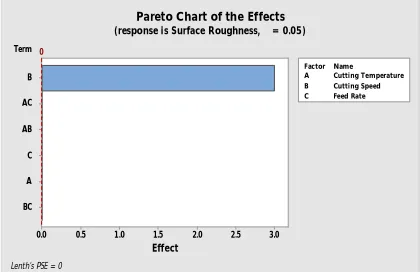
INFERENCE: The interaction study indicates that there is not much relation between the cutting speed and the feed rate on te surface roughness of the finished job work. The cutting speed alone controls the quality of the surface smoothness. 100 75 50 2.5 2.0 1.5 1.0 0.5 0.0 0.20 0.18 0.16 0.14 0.12 Cutting Speed M e a n o f T o o l W e a r F la n k w e a r Feed Rate Main Effects Plot for Tool Wear Flank wear
Fitted Means 110 100 90 80 70 60 50 7 6 5 4 3 2 1 0
Cutting Spee * Feed Rate
Cutting Spee M e a n o f T o o l W e a r F la n k w e a r 0.12 0.16 0.2 Rate Feed
Interaction Plot for Tool Wear Flank wear Fitted Means 100 75 50 3.5 3.0 2.5 2.0 1.5 1.0 0.5 0.20 0.18 0.16 0.14 0.12 Cutting Speed M e a n o f S u rf a c e R o u g h n e ss Feed Rate Main Effects Plot for Surface Roughness
ISSN(Online): 2319-8753 ISSN (Print) : 2347-6710
I
nternational
J
ournal of
I
nnovative
R
esearch in
S
cience,
E
ngineering and
T
echnology
(An ISO 3297: 2007 Certified Organization)
Vol. 5, Issue 6, June 2016
Characteristics for pilot Plant study
The results of the effect of spindle speed on the surface roughness under the following Conditions: spindle speed (N) = 250 - 500rpm, feed rate (f) = 1.52mm/rev, depth of cut (d) = 1.0mm are presented. Comparison between Regular Base oil Vs. Neem Cutting oil Finished Component surface roughness value
Table 4.1 the surface roughness under various spindle speeds.
SI.No Spindle Speed (rpm) Surface Roughness (µm)
Base Oil Neem Oil
1 250 1.456 0.467
2 355 1.355 0.433
3 500 1.243 0.352
Total Average 1.351 0.417
Term
BC A C AB AC B
3.0 2.5 2.0 1.5 1.0 0.5 0.0
A Cutting Temperature B Cutting Speed C Feed Rate Factor Name
Effect
0
Pareto Chart of the Effects (response is Surface Roughness, α = 0.05)
ISSN(Online): 2319-8753 ISSN (Print) : 2347-6710
I
nternational
J
ournal of
I
nnovative
R
esearch in
S
cience,
E
ngineering and
T
echnology
(An ISO 3297: 2007 Certified Organization)
Vol. 5, Issue 6, June 2016
The results of the effect of feed rate on the surface roughness under the following conditions: feed rate (f) = 1.05 – 2.10mm/rev, depth of cut (d) = 1.0mm, spindle speed (N) = 355rpm are presented in Table 4.2.
SI.No Feed rate (mm/rev ) Surface Roughness (µm)
Base Oil Neem Oil
1 250 1.234 0.433
2 355 1.119 0.412
3 500 1.023 0.407
Total Average 1.125 0.421
IV. CONCLUSION
In This Project, the concluded applicability of vegetable Neem oil-based metalworking fluids in machining of ferrous metals has to be taken. The advantages of metalworking fluids and its performances with respect to the cutting force, surface finish of work piece, tool wear and temperature at the cutting zone have been investigated.We have try to Use Vacuum Blending (or) mixing reactor in a closed system For example – Normal Heating and Blending Temperature of Neem oil up to 70 °c instead of using Vacuum means – Reduce the temperature up to 40°c and benefit of using Vacuum, since it is bio product contains AZADIRACHTIN (natural chemical) Antibacterial activity. If the maintaining the low temperature 40°c AZADIRACHTIN cannot be degraded and also originality of the product.
In this work, the suitability of neem cutting oil as cutting fluid and its effect on surface roughness of mild steel and tool wear during were confirmed in terms of selected parameters such as spindle speeds, feed rates, and depths of cut. Therefore, the following conclusions are being drawn
The minimum surface roughness (best surface quality) was obtained using neem cutting oil as cutting fluid compared to base oil cutting fluid during the turning operation.
Vegetable based Neem cutting oils are highly degradable, non-toxic, good physical properties. Neem based metalworking fluid is being recognized as having superior lubricating properties compared to other based-oil.
REFERENCES
1. M.Amritaa*, S.A.Shariq, Manoj, Charan gopal – “Experimental investigation on application of emulsifier oil basednano cutting fluids in metal cutting process”published the journal of Procedia Engineering 97 ( 2014 ) 115 – 124
2. Carlos Alberto Schuch Bork , Janaina Fracaro de Souza Gonc¸alves *, Jefferson de Oliveira Gomes, Jorda˜o Gheller – “Performance of the jatropha vegetable-base soluble cutting oil as a renewable source in the aluminum alloy 7050-T7451 milling” Published the CIRP Journal of Manufacturing Science and Technology 7 (2014) 210–221
3. Geoff Burtona, Chan-Seo Goob, Yanqiao Zhanga, Martin B.G. Juna, - “Use of vegetable oil in water emulsion achieved through ultrasonicatomization as cutting fluids in micro-milling” Published the Journal of Manufacturing Processes JMP-240; Pages 1-9
4. Alejandrina Campanella, Eduardo Rustoy, Alicia Baldessari, Miguel A. Baltanás a,* - “Lubricants from chemically modified vegetable oils” Published the Bioresource Technology 101 (2010) 245–254
5. Chetan*, Sudarsan Ghosh, P Venkateswara Rao –“Application of sustainable techniques in metal cutting for enhanced machinability: a review” Published the Journal of Cleaner Production (2015) 1-18
6.* Sujan Debnath, Moola Mohan Reddy and Qua Sok Yi – “Environmental friendly cutting fluids and cooling techniques in machining: A Review” Published theJournal of Cleaner Production(2014), doi: 10.1016/ j.jclepro.2014.07.071.
7.Mohamed Handawi Saad Elmunafi, D. Kurniawan, M.Y. Noordin* - “Use of Castor Oil as Cutting Fluid in Machining of Hardened Stainless Steel with Minimum Quantity of Lubricant” Published the Procedia CIRP 26 ( 2015 ) 408 – 411
8.Jacob John a, Mrinal Bhattacharya a*, Peter C. Raynor b – “Emulsions containing vegetable oils for cutting fluid application” Published the Colloids and Surfaces A: Physico-chem. Eng. Aspects 237 (2004) 141–150
9. S.A. Lawal a, I.A.Choudhury b, Y.Nukman a –“Application of vegetable oil-based metal working fluids in machining ferrous metals—A review” Published the International Journal of Machine Tools & Manufacture 52 (2012) 1–12
10. H.M.Mobarak n, E.NizaMohamad, H.H.Masjuki, M.A.Kalam, K.A.H.AlMahmud, M.Habibullah, A.M.Ashraful – “The prospects of bio lubricants as alternatives in automotive applications” Published the Renewable and Sustainable Energy Reviews 33(2014)34–43
ISSN(Online): 2319-8753 ISSN (Print) : 2347-6710
I
nternational
J
ournal of
I
nnovative
R
esearch in
S
cience,
E
ngineering and
T
echnology
(An ISO 3297: 2007 Certified Organization)
Vol. 5, Issue 6, June 2016
12.Sunday Albert Lawal*, Imtiaz Ahmed Choudhury, Yussof Nukman – “Evaluation of vegetable and mineral oil-in-water emulsion cutting fluids in turning AISI 4340 steel with coated carbide tools” Published the Journal of Cleaner Production 312 (2013) 1- 9
13.L.A. Quinchia, M.A. Delgado*, C. Valencia, J.M. Franco, C. Gallegos – “Viscosity modification of different vegetable oils with EVA copolymer for
Lubricant applications” Published the Industrial Crops and Products 32 (2010) 607–612