Comparative Study on Seismic Response of
Irregular Structure with Lead Rubber
Bearing and Friction Pendulum Bearing Base
Isolation System
Mithun 1, Dileep Kumar U 2
P.G. Student, Department of Civil Engineering, Sahyadri College of Engineering and Management, Mangaluru,
Karnataka, India1
Assistant Professor, Department of Civil Engineering, Sahyadri College of Engineering and Management, Mangaluru,
Karnataka, India2
ABSTRACT: Base isolation is one of the most modern technique and widely accepted seismic protection system used in the building in Earthquake prone areas. The base isolation system separates the structures from its foundation and primarily moves it relative to that of the super structure. The main objective of this project is to understand the seismic performance of a G+10 irregular building made of three different materials such as RCC, Steel and Composite with Lead Rubber Bearing (LRB) and Friction Pendulum Bearing (FPB) base isolation system and to compare the seismic response with and without base isolation using Response spectrum method in ETABS-2015 software. The response of the structure such as time period, base shear, story drifts and story displacements are studied and comparison is made. From this study it can also be concluded that it is better to provide isolation systems in seismic prone areas rather than providing fixed base and among two isolators used here FPB performs better than LRB for all the structures.
KEYWORDS: - RCC, steel, Composite structures, Irregular, Response spectrum, Fixed, LRB, FPB base isolation, ETABS 2015.
I. INTRODUCTION
modification isolation. The fundamental principal of seismic isolation is to modify the response of the building to permit the dissipations of vibration energy or by base isolation. The basic principle of base isolation is to reduce and control vibrations induced from earthquake on any structures. The isolation system deflects through the dynamics of the system but it does not absorb the energy. In this project “plus” shaped plan irregular structure is considered and here two types of base isolation systems are considered, one is Lead Rubber Bearing (LRB) and the other one is Friction Pendulum Bearing (FPB) base isolation system.
1.1 Objectives of the work
i. To study the behaviour of structure with and without base isolation.
ii. To study the response of the RCC, Steel and Composite structure with and without base isolation. iii. To know the good base isolation system for various structures.
II. METHODOLOGY
The experimental model is analysed using the software ETABS-2015.The methodology mainly discusses the method of analysis of structure and seismic analysis of fixed and base isolated structures.
2.1 Geometrical modelling
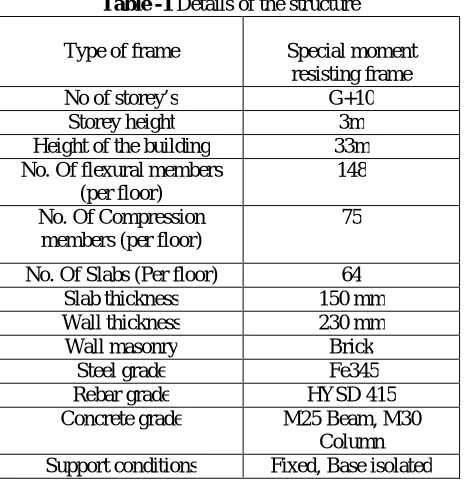
The below table shows the details of the model used for the analysis and also seismic evaluation is carried out as per IS 456:2000 and IS 1893 (part 1):2002 using ETABS 2015 software.
Table -1 Details of the structure
Type of frame Special moment
resisting frame
No of storey’s G+10
Storey height 3m
Height of the building 33m
No. Of flexural members (per floor)
148
No. Of Compression members (per floor)
75
No. Of Slabs (Per floor) 64
Slab thickness 150 mm
Wall thickness 230 mm
Wall masonry Brick
Steel grade Fe345
Rebar grade HYSD 415
Concrete grade M25 Beam, M30
Column
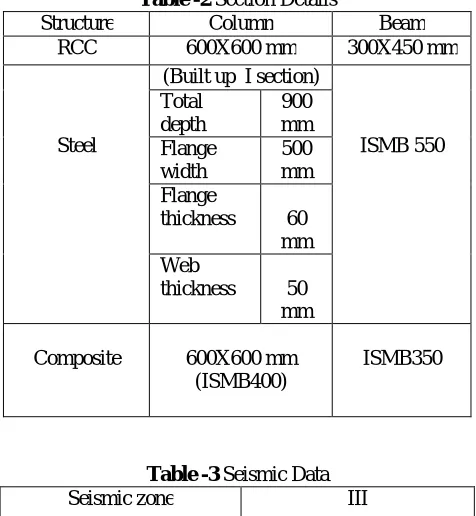
Table -2 Section Details
Structure Column Beam
RCC 600X600 mm 300X450 mm
Steel
(Built up I section)
ISMB 550 Total
depth
900 mm Flange
width
500 mm Flange
thickness 60
mm Web
thickness 50
mm
Composite 600X600 mm
(ISMB400)
ISMB350
Table -3 Seismic Data
Seismic zone III
Zone factor 0.16
Soil type Type II (Medium)
Importance factor 1.0
Response reduction factor 5.0
Damping of the structure 5%
2.2 Description of models
Totally 9 models is been considered for this study below describes the details of it, Model 1: Response spectrum analysis of RCC structure with fixed base.
2.3 Modelling of LRB and FPB in ETABS 2015
Properties of FPS and LRB Isolators are modelled as spring elements (point springs) in ETABS 2015 and their properties are given as Link Properties. The properties of the friction pendulum bearing system isolator and lead rubber bearing isolator are referred from Torunbalci1 and G. Ozpalanlar octo.12-17(2008) [10] pp: 3-4, based on which they are enlisted below in table,
Table-4 Properties of Lead Rubber Bearing Isolator
U1 Linear Effective Stiffness 15000000 kN/m
U2 and U3 Linear Effective Stiffness 800 kN/m
U2 and U3 Nonlinear Stiffness 250 kN/m
U2 and U3 Yield strength 80 kN
U2 and U3 Post Yield stiffness ratio 0.1
PYSR 0.1
Table-5 Properties of Friction pendulum system isolator
U1 Linear Effective Stiffness 15000000 kN/m
U1 Nonlinear Effective Stiffness 15000000 kN/m
U2 and U3 Linear Effective Stiffness 750 kN/m
U2 and U3 Nonlinear Stiffness 15000 kN/m
U2 and U3 Friction Coefficient, Slow 0.03
U2 and U3 Friction Coefficient, Fast 0.05
U2 and U3 Rate Parameter 40
U2 Radius of Sliding Surface 2.23
2.4 Loads considered
Dead Load: The dead load is considered as per IS: 875 (Part-1)-1987.
Imposed Load: The Imposed load is considered as per IS: 875 (Part-2)-1987, Live Load for Floors: 3.0 kN/m2,Floor Finish: 1.25 kN/m, Wall Load: 11.14 kN/m.
Seismic Load: The seismic load is considered as per IS: 1893 (Part-1)-2002
III. RESULTS AND DISCUSSIONS
3.1 Storey Displacement
Fig.4 Displacement v/s different models
The fig.4 shows that the displacement of both the base isolated structures increases compared to that of fixed base structures. In RCC (LRB= +35%, FPB= +36%), In Steel (LRB=+50%, FPB=+51%), In Composite (LRB & FPB= +22%) increase is obtained.
3.2 Storey Drift
Fig.5 Storey drifts v/s different models 0 5 10 15 20 25 30 D IS P LA C EM EN T ( m m )
RCC STEEL COMPOSITE
FIXED LRB FPB 0 2 4 6 8 10 12
0 0.0005 0.001
N o .o f S to re ys Dirift (mm) FIXED R LRB R FPB R Fixed S LRB S FPB S Fixed C LRB C FPB C 0 5 10 15 20 25 30 ST O R EY D R IF T
RCC STEEL COMPOSITE FIXED
LRB
The fig.5 shows that the storey drifts in both the base isolated structures decreases (except initial floor levels) with the increase in storey heights compared to that of fixed base structures. The base isolated structure produces larger drifts only in the first floor as shown in the figure. The reduction in RCC (LRB= -20%, FPB= -25%), In Steel (LRB=-58%, FPB=-62%), In Composite (LRB =-19%, FPB= -23%) is obtained.
3.3 Base Shear
Fig.6 Storey shear v/s different models
The fig.6 shows that the base shear reduces completely in both the base isolated structures compared to that of fixed base structure. The reduction in RCC (LRB= -69%, FPB= -68%), In Steel (LRB=-77%, FPB=-78%), In Composite (LRB =-58%, FPB=-59%) is obtained. Among two isolators FPB isolated structures shows lesser base shear than that of LRB isolated structures.
3.4 Time Period
0 200 400 600 800 1000 1200 1400 B A SE S H EA R ( kN )
RCC STEEL COMPOSITE
FIXED LRB FPB 0 0.5 1 1.5 2 2.5 3 3.5 TI M E P ER IO D ( Se c)
RCC STEEL COMPOSITE
FIXED
LRB
The fig.7 shows that the time period of base isolated structures increases compared to that of fixed base structures in all the three material properties. In RCC (LRB= +64%, FPB= +65%), In Steel (LRB=+69%, FPB=+70%), In Composite (LRB =+55% & in FPB= +56%) increase is obtained.
IV.CONCLUSION
In this project an attempt is made to understand the effectiveness of base isolating system for earthquake. On the basis of the analysis the following conclusions are drawn.
There is an increase in time period value for base isolated structure compared to that of fixed base structure.
Both the isolation system increases the time period compared to fixed base. But FPB isolation system provides more time period than LRB isolation system.
Results also shows that the time period in the Composite structure is maximum compared to RCC and steel structure in both base isolated and fixed base structures.
There is a large reduction in the base shear for the structure with base isolation as compared to fixed base structures.
Both the base isolation system gives almost same amount of reduction in the base shear for different structures such as RCC, Steel and Composite.
More reduction in base shear can be achieved for steel structure as compared to RCC & Composite structure.
The displacement of the isolated structure increases due to a large increase in the flexibility of the structure.
Out of two base isolation systems, it is found that the displacement in FPB isolation is more compared to that of LRB isolation system. The analysis result also shows that the maximum displacement is occurred in Composite structure as compared to RCC and Steel structure.
From the analysis result, it is observed that only the first storey of the base isolated structure gets more storey drift value compared to fixed base structure. But in the remaining storeys the drift values goes on decreasing in the base isolated structure and the drift value goes on increasing in the fixed base structure.
Based on the results, it was also found that among the two isolators, FPB isolator gives better performance compared to LRB isolator for irregular medium storey structures.
REFERENCES
[1] Dr. H.M.Somasekharaiah, Er. Dharmesh. N and Mohammed Ghouse (2016),” A Comparative Study on RC Frame Structure Considering Lead Rubber Bearing and Triple Friction Pendulum Bearing”, IJIRSET, Vol. 5, Issue 8, August 2016, ISSN: 2319-8753.
[2] Vinodkumar Parma, G.S.Hiremath (2015),”Effect of base isolation in multistoried RC irregular building using time history analysis”, IJRET, Volume: 04, Issue: 06, June-2015, ISSN: 2319-1163.
[3] Nitya M and Arathi S (2016),” Study on the Earthquake Response of a RC Building with Base Isolation”, IJSR, Vol.5, Issue 6,July 2016, ISSN (Online): 2319-7064.
[4] Devi Sreenivas and Ancy Mathew (2016),” Evaluation of Seismic Performance of Re-Entrant Cornered Buildings with Base Isolators”, IJSTE, Vol.03,Issue 3,September 2016, ISSN (online): 2349-784X.
[5] T.Dinesh Kumar, S.Manivel, A.Arokiaprakash (2016),”Study, Behaviour and Comparision of base isolated steel-concrete-composite structures by response spectrum analysis”, IRJET, Volume: 03 Issue: 04, Apr-2016, ISSN: 2395 -0056.
[6] Sonali Anilduke, Amay khedikar (2015),”Comparision of building for seismic response by using base isolation”, IJRET, Vol.04, Issue:06, June 2015, eISSN: 2319-1163 pISSN: 2321-7308.
[7] Chandak N.R.(2013),” Effect of Base Isolation on the Response of Reinforced Concrete Building”, Journal of Civil Engineering Research 2013, 3(4): 135-142.
[8] N. Torunbalci and G. Ozpalanlar (2008),” Earthquake response analysis of mid-story buildings isolated with various seismic isolation techniques”, The 14th World Conference on Earthquake Engineering, October 2008, Beijing, China .
[9] Suhail V.M, Syed Ahamed Raza (2015),”Seismic analysis of RC buildings provided with HDRB isolators of various rubber thickness”, International Journal of Advanced Technology in Engineering and Science, Volume No.03, Issue No. 06, June 2015, ISSN (online): 2348 – 7550.
[12] Venkatesh, Mr.Arun Kumar.H.R (2016),”Dynamic analysis of 11 storey RC structure by providing Lead rubber bearing as isolation system”, International Research Journal of Engineering and Technology (IRJET), Volume: 03 Issue: 07 , July-2016, ISSN: 2395 -0056.
BIOGRAPHY
Mithun, P.G. Student in Structural Engineering, Dept. of Civil Engineering, Sahyadri College of Engineering and Management, Karnataka, Obtained B.E from Srinivas school of Engineering, V.T.U, In the year 2014.