PREFERENTIAL SEGREGATION I N MAIZE
M. M. RHOADES Columbia University, New York City
Received December 25, 1941
H E orientation of a bivalent on the metaphase plate is usually a t
T
random so that the distribution of any one of the two homologues to a specific pole of the spindle figure is wholly a matter of chance. The validity of this statement is established by the large number of cases in many diverse organisms in which I : I genetic ratios are obtained when thetwo homologous chromosomes are marked by contrasting alleles and when there are no complications due to viability differences of the two pheno- types. Preferential segregation (that is, the passing of a specific chromosome to a specific pole) may be detected genetically in oogenesis and megasporo- genesis since normally only one of the four nuclei arising from the two meiotic divisions survives. Here preferential segregation will give rise to distorted genetic ratios. Since a number of mechanisms are known which produce distorted genetic ratios, all other possible causes must be shown to be non-operative before any aberrant ratio can be ascribed to prefer- ential segregation. This is often a difficult task, and few cases of non- random segregation have been established.
Results obtained in the course of some investigations with an abnormal type of chromosome IO in maize are apparently explicable only on the as-
sumption of preferential segregation in megasporogenesis. This paper pre- sents the data which justify such a conclusion.
EXPERIMENTAL RESULTS
LONGLEY (1937, 1938) found an unusual type of chromosome IO in four
strains of maize grown by Indian tribes in the southwestern part of the United States and also in a strain of teosinte from Chapingo, Mexico. This unusual typeof chromosome IO differs from the chromosome IO found
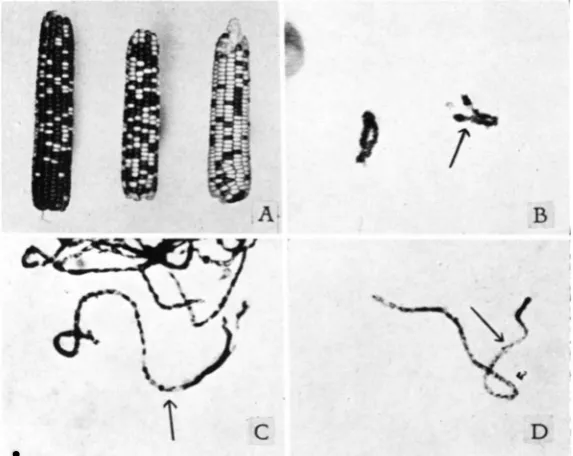
in all other tested strains of maize in having an extra piece of chromatin attached to the end of the long arm. The length of this piece is about that of the short arm of chromosome IO (fig. C, D). The proximal portion of the
attached piece is euchromatic, as is a smaller distal portion. A large and conspicuous knob comprising approximately one-half of the pachytene length lies between the two euchromatic portions. The relative length of the extra piece is much greater at late diakinesis than a t pachytene, since a t diakinesis it constitutes a bulk equal to the entire length of a normal chromosome IO. This is due to the fact that the large pycnotic knob under-
goes a comparatively slight reduction in size as meiosis advances while the euchromatic portions become greatly contracted. Nothing is known of the
396 M. M. RHOADES
origin of this extra piece. It is not morphologically similar to the B chromo- somes, and insofar as the present tests indicate, it carries no loci found in the normal chromosome IO. No pairing of the attached piece with any of the other chromosomes composing the regular complement has been ob- served.
A strain of maize homozygous for the abnormal chromosome IO was obtained through the kindness of DR. LONGLEY. It was originally planned to use this abnormal type of determine the amount of recombination be- tween the R locus and the distal end of the long arm of chromosome IO. It
is known from the studies of MCCLINTOCK (1931), STADLER (1933), and ANDERSON (1935) that the R gene is in the distal portion of the long arm. The abnormal chromosome carried the recessive r allele. Crosses were made between plants with the abnormal tenth and those with the dominant R allele from two unrelated normal strains. Both sets of F1 plants were backcrossed to strains with normal chromosomes IO possessing the r allele and homozygous for the dominant alleles of the other loci concerned with aleurone color. In these heterozygous plants the abnormal chromosome carried the r allele while the normal tenth bore the R alIele, and a ratio of one colored to one colorless was expected in the backcross progenies. When the F1 plants from one of the two original crosses were pollinated with r
pollen, a total of 1881 R r and 4441 r r seeds (29.8 percent R) was obtained on 15 backcrossed ears instead of the expected I:I ratio. The second set of F1 plants gave a total of 1092 R r and 3409 r r kernels (24.3 percent R ) on ten ears similarly pollinated. Although the R : r ratio was far from the expected I:I, it is evident that all R r plants should have two normal chromosomes I O and that r r plants should have one abnormal and one normal chromosome IO if there was no crossing over between R and the point of attachment of the extra piece. The constitution of IOO plants from R r and T r seeds was determined. Crossover types would be r r plants with two normal chromosomes and R r plants with one abnormal and one normal chromosome. One crossover was found in the IOO tested plants; in this case a plant of R r constitution had an abnormal chromosome with the R allele. The close linkage of the R locus and the extra piece indicated that the aberrant R : r ratio was due to a peculiar behavior of the abnormal chromosome resulting its being included in more than half of the function- ing ovules. The close linkage of the R locus with the extra piece made this locus a valuable tool in following the two types of chromosomes IO in sub- sequent breeding experiments.
PREFERENTIAL SEGREGATION I N MAIZE 397
heterozygotes should carry two normal chromosomes if no crossing over occurred. Plants with non-crossover chromosomes should give I : I ratios of R : Y when used as the female parent in backcrosses. Crossovers, with the R allele in the abnormal chromosome, would give a marked excess of colored seeds above a I:I ratio. (It has been concluded that preferential segregation is responsible for these distorted ratios. The evidence per- mitting such a conclusion will be presented later.) It is assumed that when
a normal chromosome receives the extra piece through crossing over, this newly formed abnormal chromosome will undergo preferential segregation as did the original abnormal chromosome-that is, the extra piece is the cause of the non-random segregation. Data showing that this is true will be given below. A total of 633 gametes were tested by this method; 6 2 0 were non-crossovers while 13 or two percent were crossovers between R and the attached piece. In most of the ears there was no doubt of the cor- rect classification, but in a few cases it was necessary to check the in- ferred constitution by cytological examination or further breeding tests. The low percentage of recombination found by this method is in agree- ment with that found by direct cytological examination as previously de- scribed.
Counts of colored and colorless seeds were made on 131 backcrossed ears from plants heterozygous for the two types of chromosome IO. The
abnormal chromosome carried the R allele by virtue of an earlier crossover.
A
total of 27,470 R Y (colored) and 10,515 r r (colorless) seeds, a percentage of 72.3 R, was found. Since the R locus is so closely linked to the attached piece, the ratio of colored to colorless kernels is approximately equal to the ratio of abnormal to normal chromosomes IO. It follows that about 7 2 percent of the ovules received the abnormal chromosome. There was a total of 4,806 R Y and 10,939 T Y seeds, a percentage of 69.5 r , on 43 back- crossed ears where the R allele was in the normal tenth and the r allele in the abnormal chromosome. These data indicate that approximately 70percent of the ovules have received the abnormal chromosome. The two sets of crosses, differing in phase of linkage, agree very well on the degree of preferential segregation.
398 M. M. RHOADES
chromosomes with the
li
g R alleles, derived from a normal chromosome, and the extra piece undergo preferential segregation. Theli
locus is about 35 crossover units to the left of R. It is evident that the distal part of the long arm of chromosome IO is free from genetic factors producing the un-usual distribution of the abnormal chromosome.
Before accepting the correctness of the preferential segregation hy- pothesis, it was necessary to prove that other mechanisms were not a t play.
It seemed possible that equal numbers of ovules with the two types of chromosomes IO were formed and the the deficiency of one type was due
to abortion. For example, RHOADES and RHOADES (1939) have shown that the sp2 gene, which is situated in chromosome IO, causes the abortion of 44 percent of the sp2 ovules. A similar abortion-inducing gene might ac- count for the present deviation from a I : I ratio. If this factor were located near the R locus it would produce a deficiency of ovules possessing this gene and consequently distort the R : r ratio. But the abortion of a number of ovules carrying the normal chromosome sufficient to give the observed deviation from equality would produce a noticeable sterility on the ear. No such sterility was found, as figure A illustrates. The fertile spikelets of
the maize cob are paired-a condition which makes possible the detection of even a slight degree of abortion if the ears are carefully examined. The maximum sterility on three closely inspected ears with marked deviations in the R : r ratio was six percent, a value far too small to account for the deviation from a I : I ratio. Furthermore, the normal tenth chromosomes
used in these experiments are free from ovule abortion genes. Extensive control data on the R : r ratio from plants with normal chromosomes IO
gave an extremely good fit to a I : I ratio. Four hundred and four ears from
the backcrossing of heterozygous plants had a total of 53,740 R r (colored) and 53,492 r r (colorless) seeds. The absence of sterility on the ear and the freedom of the normal chromosome IO from ovule abortion genes negate
the abortion hypothesis. Normal I : I ratios of R : r in both male and female
flowers were obtained from plants homozygous for the abnormal chromo- some.
The above data indicate that the two types of chromosome IO were
never represented with equal frequencies in the ovules of heterozygous plants. Such a condition could arise from megaspore competition. The basal (chalazal) one of the linear series of four megaspores of maize gives rise to the embryo sac, while the other three megaspores degenerate. The distorted ratios reported in these experiments could arise if non-basal megaspores with the abnormal chromosome frequently competed success- fully with the basal megaspores containing the normal chromosome IO and
formed the embryo sac. Such a phenomenon has been reported by RENNER
399
develop into the functioning embryo sac irrespective of their position in the row of four megaspores. In order to determine if megaspore competition is responsible for the distorted ratios observed in the present experiments, the development of more than 2 0 0 embryo sacs was followed in plants
heterozygous for the abnormal chromosome. Here, as normally, the basal megaspore always developed into the embryo sac, while the other three megaspores degenerated. Megaspore competition, then, does not account for the unusual breeding results reported in this paper.
The preferential segregation hypothesis was accepted only after the elimination of other explanations. Although it was not verified by cyto- logical observations of anaphase disjunction during megasporogenesis be- cause of technical difficulties (the aceto-carmine smear technic is not feasible for this tissue, and sectioned material is not satisfactory), it satis- factorily accounts for all known facts. It is believed that the orientation of the heteromorphic bivalent on the spindle figure is non-random so that the abnormal chromosome passes to the lower pole of the spindle in a majority of the cases. The genetic length of the long arm of chromosome
I O is such that an average of a t least one chiasma is formed between the
centromere and the distal end. If one chiasma always occurred, anaphase I would be equational for the extra piece, and the dyads in both of the telophase nuclei would consist of one normal and one abnormal chromatid. Preferential segregation then would occur a t the second division, with the abnormal chromosome passing to the lower pole, from which the basal megaspore arises. It m.ay be that preferential segregation invariably occurs at anaphase I1 when a heteromorphic dyad is present. If such be the case, then the ovules with normal chromosomes IO would come from those
anaphase I disjunctions where two normal chromatids pass to the basal pole. It is doubtful if preferential segregation is obligatory a t anaphase I1 when heteromorphic dyads are present ; it seems more probable that the abnormal chromatid has a propensity to go to the basal pole and that this inclination is subject to modification.
PREFERENTIAL SEGREGATION TN MAIZE
TRANSMISSION OF THE ABNORMAL CHROMOSOME THROUGH POLLEN
400 M. M. RHOADES
two kinds of pollen would give distorted R : r ratios. Forty-nine pairs of direct and reciprocal crosses were made between individuals of normal r
strains and those heterozygous for the abnormal chromosome. When heterozygous plants were used as the female parent, there was a total of
10,542 R r (colored) and 5,064 r r (colorless) seeds on the 49 ears (68 per- cent R). The reciprocal cross, in which the heterozygous plants were used as the pollen parent, had a total of 6,705 colored and 9,225 colorless seeds
(42 percent R). This percentage is significantly less than the expected 50
percent. The R locus is so close to the point of attachment of the extra piece that the ratio of R : r is a good approximation of the relative frequencies of the abnormal and normal types of chromosome IO. These data indicate
that the extra piece has a deleterious effect on the growth of the pollen tube. Data comparable to the above were obtained from heterozygous plants with the abnormal chromosome carrying the r allele. On a total of 31 ears there were 3,801 colored and 3,470 colorless kernels. The deficiency of functioning grains with the abnormal chromosome is less here than in the first experiment, but the deviation from equality is highly significant. The deviation through the male gametes is the reverse of that through the female flowers.
The conclusion that there is unequal transmission of the two types of chromosome IO through the pollen is contingent upon the two chromo- somes being represented equally among the pollen grains and also upon I : I ratios being obtained with two normal chromosomes IO. While an un-
usual situation was encountered in certain plants involving the formation of spindle fibers by regions of the chromosome other than the centromere, this was a phenomenon affecting all the chromosomes, and there was no indication that the abnormal chromosome was lost through failure of dis- junction during microsporogenesis. There was no more than the usual amount of pollen sterility in the heterozygous plants, so the evidence, while not conclusive, lends no support to the suggestion that the two types of chromosome IO might be unequally represented in the pollen sample.
The control data through the pollen are as follows: There were 4,428 R r
and 4,333 r r kernels (50.5 percent R) on 40 backcrossed ears using plants with normal chromosomes IO heterozygous for R as the pollen parent. The
PREFERENTIAL SEGREGATION I N MAIZE 40 1
It is conceivable that the abnormal chromosome is deficient for the tip of chromosome IO even though it carries extra chromatin of uncertain
origin. Such a duplication-deficiency chromosome could arise from a trans- location followed by aneuploid segregation. If the abnormal chromosome possesses, in addition to the extra chromatin, all loci normally present in chromosome IO, then it is probable that the extra piece has been inserted
into the long arm near the distal end and is not terminally attached, since simple translocations are not known to occur. However, a study of pachytene pairing in heterozygous cells shows in most cases a close synapsis of the two chromosomes up to the distal end of the normal chromosome, suggesting a terminal attachment of the extra piece. The occurrence of non-homologous pairing in maize makes such a conclusion hazardous. LONGLEY (1937) suggested that the abnormal chromosome might be the ancestral form and that the type of chromosome IO now found in nearly
all strains arose as a deletion. If this is so, then the extra piece is truly terminal. While it is not possible to disprove this postulated origin, there is no evidence favoring it, and several factors weigh against it.
EFFECl O F THE EXTRA CHROMATIN ON CROSSlNG OVER
There is one or two percent of crossing over between R and the point of attachment of the extra piece. The observed recombination value is prob- ably less than the map distance between R and the tip of the normal chromosome. ANDERSON (unpublished) finds about four or five percent recombination between R and a distally placed break in a translocation heterozygote, and there is an unknown amount of crossing over in the small terminal portion of chromosome IO moved to the other chromosome.
402 M. M. RHOADES
These data show that the amount of crossing over between g and R (14 percent) is the same as occurs in stocks with normal chromosomes IO. The
data in table I also show that the distortion of the G:g ratio from the usual I : I is less than that of the R : r ratio. This, of course, is due to the fact that
the golden locus is further removed in crossover units from the extra piece than is the R locus. A gene located in the short arm of chromosome
IO would be expected to be little affected by the extra piece. The data in
table I further show that crossing over in the g R interval has no effect on
preferential segregation, since the ratio of R to r is approximately the same in both crossover and non-crossover classes. The amount of recombination between g and R was 17 percent in the male flowers, but the population
TABLE I
Linkage data from the cross of G r abnormallg R normalXg r.
LINKAGE
PHASE CONSTITUTION OF CHROEJOSOnS
RATIO OF
R : r O N E A R
243 138 29 49 459 186R : 326r
102 86 9 I3 210 136R : 3197
150 114 18 2 0 302 145R : 288r
396 50 7 59 512 169R : 588r
I54 81 I 1 29 275 12oR : 2 7 7 T
I045 469 74 170 1758 7 5 6 1 : 179%
consisted of only 345 individuals, and the difference in crossing over be- tween the male and female flowers is not significant. RHOADES and RHOADES (1939) found no differences in crossing over in several regions of chromosome IO in the male and female flowers.
EFFECT OF THE ENVIRONMENT ON PREFERENTIAL SEGREGATION
PREFERENTIAL SEGREGATION I N MAIZE 403 which can be only surmised a t present. Perhaps a marked difference in temperature existed a t the critical period (presumably the meiotic divi- sions), This supposition gains some support from the fact that SEILER (1921) found the behavior of the X chromosome in Talaeporia tubulosa to be markedly influenced by the temperature level. He reported that with normal temperatures, and also with subnormal temperatures, the X most frequently passed into the polar body, but under high temperatures, and also in overripe eggs, the X was more often left in the egg.
If the degree of preferential segregation is affected by inter-seasonal environmental differences, it might be expected that intra-seasonal varia- tion would also affect preferential segregation. If such be the case, then the frequency of eggs with the abnormal chromosome would vary con- siderably among the different plants of a family, since the meiotic divisions would not occur simultaneously in all the plants. There would be ample opportunity for environmental changes to take place, especially tempera- ture differences. If a varying environment affects preferential segrega- tion, i t would result in heterogeneity of the percentages of colored and colorless seeds on sister ears. The degree of preferential segregation, as reflected in the ratio of colored and colorless seeds, was determined for 12
groups (families) of sister plants. The
x2
test for homogeneity was made within each of these groups. In only one group consisting of ten ears, family 6471, did the percentages of R and r kernels on the sister ears sug- gest that they formed a homogeneous population. A marked heterogeneity was found within the ears comprising family 7233. The analysis of variance of the data in families 6471 and 7233 showed that the variance between seasons was significantly greater than that within seasons, since the mean square between seasons was more than 11 times that within seasons. Thisindicates that greater environmental differences existed a t the time of meiosis between the two seasons than within. The heterogeneity among sister ears grown the same season and the significant difference in variance between seasons can both be ascribed to changes in the environment. This is true only if the marked deviations of individual ears from the mean of the population are not due to genetic differences. A percentage of 72.3 R seeds was obtained on 131 ears when the R allele was in the abnormal chromosome. A few ears had percentages of colored and colorless seeds differing significantly from the mean. Such differences might be due to genetic modifiers, but data were obtained showing that these ears with significant deviations from the mean do not transmit this condition to the
404 M. ' M. RHOADES
due to a crossover having occurred in the previous generation transferring the
R
allele to a normal chromosome IO. Colored seed from ear 7 2 2 ~ 1 4 was planted and the ensuing plants backcrossed with r pollen. There were7,215
R
r (73.3 percent) and 2,630 r r seeds on 27 ears. It may reason- ably be concluded that the lack of preferential segregation in ear 7229-14 cannot be laid to a genetic agent but may be attributed to some external influence affecting the mechanics of chromosome movement.RELATION OF PREFERENTIAL SEGREGATION TO FORCE OF GRAVITY
It has been concluded that the abnormal chromosome passes to the lower pole of the spindle during megasporogenesis. The length of the extra piece a t late diakinesis is approximately equal to that of the normal chromosome IO. The longitudinal axes of the meiotic spindles are ap- proximately parallel to the longitudinal axis of the main stalk, which normally grows vertically. The equatorial plate of the meiotic spindle is a t right angle to the force of gravity. If, by virtue of possessing the large and presumably heavy pycnotic knob in the extra piece, the tendency of the abnormal chromosome to pass to the lower pole was a response to the power of gravity, then inverting the plants 180 degrees a t the time of meiosis should result in the abnormal chromosome now passing as before to the lower pole, with reference to gravity, but to one which gives rise to a non-basal megaspore. Normal chromosomes IO should be found in more than half of the basal megaspores. Heterozygous plants which had been growing in an upright position were inverted prior to the onset of meiosis and left in this position until the silks had extruded and were ready for pollinating. A number of sister plants were left in an upright position. Both sets of plants were backcrossed by recessive r pollen. Eight control plants had a total of 9 5 9
R
r and 3 1 4 r r kernels (75.3 percent R), while seven inverted plants had a total of 599R
r and 209 r r kernels (74.1 percent R). Apparently the preferential disjunction of the abnormal chromosome to the lower pole is not a response to the force of gravity.DISCUSSION
PREFERENTIAL SEGREGATION I N MAIZE 405 between the two poles, with two chromosomes going to one pole and three to the other. Evidently some sort of regulation is involved so that the align- ment of the five chromosomes is not a t random, else a definite com- plement of chromosomes would not pass to the two poles. METZ (1938) re- ported that monocentric mitoses occurred in Sciara, with the paternal set of chromosomes passing away from the pole and finally degenerating. The chromosomes derived from the mother go to the functional pole and hence are transmitted to the next generation. DOBZHANSKY (1935) presented genetic evidence that the unpaired X2 chromosome of the Drosophila miranda male passes to the same pole as the X1 chromosome, which regu- larly disjoins from the Y with which it forms a bivalent. BRIDGES, in MORGAN, BRIDGES, and STURTEVANT (1925) found that in triploids the distribution of the chromosomes is not according to chance. An inter- dependence of such a nature exists whereby certain combinations of sex chromosomes and autosomes are formed more often than others.
STURTEVANT (1936) described an extensive series of crosses involving segregation in triplo-IV females of Drosophila melanogaster. He found that the segregation of the three chromosomes I V was not a t random but that certain of the chromosomes passed to the same pole more frequently than expected with random segregation. MATHER (1939) mentioned that in sc8/sc8-def. females of Drosophila melanogaster the sc8-def. chromosome was recovered twice as frequently among the daughters as was the sc8 chromosome. MATHER was concerned with other considerations and did not determine the cause of the deviating ratio but stated that it probably was a maternal effect. It may be that non-random disjunction was re- sponsible. The work of SEILER has already been cited.
It is clear, however, that with the possible exception of MATHER’S case, none of the above examples is similar to the present account. We are here concerned with the preferential segregation of one member of a hetero- morphic pair. The above examples involve non-random segregation of sets of chromosomes, of individual members of a trivalent group, or of unpaired chromosomes. But all of these cases including the present one share a common feature in that they disclose unsuspected forces affecting chromosome movement and segregation.
SUMMARY
An abnormal type of chromosome IO, found by LONGLEY in maize from
406 M. M. RHOADES
some IO. The proximal and distal portions of the extra piece are euchro-
matic, but a large and conspicuous knob lies between the two euchromatic portions. The origin of this extra piece is unknown.
Pollen with the abnormal chromosome IO is only partially successful in
competing with pollen possessing a normal chromosome IO. It is suggested
that extra chromatin present in the abnormal chromosome produces a deleterious effect on pollen tube growth.
The excess of ovules with the abnormal type of chromosome is due neither to abortion of ovules with a normal chromosome nor to megaspore competition.
The R locus, known to lie in the long arm of chromosome IO, proved to
be closely linked to the extra piece of chromatin which is believed to be inserted near the tip of the long arm. The observed percentage of recom- bination (one or two percent) is probably less than the amount occurring distal to R in stocks carrying two normal chromosomes IO. Crossing over
in the g R region is not affected when the abnormal chromosome is hetero- zygous, and crossing over in this interval did not affect preferential segre- gation.
Evidence was obtained indicating the influence of the environment on the degree of preferential segregation.
ACKNOWLEDGMENTS
The writer wishes to express his gratitude to VIRGINIA H. RHOADES who made most of the earlier cytological observations, and also to HILDA
VILKOMERSON for technical assistance.
LITERATURE CITED
ANDERSON, E. G., 1935 DOBZHANSKY, TH., 1935 LONGLEY, A. E., 1937
Chromosomal interchanges in maize. Genetics 20: 70-83. Drosophila miranda, a new species. Genetics 20: 377-391.
Morphological characters of teosinte chromosomes. J. Agric. Res. 54:
835-862. 1938
MATHER, K., 1939 Crossing over and heterochromatin in the X chromosome of Drosophila melanogaster. Genetics 24: 413-435.
MCCLINTOCK, B., 1931 Cytological observations of dehciencies involving known genes, trans- locations and an inversion in Zea mays. Missouri Agric. Expt. Sta. Research Bull. 163: 1-30. METZ, C. W., 1938 Chromosome behavior, inheritance and sex determination in Sciara. Amer.
Nat. 72: 485-520.
MORGAN, T. H., C. B. BRIDGES, and A. H. STURTEVANT, 1925 The genetics of Drosophila. Bibliogr. Genet. 2: 1-262.
RENNER, O., 1921 Heterogamie im weiblichen Geschlecht und im Embryosackentwicklung bei
den Oenothera. Z. f . Bot. 13: 609-621.
RELOADES, M. M., and V. H. RELOADES, 1939 Genetic studies with factors in the tenth chromo- some in maize. Genetics 24: 302-314.
SCHRADER, F., 1931 The chromosome cycle in Protortonia primiliva (Coccidae) and a considera- tion of the meiotic division apparatus in the male. Z. wiss. Zool. 138: 386-408.
B
T
c
I<XPLAXATION OF FIGVRES A-T)
FIGURE ;\.-The ear on the left is from the cross of R abnormal /r normal times r r pollen and illustrates the marked excess of R (colored) seed over a I : I ratio. The ahnormal chromosome hear- ing the R allele is preferentially segregated to the hasal pole during mepsporogmesis. A back- crossed ear from a plant carrying two normal chromosomes is shown in the middle. liere the ex- pected I : I ratio of colored to colorless seed is apparent. The ear on the right is from the cross of
r abnormal / K normal times r r pollen and again illustrates the striking excess of ovules receiving the abnormal chromosome. Sote that there is no indication of sunicient sterility on the ear t o
account for the deficient class.
I ~ U R E 13.-Diakinesis of hivalent composed of two abnormal chromosomes IO. The large
pycnotic knoh is clearly visihle a t this stage. The arrow indicates the approximate position of the proximal entl o f the extra piece of chromatin. At late diakinesis the knoh portion of the extra piece seems to he equal in size to a normal chromosome IO. This is best seen in heterozygous material.
There are no chiasmata in the extra piece in this figure, and none is usually found.
FI(:URF: C.-Pachytene of homozygous abnormal chromosomes IO. The arrow marks the a p proximate position of the proximal entl of the extra piece. In this G y r e the pycnotic (knob) region is longer and slenderer than in many cells, while the distal euchromatic portion is shorter ancl more deeply skiined than usual.
PREFERENTIAL SEGREGATION I N MAIZE 407
SEILER, J., 1921 Geschlechtschromosomenuntersuchungen an Psychiden. I. Experimentelle Beeinflussung der geschlechtsbestimmenden Reifeteilung bei Talaeporia tubulosa Retz. Arch. Zellforsch. 15: 249-268.
STADLER, L. J., 1933 On the genetic nature of induced mutations in plants. 11. A haplo-viable deficiency in maize. Missouri Agric. Expt. Sta. Research Bull. 204: 1-29.
STURTEVANT, A. H., 1936 Preferential segregation in triplo-IV females of Drosophila melano-