DOI: 10.1534/genetics.107.075176
The Expression Pattern of a Rice Disease Resistance Gene
Xa3/Xa26
Is
Differentially Regulated by the Genetic Backgrounds and
Developmental Stages That Influence Its Function
Yinglong Cao, Xinhua Ding, Meng Cai, Jing Zhao, Yongjun Lin, Xianghua Li, Caiguo Xu
and Shiping Wang
1National Key Laboratory of Crop Genetic Improvement, National Center of Plant Gene Research (Wuhan), Huazhong Agricultural University, Wuhan 430070, China
Manuscript received April 27, 2007 Accepted for publication June 18, 2007
ABSTRACT
Genetic background and developmental stage influence the function of some disease resistance (R) genes. The molecular mechanisms of these modifications remain elusive. Our results show that the two factors are associated with the expression of the Rgene in rice Xa3 (also known as Xa26)-mediated resistance to Xanthomonas oryzae pv.oryzae (Xoo), which in turn influences the expression of defense-responsive genes. The background ofjaponicarice, one of the two major subspecies of Asian cultivated rice, facilitates the function ofXa3more than the background ofindicarice, another rice subspecies.Xa3 expression gradually increases from early seedling stage to adult stage.Japonicaplants carryingXa3 regu-lated by the native promoter showed an enlarged resistance spectrum (i.e., resistance to moreXooraces), an increased resistance level (i.e., further reduced lesion length), and whole-growth-stage resistance compared to theindicarice; this enhanced resistance was associated with an increased expression ofXa3 throughout the growth stages in thejaponicaplants, which resulted in enhanced expression of defense-responsive genes. Overexpressing Xa3 with a constitutive strong promoter further enhanced rice resistance due to further increased Xa3 transcripts in both indica and japonica backgrounds, whereas regulatingXa3with a pathogen-induced weak promoter impaired rice resistance.
P
LANT disease resistance (R) genes are an important source of plant immunity. The encoding products ofRgenes recognize or guard against specific pathogen effectors and trigger signal transduction cascades that lead to rapid disease resistance in the host plants (Dangland Jones 2001; Belkhadir et al. 2004). Since each
R protein can only directly or indirectly recognize limited types of pathogen effectors,Rgenes are characterized to mediate race-specific resistance. The same plant species carrying different R genes frequently has a different re-sistance spectrum to different pathogen species or the same pathogen species but different races. A large num-ber of R proteins have been identified as recognizing different pathogens, including bacteria, fungi, viruses, oomycetes, and nematodes, from diverse plant species; most of the characterized proteins contain a leucine-rich repeat (LRR) domain (Martinet al. 2003). It is generally
accepted that the LRR domain of the LRR-containing R proteins is the major contributor of pathogen recog-nition specificity (Dangland Jones2001). A few studies
have revealed that non-LRR regions, such as the Toll/ interleukin-1 receptor homology region and the region
between signal peptide and LRR domain of some R pro-teins, are also involved in pathogen resistance specificity (Elliset al. 1999; Lucket al. 2000; VanDerHoornet al.
2001).
Although the amino acid sequence of R proteins is an important determinant of pathogen resistance specific-ity, limited information has shown that other host fac-tors are also required for pathogen recognition in some
Rgene-mediated disease resistances. Host genetic back-ground is a factor that influences the function ofRgenes. The riceXa26gene conferring resistance toXanthomonas oryzaepv.oryzae(Xoo), which causes bacterial blight, the most devastating plant bacterial disease worldwide, is one example. Asian-cultivated rice (Oryza sativaL.) con-sists of two major groups, which are known by the sub-species names indica and japonica. Transgenic plants carrying Xa26 in the background of japonica variety Mudanjiang 8 showed increased resistance to five Xoo
strains and enhanced resistance to another three Xoo
strains as compared to the gene donor ofindicavariety Minghui 63 (Sunet al. 2004). In addition, differentindica
backgrounds also influence the function of R genes. Minghui 63 carries another bacterial blight resistance gene,Xa25(t), in addition toXa26(Chenet al. 2002).
Another indica rice line IRBB3 is well known to carry only oneR gene,Xa3, forXooresistance (Ogawaet al. 1Corresponding author: National Key Laboratory of Crop Genetic
Improvement, Huazhong Agricultural University, Wuhan 430070, China. E-mail: [email protected]
1991). Our studies have demonstrated that Xa3 and
Xa26are the same gene, with identical sequences in the coding region and only one nucleotide substitution occurring at 475 bp upstream of the translation initia-tion site (Sunet al. 2004; Xianget al. 2006). Thus this
gene is named Xa3. However, IRBB3 showed better resistance to differentXoostrains than Minghui 63 (Sun
et al. 2004), although this difference may be partly caused by different quantitative trait loci for disease resistance in the two genetic backgrounds. Furthermore, the func-tion of an allele of the ArabidopsisR geneRPS2is in-fluenced by genetic background, and the LRR domain determines the effectiveness of the interaction between RPS2 and other host factors in RPS2-mediated resis-tance (Banerjeeet al. 2001).
The developmental stage of the host is another factor that influences the function ofRgenes. The activity of rice bacterial blight resistance gene Xa21 is develop-mentally controlled.Xa21-mediated resistance increases progressively from the susceptible juvenile stage to full resistance at the later adult stage (Centuryet al. 1999).
Several other riceRgenes conferring resistance toXoo
also mediate full disease resistance only in the adult stage (Zhangand Mew1985; Mew1987; Goeland Gupta
1990; Ogawa1993). Developmentally controlled disease
resistance has also been observed in other plant-pathogen systems. TheCf-9Bis a family member of the tomatoCf-9
gene, conferring resistance toCladosporium fulvum;Cf-9B
mediates weaker resistance than Cf-9 and protects only mature plants from infection (Panteret al. 2002).
Although different host factors can modify the func-tion of R genes, the molecular mechanisms of these modifications remain elusive. Here we report that the expression pattern of riceXa3, encoding LRR receptor kinase type of protein, is associated with its variant re-sistant activity in different genetic backgrounds and dif-ferent developmental stages. A higher expression level ofXa3results in a wider resistance spectrum, a strong resistance level, and whole-growth-stage resistance. The explanation of the dosage-dependent resistance con-ferred byXa3is discussed.Xa3may be used as a tool to unravel the molecular mechanisms of R protein func-tion in genetic background-dependent and develop-mental stage-dependent disease resistance. In addition,
Xa3-overexpressing plants showed no remarkable mor-phologic and developmental difference from wild type, implicating the gene’s value in breeding programs.
MATERIALS AND METHODS
Plant transformation:The overexpression construct carry-ingPUbi:Xa3was made by inserting the genomic fragment of theXa3coding region amplified using primers MRKbR and MRKbF (supplemental Table 1 at http://www.genetics.org/ supplemental/) into vector pU1301 (Qiuet al. 2007) (supple-mental Figure 1A). The construct carryingPWRKY13:Xa3was made by inserting the Xa3 coding region amplified using
primers MRKbR and MRKbF into vector pI1381 (supplemen-tal Figure 1B). The pI1381 was modified by insertion of a 728-bp riceWRKY13gene promoter located at691 to137 of WRKY13(Qiuet al. 2007) into the multiple cloning sites of vector pCAMBIA1381. The construct (MKb) carryingPXa3:Xa3was the same as used previously (supplemental Figure 1C; Sunet al. 2004). Agrobacterium-mediated transformation was performed ac-cording to the protocol of Linand Zhang(2005).
Pathogen inoculation: To evaluate bacterial blight disease, plants were inoculated with Xoo strains at the seedling or booting stage, as described previously (Sunet al. 2004). Z173 is a Chinese strain. PXO61, PXO86, PXO79, PXO71, PXO99, PXO145, and PXO280 are strains representing Philippine races 1, 2, 3, 4, 6, 7, and 8, respectively. T7174, T7147, and T7133 are Japanese strains. Disease was scored by measuring the per-centage of lesion area (lesion length/leaf length) at 2–3 weeks after inoculation. Mock-inoculated (control) plants were treated under the same conditions, except that pathogen suspension was replaced with water.
Reverse transcription–quantitative PCR analysis: Reverse transcription–quantitative PCR analysis (RT–qPCR) was con-ducted as described by Wenet al. (2003). Quantitative PCR was performed using primers RealF and Real2R for the plants in the Zhonghua 11 background and using primers RKb3F and RealR for the plants in the backgrounds of Mudanjiang 8, 02428, Minghui 63, or IRBB3 (supplemental Table 1 at http:// www.genetics.org/supplemental/) and the ABI 7500 real-time PCR system (Applied Biosystems, Foster City, CA), according to the manufacturer’s instructions. The expression level of actin was used to standardize the RNA sample for each RT– qPCR. The qPCR reaction was in a 25-ml volume containing 1ml of diluted reverse transcription product, 12.5ml of 23SYBR Green PCR Master Mix (Applied Biosystems), and 0.32mmof each primer. For each analysis, RT–qPCR assays were repeated at least twice with each repetition having three replicates; sim-ilar results were obtained in repeated experiments.
RESULTS
Japonicabackground facilitates the function ofXa3:
Our previous study has shown thatXa3(also known as
Xa26) mediates race-specific resistance toXoo; transgenic rice plants carryingXa3in the genetic background of
japonica rice variety Mudanjiang 8 showed enhanced resistance as compared with a Xa3 donor, indica rice variety Minghui 63 (Sunet al. 2004). To explore whether
this is a general phenomenon, we transferred theXa3
gene with its native promoter (PXa3) from Minghui 63 to
two other susceptiblejaponica rice varieties, Zhonghua 11 and 02428. A total of 12 independent transformants (MKbZH) in a Zhonghua 11 background were gener-ated. Eight of the nine positive transgenic plants were highly resistant toXoostrain PXO61 at adult (booting) stage, with lesion areas ranging from 0.460.2% to 3.36
from three of the resistant T0plants carrying one copy
ofXa3were further examined individually for resistance by inoculating with PXO61 and also for the presence of the transgene by PCR analysis at booting stage. It was shown that the resistance cosegregated withXa3in all three T1 families (supplemental Table 2), indicating
that the improved resistance was due to the existence of
Xa3. Resistant T1plants from the MKbZH2 family were
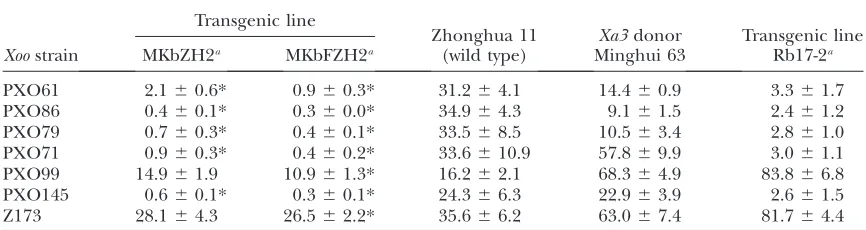
further examined for their resistance spectra. Trans-genic plants showed significantly enhanced (P,0.01) resistance to five (PXO61, PXO86, PXO79, PXO71, and PXO145) of the seven strains representing differentXoo
races compared with wild type and Minghui 63 at booting stage (Table 1). The transgenic plants were also
more resistant than transgenic line Rb17-2 carrying one copy ofPXa3:Xa3in the background ofjaponica
Mudan-jiang 8 (Table 1).
Two independent positive transformants (MKb024) in the background of japonica variety 02428 were ob-tained. The T0transgenic plants were highly resistant to
Xoostrain PXO61, with lesion areas of 3.160.3% and 3.26 0.2%, as compared to 47.5 6 9.4% and 23.9 6
2.2% measured for the controls of susceptible 02428 and moderately resistant Minghui 63 at booting stage, respectively (Figure 1A, supplemental Table 2 at http:// www.genetics.org/supplemental/). The resistance of the T1family cosegregated withXa3(supplemental Table 2),
indicating that the improved resistance was due toXa3. These results suggest that genetic background has a large influence on the function ofXa3 and that a japonica
background facilitatesXa3function more than anindica
background.
Host background-enhanced resistance is associated with increased expression ofXa3:To determine whether genetic background influenced the expression ofXa3, we quantified its transcripts in different rice lines by RT– qPCR. In addition to Minghui 63, theindicaline IRBB3 also carries theXa3gene (Sunet al. 2004; Xianget al.
2006). Transgenic lines Rb1, Rb49, and Rb17-2, carrying one copy of Xa3 driven by a native promoter in the genetic background ofjaponicaMudanjiang 8, showed enhanced resistance compared with the native rice lines carryingXa3(Sunet al. 2004). Compared with Minghui
63 and IRBB3, transgenic lines carrying one copy ofXa3
driven by a native promoter in the genetic backgrounds of Zhonghua 11 and Mudanjiang 8 showed 3- to 242-fold more Xa3 transcripts (Figure 2A). Transgenic plants carryingPXa3:Xa3in the 02428 background had 44-fold
more Xa3 transcripts. The data also showed that the expression level ofXa3 was remarkably higher in the Zhonghua 11 background than in Mudanjiang 8 and 02428 backgrounds (Figure 2A). These results suggest that increased Xa3transcripts may be associated with
the enhanced resistance in the transgenic plants with a
japonicabackground.
To evaluate the above hypothesis, we transferredXa3
driven by a strong constitutive promoter, maize ubiq-uitin gene promoter (PUbi), into Zhonghua 11,
Mudan-jiang 8, and Minghui 63. Eight of the 10 positive T0
plants, all 10 positive T0plants, and 11 of the 12 positive
T0plants transformed withPUbi:Xa3in backgrounds of
Zhonghua 11, Mudanjiang 8, and Minghui 63, respec-tively, were highly resistant to PXO61 at booting stage (Figure 1A, supplemental Table 2 at http://www.genetics. org/supplemental/). The lesion area of these highly resistant plants ranged from 0.260.1% to 1.560.5% in the Zhonghua 11 background as compared to 39.06
11.9% and 25.66 4.5% measured for the susceptible wild-type and moderately resistant Minghui 63 controls, respectively, and from 2.060.4% to 8.460.6% in the Minghui 63 background as compared to 53.2 6 2.8% measured for the moderately resistant wild type. Similar results were also obtained for the transgenic plants carryingPUbi:Xa3in the Mudanjiang 8 background
(sup-plemental Table 2). T1families derived from 2–3 of the
resistant T0plants from each genetic background were
further examined. It was shown that the resistance co-segregated with Xa3 in all the T1 families examined
(supplemental Table 2), indicating that the enhanced resistance was due to the transgeneXa3.
Resistant T1plants MKbFZH2 carryingPUbi:Xa3in the
Zhonghua 11 background were further examined for their resistance spectra. Transgenic plants showed signifi-cantly enhanced (P, 0.01) resistance to all sevenXoo
strains compared with wild type (Table 1). The MKbFZH2 plants also appeared to be more resistant toXoostrains PXO61, PXO79, PXO71, PXO99, PXO145, and Z173 than transgenic plants MKbZH2 carrying PXa3:Xa3, as
determined by a comparison of lesion areas at booting stage (Table 1). A bacterial growth analysis also indi-cated that plants carryingPUbi:Xa3were more resistant
to Xoo infection than plants carrying PXa3:Xa3 in the TABLE 1
Resistance spectrum (lesion area in percentage) of transgenic plants injaponicaZhonghua 11 background at booting stage
Transgenic line
Xoostrain MKbZH2a MKbFZH2a
Zhonghua 11 (wild type)
Xa3donor Minghui 63
Transgenic line Rb17-2a
PXO61 2.160.6* 0.960.3* 31.264.1 14.460.9 3.361.7
PXO86 0.460.1* 0.360.0* 34.964.3 9.161.5 2.461.2
PXO79 0.760.3* 0.460.1* 33.568.5 10.563.4 2.861.0
PXO71 0.960.3* 0.460.2* 33.6610.9 57.869.9 3.061.1
PXO99 14.961.9 10.961.3* 16.262.1 68.364.9 83.866.8
PXO145 0.660.1* 0.360.1* 24.366.3 22.963.9 2.661.5
Z173 28.164.3 26.562.2* 35.666.2 63.067.4 81.764.4
*Significant difference (P,0.01) was detected compared with wild type.
a
Zhonghua 11 background; the bacterial growth rate of PXO61 on MKbFZH plants was 1.5-fold lower than that on MKbZH plants at 14 days after inoculation (Figure 1B). Similar results were also obtained in transgenic plants in the Mudanjiang 8 background. Resistant T1
plants MKbFMDJ4, MKbFMDJ5, and MKbFMDJ7 carry-ing PUbi:Xa3 appeared to be more resistant to strains
PXO61, PXO79, PXO71, PXO145, PXO280, T7174, T7147, T7133, and Z173 than transgenic line Rb17-2 carrying PXa3:Xa3, as determined by a comparison of
lesion areas at booting stage (Table 2). The bacterial growth rate of PXO61 on MKbFMDJ plants was also 1.5-fold lower than that on Rb17-2 plants at 14 days after inoculation (Figure 1B). Overexpression of Xa3 en-hanced rice resistance not only in plants in thejaponica
background but also in those in theindicabackground. Transgenic plants MKbFMH2, MKbFMH3, MKbFMH4, MKbFMH6, and MKbFMH7 carrying PUbi:Xa3 in the
Minghui 63 background showed significantly enhanced (P , 0.01) resistance to six (PXO61, PXO79, PXO71, PXO145, T7133, and Z173) of the sevenXoostrains as compared to the donor ofXa3, Minghui 63, at booting stage (Table 2).
We also transferred Xa3 driven by a weak and pathogen-induced promoter, riceOsWRKY13gene pro-moter (PWRKY13) (Qiu et al. 2007), into Zhonghua 11
and Mudanjiang 8. All 16 and 4 positive T0plants in
Zhonghua 11 and Mudanjiang 8 backgrounds, respec-tively, carryingPWRKY13:Xa3showed enhanced resistance
as compared to wild type; this enhanced resistance co-segregated withXa3in T1families (Figure 1A,
supplemen-tal Table 2 at http://www.genetics.org/supplemensupplemen-tal/). However,Xa3-mediated resistance was significantly im-paired (P , 0.01) in plants carrying PWRKY13:Xa3 as
compared to plants carrying PXa3:Xa3in the same
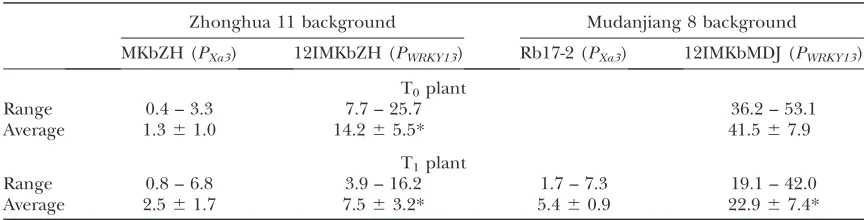
ge-netic background. The average lesion area of transgenic plants carrying PWRKY13:Xa3 was 3- to 11-fold larger
than that of the transgenic plants carryingPXa3:Xa3in
the same genetic background on infection (Table 3). The bacterial growth rate on plants carryingPWRKY13:Xa3
was 7.9- and 29.5-fold higher than that on plants car-ryingPXa3:Xa3in Zhonghua 11 and Mudanjiang 8
back-grounds, respectively (Figure 1B).
The Xa3expression level driven by PUbi was, on
av-erage, 2-, 11-, and 63-fold higher than that driven by the native promoter in the backgrounds of Zhonghua 11,
Mudanjiang 8, and Minghui 63, respectively. TheXa3
expression level driven byPWRKY13was only, on average,
2 and 18% of that driven by the native promoter in the backgrounds of Zhonghua 11 and Mudanjiang 8, re-spectively (Figure 2A). The negative correlation be-tween lesion area andXa3expression level in the plants shown in Figure 2A was0.523, significant ata¼0.05 (n ¼17). The variable resistance ability of plants car-ryingXa3driven by different promoters and different expression levels ofXa3 suggests that the function of
Xa3is associated with its expression level: The higher its expression, the more resistant the plant.
Developmentally controlledXa3activity is associated with its expression level: Minghui 63 and IRBB3 were susceptible toXoostrains PXO61 and PXO71 at seedling stage (Table 4). However, Minghui 63 became moder-ately resistant or modermoder-ately susceptible to PXO61,
al-though still susceptible to PXO71, and IRBB3 became resistant to PXO61 and PXO71 at adult (booting) stage (Tables 1 and 2) (Sunet al. 2004). Plants carryingPXa3:
Xa3in the background ofjaponica variety Mudanjiang 8 were highly resistant to theseXoo strains at seedling stage (Table 4) (Sunet al. 2004). Transgenic plants
car-ryingPXa3:Xa3in Zhonghua 11 and 02428 backgrounds
were also highly resistant toXoostrains at seedling (four-leaf ) stage as compared to Minghui 63 and IRBB3 (Table 4). The growth rates of PXO61 on resistant trans-genic plants carrying PXa3:Xa3 in Zhonghua 11,
Mu-danjiang 8, and 02428 backgrounds were 28-, 16-, and 13-fold lower than those on Minghui 63 at 12 days after bacterial infection at the four-leaf stage, respectively (supplemental Figure 2 at http://www.genetics.org/ supplemental/, Figure 1C). The bacterial growth rates on transgenic plants carryingPUbi:Xa3in Zhonghua 11, TABLE 2
Resistance spectrum (lesion area in percentage) of transgenic plants injaponicaMudanjiang 8 andindica
Minghui 63 backgrounds at booting stage
Mudanjiang 8 backgrounda Minghui 63 backgrounda
Xoostrain Rb17-2b MKbFMDJ4, -5, -7b Mudanjiang 8 (wild type) MKbFMH2, -3, -4, -6, -7b Minghui 63 (wild type)
PXO61 2.460.8** 1.560.7** 88.7610.2 8.065.7** 46.169.4
PXO79 1.560.3** 0.860.1** 89.6619.0 3.461.5** 38.768.2
PXO71 3.661.8** 0.7** 81.9613.7 7.964.9** 42.769.6
PXO99 48.0616.9 54.369.9 46.166.2 59.0624.8 62.4614.0
PXO145 4.360.9** 0.760.1** 39.868.8 9.362.8** 35.4610.8
PXO280 12.067.6** 1.260.1** 59.5616.8
T7174 18.566.8 5.960.6* 29.0614.7
T7147 24.9610.2 3.561.8** 21.466.3
T7133 2.261.0** 1.160.5** 85.7612.9 4.061.0** 44.4619.1
Z173 25.464.5 8.166.6 29.163.2 36.466.2** 52.566.8
*Significant difference (P,0.05) was detected compared with wild type. **Significant difference (P,0.01) was detected com-pared with wild type.
a
Plants with the two genetic backgrounds were inoculated withXoostrains at different times.
b
Rb17-2, homozygote transgenic line carrying one copy ofPXa3:Xa3; MKbFMDJ4, -5, -7, resistant T1plants carrying one copy of
PUbi:Xa3; MKbFMH2, -3, -4, -6, -7, resistant T0plants carryingPUbi:Xa3.
TABLE 3
Comparison ofPXa3:Xa3- andPWRKY13:Xa3-mediated resistance (lesion area in percentage) toXoostrain PXO61 at booting stage
Zhonghua 11 background Mudanjiang 8 background
MKbZH (PXa3) 12IMKbZH (PWRKY13) Rb17-2 (PXa3) 12IMKbMDJ (PWRKY13)
T0plant
Range 0.4 – 3.3 7.7 – 25.7 36.2 – 53.1
Average 1.361.0 14.265.5* 41.567.9
T1plant
Range 0.8 – 6.8 3.9 – 16.2 1.7 – 7.3 19.1 – 42.0
Average 2.561.7 7.563.2* 5.460.9 22.967.4*
Mudanjiang 8, and Minghui 63 backgrounds were 25-, 44-, and 101- to 207-fold lower than the growth rate on Minghui 63 at the four-leaf stage, respectively.
To examine whetherXa3is expressed differentially at different developmental stages, Minghui 63 and trans-genic line Rb49 carryingPXa3:Xa3in the background of
japonicavariety Mudanjiang 8 were grown with staggered planting so that RNA samples were obtained from plants at the two-leaf, four-leaf, maximum-tillering, booting, and grain-filling stages at the same time from different varieties. RT–qPCR analysis showed that theXa3 expres-sion level was very low at the two-leaf stage, gradually increased with development, and reached the highest level at the maximum-tillering or booting stage in both Minghui 63 and Rb49 (Figure 2B). However,Xa3 tran-script levels in Rb49 were21-, 11-, 12-, 17-, and 5-fold higher than those in Minghui 63 from the two-leaf to the grain-filling stages, respectively. The association between increasingXa3-mediated resistance andXa3expression level accompanying development suggests that the de-velopmentally controlled disease resistance in theindica
background plants isXa3-dosage dependent.
Increasing Xa3 expression results in enhanced expression of defense-responsive genes: The expres-sion of riceOsWRKY13, encoding a transcription factor, was rapidly induced in incompatible (resistant) host– pathogen interaction and lightly induced in compatible (susceptible) host–pathogen interaction; overexpres-sion ofOsWRKY13enhanced rice resistance toXoo(Wen
et al. 2003; Qiuet al. 2007).NH1 is the rice ortholog of
ArabidopsisNPR1; this gene was rapidly induced in in-compatible host–pathogen interaction as compared to compatible interaction and overexpression of NH1 en-hanced rice resistance toXoo(Chernet al. 2005; Yuanet al.
2007). These results suggest thatOsWRKY13andNH1are involved in R gene-mediated resistance against Xoo. To determine the role of OsWRKY13 and NH1 in genetic background-influenced andXa3-mediated resistance, we analyzed their expression in rice lines with different ex-pression levels of Xa3. RT–qPCR analysis showed that plants with moreXa3transcripts (Figure 2A) induced the expression ofOsWRKY13andNH1more rapidly and/or effectively upon bacterial infection (Figure 3). Japonica
transgenic lines Rb49 and MKbZH1 carrying one copy of
PXa3:Xa3had 5.6- and 15-fold moreOsWRKY13transcripts
and 2.1- and 1.6-fold moreNH1transcripts thanindicaline Minghui 63 carryingXa3as compared with the maximum transcript level within 1 day postinfection. The same two transgenic lines had 1.2- and 3.1-fold more OsWRKY13
transcripts and 3.9- and 2.9-fold more NH1 transcripts than indica line IRBB3 carrying Xa3. Transgenic line MKbFZH2 carrying the strong expression construct
PUbi:Xa3 had 2-fold moreOsWRKY13 transcripts than
MKbZH1 in the same genetic background, although the maximum transcript level of NH1 in MKbFZH2 was slightly lower than that in MKbZH1. However, the max-imum transcript levels ofOsWRKY13andNH1in trans-genic line 12IMKbZH2 carrying the weak expression construct PWRKY13:Xa3 were only 59 and 36%,
respec-tively, of those in MKbZH1. Consistent with the expres-sion pattern reported previously (Qiuet al. 2007; Yuan
et al. 2007), both resistant and susceptible responses in the same genetic background inducedOsWRKY13and
NH1, but the former reaction resulted in moreOsWRKY13
and NH1transcripts than the latter as compared with the maximum transcript level within 1 day postinfection (Figure 3).
Pathogen infection differentially influences Xa3 expression in plants with different genetic back-grounds: Xa3 expression was suppressed (2.5- to 3-fold) at 4 hr postinoculation and then induced (2- to 4-fold) as compared to noninfected plants inindicarice lines Minghui 63 and IRBB3 (Figure 4). This suppression was not observed in transgenic lines carryingPXa3:Xa3in
japonica backgrounds. In contrast, pathogen infection induced (5.5- to 7-fold)Xa3expression in transgenic lines Rb49 and Rb17-2 in the genetic background of
japonicavariety Mudanjiang 8 (Figure 4). The expression level ofXa3in transgenic lines MKbZH1 and MKbZH2 in the background ofjaponicaZhonghua 11 showed no remarkable differences before and after pathogen in-fection. Pathogen infection showed10-fold induction of Xa3 in the transgenic plants 12IMKbZH2 carrying one copy of PWRKY13:Xa3 with a Zhonghua 11
back-ground at 12 hr after infection, although the induced transcript level was still 1.5-fold lower than that in
TABLE 4
Reaction (lesion area in percentage) of transgenic plants carryingPXa3:Xa3in differentjaponicabackgrounds at seedling (four-leaf) stage
Indicavariety (Xa3) Zhonghua 11 background 02428 background Mudanjiang 8 background
Xoostrain Minghui 63 IRBB3 Transgenica
Zhonghua 11
(wild type) Transgenicb
02428
(wild type) Transgenicc
Mudanjiang 8 (wild type)
PXO61 70.764.4 75.463.8 5.261.3 59.266.3 9.361.1 100.060.0 6.061.5 100.060.0
PXO71 76.168.7 75.366.7 6.662.3 51.067.4 10.362.0 100.060.0 5.462.6 100.060.0
aResistant T
1plants MKbZH2.
bResistant T
1plants MKb024-1.
noninoculated MKbZH2 plants carryingPXa3:Xa3
(Fig-ure 4). These results suggest that genetic background also influencesXa3expression in response to bacterial invasion.
DISCUSSION
The present results confirm our previous finding that a japonica background facilitates the function of Xa3
more than anindicabackground (Sunet al. 2004). These
results are also consistent with the identification and application ofXa3in rice production. This gene was first identified injaponicavariety Wase Aikoku 3 (Ezukaet al.
1975) and is an important resistance gene injaponica
cultivar breeding in China (Xuet al. 2004), one of the
largest rice-growing countries in the world.
The resistance spectrum conferred by an R gene is related to pathogen recognition specificity. Although the amino acid sequence, especially the LRR sequence, of LRR-containing R proteins is the major determinant of pathogen recognition (Dangland Jones2001), our
results indicate that the expression level of anRgene can also influence the resistance spectrum conferred by this gene. IncreasingXa3 expression can enlarge the
resistance spectrum mediated byXa3. Studies of other genes also support that some R gene-mediated re-sistance has a dosage effect. Overexpression of tomato
RgenePto, encoding a serine/threonine protein kinase, activates defense responses and confers broad resistance (Tanget al. 1999). Overexpression of tomato Prf and
Arabidopsis RPS2, encoding nucleotide-binding site (NBS)–LRR-type proteins, leads to constitutive activation of the defense response and broad-spectrum resistance, respectively (Oldroydand Staskawicz1998; Taoet al.
2000). Overexpression of the tomato LRR membrane protein typeRgene inNicotiana benthamianaalso induces a constitutive defense response (Wulffet al. 2004).
How-ever, not allRgenes can mediate an enlarged resistance spectrum by overexpression. Overexpression of the Arabi-dopsisSSI4gene, encoding Toll interleukin 1 receptor– NBS–LRR protein, failed to enhance disease resistance, while its mutant allele, ssi4, encoding a protein with a single-amino-acid substitution in the NBS domain, showed enhanced resistance to bacterial and oomycete pathogens (Shiranoet al. 2002).
The putative mechanisms that enhanced resistance associated with increased expression ofXa3include the following: First, increasing XA3 proteins may facilitate
their interaction with different pathogen effectors or guardees, the pathogenicity targets of the host (Dangl
and Jones2001). The interaction specificity between an
R protein and pathogen effector or the host guardee should determine the pathogen recognition efficiency of a host. Highly specific host–pathogen interaction may require only small amounts of R proteins, which may explain why R genes usually show a low level of ex-pression (DeIlarduyaand Kaloshian2001; Shenet al.
2002; Paalet al. 2004; Schornacket al. 2004; Sunet al.
2004; Huanget al. 2005). Otherwise, large amounts of
R proteins are needed for nonperfect interaction. It has been reported that overexpression of a pathogen effector avrBs3 causes a loss of recognition specificity of tomato R protein Bs4 (Schornack et al. 2004). The
enlarged resistance spectrum mediated by Xa3in the
japonicabackground and in overexpression status may be due to the loss of perception specificity of the XA3
protein to some bacterial effectors. However, plants car-rying PUbi:Xa3 could not confer full resistance to Xoo
strains PXO99 and Z173, indicating that overexpression of Xa3caused only a partial, but not complete, loss of recognition specificity among different Xooraces. Sec-ond, increasing XA3 proteins may facilitate more rapid or effective initiation of defense signaling transduction during host–pathogen interaction, which resulted in reduced lesion area and bacterial growth rate. Both
OsWRKY13 andNH1are involved inR gene-mediated
Xoo resistance and they are dosage dependent in bac-terial resistance; OsWRKY13 and NH1 are transcript reg-ulators that directly or indirectly control the expression of a subset of defense-responsive genes (Wenet al. 2003;
Chern et al. 2005; Qiu et al. 2007; Yuanet al. 2007).
Rice lines with moreXa3transcripts inducedOsWRKY13
andNH1more rapidly and/or effectively as compared with the rice lines with less Xa3transcripts or without
carryingXa3. These results suggest that rapid activation of OsWRKY13- and NH1-involved defense signal trans-duction might partly explain the enhanced resistance associated with increased expression ofXa3.
Developmentally controlled resistance has been ob-served in many plant–pathogen systems. Full disease re-sistance usually occurs at adult stages in these systems. RiceXa21is expressed at both susceptible and resistant stages, indicating thatXa21-mediated developmentally controlled disease resistance may not be related to its expression (Centuryet al. 1999).Xa3andXa21encoding
the same type of proteins share 53% sequence similarity (Sun et al. 2004). However, the present results indicate
that the developmentally controlledXa3-mediated resis-tance to someXoostrains is associated with its expression level. This dosage-dependent developmental control may also be related to bacterial recognition specificity. Minghui 63 was highly resistant toXoostrain JL691 at both seedling and adult stages (Chenet al. 2002),
sug-gesting that XA3 can efficiently and specifically perceive the effector of JL691 and that more XA3 proteins are required for recognition of PXO61. R genes often express constitutively in either uninfected or infected plants (DeIlarduyaand Kaloshian2001; Shenet al.
2002; Paal et al. 2004; Huanget al. 2005; Schornack
et al. 2005), which agrees with their common role in pathogen recognition. This indicates that in most cases, the basal level of R proteins preexisting in cells is suf-ficient to guard pathogen invasion and initiate host re-sistance. However, in a few cases, pathogen induction increasesRgene expression (Thurauet al. 2003; Levy
et al. 2004; Gu et al. 2005). These results suggest that
more R proteins are required on infection to help amplify the resistance response.Xa3belongs to the lat-ter group ofR genes. Low levels of pathogen-induced
Xa3expression were constantly observed inindicarice lines andjaponicatransgenic lines in the Mudanjiang 8 background. This result is consistent with the observa-tion that increasingXa3 expression can enhance rice resistance. This induction was not detected injaponica
transgenic lines in the Zhonghua 11 background, which may be due to very high levels ofXa3transcripts in these plants masking the light induction. However, a suppres-sion ofXa3expression was also observed only inindica
rice lines at early infection (4 hr). Further study is needed to determine whether this is one of the causes of the impaired disease resistance inindica lines as compared tojaponicatransgenic plants.
Xa3preferentially expresses in the cells surrounding the vascular vessels (Y. Caoand S. Wang, unpublished
data), which perfectly fits the function of genes confer-ring resistance toXoo, a vascular pathogen. Functional overlap between pathogen-induced defense signaling and plant development has been reported (Holtet al.
2002; Godiardet al. 2003; Chuet al. 2006), which may
partly explain the fitness cost in disease resistance. Con-stitutive expression of anR gene sometimes results in
plants with abnormal morphology or decreased fertility. Overexpression of the tomato Ptogene caused consti-tutive cell death (Tanget al. 1999). Arabidopsis
over-expressingRPW8was lethal (Xiaoet al. 2003). Even the
native expression ofRPM1influenced Arabidopsis de-velopment (Tian et al. 2003). Interestingly, Xa3
-over-expressing plants showed no remarkable morphologic and developmental differences from wild type, which may contribute to, at least partly, the restricted expres-sional location ofXa3. Thus overexpression ofXa3can be applied to breeding programs to produce whole-growth-stage and wide-resistant-spectrum rice.
This work was supported by grants from the National Program of High Technology Development of China and the National Natural Science Foundation of China.
LITERATURE CITED
Banerjee, D., X. Zhangand A. F. Bent, 2001 The leucine-rich re-peat domain can determine effective interaction betweenRPS2
and other host factors inArabidopsis RPS2-mediated disease resis-tance. Genetics158:439–450.
Belkhadir, Y., R. Subramaniamand J. L. Dangl, 2004 Plant disease resistance protein signaling: NBS-LRR proteins and their part-ners. Curr. Opin. Plant. Biol.7:391–399.
Century, K. S., R. A. Lagman, M. Adkisson, J. Morlan, R. Tobias
et al., 1999 Developmental control ofXa21-mediated disease re-sistance in rice. Plant J.20:231–236.
Chen, H., S. Wangand Q. Zhang, 2002 A new gene for bacterial blight resistance in rice located on chromosome 12 identified from Minghui 63, an elite restorer line. Phytopathology 92:
750–754.
Chern, M. S., H. A. Fitzgerald, P. E. Canlas, D. A. Navarreand P. C. Ronald, 2005 Overexpression of a rice NPR1 homolog leads to constitutive activation of defense response and hypersen-sitivity to light. Mol. Plant-Microbe Interact.18:511–520. Chu, Z., M. Yuan, J. Yao, X. Ge, B. Yuanet al., 2006 Promoter
muta-tions of an essential gene for pollen development result in dis-ease resistance in rice. Genes Dev.20:1250–1255.
Dangl, J. L., and J. D. Jones, 2001 Plant pathogens and integrated defence responses to infection. Nature411:826–833.
DeIlarduya, O. M., and I. Kaloshian, 2001 Mi-1.2transcripts accu-mulate ubiquitously in resistantLycopersicon esculentum. J. Nematol.
33:116–120.
Ellis, J. G., G. J. Lawrence, J. E. Luckand P. N. Dodds, 1999 The identification of regions in alleles of the flax rust resistance gene
Lthat determine differences in gene-for-gene specificity. Plant Cell11:495–506.
Ezuka, A., O. Horino, K. Toriyama, H. Shinodaand T. Morinaka, 1975 Inheritance of resistance of rice variety Wase Aikoku 3 to
Xanthomonas oryzae. Bull. Tokai-Kinki Natl. Agric. Exp. Stn.28:
124–130.
Godiard, L., L. Sauviac, K. U. Torii, O. Grenon, B. Manginet al., 2003 ERECTA, an LRR receptor-like kinase protein controlling development pleiotropically affects resistance to bacterial wilt. Plant J.36:353–365.
Goel, R. K., and A. K. Gupta, 1990 Host age in relation to resistance in rice to bacterial blight caused byXanthomonas campestris pv.
oryzae. Trop. Agric.67:368–370.
Gu, K., B. Yang, D. Tian, L. Wu, D. Wanget al., 2005 R gene expres-sion induced by a type-III effector triggers disease resistance in rice. Nature435:1122–1125.
Holt, B. F., D. C. Boyes, M. Ellerstrom, N. Siefers, A. Wiiget al., 2002 An evolutionarily conserved mediator of plant disease re-sistance gene function is required for normalArabidopsis develop-ment. Dev. Cell2:807–817.
Huang, S., E. A.van derVossen, H. Kuang, V. G. Vleeshouwers, N. Zhanget al., 2005 Comparative genomics enabled the iso-lation of theR3alate blight resistance gene in potato. Plant J.
Levy, M., O. Edelbaumand H. Sela, 2004 Tobacco mosaic virus regulates the expression of its own resistance gene N. Plant Physiol.135:2392–2397.
Lin, Y., and Q. Zhang, 2005 Optimising the tissue culture condi-tions for high efficiency transformation of indica rice. Plant Cell Rep.23:540–547.
Luck, J. E., G. J. Lawrence, P. N. Dodds, K. W. Shepherdand J. G. Ellis, 2000 Regions outside of the Leucine-rich repeats of flax rust resistance proteins play a role in specificity determination. Plant Cell12:1367–1377.
Martin, G. B., A. J. Bogdanoveand G. Sessa, 2003 Understanding the functions of plant disease resistance proteins. Annu. Rev. Plant Biol.54:23–61.
Mew, T. W., 1987 Current status and future prospects of research on bacterial blight of rice. Annu. Rev. Phytopathol.25:359–382. Ogawa, T., 1993 Methods, and strategy for monitoring race
distri-bution and identification of resistance to bacterial leaf blight (Xanthomonas campestrispv.oryzae) in rice. Jpn. Agric. Res. Q.27:
71–80.
Ogawa, T., T. Yamamoto, G. S. Khushand T. W. Mew, 1991 Breed-ing of near-isogenic lines of rice with sBreed-ingle genes for resistance to bacterial blight pathogen (Xanthomonas campestrispv.oryzae). Jpn. J. Breed.41:523–529.
Oldroyd, G. E., and B. J. Staskawicz, 1998 Genetically engineered broad-spectrum disease resistance in tomato. Proc. Natl. Acad. Sci. USA95:10300–10305.
Paal, J., H. Henselewski, J. Muth, K. Meksem, C. M. Menendezet al., 2004 Molecular cloning of the potatoGro1–4gene conferring resistance to pathotype Rol of the root cyst nematodeGlobodera rostochiensis. Plant J.38:285–297.
Panter, S. N., K. E. Hammond-Kosack, K. Harrison, J. D. Jonesand D. A. Jones, 2002 Developmental control of promoter activity is not responsible for mature onset of Cf-9B-mediated resistance to leaf mold in tomato. Mol. Plant-Microbe Interact.15:1099– 1107.
Qiu, D., J. Xiao, X. Ding, M. Xiong, M. Caiet al., 2007 OsWRKY13 mediates rice disease resistance by regulating defense-related genes in salicylate- and jasmonate-dependent signaling. Mol. Plant-Microbe Interact.20:492–499.
Schornack, S., A. Ballvora, D. Gurlebeck, J. Peart, D. Baulcombe
et al., 2004 The tomato resistance protein Bs4 is a predicted non-nuclear TIR-NB-LRR protein that mediates defense re-sponses to severely truncated derivatives of AvrBs4 and over-expressed AvrBs3. Plant J.37:46–60.
Schornack, S., K. Peter, U. Bonasand T. Lahaye, 2005 Expression levels ofavrBs3-like genes affect recognition specificity in tomato
Bs4- but not in pepper Bs3-mediated perception. Mol. Plant-Microbe Interact.18:1215–1225.
Shen, K. A., D. B. Chin, R. Arroyo-Garcia, O. E. Ochoa, D. O. Lavelle
et al., 2002 Dm3is one member of a large constitutively expressed family of nucleotide binding site-leucine-rich repeat encoding genes. Mol. Plant-Microbe Interact.15:251–261.
Shirano, Y., P. Kachroo, J. Shahand D. F. Klessig, 2002 A gain-of-function mutation in anArabidopsisToll interleukin 1 receptor-nucleotide binding site-leucine-rich repeat typeRgene triggers defense responses and results in enhanced disease resistance. Plant Cell14:3149–3162.
Sun, X., Y. Cao, Z. Yang, C. Xu, X. Lieet al., 2004 Xa26, a gene con-ferring resistance toXanthomonas oryzaepv.oryzaein rice, encodes an LRR receptor kinase-like protein. Plant J.37:517–527. Tang, X., M. Xie, Y. J. Kim, J. Zhou, D. F. Klessig et al.,
1999 Overexpression of Pto activates defense responses and confers broad resistance. Plant Cell11:15–29.
Tao, Y., F. Yuan, R. T. Leister, F. M. Ausubeland F. Katagiri, 2000 Mutational analysis of theArabidopsisnucleotide binding site-leucine-rich repeat resistance geneRPS2. Plant Cell12:2541– 2554.
Thurau, T., S. Kifle, C. Jungand D. Cai, 2003 The promoter of the nematode resistance gene Hs1pro-1activates a nematode-respon-sive and feeding site-specific gene expression in sugar beet (Beta vulgarisL.) andArabidopsis thaliana. Plant Mol. Biol.25:643–660. Tian, D., M. B. Traw, J. Q. Chen, M. Kreitmanand J. Bergelson, 2003 Fitness costs ofR-gene-mediated resistance inArabidopsis thaliana. Nature423:74–77.
Van derHoorn, R. A., R. Rothand P. J.deWit, 2001 Identification of distinct specificity determinants in resistance protein Cf-4 allows construction of a Cf-9 mutant that confers recognition of avirulence protein Avr4. Plant Cell13:273–285.
Wen, N., Z. Chuand S. Wang, 2003 Three types of defense-respon-sive genes are involved in resistance to bacterial blight and fungal blast diseases in rice. Mol. Genet. Genomics269:331–339. Wulff, B. B., M. Kruijt, P. L. Collins, C. M. Thomas, A. A. Ludwig
et al., 2004 Gene shuffling-generated and natural variant of the tomato resistance geneCf-9exhibit different auto-necrosis-inducing activities inNicotiana species. Plant J.40:942–956.
Xiang, Y., Y. Cao, C. Xu, X. Liand S. Wang, 2006 Xa3, conferring resistance for rice bacterial blight and encoding a receptor kinase-like protein, is the same asXa26. Theor. Appl. Genet.
113:1347–1355.
Xiao, S., S. Brown, E. Patrick, C. Brearley and J. G. Turner, 2003 Enhanced transcription of the Arabidopsisdisease resis-tance genesRPW8.1andRPW8.2via a salicylic acid-dependent amplification circuit is required for hypersensitive cell death. Plant Cell15:33–45.
Xu, Z., Q. Sun, F. Liu, Z. Chen, B. Huet al., 2004 Race Monitoring of rice bacterial blight (Xanthomonas oryzaepv.oryzae) in China. Chin. J. Rice Sci.18:469–472.
Yuan, Y., S. Zhong, Q. Li, Z. Zhu, Y. Louet al., 2007 Functional anal-ysis of rice NPR1-like genes reveals that OsNPR1/NH1 is the rice orthologue conferring disease resistance with enhanced herbi-vore susceptibility. Plant Biotech. J.5:313–324.
Zhang, Q., and T. W. Mew, 1985 Adult-plant resistance of rice cul-tivars to bacterial blight. Plant Dis.69:896–898.