Abstract
CHOPRA, AMITKHUSHWANT. Nonmonotonic Commitment Machines. (Under the
direc-tion of Dr. Munindar P. Singh).
NONMONOTONIC COMMITMENT MACHINES
BY
AMITKHUSHWANT CHOPRA
A THESIS SUBMITTED TO THE GRADUATE FACULTY OF
NORTH CAROLINA STATE UNIVERSITY
IN PARTIAL FULFILLMENT OF THE
REQUIREMENTS FOR THE DEGREE OF
MASTER OF SCIENCE
DEPARTMENT OF COMPUTER SCIENCE
RALEIGH
NOVEMBER 2003
APPROVED BY:
R. MICHAEL YOUNG RADA CHIRKOVA
MUNINDAR P. SINGH
Biography
Acknowledgement
I am indebted to my advisor, Dr. Munindar Singh for his constant guidance, attention and patience. I thank Dr. Jon Doyle and Dr. Rada Chirkova for their numerous helpful sugges-tions that helped improve this document. I am grateful to Pınar, who has since graduated, for mentoring me. I thank my roommates, Gopi and JD, for bearing with my eccentricities and not minding my minding theirs. Ashok, Ruben, Vishwas, Rakesh and Gotu have been such good company throughout that I seldom felt homesick. I thank Hemant, Veena, Sonu and Manjusha who are all in India, for many a delightful long distance conversations.
I thank my family for supporting me in this endeavor. And the person who selflessly let me go.
Table of Contents
List of Figures vii
1 Introduction 1
1.1 Motivation . . . 2
1.2 Approach . . . 4
1.3 Outline . . . 5
2 Nonmonotonic Causal Logic 6 2.1 Introduction . . . 7
2.2 Semantics . . . 8
2.3 Action Descriptions in C+ . . . 10
2.4 Translating C+ to NCL . . . 11
3 Commitments 14 3.1 Definition . . . 14
3.2 Operations . . . 15
4 Nonmonotonic Commitment Machine Representation of Protocols 16 4.1 Commitments in Causal Logic . . . 16
4.2 NetBill Specification in Causal Logic . . . 18
4.3 Executing NetBill in CCalc . . . 20
5 Formal Definition of Nonmonotonic Commitment Machines 23 6 Compiling Nonmonotonic Commitment Machines 26 6.1 Compilation Procedure . . . 27
7 Discussion 30
7.1 Conventional Protocols and Protocol Modeling . . . 31
7.2 Commitments . . . 32
7.3 Protocols . . . 33
7.4 Agent Communication Languages . . . 34
8 Future Directions 36 8.1 Protocol Specification . . . 36
8.2 Protocol Distribution . . . 37
8.3 Creating Role Skeletons from BPEL Flows . . . 37
8.4 Verifying Strategies . . . 38
List of Figures
1.1 FSM representation of the simplified NetBill protocol . . . 3
4.1 Example Query . . . 21
4.2 Answer to Example Query . . . 22
Chapter 1
Introduction
1.1 Motivation
Protocols for interaction in multiagent systems often resemble protocols routinely used by humans in their social interactions. The Contract Net [Smith, 1980] and NetBill [Cox et al., 1995] are examples of such protocols. Such protocols have traditionally been represented by FSMs that represent sequences of states and transitions. Since FSMs are a low level representation, it becomes cumbersome to capture multiple scenarios in an FSM. Thus FSMs designed by hand tend to be rigid and do not allow scenarios other than the specified “normal” ones. A protocol transitions from state to state as a result of the actions of the interacting agents. A transition is usually labeled with the actions that cause it. In an FSM, the states and the actions in the protocol are meaningless tokens. The agent is limited to executing one of the sequences of actions hard-coded by its designer. These sequences represent the only legal behaviors of the agent. Anything the agent does outside of this protocol is considered a violation. This makes the protocol inflexible and, therefore, unde-sirable in open multiagent systems where agents are autonomous and heterogeneous, and opportunities and exceptions need to be handled appropriately.
Acting flexibly presupposes reasoning about the protocols. Reasoning formally presup-poses that the protocols have a formal semantics. We base our semantics on the notion of commitments. Protocols can naturally be seen as an exchange and manipulation of com-mitments. A commitment is a directed obligation from one agent to another for achieving or maintaining a state of affairs. A commitment is social because it involves two parties and is publicly observable by all the agents in the agent society. Since a commitment is public, it is also possible to verify whether an agent has fulfilled its commitment, thereby making it possible to check an agent’s compliance with a protocol.
2
3
4
5
6 C: Send Accept
C: Send Payment
M: Send Offe r
M: Send Goods C: Send Request
M:Send Receipt
1
7
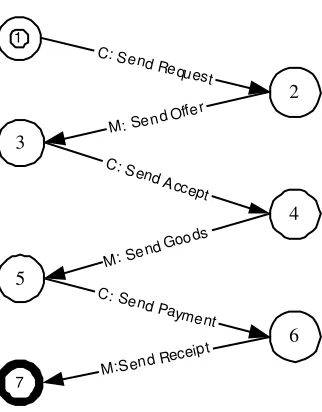
Figure 1.1: FSM representation of the simplified NetBill protocol
throughout the thesis. Figure 1.1 shows an FSM representation of a NetBill simplified to focus on the core part. The customer, represented byc, sends a request for offers to the merchant, represented bym. The merchant sends an offer in response. If the customer ac-cepts the offer, the merchant sends the goods. The customer then sends the payment for the goods in return for which the merchant sends a receipt. The only execution scenario pos-sible in the protocol starts with the customer sending a request and ends with the merchant sending a receipt. The FSM in Figure 1.1 does not accommodate scenarios that would arise naturally in open and dynamic multiagent systems and is, therefore, unnecessarily rigid. Protocols for multiagent interaction should be flexible in the following ways:
request for offers.
Opportunities:A protocol should enable an agent to take advantage of oppor-tunities that may arise. For example, if a merchant advertises an attractive deal to a customer, the customer should be able to entertain this offer.
Exceptions:A protocol should enable an agent to deal with exceptions instead of aborting the interaction altogether. For example, a customer who doesn’t have enough money might delegate a commitment to pay the merchant to some other agent. This is not allowed in the NetBill protocol as specified above.
1.2 Approach
The above forms of flexibility can be achieved only if we are able to reason about the content of the states and actions in a protocol. Often, the essential element of content in many protocols is the commitments of the different parties in a protocol. Specifically, we claim that if the protocol representation uses commitments and the criterion for protocol compliance is the satisfaction of commitments, then the above scenarios would be valid behaviors in the protocol.
commitment machines. They did not consider situations during the execution of a protocol when agents must act with incomplete information. In such situations, the agent would need nonmonotonic or defeasible reasoning. Since NCL supports nonmonotonic reason-ing, NCMs can express defaults in a protocol in a natural manner. Protocols represented as NCMs are more elaboration tolerant McCarthy [1999] than those represented using classi-cal logic or FSMs. We develop a causal theory of commitments and represent the NetBill protocol as an NCM using that theory. We also formally define NCMs in terms of NCL and show how an NCM can be compiled into an FSM. This is helpful for applications where efficient execution is important.
1.3 Outline
Chapter 2
Nonmonotonic Causal Logic
In logic, the consequence relation
is a relation between sets of propositions and individual propositions.
, whereAis a set of propositions andxis a proposition, means thatx
is a logical consequence ofA. Classical logic is monotonic meaning that if , where
andBis a set of propositions, then
. Informally, monotonicity means that the addition of new information does not invalidate old information. Therefore, making rules defeasible in the face of change poses difficulties. Consider Example 1.
Example 1 A customer may not return goods received and should pay for them. However, if the goods are damaged, then the customer may return the goods and then cancel his commitment to pay.
the essence of nonmonotonic reasoning. Such defeasible reasoning is beyond the realm of classical logic.
2.1 Introduction
To overcome the aforementioned difficulties in specifying protocols, we use NCL. We choose NCL because it has an intuitive syntax and semantics. The languageC+[Giunchiglia et al., 2003], which is based on NCL, has a semantics based on state transition systems which agrees with our intuition about protocols. Further, it has been shown to be elabora-tion tolerant [Lifschitz, 2000]. NCL is a logic of universal causationmeaning that every fact that is caused holds and every fact that holds is caused. Universal causation is not so much a philosophical stance as a practical one, as universal causation yields a uniform semantics for causal theories. Taking this stance makes NCL suitable for simulation and planning since everything can be explained. Also, in our domain, a commitment holds or does not hold only because there is a reason for it to hold or not hold. Moreover, as we show below, universal causation can be disabled for selected formulas.
Thesignatureof a causal theory is the set of symbols calledconstants. Each constant cis assigned a nonempty finite domainDom(c)of symbols. Anatomis of the formc = v
wherev Dom(c). Aninterpretationof is an assignmentc = vfor eachc wherev
Dom(c). Since we consider only boolean atoms, eitherc = trueorc = false. Aformula
in NCL is a combination of atoms using the connectives of classical logic. A causal rule is of the formF G, whereFandGare formulas of classical logic and are called the head
that, when closed, lights two bulbsAandB. Even thoughAbeing lit is not the cause forB
being lit, it is correct to say that there is a cause forBto be lit whenAis lit. A theory in NCL consists of a set of causal rules.
Constants in causal theories are either fluents or actions. A causal theory describes histories of lengthm+1, (m 0), by creating for alli, (i 0, , m ), a copy of every
fluent and, for alli, (i 0,, ), a copy of every action. The interpretation of fluents
for a particularirepresents state and the interpretation of actions in state represent the
transition to state "!$#.
2.2 Semantics
Models for formulas in NCL are defined in the same way as classical logic. An interpreta-tion is a model of a setXof formulas iff it satisfies all the formulas inX. If every model of
Xsatisfies a formulaF, thenXentailsF, or symbolicallyX %& F. We can now define models
of a causal theory. LetIbe an interpretation of the signature of a theoryT. The reduct')(
is the set of all heads whose bodies are satisfied by the interpretationI. IfIis also a unique model of ' ( , then I is a model of T. If Iis not a unique model of the reduct, then some
constant is missing from the reduct, and therefore there is no explanation for that constant. But NCL is a logic of universal causation, therefore, no constant should be unexplained.
As an example, consider the following theory'*# consisting of rulesR1andR2.
R1. p q
R2. q q
cause for+ pto be true. Therefore,phas to be true. Therefore,pmust be caused. The only
waypcan be caused is if qis true. And, qis caused by R2. Therefore, the only possible interpretation for this theory isI= p=true,q=true .
Intuitively,' ( represents facts that are caused, according to theoryTunder
interpreta-tionI. If a causal theoryT has a modelI, we say that it is consistent or satisfiable. If all models ofTsatisfy a formulaF, that meansTentailsForT %& F.
Coming back to our example theory ',# with rules R1 and R2, we consider all the
possible interpretations to see which, if any, is a model of'*# :
1.
-#
= p=true,q=true : ' (/.
# =
p, q . -0# is a unique model of' (/.
# . Therefore, -1# is
a model of'2# .
2. -43 = p=false, q= true : ' (65
# =
p, q .
-3
is not a model of' (65
# . Therefore,
-3
is not a model of'2# .
3. -47 = p=true,q=false : ' (98
# =
: . ' (98
# has no models. Therefore,
-7
is not a model of'2# .
4. -:; = p=false,q=false : ' (9<
# =
: . ' (6<
# has no models. Therefore,
-;
is not a model of'2# .
Note that
-#
= p= true, q= true is the only model of this theory that matches the
result of our informal reasoning.
To see how NCL is nonmonotonic, consider a theory'
3
consisting of the rule =>&?@
=A&B . This rule is like a default rule. The only model of'
3
isI(c) = 1. Now consider a theory'
7
such that it had two rules,=C&?@ =C&D and=C&FEGIHKJ0LNM . Note that'
3
O'
7
. However, the only model of'
7
2.3 Action Descriptions in C+
Recall that C+ is a high level action description language based on NCL. It is easier to specify theories in C+ than directly in NCL because of it’s concise notation. Before we describe the syntax and semantics of NCL and C+ formally, we describe informally the meanings of some ofC+rules that we use later. A formula inC+is a propositional com-bination of constants which could either be actionconstants or fluent constants. Actions in NCL are interpreted to be unit-length. This thesis is restricted to boolean constants. An action constant being true represents the execution of the action. The meanings of the rules we use follow.
a causes b, whereaandbare actions.
This means that actionacauses actionband both happen concurrently.
a causes f, whereais an action andfis a fluent.
This means that actionacausesfto hold in the next state.
A P F causes b, whereAis a conjunction of actions, bis an action andFis a
conjunction of fluents.
This means that in a state whereFis true and actions inAhappen, then action
bhappens concurrently.
a causes a, together with the rule+ a causes+ a, whereais an action.
These two rules mean that there is a cause for a and there is a cause for + a
respectively. In other words theais exogenous, it simply happens or does not happen. Without these rules, the action is not exogenous. Universal causation is disabled for these rules.
a may cause f, whereais an action andfis a fluent.
this rule expresses nondeterminism.
caused a after f, whereais an action andfis a fluent.
This means that f causes a in the same state. Notice that this rule uses the
causedform and not thecausesform because no suitable formulation in terms ofcausesexists. This rule expresses the causation of an action and differs from the rulea causes fabove which expresses the causation of a fluent.
Fluents are declared asinertialFluentsmeaning that their assignment persists from one state to the next unless changed by some other rule.
2.4 Translating C+ to NCL
Let’s describeC+formally and show the translation from rules inC+to rules in NCL.C+
includes three kinds of rules, namely, static rules, fluent dynamic rules and action dynamic rules. A fluent can be either a statically determined fluent or a simple (dynamic) fluent. Static fluents can appear in the heads of only static rules. Afluent formulaconsists only of fluents. An action formulaconsists only of actions. A static rule is an expression of the form
R3. caused F if G
whereFandGare fluent formulas. Static rules express indirect effects of actions that are instantaneous with respect to the causal fluent formula. A dynamic rule is an expression of the form
R4. caused F if G after H
It is called an action dynamic rule ifF andG are both action formulas. It is called a
causation of an action and fluent dynamic rules the causation of a fluent.
An action description Q consisting of such rules is turned into a causal theory QSR
wheremis the length of the history. The signature ofQTR then consists of
1. iUcfor every fluentc V for everyi V 0, , m
2. iUcfor every actionc V for everyi W 0, , m-1
The domain of iUc is the same as Dom(c) and iUF means i is inserted in front of every
occurrence of every constant inF. The rules of QTR are then:
R5. iUF iUG, for every static rule R3 inDand everyiV 0, , m ;
R6. iUF iUGP iUH, for every action dynamic rule R4 inDand everyi V 0, , m-1 ;
R7. i+1UF i+1UG P iUH, for every fluent dynamic rule R4 inDand everyi X 0, , m-1 ;
R8. 0Uc = v 0Uc = v, for every simple fluent constant c Y and everyv Dom(c).
(Notice that every simple fluent has all possible values in the initial state and there-fore, they are exogenous in the initial state. Thus, universal causation is disabled for them.)
All examples that follow are in the abbreviatedC+ notation. We list the relevantC+
abbreviations below, extracted from [Giunchiglia et al., 2003].
A1. A dynamic rule of the formcaused F if true after Habbreviates toH causes F.
A3. The action dynamic rules caused a if aand caused + a if + a wherea is an action,
together abbreviate toexogenous a. InC+such an action is called an exogenousAc-tion.
A4. The fluent dynamic rulescaused p if p after pandcaused+ p if+ p after + pwherep
is a fluent together abbreviate toinertial p
Chapter 3
Commitments
Commitments among agents have been recognized as a fundamental notion in cooperative problem solving [Bratman, 1992; Shoham, 1993; Grosz and Kraus, 1996]. Castelfranchi [1993] and Krogh [1995] present, respectively, a social and logical perspective on commit-ments. In our work, we do not reason about the commitments from the point of view of cooperation among agents. We use commitments to specify protocols. As agents interact with each other using some protocol, they create and manipulate commitments. The breach of a commitment represents a violation of a protocol.
3.1 Definition
The agent that is bound to fulfill the commitment is called the debtor of the commitment. The agent that is the beneficiary of the commitment is called the creditor.
Definition 1 A base-level commitmentC(x,y,G,p)binds a debtorxto a creditoryfor ful-filling the conditionpin contextG.
Both commitments and conditional commitments are created in a contextG, which can be thought of as an institution or society whose rules are binding on the agents that join it. The context also defines the meanings of the terms used in the context. Henceforth, we omitGto reduce clutter.
3.2 Operations
Singh[1999] lists operations for the creation and manipulation of commitments. These operations cannot be arbitrarily carried out. They are subject to metacommitments that are rules that govern the commitment operations and are part of the contextG. The operations are listed below.
Create(x,y,p)creates a new commitmentC(x,y,p).
Discharge(x,y,p) discharges the existing commitment C(x,y,p) so that it no longer holds.
Cancel(x,y,p) cancels the existing commitment C(x,y,p) so that it no longer holds.
Delegate(x,y,p,z)delegates the commitmentC(x,y,p)to a new debtor z. More specifically, the original commitmentC(x,y,p)no longer holds and a new com-mitmentC(z,y,p)is created in its place.
Assign(x,y,p,z) assigns the commitment C(x,y,p) to a new creditor z. More specifically, the original commitmentC(x,y,p)no longer holds and a new com-mitmentC(x,z,p)is created in its place.
Chapter 4
Nonmonotonic Commitment Machine
Representation of Protocols
In our approach, we represent protocols as NCMs. An NCM is a causal theory inC+that consists of two parts. The first part is a protocol-independent causal theory of commitments in which we capture the representation of commitments and the operations on them. The second part is protocol specific and includes constants and rules describing the given pro-tocol’s domain. The distinction between the two parts is only to separate out the domain independent part, logically they form a complete causal theory as we shall see later. We first present the theory of commitments and then model the NetBill protocol in causal logic. Together they represent the NetBill NCM.
4.1 Commitments in Causal Logic
We represent commitments and operations on them in the causal logic. Commitments in causal logic are declared to be constants of the type inertial fluents.
wherex and yare variables of the sortagentand pand qare variables of the sort condi-tion. By declaring commitments to beinertialFluents, we include rules of the kind A4 for each commitment. Conditional commitments are declared asCC(x,y,p,q) whereqis also a variable of sortcondition. Conditional commitments are also declared asinertialFluents. For each of the operations on commitments listed in Chapter 3, there is a declaration of the form
Z
Operation[ :: action
Constants of typeactionare not exogenous, that is, rules of the form A3 are not included in the theory. Their execution, therefore, has to becausedby other actions or fluents. We add two more operations for handling conditional commitments.
CDischarge(x,y,p,q), CCreate(x,y,p,q) :: action
The following rules capture the meaning of the operations:
R9. Create(x,y,p) causes C(x,y,p)
R10. Discharge(x,y,p) causes + C(x,y,p)
R11. Cancel(x,y,p) causes+ C(x,y,p)
R12. Delegate(x,y,p,z) causes+ C(x,y,p) & C(z,y,p)
R13. Release(x,y,p) causes+ C(x,y,p)
R14. Assign(x,y,p,z) causes+ C(x,y,p) & C(x,z,p)
R15. CCreate(x,y,p,q) causes CC(x,y,p,q)
All the variables are grounded such that x &\ y andp &\ q. We omit the rules specifying
the grounding of the variables. Since we want the operations to becausedby other things, then in those states where an operation is not caused, there must be a reason for it to be not caused. In other words, we want the operations to be partially exogenous. So for each of the commitment operations, we include rules of the form
R17. +
Z
Operation[ causes+
Z
Operation[
An example is the rule + Create(x,y,p) causes + Create(x,y,p). The specification also
includes rules to capture the restriction that no two commitment operations are concurrent.
4.2 NetBill Specification in Causal Logic
We now represent the NetBill protocol in causal logic. The following rules together with the theory of commitments given above represent the specification of NetBill NCM. We declare
m, cto be of the sortagent
goodsc, payc, acceptc, receiptcto be of the sortcondition request, offer, accept, goods, pay, receiptto beinertialFluents
SendRequest, SendOffer, SendAccept, SendGoods, SendPayment, SendReceipt
to beexogenousActions.
The meanings of the above constants are as their name indicates. Conditions are an artifact of conditional commitments. We assume that all fluents and actions have unique identifiers. We have the following rules.
R18. SendRequest causes request
R20. SendOffer causes CCreate(m, c, acceptc, goodsc)
R21. SendAccept causes accept
R22. SendAccept & CC(m,c,acceptc,goodsc) causes CDischarge(m,c,acceptc,goodsc)
R23. SendAccept causes CCreate(c,m,goodsc,payc)
R24. SendGoods causes goods
R25. SendGoods causes CCreate(m, c, payc, receiptc)
R26. SendGoods & CC(c,m,goodsc,payc) causes CDischarge(c,m,goodsc,payc)
R27. SendGoods & C(m,c,goodsc) causes Discharge(m,c,goodsc)
R28. SendPayment causes pay
R29. SendPayment & CC(m,c,payc,receiptc) causes CDischarge(m,c,payc,receiptc)
R30. SendPayment & C(c,m,payc) causes CDischarge(c,m,payc)
R31. SendReceipt causes receipt
R32. SendReceipt & C(m,c,receiptc) causes Discharge(m,c,receiptc)
In our representation no two commitment operations are concurrent. Also, no two protocol actions are concurrent. However, when a protocol action causes a commitment operation, they are concurrent. By rule R6, the interpretation of ActionA causes ActionB
We now add rules for our motivating example, Example 1, to this protocol specifica-tion. We introduceSendReturnandSendGoodsas exogenous actions. We introduce a new actionAband a new fluentdamagedGoodsto indicate that the goods are damaged. We also include the nondeterministic rule R34 to say that as a result of theSendGoodsaction, the goods may be damaged. Rule R33 captures the condition that the cancel operation is not allowed for any commitment. Rule R35 however says that a commitment can be canceled under abnormal conditions. Rules R36 and R37 ensure thatAbis false, except when dam-agedGoodsis true. We add the Rules R35 R37 to accommodate Example 1. Rules R33
and R34 are already in the theory. Abis an action because it has no meaning in the states. It acts as a qualifier for the exogenous actionSendReturn.
R33. + Cancel(x,y,p) causes+ Cancel(x,y,p)
R34. SendGoods may cause damagedGoods
R35. SendReturnP C(c,m,pay) P Ab causes Cancel(c,m,pay)
R36. caused Ab if damagedGoods
R37. + Ab causes+ Ab
The theory also contains rules that place constraints on the actions so that the execution of actions makes sense. For example, we specify that theSendRequestaction cannot happen after the payment has been made.
4.3 Executing NetBill in CCalc
causal theory intoCCalc and pose queries one by one. CCalcthen finds paths to satisfy each query.
:- query label::0; maxstep:: 3; 0: -offer,
-accept, -returned, -goods, -C(x,y,p), -CC(x,y,p,q), -pay,
-request, -receipt,
-damagedGoods; maxstep: returned.
Figure 4.1: Example Query
Figure 4.1 shows an example query. This query asks for an execution sequence of three of fewer steps, beginning from a state in which all fluents are false, in which the goods have been returned. Running this query inCCalcproduces the output as shown in Figure 4.2 (formatted for readability).
The action SendAccept is caused which in turn causes the CCreate which creates the conditional commitment that if the goods are sent then the customer will pay. The re-sult of these actions is reflected in state 1. SendGoodsis then caused which reflects the fact that the merchant has sent the goods. SendGoodscauses the discharge of the condi-tional commitment created by the customer resulting in the customer’s commitment to pay.
Solution:
State 0:
ACTIONS: CCreate(c,m,goodsc,payc)
SendAccept
State 1: CC(c,m,goodsc,payc) accept
ACTIONS: CCreate(m,c,payc,receiptc)
CDischarge(c,m,goodsc,payc) SendGoods
State 2: C(c,m,payc) CC(m,c,payc,receiptc)
accept goods damagedGoods
ACTIONS: Cancel(c,m,payc) Ab Return
State 3: CC(m,c,payc,receiptc) accept
goods returned damagedGoods
Figure 4.2: Answer to Example Query
merchant will send the receipt. This example is interesting asSendGoodsalso causes dam-agedGoods, resulting in state 2. damagedGoods causesAbin state 2. So the SendReturn
Chapter 5
Formal Definition of Nonmonotonic
Commitment Machines
We formalize NCMs in terms of the state machine semantics of C+ [Giunchiglia et al., 2003]. Consider an action descriptionDinC+. Let]2^`_ and]badcfe represent the set of fluents
and actions inDrespectively. An action descriptionDrepresents a sequence of causal theo-riesQhgijQS#`i. A causal theory with a history of lengthmis denoted byQkgijQS#`i,QhRmln# ,
where 0. In Chapter 2.3, we saw how causal rules inC+ are translated into causal
logic to represent histories.QR contains all those causal rules that have state indices
(repre-sented byi) less than or equal tom. An interpretation of the signature ofQkR is represented
by
(0Ujg )o (0UjMg )o (1U`1# )o (1UjM1# )ojo (mU`R )
whereg , , R are interpretations of]p^j_ andMg , , MRmln# are interpretations of]qadc9e.
Definition 3 Astateis an interpretationsof]p^`_ such that 0Usis a model ofQTg .
Definition 4 Atransitionis a triple Z
rijMri`st[ , wheresand s are interpretations of ]
^`_ and
States are the vertices and transitions correspond to the edges of the transition system. Giunchiglia et al. [2003] show that for any transition Z
rijMrij s[ , s and s are states. We
denote the set of states inDbyv?w . With this background, we can now define an NCM in
terms of the transition semantics of action descriptions.
Definition 5 An NCM based on an action descriptionDis a 4-tuple Z
vxijyzij{|i~}k[ where v is the set of states and is defined asv = m % mis an interpretation of] ^j_ y is the set of actions and is defined asy =] adcfe
{ is the set of final states ({Yv ) } =
Z
u/ijni~[G%
Z
u/i~Mri~[ is a transition inDwherei~Cv , u>\
andeis an interpretation of] adcfe such that it assigns true only to the actions a
We have\
to eliminate redundant transitions.
Lemma 1 v vDw .
Proof. If there exists somemsuch thatm Vv , but m \Vvw , thenDis not a correct
action description of the protocol. It needs to be corrected. To show that vw can have more states than v , let ]2
R
^j_ denote the set of simple fluents. By rule R8, we observe that simple fluents are exogenous in the initial state. There-fore, all possible interpretations of ]2
R
^`_ are all models of Qg . By Definition 3, they are
also states of D. However, not all interpretations of ] R
^j_ may be meanings of an NCM.
Letv? denotevDwWv .
Lemma 2 There exists no statem Wv? such that
Z
rijni~[mV} for anysand anya. Proof. Consider anym W . Assume that
Z
rijni~[V} . Then by Definition 5,m zv
The states inv? are not inv and they cannot be reached by any transition. Intuitively,
they are there only because of the models ofQkg allowed by simple fluents. Recall that all
possible interpretations of ]p R
^j_ are all models of Qg and are therefore states. They can
Chapter 6
Compiling Nonmonotonic Commitment
Machines
2 3 4 5 6 8 9
m: Send Goods
7
c: Send Accept
c: Send Payment m: Send Offer
m: Send Goods
c: Send Request
m:Send Receipt
m: Send Goods
c: Send Payment
m: Send Goods c: Send Accept
m: Send Offer
1
c: Send Accept
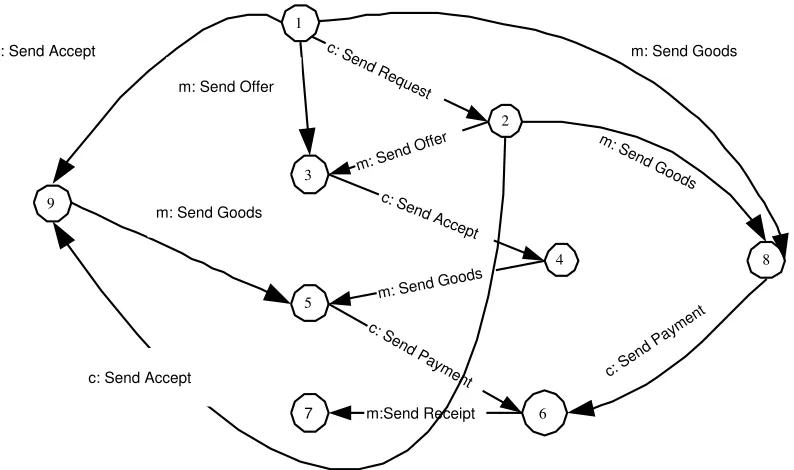
Figure 6.1: FSM representation of the extended NetBill protocol
6.1 Compilation Procedure
We now present the procedure for compiling an NCM into its corresponding FSM that has no representation of commitments.
Definition 6 An FSM is defined as a 5-tuple ZK
iki`giij[ where
is a finite set of states, is the input alphabet,g@
is the start state,
is the set of final states, and
A
W
is the transition relation.
Definition 7 LetX &
Z
vi~yzij{|ij}T[ be an NCM. Construct an FSM Y & ZK
iSi`giij1[
where
&Fv , = y , g =nothing, x&Y{ , =
Z
/ijni~[%
Z
uijni~[Cz}
We defined nothing as the initial state g of an FSM. This is simply the state where no
actions have happened. In the NetBill NCM, this state would be the one specified as the initial state in the query in Figure 4.1.
6.2 Correctness of Compilation
Correctness of a compilation procedure depends on the computations that can be realized as a result of it. Two important aspects of the correctness of a procedure aresoundnessand
completeness. Soundness means that only originally allowed computations are realized. Completeness means that all allowed computations are realized. Lemma 3 below shows that the FSM resulting from Definition 7 is sound. Lemma 4 shows that the FSM is com-plete under some restrictions. We start by defining the notion of the computation formally. We introduce sets of indices1i . LetW be an ordinal. is the set ( irii`u¡ ).
is the set ( iii` ).
Definition 8 ¢ =
Z
gij:gi~#ij #`ii~
^
ln#`i
^
[ is a computation if (£$¤mV-¥i¦kX§U::2¨
and©V ).
Definition 9 ¢ =
Z
gi~4gi~#ij #`ii~
^
[ is a computation generated by an NCM X =
Z
vxijyzij{|i~}k[ iff
^
V{ , and (£$¤ªzCU1ui~u"!$#«Vv ) and (¬rU
Z
u®ijr/i~ut!$#[>z} ).
Definition 10 ¢ =
Z
gij:gi#ij #`ii~
^
[ is a computation realized by an FSM Y = ZK
iki`giij1[ iffg¯&Fg ,
^
, and (£$¤ª1i
Z
Lemma 3 LetX= Z
vxijyzij{|ij}T[ be compiled intoY= ZK
iki`giij1[ according to
Procedure 7. Then any computation realized byYcan be generated byX.
Proof. Let¢ =
Z
gij:gi#ij #`ii~
^
[ be a computation realized byY. By Procedure 7,
&Yv , (£$¤ª-Ni2Vv ) and
^
V{ . Consider the¤ e"° transition in¢ ,
Z
u®ijr/i~u"!$#[¯V . From the Definition of in Procedure 7,
Z
/ijni~[¯V} . By
Definition 9,Xgenerates¢ .
Since an NCM can start from any state and an FSM has a single start state, it is not possible for a compiled FSM to realize all the allowed computations. We instead define a weaker notion of completeness.
Lemma 4 LetX= Z
vxijyzij{|ij}T[ be compiled intoY= ZK
iki`giij1[ according to
Definition 7. Then every computation generated byXthat begins withnothingcan be realized byY.
Proof. Let 6e
i~ 9e
zv represent the start statenothing. Let¢ =
Z
gij:gi#`ij #ii~
^
[ be any computation realized byXsuch that 6e
&Yg . Let
Z
u®ijr/ijr"!$#[¯V} be the¤±e"° transition in¢ . By Definition 7,
Z
/ijni~[¯V . By
Chapter 7
Discussion
Our focus in this work is to develop meaningful representations of agent communication protocols. We do so by using commitments to declaratively represent states and actions. This gives our representation a verifiable semantics [Singh, 2000]. By using commitments to model protocols, we constrain protocols no more than is necessary. We have highlighted the need for a nonmonotonic logic for commonsense reasoning in protocols. We used NCL towards this end and showed how a protocol can be represented in NCL. Like the NCL, there are a few other noteworthy formalisms for reasoning about action and change. Dynamic Logic [Harel et al., 2000] is a modal logic augmented with an algebra of regu-lar events. However, it is monotonic and therefore not suitable for our purposes. Event Calculus [Kowalski and Sergot, 1986] and situation calculus [McCarthy, 1963] have been extended with circumscription to enable nonmonotonic reasoning.
violated. Alternate paths through the protocol may be selected based on criteria like safety or number of messages exchanged. For example, an agent can adopt an approach where it does not commit unless another agent also commits for some desirable condition. Also it is not convenient to express defaults in FSMs. In fact, the defaults wouldn’t be obvious at all in an FSM. FSMs are also not as elaboration tolerant as NCMs.
7.1 Conventional Protocols and Protocol Modeling
7.2 Commitments
Commitments have been studied in the context of distributed problem solving and coor-dination. Bratman [1992] argues that for shared cooperative activity, among other things, commitment to joint activity and commitment to mutual support are required. Grosz and Kraus [1996] investigate the formulation of shared plans for coordinating group action. In their framework, an agent can adopt two types on intentions, intend-to and intend-that, that commit the agent to an action and state of affairs respectively. Jennings [1993] presents commitments as a fundamental notion for efficient coordination in distributed systems. Jen-nings also mentions conventions which monitor the commitments and state when a commit-ment may be reassessed. Jennings further reformulates different models of coordination in terms of commitments. A distinguishing feature of all of the above work is that they present commitments as a mentalistic notion, assuming a system of cooperative agents. Shoham’s agent oriented computing paradigm [1993] introduces obligation as a modality required to describe the mental state of an agent. Sandholm and Lesser [1998] study automated negoti-ation among self-interested agents whose computnegoti-ations are resource bounded. They argue that protocols that have leveled commitments, that is, when commitments vary from break-able to unbreakbreak-able in a continuum by assigning a function to evaluate the cost of breach of each commitment, are more suitable for contracts than full commitment protocols. Krogh [1995] examines the possibility of using of deontic logic for analyzing multiagent systems. Castelfranchi [1993] presents an ontology of commitments with the aim of understanding organizational activity. He defines social commitment as a relation between two or more agents and discusses its various aspects. Singh [2000] defends a commitment-based social semantics for agent communication.
pointed out earlier in this chapter, an agent can reason about its future actions depending upon the commitments it already has or ones that the agent might have to make in the future. Also, we do not specify that commitments necessarily have to be represented in an agent’s state, since a commitment based representation can be compiled into an FSM. We are also not concerned directly with the economic impact of the breach of a commitment. Though we specify protocols in a logical language using commitments, we do not present a deontic logic. Social commitments, that is, directed obligation from one agent to another, represent the cornerstone of our research. Our scope is limited to the flexible specification of protocols and their verification.
7.3 Protocols
7.4 Agent Communication Languages
An agent communication language (ACL) allows agents of heterogeneous designs to inter-act. Developing a semantics for agent communication languages (ACLs) that is expressive and verifiable has been a long standing goal of the agent community. To be verifiable, an ACL should have social semantics [Singh, 1998]. Earlier efforts at standardization of ACLs like Arcol [Sadek, 1997] and KQML [Finin et al., 1994] promoted mental agency, that is, they were based on mental concepts like beliefs and intentions, and were therefore, not verifiable. The ongoing efforts at standardizing ACLs are based on communicative acts. The problem with giving a communicative acts based semantics is that it is not clear what the meanings of the communicative acts should be. Also it is not clear how many com-municative acts are needed. Another challenge is relating the comcom-municative acts to the conversation in which they occur. By giving semantics to protocols directly we are able to give a simple, operational characterization of protocols without getting bogged down with the above issues.
Dignum and van Linder [2002], and Guerin and Pitt [2001] define ACLs in term of communicative acts. Dignum and van Linder’s framework considers four components, the information component, the action component, the motivational component and the
social component as constituting an agent framework and formally describes and relates them. The framework is developed in dynamic logic which is monotonic. They postulate a
COMMIT communicative act, but other communicative acts have mentalistic preconditions
which makes the framework suitable only for a system of cooperative agents.
Chapter 8
Future Directions
Our main aim in this work is to come up with protocols that have verifiable semantics and constrain the agent no more than to the extent necessary to carry out legal interactions. To carry our work further, we have identified the following areas for future work.
8.1 Protocol Specification
8.2 Protocol Distribution
In the NCM representation of NetBill, we did not specify roles in the protocol. However, an agent will be executing the role that it adopts in the protocol. We want to formulate procedures based on symbol manipulation to distribute a centralized protocol among the various roles in the protocol. The result will be roles skeletons that are also NCMs. It is not clear what the specification of a role itself should be. Is a role just a label, or does it specify the required capability of an agent to adopt a role along with normative rules and authorizations that come along with the role? Another technical challenge is proving that a distributed protocol is sound and complete with respect to the centralized protocol.
8.3 Creating Role Skeletons from BPEL Flows
BPEL [BPEL], the Business Process Execution Language is a draft standard for specifying and coordinating business processes. Intuitively, it is a process flow graph with nodes as tasks and edges as messages. Business flows, as they are currently specified, are like FSMs in the sense that they have been designed with certain scenarios in mind. As such, they are quite rigid. To make business processes more flexible, we envisage the following design-time methodology.
1. The designers start with an interaction diagram or state machine or some other graph-ical representation for the protocol that is to be modeled as a BPEL flow.
2. The designers build NCM representation of the protocol with enhancements to make it more flexible and then partition the NCM into the role skeletons.
4. Compile FSMs into a BPEL flow. This should be easier than compiling an NCM into a BPEL flow.
We plan to build a tool which incorporates this methodology. The tool would suggest enhancements to the designer for a given protocol, build an NCM based on the choices of the designer and compile it into an FSM and then, perhaps with annotations from the user, compile it into a BPEL flow.
8.4 Verifying Strategies
It will often be the case that an agent is confronted with the problem of selecting between multiple paths that it can take to reach a goal. The agent selects a path based on some strategy. For example, if the customer does not trust a merchant, the customer might adopt a strategy where it never pays before receiving the goods. On the other hand, if it does, it could adopt a strategy where it accepts to buy goods for a certain price without even asking the merchant for offers or pays before getting the goods. It is possible to imagine more complex strategies. An interesting problem is the specification of strategies with respect to commitments and determining which protocols (more specifically, paths in the protocol) satisfy a given strategy. An agent can then inspect a role to check whether it satisfies its strategy.
Bibliography
Michael E. Bratman. Shared cooperative activity.The Philosophical Review, 101:327–341, 1992.
Cristiano Castelfranchi. Commitments: From individual intentions to groups and organi-zations. In Proceedings of the AAAI-93 Workshop on AI and Theories of Groups and Organizations: Conceptual and Empirical Research, 1993.
Benjamin Cox, J.D. Tygar, and Marvin Sirbu. Netbill security and transaction protocol. InProceedings of the First USENIX Workshop on Electronic Commerce, pages 77–88, 1995.
Frank Dignum and Bernd van Linder. Modelling social agents: Towards deliberate commu-nication. InHandbook of Defeasible Reasoning and Uncertainty Management Systems, pages 357–380. Kluwer, 2002.
Tim Finin, Richard Fritzson, Don McKay, and Robin McEntire. KQML as an agent com-munication language. In Proceedings of the International Conference on Information and Knowledge Management, pages 456–463. ACM Press, 1994.
Enrico Giunchiglia, Joohyung Lee, Vladimir Lifschitz, Norman McCain, and Hudson Turner. Nonmonotonic causal theories. Artificial Intelligence, 2003. To appear.
Barbara J. Grosz and Sarit Kraus. Collaborative plans for complex group action. Artificial Intelligence, 86(2):269–357, October 1996.
Frank Guerin and Jeremy Pitt. Denotational semantics for agent communication languages. InProceedings of the Fifth International Conference on Autonomous Agents, pages 497– 504. ACM Press, 2001.
David Harel. Statecharts: A visual formalism for complex systems. Science of Computer Programming, 8:231–274, 1987.
David Harel, Dexter Kozen, and Jerzy Tiuryn. Dynamic Logic. MIT Press, Cambridge, MA, 2000.
Gerard J. Holzmann.Design and Validation of Computer Protocols. Prentice-Hall, London, 1991.
Michael N. Huhns and Munindar P. Singh, editors.Readings in Agents. Morgan Kaufmann, San Francisco, 1998.
N. R. Jennings. Commitments and conventions: The foundation of coordination in multi-agent systems. Knowledge Engineering Review, 2(3):223–250, 1993.
Jean-Luc Koning and Marc-Philippe Huget. A semi-formal specification language dedi-cated to interaction protocols. In H. Kangassalo, H. Jaakkola, and E. Kawaguchi, editors,
Information Modeling and Knowledge Bases XII, Frontiers in Artificial Intelligence and
Robert Kowalski and Marik Sergot. Logic-based calculus of events. New Generation Computing, 4(1):67–95, 1986.
Christen Krogh. Obligations in multiagent systems. In Agnar ˚Amodt and Jan Komorowski, editors, Scandinavian Artificial Intelligence Conference 1995 (SCAI’95), pages 19–30, Trondheim, May 1995.
Vladimir Lifschitz. Missionaries and cannibals in the causal calculator. InProceedings of the 7th International Conference on Principles of Knowledge Representation and Rea-soning, pages 85–96, 2000.
John McCarthy. Situations, actions and causal laws. TR, Stanford University, 1963.
John McCarthy. Elaboration tolerance. In progress, 1999. http://www-formal.stanford.edu/jmc/elaboration.html.
David Sadek. Compliance in Arcol, April 1997. Personal communication.
Tuomas Sandholm and Victor Lesser. Issues in automated negotiation and electronic com-merce: Extending the contract net framework. InHuhns and Singh [1998], pages 66–73. 1998. (Reprinted fromProceedings of the International Conference on Multiagent Sys-tems, 1995).
Yoav Shoham. Agent-oriented programming. Artificial Intelligence, 60(1):51–92, 1993.
Munindar P. Singh. Agent communication languages: Rethinking the principles. IEEE Computer, 31(12):40–47, December 1998.
Munindar P. Singh. A social semantics for agent communication languages. In Proceed-ings of the 1999 IJCAI Workshop on Agent Communication Languages. Springer-Verlag, 2000.
R. G. Smith. The contract net protocol: High-level communication and control in a dis-tributed problem solver. IEEE Transactions on Computers, 29(12):1104–1113, 1980.
BPEL. Business process execution language for web services, version 1.1. W3C, May 2003. URL: http://www-106.ibm.com/developerworks/webservices/library/ws-bpel/.
Pınar Yolum and Munindar P. Singh. Commitment machines. In Proceedings of the 8th International Workshop on Agent Theories, Architectures, and Languages (ATAL-01), pages 235–247. Springer-Verlag, 2002a.