Plastic Waste Prevention System Analysis &
Application
Chandrakant S.Bhashakhetre1, Abhijit N. Chalkhure2, Shradhesh R. Marve3, Nilesh T. Wadhai4
Associate Professor, Department of Civil Engineering, SSCET, Bhadrawati, MH, India 1
Assistant Professor, Department of Civil Engineering, SSCET, Bhadrawati, MH, India2,3,4
ABSTRACT: In the post globalization era, India is witnessing significant growth in every sector which is evident by
rapid growth in infrastructure developments. The country is building a huge network of expressways, national highways and rural roads and improvement programs involving large investments. But here disposal of non-biodegradable waste materials including waste plastic has become a serious problem. Prevention on it waste plastics of Polyethylene, Polystyrene and Polypropylene are collecting from dump yard or directly from houses. They cleaned and cut into a size such that it passes through 4.75mm IS sieve for maintaining informality of plastic waste partials. Temperature varying between 120˚C - 160˚C gives the softening point of these plastics. They do not produce any toxic gases during heating
and these softened plastics have tendency to form a coating over hot aggregates. The plastic waste is effectively coated over the aggregate. Aim of this technique is not only know the effective utilization of plastic waste in the road construction but also to solve the disposal problem of plastic waste to improve the environment and reduce the cost of
construction of road.
KEYWORDS: Plastic waste, aggregate, plastic waste coated aggregate, bitumen, plastic waste mix bitumen, plastic
waste road, etc.
I
. INTRODUCTIONRoads are the key to the development of an economy. A good road network constitutes the basic infrastructure that accelerates the development process through connectivity and opening up of the backward regions to trade and investment. Roads also play a key role in inter-modal transport development establishing links with airports, railway stations and ports. In addition, they have an important role in promoting national integration, which is particularly important in a large country like India. In the post globalization era, India is witnessing significant growth in every sector which is evident by rapid growth in infrastructure developments. The country is building a huge network of expressways, national highways and rural roads and improvement programs involving large investments and in generally all this types of roads are come in categories of flexible pavement.
Disposal of non-biodegradable waste materials including waste plastic bags has become a serious problem and burnt for apparent disposal which cause environmental pollution. Plastic waste contains waste plastics of Polyethylene, Polystyrene and Polypropylene collecting from dump yard or directly from house and cleaned this plastic waste cut into a size such that it passes through 4.75mm IS sieve to maintaining informality of plastic waste partials. Generally temperature varying between 120˚C - 160˚C gives the softening point of these plastics. They do not produce any toxic
gases during heating but the softened plastics have tendency to form a lamination or coating over the aggregate, when it is sprayed over the hot aggregate at 160˚C.Thus, this project study objective is to know the comparative properties of
purpose. So that by use of this innovative process will not only strengthen the road construction but also increase the road life as well as will help to improve the environment.
II. LITERATURE REVIEW
1 Studies on Polyethylene
a) IPC, Institute for Interconnecting and Packaging Electronic Circuits (1995) published a test manual for determining the tensile strength, elongation and Young’s modulus of organic free films by using ASTM D 618, ASTM D 882, ASTM D 1005 and ASTM D 2370.
b) Sichina et al. Characterized Polymers Using TGA (thermo gravity analysis). According to him TGA measures the amount and rate of change in the mass of a sample as a function of temperature or time in a controlled atmosphere to determine the thermal and/or oxidative stabilities of materials as well as their compositional properties. It is especially useful for the study of polymeric materials, including thermoplastics, thermo-sets, elastomers, composites, films, fibers, coatings and paints.
2 Studies on Use of waste polyethylene in paving mixes
[1]Bindu and Beena (2010) studied how Waste plastic acts as a stabilizing additive in Stone Mastic Asphalt when the mixtures were subjected to performance tests including Marshall Stability, tensile strength, compressive strength tests and Tri-axial tests. There results indicated that flexible pavement with high performance and durability can be obtained with 10% shredded plastic.
[2]Gawande et al. (2012) gave an overview on waste plastic utilization in asphalting road by using both wet and dry method. They said that use of modified bitumen with the addition of processed waste plastic of about 5-10% by weight of bitumen helps in improving the longevity and pavement performance with marginal saving in bitumen usage and according to them use of waste plastics in the manufacture of roads and laminated roofing also help to consume large quantity of waste plastics. Thus, these processes are socially highly relevant, giving better infrastructure.
[3]Katara S. D. (2014),Intemational Journal of Engineering and Technical Research (IJETR) Vol 2, Issue 4, studied both dry and wet mix and concluded that the dry process is more economical and beneficial for construction of flexible pavements. Because in case of higher percentage of polythene in wet process they get separate out from bitumen on cooling, so it needs some additives.
[4]Khan and Gundaliya (2012) stated that the process of modification of bitumen with waste polythene enhances resistance to cracking, pothole formation and rutting by increasing softening point, hardness and reducing stripping due to water, thereby improving the general performance of roads over a long period of time. According to them the waste polythene utilized in the mix forms coating over aggregates of the mixture which reduces porosity, absorption of moisture and improves binding property.
[5]Moghaddam and Karim (2012) reported that the utilization of waste material in asphalt pavement would be beneficial in order to find an alternative solution to increase service life of asphalt pavement and reduce environmental pollution as well. Form their study it is concluded that Polyethylene Terephthalate (PET) reinforced mixtures possess higher stability value, flow, fatigue life in comparison with the mixtures without PET.
[6]Sangita et al. (2011) suggested a novel approach to improve road quality by utilizing plastic waste in road construction. According to them India spends Rs 35,000 crores a year on road construction and repairs, including Rs 100,000 crores a year just on maintenance and roads by bitumen modification lasts 2-3 times longer, which will save us Rs 33,000 crores a year in repairs, plus reduced vehicle wear and tear.
[8]Verma(2008),The Indian Concrete Journal studied that plastic increases the me/ting point of the bitumen and makes the road flexible during winters resulting in its long life. According to author while a normal "highway quality" road lasts four to five years, plastic-bitumen roads can last up to 10 years and it would be a boon for India's hot and extremely humid climate, where temperatures frequently cross 50 and torrential rains create havoc, leaving most of the roads with big potholes.
3. RECENT APPLICATIONS
[1]A 25 km plastic modified bituminous concrete road was laid in Bangalore. This plastic road showed superior smoothness, uniform behavior and less rutting as compared to a plastics-free road which was laid at same time, which began developing “crocodile cracks” very soon after. The process has also been approved, in 2003 by the CRRI (Central Road Research Institute Delhi).
[2]Justo et al (2002), at the Centre for Transportation Engineering, of Bangalore University used processed plastic bags as an additive in asphalt concrete mixes. The properties of this modified bitumen were compared to that of ordinary bitumen. It was noted that penetration and ductility values, of modified bitumen was decreasing with the increase in proportion of the plastic additive, up to 12 % by weight.
[3]Mohammad T. Awwad et al (2007), polyethylene as one sort of polymers is used to investigate the potential prospects to enhance asphalt mixture properties. The objectives also include determining the best type of polyethylene to be used and its proportion. Two types of polyethylene were added to coat the aggregate High Density Polyethylene (HDPE) and Low Density Polyethylene (LDPE). The results indicated that grinded HDPE polyethylene modifier provides better engineering properties. The recommended proportion of the modifier is 12% by the weight of bitumen content. It is found to increase the stability, reduce the density and slightly increase the air voids and the voids of mineral aggregate.
[4]Shankar et al (2009), crumb rubber modified bitumen (CRMB 55) was blended at specified temperatures. Marshall’s mix design was carried out by changing the modified bitumen content at constant optimum rubber content and subsequent tests have been performed to determine the different mix design characteristics and for conventional bitumen (60/70) also. This has resulted in much improved characteristics when compared with straight run bitumen and that too at reduced optimum modified binder content (5.67%).
4. STUDY PARAMETERS
A. Need of Study:
The necessities which come across during detail study of this project; i. To develop a technique to reuse a waste plastic as a resource. ii. To increase the road communication facility efficiently. iii. To increase the useful life of bituminous overlay.
B. Study Objectives:
Basic intension is to efficiently utilize the waste plastic in constructive way so that it can be beneficial to society and a comparative study has been made in polyethylene mix and natural material.
However the objectives of this project investigation are to observe the followings;
i. To utilize the plastic waste in flexible pavement so as to avoid accumulation of waste plastic in environment.
ii. To know the effective utilization of plastic waste in flexible pavement. iii. To reduce the percentage of bitumen used in bituminous concrete.
III.PROPOSED METHODOLOGY AND DISCUSSION
A. Primary Works
i. Collection of Waste Plastic from Dumping yards & Houses:
As a very important ingredient to be used in our project is waste plastic. Waste plastic is most commonly generated from household. The best way we decided to collect waste from houses. we collected different types of plastic which are out of use in the houses. But the work was not so easy, from 25th, Dec 2016 to 25th Jan 2017 around, it takes four weeks to collect required quantity of plastic wastes from dumping yards & houses. The waste plastics mainly consist of Plastic waste only except PVC waste.
ii. Collection of Bitumen Samples
Collection of bitumen sample from Hot Mix Plant, Nandori, Under the guidance of skilled Assistant Engineer, Sub Division PWD, Bhadrawati, visited Hot Mix Plant, Quality Control Department and Testing Lab, Nandori. In the QT & LT department of the HMP check the quality of materials used in the Civil Engineering work by performing various test over the materials. Also collected bitumen sample from the plant with their standard test value. The Managing Director of Company Mr. Abhijit Maniyar giving us a valuable information about their plant and what parameter the used to maintain the quality of material.
iii.Initial stage is to identify the Grade & Standard Specification of Bitumen:
It was very important to know the grade of bitumen collected from different sources. So that perform penetration test over the collected bitumen sample is performed, by performing penetration test we get conformation about the grade of bitumen.
The sample collected from Hot Mix Plant, Nandori, is found to be 60/70 Grade. This grade of bitumen is use in Bituminous Concrete.
B. Process Flow
The Laboratory Experimental Test are performed in the College Laboratory and Testing Lab of Hot Mix Plant, Nandori with corrective measurement of sample and ingredient to be used in test with safety measurement.
This Process is divided in four Parts. Part-I: Preparation of Plastic Waste
Part-II: Aggregates are coated by Plastic Waste
Part-III: Plastic waste coated aggregates and natural aggregate are used for testing Part-IV: Plastic waste Mix Bitumen and Bitumen are used for testing.
To investigate the properties of Aggregate & Bitumen following tests were conducted: A] TESTS FOR AGGREGATE
i. Specific Gravity & Water Absorption Test ii. Aggregate Impact Value Test
iii. Aggregate Crushing Value iv. Los Angeles Abrasion Value
B] TESTS FOR BITUMEN i. Penetration Test ii. Softening Point Test iii.Ductility Test
C. EXPERIMENTAL RESULTS
1. Aggregate Test:
The tests are conducted as per IS codes on Aggregate various tests are conducted such as Specific Gravity test, Water Absorption test, Impact test, Crushing Value Test and Abration test and its reading noted while on 0% Plastic Waste, 6% Plastic Waste, 8% Plastic Waste, 10% on X-Axis and on Y-Axis reading is to be done from 0 to 20 as shown in chart number 1.
Chart-1: Comparison of plastic waste content aggregate and plain aggregate
2. Bitumen Test:
The tests are conducted as per IS codes on Bitumen various tests are conducted such as Penetration Value test, Softening Point test, Ductility Value, Flash Point Test, Fire Point and Specific Gravity test and its reading were noted at 0% Plastic Waste, 6% Plastic Waste, 8% Plastic Waste, 10% on X-Axis and on Y-Axis reading is to be done from 0 to 210 as shown in chart number 2.
Chart-2: Comparison of plastic waste content bitumen and plain bitumen.
0 % Plastic Waste
6 % Plastic Waste
8 % Plastic Waste
10 % Plastic Waste
Penetration Value 64 64 62 60
Softening Point 55.36 54.7 54.25 53.65
Ductility Value 105.33 99.66 97.16 94.33
Flash Point 180 185 195 205
Fire Point 200 210 215 225
Specific Gravity 0.99 1.11 1.25 1.6 0
50 100 150 200 250
Bitumen Test 0 % Plastic
Waste
6 % Plastic Waste
8 % Plastic Waste
10 % Plastic Waste
Specific Gravity 2.64 2.8 2.86 2.91
Water Absroption 0.81 0.7 0.67 0.58
Impact Value 18.2 17.43 16.2 14.87
Crushing Value 18.45 14.93 12.01 9.16
Abration Value 13.9 10.78 9.58 8.43 0
5 10 15 20
IV. RESULT
Several tests were conducted on the aggregates with different percentage of plastic waste and also the analyzed on the particular tests the recommended values is to given on various Samples 1,2,3,4. such as 6 % to 10 % in Plastic Waste is in Under Control, in Specific gravity ranges from 2.5 to 3.0 have Increase in Strength, Water Absorption value from 0.1to 0.2 Reduce water absorption, in Crushing Value ranges from < 30 to 35 results in Reduce impact failure and lastly Abrasion Value <35 results in Reduce abrasion shown in Table no.1
Table-1– Aggregate test result analysis with different percentage of plastic waste used
Sample Plastic
Waste (%) Specific Gravity Water Absorption (%) Impact Value (%) Crushing Value (%) Abrasion Value (%)
1 0 2.64 0.81 18.20 18.45 13.90 2 6 2.80 0.70 17.43 14.93 10.78 3 8 2.86 0.67 16.20 12.01 9.58 4 10 2.91 0.58 14.87 9.16 8.43
Recommended
Values 6 to 10 2.5 to 3.0 0.1 to 2.0 10 to 20 < 30 to 35 < 35
Analysis Under control Increase strength Reduce water absorption Reduce impact failure Reduce crushing failure Reduce abrasion
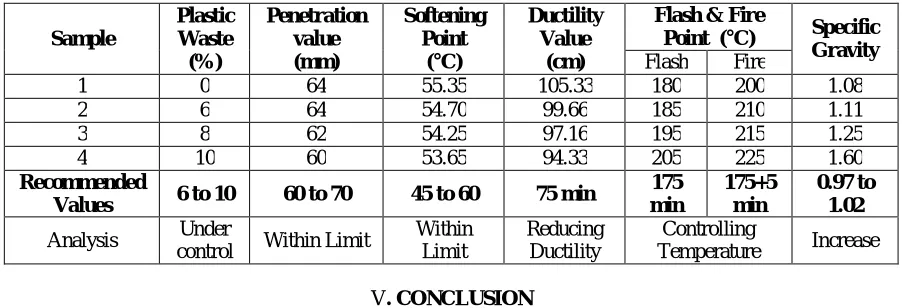
Tests were conducted on the Bitumen with different percentage of plastic waste and also the analyzed on the particular tests the recommended values is given on various Samples 1,2,3,4. such as 6 % to 10 % in Plastic Waste is in Under Control, in Penetration Value test ranges from 60 to 70 have Within Limit, Softening Point test from 45 to 60
℃ ,is in within limit, Ductility Value is 75 min results in Reduce Ductility, in Flash Point Test, Fire Point ranges from 175+5min results in Controlling Temperature and lastly Specific Gravity test 0.97 to 1.02 results in Increase shown in Table no.2
Table 2– Bitumen test result analysis with different percentage of plastic waste used
V. CONCLUSION
This project study includes a comparative study on prevention system analysis and application of plastic waste in Flexible Pavement.
Plastic waste improves the properties of aggregates uses for road construction work. Using plastic waste in mix will help reduction in need of bitumen by around 6% to 10%, increase the strength and performance of road, avoid disposal of plastic waste by incineration and land filling and ultimately develop a technology, which is
eco-Sample Plastic Waste (%) Penetration value (mm) Softening Point (°C) Ductility Value (cm)
Flash & Fire
Point (°C) Specific
Gravity
Flash Fire
1 0 64 55.35 105.33 180 200 1.08 2 6 64 54.70 99.66 185 210 1.11 3 8 62 54.25 97.16 195 215 1.25 4 10 60 53.65 94.33 205 225 1.60
Recommended
Values 6 to 10 60 to 70 45 to 60 75 min
175 min 175+5 min 0.97 to 1.02
Analysis Under
control Within Limit
Within Limit
Reducing Ductility
Controlling
friendly. By modification of bitumen with plastic waste the problems like bleeding in hot temperature regions and it ultimately improves the quality of road. The bituminous mix plastic is suitable to use in hot climatic areas. Increased traffic conditions will and are reducing the life span of roads. Plastic waste roads are means of prevention and ultimately will be the cure. It will save large expenses in future and reduce the amount of resources used for construction.
REFERENCES
[1] Bindu C.S., Beena K.S, “Waste plastic as a stabilizing additive in SMA”, International Journal of Engineering and Technology, Volume 2, pp. 379-387, 2010.
[2] Gawande A., Zamare G., Renge V.C., Tayde S. And Bharsakale G, “An overview on waste plastic utilization in asphalting of roads”, Journal of Engineering Research and Studies Vol. III/ Issue II.,2012
[3] Justo C.E.G., Veeraragavan A , “Utilization of Waste Plastic Bags in Bituminous Mix for Improved Performance of Roads”, Centre for Transportation Engineering, Bangalore University, Bangalore, India.,2002.
[4] Katara S. D et. al. “Comparative study on the economical process for mix for flexible pavement”, Intemational Journal of Engineering and Technical Research (IJETR) Vol 2, Issue 4, 2014.
[5] Khan I. and Gundaliya P. J., “Utilization of waste polyethylene materials in bituminous concrete mix for improved performance of flexible pavements”, Journal of applied research, volume 1, issue 12, pp. 85-86.,2012