ISSN(Online): 2319-8753 ISSN (Print): 2347-6710
I
nternational
J
ournal of
I
nnovative
R
esearch in
S
cience,
E
ngineering and
T
echnology
(A High Impact Factor & UGC Approved Journal)
Website: www.ijirset.com
Vol. 6, Issue 9, September 2017
A Review on Usage of Non
-
Biodegradable
Material in Construction Application
V.Boyaiah1, Dr.V.Srinivas Rao2Department of Environmental Engineering, GMR institute of Technology, Rajam, India1
Department of Chemical Engineering, GMR institute of Technology, Rajam, India2
ABSTRACT: Nowadays there is constant search for identifying usage of waste (as additive in concrete) from various
activities and there-by preparing eco-friendly concrete in construction works. In this direction, waste material additive obtained from landfills have the potential of use in concrete; thus minimizing waste material generation. In the process we can conserve our valuable natural resources and reduce environment pollution; this may be achieved by recycling the waste material (source recovery). The construction industry is exploring the use of recycling material like stone waste (SW),fly ash (FA),palm oil fuel ash (POFA),rubber waste (RW),wood powder (WP),plastic waste (PW),rice husk (RH) and municipality solid waste ash (MSWA) for partial replacement in concrete. This study surveys various waste material additives as one of symbioses process (used in construction application). In this investigation more emphasis is put towards environmental conditioning, pollution prevention and waste minimization.
KEYWORDS: Recycling material, Natural resource, SW, FA, POFA, RW, Environmental conditioning.
I. INTRODUCTION
The population increase more generated source and waste, one of source is need shelter used to cement,1 ton generated cement approximately 0.6 ton CO2 gas emission produced ,which causes to global warming.7% Total produced CO2 gas emission in atmosphere, reduces CO2 gas emission is cement replacing some waste or ash, used waste in concrete. Waste as well as controlled to pollution. One of the major causes of CO2emission in the world is caused by construction. This is due to the fact that the construction industry uses untreated materials which are considered as major elements in generating noise, dust and considerable amount of waste. Furthermore, the production and use of concrete has an enormous environmental effect this is because Cement is an energy consumer and CO2fabricated material.
Other factors and causes of CO2emission are things such as products that use high temperature processes to produce elements such as cement, bricks; these are considered as a main user of energy and emitter of greenhouse gases. Other material productions that can lead to CO2emission are lead, iron and other chemical creation such as ammonia and titanium dioxide that can definitely cause negative impact to the environment. Most of the waste generated to India is several issues reducing waste, stone waste (SW),fly ash (FA),palm oil fuel ash (POFA),rubber waste (RW),wood powder (WP),plastic waste (PW),rice husk (RH) and municipality solid waste ash (MSWA)these types of waste suitable replacing cement in concrete because of this fine particles.
ISSN(Online): 2319-8753 ISSN (Print): 2347-6710
I
nternational
J
ournal of
I
nnovative
R
esearch in
S
cience,
E
ngineering and
T
echnology
(A High Impact Factor & UGC Approved Journal)
Website: www.ijirset.com
Vol. 6, Issue 9, September 2017
II. MATERIALS AND METHODS
2. Material 2.1 Stone Waste (SW)
Stone rocks are cutting into small stone and gets them dust powder, 20% mass of loss stone. Every year 300 ton waste generated in site.The world wide producing stone waste in India 3rd rank and the use of the replacement materials cost reduction, energy savings, arguably superior products, and fewer hazards in the environment.
2.2 Fly Ash (FA)
Fly ash are generated area is power plant, most off the India used power source is coal. India is the world’s third largest producer of thermal coal. While production has increased over the past few decades, the pace of growth has been insufficient to meet demand. Consequently, India has become more reliant on imported coal (thermal coal imports increased from 10 million tons in 2000 to 142 million tons in 2013).Every 1 ton of coal will produce 0.250 to 0.350 ton of fly ash and 0.025 to 0.035 ton bottom ash. Fly ash replacement in cement will minimize waste ash.
2.3 Palm Oil Fuel Ash (POFA)
India is the largest consumer of palm oil in the world, consuming around 17 per cent of total world consumption.World producing palm oil is Indonesia, Malaysia and 3 rank places India. Every 1 ton palm oil fruit bunchproduces the 0.70 ton waste and palm oil husk, palm oil shells and agro waste are burned together in a chambergets 0.40 ton ash. Palm oil fuel ash used in cement or fine aggregate.
2.4 Rubber Waste (RW)
The quick development of the automobile industry and superior standard of living ofpeople in India, the quantity of autos increased rapidly. Now India is facing the ecological problems related to the removal of large-scale waste tyres. Near about 1.5 billion waste tyres are generated by the world annually, in which 40% in rising markets such as China, India, South Africa, South East Asia, South America and Eastern Europe etc. and more than 40 million vehicles added to the Indian Roads in the last five year, rubber waste replacing aggregate.
2.5 Plastic Waste (PW)
One of non-biodegradable waste is plastic waste, more than 15,000 tons of plastic waste is generated in every day. Present time more used to PET (Polyethylene terephthalate)bottle some soft drink company and which is recycling few company fellow, plastic material waste replacing to fine aggregate, coarse aggregate and bricks .PET bottle house used for villa houses minimize to waste.
2.6 Wood Powder (WP)
Wood waste generated source is wood cutting company, most of all house purpose wood must be need. Every year 130 million ton produces wood powder, cement partial replacing wood powder In concrete, and fine aggregate.
2.7 Rice Husk (RH)
Rice milling generates a byproduct know as husk. This surrounds the paddy grain. During milling of paddy about 78 % of weight is received as rice, Rest 22 % of the weight of paddy is received as husk. There are husk powders in animals feed or used to construction purpose; rice husk is replacing concrete or roof sheet. Every 1 ton rice milling gets 0.22 ton rice husk and 0.78 rice. Rice husk replacement cement, fine aggregate and roof sheet, and weight concrete used to this rice husk.
2.8Municipality Solid Waste Ash (MSWA)
Municipality solid waste ash is generated 1, 45,000 tons per day. In this collected 1, 30,000 tons and some waste landfilling and some waste open burning, major city/town doing open burning gets ash. In this waste ash partial replacing cement in concrete application. Every major ~400 tones generated waste.
Methodology
a) Method of replacing cement
ISSN(Online): 2319-8753 ISSN (Print): 2347-6710
I
nternational
J
ournal of
I
nnovative
R
esearch in
S
cience,
E
ngineering and
T
echnology
(A High Impact Factor & UGC Approved Journal)
Website: www.ijirset.com
Vol. 6, Issue 9, September 2017
b) Method of replacing fine aggregate
In this method replacing fine aggregate with different waste material such as stone waste, palm oil fuel ash, rice husk, municipality solid waste ash we should be particles size range 150 microns to 4.75 mm, this basically range concrete used fine aggregate.
c) Method of replacing coarse aggregate
Basically depend on design grade of concrete, the coarse aggregate replacing waste range in between 16 to 40 mm. Waste material like rubber waste, plastic waste suitable for coarse aggregate replacement.
d) Method of replacing brick
Method of replacing bricks with PET bottles only. Before using PET bottle, it is filled with soil or ash in the bottle.
fig.1: showing brick replacing PET bottles
III. DISCUSSIONS
3.1 Statistical Analysis
In India there are generated wastes in States
Fig.2:shown Percentage of waste generated States in India. Maharahstra
16%
West bengal 13%
Tamil naidu 9%
Uttar pradesh 9% Delhi
9% Karnataka
6% Gujarat
6% Andhra pradesh
5% Rajastan
4%
Madyapradesh 4%
Telengana 3%
Other 16%
ISSN(Online): 2319-8753 ISSN (Print): 2347-6710
I
nternational
J
ournal of
I
nnovative
R
esearch in
S
cience,
E
ngineering and
T
echnology
(A High Impact Factor & UGC Approved Journal)
Website: www.ijirset.com
Vol. 6, Issue 9, September 2017
Table -1
Percentage use of Replacing Waste Material
S.no Waste Materials %
1 Stone waste 2
2 Fly ash 5
3 Palm oil fuel ash 0.5
4 Rubber waste 1.5
5 Wood powder 3
6 Plastic waste 3.5
7 Rice husk 2
8 Municipality solid waste ash 0
Table -2
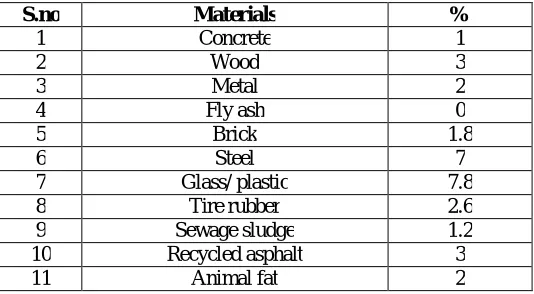
Percentage use of Recycled Waste Material
Table-1 and Table -2 summarize the statistical finding of the survey. Table-1 was waste material less used to Palm oil fuel ash and no used municipality solid waste ash replacing to construction application. Table-2 recycled material and shown in different material company, some of the companies that do not use recycled materials and the reason is more cost. Replacing may be better option, using non- bio gradable materials.
VI. CONCLUSION
Review of several studies indicates that today we live in the world, full of development al activities coupled with enthusiastic people all over the world looking for still more comforts and facilities. This leads to innovations and revolutions in each and every field, but on contrary it has negative impact on environment as resources get depleted and pollution to different natural sources are also occurred. So after studying all these research papers; we may play an important role towards environment protection by reducing or reusing some material in field of concrete production which is at its top priority now a-days. And this replacing method may be economically best; but at the same time by considering the Govt. approval procedures the concrete replacement can be limited to villa housing and G+4 houses construction activities.
REFERENCES
[1] AnkitNileshchandra Patel, Jayesh kumar Pitroda “stone waste: Effective Replacement of cement for Establishing Green concrete”, International Journal Innovative Technology and Exploring Engineering(IJITEE),ISSN:2278-3075,volume -2,Issue -5,april 2013.
[2] S L Patil,J N Kale, S Suman, ”Fly ash concrete: a Technical analysis for compressive strength “International Journal of Advanced Engineering Research and Studies(IJAERS),volume-2,Issue-1,Oct-Dec 2012/128-129.
S.no Materials %
1 Concrete 1
2 Wood 3
3 Metal 2
4 Fly ash 0
5 Brick 1.8
6 Steel 7
7 Glass/ plastic 7.8
8 Tire rubber 2.6
9 Sewage sludge 1.2
10 Recycled asphalt 3
ISSN(Online): 2319-8753 ISSN (Print): 2347-6710
I
nternational
J
ournal of
I
nnovative
R
esearch in
S
cience,
E
ngineering and
T
echnology
(A High Impact Factor & UGC Approved Journal)
Website: www.ijirset.com
Vol. 6, Issue 9, September 2017
[3] V.Suleman Ahamed,S.Siddiraju, ”study of strength of concrete with palm oil fuel ash as cement replacement “International Journal of civil engineering and technology (IJCIET),volume -7,Issue-3,may-june 2016,pp.337-341.
[4] Begum, R.A., S.K. Satari and J.J. Pereira, 2010. Waste generation and recycling: Comparison of conventional and industrialized building systems. Am. J. Environ Sci. (AJES), 6: 383-388,2010.
[5] Paul O. Awoyera, Joseph O. Akinmusuru, Julius M. Ndambuki, “Green concrete production with ceramic wastes and laterite”, ELSEVIER, volume-117 pp.29-36, 2016.
[6] Blessen Skariah Thomas, Sanjeev Kumar, Priyansha Mehra, Ramesh Chandra Gupta , Miquel Joseph, Laszlo J. Csetenyi,” Abrasion resistance of sustainable green concrete containing waste tire rubber particles” , ELSEVIER, volume-124, pp.906-909, 2016.
[7] Janez Turk, Zvonko Cotic, Ana Mladenovic, Aljoša Šajna,” Environmental evaluation of green concretes versus conventional concrete by means of LCA”, ELSEVIER, 2015.
[8] Jiji Antony, Deepa G Nair,”Roof tile powder as a partial replacement to cement in masonry mortar”.Civil Engineering and Urban Planning: An International Journal (CiVEJ) Vol.3, No.2, June 2016.
[9] Alireza Naji Givi, Suraya Abdul Rashid , Farah Nora A. Aziz, Mohamad Amran Mohd Salleh “Contribution of Rice Husk Ash to the Properties of Mortar and Concrete: A Review”, Journal of American Science, 6(3), 2010.
[10] Caijun Shi, Keren Zheng “ A review on the use of waste glasses in the production of cement and concrete”, ELSEVIER, volume-54, pp.234-247, 2007.
[11] Bashar Taha, GhassanNounu,”Utilizing Waste Recycled Glass as Sand/Cement Replacement in Concrete “,Journal of Materials in Civil Engineering , 21:709-721. December 2009 .
[12] Vinita Vishwakarma, D. Ramachandran, N. Anbarasan, Arul Maximus Rabel,” Studies of rice husk ash nanoparticles on the mechanical and Microstructural properties of the concrete “,ELSEVIER, volume-3, pp.1999-2007, 2016.
[13] IS: 3812-2003, Specification for Fly ash for Use as Pozzolanna and Admixture, Bureau of Indian Standards, New Delhi, India.
[14] Nabajyoti Saikia,Jorge de Brito,”Use of plastic waste as aggregate in cement mortar and concrete preparation: A review”, ELSEVIER34 (2012) 385–401.
[15] Frigione M. “Recycling of PET bottles as fine aggregate in concrete”. Waste Manage 2010;30:1101–6.
[16] Choi, Y.W., Moon, D.J., Chumg, J.S., Cho, S.K., 2005. Effects of waste PET bottles aggregate on the properties of concrete. Cem.Concr. Res. 35 (4), 776–781.
[17] Panyakapo, P, Panyakapo, M., 2008. “Reuse of thermosetting plastic waste for lightweight concrete”., Waste Manage. 28 (9), 1581–1588. [18] Gu¨ neyisi, E., 2010. Fresh properties of self-compacting rubberized concrete incorporated with fly ash. Mater.Strict. 43 (8), 1037–1048. [19] Adegoke, C. W., Abiodun Funmi,” Development Of An Improved Concrete Roman Tile Alternative Roofing System Using Waste Raw Materials (Paper & Saw Dust) As Additives “ ,International Journal of Scientific & Technology Research volume 4, issue 05, may 2015.
[20] K. S. Al-Jabri, A. W. Hago, R. Taha, A. S. Alnuaimi and A. H. Al-Saidy “Strength and Insulating Properties of Building Blocks Made from Waste Materials”, Journal of Materials in Civil Engineering, 2009, Vol.21, No. 5,page no: 191–197.
[21] S. P. Mukherjee, Gerang Vesmawala ,”Literature Review on Technical Aspect of Sustainable Concrete “,International Journal of Engineering
Science Invention, Volume 2 Issue 8ǁ August. 2013 ǁ PP.01-09.
[22] T. Felix Kala ,“Effect of Granite Powder on Strength Properties of Concrete “,International Journal Of Engineering And Science, Vol.2, Issue 12 (May 2013), Pp 36-50.
[23] Akshay B. Mokal, Allaudin I. Shaikh Shamashree S. Raundal,Sushma J. Prajapati ,Uday J. Phatak “GREEN BUILDING MATERIALS – A Way towards Sustainable Construction”, International Journal of Application or Innovation in Engineering & Management (IJAIEM), Volume 4, Issue 4, April 2015.
[24] Y. Shao, T. Lefort, S. Moras, D. Rodriguez, “Studies on concrete containing ground waste glass”, Cement and Concrete Research, 30 (2000), pp. 91–100.