OFA
NETWORK INTERFACE IN A PACS
David D'Lima
center for Communications
and
Signal Processing
Department of Electrical
and
Computer Engineering
North Carolina State University
January 1989
ABSTRACT
D'LIMA DAVID. Performance Models of a Network Interface Unit ina PACS. (Under thedirection of Harry G. Perros)
Increasingly, dataoutput from imaging equipment in hospitals is being generated in a form suitable for transport, from the radiology department toreferring pbysiciam as well
as around the radiology department, over electronic communications facilities such as
picture archival and communications systems. To some extent, there maybe
communica-tions incompatibilities between products so that network interface units are needed to
interconnectsubsystems.
In this thesis, we present some queueing network performance models of anetwork
inter-face unit that permits communications between the image database aDddisplay stations in a PACS. The ease of solution and accuracy afforded by these models vary widely. A preliminary model is a product-form queueing network but incorporates some unrealistic
assumptions. Another is extremely detailed so that only adiscrete-eveat simulation can
be used to extract performance measures. Two other approximations were developed.
They are based on some simplifying assumptions about the det.ilrd model and are extremely easy to solve. Comparing the results with those obtainedby simulation
indi-cates that the second model is invariably more accurate than the first Inaddition, a
pro-gram was written to simulate an acquisition station communicating with theimage
1. 'INTRODUCTION 1
1.1 Outline 1
1.2 Problem Statement 2
1.3 Organization of the Thesis 3
2. SYSTEM DESCRIPTION AND PERFORMANCE MODELS 4
2.1 System Description 4
2.1.1 Description of the PACS 4
2.1.2 Network Interface Units 7
2.2 Performance Models 9
2.3 Objectives 10
3. A QUEUEING NETWORK MODEL OF THE SySTEM 11
3.1 Introduction 11
3.2 A Queueing Network Representation 11
3.3 Solution of this Model 15
4. APPROXIMATE ANALYTICAL PERFORMANCE MODELS 17
4.1 Introduction 17
4.2 A Product-Form Queueing Network 17
4.3 An Approximate Equivalent 20
4.4 An Improved Approximation 26
5. RESULTS AND DISCUSSION 34
5.1 Parametric Variations 34
5.2 Performance Criteria 36
5.3 Results and Discussion 37
6. SIMULAnON MODEL OF AN ACQUIsmON STAnON 49
6.1 Introduction : 49
6.2 System Description 49
6.3 The Simulation Model 51
7. CONCLUSIONS 54
REFERENCES 55
CHAPTER I
INTR()DUCTION
1.1 Outline
During the past decade, digital technology has become the method of choice for the
design of medical imaging equipment. Computerized tomography, ultrasound, digital
subtraction angiography, storage phosphor computed radiography and magnetic
reso-nance systems provide hitherto unavailable medical diagnostic capabilities to
radiolo-gists. Consequently, they can make better recommendations to referring physicians.
Driven by the growing need for such services and the availability of mature technology
for both mass digital storage devices, like the optical disk, as well as high speed digital
communications systems, like local area networks, a number of institutions have initiated
development efforts for picture archival and communications systems (PACS) for
hospi-tals [7].
A PACS comprises a database of medical images, display stations (at which these images
may be viewed), acquisition systems (attached to medical imaging modalities) and the
broadband communications network that ties them together.
Traditionally, data output from imaging devices like X-Ray machines was generated in a
form suitable for transport, from the radiology department to referring physicians as well
as around the radiology department, by a human operator rather than over electronic
designed with communications ports but the intent was usually to perform stand-alone
functions. The communications approach, commands and data format from product to
product are, not surprisingly, usually unrelated, so the age-old problem of
communica-tions incompatibility arises. Some protocol translation (of headers) and signal processing
(of pixel data) may need to be performed by network interface units on the messages
car-ried on the PACS in order that a hospital be able to purchase the expensive systems that
comprise a digital radiology department without being tied to a particular vendor's
fam-ily of products.
1.2 Problem Statement
There are several possible architectural approaches for designing a PACS. For any given
system, an important consideration, in a multi-vendor environment, is the impact that
communications incompatibilities between different vendors' products have on the
per-formance of the PACS.
In this thesis, we examine one such PACS architecture. The system comprises several
display workstations communicating with a centralized image database. Requests entered
at the workstations are for images to be retrieved from the database. Images are archived
onto the database from acquisition stations. These stations may be made by different
vendors. However there is a network interface unit to resolve communications
incompa-tibilities between the two types of systems. The performance measures of interest
include the average end-to-end delay per image from database to workstations and design
parameters for the network interface units. In this thesis we address the construction of
3
measures of interest.
1.3 Organization of the Thesis
Chapter 2 first presents a detailed outline of the PACS system that was studied as well as
design considerations for the network interface unit. Next, the basic theory that is used in formulating the performance models is dwelt on.
In Chapter 3, we describe the PACS environment in which the network interface unit is
used. A queueing network model for this system is presented. In order that all the details
be captured, this model can only be analyzed by simulation which takes very long to run.
In Chapter 4, some analytical performance models are presented. Based on some
simpli-fying conditions, quick approximate solutions can be obtained.
In Chapter 5, results from the approximate analytical performance models are compared
with those obtained by simulation with a view to demonstrating their accuracy and
evaluating some design alternatives.
In Chapter 6, a simulation model of an acquisition station communicating with the image
database is presented.
SYSTEM DESCRIPTI()N AND MODELIN(i TECHNIQUES
2.1 System Description
2.1.1 Description of the PACS
There are two prominent architectural approaches in vogue for the design of a PACS - a
bus-based system and a star network. See Fig. 2.1. The system that is examined in this
thesis is a star network and is based on an actual product - the AT&T CommViewTM
PACS [6].
This PACS comprises a centralized image database and a colocated centralized
commun-ications hub that is connected to display stations and acquisition systems over
point-to-point optical fiber links. Images are acquired from various modalities and eventually
archived in the centralized image database. Radiologists at diagnostic viewing stations
request images from the image database and can manipulate these images to improve the
quality of their diagnosis. Referring physicians request images and text diagnoses from
the database. Server processes run in the nodes to handle requests, image and text
transfers as necessary. Both kinds of requests are "single-threaded", i.e. a second request
may not be entered till the current request has been completed.
Images are of varying sizes while the database uses a constant block size for fragments of
5
Figure 2.1. Possible architectures for a PACS
Display Station Acquisition System
•
Display Station
Image Database Display Station
Imaae Da•• base
Communicatioas ....runt-en
Display Station
Acquisition System
=-.
Display Sta lion
corresponds to the smallest possible image which is of dimensions 512x512 pixels and 8
bits deep. A much larger image, say a 2048x2048 image, with each pixel having 12 bits
blocks cannot be individually addressed, except in the case when one block corresponds to a full image, they are the logical units in the communications between session layers
of communicating devices. Compression algorithms, exploiting the redundant areas
within an image, are applied so as to reduce both the network transmission time and the
memory requirements for storing the image in the database. Bit-preserving compression
allows for a ratio of upto 3:1 compressionin pixel data. Clearly there will be small
varia-tions in the degree of compression that can be achieved when comparing images from the same modality, but relatively larger variations when comparing images acquired from
different modalities. The compression (decompression) time is nearly invariant to the
degree of compression desired (used).
There is a hierarchy associated with messages circulating in a PACS. At the lowest level,
the messages are termed images. The set of all images acquired from the same patient at
a certain time is called a study. Within a study, there may be a related group of images,
called a series and within a series the component images must have come from multiple
acquisitions. However.. a single acquisition, which refers to the collection of physical
data, may result in more than one image. The database search keys use the complete
hierarchical description to locate individual images.
In this thesis, this terminology is changed somewhat. We consider that requests are for
exams and that each exam is made up of a variable number ofimage records. The
hierar-chy is carried upward by employing a transaction called a batch which is a series of
exams. Within an exam, all image records are homogenous. A large image is modeled
7
The ACR-NEMA Standard [3] specifies commands, communications and data formats to
follow in interconnecting digital imaging equipment from different vendors. A sample
session, depicting the possible message flow for image retrieval, is illustratedin Fig. 2.2. As the standard only governs equipment connected on point-to-point links, network
inter-face units, or, more loosely, protocol converters, will be needed to connect imaging
equipment from one vendor to another vendor's PACS network.
2.1.2 Network Interface Units [2], [3]
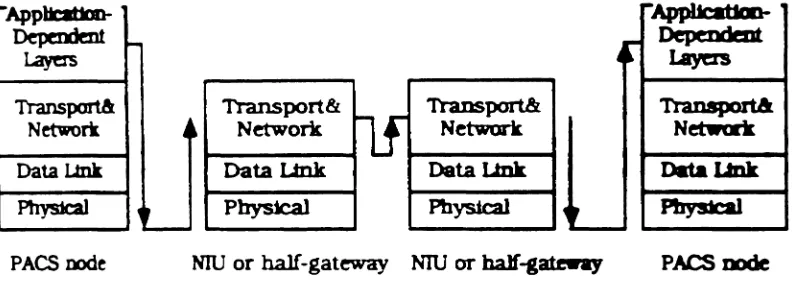
Network interlace units are expected to provide translation and relay, or a virtual circuit
connection, from the imaging equipment at one end to the PACS on the other. The
inter-face is expected to be transparent with regard to end-to-end message delivery and
response. Fig. 2.3 illustrates an ISO Open Systems Interconnection representation of a
network interface unit. The two half-gateways may belocated in a single physical unit or
Figure 2.2. Sample message flowin a PACS
search aam-ID
4 tmages-tn-exam
Display
Station
spedfkunage ..44---
acknowledgeacknowledge ---~
lB-••
Figure 2.3. OSIRepresentation of a Network Interface Unit
~
AppJtcwttnn-Depemient .... Layers
Ttansport&
Network
4.
Data Unk
Physical
"
--Transport&
Network
DataUnk
Physical
Transport& Network
DataIJnk
Pbystcal
~teatkJn
Depenr1eat
Layfn
PACSnode NIU or half-gateway NYUor half-gateway PACSnode
in separate units at either end of the network.
There are a variety of possible complications that may be introduced when imaging
equipment from one vendor has to be connected to a PACS supplied by another vendor.
The communications formats, notably the packet sizes, may be different on either end of
the interface so that packet fragmentation an~ reassembly will have to be performed.
There may be some inconsistencies between database key organizations so that some
parsing of the image header fields becomes essential. The ACR-NEMA standard
specifies "low order byte first, low order 16 bits first" governing transfers across the
inter-face whereas some computers store long words differently, i.e. the order of 16 bit words
is reversed, so that word-swapping has to be carried out in such cases. Finally, the compression algorithms used on either side of the interface may be different, or images
may be archived in compressed form but transmitted to viewing stations uncompressed
9
2.2 Performance Models
Queueing networks are used to model a variety of applications characterized by
conten-tion that arises as a result of transacconten-tions having to share a set of resources at the queues
(or service centers) in the network. If a transaction finds that all the servers at a queue are occupied, it is enqueued at that center and will be served according to some
schedul-ing discipline once a server is freed. After completion of service, a transaction will
proceed onward to another (or possibly even the same) queue. In an open queueing
net-work transactions eventually depart, whereasin a closed queueing network they circulate continuously.
There is a class of queueing networks that has a "product-form" steady-state probability
distribution [5]. Algorithms are available to extract the mean value of various
perfor-mance measures, such as response and utilization, from this distribution with minimum
computational effort.
A closed queueing network, with customers who may change classes, and service
sta-tions that must be of the following types: (i) first-come-first-served discipline with the
same exponentially distributed service time for all classes, (ii) processor-sharing
discip-line, (iii) infinite-servers or server-per-job so that no queue develops or (iv)
last-come-first-served discipline with pre-empt resume, can be shown to have a product-form
steady-state probability distribution.
QNAP2 [4] is a queueing network analysis package that can be used to compute
to analyze certain classes of non-product-form queueing networks. Finally, QNAP2
per-mits the user to simulate a queueing network and also to analyze it using a numerical
technique for Markov chains.
2.3 Objectives
In this thesis, we address the construction of models of display stations communicating
with the centralized image database with a view to obtaining the average end-to-end
de-lay per image from database to workstations, under varying traffic conditions and system
parameters. Additionally, some design parameters, notably the buffer size, for the
net-work interface unit can be obtained, as well as design alternatives that would reduce the
CHAPTER 3
A QUEUEING NETWORK MODEL OF THE SYSTEM
3.1 Introduction
The specific configuration that will be examined is depicted in Fig. 3.1. There are four
display workstations communicating with a centralized image database through a
net-work interface unit. Point-to-point communications links connect the nodes. Images are
stored compressed in the database but need to be transmitted uncompressed to the works-tations.
3.2 A Queueing Network Representation
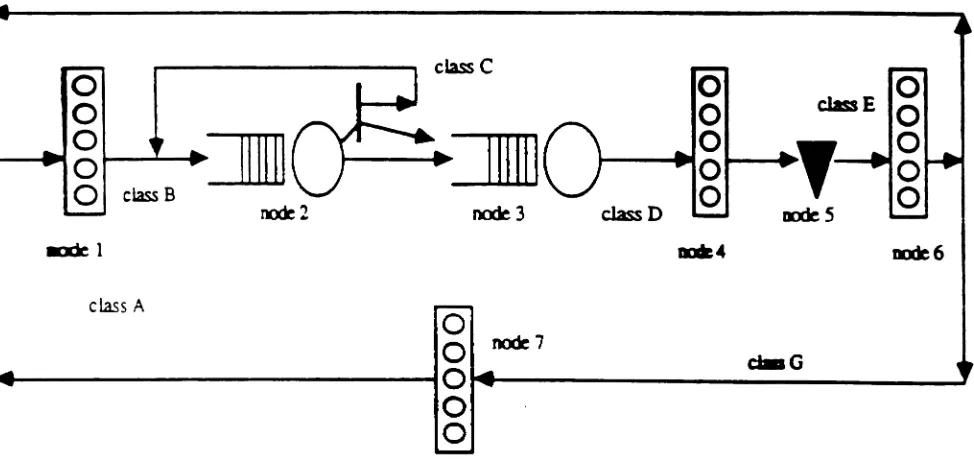
We now present a queueing network model of the aforementioned system. It is illustrated
Display
8tIdkm
II
i i
Network
Interface
Unit
in Fig. 3.2.
Requests entered at the workstations are for exams, or a series of image records, to be
retrieved from the database. The service experienced by requests for exams, proceeding
.ade1
class A
DDde6
o
o
node?...---....
O~---~
o
o
13
from the workstations, across one fiber link, through the interface, to the database, was
modeled as an infinite-server station. This station is labeled as node 1. As request
pack-ets are expected to have higher priority than image packpack-ets, there will be almost no
queueing delay for exam requests so the only delay they encounter is the time to transmit
an exam request to the database. That is to say, the priority of the server process that
han-dles an exam request will be higher than those which handle image and text transfers so
that requests would typically not have to wait for the appropriate server process.
Addi-tionally, it is assumed that this delay would not vary significantly with increased
worksta-tion traffic or even increased extemalload on the database. The latter effect can easily be
captured nevertheless by calibrating these delays uniformly.
The transactions, labeled as class A, arriving at node 1 are exam requests and they
proceed to the database manager, represented by node 2, which services these exam
requests on a per-image-record basis. Indeed, an analogy can be made with the following
queueing system: on service completion, a transaction (to wit, an image record) proceeds
onward, but, in addition, may, with some probability, spawn a sibling which is fed back
to the queue. Fresh transactions, labeled as class B, represent exam requests, while
fed-back and spawned transactions represent image records, labeled as class C. Upon service
at node 2, these customers proceed onward besides which they may spawn a sibling
which returns to the composite as class C with probability PB-to-C = [(size - l)/size]. That is, a geometric distribution is used to determine the probability that all the record s that make up an exam have been read off the database. As the database manager is also
serving requests by the other nodes, both acquisition and display, that comprise the
representing an otherwise idle database to an upper limit representing a fully loaded
PACS.
A composite server is used to model the delay in servicing image records at the interface.
This is made up of the time spent in decompressing the pixel data and performing the required protocol conversion therein, till it is available in interface memory in a form suitable for processing by the other half-gateway. The scheduling discipline is
first-come-first-served on a per-image record basis. This station is represented in the model as
node 3. The transactions, labeled as class D, are image records.
Considering that there is a dedicated fiber link from the interface to each workstation, the
service experienced by image records, propagating from the local half-gateway of the
interface to the workstations, was also modeled as an infinite-server station. Additionally,
it is assumed that the interface delay is much larger than the communications delay. This
represents the protocol delay in sending an image record from interface memory to
workstation memory. This is depicted as node 4 in the queueing network.
At the station labeled node 5, image records are reassembled to form an exam.
Conse-quently, transactions labeled class D must be distinguished from those labeled class E,
that represent exams.
The complete set of image records is now available for examination at the display
sta-tion. The service for a workstation user, either a physician or a radiologist, who spends
some time studying the retrieved exam before entering a new exam request, is modeled
15
multiprogramming computer system performance models. This station is represented by
node 6 and is visited by every class E transaction.
It is assumed that there is single-threading of exam requests at each workstation so that
once a request is entered, the workstation gets blocked to further requests till the current
request has been serviced. This limits the population of customers of class exam to one
per workstation-to-database loop. If there is adequate local memory at each workstation,
there could conceivably be a chain of exam requests in service at each workstation.
Furthermore, the phenomenon of a workstation being completely idle (such as when the
radiologist is on a relief break) can also be modeled by forcing the transactions to
period-ically visit a station which introduces the idle tune delay. In the model, this is achieved
.by introducing a branching probability after service completion at node 6. Transactions,
labeled class E, may either change class to type G and visit the idle time delay station,
which is node 7, or change class to type A and return to node 1. Class E transactions
change to class A transactions with probability PE-to-A = [(batch - 1)/batch] where
batch is the average size of a batch of exams. That is, the geometric distribution of tile
number of exam requests in a batch is used to determine the branching probability that
the workstation is going to be idle for awhile. Thus, type A transactions may be
con-sidered to be the last exam in a batch of exams while type G transactions represent any
otherexam inthe batch.
3.3 Solution of this Model
"product-form" queueing networks with regard to the permitted service disciplines. As
this queueing network no longer has a product-form solution, a discrete-event simulation
was carried out instead. The simulation program was written in QNAP2 and a listing is
in Appendix 4. Each simulation run took approximately 40 minutes on a VaxStation
2000 to generate 95% confidence intervals with the range of error less than 15% of the
CHAPTER 4
APPROXIMATE ANALYTICAL PERFORMANCE MODELS
4.1 Introduction
In this chapter, we present three queueing network performance models: the first is of
product form, the other two are not. Of the other two, the first model is solved
numeri-cally while the second is solved approximately by an iterative procedure. As opposed to
the simulation model, neither captures all the characteristics of the actual system,
how-ever they take considerably less time to solve.
4.2 A Product-Form Queueing Network
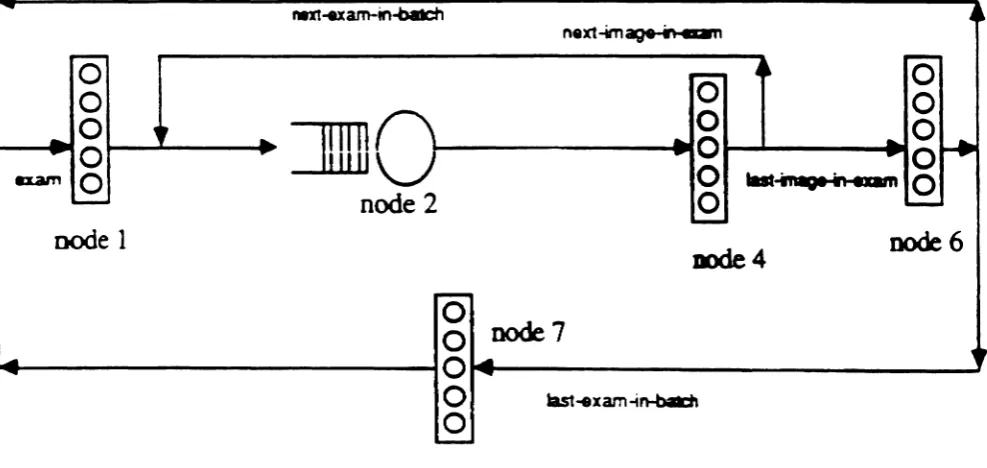
If a composite server is used to model all the delays in servicing any image record at the
database and in the interface, Fig. 4.1 results. Note that the station represented by node 2
now includes the time spent in locating the image record, transmitting the compressed
image from the database to the local half-gateway of the interface, decompressing the
pixel data and performing the required protocol conversion therein, till it is available in interface memory in a form suitable for processing by the other half-gateway. This
queueing network representation is observed to satisfy all the assumptions of
"product-form" queueing networks so that performance measures such as end-to-end delay of
image records and utilization and mean queue length at the DBMS composite can be
Figure 4.1. Aproduct-form queueing network model
nn1-exam-in~
neX1-tmage-ft4aaiI
node
1
node
2
DOde4
Bs1...xam-1~
node
6
However this model has one important drawback. The design parameters of the network
interface unit are not easy to obtain. One cannot claim the performance measures of the
19
4.2, where the performance measures obtained from solving the product-form queueing
network are compared with those from the simulation of the complete queueing network.
The product-form queueing network consistently produces very pessimistic results, i.e, it
Figure 4.2. Comparison of results from the product-form queueing network and the complete network, studied bysimulation
(Tx time
=
1img/sec,Examsize=
14 img,TbiDk= -. Idle=120)30....---...
U GO
•
E1
-Ii- prod form
... simulation
20
10
0
,
2 DBMStime 311
15
..
§
l
...
.5
.,
12-=
•
Ie t~
f
.5
...
e 6..
.8
~ 3
c:
D
1 2 3
under-predicts system capacity. The error for the case illustrated isof the order of 160% for the mean queue length at the interface and 100% for the end-to-end response. The
fundamental problem is that choosing a composite to represent a variety of delays is
simplistic. Any reasonable implementation of a PACS would pipeline, to the best extent
possible, all the delays that an image would encounter between the database and the
workstations. A server process in the communications hub would first locate the exam
header and then proceed to sequentially read off all the blocks that comprise the image.
As a result some speedup is obtained through whatever degree of pipelining is afforded.
However this mechanism is complicated and does not satisfy the "product form"
queue-ing network assumptions.
4.3 An Approximate Equivalent
Consider the queueing network depicted in Fig. 3.2. As explained earlier, the reason why
it did not lead to a product-form solution was because of the complicated mechanism by
which image records were read off the database. Conditioning on the assumption that the
actual time spent by individual images in the course of undergoing a database retrieval is
small, compared to that spent in the interface, the natural extension is Fig. 4.3. The
model is practically identical to that in Fig. 3.2 except for the station that represents the
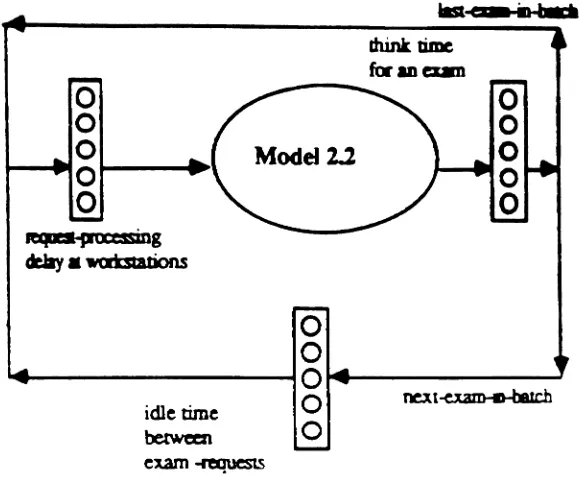
retrieval delay from the DBMS. Note that this model features two related subnetworks.
Model 2.1 includes all the delays that exams encounterin circulating around the network.
The only queueing delays are encountered in model 2.2. Model 2.2 only examines the
delay that exams, each comprising a series of images, encounterin the interface.
21
Figure 4.3.An approximate equivalent, studied numerically
idle time between exam-requestS
Sub-model 2.1: Pmdoct-fonnqueueingnetworktoesumaie arrival rater:iexams
to sub-model 2.2
in1erface
delay
S8b--*l 2.2: Swe.«pendentbulkarrivalstothe iDIerfEe
because the retrieval delay incurred by each image is neglected. The sizeB of the bulk is
the mean number of images in an exam. All workstations are assumed to be homogenous
However these arrivals are throttled because requests for exams from individual
worksta-tions are single-threaded which guarantees that there can never be more than four exams
in service at the interface. This model is therefore a system with state-dependent bulk
arrivals to an exponential server. The transactions are exam requests but service is by
phases, i.e. image records. The parameter of the arrival process, 'A(n), with n
=
0,1, ...,4,is the rate at which exam requests arrive at the interface, given that there are (4-n )exam
requests already pending.
Model 2.1 is used to determine A(n ). Transactions circulating in this closed network are
exam requests. Conditioned on the fact that there are (4-11 ) exam requests already
pend-ing, (i.e. awaiting service in model 2.2), application of Norton's Theorem [5] (short out
the sub-network and measure the throughput of transactions in the aggregate)
immedi-ately gives the throughput of transactions. In the general case, the throughput of
transac-tions in the aggregate has to be obtained by studying it as a closed queueing network with
n transactions, but for the case of model 2.1, in which all stations are of the "infinite-server" type, the throughput can be written by inspection as:
A(n) = n n = 0,1, ...,4
Treq
+
PnextT;dle+
Tlink+
Tthinkbecause all stations are modeled as "infinite-server" queues with mean service times of
the request delay, idle interval, transmission time (scaled up for an exam) and think time
set at Treq , T;dle' Tlink , Tthink respectively andPnext is the probability that any exam is the
lastin the batch.
With this expression for A,(n ) available, we return to model 2.2. The state descriptor used
23
i is the number of exam requests in the interface and
j is the number of pending image records of the exam request currently being served,
An exam is considered to complete service only when all its pending component image records have been served. Exam sizes are between 2 and 32 images; in this case we only
allow exam sizes of 2,8 or 32 images. Clearly there are 129 possible states in which the
system can be found.
We note that because of the assumption that the network interface sees bulk arrivals of
exam requests, there will be no interleaving of image records belonging to different
exams (as should really have been the case) in the interface. The implication of this
behavior is that the system basically serves exam requests to completion on a
"first-come-first-served" basis rather than on a "per image record" basis.
The underlying continuous time Markov chain of state transitions for model 2.2 is
illus-trated in Fig. 4.4.
The steady-state equations from which the state probabilities can be determined are:
J.lP (1,1) = A(4)p (0)
(A(3) + J.1)p(l,j) = A(4)PjP(O)+ J.1PjP(2,1)+ J.lP(l,j+l)
(A(2)+Jl)p(2,j) = A(3)p(1,j)+ J.lPjP(3,1)+ J.lP(2,j+l)
(A(I)+ J.1)p(3,j) = A(2)p(2,j)
+
JlPjP(4,1) + J.lP(3,j+l)J.lP(4,j) = A(I)p(3,j)
+
J.lP(4,j+l)whereP] is the probability that the exam contains j images andj = 0,1,0,0,32.
2S
Figure 4.5. Structure of the rate matrix for model 2.2
-~4) ~ 0 0
~4"1 -(A(3)+p) IJ 0
o
-(A(3)+
JJ) ~o
0 -(A(3)+
u) _A(3) 0 0
o
A(3) 0o
A(3)o
o
J.lPI
fJP2
o
o
o
o
[P(O) p(l,l) ... p(1,32) ... p(4,1) ... p(4,32)]T
Using QT
n
=
0, which yields 128 independent equations, with the additional con-straint that all probabilities should sum to unity,4 32
L L
p(i ,j) = 1i=lj=l
this system can be solved for the state probabilities. As the system is small, with only 129
possible states, a direct Gaussian elimination technique was used.
From the state probabilities, the following performance measures can be found:
utilization of the network interface unit as 1 - P(0,-),
4 32
throughput of exam requests as
L L
A(i)p (i ,j),32 4
buffer requirements at the network interface units as
L L
jp(i,j)j=li=l
The entire solution technique was written as a C program with parameters being Treq ,
T'dlr e»T/,tnkk»T,tnterfiace and distributions of exam size and batch size. The listing of the
pro-gram is in Appendix 1. This was run for a range of parametric variations.
4.3 An Improved Approximation
In this model, depicted in Fig. 4.6, we discard the assumption that the database retrieval
time is negligible compared to the time an image spends in the interface. As a result, the
queueing network model closely resembles the one in Fig. 3.2 that was studied by
simu-lation. Again, this model features two related subnetworks - model 3.1 includes all the
delays that exams encounter in circulating around the network while model 3.2 only
examines the delay that images encounter in database retrieval and in the interface. In
model 3.1 it is assumed that there are no queueing delays. As before, all workstations are
assumed to be homogenous with regard to their exam request patterns as well as think
and idle time distributions.
Consider model 3.2 in Fig. 4.6. The goal is to find the departure process of image records
from the first queue (which represents the database) so that submodel 3.2 could be
stu-died as a G /M /1 queue with state-dependent parameters that can be found from its
com-plement, model 3.1, similar to the approach followed for the previous approximation.
To review the service mechanism of the database retrieval: on service completion, a
27
Figure 4.6. Animproved approximation, solved byaniterative technique
last-exam-in-ta:b
dUnktime
foran cum
idletime between eum -requests
rext-exam-in-bach
Sub-model 3.1: PnIIII;t-form queueingDetwtrttoestimate arrival rate of exams 10sub-model 3.2
DBMSdelay inlf2'face
delay
which is fed back to the queue. Fresh transactions represent exam requests, while
spawned and fed-back transactions represent image records. Again, the geometric
probabil-ity. Each exam is made up ofB fragments so that the probability p that any fragment
spawns a sibling fragment isp = (8-1 )/B ·
Assume that the arrival process of fresh exams to the database in model 3.2 is a Poisson process with parameter
A.
This is the first type of transaction in the database station. Letp be the probability that a sibling is spawned. Considerqn+l' the number of transactions
(now images) left behind by the departure of the (n
+
1)st transaction. This quantitydepends on Vn+1, the number of arrivals during the departure process of the (n+l)th job as follows:
qn
+
Vn+1 with probability p if qn > 0qn - 1 + Vn+1 with probability (l-p) if qn > 0
1
+
Vn+1 with probability p if qn=
0Vn+1 with probability (l-p) if qn
=
0In other words, the number of transactions left behind following the departure of the
(n+ 1)st transaction depends on both, the state of the queue on departure .. as well as the
number of fresh arrivals during the departure process.
Consider the random variable qn .Its z -transform is
00
Q(z)
=
LPr[qn =k]zk=
E[zq,,]k:{)
29
E[zq"+I] = E[zq"+11qn=O]q0
+
i
E[zq"+11qn = k]qkk=l
where
and
DenotingE[zV"+l] and E[zq"+I]byV(z) and Q(z)respectively,
00
Q(z) = (pz
+
I-p)V(z)qo+
'Lqkzk-1(pz+
I-p)V(z)k=l
1
Q(z)
=
(pz+
I-p)V(z)[Qo+
(-)(Q(z)-qo)]z (pz
+
1 - P )V(z)q o(z - 1) Q(z) =z - V(z)(pz
+
1 - P )qocan be obtained by using L'Hospital's rule and the following:
Q(l) = 1; V(l) = 1; V(l)(l) = P
the third equation representing the average number of fresh exam arrivals during the
ser-vice interval of an image. Finally,
qo=(l-p-p)
from which we obtain a useful condition relating the utilization of the database station
with the upper limit on the probability of a fresh arrival spawning a transaction as
p
s
(l-p)Finally, Xl' the mean queue length in the first station is found by applying L'Hospital's
rule twice to the expression for Q(1)(z ) with V(z ) set to B '"[A,(l-z )] where B '" [s] is the Laplace Transform of the (exponential) service time distribution with mean
1.-:
qoJl(A. - pA.
+
IlP - IlP
2) (Jl- A. -IlP
)2andRI' the mean response of the first station is obtained from Little's Law:
Xl
R1
=
BA.
whereB is the average number of images in an exam. Note that by introducing the aver-age exam size B ,we have converted the mean response time perimage at the first station to an approximate response time perexam.
Conditioned on the fact that arrivals to the queue follow an exponential distribution, the
Laplace Transform of the departure process can be written as
*
A
~ ~D (s) = q0
A
+
(1 - q0)( +s) (Jl+s) (Jl+s)
Thus the departure process of the first queue, which is, in turn, the arrival process to the
second queue, is known and model 3.2 can now be studied as a G /M / 1 system.
For a G /M /1 system, if A*(s) is the Laplace Transform of the arrival process and J.l is the mean service time, the distribution ofrk' the number of customers at arrival instants
is, from [8],
where0 is the unique root of
*
<1 = A (u-uc)
The mean queue length,N and response, R , are
k =0,1, ...
0<0<1
N 0'
1-0' R
=
1 Jl(l - 0)
31
and
where
J.11
andJ.12
are the mean service rates of the database and interface stations.After some algebraic manipulations and factoring out
ro-
1) as a root, the requiredsolu-tion is found from:
A2
a2
+
A1a
+
A0=
0 0<a
< 1and the coefficients of this quadratic equation in a are:
A1
=
-Jl2()12+
)11+
A)A0 = fl.l ()12 - qof.l2+ A)
from which x2, the mean queue length, andR2, the mean response, at the second station
are calculated as
X2
=
- -
oI-a
1
R2 =
J.l2(1 - a)
The only unknown quantity that remains is
A,
the arrival rate of fresh exams to model3.2. Unlike for the case of the previous model, the transactions circulating in the two sub-networks are not the same. Transactions in model 3.1 are exams while transactions
in model 3.2 are images. Hence the technique adoptedin the previous approximation can no longer be used directly to find
A.
An arbitrary value ofA
will have to be used as a starting point. Next, an approximation will be used to find the mean response time of an4
(R1
+
R2). With the approximation that the mean time that an exam, whose mean size isB images, will spend will beB times as long as that of a single image, the sojourn time,
Tsoj , spent by an exam in model 3.2 can be used to find the throughput of exams in model 3.1 as before:
A,=
T req
+
T soj+
PnextTid1e+
Tlink+
Ttltinkbecause all stations are modeled as "infinite-server" queues with mean service times of
the request delay, idle interval, transmission time (scaled for an exam) and think time set
at T,.eq' Tid1e , T link, Tthink respectively and Pnext is the probability that any exam is the
last in the batch.
An iterative scheme, outlined below, suggests itself:
Step I: Assume an arrival rate, A,(O)of exams to model 3.2
Step 2: Solve the G1MII system and find the sojourn time of an image in this model as the sum of the mean response times at the two stations
Step 3: Extend this result to estimate the time that an exam would spend in this model by multiplying it by the mean exam size
Step 4: Use this delay as the service time for the equivalent (which is an
"infinite-server" station) and find the throughput of exams in the product form
queueing network that is model 3.1
Step 5: Use this value as an updated arrival rate, A,(l), for Step 1 and repeat this
algorithm till a convergence criterion is reached
33
throughput of exams and buffer requirement at the interface. The entire solution
tech-nique was written as a C program with parameters beingT req, T id1e, T Unk' Tinter/ace, Tdbms
and distributions of exam size and batch size. The listing of the program isin Appendix
2. This was run for a range of parametric variations. The convergence criterion was set
to reaching a specified tolerance between two successive values of the arrival rate of
RESULTS AND DISCUSSION
5.1 Parameter Variations
The request processing delay includes all the delays from the point an exam request is
keyed in at the display station upto the point when the first image is about to be read off
the database. It is assumed that the request message, and its acknowledgement, are
smaller than and have higher priority than the actual images. As a consequence, these
transactions experience only the service times of the intermediate stations and no
queue-ing delays. This parameter is set to follow an exponential distribution with the mean
allowed to vary from 300 millisec to 900 millisec. This delay is associated with each
exam. For radiologists using a worklist, this delay will still be incurred by every exam in the worklist.
The communications link time represents the delay in moving images from the network
interface unit to the workstations. As each workstation has its own link to the interface,
and if, as is very likely, there are four different communications server processes in the interface, again it is clear that there will be practically no queueing delays on this link.
Implicitly it has been assumed that the transmission delay is smaller than the interface
delay. Images are transmitted uncompressed on this link. The mean of this exponentially
distributed service time is allowed to vary between 1.0 and 2.0 sec per image. Being a
composite, any variation in the link level communications protocol does not directly
35
different layers and other protocol details. Note that it represents the delay incurred in
transactions moving across the link, hence software overhead would eat away at the large
bandwidth of the chosen communications medium.
The size of the transaction at the session layer is 256 KB, abbreviated as SPF (for
stan-dard picture frame). The compression ratio is kept fixed at 2: I. An entire image must be
reassembled in interface memory from its component frames (on the communications link).
The think time and idle time distributions were also assumed to be exponential with
means varying from 60 sec to 240 sec per exam in each case. It is assumed that there is only one server process available at each workstation that retrieves images; moreover it
gets blocked even when the user isin the "think" phase.
The database retrieval time is again a composite. It includes all the delays incurred by an
image from the time the exam request arrived at the database to the point when the image
is available in interface memory. We assume that it is not possible to pipeline the two components of this delay, i.e. the disk read from the database and the transmission delay
to the interface. These can be separated out into two different stations, an upstream
data-base retrieval and a downstream transmission delay, should pipelining in fact be possible.
Even in the latter case, ifthere are multiple interfaces connected to the central database,
the pipelining effect of images between the database and the respective interface station
would be effectively very small. Additionally, we assume that the time to locate the
exam is fixed, i.e. there is no distinction between memory levels (such as on-line
chosen was 1.0 to 4.0 sec, exponentially distributed, per image.
The interface delay will clearly vary with the functions that it needs to perform. In
gen-eral, however, this interface can be anticipated to be a system bottleneck primarily
because it will invariably have several display stations connected. For the configuration
we studied, this was set to be an exponentially distributed parameter with mean between
0.75 and 2.0 sec per image.
Finally, the exam size distribution varied over mixes of small (2 images/exam), medium
(8 images/exam) and large (32 images/exam). exams while the batch size distribution
varied from 1 to 20 exams per batch. Detailed studies of patterns of radiographic usage,
such as [1], list the specific distributions for certain modalities.
In the results presented over the following pages, the following key is used on the
abscissa:
A: DBMS retrieval 4.0 sec, Interface delay 2.0 sec
B: DBMS retrieval 2.0 sec, Interface delay 2.0 sec
C: DBMS retrieval 2.0 sec, Interface delay 1.0 sec
D: DBMS retrieval 1.0 sec, Interface delay 1.0 sec
E: DBMS retrieval 1.0 sec, Interface delay 0.75 sec
5.2 Performance Criteria
For referring physicians and radiologists at display stations, the primary consideration is
37
stations for storing previously retrieved images or performing any signal processing
thereon.
For technicians at acquisition stations and image archival and database staff, throughput
of images becomes more important. In each case, images are always archived from disk,
never directly from the modality.
At the interface, the over-riding concern is to identify the bottleneck resource and design
the system around this. This is manifested in, for instance, specifying buffer
require-ments and response per image at the interface.
5.3 Results and Discussion
In Figs. 5.1 through 5.9, selected results of the modeling exercise are presented. Though
results were obtained over a wide parametric variation, only variations in traffic mix are considered for presentation purposes.
The end-to-end delay is computed by adding up the mean response time per image at the
stations that represent the request processing delay, the database, the interface and the
second communications link.
Over controlled variation in the database retrieval and interface delays, running along the
abscissa, a family of curves is presented for a particular exam size distribution (in
images) and batch size (in exams). The three curves, labeled Ml, M2, M3, in each graph
represent results obtained from simulation of the queueing network of Fig. 3.2, the
respec-tively.
The delay and queue length at the interface decrease, as expected, with lower database
retrieval and interface delays. At the same operating point, if either the batch size in
exams or the exam size in images is increased (from 1 to 10 exams per batch and 5 to 14
images per exam respectively), the delay and queue length increase, as expected. The
"think" and "idle" time delays would clearly have had an effect on the slope of the curves
- e.g. being comparable to the delays of the other stations would have resulted in sharper variations; but they were held constant throughout. The transmission time and
compres-sion ratio were also unchanged.
These characteristics are observed irrespective of the model chosen for examination.
However, these graphs also reveal that both the approximations almost invariably result
in optimistic predictions.. i.e. they over-estimate system capacityin some way. Moreover
the first approximation is invariably inferior to the second.
In the first approximation.. the optimistic trend is easy to explain. The database retrieval
delay was ignored in computing the queue length at the interface, though it was patched
on as a component in the calculation of end-to-end delay. In the second approximation,
as the database retrieval is considered when computing the performance measures of the
interface, the second model can be expected to be more accurate than the first
approxima-tion. Less easy to explain is why the second model also results in conservative estimates.
We surmise that the pessimistic approximation resulting from assuming that the arrival
process of fresh exams is Poisson is counterweighed by the optimistic assumption that
encountered by an exam.
• M1-simulation • M2-numericaJ • M3-iterative 12 u DO
•
E 10"
~ID.s 8 u
=
8-..
u 6..
"0 c: u .9 -0 4 &3 2A B
c
o
E71
w
6
•
M1-simutation~
't:
•
M2-numericaJE
a M3-iteratrve -; 5 ~s
5-4 6 ~ ~ 1:10•
.5
3 .... 0 ... ~ E 2 =' zFigure5.2(Tltime:1
imllelsec.
Eumsizeseitherof2.Bar32~ BalChsizeof5exams.TbiDk Time-60sec.IdleTime::120~)16~---..
I! M1-slmuiallon • M2-numerical • ~-iterative ~ ClC as 14
e
"-~ 12 .5 ~ 10 c 8-~ 8 ~&,) Sg
~=
4 U.J 2A B
c
D ECJ 8
~
't: e ~...-sr-uianoo
~ 7
-
•
M2-numencal~
•
M3-lleratfV81
6 ~=
g-5 &,) ~ C) co ca 4.5
':..
3 ~ E =' 2z
'7 M}-simulation
~ II
i
15•
M2-numerica1•
M3·iterative13
.5
~
,,
i
9~ 7
~
-c
5r~
--
3A B C 0 E
~ '0
~
~•
MI-simulation.E 8 M2-numerical
;;
•
1
6•
MJ-iteTwve~
U
Zi
4
E
~
0 2
J
E
=
Z 0
Figure
5.4 (Txtime
= 1 img/sec,Exam= 2 or 8ima~Think=60 s.Idle
=
120
s,Batch
=
1 exam)
8 ....- - - ....
7 I!I M1-simu&a1iDn
•
M2-numerical•
-u 6 bI)=
E
....
... ~ 5 C'-) .5 Q.) C'-) e .0 4 Q. C'-) ~ we C QJ 3 I 0..
I ~ c t1J 2A B
c
o
E7
B M1-SImulation
~
6
M2-numericaJ
u
•
~
....
u•
M3-iteralive=
12
•
M1-simulationu 10
•
M2-numericaJboO
•
W-itera1ive ~ E:-s
u ~ 8 .5 0 ~ c 8-en 6 0 "--0 :: 09
I 4 -0 e UJ 2A B C D E
7
0 II M1-sfmulation
~
~
•
M2-numericaJ--~ 6
•
M3-iterativeI:
c::
~
0 5 C" ,.. U v: U eJ) ~ 4 E...
c... 0"-.B
,.. 3 e--Z
r"I
t:.
Ftpre 5.6(Txtime=1~Exam=2or8 . . . . .
Think • 60s.1dIe • 120 ..Balch• 10exams)
12 ....- - - --..
• M1-simulation • M2-numericaJ • M3-iterative 6 8 4-L--..-...,.-~-...,..-.,_-.,....__:r__--,.-_.,.-.... 10 .5
A 8
c
D E8
•
M1·simuiation7
•
M2-numericaJ(,)
•
MHterative~
~ 6.5 ~ ~Cj 5
=
c:T C c,) CI;) c,) co ~ 4.5
~ 0..
.8
§
3 Z 2 0=
=
12
•
M1-simulation•
M2-numericaJ\> 10
•
M3-iterativeb.O ~ E :.::::. ~ C'-) e 8
....
0 Vj c: 0 c, C'-) ~-0c 6 u
9
I -0 e UJ 4 2A B C D E F
~
I
l!I M1-simulation
tU 6
•
M2-numencaju
~ a M3-iterative
£
c
.-
....
5co ] ~ ~ 4 0-c: ~ v: ~ ell ~ 3 E
.-~ 0 &...E
2 E=
z
Figure 5.8(Tx time
=
1image/sec, ExamsI ~ Batch=5 exams,Think
time=60 s, Idletime=
120s)12 - - - ---.
M1-simulatian
M2·nu~
M3-iterative
•
•
•
10
.5
2
A B C 0 E F
81
I!I M1-simulation
7
•
M2-numericaJa M3-iteratlVe
~
I
6.5
~
co
~
5t.>
:=
e:r
c ~
~ 4
t:lO
=
.5
...
0!
3§
Z
2
14 ....- - - -...
u '2
•
M1-simlialiDne..o
•
M2-numeraJe
•
MHteratiwc-:::. ~ CI.) 10 c
.-~ c 8-rI} 8e
-0 c t.) I 0 ..., S I -0 e UJ 4A B
c
D E F'0 II M1-simulation
•
M2-nurnericaJ u•
MJ-iterative oi
8 ..., .5 ~ Cd ~ == t) == c- 6 c u CI.) U taO as.5
~ 0 "'" ] 4E
=
Z &49
CHAPTER 6
SIMULATI()N M()DEL OF AN ACQUISITION STATI()N
6.1 Introduction
The configuration that will be examined in this chapter is illustrated in Fig. 6.1. There is
an acquisition station that is connected to a single imaging modality, such as a film
digi-tizer, that archives images onto the centralized database through a gateway that resolves
any communications incompatibilities that arise between devices. Images are acquired
uncompressed but need to be stored in compressed form in the database.
6.2 System Description
We now present a queueing network representation of the above system in Fig. 6.2.
Figure 6.1. The configuration under study
Imaae
DatBbueandCoJmmmjeztjQDIHub
Figure 6.2. A queueing network representation of the system
N2!Q][
\-4---
....
4...- - - 'Exams, such as radiographic films that are to be digitized, are fed into the acquisition
sta-tion, Nl, at periodic intervals. Processing of exams does not start immediately. The
51
N2. Once an exam is scanned, atN3, a set of images results. Each of these images
under-goes some protocol processing delay, represented by station N4. Individual images are
split into frames at N5 before being put out onto the communications link N7 which is flow controlled at N6. Frames are reassembled at the half-gateway, NI0, of the interface
to form images which experience some signal and/or protocol processing delay at the
interface, N11. Images must now be fragmented, at N12, before being sent out to the database over communications link N14 which is flow-controlled at N13. Images are reassembled from frames at N17 and exams are reassembled from images at the database
N19 after some communications protocol processing atN18. N8, N15 and N20 are
sta-tions that result in permits for subsequent frames (or exams) to be returned to the
ori-ginating station in each case because of successful transmission of frames (or exams)
across the communications link (or interface). Finally, N9, N16 and N21 represent the
delays that the acknowledgements encounter.
The level of detail that may be captured in this model is considerably more than that
pos-sible in models examined in earlier chapters. The effect of changing a communications system parameter such as frame size or window size can be studied. The drawback is
that the system needs to be studied by simulation as the fragmentation and merge
mechanisms are difficult to study analytically.
6.3 The Simulation Model
The discrete-event simulation model was written in C and run on a 3B2-300 personal
There are five different kinds of nodes in the network. They are denoted as split, merge,
sync,fork and delay stations. The split stations are N3, N5 and N12; the merge stations
are N10, N17 and N19; the sync stations are N2, N6 and N 13 while the fork stations are
N9, N15 and N20. Two global data structures are maintained: one is the event list,
ordered according to the next chronological event that will be performed, while the
second is an array of queues that is used to keep track of performance measures at the
different nodes. There are as many different kinds of events as there are nodes;
execu-tion proceeds according to the type of the next event that is popped off the event list.
The sustained arrival rate of exams over the length of time simulated was a parameter.
The principal inputs to the model are the protocol processing delays at the two nodes, the
number of images per exam, the window sizes for flow control over the two
communica-tions links and the interface delay.
The transmission delays on the links and the compression ratio were fixed.
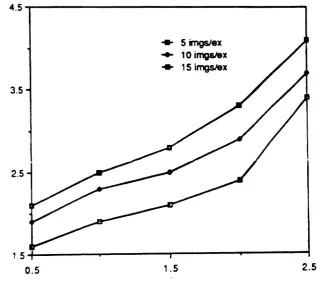
Some graphical results are presented in Fig. 6.3 to show the variation of the delay at the
interface with different exam sizes and arrival rates. Inthis case the network-wide
win-dow flow control is set to three transactions and the frame sizes on the links are set to 32
53
Figure 6.3Variation of delay at the interface with
different exam sizes and arrival rates.
(Txl=Tx2=l
sec,
WI=
W2 = 1, NetW =3,PI=
32~P2=
2Kb)4.5 ...- - - .
. . 5 imgsIex . . 10imgslex
. . 15imgsJex
3.5
2.5
2.5
1.5
1.5
-1---..,.---...,...----...,.----..,
0.5CHAPTER 7
C()NCLUS()NS
In this thesis a set of queueing network models were constructed with the intention of
obtaining performance measures of a PACS that included component systems from
dif-ferent vendors communicating through network interface units. The specific
configurations examined were display stations requesting images from and an acquisition
station archiving images onto a centralized image database. The performance measures
were the mean queue length and response at the interface; the end-to-end delay
encoun-tered when users at display stations requested images from the database in the first case and the throughput that could be sustained by the interface in the second configuration.
For the case of the acquisition station a simulation program was developed. Four
dif-ferent models were examined for the display station configuration. The ease of solution
and accuracy afforded by these models vary widely. A preliminary model is a
product-form queueing network but incorporates some unrealistic assumptions, rendering it
unsa-tisfactory in spite of its ease of solution even when workstations have different image
traffic workloads. Results are not illustrated in any detail except to draw a comparison between this model and the complete queueing network that had to be simulated in order
to extract performance measures. Two other approximations were developed. They are
based on some simplifying assumptions about the detailed model and are extremely easy
to solve. Analysis shows that both approximations over-estimate system capacity. The
55
REFERENCES
[1] D'Silva, V., "Design of a Picture Archival and Communications System Based on
Collected Data", Masters' Thesis, Dept. Of Elect. & Computer Engg., North Carolina
State University, 1986
[2] Almer, E. Arink, G. et al, "A Standard Product Interface for Digital Medical Imaging
Equipment", Proceedings ojSPIE, 1984
[3] ACR-NEMA, "Digital Imaging and Communications", Standards Publication 300,
1985
[4] Veran, M. and Potier, D., "A Portable Environment for Queueing Systems Modeling",
INRIA Report314, 1984
[5] Gelenbe, E., and Mitrani, I., "Analysis and Synthesis of Computer Systems",
Academic Press, 1980.
[6] Hegde, S. S., Gale, A. O. and Giunta, 'J. A. "AT&T PACS Architecture", SPIE Proceedings MedicineXWand PACSW, 1986
[7] Cox Jr., J. R., Blaine, G. J. et al, "Some Design Considerations for Picture Archiving
and Communications Systems",IEEE Computer, August 1983.
APPENDICES
1. Listing of the program to solve model 2
2. Listing of the program to solve model 3
3. Listing of the program to simulate the acquisition station
APPENDIX 1
.wa(arse, arr)
iat &riC;
claar ~;
(
FILE "pin, 'open
0;
enera FILE 'pout;
enera ~ coef!112g)[ 12i);
tat I, batch;
ester.
neal
lambda, mu; erleraneal
pbig, pmed, psmaJ..l;exi.era nod link, think,idle~req,prob;
fpiD
=
fopea(lI'IYil], 'r');fpoat
=
f.-(arr[21, 'wl) ;
fscaDl(fpiD, .~ ~r %t %d', &think, &link, &idle, heeL abatch );
prob = (batch-I);b&tc~
lambda = enl(link, think,idle,req,prob);
rsa.nC{rpin, '%C %r %fW
, &mu. &:pbig, kpmed )~
p!m.al1 = 1.0 - pbig - pmed: fdose(fpin);
popmat(lambda, m~ pbig, pmed, psmall, coeff);
tnnsmat();
pdrin();
}
.oicl popm.&i(lambcia, mu, pbil, pmed, psuWl. coe1T)
float lambda, mu, pOic, paaed., psmall, coeffl12~J[1%g
I;
{
ia" l. j; I1eai I1UIl; ia\ 11 = 1ft;
f... (i=O; i<~ i++) {
for (j=O; j<n; j,-+) { coe1l1i}[j; = 0.0;
}
~II~J ~=
: :
=:: :
:';:1;
r
lour • /::ftiO
~~
4 • lambda • pbic;tor (i=l; i<=3; i++) {
~~I:~~
:
alii :
~i~~=~~1
=:: :
=~
~32~~
-r 1)Jl32 + 32'{i-l)]=
mu - pbic;for (i=~ i<=2; i++) (
for U=l; j<=32: j ..._) (
} I' ,
-}
}
}
coli128} = 1.0;
}
ror (i=l; i<n; i++) ( 1 coetllill{i-I)I
=
mu;for (i=O; i< 129; i++) {
sum = G.O;
tor (j=O; j<l29; j++) {
} sum -'-= coelflilUj;
coetrliJliJ = -1.0 • I1UIl;
ror (i=O; i<l%9; i++) {
coetll~(128) = 1.0;
void ~iveO
extera noat coeff11n)(129f; extern noat qmt(129l(1291; extern noat col~l29I;
extern noat r~1129:
extern noat Jamb<1&, !I1U; exterll "oat phiC, pmed, psmall;
noat ••
~ &vlfrap, pi, pi, p3;i . t dim., I, j;
FILE -rpm, 'ropenO;
extern F~E "pout~
FILE "pda;
dim = l%V;
r... (i=O; i<12l; i++) colli}
=
0.0;gauelim(dim);
rpclia
=
ropeD ('tmp', ty ' );rpriDtt(Ipdb, • \Il\1U'OOtI of the aystem:\DI);
for (i=O; i<dim; i++) (
rpriDtf{fpdb, Ires[%d)
=
%1\11
1, I, res(i);
fclose(fpclia);
CpriDtf(fpout, 'Tdecamp = %« \IlI
, (1,/mu));
(printl(fpout, ·pbi( = %g psma1l
=
~01 \DI, pbil, psmall);
rprintr(rpout, ·prob.
or
empty system = %C\DI, res(OI);
avlambda = res!OJ ' 4 • l3mbda;
pi = O~
ror (i=l; i<=3~; i.+)
}
fprintf(fpout, 'mUll number
or
Crqmenu = %g\nl, aYlfrap); rclose( (pout);
}
p2 = p1;
for (i=33; i<==t4; i++) (
p2 += res(i); }
fprintl(rpout., wprob. of at least two exams
-p3 = p2;
ror (i=U; i<=tI; i++) {
p3 += res(i);
}
Cprintf{fpout, 'prob. of at least three aaIDI
=
%I\D·, pJ);aY'lfracs = 0;
r.r (i=l; i<=32; i++) {
a~ +- ( i ' ( rea(i) + res(33+i)J + res{(I5+i)) +
res((17+1)) ) );
void tnnsmat
0
{
erlera noat coetr1129H1291;
extern noat qmat{12~)(12gJ;
i.t iJ;
for (i=O; i<l2t; ++i) (
ror 0=0; j<l2t; ++j) {
qmat(jIIi)
=
coeft{i)(j);void gauelim(n}
iD~ n;
{
illt I, j, k, 1., place, temp, abbl, abb2, status; extern noat. qmat!12g!{12g}, CQ1(12~1;
ex&rerD Fn..E '!pout;
FILE "ptmp;
n.a&
piYOt, I1Ia;erlera n.aa, ns(12l);
#defiDe error 0
#defiDe eoati...e 1
fptmp = Copen(ltmp·, ·wl
) ; status = eo.t.i••e:
tor (i=l; i<n; i++) {
for (j=O; j<l; J++) {
pm,t-....t(i)(j)/cpaattJJ(j);
r... (k=j; k<n; k++) {
qmat{iJlk) = qmat(iJIk! - (qmatUl(k) • piTot);
}
}
}
elee
statu
=
8TOr';-uta... ==
0\_e);
}
ror (i=(Il-2); i>=e; i--) (
sum = CUt;
f.r (j=(i+l); j<a.; j++) {
sum += qmat(i)Ul - r~(j;:
}
ra(i]
=
(res{iJ - SWIl) / qmat(iJ[iJ;}
noat. eva.l(tagl,tag2,tag3,tag4)
noat. tagl,tag2,tagJ,ta«4;
{
noat yalue;
value
=
1.0~tacl+tac3+tac2 ~4);ret.rD(valQe~
#i.et.4e <...
>
#lad.4e <..aLIa:> maia(ucCy allY) i.t ~ claar ~i {FILE -rpm, "pout, 'ropea();
n..,
laabda. sent1, sent2;IIeat rho, q&ero, Dum, den, AD, AI, AJ., det, testl, telt2;
n..t
rap;IIeat tx;
n..t, t.t., root;
neat
mu~neat
psis;f1ea& m1l1, mu2;
n..t, bk. iii, thinkJdl~prob;
IIeat naI();
neat
pes!, error, delta, delay;f1eai pbi&, pmed, psmaI1;
neat NI, N2, Rl, R2;
i.t baicb.;
i.t niter, muiter;
rpm = ropeD(.rr(l], -re ) ;
rpoat
=
fopell(arr(21, 'we );fscanf'(Cpin.
leer
%r %r %r %d '. hhink, &id1e, &tx, heq, ~atch);rscanl(fpin, •%r %r %r', &servtl, &:sen~2, &pmed, ~mall ); fsant(lpin,'%f',&error);
rdose(lpm);
psm.all \= 1.0 - pbil - pmed;
preb
=
(batch-I) ~atch;sU
=
(puDall'2+
pmedts + pbic-:n);pIis - (sis - 1),Im;
link = t'X • !iz: mal = 1/senti;
mtl2
=
1jlernt;pelS
=
(dUBk+prob1d1e+req+liDk)II;delta = 100.0;
muur
=
0.1;InUita'
=
100:nnu = 0;
-lUte ( (abs(ddta) > maxerl') At~ (niter < m.a.xitu) ) { lambda = e...a1(lUess,thiDk,idl~eq,probJink); rho = lambda /mol;
cpero = 1 - psiI - rho;
Dum = lambda - pm'lambda + mal~ - ID1
-..u
"pm;den = (mal - lambda - mul~ir,)'mQl - La.wa - ••1~); Nl = mul • qsere • DWIl I den;
Rl
=
Nl / (lambda ~ m);A.O = mUl'mu2 - qtero~u2 + lambda);