on the BSI eIDAS Token
?Mirosław Kutyłowski, Lucjan Hanzlik??, Kamil Kluczniak? ? ? Faculty of Fundamental Problems of Technology, Wrocław University of Technology
{firstname.secondname}@pwr.edu.pl
Abstract. In this paper we present an extension of Pseudonymous Signature in-troduced by the German Federal BSI authority as a part of technical recommen-dations for electronic identity documents.
Without switching to pairing friendly groups we enhance the scheme so that: (a) the issuer does not know the private keys of the citizen (so it cannot imperson-ate the citizen), (b) a powerful adversary that breaks any number of ID cards created by the Issuer cannot forge new cards that could be proven as fake ones, (c) deanonymization of the pseudonyms used by a citizen is a multi-party proto-col, where the consent of each authority (e.g. a court) is necessary to reveal the identity of a user. (d) we propose extended features concerning fully anonymous signatures and a pragmatic revocation approach. (e) we present an argument for unlinkability (cross-domain anonymity) of the presented schemes.
In this way we make a step forwards to overcome the substantial weaknesses of the Pseudonymous Signature scheme. Moreover, the extension is on top of the original scheme with relatively small number of changes, following the strategy of reusing the previous schemes – thereby reducing the costs of potential tech-nology update.
1
Introduction
Introduction of strict personal data protection rules in the European regulation GDPR [13] creates a market for technical solutions that attempt to satisfy the requirements by-design. One of the solutions is to change the status from personal data to non-personal data. It suffices to ensure that the data does not concernidentifiable person. So changing explicit identification data by pseudonymous identity may solve the problem as long as the pseudonym cannot be linked with the pseudonym owner using available data. On the other hand, as already reflected by GDPR, the pseudonymization process should be reversible: in certain circumstances, like law enforcement, it might be neces-sary to link the pseudonym back to the original identity.
?
This paper is an extended raport, where an initial version, “Pseudonymous Signature on eI-DAS Token Implementation Based Privacy Threats”, has been presented at ACISP 2016. New results contained in this paper have been supported by National Science Centre (Poland) under grant OPUS no 2014/15/B/ST6/02837
??
current affiliation: Stanford University, USA
? ? ?
Domains specific pseudonyms.
There might be many strategies to replace the real identity with pseudonyms. Re-placing the ID with a single pseudonym is very likely to be totally ineffective: high amount of data related to a single pseudonym enables eliminating all candidates but the pseudonym owner. So the best solution would be to use the same pseudonym only when it is necessary to indicate that the same (anonymous) person is concerned. These leads to the concept of adomain, which is a virtual environment where all activities of a physical person should be linked together (so a single pseudonym per person should be used), while activities within domain should not be linked with activities outside the domain.
The concept of domains appeared probably for the first time in Austria together with the concept ofBürgerkarte. The domains have been defined as different areas of public administration. The solution has been based on symmetric cryptography and enabled the user to create a domain specific password. The main invention was to prevent using the password from one domain in another domain. Otherwise the solution is not stronger than one could achieve with symmetric cryptography.
The Austrian concept of domains have been reused by German authorities with in-troduction of Restricted Identification on electronic personal identity documents [7]. A single (asymmetric) key stored on an ID card enables to create exactly one crypto-graphic pseudonym per domain, which serves as a password authenticating the request.
Domain specific pseudonymous signatures.
The main advantage and disadvantage of Restricted Identification is that the scheme creates a volatile proof. The advantage is that as a volatile proof it cannot be misused as it does not create an undeniable digital data. The disadvantage is that one the pass-word created by Restricted Identification has been learned by a malicious party (e.g. via leaking from the target system), it can be used to authenticate as the legitimate user. Moreover, it cannot authenticate any digital data contributed by the user.
Domain specific pseudonymous signature is a concept that:
• a user hold exactly one signing key (or set of keys of a fixed size),
• for any given domain, the user may create its pseudonym using their signing key; the pseudonyms acts simultaneously as a public of this person,
• given domainD and digital data M, a user can create its signature for M; the signature points toDas well as the pseudonym of the signer in domainD,
• the verification process requires the name of domain, signer’s pseudonym in this domain, the signature and the signed data. The verification result is negative if, among others, there is mismatch in the domain name or the pseudonym.
mentioned in [7]; the second one enables deanonymization of the signer. For more about the formal concept of domain signatures see [11].
Applications. There is a large number of potential applications for domain specific pseudonymous signatures. For typical cases and a classification of such schemes see [3], but let us name just a few ones:
anonymous authentication: domain specific pseudonymous signature might be a part of a challenge-response authentication mechanism, where the user authenticates themselves under domain specific pseudonym. This option has been used for Chip Authentication v.3 from [7] – this scheme is an improvement over the former method based on Chip Authentication with Restricted Identification.
authenticating database entries: if a database consists from records that need to be strongly authenticated, then a good way is to attach a pseudonymous signature of the author for each record. The domain in this case is a database.
self-organization in ad hoc groups: suppose that a self-organization algorithm has to be executed in a group of users that has emerged ad hoc. If the domain is an ad hoc one, related to the group and the situation in which the self-organization algorithm is run, then we may use the domain specific pseudonyms of the users as a source of randomness for the algorithm, thereby derandomizing it in a verifiable way. The signatures can be used to authenticate the data presented by the participants as well as the pseudonyms. For further details see [8].
Previous schemes.
While Pseudonymous Signature presented in [1, 2, 7] is the initial scheme developed in Germany, a few other schemes have followed it, but all of them have been based on pairings friendly groups. The first scheme is due to a French team ([4, 5], see also [10]). Then a few improved schemes for different scenarios have been developed by Kluczniak [9]. A version based on self-created certificates has been presented by M.Wszoła and Marcin Słowik during CECC 2017 (see [3] for a concise description of the scheme). A scheme dealing with “two-dimensional” domains and deanonymizations along dimen-sions has been presented in [8].
As far as Pseudonymous Signature from [1] are concerned, the only following secu-rity report has been published in [12]. Later in this paper we recall its conclusions and countermeasures proposed.
1.1 Paper contribution
The goal of this paper is to improve the Pseudonymous Signature by eliminating its weaknesses – both known before as well as a few ones presented in this paper. We work under the assumption that all countermeasures need to work for standard groups, without retreating to pairings friendly groups. This is motivated by the fact that there are some concerns (economic and technical ones) against wide scale transition to pairing friendly groups.
• the private keys of the user are known only for the user, the Issuer has no longer access to them (we follow the approach from [12]),
• the Issuer has no longer possibility to create trapdoor information for tracing links between pseudonyms in different domains (we defer the attacks presented in [12]),
• despite the ability of the user to create own private keys, the Issuer together with a Control Authority has possibility to deanonymize the domain specific pseudonym of the user, deanonymization by the Issuer alone is infeasible,
• there is a limited seclusiveness property: if a given user has not been enrolled to the system by the Issuer, then it can be proved during a deanonymization procedure, (However, detection is not automatic during a standard signature verification.)
• we propose a framework of certificates-of-health as an effective solution for Pseudony-mous Signature revocation (as well as an ultimate solution for the seclusiveness problem) – lack of a pragmatic revocation procedure have been limiting the scope of applications of Pseudonymous Signature to low risk areas, even in case of schemes based on pairing friendly groups where seclusiveness problem has been solved, (ac-cording to [1] the Issuer together with each domain authority creates a blacklist of revoked user – which is not practical if the number of domains is large),
• we present an proof for unlinkability, thereby filling the crucial gap due to problems regarding the argument from [1],
• we extend the scheme so that if only part of the pseudonym is given, then the signatures of a user in a domain remain linkable, but deanonymization is infeasible.
2
Pseudonymous Signature
2.1 Pseudonymous Signature from BSI Technical Recommendation [7]
Let us recall the Pseudonymous Signature Protocol described in the BSI Technical Rec-ommendation [7]. Note that an almost the same protocol has been published by the same authors in the paper [1]; we shall discuss the differences shortly and the end of this section.
Setup. The scheme uses a groupGof a prime orderq. The DDH Problem forGmust be hard. Moreover, specification ofGmust point to a generatorg∈ G.
During the setup process the Issuer creates its system keys:
• secret keysSKICC,SKM ∈Zq,
• public keysPKICC,PKM ∈ G, wherePKICC=gSKICCandPKM =gSKM.
One of peculiar properties of the scheme described in [7] is that the keysPKM,SKM are long term keys, whilePKICC,SKICCchange periodically.
User’s keys. The user gets a signing device with the following keys installed there by the Issuer:
• private key(x0, x1)such thatSKICC =x0+x1·SKM modq,
Setup of a domain. For a domainD, a public keyPKDis defined. There are two ways to do it: according to the first option the discrete logarithm ofPKDis not known to any party. A way to realize it is to computePKDby hashing the domain’s official name (the hashing function has to map intoG). According to the second option,PKD=gd, where
dis a secret key. The keydcan be divided into parts:d=r·R, whereris known only to the Issuer andRis known only to the domain’s authority.
Domain pseudonyms of a user. In a domainDwith the public keyPKD, a user holding the keysx0, x1has identifiersI0D,I1D, where
I0:= (PKD)x0 and I1:= (PKD)x1 .
According to the specification, it is possible to use the scheme with just one of the pseudonym components or even to create a signature without indicating the pseudonym.
Creating a signature. A device holding the keysx0, x1creates a signature formand
domain with the public keyPKDin the following way:
• choosek0,k1< qat random,
• computeQ:=gk0·PKk1 M,
• compute the pseudonymsI0:= (PKD)x0,I1:= (PKD)x1,
• [optional?] compute the commitmentsA0:= (PKD)k0,A1:= (PKD)k1,
• compute
c:=Hash(Q, I0, A0, I1, A1,PKD, m), (1)
• computes0:=k0−c·x0modq, s1:=k1−c·x1modq,
• output the signature(c, s0, s1)together with the pseudonymsI0, I1.
Verification of a signature. Given the signature(c, s0, s1)and pseudonymsI0, I1, the
following steps are executed by a verifier:
• reconstructQasQ0 := (PKICC)c·gs0·(PKM)s1,
• reconstructA0asA00:= (PKD)s0·(I0)c,
• reconstructA1asA01:= (PKD)s1·(I1)c,
• accept the signature if and only if
c=Hash(Q0, I0, A00, I1, A01,PKD, m)
Note:There are slight differences between the version of the algorithm presented in [1] and in [7]. In [1] onlyI0andA0are used andI1, A1are skipped. The
3
Problems
3.1 Securing against the Issuer
• According to [7], the Issuer creates the private keys for each user and during this process has full access to them. As the Issuer may retain these keys (or modify the generation process so that the domain key of a user can be recovered later), there is a silent assumption that the Issuer is unconditionally honest.
• The above problem has been solved in [12]. According to the modified scheme a user personalizes the private keys, so that they is protected against Issuer aiming to forge signatures of the user. However, this is a double edged sword: the technique applied in [12] prevents (controlled) deanonymization of the user. On the other hand, such a special deanonymization procedure is necessary for most practical applications.
The goal of this paper is to enable personalization such that deanonymization remains possible on a cryptographic way even if the user does not register the personalized public keys.
3.2 External Hash Attack
Below we discuss an attack that may happen, if an implementation of the scheme is not careful enough and does not take care of some details that are not included in the original documentation. Namely, we show that a likely implementation of Pseudony-mous Signature can lead to a situation where creating users gets out of control and a PC communicating with 2 different electronic identity documents can create Pseudony-mous Signatures attributed to a new identity. Therefore, in such a case seclusiveness property does not really hold, despite that there is no physical attack against the identity documents.
The attack has the following background:
• One of the operations performed during signature creation is computing the value
c=Hash(Q, I0, A0, I1, A1,PKD, m)for a messagemto be signed. However,m might be a very long document and sending it to the signing device and computing the hashcthere would be quite tedious. If for example computing a hash value of a 256-bit block on a smart card takes 5ms, then signing a 4MB document (a photo) would take over 10 minutes due to the hashing effort.
• None of the arguments used for computingc is confidential. What is more, they are explicitly used during a standard signature verification. Therefore, it seems to be harmless to outsource this computation to the computer, from which the signing request originates. Definitely, this would solve the problem of computing a hash value for a long documentm.
• One can also argue that even if PC is malicious and sends a manipulated value
Given protocol specification and the arguments raised above, it seems acceptable tooutsource computing the hash c to the machine interacting with the identity document. Sometimes, to be on the safe side (“random” properties of the hash output) it is required that the final stage of computing the hash value is performed by the signing device.
Attack description. For the attack described below we assume that the implementation of Pseudonymous Signature outsources computation of the hashc, at least up to the moment whenA1is fully processed.
Steps of the attack performed by a computerC:
1. Copens communication with two different identity documents, sayU andV. Let
x0,U, x1,Uandx0,V, x1,V denote their private keys. 2. Csends signing requests toUandV.
3. Ureturns the valuesQ, I0, A0, I1, A1, while deviceV returnsQ0, I00, A00, I10, A01.
4. Cchoosesαat random and computes:
• Qˆ :=Qα·Q01−α
• Aˆ0:=Aα0 ·A00 1−α
• Aˆ1:=Aα1 ·A01 1−α
• Iˆ0:=I0α·I00 1−α
• Iˆ1:=I1α·I10 1−α
• c:=Hash( ˆQ,Iˆ0,Aˆ0,Iˆ1,Aˆ1,PKD, m) and returnscboth toU andV.
5. Ucomputes the signature valuess0, s1and returns them toC,
analogously,V computes the signature valuess00, s01and returns them toC.
6. Ccomputessˆ0:=α·s0+ (1−α)·s00 andˆs1:=α·s1+ (1−α)·s01.
7. Finally,Coutputs the signature(c,sˆ0,sˆ1)for an (artificial) identityIˆ0,Iˆ1.
Fact 1 (c,ˆs0,sˆ1)is a valid Pseudonymous Signature for pseudonymous identityIˆ0,Iˆ1
and the messagem.
Proof. The verification procedure yields the positive result if
ˆ
Q= (PKICC)c·gsˆ0·(PKM)ˆs1 ˆ
A0= (PKD)ˆs0·( ˆI0)c
ˆ
A01= (PKD)ˆs1·( ˆI1)c
We have
(PKICC)c·gˆs0·(PKM)ˆs1 = (PKICC)c·gα·s0+(1−α)·s
0
0·(PKM)α·s1+(1−α)·s
0
1
= (PKICC)c·gα·s0·g(1−α)·s
0
0·(PK
M)α·s1·(PKM)(1−α)·s
0
1
=(PKICC)c·α·gα·s0·(PKM)α·s1
·(PKICC)c·(1−α)g(1−α)·s
0
0·(PK
M)(1−α)·s
0
1
Moreover,
(PKD)ˆs0·( ˆI0)c = (PKD)α·s0+(1−α)·s
0
0·(Iα
0 ·I00 1−α
)c = (PKD)α·s0·(I0α)
c·(PK
D)(1−α)·s
0
0·(I0
0) 1−α)c = (PKs0
D·I c
0)α·(PKD)s
0
0·(I0
0)c)1−α=Aα0 ·(A00)1−α= ˆA0.
Analogously, one can check thatAˆ01= (PKD)s1ˆ ·( ˆI1)c. ut
One might hope that the identities created by the attack are in some sense specific and that some test (different from the standard verification procedure) might indicate the attack. Unfortunately, this is not the case:
• The user private keysx0, x1satisfy the linear equationSKICC=x0+x1·SKM mod
q, so all valid keys form a 1-dimensional affine subspace ofZ2q.
• The keysˆx0,xˆ1 created by the attack form an affine subspace of dimension one.
Therefore, each private key pair can be obtained in this way.
Attack countermeasures. A simple change that disables the above mentioned attack is to compute the hashcvia the following equation.
c=Hash(Q, I0, A0, I1, A1,PKD,Hash(m))
In this scenario the signing device receives the inputHash(m)and therefore can easily perform the whole computation itself. Another approach could be to takemas the first argument for hashing:
c=Hash(m, Q, I0, A0, I1, A1,PKD)
In this approach the computation can be outsourced to a PC until the time when the wholemis consumed.
4
Pseudonymous Signature 2.0
In this section we present an enhancement of the scheme presented in [12] (as well as [7]). The current solution eliminates the following problems:
• the Issuer does not know the secret keys of the user (as in [12], but not [7]),
• a user is not forced to register after private key personalization in order to enable deanonymization,
• enables detection of forged identities created after breaking into some number of identity documents,
Setup. We use a groupGof a prime orderqsatisfying the same properties as for the original Pseudonymous Signature. Letgbe a chosen generator ofG.
• The Issuer holds the following system keys used for generating private keys of the users:
- secret keysSKICC,SKM,SKL∈Zqchosen at random, - the corresponding public keysPKICC,PKM,PKL, where
PKICC=gSKICC, PKM =gSKM, PKL=gSKL.
• For deanonymization purposes, the Issuer holds the following keys: - private keysδ,γchosen at random,
- the corresponding public keys∆,Γ, where
∆=gδ and Γ =gγ.
• For auxiliary purposes (signing database entries), the Issuer also holds keys for creating standard electronic signatures.
User’s pre-keys. The Issuer prepares a signing device with the following keys:
• a private key(x00, x01, x02)such that
SKICC=x00+x01·SKM +x02·SKLmodq ,
IDA =x01·γ+x02·δmodq ,
whereIDAis an ID token of the user (see below for the ID token specification),
• a twin private key(x000, x001, x002)satisfying the same system of linear equations:
SKICC=x000+x001·SKM+x002·SKLmodq ,
IDA =x001·γ+x002·δmodq ,
• and the corresponding public keys(P00, P10, P20)and(P000, P100, P200), where
(P00, P10, P20) = (gx
0
0, gx
0
1, gx
0
2), (P00
0, P100, P200) = (gx
00
0, gx
00
1, gx
00
2).
For this purposex01 ∈ Zq (respectively,x001) is chosen at random, andx02, x00
(respec-tively,x00
2, x000) are derived based on the linear equations presented above.
The signing device containing(x0
0, x01, x02),(x000, x001, x002)is given the the user. At the
CreatingIDA. The following procedure is executed by the Issuer when enrolling a user
A. Among others, during the execution an entry concerningAis stored in a database
DBIDrun by the Issuer.
1. chooses∈Zqindependently at random, setIDA=s, 2. store a signed record containing(gIDA, A)in the databaseDB
ID. (The valueIDAis not published and should be destroyed.)
If the identity of users that have the signing devices is not to be published, then the publicly available part ofDBIDmay contain the entries(gIDA,SignIssuer(gIDA)).
Note that the construction opens room for a further improvements, where the Issuer chooses numberssfrom some subset of all possible exponents, but recognizing whether
gshas been created in this way requires a trapdoor from the Issuer.
Signing key personalization. The user personalizes the pre-keys so that the Issuer loses control over the private keys in a signing device, even if the pre-keys are retained by the Issuer. We follow the approach presented in [12]:
• the user choosesαat random and setsβ := 1−αmodq, the valueαis presented to the signing device,
• the signing device sets the signing key to(x0, x1, x2), where
(x0, x1, x2) =α·(x00, x
0
1, x
0
2) +β·(x
00
0, x
00
1, x
00
2) modq
Note that(x0, x1, x2)satisfies the same system of linear equations:
SKICC=x0+x1·SKM +x2·SKLmodq
IDA =x1·γ+x2·δmodq
(2)
• the public keys(P0, P1, P2) corresponding to the personalized private keys are
computed according to the formula
Pi= (Pi0) α
·(Pi00)β for i= 0,1,2. (3) Note that this computation can be done by the user outside the signing device.
The user may verify that the signing device has installed the private key according to the method described above. The detailed procedure based on the equalities (3) is presented below after describing the pseudonym creation and signing processes.
Domain’s parameters. For each domain there are assigned three public keysPKdom,
PKdom,PKdom. The public keyPKdom is created by hashing the domain name (so its discrete logarithm is not known with very high probability). The two other public keys fulfil the following equalities:
PKdom=gd1·d2, PKdom=∆d1·d2
where the exponentd1is chosen at random by the Issuer and the exponentd2is chosen
Creating a signature. Assume thatPKdom,PKdom,PKdomare the domain parameters of a domain for which a user holding(x0, x1, x2)has to signm. The signing procedure
is analogous to the procedure from [7]:
• choosek0,k1,k2random,
• computeQ=gk0·PKk1 M ·PK
k2 L,
• compute domain specific pseudonyms of the signer:
I0= (PKdom) x0, I
1= (PKdom)x1, I2= (PKdom)x2 ,
• [optional1] compute commitments to random elementsk0,k1,k2:
A0= (PKdom) k0, A
1= (PKdom)k1, A2= (PKdom)k2,
• for a messagemto be signed compute
c=Hash(Q, I0, A0, I1, A1,PKdom, I2, A2,Hash(m)),
• compute the second components of Schnorr signatures:
s0=k0−c·x0modq, s1=k1−c·x1modq, s2=k2−c·x2modq ,
• output signature(c, s0, s1, s2)together with pseudonymsI0,I1,I2and the identity
of the domain concerned.
Verification of a signature. The verification is a simple extension of the verification procedure of the Pseudonymous Signature [7]:
• recomputeQas
Q0 = (PKICC)c·gs0·(PKM)s1·(PKL)s2
• reconstructA0asA00= (PKdom) s0·(I
0)c,
• reconstructA1asA01= (PKdom)s1·(I1)c,
reconstructA2asA02= (PKdom)s2·(I2)c,
• accept the signature iff
c=Hash(Q0, I0, A00, I1, A01,PKdom, I2, A02,Hash(m))
1
Verifying initialization of the keys. Potentially, the signing device might pretend to follow the procedure of device initialization, but instead of initializing the private keys according to the equality (2), it might install some predefined values known to the Is-suer, thereby enabling it to create signature on behalf of the user. The following proce-dure enables to check that the keys are set according to (2):
1. a user choosesr0, r1, r2at random and ask the device for a signature for a domain
with parametersPKdom,PKdom,PKdom, where
PKdom=g
r0, PK
dom=gr1, PKdom=gr2,
2. when a signature with pseudonymsI0, I1, I2is returned, then the user checks that:
I0= ((P00)
α·(P00
0)
β)r0, I
1= ((P10)
α·(P00
1)
β)r1, I
2= ((P20)
α·(P00
2)
β)r2 A user can also check that hisIDAhas been correctly marked in the databaseDBID. That is, the entrygIDA should be contained there. For this purpose the following steps
are executed:
1. the user choosesrat random and creates artificial domain parameters:PKdom =
∆r,PK
dom=Γr,
2. the user asks the signing device for a domain signature for such domain parameters, 3. the signing device returns a signature with pseudonymsI1,I2,
4. the user computesS = (I1·I2)r
−1modq
and check whetherS is on the publicly available part ofDBID.
Deanonymization. Let us assume that in a domain with parametersPKdom,PKdom,
PKdom there is a misbehaving user with a pseudonymI0,I1,I2. Then the following
steps are executed:
• The domain authority (holdingd2) computes
I10 :=I
d−1 2 modq
1 , I
0
2:=I
d−1 2 modq
2
• The Control Authority (holdingd1) computes
I100:= (I10)d−11modq, I00
2 := (I
0
2)
d−11modq The resulting values areI100=gx1,I00
2 =∆x2.
• Finally, the Issuer computesI= (I00
1)γ·I200, which should be equal togIDA.
• the Issuer looks for an entryIinDBIDand finds the identityAof the misbehaving user.
Note that all computations (raising to powers) can be accompanied by some proof of correctness.
Remark 1. One may observe that the Control Authority and the domain authority may
derivegx1 (by performing analogous steps for the pseudonymI
0). So linking between
Fully anonymous version. Let us recall that in our construction we have used the domain parameterPKdom, for which the discrete logarithm is not known. Introducing such domain parameter has been possible sincePKdomandPKdomenable deanonymiza-tion. On the other hand, this opens a option for creating signatures, where only the pseudonymI0 = (PKdom)x0 is presented. Such signatures are bound to the given do-main, all signatures of the same user in this domain can be immediately linked, but it is infeasible to recover the identity of the user via deanonymization procedure as long as
I0is not used together withI1, I2in any signature in this domain.
A similar possibility has been indicated for [7], but then we had two choices: First, the domain parameters could be generated so that the discrete logarithm is not known. In this case every signature in this domain is anonymous. The other case is that no pseudonym is given in the signature (it does not appear as an argument of the hash in (1). In this case the signatures created by the same user in this domain cannot be linked.
5
Comparison
Table 1 presents the proposed algorithm and its basic version from [7] in a tabular form. The new or changed elements in our scheme are presented in the red color.
BSI Pseudonymous Signature [7] Pseudonymous Signature 2.0
System setup
PKICC=gSKICC PKICC=gSKICC
PKM =gSKM PKM =gSKM
PKL=gSKL
∆=gδ
, Γ =gγ
Domain setup
PKdom=gd1·d2 PKdom, PKdom=gd1·d2, PKdom=∆d1·d2
User keys
x0, x1 x0, x1,x2
where: where:
SKICC=x0+x1·SKM SKICC=x0+x1·SKM+x2·SKL
IDA=x1·γ+x2·δ
Signature creation
choosek0,k1at random choosek0,k1,k2at random Q=gk0·PKk1
M Q=g
k0·PKk1
M ·PK
k2 L
I0= (PKdom)x0,I1= (PKdom)x1 I0= (PKdom)
x0,I
1= (PKdom)x1,I2= (PKdom)x2
A0= (PKdom)k0,A1= (PKdom)k1, A0= (PKdom)k0,A1 = (PKdom)k1,A2= (PKdom)k2
c=Hash(Q, I0, A0, I1, A1,PKdom, m) c=Hash(Q, I0, A0, I1, A1,PKdom,I2,A2,Hash(m))
s0=k0−c·x0,s1=k1−c·x1 s0=k0−c·x0,s1=k1−c·x1,s2=k2−c·x2
Signature verification
Q0= (PKICC)c·gs0·(PK
M)s1 Q0= (PKICC)c·gs0·(PKM)s1·(PKL)s2
A00= (PKdom)s0·(I0)c A00= (PKdom)
s0·(I 0)c
A01= (PKdom)s1·(I1)c A01= (PKdom)s1·(I1)c
A02= (PKdom)s2·(I2)c
c=? Hash(Q0, I0, A00, I1, A01,PKdom, m)c ?
=Hash(Q0, I0, A00, I1, A01,PKdom,I2,A02,Hash(m))
Deanonymization / checking ID validity
I10 :=I
d−21
1 I
0
1:=I
d−21
1 ,I
0 2 :=I
d−21
2 (domain authority) I:= (I10)
d−11
I100:= (I
0
1)
d−11
,I200:= (I 0 2)
d−11
(Control Authority)
I:= (I100)γ·(I 00
2) (Issuer)
check forIin the database of the Issuer check forIin the databaseDBID
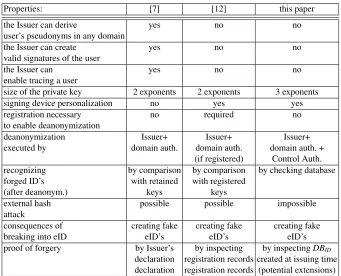
Properties: [7] [12] this paper
the Issuer can derive yes no no
user’s pseudonyms in any domain
the Issuer can create yes no no
valid signatures of the user
the Issuer can yes no no
enable tracing a user
size of the private key 2 exponents 2 exponents 3 exponents
signing device personalization no yes yes
registration necessary no required no
to enable deanonymization
deanonymization Issuer+ Issuer+ Issuer+
executed by domain auth. domain auth. domain auth. + (if registered) Control Auth. recognizing by comparison by comparison by checking database forged ID’s with retained with registered
(after deanonym.) keys keys
external hash possible possible impossible
attack
consequences of creating fake creating fake creating fake
breaking into eID eID’s eID’s eID’s
proof of forgery by Issuer’s by inspecting by inspectingDBID
declaration registration records created at issuing time declaration registration records (potential extensions)
6
Security
6.1 Seclusiveness
As for the scheme [7] breaking into a small number of signing devices may create problems. Indeed, after breaking into three signing devices the adversary gets three triples(x0, x1, x2)that satisfy
SKICC=x0+x1·SKM+x2·SKL Thereby the adversary may deriveSKICC,SKM,SKL. The equality
IDA=x1·γ+x2·δ
is more problematic, since each new broken device brings one new equality but also a new unknownIDA(note thatIDAis not stored inside the device and not available in
DBID). Therefore it is infeasible to deriveγandδ.
It follows that an adversary may create signing devices that create signatures ac-cepted via the regular verification procedure. However, in order to escape detection of a forgery after executing the deanonymization procedure the adversary would have to usex1,x2such that
gs=∆x1·Γx2 (4)
for some entrygs from the database, wheres is secret. For modelling the attack we have to assume that the adversary knows some number of entriesvand keysx01andx02
such thatv=∆x01·Γx02.
First assume that an adversary knowsx1, x2such that (4) holds and can find
dif-ferent keysx01, x02, which point to the samegs through running the deanonymization procedure. We shall see that in this case it would be possible to break the discrete loga-rithm problem. Namely, assume that for an inputUwe aim to findusuch thatU =gu. First we chooser1andr2at random and set∆ =gr1,Γ = Ur2. Then we choose at
randomx1, x2and create an entry (gsfrom (4)) equal to∆x1Γx2. We feed these data
to the adversary and obtain back different keysx01, x02such that
∆x01Γx
0
2 =∆x1Γx2 . Then
∆(x01−x1)/(x2−x02)=Γ, so gr1·(x01−x1)/(x2−x02)=Ur2 and the sought discrete logarithm equals r1·(x01−x1)
(x2−x02)·r2 modulo the group order. If an adversary can findx01, x02such that∆x01Γx
0
2equals another entry in the database, then we provide a similar argument. We set such an entry asgr0, and provide the system parameters of the form∆=gr1 andΓ =Ur2, wherer
0, r1, r2are chosen at random.
Then a solutionx01, x02given by the adversary satisfies
gr0 =gr1·x10 ·Ur2·x02 .
Consequently, the discrete logarithm ofU equalsr0−r1·x01 r2·x02
6.2 Malicious Issuer
We concern here the problem of effectiveness of personalization of the signing keys. The Issuer knows the pre-keys, so the question is whether he can link the set of keys be-fore personalization with the keys after personalization. The second question is whether the Issuer can impersonate the user once his public keys after personalization are given (in principle, this may not require to learn the identity of the user).
Theorem 2. If the Issuer can link the private keys before personalization to the public keys after personalization, then the Issuer can solve the DDH problem as well.
Proof. Assume that the Issuer learnsI0=PKx0dom,I1=PKx1dom,I2=PK
x2
domand has to decide whether they correspond tox00, x01, x02, x000, x001, x002. It corresponds to the question whether there isαsuch that
xi=αx0i+ (1−α)x 00
i fori= 0,1,2. These equations are equivalent to
(xi−x0i) =α(x0i−x0i) + (1−α)(x00i −x0i) fori= 0,1,2. which in turn reduces to the question whether there isβsuch that
(xi−x0i) =β(x 00 i −x
0
i) fori= 0,1,2. This corresponds to existence ofβfulfilling the equalities
I0/PK
x0
0 dom=PK
(x00
0−x
0
0)β
dom , I1/PK
x0
1 dom=PK
(x00
1−x
0
1)β
dom , I2/PK
x02 dom=PK
(x002−x02)β dom (5)
LetAbe an algorithm that enables to check if there is suchβ. We use it to solve the Problem of Equality of 3 Discrete Logarithms. That is, given an instance(A, B, C, D, E, F) we have to decide whether there isζsuch thatAζ =B,Cζ =D, andEζ =F.
Note that the DDH problem is the problem of equality of 2 logarithms: given an instance (A, B, C, D) we have to decide whether there is ζ such that Aζ = B,
Cζ =D. Obviously, solving DDH implies solving Problem of Equality of 3 Discrete Logarithms. Also solving the later problem implies solving problem of equality of 2 logarithms: given(A, B, C, D)we choose r, r0 at random and solve the question for (A, B, C, D, ArCr0, BrDr0)(one can see that if for(A, B, C, D)the answer is nega-tive, thenArCr0, BrDr0 is uniformly distributed).
Now we prepare an input for algorithmA:
- choosex0i, x00i at random fori= 0,1,2, - setPKdom=A(x000−x00)−1,PK
dom=C(x
00
1−x
0
1)
−1
,PKdom=E(x
00
2−x
0
2)
−1
- setI0=B·PK
x00
dom,I1=D·PK
x01
dom,I2=F·PK
x0
2 dom,
Then for the tuple(A, B, C, D, E, F)the answer is positive, if and only if there isβ,
Remark 2. Theorem 2 can be extended to the version where the Issuer is given sig-natures of the user over messages of his choice, under the assumption of the Random Oracle Model.
Corollary 1. If the Issuer can forge signatures of a user, given his pre-keys and the public keys after personalization, then he will be able forge the signatures of users for which he does not know the pre-keys.
Proof. Any difference in forging capabilities would contradict Theorem 2. ut
The above corollary says that creating the pre-keys does not endanger the user. Note that this holds despite that the user cannot personalize his keys to get an arbitrary valid triple of keys satisfying (2). Note that the situation is less obvious than in case of the scheme from [12], where any pair of keys could be derived during the personalization process.
6.3 Unlinkability
As pointed out in [6, 10] unlinkability proof from [1] is faulty, so at the moment we are missing even the proof for the standard [7]. The situation in our case is even more complex due to more relationships between the secret key components.
We express unlinkability property in the same way as in [9]: given the pseudonyms and signatures of a user in all domains except for a domain with parameters PKdom,
PKdom,PKdom, we wish to determine whether given pseudonymsI0, I1, I2in this
do-main correspond to the key(x0, x1, x2):
I0=PKx0dom, I1=PKx1dom, I2=PK
x2 dom
or have been created as
I0=PK
x00
dom, I1=PK
x01
dom, I2=PK
x02 dom
where(x00, x01, x02)have been chosen at random from the set of valid keys. “Unlinka-bility” means that it is infeasible to distinguish between these two cases given that the challenger chooses the option to present with probability 12 and that the discrete log-arithms ofPKdom,PKdom,PKdomare not known. However, following the construction we know that two discrete logarithms are equal:PKdom =gd,PKdom =∆dfor some (unknown)d.
Our strategy is to show that the case of unlinkability for the scheme [1] (called below the basic scheme) would be solved if unlinkability would be violated for our scheme. For this purpose we build a reduction where a case from the basic scheme is converted to a case for an adversary breaking unlinkability of our scheme. So we deal with a case when a user holds private keysx0andx1. The corresponding pseudonyms
are generated with these keys.
For our scheme we need three keys as well as new system keysSKLandδ, γ. First we takeωat random and set:
The keyδ, γare chosen at random.
The next step is to convert thex0andx1from the basic scheme to keysx00, x01, x02.
We putx00=x0,x01is chosen at random, whilex02is chosen so that
x1=x01+x02·ω .
Of course, we cannot compute these keys explicitly. However note that
SKICC=x0+SKM·x1=x00+SKM·(x01+x
0
2·ω) =x
0
0+SKM·x01+SKL·x02
and so the new keys fulfill the property required by our scheme.
Having the new keys one has to show how to create pseudonyms in our new case when having the pseudonyms in the corresponding domains of the basic scheme. First, as PKdom is a result of a pseudorandom process, we can program the oracle to get
PKdom= (PKdom)r, whereris chosen independently at random for each domain. Then the pseudonym corresponding to PKdom equals I00 = (I0)r. In the next step we set
PK0dom = PKdom. Then the new pseudonym I10 is simply (PKdom)x
0
1 (recall that we knowx01). The third domain parameter isPK0dom= (PK0dom)δ. So we have to derive the pseudonymI20 = (PK0dom)x02– while of course we do not knowx0
2. Note that
(x1−x01)/ω=x02.
Therefore it suffices to compute
(PKdom)δ)(x1−x
0
1)/ω, or equivalently ((PK
dom)x1)/(PKdom)x
0
1))δ/ω. As(PKdom)x1 is known (as the pseudonym in the basic scheme), we can compute the right-hand side expression.
The next problem is to convert the signatures created in the basic scheme into sig-natures created in our scheme. Let (c, s0, s1)be such a signature. Then in particular
s1=k1−c·x1. As we shall program the hash oracle, let us note that finally we shall
get the a signature of the form(c, s0, s01, s02). First we choosek10 at random and set
s01=k01−c·x01. For the components02note that
s1=k1−c·(x01+x02·ω)
Ass01=k01−c·x01, we can rewrite the last equation:
s1−s01=k1−k10 +c·x
0
1−c·(x
0
1+x
0
2·ω) = (k1−k01) +c·x
0
2·ω
So finally
(s1−s01)/ω= (k1−k01)/ω+c·x02
and we sets02= (s1−s01)/ω. For the hash oracle we set
c=Hash(Q0, I00, A00, I10, A01,PKdom, I20, A
0
where
Q0= (PKICC)c·gs0·(PKM)s
0
1·(PK L)s
0
2
A00=A0
A01= (PKdom)k
0
1
A02= (PK0dom)s02·(I0
2)
c
(Note that we could completely replace the computation ofA00, A01, A02by the one used by verification. This is possible as we program the hash oracle).
It is easy to see that the transformation of pseudonyms results in pseudonyms cor-responding tox00, x01, x02if in the basic scheme we had the pseudonyms corresponding
tox0, x1. If this is not the case, and, say, the pseudonyms correspond to some different
y0, y1. However, in this casey0 6=x0, as all valid keys have to satisfy the same linear
equation. Consequently,I00 =Ir
0 =gy0r 6=gx0r. One can see also thatI20 would also
be different, then derived fromx1.
Remark 3. The same technique as above can be used to reduce the question of
unlink-ability for the scheme [1] to an artificial scheme, where a user holds only one secret key and the signature scheme reduces to Schnorr signatures where the base element is
PKdom. (Of course, such a scheme is useless as it is impossible to show seclusiveness property.) On the other hand, for the artificial scheme unlinkability property can be re-duced to the DDH problem, as long as we can program the hash oracle. Consequently we may claim that the proposed schemes, including the standard [7], indeed satisfies unlinkability property.
6.4 Unforgeability
The argument for unforgeability of the scheme follows the same steps as for [1] and is based on the Forking Lemma.
7
Seclusiveness and revocation with certificates-of-health
From the practical point of view, the main problem related to domain specific signatures might be checking the status of the signature keys. Indeed, if the signature scheme has to be used to any serious application, then we have to take into account that the signing devices are sometime lost or stolen, the keys might be compromised, etc. This fundamental problem has not been addressed so far in the literature. In particular, the schemes based on pairing friendly groups solve the seclusiveness problem but provide no answer how to revoke the signing keys.
known in which domains a user might be active, the white or blacklist should be up-dated for each single domain when a status change occurs. The fundamental problem is that even if we learn that a pseudonymIin domainDhas to be included in the white-or blacklist, we cannot say which pseudonym in a domainD0, forD0 6=D, should be revoked as well. So, alone computing all pseudonyms corresponding to a compromised key is a practical challenge and must require additional secret keys, presumably held by the Issuer. So potentially for each change of the status of a key the Issuer would be forced to create as many updates to the lists as the number of existing domains. This is hard to imagine to work in practice, especially in case of trans-border services.
A domain signature scheme by Słowik and Wszoła enable to issue a single certifi-cate per user (see [3]). Such a certificertifi-cate can be randomized and recomputed by the user to create a domain specific certificate authenticating the pseudonym of the user in a given domain. The derived certificates are unlinkable between themselves and in par-ticular do not link to the “base” certificate. This solutions looks very attractive, however leaves revocation problem unsolved.
In this situation we believe that usingcertificates-of healthmight be the best solu-tion. This can be supported by the following arguments:
• in most cases the signatures and pseudonyms will be used online, we may assume that at least the user will periodically go online and at his moment be able to fetch new certificates,
• in some application cases the risk is relatively low and we do not need to check the status of the signing key, so the number of certificates is not as high as the number of domains, where the user is active.
However, perhaps the most important argument is that (as a side effect) the certificates-of-health solve also the seclusiveness problem: no fake user can get a certificate-of-health.
Below we present a draft of the proposed solution. The construction is quite generic and we talk about a single private keyxinstead of two componentsx1,x2that are used
in case of Pseudonymous Signature. In the later case we can fetch and use a certificate for one component of the key or extend the procedures in a straightforward way.
FETCHING A CERTIFICATE
Assume that Alice is a system participant and holds a device Aimplementing her a private keyx. Assume that the Issuer holds the public keygxof Alice. The following steps are executed to get a certificate-of-health:
1. Achooseskat random and computesh=gx·k,
2. a secure connection betweenAand the Issuer is established,Aauthenticates itself against the Issuer with the keyx, for instance by executing a chip authentication protocol based on Pseudonymous Signature and wheregis the domain public key, 3. the Issuer checks the status of the public keygxand rejects the request, if it is on a
black list,
4. Arequests a blind signature overhand the current timet,
asksAto open the commitment forhand discloseksuch thath= (gx)k, after the test the procedure is restarted with a newh,
6. Arecovers a signaturesofh, tcreated blindly by the Issuer,(h, t, s)is the certificate-of health.
In case of any irregularity during opening the commitment forhthe deviceAis perma-nently blacklisted as a malicious one and consequently excluded from the system.
AUTHENTICATING A PSEUDONYM
Assume that Alice aims to confirm validity of her pseudonymI = Dxfor a domain with domain public keyD. The following steps are executed:
1. Asends to the domain the following data:
the certificate(h, t, s), the pseudonymI, and the elementI0 =Ik, 2. Aproves that it knowslogDI,logII0, and thatloggh= logDI0.
3. The domain accepts pseudonymIif the proof is valid and the timetis fresh enough to be accepted according to the security policy of the domain.
If the second step succeeds, then one can conclude thatA knowsloggh. On the other hand, the certificate-of-health has been given to a device that has presented a valid ID and has knownloggh, where the logarithm has been generated at random. So one can assume that that the device presenting the certificate and the pseudonymIis the same person that has obtained the certificate-of health
For the proof of knowledge of discrete logarithms any standard protocol can be applied.
References
1. Bender, J., Dagdelen, Ö., Fischlin, M., Kügler, D.: Domain-specific pseudonymous sig-natures for the German identity card. In Gollmann, D., Freiling, F.C., eds.: Information Security, ISC 2012,. Volume 7483 of LNCS., Springer (2012) 104–119
2. Bender, J., Dagdelen, Ö., Fischlin, M., Kügler, D.: Domain-specific pseudonymous signa-tures for the German identity card. IACR Cryptology ePrint Archive2012(2012) 558 3. Bła´skiewicz, P., Hanzlik, L., Kluczniak, K., Krzywiecki, Ł., Kutyłowski, M., Słowik, M.,
Wszoła, M.: Pseudonymous signature schemes. In Li, K.C., Chen, X., Susilo, W., eds.: Advances in Cyber Security: Principles, Techniques, and Applications. Springer Nature, Singapore (2018)
4. Bringer, J., Chabanne, H., Lescuyer, R., Patey, A.: Efficient and strongly secure dynamic domain-specific pseudonymous signatures for ID documents. IACR Cryptology ePrint Archive2014(2014) 67
5. Bringer, J., Chabanne, H., Lescuyer, R., Patey, A.: Efficient and strongly secure dynamic domain-specific pseudonymous signatures for ID documents. In Christin, N., Safavi-Naini, R., eds.: Financial Cryptography and Data Security - 18th International Conference, FC 2014, Christ Church, Barbados, March 3-7, 2014, Revised Selected Papers. Volume 8437 of Lecture Notes in Computer Science., Springer (2014) 255–272
7. BSI: Advanced Security Mechanisms for Machine Readable Travel Documents and eIDAS Token 2.20. Technical Guideline TR-03110-2 (2015)
8. Hanzlik, L., Kluczniak, K., Kutyłowski, M., Dolev, S.: Local self-organization with strong privacy protection. In: Trustcom/BigDataSE/ISPA, 2016 IEEE, IEEE (2016) 775–782 9. Kluczniak, K.: Anonymous authentication using electronic identity documents. Institute of
Computer Science, Polish Academy of Sciences, PhD Thesis (2015)
10. Kluczniak, K.: Domain-specific pseudonymous signatures revisited. IACR Cryptology ePrint Archive2016(2016) 70
11. Kluczniak, K., Hanzlik, L., Kutylowski, M.: A formal concept of domain pseudonymous signatures. In Bao, F., Chen, L., Deng, R.H., Wang, G., eds.: Information Security Practice and Experience - 12th International Conference, ISPEC 2016, Zhangjiajie, China, November 16-18, 2016, Proceedings. Volume 10060 of Lecture Notes in Computer Science. (2016) 238–254
12. Kutyłowski, M., Hanzlik, L., Kluczniak, K.: Pseudonymous signature on eIDAS token -implementation based privacy threats. In Liu, J.K., Steinfeld, R., eds.: Information Security and Privacy - 21st Australasian Conference, ACISP 2016, Melbourne, VIC, Australia, July 4-6, 2014-6, Proceedings, Part II. Volume 9723 of Lecture Notes in Computer Science., Springer (2016) 467–477
![Table 1: Pseudonymous Signature from [7] and our scheme in a tabular form](https://thumb-us.123doks.com/thumbv2/123dok_us/7966195.1321266/14.612.136.489.163.584/table-pseudonymous-signature-scheme-tabular-form.webp)