
The Complexity of
Multiparty PSM Protocols and Related Models
?Amos Beimel1, Eyal Kushilevitz2, and Pnina Nissim1
1
Dept. of Computer Science, Ben Gurion University, Beer Sheva, Israel
[email protected],[email protected]
2 Dept. of Computer Science, Technion, Haifa, Israel
Abstract. We study the efficiency of computing arbitraryk-argument functions in thePrivate Simultaneous Messages(PSM) model of [10, 14]. This question was recently studied by Beimel et al. [6], in the two-party case (k= 2). We tackle this question in the general case of PSM protocols fork≥2 parties. Our motivation is two-fold: On one hand, there are var-ious applications (old and new) of PSM protocols for constructing other cryptographic primitives, where obtaining more efficient PSM protocols imply more efficient primitives. On the other hand, improved PSM pro-tocols are an interesting goal on its own. In particular, we pay a careful attention to the case of small number of parties (e.g.,k= 3,4,5), which may be especially interesting in practice, and optimize our protocols for those cases.
Our new upper bounds include ak-party PSM protocol, for anyk >2 and any function f : [N]k → {0,1}, of complexity O(poly(k)·Nk/2) (compared to the previous upper bound ofO(poly(k)·Nk−1)), and even better bounds for small values of k; e.g., an O(N) PSM protocol for the casek = 3. We also handle the more involved case where different parties have inputs of different sizes, which is useful both in practice and for applications.
As applications, we obtain more efficient Non-Interactive secure Multi-Party (NIMPC) protocols (a variant of PSM, where some of the par-ties may collude with the referee [5]), improved ad-hoc PSM proto-cols (another variant of PSM, where the subset of participating par-ties is not known in advance [4, 7]), secret-sharing schemes for strongly-homogeneous access structures with smaller share size than previously known, and better homogeneous distribution designs [4] (a primitive with many cryptographic applications on its own).
1
Introduction
Private simultaneous messages (PSM) protocols, introduced by Feige, Kilian, and Naor [10] and further studied by Ishai and Kushilevitz [14], are secure multi-party computation (MPC) protocols with a minimal communication pattern. In
?The first and third authors are supported by ISF grants 544/13 and 152/17. The
a PSM protocol for a functionf, there arekparties, each of them holds a common random stringrand a private inputxi. Each party computes a message based on its input and the common random string and sends it to a referee. The referee, which gets thekmessages but does not know the common random string, should be able to compute f(x1, . . . , xk) without learning any additional information about the inputs. This model, beside being interesting for its simplicity, implies many cryptographic primitives e.g., constant round secure multi-party protocols (without a common random string) [14, 15], protocols for conditional disclosure of secrets [6], generalized oblivious transfer protocols [14], and zero-information Arthur-Merlin protocols [1]. Several generalizations of PSM protocols have been studied, e.g., non-interactive (or robust) MPC [5], in which security is guaranteed even when the referee colludes with some parties, and ad-hoc PSM protocols [4, 7], in which only a subset of the parties take part in computing the function. It was shown that PSM protocols imply these generalizations [7, 8].
The common random string is crucial for this model – without it only very simple functions can be securely computed against an unbounded adversary; however, given the common random string, there is a PSM protocol (i.e., with-out any interaction) for any function [10]. Furthermore, many functions can be computed by PSM protocols with short messages, e.g., functions that have small non-deterministic branching programs (i.e., NL) [10] and even functions that have small modular branching programs [14]. Beimel et al. [6] presented improved upper-bounds for computing arbitrary functions in the 2-party PSM model. In this paper, we present improved upper-bounds for computing arbitrary functions in thek-partycase. Then, we show that these improvements imply bet-ter complexity for various other primitives, including homogenous distribution designs,t-robust non-interactive secure multi-party computation protocols, and secret-sharing schemes for, so-called, strongly-homogenous access structures. We elaborate below.
1.1 Our results
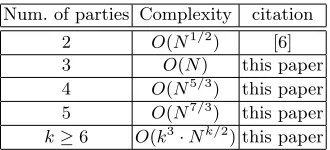
Our main contributions are constructions of multi-party PSM protocols for every function. Prior to our work, the length of the messages in the best known PSM protocol for an arbitrary functionf : [N]k → {0,1}wasO(Nk−1) fork≥3 [10] and O(N1/2) for k = 2 [6]. We present, for every k >2, a PSM protocol with messages of lengthO(poly(k)Nk/2); for k= 3,4,5 we present better protocols (see Fig. 1). Understanding the complexity of secure computation with small number of parties is motivated by practical systems and was done in other secure computation contexts (see, e.g., [13]). We also design PSM protocols for functions in which the inputs have different lengths. For example, for any 3-argument function f : [Nα]×[Nα]×[N] → [N] for some α ≥ 1 (i.e., a function in which the largest two input domains are the same), we design a PSM protocol whose communication complexity isO(N(2α+1)/3) (that is, proportional to the geometric average of the domains).
Num. of parties Complexity citation 2 O(N1/2) [6]
3 O(N) this paper
4 O(N5/3) this paper 5 O(N7/3) this paper
k≥6 O(k3·Nk/2) this paper
Fig. 1.Complexity of PSM protocols for an arbitrary functions.
– They can handle long outputs with the same message length, that is for every function f : [N]k → [Nk], we construct a PSM protocol with complexity
O(k3·Nk/2).3
– By increasing the complexity by a poly(logN) factor, the protocol can be madelocally computable; that is, each party, holding an input from [N], can compute logN messages, where each message depends on asinglebit of the input. This property is useful when we design PSM protocols for some of the applications (e.g., when constructing NIMPC protocols from our PSM protocols; see below).
Following [6], our protocols use techniques from private information retrieval (PIR) [9]; specifically, we use the cube approach of [9], where a function f : [N]k → {0,1} is represented by a d-dimensional cube, for some integer d. The 2-party PSM protocol of [6] uses a 4-dimensional cube. Fork= 3,4,5 we use a 3-dimensional cube, and fork≥6 we use a 2-dimensional cube. These turn out to be the optimal values ofdforourapproach. The fact that we can only use integral values fordresults in the “somewhat unnatural” exponents in the Fig. 1. As the number of dimensions in our protocols for k≥4 is smaller than the number of parties, our protocols have to address a few problems that were not relevant in the 2-party protocol of [6].
We note that, by simulation arguments, if for everyN, every function f : [N]k → {0,1} has a k-party PSM protocol with message length O(Nα) for some constant α, then every function g : [N]2 → {0,1} has a 2-party PSM protocol with message lengthO(Nα/bk/2c). Thus, if one can improve the message length fork-party PSM protocols for an arbitrary function beyondO(Nk/4) for an even k, then this would yield 2-party PSM protocols with message length
O(Nα) for α < 1/2. Similarly, any improvement for k-party PSM protocols for k > 6, would imply an improvement for 6-party PSM protocols compared to our protocols. Thus, to improve the complexity of k-party PSM protocols for arbitrary functions, one might want to start with designing k-party PSM protocols for small values ofk.
3
1.2 Applications
We show that our PSM protocols imply the following constructions.
Non-Interactive secure Multi-Party (NIMPC) protocols. A non-interactive MPC protocol [5] is a PSM protocol in which the security is guaranteed even when the referee colludes with some parties. Specifically, ak-party NIMPC protocol is
t-robustif it is secure against any coalition of the referee and at mostt parties, and it is fully robust if it is k-robust. Prior to our work, the length of mes-sages in the best known fully robust NIMPC protocol for an arbitrary function
f : [N]k → {0,1} wasO(poly(logN, k)·Nk) [19] (improving on [5]). No better
t-robust protocols were known for any t > 0. We construct t-robust NIMPC protocols for any function f : [N]k → {0,1} with complexity ˜O(Nk/2+t); that is, we improve the complexity when t < k/2. Our construction is based on an information-theoretic transformation of [8] that takes any PSM (i.e., 0-robust NIMPC) protocol and transforms it into a t-robust NIMPC protocol. An im-mediate application of this transformation yields a t-robust NIMPC protocol with complexity ˜O(Nk/2+t+1). We use properties of our protocols and of the transformation of [8] to improve the complexity by a factor ofN. For example, we construct a fully-robust 3-party NIMPC protocol with complexity ˜O(N2.5) (compared to O(N3) using the transformation as is). Thus, for 3 parties, we improve the complexity of fully-robust NIMPC protocols compared to [19].
Ad-hoc PSM protocols. Ak-out-of-nad-hoc PSM protocol [4, 7] is a PSM proto-col withnparties, where onlykparties, whose identity is not known in advance, actually participate in the execution of the protocol. For example, think of an election, where only some of the potential voters will end up voting. Using a transformation, presented in [7], from a t-party PSM protocol for a symmetric function to an ad-hoc PSM protocol for the same function, we construct ak -out-of-n ad-hoc PSM protocol for any symmetric function f : [N]k → {0,1} with communication complexityO(ek·k6·logn·Nk/2).
Distribution designs. The goal of a distribution design, introduced in [4], is to find a joint distribution on N random variables that satisfies a given set of constraints on the marginal distributions. Each constraint can either require that two sets of variables are identically distributed or, alternatively, that two sets of variables have disjoint supports. Distribution design generalizes many cryptographic primitives, such as secret-sharing, PSM protocols, and NIMPC protocols. We consider k-homogeneous sets of constraints, where all sets in the constraints are of size exactlyk. In [4], it was shown that everyk-homogeneous set of constraints without contradictions can be realized by a distribution design such that the size of the support of each variable isO( NkklogN). We show that, for everyk-homogeneous set of constraints, we can define a symmetric function
f : [N]k → N [k]
described above, we get a distribution design for every 2-homogeneous set of constraints in which the size of the support of each variable isO(log2N·√N). Using our constructions of PSM protocols, we get a distribution design for every
k-homogeneous set of constraints in which the support of each variable is of size
O(k6eklogN·Nk/2). For 3≤k≤5, we get better distribution designs.
Conditional Disclosure of Secrets. In Conditional Disclosure of Secrets (CDS) protocols, introduced in [12], there are k parties, a referee, and a functionf : [N]k → {0,1}. As in the PSM model, each party gets a common random string
rand an inputxi. In addition, all parties (excluding the referee) have a secrets. Each partyPisends one message to the referee, based onr, xiands. The referee, which in the CDS setting knows the inputsx1, . . . , xk, should learnsif and only iff(x1, . . . , xk) = 1. It was shown in [2] that every PSM protocol forf implies a CDS protocol forf with the same complexity. Thus, our PSM protocols imply CDS protocols. However, there are direct constructions of CDS protocols that are much more efficient than the known PSM protocols. Liu, Vaikuntanathan, and Wee [16] showed a CDS protocol for an arbitrary 2-party functionf : [N]×[N]→ {0,1}with communication complexity 2O(√logNlog logN)=No(1). Very recently, Liu, Vaikuntanathan, and Wee [17] have shown a construction of k-party CDS protocols for any functionf : [N]k→ {0,1} with complexity 2O˜(
√ klogN). We show that CDS protocols imply secret-sharing schemes for strongly ho-mogeneous access structures. An access structure ist-homogeneous if all minimal authorized sets are of sizet. In such access structures all sets of size less thantare unauthorized and there can also be large sets that are unauthorized. We say that an access structure is stronglyt-homogeneous if all minimal authorized sets are of sizetort+ 1 and all sets of sizet+ 1 are authorized. Strongly 2-homogeneous access structures are called forbidden graph access structures [18] and were stud-ied in, e.g., [3, 2]. Secret-sharing schemes for forbidden bipartite graph access structures withN parties are equivalent to 2-party CDS protocols for functions
f : [N]2→ {0,1}. We show that if everyk-party functionf :{0,1}k → {0,1}has a CDS protocol with communication complexity Com(k), then every stronglyt -homogeneous access structure withkparties can be realized by a secret-sharing scheme with share sizek·Com(k). Combined with the result of [17], we get that every strongly t-homogeneous access structures with k parties can be realized by a secret-sharing scheme with share size 2O˜(
√ k).
1.3 Discussion
CDS protocols vs. PSM protocols. The models of CDS and PSM look similar except that, in CDS protocols, the referee knows the inputs and should learn the secret if and only if some function of the inputs returns 1, while in PSM protocols the referee should learn the value of the function without learning additional information about the inputs. It was shown in [12, 6] that a PSM protocol forf
There are, however, some differences between the models. In [11], it was shown that a CDS protocol for a function f : [N]×[N] → {0,1} can be con-structed from a CDS for the index function – a function where P1 holds a list of length N, party P2 holds an index i and the referee should reconstruct the secret if and only if theith element in the list is 1. The CDS protocols of [16] for an arbitrary function build on a construction of a CDS protocol for the index function. The PSM of [10] for an arbitrary function can be seen as, implicitly, constructing a PSM for the index function. However, the correctness of PSM protocols (even without the security requirement) implies that the communica-tion complexity of any PSM protocol for the index funccommunica-tion isΩ(N). Thus, for non-binary functions there is a separation between the CDS and PSM models. It is open if such huge separation exists for Boolean functions. We note that our constructions of PSM protocols use PSM protocols for the (k-dimensional) index function, however with shorter lists.
An alternative approach. We next describe an alternative approach for con-structing PSM protocols with communication complexity that is better than that of previously known protocols, but is worse than the complexity of the pro-tocols constructed in this paper. We explain some difficulties in applying this approach. Suppose we want to construct a 4-party PSM protocol for a function
f : [N]4 → {0,1} using a 2-party PSM protocol. Viewing the function f as a two-argument function with domain [N2]×[N2], by [6], it has a 2-party PSM protocol with complexityO(N), where the first messagem1 depends on the in-puts of the first two parties and the second message m2 depends on the inputs of the other two parties. Thus, the first two parties can execute a PSM protocol for computing m1. This can be done by O(N) invocations of a (2-party) PSM protocol with a binary output. If the parties could have used the PSM of [6], which has complexity O(N0.5), then the resulting PSM protocol would have complexity O(N1.5). However, we do not know how to use the PSM protocol of [6] here, since it only applies to deterministic functions and the messages of the 2-party PSM protocol depend on the common randomness.4Instead, one can apply the protocol of [10], which can be used for randomized functions as well, but has complexityO(N). This gives a protocol with complexityO(N2). More generally, fork-party functions this approach results in a PSM with complexity
O(N3k/4−1). This approach is described in more details in Section 6.
Our protocols can be viewed as a generalization of the above approach. In-stead of using the PSM protocol of [10] to compute the message of a 2-party protocol, we use a special purpose PSM protocol to compute the message. For example, our k-party protocol from Section 4 can be viewed as simulating the 2-party PSM protocol from Section 3.2.
4 We can treat the random string generating the message as a common input (or as
2
Preliminaries
In this section we define PSM protocols and describe two PSM protocols that will be used in this paper.
2.1 Private Simultaneous Messages Protocols
In a PSM protocol, k parties P1, . . . , Pk hold a common random string r and inputs x1, . . . , xk, respectively; each party Pi sends a single message to a ref-eree, based on r and its xi, so that the referee learns the value of a function
f(x1, . . . , xk) but nothing else. It is formally defined as follows:
Definition 2.1 (PSM protocols – Syntax and correctness).LetX1, . . . , Xk,
and Z be finite domains. A private simultaneous messages (PSM) protocol P, computing a k-argument functionf :X1× · · · ×Xk →Z, consists of:
– A finite domainR of common random inputs, andkfinite message domains M1, . . . , Mk.
– Message computation algorithmsEnc1, . . . ,Enck, where Enci :Xi×R →
Mi.
– A reconstruction algorithmDec:M1× · · · ×Mk→Z.
We say that the protocol P is correct (with respect to f) if Dec(Enc1(x1, r),
. . . ,Enck(xk, r)) =f(x1, . . . , xk), for every input (x1, . . . , xk)∈X1× · · · ×Xk
and every random inputr∈R. The communication complexity of PSM protocol
P is defined asPk
i=1log|Mi|. The randomness complexity of PSM protocolP is
defined as log|R|.
The security of a PSM protocol requires that the message distribution seen by the referee on input x1, . . . , xk can be generated by a simulator that has access only to f(x1, . . . , xk); that is, everything that can be learned from the PSM protocol can be learned from the output off.
Definition 2.2 (PSM protocols – Security). A PSM protocol P is secure with respect tof if there exists a randomized algorithmSimsuch that, for every input(x1, . . . , xk)∈X1× · · · ×Xk, the distribution of messages (Enc1(x1, r), . . .
,Enck(xk, r)) induced by uniformly choosing a common random string r ∈ R
and the distribution of the output of Sim(f(x1, . . . , xk))are identical.
Ishai and Kushilevitz [14] have shown that every function that has a small modular or non-deterministic branching program can be computed by an efficient PSM protocol. We will use their result for a deterministic branching program.
Theorem 2.3 ([10, 14]). Let BP = (V, E, φ, s, t)be a deterministic branching program of size α(k) computing a function f : {0,1}k → {0,1}. Then, there
exist a PSM protocol forf with communication and randomness complexityO(k·
Notation. Denote by [N] the set{1,2, . . . , N}. For a finite setS, denote choosing a random element i from S with a uniform distribution by i ∈R S; similarly, denote choosing a random subsetT ofSwith a uniform distribution byT ⊆RS.
2.2 A PSM Protocol for the Index Function
In this section, we show a construction of [10] of a PSM protocol for the index function defined below.
Definition 2.4. We represent a stringD∈ {0,1}Nk−1
as a(k−1)-dimensional cube (array), that is, D = (Dx2,...,xk)x2,...,xk∈[N], where each Dx2,...,xk is a bit.
For a(k−1)-dimensional cube D, and a position(i2, . . . , ik)letDi2,...,ik denote
the value in position(i2, . . . , ik)in the cubeD. We define ak-argument function indN,k : {0,1}N
k−1
×[N]× · · · ×[N] → {0,1}, whose inputs are a (k−1) -dimensional cube andk−1indices, byindN,k(D, x2, . . . , xk) =Dx2,...,xk; that is,
indN,k(D, x2, . . . , xk)returns the value ofDin the position indexed byx2, . . . , xk.
WhenN, k will be clear from the context, we will writeind instead ofindN,k For sake of completeness, we next present a PSM protocol for the index function, based on a PSM from [10]; for simplicity, we assume here thatN is a power of 2 (and so values in [N] can be represented by logN-bit strings).
Claim 2.5 ([10]).There is ak-party PSM protocolPindN,k computing the func-tionindN,k with communication and randomness complexity is O(kNk−1).
Proof. In a non-secure protocol for indN,k, partyP1would send its inputDand partiesP2, . . . , Pk would send their inputs,x2, . . . , xkrespectively, to the referee who could easily compute Dx2,...,xk. However, in a secure protocol, the referee
should not learn information onD andx2, . . . xk except forDx2,...,xk.
To hide the indicesx2, . . . , xk we permuteD: we give (k−1) random strings
r2, . . . , rk∈[N] to the parties as their common randomness. Now, partyP1 cre-ates a new cubeD0 such thatD0x
2,...,xk=Dx2⊕r2,...,xk⊕rk for everyx2, . . . , xk ∈
[N]. Party P1 sends to the referee D0 and parties P2, . . . , Pk send to the ref-eree x2⊕r2, . . . , xk⊕rk respectively. The referee computes D0x2⊕r2,...,xk⊕rk = D(x2⊕r2)⊕r2,...,(xk⊕rk)⊕rk=Dx2,...,xk as required.
In the above protocol the referee does not learn information on x2, . . . xk; however, it learns information on the cubeDbecause partyP1sendsD0, which is a shift of the cube D. We fix this protocol by masking D0 and revealing to the referee only the mask of position x2, . . . , xk. Specifically, we choose (k− 1) random strings r2, . . . , rk ∈ {0,1}Nk−1
; each string is viewed as a (k− 1)-dimensional cube. PartyP1 computes D00 =D0⊕r2⊕ · · · ⊕rk and sendsD00, which is now a random string. Each party Pj, for j = 2, . . . , k, sends xj⊕rj and also rij
2,...,ij−1,xj⊕rj,ij+1,...,ik for every i2, . . . , ij−1, ij+1, . . . , ik ∈ [N] (the
length of the message ofPj is logN+Nk−2). The referee computesDx2,...,xk as D00x2⊕r2,...,x
k⊕rk⊕(
Lk
j=2r j
x2⊕r2,...,xk⊕rk). To see that the protocol is secure note
the entry (x2⊕r2, . . . , xk⊕rk) for which the referee gets allk−1 masks). The communication complexity of this protocol isO(Nk−1+k·Nk−2) =O(k·Nk−1) and the randomness complexity is O(k·Nk−1). ut
Remark: The dominant contribution to the complexity of the above protocol comes from the size of the cube (i.e.,Nk−1). We will sometimes need a natural extension of Pind, where the dimensions are not necessarily of the same size. It is not hard to see that the complexity of this variant remains proportional to the size of the cube.
2.3 A PSM Protocol for S⊕ {x}
For a setSand an elementi, letS⊕{i}denote the setS\{i}ifi∈S, and the set
S∪{i}otherwise.
Definition 2.6. Define the functionSxor :{0,1}Nk
×[N]×· · ·×[N]→ {0,1}Nk
as the function, whose inputs are a string of lengthNk (interpreted as a set
con-tained in[Nk]) and kelements from[N], where Sxoroutputs a string of length
Nk(again, interpreted as a set contained in[Nk]) such thatSxor(S, x
1, . . . , xk) =
S⊕ {x1◦x2◦ · · · ◦xk} (where x1◦x2◦ · · · ◦xk is the concatenation of the k
strings, interpreted as an element of[Nk]).
We construct a k-party PSM protocol for Sxor, where P1 holds S and x1 and
P2, . . . , Pk holdx2, . . . , xk, respectively.5
Claim 2.7. There exists a PSM protocolPSxorcomputing the functionSxorwith communication and randomness complexityO(k3·Nk).
Proof. LetS0= Sxor(S, x1, . . . , xk) and for everyi1, . . . , ik ∈[N] denoteSi1,...,ik
andSi01,...,ik as thei1◦ · · · ◦ikth bits of the stringsS andS0 respectively. To compute Sxor, for every bit of S0 we execute a PSM protocol comput-ing the bit as explained below. For each (i1, . . . , ik) such that (i1, . . . , ik) 6= (x1, . . . , xk), it holds thatSi01,...,ik=Si1,...,ik, andS
0
x1,...,xk =Sx1,...,xk⊕1. Let`j
be 1 ifij =xjand 0 otherwise. Notice thatSi01,...,ik =Si1,...,ik⊕(`1∧`2∧. . .∧`k).
Thus, every bit of Si0
1,...,ik depends only on one bit of S and on `1, . . . , `k,
where party Pj can locally compute `j from xj and ij. Define the function
g:{0,1}k+1→ {0,1}such thatg(s, `
1, . . . , `k) =s⊕(`1∧`2∧. . .∧`k) for every
s, `1, . . . , `k ∈ {0,1}. We have shown thatSi01,...,ik could be computed using N
k
copies of a PSM forg.
Next, we show the existence of an efficientk-party PSM protocol Pg forg, where P1 holds the inputs s and `1 and each party Pj, for 2 ≤ j ≤ k, holds the input `j. There is a simple deterministic branching program of size O(k) computingg, thus, by Theorem 2.3, we get thatghas an efficient PSM protocol Pgwith complexityO(k3).
5
Protocol PSxor computing Sxor executes the protocol Pg for every bit of
S0, namely Nk times. The correctness and privacy of protocol P
Sxor follows immediately from the correctness and privacy of the PSM protocol Pg. The
complexity ofPSxorisO(k3Nk). ut
3
A 3-Party PSM Protocol for an Arbitrary Function
In this section we show that every functionf : [N]3→ {0,1}has a PSM protocol with communication and randomness complexity of O(N). Our construction is inspired by the cubes approach of [9]. We describe this approach in Section 3.1. Next, as a warm-up, we construct a 2-party PSM protocol using this approach in Section 3.2. We describe the 3-party PSM protocol in Section 3.3.
3.1 The Cube approach
We start with a high level description of the cube approach; specifically, for the case of 2-dimensional cubes, we present a PIR protocol with 4 servers from [9]. Recall that in a PIR protocol, a client holds an indexx, each server holds a copy of database D, and the goal of the client is to retrieve Dx without disclosing information aboutx.
The starting point of the cube approach [9] (restricted here to 2 dimensions) is viewing the databaseD as a 2-dimensional cube containing N2 bits, that is
D= (Di1,i2)i1,i2∈[N]. Correspondingly, the index that the client wishes to retrieve
is viewed as a pair x = (x1, x2). The protocol starts by the client choosing a random subset for each dimension, i.e. S1, S2⊆R [N]. The client then creates 4 queries of the form (T1, T2) where each Tj is either Sj itself or Sj⊕{xj}; i.e. (S1, S2), (S1⊕ {x1}, S2), (S1, S2⊕ {x2}), and (S1⊕ {x1}, S2⊕ {x2}); we denote these 4 queries by q00, q10, q01, q11, respectively. The client sends each query to a different server (2·N bits to each server). A server, which gets a query (T1, T2), replies with a single bit which is the XOR of all bits of D in the sub-cubeT1⊗T2, i.e.Li1∈T1,i2∈T2Di1,i2. The observation made in [9] is that
each element of the cube appears in an even number of those 4 sub-cubes except the entryx= (x1, x2) that appears exactly once. Therefore, taking the XOR of the 4 answer bits, all elements of the cube are canceled except for the desired element in positionx. Each server gets no information aboutxfrom its query. For example, in the query q01, the setsS1 andS2⊕ {x2}are uniformly distributed, independently ofx1, x2.
The above approach can be generalized to any number of dimensions. Specif-ically, for 3 dimensions, the client chooses 3 sets S1, S2, S3⊆[N] and generates 8 queriesq000, . . . , q111.
3.2 A 2-Party PSM Protocol
PSM protocol of [6]; we present it to introduce the ideas we use in our PSM protocol for k >2 parties. The protocol is formally described in Fig. 2.
Next, we give an informal description of an insecure protocol, and then we fix it so it will be secure. We associate the functionf with anN2-bit database, viewed as a 2-dimensional cube (that is, the (x, y) entry in the database is
f(x, y)). The common randomness of the two parties is viewed as two random subsets, one for each dimension, i.e.S1, S2⊆R [N]. In the PSM protocol, party
P1holdsx1, partyP2holdsx2, and the referee wishes to computef(x1, x2), i.e. the XOR of the answers to the same 4 queries mentioned above. This should be done without learning information about x1, x2 (besides what follows from
f(x1, x2)). In the protocol, P1 computes the answers, denoted a00, a10, to the queries q00, q10 (usingS1, S2 and its inputx1). For example, the answer to the queryq10 is
a10=⊕i1∈S1⊕{x1},i2∈S2f(i1, i2).
It then sends these answers to the referee. Similarly, P2 computes the answer, denoted a01, to the queryq01 and sends it to the referee. Now, the referee has the answers to 3 of the 4 queries and the only query that remains unanswered is q11. To compute the answer to q11, party P1 sends to the referee S1⊕{x1} andP2 sendsS2⊕{x2}, i.e. the referee gets the query q11 and can compute the corresponding answera11(as it knows the functionf). Now, the referee has the answers to all 4 queries and it can computef(x1, x2) =a00⊕a10⊕a01⊕a11. The correctness of this protocol follows immediately from the correctness of the cube approach.
This protocol is not secure because the referee learns the answers to all 4 queries and this could leak information about x1 and x2. In order to deal with this problem, we add one more random bit to the common randomness of the two parties, i.e., b ∈R {0,1}. Party P1 sends to the referee a00⊕a10⊕b instead ofa00, a10, andP2sendsa01⊕binstead ofa01. Now, the referee only gets random bits from the parties (from the randomness of S1, S2, b) and it learns only f(x1, x2). The communication complexity and randomness complexity of this protocol areO(N).
More formally, to argue that the PSM protocol P2 described in Fig. 2 is secure, we construct a simulator whose input is f(x1, x2) and whose output is two messages distributed identically to the messages in P2. The simulator first chooses with uniform distribution two sets T1, T2 ⊆R [N] and a random bit c ∈ {0,1}. It then computes the answer to the query q11, namely, a11 = ⊕i1∈T1,i2∈T2f(i1, i2). Finally, it outputs (c, T1),(c⊕f(x1, x2)⊕a11, T2). Note
Protocol P2
Common randomness:Both parties share uniform random strings:
– S1, S2⊆R [N] andb∈R{0,1}.
The protocol:
1. P1, holdingx1, computes the answersa00, a10to the queriesq00= (S1, S2) andq10= (S1⊕ {x1}, S2) respectively. It then computesq111 =S1⊕ {x1}. Finally, it sendsm1=a00⊕a10⊕bandq111to the referee.
2. P2, holdingx2, computes the answera01to the queryq01= (S1, S2⊕{x2}). It then computesq2
11=S2⊕ {x2}. Finally, it sendsm2 =a01⊕band q211 to the referee.
3. The referee computes the answer a11 to the query q11 = (q111 , q 2 11) = (S1⊕ {x1}, S2⊕ {x2}). The referee computesf(x1, x2) =m1⊕m2⊕a11.
Fig. 2.A 2-party PSM protocolP2for a functionf: [N]×[N]→ {0,1}.
3.3 A 3-Party PSM Protocol
In this section, we show how to construct a PSM protocolP3 for any function
f : [N]3→ {0,1} with communication and randomness complexityO(N). As in the 2-party case above, our construction is inspired by the cube approach [9], as described in Section 3.1, using 3-dimensional cubes.
Again, we first give an informal description of an insecure protocol, and then we fix it so it will be secure. The protocolP3is formally described in Fig. 3. We associatef with anN3-bit database that is viewed as a 3-dimensional cube. The common randomness of the 3 parties consists of 3 random subsets, one for each dimension, i.e., S1, S2, S3⊆R [N]. The referee wishes to compute f(x1, x2, x3), i.e. the XOR of the answers to 8 queries. Each query is of the form (T1, T2, T3) where eachTj is eitherSjorSj⊕{xj}. PartyP1computes the answersa000, a100 to the queries q000, q100 respectively, and sends these answers to the referee. Similarly, partyP2(resp.P3) computes the answera010(resp.a001) to the query
Protocol P3
Common randomness:The three parties share uniform random strings:
– S1, S2, S3⊆R [N].
– r110, r101, r011 ∈R {0,1}O(N) required for the PSM protocolPind with a list of lengthN.
– b100, b010, b001, b110, b101, b011 ∈R {0,1},b000=b100⊕b010⊕b001⊕b110⊕
b101⊕b011.
The protocol:
1. PartyP1:
– Computes the answersa000, a100to the queriesq000= (S1, S2, S3) and
q100= (S1⊕ {x1}, S2, S3), respectively.
– Computes the answers to all queries (S1⊕ {x1}, S2⊕ {`}, S3) for all possible values of`∈[N] and represents the answers as a 1-dimension database (a1
110, . . . , aN110). UsingD110= (a1101 ⊕b110, . . . , aN110⊕b110) and common randomnessr110, partyP1computesm1110– the message of the first party in the 2-party PSM protocolPind.
– Computes the answers to all queries (S1⊕ {x1}, S2, S3⊕ {`}) for all possible values of`∈[N], and represents the answers as a 1-dimension database (a1101, . . . , aN101). UsingD101= (a1101⊕b101, . . . , aN101⊕b101) and common randomnessr101, computesm1101 – the message of the first party in the 2-party PSM protocolPind.
– Sendsm000=a000⊕b000,m100=a100⊕b100,m1110,m1101, andS1⊕{x1} to the referee.
2. PartyP2:
– Computes the answera010 to the queryq010= (S1, S2⊕ {x2}, S3).
– Usingx2and common randomnessr110, computesm2110– the message of the second party in the 2-party PSM protocolPind.
– Computes the answers to all queries (S1, S2⊕ {x2}, S3⊕ {`}) for all possible values of`∈[N] and represents the answers as a 1-dimension database (a1
011, . . . , aN011). UsingD011= (a0111 ⊕b011, . . . , aN011⊕b011) and common randomnessr011, computesm2011 – the message of the first party in the PSM protocolPind.
– Sendsm010=a010⊕b010,m110,2 m2011, andS2⊕ {x2}to the referee. 3. PartyP3:
– Computes the answera001 to the queryq001= (S1, S2, S3⊕ {x3}).
– Usingx3and common randomnessr101, computesm3101– the message of the second party in the 2-party PSM protocolPind.
– Usingx3 and common randomnessr011 it computesm2011– the mes-sage of the second party in the 2-party PSM protocolPind.
– Sendsm001=a001⊕b001,m101,3 m3011, andS3⊕ {x3}to the referee. 4. The referee:
– Computes the answer a111 to the query q111 = (S1 ⊕ {x1}, S2 ⊕
{x2}, S3⊕ {x3}) (using the sets received fromP1, P2, P3and the truth table off).
– Using the PSM messagesm1110,m2110the referee computesD110x2 . Using the PSM messagesm1
101,m3101 the referee computes D101x3 . Using the PSM messagesm2011,m3011the referee computesDx0113 .
– Outputf(x) =m000⊕m100⊕m010⊕m001⊕Dx1102 ⊕D 101
x3 ⊕D 011
x3 ⊕a111.
q011). Finally, partyP1sends to the refereeS1⊕ {x1}, partyP2sendsS2⊕ {x2}, and party P3 sends S3⊕ {x3}. The referee gets the query q111 and computes the answer a111. It now has the answers to all 8 queries and it can compute
f(x1, x2, x3) as the XOR of these 8 answers.
As in the 2-party case, this protocol is not secure because the referee learns the answers to all 8 queries, which could leak information aboutx1,x2, andx3. To deal with that, we mask these answers so that the referee gets random bits from the parties whose sum isf(x1, x2, x3) (the details of applying these masks appear in Fig. 3).
Theorem 3.1. Let f : [N]3→ {0,1} be a function. The protocolP3 is a secure PSM protocol for f with communication and randomness complexity O(N). Proof. First, we argue that the protocol is correct. The output of the referee is
m000⊕m100⊕m010⊕m001⊕D110x2 ⊕D
101 x3 ⊕D
011 x3 ⊕a111
= (a000⊕b000)⊕(a100⊕b100)⊕(a010⊕b010)⊕(a001⊕b001)⊕(ax1102 ⊕b110) ⊕(ax3
101⊕b101)⊕(a x3
011⊕b011)⊕a111 =a000⊕a100⊕a010⊕a001⊕ax1102 ⊕a
x3
101⊕a x3
011⊕a111 (1)
=f(x1, x2, x3), (2)
where the equality in (1) follows from the fact that the exclusive or of the b’s is zero, and the equality in (2) follows from the correctness of the cube approach. To argue that protocolP3 is secure, we construct a simulator whose input is
f(x1, x2, x3) and whose output is three messages distributed as the messages in P3. The simulator on inputf(x1, x2, x3) does the following:
1. Chooses three random sets T1, T2, T3 ⊆R [N] and 6 random bits c100, c010,
c001, c110, c101, c011∈R{0,1}.
2. Computes the answer to the queryq111, namely,
a111=⊕i1∈T1,i2∈T2,i3∈T3f(i1, i2, i3).
3. Computesc000=f(x1, x2, x3)⊕a111⊕c100⊕c010⊕c001⊕c110⊕c101⊕c011. 4. Invokes the simulator Simind of protocolPind3 times:
– (m1
110, m2110)←Simind(c110),
– (m1101, m3101)←Simind(c101),
– (m2011, m3011)←Simind(c011). 5. Outputs
(c000, c100, m1110, m 1
101, T1),(c010, m2110, m 2
011, T2),(c001, m3101, m 3 011, T3).
Note that in the messages of protocol P3 the sets S1 ⊕ {x1}, S2⊕ {x2}, and
S3⊕ {x3}are distributed independently with uniform distribution. Furthermore,
m100, m010, m001, Dx1102 , D
101 x3 , D
011
x3 are uniformly distributed given these 3 sets,
since we mask them using independent random bits. Since D110
x2 and c110 are
Pind(D110, x2). The same holds for the other two invocations ofSimind. Finally, given the setsS1⊕{x1}, S2⊕{x2}, S3⊕{x3}, the bitsm100, m010, m001, D110x2 , D
101 x3 , D011
x3 , a111, andf(x1, x2, x3), the value ofm000 is fully determined (by the
cor-rectness of P3 and by the fact that the above sets determine a111). Thus, the simulator’s output is distributed as the messages generated in protocol P3 on inputsx1, x2, x3.
We next analyze the complexity ofP3. The communication and randomness complexity of each invocation of Pind is linear in the length of the list, i.e., it isO(N). In addition, partiesP1, P2, P3 send the subsets S1⊕{x1}, S2⊕{x2},
S3⊕{x3} respectively, which are of sizeN, and O(1) bits each for the answers of the queriesq000, q100, q010, q001. Therefore, the communication complexity and randomness complexity of our PSM protocolP3 isO(N). ut
4
A
k
-Party PSM Protocol for an Arbitrary Function
and Some Extensions
In this section, we show how to construct a k-party PSM protocol Pk for a functionf : [N]k→[Nk] with communication and randomness complexityO(k3·
Nk/2). The above complexity is achieved even when the output is of length
klogN(as the input length isklogN, we can assume, without loss of generality, that the output length is at most klogN). In general, when the output of f is anL-bit string, one can execute a PSM protocol for every bit of the output, and the complexity of the PSM protocol for f isL times the complexity of a PSM protocol for a Boolean function. In protocolPk, we do not pay any penalty for long outputs. We also present better protocols for 4 and 5 parties.
We first describe our construction for an evenk. Our construction is inspired by our 2-party PSM protocol presented in Section 3.2. The protocol is formally described in Fig. 4. Next, we give an informal description of the protocol for the case that the range of f is Boolean. We associate f with an Nk-bit database that is viewed as a 2-dimensional cube, where each dimension of the cube is of size Nk/2. Correspondingly, each input x= (x
1, . . . , xk)∈ [N]k is viewed as a pair (y1, y2)∈[Nk/2]2, wherey1= (x1, . . . , xk/2) andy2= (xk/2+1, . . . , xk). The common randomness of thekparties contains two random subsets, one for each dimension, i.e. S1, S2⊆R [Nk/2]. The referee wishes to compute f(x1, . . . , xk), i.e., the XOR of answers to the same 4 queries of the cube approach described in Section 3.1. Party P1 can easily compute the answer to the query (S1, S2) (i.e., q00) and send the answer to the referee. However, as the inputs y1, y2 are distributed among the parties, there are two problems we have to address: (1) how to answer the queries (S1⊕ {y1}, S2),(S1, S2⊕ {y2}), and (2) how to send
S1⊕ {y1}andS2⊕ {y2}to the referee.
an-swers to all queries (S1⊕{`}, S2) for`= (x1, i2, . . . , ik/2) for all possible values
i2, . . . , ik/2∈[N]k/2−1. This is a list of lengthNk/2−1in which the entry corre-sponding to`=y1 is the desired answer for the queryq10. We view this answer as a (k/2−1)-dimensional cube such that the answer corresponding to the values (x1, i2, i3, . . . , ik/2) is in position (i2, i3, . . . , ik/2). Specifically, the answer to the query (S1⊕{y1}, S2) is in position (x2, . . . , xk/2) in the cube. PartiesP1, . . . , Pk/2 use the PSM protocolPindfor the index function described in Section 2.2, from which the referee learns the answer to the query (S1⊕{y1}, S2) and nothing else. Similarly, Pk can compute an Nk/2−1-bit cube, corresponding to all choices of
ik/2+1, . . . , ik−1, such that the answer to the query (S1, S2⊕ {y2}) is in position
xk/2+1, . . . , xk−1in this cube. PartiesPk, Pk/2+1. . . , Pk−1use the PSM protocol Pind, from which the referee learns the answer to the query (S1, S2⊕ {y2}) and nothing else.
The only query that remained unanswered is the queryq11. PartiesP1, . . . , Pk/2 execute the PSM protocolPSxordescribed in Section 2.3 that enables the referee to computeS1⊕{y1} without learning any information abouty1. Similarly, par-ties Pk/2+1, . . . , Pk execute the PSM protocolPSxor that enables the referee to computeS2⊕{y2}. The referee learns the queryq11= (S1⊕{y1}, S2⊕{y2}) and computes the corresponding answera11. Now, the referee has the answers to all 4 queries and it can XOR them to computef(x1, . . . , xk).
The main contributions to the communication complexity of the above proto-col is the invocations of the PSM protoproto-colsPindandPSxor. We invokePindwith
k/2 parties and a database containingNk/2−1bits, thus, the complexity of this protocol is O(kNk/2−1). We invokePSxorwith k/2 parties and a set contained in [Nk/2], thus, its complexity isO(k3·Nk/2).
Note that the complexity of invoking PSxor dominates the complexity of invokingPind. We capitalize on this gap and construct a PSM protocol for any function with output range [Nk]. Again, we representf : [N]k →[Nk] as a two dimensional cube, where the size of each dimension isNk/2, however now every entry in the cube is from [Nk]. The protocol proceeds as above, where the only difference is that we invoke Pind with a database containing Nk/2−1 elements from [Nk].6 Thus, the complexity of this protocol isO(kNk/2−1·klogN). The resulting PSM protocol has complexityO(k3·Nk/2).
Next, we give an informal description of protocolPk for an oddk, i.e.,k= 2t+ 1 for somet. Here, we partition the inputxt+1 of partyPt+1 to two parts, i.e. xt+1 = (x1t+1, x2t+1) such that x1t+1, x2t+1 ∈ [N1/2]. Again, we associate f with anNk-bit database that is viewed as a 2-dimensional cube (i.e., the size of each dimension is Nk/2). Correspondingly, each input x= (x
1, . . . , xk)∈ [N]k is viewed as a pair (y1, y2) ∈ [Nk/2]2, where y1 = (x1, . . . , xt, x1t+1) and y2 = (x2
t+1, xt+2, . . . , xk). The referee needs the answers to the same 4 queries in order to computef(x1, . . . , xk). The rest of the protocol is similar to the protocol for an even k, just that in this case, partyPt+1 participates in the PSM protocols for both queriesq10, q01, each time only with half of its input, as well as in both
6
ProtocolPk
Common randomness:Thekparties share uniform random strings:
– S1, S2⊆R [N k/2
].
– r10, r01∈R{0,1}O(kN
k/2−1logN)
required for the PSM protocolPind with a list of length [N]k/2−1, where each element is from [Nk].
– ρ10, ρ01 ∈R {0,1}O(N k/2)
required for thek/2-party PSM protocol PSxor with a setS⊆[Nk/2].
– b10, b01∈R{0,1}klogN,b00=b10⊕b01.
The protocol:
1. PartyP1:
– Compute the answera00 to the queryq00= (S1, S2).
– Compute the answers to all queries (S1 ⊕ {`}, S2) where ` = x1 ◦
i2◦. . .◦ik/2, for all possible valuesi2, . . . , ik/2 ∈[N], and represent
the answers as a (k/2−1)-dimensional cube (a10i2,...,ik/2)i2,...,ik/2∈[N].
UsingD10= (ai102,...,ik/2⊕b10)i2,...,ik/2∈[N] and common randomness
r10, computem110 – the message of the first party inPind.
– Usingx1, S1and common randomnessρ10, computes110– the message of the first party inPSxor.
– Sendm00=a00⊕b00,m110, ands110 to the referee. 2. PartyPj, wherej∈ {2, . . . , k/2}:
– Usingxj and common randomness r10, computemj10– the message of thejth party inPind.
– Usingxjand common randomnessρ10, computesj10– the message of thejth party inPSxor.
– Sendmj10andsj10 to the referee. 3. PartyPk:
– Compute the answers to all queries (S1, S2 ⊕ {`}) where ` =
ik/2+1 ◦. . .◦ik−1 ◦ xk, for all possible values ik/2−1, . . . , ik−1 ∈ [N], and represent the answers as a (k/2−1)-dimensional cube (ai01k/2+1,...,ik−1)ik/2+1,...,ik−1∈[N]. Using D
01
= (ai01k/2+1,...,ik−1 ⊕
b01)ik/2+1,...,ik−1∈[N] and common randomness r01, compute m
k
01 – the message of the first party inPind.
– Usingxk, S2and common randomnessρ01, computesk01– the message of the first party inPSxor.
– Sendmk
01andsk01 to the referee. 4. PartyPj, wherej∈ {k/2 + 1, . . . , k−1}:
– Usingxj and common randomness r01, computemj01– the message of the (j−k/2 + 1)th party inPind.
– Usingxjand common randomnessρ01, computesj01– the message of the (j−k/2 + 1)th party inPSxor.
– Sendmj01ands
j
01 to the referee. 5. The referee:
– Using the messagess110, . . . , s
k/2
10 ofPSxor, compute q 1
11=S1⊕ {y1}. Using the messagessk
01, s
k/2+1 01 , . . . , s
k−1
01 ofPSxor, computeq 2
11=S2⊕
{y2}. Compute the answera11to the query q11= (q111 , q11) = (2 S1⊕
{y1}, S2⊕ {y2}).
– Using the messages m110, . . . , m
k/2
10 of Pind, compute D 10
x2,...,xk/2.
Using the messages mk
01, m
k/2+1
01 , . . . , m
k−1
01 of Pind, compute
D01xk/2+1,...,xk−1.
– Outputf(x) =m00⊕D10x2,...,xk/2⊕D 01
xk/2+1,...,xk−1⊕a11.
PSM protocols forS1⊕ {y1}and forS2⊕ {y2}. The communication complexity and randomness complexity of this protocol areO(k3Nk/2).
Theorem 4.1. Let f : [N]k →[Nk] be a function. The protocolP
k is a secure
PSM protocol forf with communication and randomness complexityO(k3Nk/2).
Proof. Correctness follows from the cube approach, wheref(x1, . . . , xk) is the XOR of the answers for the 4 queries q00, q10, q01, q11. The referee computes these 4 answers (each answer is a string in [Nk]); however, the first 3 answers are masked. Nevertheless, the XOR of the 3 masksb00, b10, b01 is zero, so when the referee computes the XOR of the 4 masked answers, the masks are canceled and the referee gets the correct answer.
To argue that the PSM protocolPkis secure, we construct a simulator whose input isf(x1, . . . , xk) and whose output iskmessages distributed as the messages in Pk. To simplify the indices, we only construct a simulator for an even k; however, the simulator (with minor changes) remains valid also for an odd k. The simulator on input f(x1, . . . , xk) does the following:
1. Chooses two random setsT1, T2⊆R[Nk/2] and two random stringsc10, c01∈R {0,1}klogN.
2. Computes the answer to the query q11, namely, a11 =⊕i1∈T1,i2∈T2f(i1, i2)
(wherei1, i2 are considered ask/2 elements from [N]). 3. Computesc00=f(x1, . . . , xk)⊕a11⊕c10⊕c01. 4. Invokes the simulator Simind of protocolPindtwice:
– (m110, . . . , mk/102)←Simind(c10),
– (mk 01, m
k/2+1
01 , . . . , mk− 1
01 )←Simind(c01).
5. Invokes the simulator SimSxor of protocolPSxortwice:
– (s1 10, . . . , s
k/2
10 )←SimSxor(T1),
– (sk 01, s
k/2+1 01 , . . . , s
k−1
01 )←SimSxor(T2). 6. Outputs
(c00, m110, s 1 10),(m
2 10, s
2
10), . . . ,(m k/2 10 , s
k/2 10 ),(m
k/2+1 01 , s
k/2+1
01 ), . . . ,(m k 01, s
k 01). Note that, in the messages ofPk, the setsS1⊕ {y1}, S2⊕ {y2}are distributed in-dependently with uniform distribution. Furthermore,Dx102,...,xk/2, D
10
xk/2+1,...,xk−1
are uniformly distributed given these 2 sets, since we mask them using inde-pendent random strings. SinceD10
x2,...,xk/2 andc10 are both random strings, the
output of Simind(c10) is distributed as the messages of Pind(D10, x2, . . . , xk/2). SinceS1⊕ {y1} andT1 are both random sets, the output ofSimSxor(T1) is dis-tributed as the messages inPSxor((S1, x1), x2, . . . , xk/2). The same holds for the other invocation ofSimindandSimSxor. Finally, given the setsS1⊕{y1}, S2⊕{y2}, the stringsm10, m01, Dx102,...,xk/2, D
01
The communication and randomness complexity of each invocation of the PSM protocolPindareO(k·Nk/2−1·klogN). The communication and random-ness complexity of each invocation of the PSM protocolPSxor is O(k3·Nk/2). Party P1 also sends a string of length klogN to the referee (that is, m00). Therefore, the communication complexity and randomness complexity of the
PSM protocolPk areO(k3·Nk/2). ut
4.1 PSM Protocols for 4 and 5 Parties
We next show how to use the ideas of our previous protocols to construct more efficientk-party PSM protocols, fork= 4,5.
Theorem 4.2.
– Letf : [N]4→ {0,1}be a function. There is a secure 4-party PSM protocol
P4 forf with communication and randomness complexity O(N5/3).
– Letf : [N]5→ {0,1}be a function. There is a secure 5-party PSM protocol P5 forf with communication and randomness complexity O(N7/3).
Proof Sketch. The protocolsP4 andP5 are similar to protocolPk, except that we viewf as a 3-dimensional cube. Specifically, inP4 the size of each dimension of the cube is N4/3. We partition the inputs x2, x3 as follows: x2 = (x12, x
2 2) and x3 = (x23, x
3
3) such thatx 1 2, x
3 3∈[N
1/3] andx2 2, x
2 3 ∈[N
2/3]. We view each input (x1, x2, x3, x4) as a 3-tuple (y1, y2, y3)∈[N4/3]3, wherey1= (x1, x12), y2= (x22, x23), and y3 = (x33, x4). The common randomness of the parties contains 3 random sets S1, S2, S3⊆R[N4/3], random strings for protocolsPind andPSxor, and random masks. The referee should get the answers of 8 queriesq000, . . . , q111. The (masked) answer to q000 is computed by P1 and sent to the referee. The answers to the queries of weight 2 and 3 are computed using protocolPind, where the more expensive queries are queries of weight 2. As an example, we explain how to answerq110. The answer to this query requires knowing (y1, y2)∈[N4/3]2. As y1 = (x1, x12) and party P1 has x1, party P1 can prepare a list of length
N5/3 (one entry for each possible value of x1
2, y2) and P1, P2, and P3 use the 3-party PSM protocolPind to send the answer ofq110to the referee. As the list contains N5/3 entries (where each entry is a bit), the complexity of invoking PindisO(N5/3) (the input ofP
2 is from [N] and ofP3 is from [N2/3]). Queries
q101, q011are dealt in a similar way, whereP1andP4, respectively, construct the list. To answer queryq111, the setsS1⊕ {y1}, S2⊕ {y2}, S3⊕ {y3}are sent to the referee usingPSxor. As each set is contained in [N4/3], the complexity of invoking PSxor isO(N4/3). The total communication and randomness complexity of P4 isO(N5/3).
InP5, the size of each dimension of the cube is N5/3 and the 5 inputs are partitioned into 3 inputsy1, y2, y3∈[N5/3]. The details are similar to the PSM protocol P4. As for the complexity analysis, to answer q110, party P1 needs (y1, y2)∈[N5/3]2 and it knows x1 ∈[N] which is part of y1, thus, it creates a list of lengthN7/3, and the complexity of invokingP
Discussion. Our protocols, and the 2-party PSM protocol of [6], use cubes of different dimensions for different values of k; i.e., in [6], 4 dimensions are used for 2 parties, and in this work 3 dimensions are used for 3,4, and 5 parties, and 2 dimensions are used for more than 5 parties. These are the optimal dimensions, when using our approach, as we next explain. If there arekinputs (each from the domain [N]) andddimensions, then the size of at least one dimension isNk/d. Thus, communicating each set Sj⊕ {yj} (either directly, as in the 2-party and 3-party protocols, or using the PSM protocolPSxor, as done fork >3 parties) requires Ω(Nk/d) bits. The parties also need to send the answers to the 2d−1 queries of weight at mostd−1 using protocolPind. The most expensive queries are queries of weightd−1, which involved−1 “virtual” inputsyj, each one is taken from [Nk/d]. As each partyPj knows only xj, the parties will invoke the PSM protocol Pind with a list of length at least N(k/d)(d−1)−1 = Nk−k/d−1; 7 the cost of this invocation will be at leastNk−k/d−1. Thus, for a given number of parties k, we need to choosedthat will minimize max{k/d, k−k/d−1}. If, hypothetically, we could choose a non-integral dimension, we would take d = 2k/(k−1) and the complexity of our protocol would have been O(N(k−1)/2). This matches the complexity of the PSM protocols for 2 and 3 parties. Fork >3, we achieve a slightly worst complexity, since we need to round 2k/(k−1) to the nearest integer.
5
PSM Protocols with Inputs of Different Sizes
In this section, we construct PSM protocols for functions in which the domains of inputs are not necessarily the same. That is, we consider functionsf : [Nα1]×
[Nα2]×· · ·×[Nαk]→ {0,1}, for some integerN and positive numbersα
1, . . . , αk. By reordering the parties and normalization, we can assume that α1 ≥ α2 ≥ · · · ≥αk = 1.
We first observe that the complexity of the PSM of [10] for an arbitrary function does not depend on the size of the largest domain (i.e., of partyP1).
Claim 5.1. Let f : [Nα1]×[Nα2]× · · · ×[Nαk]→ {0,1} be a function. Then,
there is a PSM protocol forf with communication complexityO(NPki=2αi)and
randomness complexityO(k·NPki=2αi).
Proof. We describe a protocol with the desired complexity. PartyP1 prepares a list of lengthNPki=2αi, which containsf(x
1, i2, . . . , ik) for every (i2, i3, . . . , ik)∈ [Nα2]× · · · ×[Nαk]. The parties invoke the PSMPind, where the input ofP
1 is this list and the input ofPj, for 2≤j≤k, is xj. ut We next construct more efficientk-party protocols. Again, we use the cube approach, with 2 differences compared to the previous protocols. First, the num-ber of dimensions dwill be bigger than in our previous protocols (the number
7 For the interesting parameters (specifically, when d ≤ k), there will always be a
party whose entire inputxiis part of the query and the length of the list would be
of dimensions grows asPk
i=2αi grows). Thus, thekinputs are partitioned tod virtual inputs. Unlike previous protocols, eachPi, where 1≤i≤k, holds part of each virtual input.
Lemma 5.2. Let f : [Nα1]×[Nα2]× · · · ×[Nαk]→ {0,1} be a function where α1≥α2≥ · · · ≥αk = 1. Then, there is a PSM protocol for f with
communica-tion and randomness complexity
O(min{k·N(Pki=2αi)(1−1/dae), k3·N(Pki=1αi)/bac})
wherea=α1/(P k
i=2αi) + 2.
Proof. We view f as a d-dimensional cube, where the size of each dimension is N(Pki=1αi)/d and d will be fixed later. We partition the inputs as follows: xj = (x1j, x
2 j, ..., x
d
j) for 1 ≤ j ≤ k, where x 1 j, x
2 j, ..., x
d j ∈ [N
αj/d]. We define y`= (x`1, x`2, . . . , x`k) for each 1≤`≤d. The common randomness of the parties containsdrandom setsS1, ..., Sd ⊆R[N(
Pk
i=1αi)/d], random strings for protocols
PindandPSxor, and random masks. Using the cube approach, the referee should get the answers to 2d queries. To answer query q
11...1 (the query of weight d), the sets S1⊕ {y1}, ..., Sd ⊕ {yd} are sent to the referee using PSxor. As each set is contained in [N(Pki=1αi)/d], the complexity of invoking PSxor is O(k3 · N(Pk
i=1αi)/d). The (masked) answer toq
00...0(the query of weight 0) is computed by P1 and sent to the referee. The answers to the queries of weightm for any 1 ≤ m ≤ d−1 are computed using protocol Pind, where the more expensive queries are queries of weightd−1. To answer the queryq11...10, partyP1, which has x1
1, ..., x d−1
1 , prepares a list of length N( Pk
i=2αi)(d−1)/d (one entry for each
possible value of (x1
2, . . . , x1k), ..., (x d−1 2 , . . . , x
d−1
k )) and the parties P1, . . . , Pk use the PSM protocolPindto send the masked answer ofq11...10to the referee. The complexity of invokingPindisO(k·N(Pki=2αi)(d−1)/d). All other queries are
dealt in a similar way, where P1 constructs the list. The total communication and randomness complexity of the protocol are
O(max{k·N(Pki=2αi)(d−1)/d, k3·N(Pki=1αi)/d}).
If we could choose a non-integral value fordthen the optimal value of din this approach would bed=a=α1/(P
k
i=2αi) + 2. Sincedmust be an integral value the communication and randomness complexity are minimized either onbacor ondae. Thus, we get a protocol with the following complexity.
O(min{k·N(Pki=2αi)(1−1/dae), k3·N(Pki=1αi)/bac}).
u t
Corollary 5.3. Let f : [Nα1]×[Nα2]× · · · ×[Nαk] → {0,1} be a function
where α1 ≥ α2 ≥ · · · ≥ αk = 1. Then, there is a PSM protocol for f with
communication and randomness complexityO(k·N(Pk
5.1 2-Party PSM Protocols
In this section, we describe results for 2-party PSM protocols summarized in the following lemma.
Lemma 5.4. Let f : [Nα]×[N]→ {0,1}, where α≥1. Then, there is a PSM forf with communication and randomness complexity:
– O(Nα/2) if 1≤α≤3/2,
– O(N(α+1)/(bα+2c))if α− bαc ≤1/dα+ 2eandα >3/2,
– O(N1−dα1+2e)otherwise.
Proof. For the first item, we use the protocol of [6], which has complexity
O(Nα/2) (where we consider both domains to be of size Nα). The second and
third items follow from Lemma 5.2. ut
5.2 3-Party PSM Protocols
In this section, we consider 3-party PSM protocols and show that, for many values of the parameters α1, α2, there is a PSM protocol whose complexity is the geometric mean of the sizes of domains.
Claim 5.5. Let f : [Nα1]×[Nα2]×[N] → {0,1}, where α
1 ≥ α2 ≥ 1 and
α1≤2α2−1. Then, there is a PSM forf with communication and randomness
complexity O(N(α1+α2+1)/3).
Proof. The idea of the protocol is similar to the protocols of Theorem 4.2. We viewfas a 3-dimensional cube, where the size of each dimension isN(α1+α2+1)/3.
We partition the inputs x1 ∈ [Nα1], x2 ∈ [Nα2], x3 ∈ [N] to equal size in-puts y1, y2, y3 ∈ [N(α1+α2+1)/3]. The way we partition the inputs will be de-scribed below. The common randomness of the parties contains 3 random sets
S1, S2, S3 ⊆R [N(α1+α2+1)/3], random strings for protocolsPindand PSxor, and random masks. The referee should get the answers to 8 queries q000, . . . , q111. To answer query q111, the sets S1⊕ {y1}, S2⊕ {y2}, S3⊕ {y3} are sent to the referee usingPSxor. As each set is contained in [N(α1+α2+1)/3], the complexity
of invokingPSxorisO(N(α1+α2+1)/3). The (masked) answer toq
000is computed byP1and sent to the referee. The answers to the queries of weight 1 and 2 are computed using protocol Pind, where the more expensive queries are queries of weight 2. The details of how to answer these queries depends on the partition of the inputs intoy1, y2, y3.
We partition x1 and x2 as follows:x1 = (x11, x31) and x2 = (x22, x32), where
x1
1, x22∈[N(α1+α2+1)/3],x31∈[N(2α1−α2−1)/3] (note that 2α1−α2−1≥0 since
PindisO(N(α1+α2+1)/3). Queriesq101, q011are dealt in a similar way, where P1 and P2, respectively, construct the list and all 3 parties participate (as each has a part of y3). The total communication and randomness complexity of the
protocol areO(N(α1+α2+1)/3). ut
Claim 5.6. Let f : [Nα1]×[Nα2]×[N] → {0,1}, where α
1 ≥ α2 ≥ 1 and
α1≥2α2−1. Then, there is a PSM forf with communication and randomness
complexity O(N(α1+1)/2).
Proof. The idea of the protocol is similar to the protocols of Theorem 4.2. We viewfas a 3-dimensional cube, where the size of each dimension isN(α1+α2+1)/3.
We define x1 = (x11, x13), where x11 ∈ [N(α1+1)/2] and x31 ∈ [N(α1−1)/2], and
y1 = x11, y2 = x2, and y3 = (x3, x31). The common randomness of the parties contains 3 random setsS1, S3⊆R[N(α1+1)/2] andS2⊆R[Nα2], random strings for protocols Pind and PSxor, and random masks. The referee should get the answers to 8 queriesq000, . . . , q111. To answer queryq111, the setsS1⊕ {y1}, S2⊕ {y2}, S3⊕ {y3} are sent to the referee using PSxor. The complexity of invoking PSxorisO(N(α1+1)/2) (where, forS2, we use the assumption thatα
1≥2α2−1). The (masked) answer to q000 is computed by P1 and sent to the referee. The answers to the queries of weight 2 and 3 are computed using protocolPind, where the most expensive query is q011, for which P2 has to prepare a list of length
N(α1+1)/2 (one entry for every possible value of y
3) and partiesP1, P2, and P3 use the 3-party PSM protocol Pind to send the answer of q011 to the referee. The complexity of invoking Pind is O(N(α1+1)/2). Queries q101, q011 are dealt in a similar way. The total communication and randomness complexity of the
protocol areO(N(α1+1)/2). ut
The next two lemmas summarize the various cases of 3-argument functions; the first claim deals with the case α2 ≥2 and the second claim with the case
α2<2.
Lemma 5.7. Letf : [Nα1]×[Nα2]×[N]→ {0,1}, whereα
1≥α2≥1. Ifα2≥2
then there is a PSM for f with communication and randomness complexity:
– O(N(α1+α2+1)/3) ifα
1< α2+ 1.
– O(min{N(α2+1)(1−1/dae), N(α1+α2+1)/bac})wherea= (α
1+2α2+2)/(α2+1)
ifα1≥α2+ 1.
Proof. Ifα1< α2+ 1, thenα1<2α2−1 (sinceα2≥2). Thus, the first item is implied by Claim 5.5. The second item follows from Lemma 5.2. ut
Lemma 5.8. Let f : [Nα1]×[Nα2]×[N]→ {0,1}, whereα
1≥α2≥1. Assume 1 ≤ α2 < 2. Then there is a PSM for f with communication and randomness
complexity:
– O(N(α1+α2+1)/3) if α
2≤α1≤2α2−1.
– O(N(α1+1)/2)if 2α
2−1≤α1≤(4α2+ 1)/3.
– O(min{N(α2+1)(1−1/dae), N(α1+α2+1)/bac})wherea= (α
1+2α2+2)/(α2+1)
if (4α2+ 1)/3≤α1.
6
A PSM for
k
parties from a PSM for
t
parties
In this section, we show how to construct ak-party PSM protocol for a function from at-party PSM protocol for a related function wherek > t. This is a generic transformation, which does not result in better protocols than the protocols presented in this paper. However, it shows that improvements in the complexity oft-party PSM protocols for small values oftwill results in betterk-party PSM protocols for all valuesk.
Claim 6.1. Let k, t, N be integers such that k > t and N ≥ 2t and let g : [N]k → {0,1} be a function. If every function f : [n]t → {0,1} has a t-party
PSM protocol with communication and randomness complexity O(nα) forn =
Nk/t, then there is a PSM protocol for g with communication and randomness complexity O(k·t·N(α+1)k/t−1).
Proof. We construct the following protocol Pk for g. We partition the inputs
x1, ..., xk to equal size inputs y1, ..., yt where yj ∈ [Nk/t] for j = 1, ..., t. Let
xi = (x1i, ..., xti) for alli =t+ 1, ..., k where x1i, ..., xti ∈[N1/t]. We define yj = (xj, xjt+1, ..., x
j
k) for j = 1, ..., t. Furthermore, we define g
0 : [Nk/t]t → {0,1} such that g0(y1, ..., yt) = g(x1, ..., xk). By the assumption of the claim, there is a PSM protocol Pt for g0 with communication and randomness complexity
O(nα) =O(Nαk/t).
In protocolPk, for every 1≤j≤t, partyPjtogether with partiesPt+1, ..., Pk simulate thej-th party of protocol Pt as follows. For this simulation, partyPj prepares a list of lengthNk/t−1of the possible messages of thej-th party inP
t with inputyj= (xj, xjt+1, ..., x
j
k). AsPj knowsxj and does not knowxjt+1, ..., x j k the list contains one entry for every possible value of (xjt+1, ..., xjk)∈ [Nk/t−1]. Each entry in the list is a message taken from [Nαk/t]. PartiesPj, Pt+1, ..., Pkuse the PSM protocolPindto send the message corresponding to their inputs to the referee. The referee computes thet messages and then computesg(x1, ..., xk) =
g0(y1, ..., yt) according to the protocolPt. The communication and randomness complexities of the PSM protocol Pind are O(k·N(α+1)k/t−1) and the parties
Pt+1, ..., Pk invoke this protocolttimes. Therefore, the total communication and randomness complexity of this protocol areO(k·t·N(α+1)k/t−1). ut For example, for t = 2 there is a 2-party PSM protocol with complexity
O(N0.5) [6] (hereα= 0.5). This implies that any functionf : [N]k → {0,1}has a
![Fig. 4. A k-party PSM protocol Pk for a function f : [N]k → [N k] for an even k.](https://thumb-us.123doks.com/thumbv2/123dok_us/7986240.1325118/17.612.130.477.114.742/fig-party-psm-protocol-pk-function-n-n.webp)
