O R I G I N A L R E S E A R C H
In
fl
uence of learning-style preferences in academic
performance in the subject of human anatomy: an
institution-based study among preclinical medical
students
This article was published in the following Dove Press journal: Advances in Medical Education and Practice
L Khanal1
J Giri2
S Shah1
S Koirala1
J Rimal2
1Department of Human Anatomy, BP
Koirala Institute of Health Sciences, Dharan, Nepal;2Department of Medical Education, BP Koirala Institute of Health Sciences, Dharan, Nepal
Video abstract
Point your SmartPhone at the code above. If you have a QR code reader the video abstract will appear. Or use:
https://youtu.be/U1KqysQYLYw
Purpose: The present study was conducted tofind the preferred mode of learning among
first-year preclinical students and compare the preferred mode of learning with sex, faculty of
students, and academic performance of the students using the VARK questionnaire.
Methods:A cross-sectional study was done among 142first-year Bachelor of Medicine– Bachelor of Surgery and Bachelor of Dental Surgery students from February to May 2018. Demographic data and various academic performance marks were recorded for each indivi-dual. VARK (visual, aural, read/write and kinesthetic) questionnaire version 7.8 was admi-nistered to calculate the score of each component. Mean VARK scores were calculated and
each student classified by their preferred mode of learning. The preferred mode of learning
was compared with sex, nationality, faculty of students, and academic performance usingχ2,
unpairedt-tests, and the Mann–WhitneyUtest.P<0.05 was taken as statistically significant
for comparison.
Results:A majority of the students (53.52%) were multimodal. The most common multi-modal mode of preference was bimulti-modal (26.06%), while the most common unimulti-modal preference was kinesthetic (29.06%). Total V score, K score, and VARK score were higher among males, while A and R scores were higher among females. The K score (7.96±2.35 in
males and 6.96±2.43 in females) differed significantly (P=0.019) between male and female
subjects. More subjects with higher scores in the theory exam of anatomy were unimodal learners (53.8%) compared to multimodal learners (46.2%).
Conclusion:From this study, it can be concluded that undergraduate students were diverse in their learning styles, but most were multimodal. Though learning styles were found to vary
by sex, nationality, and academic performance, differences were not statistically significant.
Keywords:academic performance, learning preference, medical education, VARK
Introduction
The BP Koirala Institute of Health Sciences (BPKIHS) is an autonomous health-science university of Nepal that has implemented a need-based, integrated, partial problem-solving, and community-oriented curriculum, conceptualized in the Edinburgh Declaration of 1988.1
“Learning style”was defined by Keefe in 1979 as“the composite of characteristic cognitive, affective, and physiological factors that serve as relatively stable indicators of how a learner perceives, interacts with, and responds to the learning environment”.2 Although a large number of learning styles and strategies are formulated based upon
Correspondence: L Khanal Department of Human Anatomy, BP Koirala Institute of Health Sciences, PO Box 7053, Dharan, Nepal
Tel +977 986 492 7925 Email [email protected]
Advances in Medical Education and Practice
Dove
press
open access to scientific and medical research
Open Access Full Text Article
Advances in Medical Education and Practice downloaded from https://www.dovepress.com/ by 118.70.13.36 on 19-Aug-2020
various psychological constructs, educators are interested in identifying learners based on visual, auditory, read/write, or kinesthetic (VARK) preferences of learning.3
The dramatic increase in the volume of content from undergraduate education to the initial phase of medical school is one of the biggest difficulties for most stu-dents. Furthermore, the diversity of the student body in terms of age, experience, culture, and level of prepared-ness, as well as learning preferences and styles, creates challenges for medical instructors to meet the educa-tional needs of the students. In a precise sense, motiva-tion and performance of the student improves when the instruction is in accordance with their learning prefer-ences and styles. Because of the diversity in learning styles, students often find a mismatch between their learning and the delivery of instruction. They have the tendency to seek information that is methodically and efficiently presented to them.4 It is the responsibility of the instructor to deliver their lesson planappropriatelyby accepting the diversity of learning styles.5
To overcome the possibility of treating all students the same way, knowledge of their learning styles seems helpful to educators. This knowledge can also be a useful asset in identifying the learning problems of students and making them effective learners.5,6
Many factors like sex, age, academic achievement, and thinking styles can influence student learning styles.7It is important to know that students remember 20% of the information they read, 30% of what they hear, 40% of what they see, 50% of what they say, and 60% of what they do. This becomes 90% for information they say, hear, see, and do.8Learners can be defined based on the sensory modality by which they prefer to get or deliver new information. Fleming and Miles defined four sensory mod-alities of learning: visual (V), aural (A), read/write (R) and kinesthetic (K), together referred to as VARK.9Students with a visual preference prefer to explain concepts by drawing pictures and diagrams. Students with an aural preference prefer to receive or give information by listen-ing and talklisten-ing. Students with a read–write preference can easily understand concepts using lists, handouts, and text-books. Students with a kinesthetic preference favor a hands-on approach, trial and error, and real-life examples. The VARK questionnaire can identify whether a student has a strong learning preference for one of the modalities or is a flexible learner who can learn using two or more sensory modalities, as revealed by a number of cross-sectional studies.5,6,9,10,11
Anatomy is considered an important component of the curriculum in medical schools. Knowledge of anatomy remains central to medical students’ training in various disciplines. For effective teaching in anatomy, it is impor-tant for instructors to understand learning styles of their students.12,13 Knowledge of dissection in anatomy is mainly gained by doing, which has also been found to be positively associated with academic success in courses involving more kinesthetic activities.14Although a number of studies with inconsistent results are available from various parts of the world, there is a lack of information about the distribution of learning preferences of medical students in Nepal, where the culture of medical education differs from other countries. This cultural diversity of students adds to the diversity of their learning styles and strategies.15 Rethinking and reframing organizational cul-ture within the medical education system has been the critical demand in Nepal. The need for lifelong learning of medical personnel should be apparent from the very early stages of medical training, but a study on students’ perception of medical education in Nepal showed that a majority are not getting the necessary knowledge from the preclinical stage. Information and communication technol-ogy is vital for medical education in the 21st century, but is not able to satisfy the needs of the majority of students. Similarly, other challenging issues are inadequate integra-tion of basic science subjects with clinical relevance, inadequate time devoted to instruction in long-term health care, inconsistency of the curriculum among medical schools, and inadequate learning of communication skills, ethics, and moral and leadership development.16,17 This study was conducted to determine learning styles and their relationship with the academic performance of medical students studying in Nepal.
Methods
This was a cross-sectional questionnaire-based study car-ried out at BP Koirala Institute of Health Science, Dharan, Nepal from February to May 2018. Ethical clearance was received in May 2017 from the institutional review com-mittee (445/073/074-IRC).
Data collection
The information included demographic details, such as sex, age, nationality (Indian, Nepali, and other), grades (percen-tage) they obtained in at higher secondary level (10+2) and in the first-unitanatomyexam, and study hours per week. The latest English version of the VARK questionnaire (version
Advances in Medical Education and Practice downloaded from https://www.dovepress.com/ by 118.70.13.36 on 19-Aug-2020
7.8), which consists of 16 multiple-choice questions, was administered after thefirst internal exam offirst-year medical students to determine their preferred mode(s) of learning. Permission was obtained from the VARK author through the VARK website (http://www.vark-learn.com). The VARK questionnaire was selected because it is concise and quick to complete and each question aims to place respondents in a
“learning”situation. The purpose of the study was explained to the students. They were informed verbally that there were no right or wrong answers, and thus their answers should repre-sent what they would really do in the context of each question and not what they believe is expected to be done. All choices corresponded to the four learning preferences: visual, aural, read/write, and kinesthetic. Students could select one or more choices for each question, skip a question, or choose two or more options if appropriate. Reliability estimates for scores of VARK subscales determined by Leite et al were 0.85, 0.82, 0.84, and 0.77 for the visual, aural, read/write and kinesthetic subscales, respectively. These were considered adequate.18 The validity of the questionnaire has been assessed in a few studies. Rasch analysis suggested that the instrument could be used as a predictor of a person’s learning-preference orientation.19Another study using a quasiexperimental design showed that word-spelling gains were highest when the teach-ing mode matched the learnteach-ing-style preference.20In an item analysis using the correlated trait–correlated uniqueness model, values of standardized loading of items ranged 0.24– 0.76, with mean loading of 0.51, 0.47, 0.50, and 0.41 for visual, aural, read/write, and kinesthetic factors, respectively.18 The risk of asking personal information like marks obtained in higher secondary level was overcome by assuring privacy regarding disclosure of the information, and confidentiality was maintained.
Inclusion criteria
Preclinical first-year medical students (Bachelor of Medicine–Bachelor of Surgery [MBBS] and Bachelor of Dental Surgery [BDS]) participated in the study. Only students who completed the questionnaire were evaluated.
Exclusion criteria
Students who were absent on the day of the study or who did not complete the questionnaire properly were not included.
Data-collection method
Data collection was done during practical sessions of anatomy in the dissection hall. Data were collected after
taking written informed consent from the students. VARK version 7.8 with 16 questions was administered, along with a semistructured questionnaire containing demo-graphic details like age, sex, nationality, study hours per week, and academic performance.
Data entry and analysis
Data were entered in Microsoft Excel, then transferred to SPSS version 20 for analysis. The qualitative variables sex, nationality, and ethnicity were entered into Excel spread-sheets using numerical coding. First, descriptive statistics like frequency, mean, range, and SD were derived and dif-ferent graphs and charts built to show the distribution of data points. To assess associations of two categorical variables,χ2 for association was conducted. Further, Student'st-test and the Mann–Whitney U test were used to assess difference between binomial categorical variables ( male vs female, unimodal vs multimodal learners). At the end, correlations were tested between variables using Spearman's correlation test. All statistical values were taken as significant atP<0.05. Outcome variables were VARK score, total V score, total A score, total R score, and total K score.
Study site
The study was carried out in the dissection hall of the Department of Anatomy.
Sampling method
Convenience sampling was used. All preclinical medical students were approached, and those who gave consent were enrolled till the desired sample size was achieved.
Sample size
The minimum sample size was 133. Sample size was calculated by applying a priori power analysis using G*Power software.21 Allfirst- year MBBS and BDS stu-dents were asked to fill in the questionnaire, and finally 142 students were enrolled.
Results
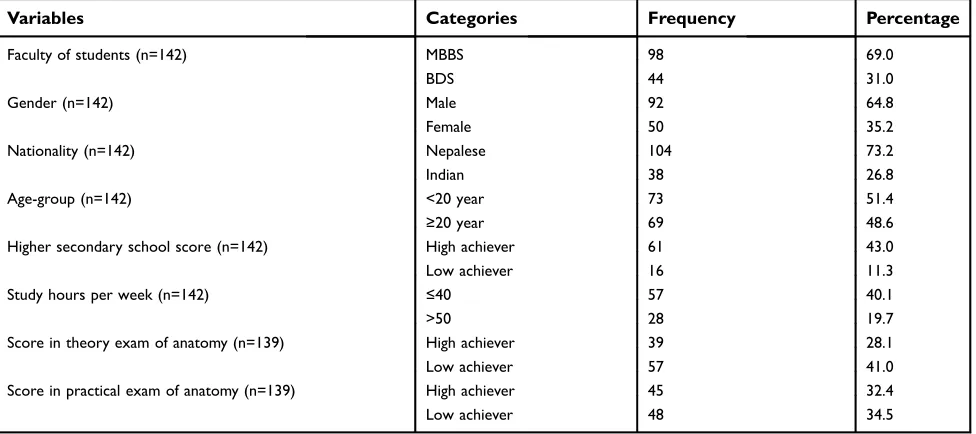
This study was conducted among 142 preclinical students enrolled in thefirst year of MBBS (98) or BDS (44) at the BPKIHS in 2017. The proportion of males to females was 1.84. By nationality, 73.2% were Nepalese and 26.8% Indian. Ages of subjects ranged 17–23 years with mean age 19.57±1.15 years. Academic marks secured in grade 12 (or equivalent) were >80% in 43% of subjects. Similarly, study hours per week were found to be >50 in
Advances in Medical Education and Practice downloaded from https://www.dovepress.com/ by 118.70.13.36 on 19-Aug-2020
19.7% of subjects. Academic performance in the subject of human anatomy during the first-unit exam was also recorded for both theory and objective structured practical examinations. Subjects were categorized as high achievers and low achievers on the basis of the marks they secured. Among them, 28.1% and 32.4% achieved >60% (high achievers) in theory and practical, respectively. Detailed descriptive statistics of the different variables are shown in
Tables 1and2.
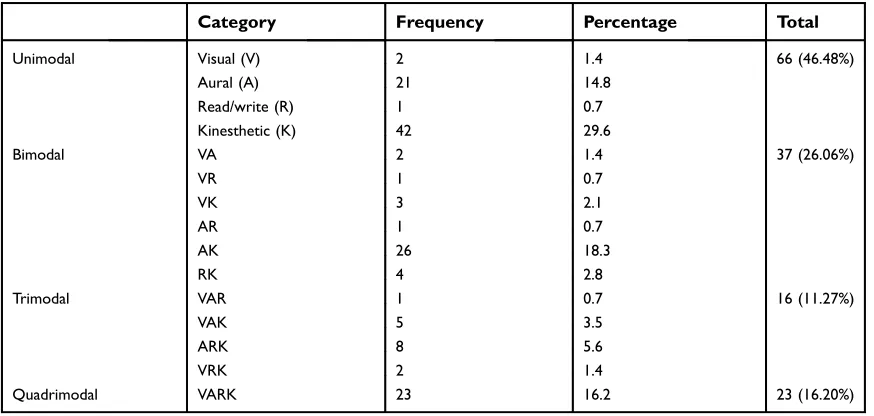
Learning-style preferences of the students were also computed using the stepping-distance method (Table 3). Multimodal and unimodal preferences were found in 53.52% and 46.48% of students, respectively. Among multimodal learners, the most common mode of prefer-ence was bimodal (26.06%), followed by quadrimodal (16.2%) and trimodal (11.27%;Table 3).
Similarly, among the unimodal learners with only one component of VARK, 29.6% were kinesthetic learners fol-lowed by aural, visual and read/write. The most preferred
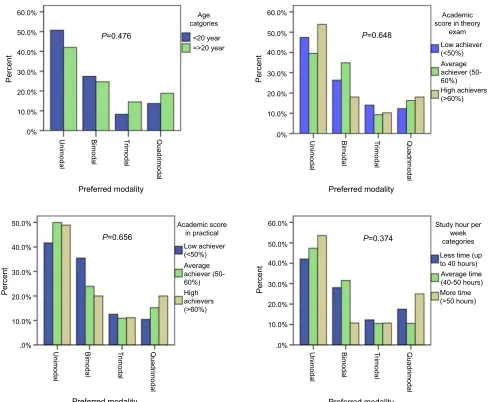
mode among bimodal and trimodal learners was AK (18.3%) and ARK (5.6%) (Table 3). Distribution of stu-dent’s preferred learning style between genders, nationality and academic performance is shown in bar diagram (Figures 1and2).
Comparison between unimodal and multimodal learn-ing was done, with many categorical variables reveallearn-ing subjects' sociobiological and academic characteristics, as depicted in Tables 4 and 5. Tests of association were carried out usingχ2.Table 4shows that multimodal learn-ing was preferred in both MBBS and BDS students, in both sexes, and also in both nationalities. Distribution of learning modalities was almost equally distributed among MBBS students, while more BDS students (59.1%) were found to have multimodal preferences. When tested for statistical significance, none of the characteristics was sig-nificantly associated with modes of learning (P>0.05).
To visualize the distribution of the study sample in dif-ferent academic parameters, students were categorized into
Table 1Frequency distribution of variables defining the study population
Variables Categories Frequency Percentage
Faculty of students (n=142) MBBS 98 69.0
BDS 44 31.0
Gender (n=142) Male 92 64.8
Female 50 35.2
Nationality (n=142) Nepalese 104 73.2
Indian 38 26.8
Age-group (n=142) <20 year 73 51.4
≥20 year 69 48.6
Higher secondary school score (n=142) High achiever 61 43.0
Low achiever 16 11.3
Study hours per week (n=142) ≤40 57 40.1
>50 28 19.7
Score in theory exam of anatomy (n=139) High achiever 39 28.1
Low achiever 57 41.0
Score in practical exam of anatomy (n=139) High achiever 45 32.4
Low achiever 48 34.5
Abbreviations:MBBS, Bachelor of Medicine–Bachelor of Surgery; BDS, Bachelor of Dental Surgery.
Table 2Study-population variables
Mean (SD) Spread Range
Age (n=142) 19.57 (1.15) 6.00 17.00–23.00
Grade 12 score, % (n=142) 78.08 (6.88) 34.60 60.00–94.00
Study hours per week (n=142) 45.45 (11.99) 66.00 18.00–84.00
First-unit exam score (%), theory (n=139) 50.48 (14.91) 73.33 3.33–76.67
First-unit exam score (%), practical (n=139) 52.34 (17.12) 76.54 10.00–86.54
Advances in Medical Education and Practice downloaded from https://www.dovepress.com/ by 118.70.13.36 on 19-Aug-2020
two categories with respect to grade achieved in 10+2 (or equivalent), marks scored in first-unit theory and practical exams and study hours per week (Table 4). Though a statis-tically insignificant association (P>0.05) was noted, more high achievers in the anatomy theory exam were unimodal learners (53.8%) than multimodal learners (46.2%) and more low achievers were multimodal (52.6%). Unlike this, more high and low achievers in the practical exam were found to be multimodal learners than unimodal.
In box-and-whisker plots, differences were more marked in 25% of subjects achieving low scores or spending less time on their studies than the other students (Figure 3): 25% of students who got the lowest marks in anatomy (theory) in sample subsets were found to have a higher proportion of unimodal learners than multimodal. A similar difference also existed for anatomy marks in the practical examination, but this was minimal compared to theory exam marks. Study hours were fewer in multimodal learners compared to unim-odal learners among the 25% of students who spent the least time on their studies. In the case of marks scored in higher secondary school (HSS) examinations, the difference can be appreciated in both thefirst and fourth quartiles of data. The median value for unimodal learners was slightly higher than multimodal learners.
Before further inferential statistical analysis, continuous variables were checked for normality using the Shapiro–Wilk test (Table 6). Data points of only one variable were found to be normally distributed (P>0.05). According to the distribution pattern, the unpaired Student's t-test, Mann–WhitneyUtest, and Spearman’s correlation test were used for inferential
statistics to see the differences and correlations among the variables.
To assess statistical differences in marks, study hours and ages of students between unimodal and multimodal learners, independentt-tests and Mann–WhitneyUtests were applied. None of the continuous variables was found to be significantly different between two types of learners (P>0.05;Table 7).
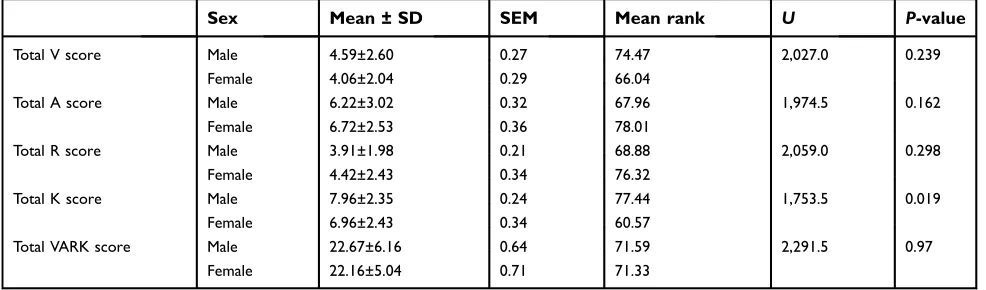
VARK scores were calculated by adding the individual score of each component of the VARK for each subject. These scores were compared between sexes to see the dif-ference (Table 8). Total V, K, and VARK scores were higher among male students than female students. The difference in total K scores (7.96±2.35 in males vs 6.96±2.43 in females) was statistically significant (P=0.019). Total A and R scores were higher among female students than male students, but the difference was not statistically significant (P<0.05).
Finally, bivariate correlation analysis was done to calcu-late correlation coefficients for different variables. V scores were significantly correlated with R scores (rs=0.17) and K
scores (rs=0.64). R score was negatively correlated with HSS
marks (rs=−0.20) and practical marks in anatomy (rs=−0.18).
K scores were correlated with study hours (rs=0.25). HSS
marks were significantly correlated with anatomy marks in theory (rs=0.17) and practical (rs=0.27) exams. Marks in
anatomy theory and anatomy practical exams were positively correlated (rs=0.71), with statistical significance (Table 9).
Discussion
Knowledge of the learning styles of students and the char-acteristics affecting them is important for teacher to improve
Table 3Preferred mode of learning and their subcategories among preclinical medical students
Category Frequency Percentage Total
Unimodal Visual (V) 2 1.4 66 (46.48%)
Aural (A) 21 14.8
Read/write (R) 1 0.7
Kinesthetic (K) 42 29.6
Bimodal VA 2 1.4 37 (26.06%)
VR 1 0.7
VK 3 2.1
AR 1 0.7
AK 26 18.3
RK 4 2.8
Trimodal VAR 1 0.7 16 (11.27%)
VAK 5 3.5
ARK 8 5.6
VRK 2 1.4
Quadrimodal VARK 23 16.2 23 (16.20%)
Advances in Medical Education and Practice downloaded from https://www.dovepress.com/ by 118.70.13.36 on 19-Aug-2020
lesson plans and develop teaching methodologies to adapt them to their needs. This can also be useful in overcoming the traditional method of the teacher-centered method of teaching.22Many factors like learner motivation, study skills, and the ability to assess their own learning needs have been identified as good predictors of student performance,23and synchronizing a teaching style with the learning preferences of learners may also bring additional benefits for the learners. Students feel happier when they are taught using their pre-ferred learning mode, ie, visual, auditory, read/write, or kinesthetic.19The most challenging situation for a medical teacher comes during imparting boundless information within a limited period and also in a way that students can understand and interpret the information effectively.24
The present study was conducted among 142 preclinical medical students recently enrolled in their courses. Results
showed that the majority of the students (53.52%) were multimodal learners with more than one component of VARK. This result is in accordance with study result from Indian,25–27Iranian,28and West Indian students.29In contrast to this, some studies have shown the unimodal type of learn-ing was a choice for a majority of students.30–33Comparison of the present study with some of the previous studies is shown inTable 10. Among unimodal learners, most of the students were kinesthetic learners (29.6%), followed by aural, visual and reading/writing. Similarly, the most pre-ferred mode among bimodal and trimodal learners was AK (18.3%) and ARK (5.6%), respectively. Kinesthetic learning is also dominant among preclinical students from other parts of the world.25,27,33Among multimodal learners, the present study showed the AK combination to be the predominant learning style, found in 18.3% of the total sample. Results of
60.0%
<20 year =>20 year
Academic score in practical
Low achiever (<50%)
Average achiever (50-60%) High achievers (>60%)
Low achiever (<50%)
Academic score in theory
exam
Study hour per week categories Average achiever (50-60%) High achievers (>60%)
Less time (up to 40 hours) Average time (40-50 hours) More time (>50 hours)
P=0.476
P=0.656 P=0.374
P=0.648
50.0%
Age catgories
40.0%
30.0%
Percent
20.0%
10.0%
.0%
Preferred modality Preferred modality
Unimodal Bimodal T rimodal Quadrimodal
Preferred modality
Unimodal Bimodal T rimodal Quadrimodal
Preferred modality
Unimodal Bimodal T rimodal Quadrimodal Unimodal Bimodal T
rimodal Quadrimodal
50.0%
40.0%
30.0%
Percent
20.0%
10.0%
.0%
60.0%
50.0%
40.0%
30.0%
Percent
20.0%
10.0%
.0%
60.0%
50.0%
40.0%
30.0%
Percent
20.0%
10.0%
.0%
Figure 1Distribution of students’preferred modes of learning by age and academic performance.
Advances in Medical Education and Practice downloaded from https://www.dovepress.com/ by 118.70.13.36 on 19-Aug-2020
this study are in accordance with findings of a study done among Indian preclinical students.25 Another study done among medical students from Ireland also showed the bimo-dal mode of learning to be predominant.32Many other stu-dies found a quadrimodal preference to be predominant.26,27,29,30
Learning style and sex
The influence of sex on learning styles is of interest to many researchers. In the present study, both males and females were found to have multimodal preferences.
Trimodal preference was the least preferred for females, whereas quadrimodal was least preferred for males. Total V, K, and VARK scores were higher among male students than female students. Only the total K score (7.96±2.35 in males and 6.96±2.43 in females) was significantly higher (P=0.019) in males than females. Results were consistent with many pre-vious studies,25,26,28–30 which also showed statistically significant differences. A study done among Indian preclinical students showed statistically significant sex differences in learning.31 Another study done among
50.0%
40.0%
30.0%
20.0%
10.0%
.0%
Percent
50.0%
40.0%
30.0%
20.0%
10.0%
.0%
Percent
50.0%
40.0%
30.0%
20.0%
10.0%
.0%
Percent
Unimodal T
rimodal Quadrimodal Unimodal Trimodal Quadrimodal
Bimodal
Unimodal T rimodal Quadrimodal
Bimodal
Bimodal
P=0.609
P=0.231
P=0.536
Preferred modality
Preferred modality
Preferred modality
faculty
MBBS BDS
Nationality
Nepalese students Indian students
Gender
Male Female
Figure 2Distribution of students' preferred modes of learning by sex, faculty, and nationality.
Abbreviations:MBBS, Bachelor of Medicine–Bachelor of Surgery; BDS, Bachelor of Dental Surgery.
Advances in Medical Education and Practice downloaded from https://www.dovepress.com/ by 118.70.13.36 on 19-Aug-2020
T able 4 Association betw een V ARK learning pr efer ences and characteristics of par ticipants Unimodal learning style Multimodal learning style χ 2 ( df ) P -value Faculty MBBS (n=98) Fr equency (%) 48 (49.0) 50 (51.0) 0.795 (1) 0.373 BDS (n=44) Fr equency (%) 18 (40.9) 26 (59.1) Sex Male (n=92) Fr equency (%) 45 (48.9) 47 (51.1) 0.622 (1) 0.430 Female (n=50) Fr equency (%) 21 (42.0) 29 (58.0) Nationality Nepalese students (n=104) Fr equency (%) 49 (47.1) 55 (52.9) 0.063 (1) 0.801 Indian students (n=38) Fr equency (%) 17 (44.7) 21 (55.3) Abbre viations: V ARK, visual, aural, re ad/write, kinesthetic; MBBS, Bachelor of Medicine – Bachelor of Surger y; BDS, Bachelor of Dental Surger y. T able 5 Association betw een V ARK learning pr efer ences with age and academic performance of the par ticipants Unimodal learning style Multimodal learning style χ
2(df
=1) P -value Age <20 ye ar (n=73) Fr equency (%) 54 (46.2) 63 (53.8) 0.028 0.867 ≥ 20 ye ar (n=69) Fr equency (%) 12 (48.0) 13 (52.0) HSS grade High achie ver Fr equency (%) 31 (50.8) 30 (49.2) 3.79 0.15 A ve rage achie ve r Fr equency (%) 25 (38.5) 40 (61.5) Low achie ver Fr equency (%) 27 (62.5) 30 (37.5) Anatom y grade (theor y) High achie ver Fr equency (%) 21 (53.8) 18 (46.2) 1.71 0.43 A ve rage achie ve r Fr equency (%) 17 (39.5) 26 (60.5) Low achie ver Fr equency (%) 27 (47.4) 30 (52.6) Anatom y grade (practical) High achie ver Fr equency (%) 22 (48.9) 23 (51.1) 0.78 0.68 A ve rage achie ve r Fr equency (%) 23 (50) 23 (50) Low achie ver Fr equency (%) 20 (41.7) 28 (58.3) Study hours (per w eek) ≤ 40 Fr equency (%) 24 (42.1) 33 (57.9) 1.023 0.600 40 – 50 Fr equency (%) 27 (47.4) 30 (52.6) >50 Fr equency (%) 15 (53.6) 13 (46.4) Abbre viations: V ARK, visual, aural, re ad/write, kinesthetic; HSS, higher secondar y school.
Advances in Medical Education and Practice downloaded from https://www.dovepress.com/ by 118.70.13.36 on 19-Aug-2020
preclinical medical students of Maharashtra showed sex-specific differences when compared for unimodal learning style only.27
Learning style and academic achievement
It is well acknowledged that assessment motivates learning.34
Various factors play a role in determining the learning style of students. Studies using the VARK inventory among med-ical students can be found in different parts of the world, but results have not been consistent. Similarly, the relationship of academic performance with learning modes has also been inconsistent. A study done on a particular group cannot be generalized to other groups in the population. Therefore, we tried to analyze the relationship between assessment out-come, which was measured in terms of exam scores, and learning styles.35
We compared the distribution of learning styles with marks in first-unit anatomy exam, incorporating practical
and theory exam marks separately. More students with high achievement in the theory exam were unimodal, while in the practical both high and low achievers were more likely multimodal learners. Though such differences, none was statistically significant (Table 6). Similar results were observed in a study by Shenwai and Patil, in which no significant differences were observed between theory and practical percentages of unimodal, bimodal, and multi-modal learners.31
ifferences in academic achievement among different learning styles might be due to differences in effectiveness of learning and matching learning methods to students’ learning styles. Remembering facts andfigures is impor-tant for attempting theory questions, while motor skills along with theory knowledge are important for attempting practical questions. This was reflected in the present study, with positive correlations of practicalanatomyexam scores with kinesthetic scores and negative correlations with V, A
80.00
60.00
40.00
20.00
.00
80.0
60.0
40.0
20.0
Unimodal learning style Multimodal learning style
Unimodal learning style Multimodal learning style Unimodal learning style Multimodal learning style Unimodal learning style Multimodal learning style
100.00 80.00
60.00
90.00
80.00
70.00
60.00 40.00
20.00
.00
First unit exam score % (theory) First unit exam score % (practical)
Study hours in a week
10+2 (or equivalent) grade
100.00
Figure 3Box-and-whisker plots showing the relationship between categorical variable (learning styles) and scale variables (academic performance).
Note:Outliers shown as circles and extreme outliers as asterisks.
Advances in Medical Education and Practice downloaded from https://www.dovepress.com/ by 118.70.13.36 on 19-Aug-2020
and R scores of VARK. More students preferred to remem-ber facts from lectures and interactive sessions using only one sensory modality, which was reflected in the higher percentage of unimodal learners achieving higher marks in
the theory exam. A study among preclinical students from Malaysia showed, though not statistically significant, more unimodal learners were mid/high achievers (82.2%) than multimodal learners.36 Due to the use of multiple
Table 6Tests for normality for all quantitative variables
Kolmogorov–Smirnov Shapiro–Wilk
Statistic P Statistic P
Age 0.204 <0.001 0.909 <0.001
10+2 (or equivalent) grade 0.098 0.002 0.967 0.002
Study hours in a week 0.156 <0.001 0.935 <0.001
First-unit exam score, % (theory) 0.083 0.020 0.963 0.001
First-unit exam score, % (practical) 0.100 0.002 0.984 0.095
Total visual (V),aural (A), read/write (R), kinesthetic (K) score 0.152 <0.001 0.933 <0.001
Total A score 0.114 <0.001 0.957 <0.001
Total R score 0.146 <0.001 0.956 <0.001
Total K score 0.104 0.001 0.977 0.020
Total VARK score 0.109 <0.001 0.925 <0.001
Note:P>0.05 signifies normal distribution of the data points of the variable.
Table 7 Comparison of quantitative variables between unimodal and multimodal learners (independent-samplet-test and Mann– WhitneyUtest)
Unimodal vs multimodal learning Mean rank Mann–WhitneyU P-value
Age Unimodal learning style 70.89 2,467.50 0.863
Multimodal learning style 72.03
10+2 (or equivalent) grade Unimodal learning style 72.08 2,469.50 0.875
Multimodal learning style 70.99
Study hours in a week Unimodal learning style 75.20 2,264.00 0.317
Multimodal learning style 68.29
First-unit exam score, % (theory) Unimodal learning style 71.93 2,279.50 0.596
Multimodal learning style 68.30
First-unit exam score, % (practical) Mean (SD) Mean difference P-value
Unimodal learning style 53.13 (17.60) 1.492 0.610
Multimodal learning style 51.64 (16.77)
Table 8Individual and total VARK scores based on sex
Sex Mean ± SD SEM Mean rank U P-value
Total V score Male 4.59±2.60 0.27 74.47 2,027.0 0.239
Female 4.06±2.04 0.29 66.04
Total A score Male 6.22±3.02 0.32 67.96 1,974.5 0.162
Female 6.72±2.53 0.36 78.01
Total R score Male 3.91±1.98 0.21 68.88 2,059.0 0.298
Female 4.42±2.43 0.34 76.32
Total K score Male 7.96±2.35 0.24 77.44 1,753.5 0.019
Female 6.96±2.43 0.34 60.57
Total VARK score Male 22.67±6.16 0.64 71.59 2,291.5 0.97
Female 22.16±5.04 0.71 71.33
Abbreviation:VARK, visual,aural, read/write, kinesthetic.
Advances in Medical Education and Practice downloaded from https://www.dovepress.com/ by 118.70.13.36 on 19-Aug-2020
modalities in identifying and finding various anatomical structures, high achievers in the practical exam were more likely to be multimodal learners than unimodal, but this result was not statistically significant. Other studies on dental students from Iran and the West Indies did not show significant differences between learning styles and mean academic scores either.37,38
Learning styles and age
We also analyzed learning-style preferences between two age-groups (above and below 20 years). More multimodal learners were found in both age-groups. Among the unim-odal learners, the most preferred style was kinesthetic followed by aural in both groups. Liew et al also found that both groups of students (above and below 20 years) were kinesthetic learners. However, a higher proportion of those aged 20 years and above were multimodal learners (21%) than students aged <20 years (11.5%).36
Learning styles and faculty
The present study showed that most MBBS and BDS students preferred multimodal learning, with a slightly higher proportion among BDS students (59.1%) than MBBS students (51.0%). The proportion of students with unimodal and bimodal styles was higher in MBBSstudents, while the proportion of trimodal and quad-rimodal styles was higher in BDS students. A study on Malaysian students from different faculties (medicine, dentistry, and pharmacy) showed that individual VARK scores were highest for medicine, followed by dentistry and pharmacy. This difference was not statistically significant.39 In contrast to this, the present study found that mean V and K scores were higher among MBBS students, while A and R scores were higher among BDS students. These differences were not statistically signifi -cant either. A similar study was done among Indian stu-dents from different faculties. Results of that study showed that all faculties were predominantly kinesthetic learners. When multimodal learners were compared with unimodal learners among the faculties, the difference was significant.40
The results of this study should facilitate medical tea-chers in adopting multiple modes of teaching methodolo-gies, rather than one-way didactic lectures. Moreover, lesson plans andcurriculumdesign should take into account stu-dents’ preferred learning styles and be designed in such a way that learners are encouraged, which should be reflected on teaching-learning interventions accordingly.
T able 9 Bivariate corr elation coef fi cient betw een differ ent V ARK scores and academic performance of the students. Test used-Spearman correlation test V ariables V scor e A scor e R scor e K scor e V ARK scor e HSS marks Study hours Marks (theor y) Marks (practical) V scor e rs 0.129 0.168* 0.233** 0.641** − 0.018 0.085 0.048 0.122 A scor e rs 0.129 0.165 0.041 0.590** 0.063 0.004 − 0.102 − 0.032 R scor e rs 0.168* 0.165 − 0.064 0.496** − 0.203* 0.057 − 0.062 − 0.182* K score rs 0.233** 0.041 − 0.064 0.509** − 0.137 0.246** − 0.032 0.015 V ARK scor e rs 0.641** 0.590** 0.496** 0.509** − 0.083 0.141 − 0.020 0.015 HSS marks rs − 0.018 0.063 − 0.203* − 0.137 − 0.083 0.021 0.167* 0.274** Study hours rs 0.085 0.004 0.057 0.246** 0.141 0.021 − 0.081 − 0.094 Marks (theor y) rs 0.048 − 0.102 − 0.062 − 0.032 − 0.020 0.167* − 0.081 0.706** Marks (practical) rs 0.122 − 0.032 − 0.182* 0.015 0.015 0.274** − 0.094 0.706** Notes: *Corr elation is signi fi cant at the 0.05 le vel; **Corr elation is signi fi cant at the 0.01 le vel (2-talied). Abbre viations: V ARK, visual, aural, re ad/write, kinesthetic; HSS, higher secondar y school.
Advances in Medical Education and Practice downloaded from https://www.dovepress.com/ by 118.70.13.36 on 19-Aug-2020
Limitations
This study did not explore the role of learning environ-ment, learner’ motivation, classroom environment, study skills, or ability to assess one's own learning preferences in the academic performance of the stu-dents. The educational background of students may have influenced performance. As learning-style prefer-ences are not fixed and likely to change as students mature and progress through their career, a longitudinal study should be done to observe such changes.
Conclusion
From this VARK survey, we concluded that though our undergraduate students were diverse in their learning styles, they were mostly multimodal. The kinesthetic mode was most preferred among unimodal learners, and the combination of aural and kinesthetic most pre-ferred among multimodal learners. V scores were found to be correlated with K and R scores. R scores were negatively correlated with marks in the practicalanat-omy exam. Though learning styles were found to vary according to sex, age, nationality, and academic perfor-mance, the differences were not statistically significant.
Acknowledgments
The authors acknowledge Dr Bishal Babu Basnet and Dr Jamal Giri for English-language correction.
Disclosure
The authors report no conflicts of interest in this work.
References
1. Vision, mission & goal. http://bpkihs.edu/?introduction/vision.html. Accessed July 7,2017.
2. Dangwal R, Mitra S. Learning styles and perceptions of self.Int Educ J.1999;1(1):61–71.
3. Nuzhat A, Salem RO, Quadri MS, Al-Hamdan N. Learning style pre-ferences of medical students: a single-institute experience from Saudi Arabia.Int J Med Educ.2011;2:70–73. doi:10.5116/ijme.4e36.d31c 4. Mon AA, Fatini A, Ye CW, Barakat MA, Jen PL, Lin TK. Original
article learning style preferences among pre-clinical medical students.
J Med Allied Sci.2014;4(1):22–27.
5. Lujan HL, DiCarlo SE. First-year medical students prefer multiple learning styles. Adv Physiol Educ.2006;30(1):13–16. doi:10.1152/ advan.00045.2005
6. Barclay SM, Jeffres MN, Bhakta R. Educational card games to teach pharmacotherapeutics in an advanced pharmacy practice experience.
Am J Pharm Educ.2011;75(2):1–7.
7. Corbin A. Assessing differences in learning styles: age, gender and academic performance at the tertiary level in the Caribbean.Caribb
Teach Sch.2017;7(1):67–91.
8. Mehta M, Sagar R. Study Skill. In: Mehta M, Sagar R, eds.A Practical Approach to Cognitive Behaviour Therapy for Adolescents. New Delhi: Springer India;2015:429. doi:10.1007/978-81-322-2241-5
9. Fleming ND, Mills C. Not another inventory, rather a catalyst for reflection.To Improv Acad.1992;1(1):137–144. doi:10.1002/j.2334-4822.1992.tb00213.x
10. Alkhasawneh E. Using VARK to assess changes in learning prefer-ences of nursing students at a public university in Jordan: implica-tions for teaching.Nurse Educ Today.2013;33(12):1546–1549. 11. Baykan Z, Naçar M. Learning styles offirst-year medical students
attending Erciyes university in Kayseri, Turkey.Adv Physiol Educ. 2007;31(2):158–160. doi:10.1152/advan.00043.2006
12. Mustafa AG, Allouh MZ, Mustafa IG, Hoja IM. Anatomy learning styles and strategies among Jordanian and Malaysian medical stu-dents: the impact of culture on learning anatomy.Surg Radiol Anat. 2013;35(5):435–441. doi:10.1007/s00276-012-1067-z
13. Mitchell BS, Xu Q, Jin L, Patten D, Gouldsborough I. A cross-cultural comparison of anatomy learning: learning styles and strate-gies.Anat Sci Educ.2009;2(2):49–60. doi:10.1002/ase.73
14. Farkas GJ, Mazurek E, Marone JR. Learning style versus time spent studying and career choice: which is associated with success in a combined undergraduate anatomy and physiology course?Anat Sci
Educ.2016;9(2):121–131. doi:10.1002/ase.1563
Table 10Comparison of present study with previous studies. Most common learning modes are presented within brackets
Reference Region Sample size Learning style
Unimodal Multimodal
25 India 152 48% (K=35%) 52% (AK)
30 India 121 53.8% (V=24.1%) 46.2% (VARK=42.3%)
31 India 150 58% 42%
33 Saudi Arabia 110 59% (K=15%) 41%
29 West Indies 500 31.3% (A=14.24) 68.7% (VARK=24.14%)
26 India 273 36.6% (V=12.22%) 63.4% (VARK=33.3%)
32 Ireland 327 57.8% 42.2% (bimodal=23.5%)
28 Iran 80 47.5% (A=29.78%) 52.5%
27 India 381 33% (K=14.52%) 67% (VARK=31.49%)
Present study Nepal 142 46.48% (K=29.6%) 53.52% (AK=18.3%)
Abbreviation:VARK, visual, aural, read/write, kinesthetic.
Advances in Medical Education and Practice downloaded from https://www.dovepress.com/ by 118.70.13.36 on 19-Aug-2020
15. Parashar R, Hulke S, Pakhare A. Learning styles amongfirst profes-sional northern and central India medical students during digitization.
Adv Med Educ Pract.2018;10:1–5. doi:10.2147/AMEP.S182790
16. Marahatta SB, Dixit H. Students’perception regarding medical edu-cation in Nepal.Kathmandu Univ Med J.2008;6(22):273–283. 17. Shah N. Undergraduate medical education in Nepal: need for change.
J Kathmandu Med Coll.2015;4(11):1–2.
18. Leite WL, Svinicki M, Shi Y. Attempted validation of the scores of the VARK: learning styles inventory with multitrait–multimethod confirmatory factor analysis models. Educ Psychol Meas. 2010;70:323–339. doi:10.1177/0013164409344507
19. Fitkov-Norris ED, Yeghiazarian A. Validation of VARK learning modalities questionnaire using Rasch analysis. J Phys Conf Ser. 2015;588(1):012048. doi:10.1088/1742-6596/588/1/012048 20. Slack N, Norwich B. Evaluating the reliability and validity of a
learning styles inventory: a classroom-based study. Educ Res. 2007;49(1):51–63. doi:10.1080/00131880701200765
21. Faul F, Erdfelder E, Lang A-G, Buchner A. G*power: a flexible statistical power analysis program for the social, behavioral, and biomedical sciences.Behav Res Methods.2007;39(2):175–191. 22. Pour MS, Ghoreishinia G, Zare S, Arbabisarjou A. Identification of
medical students’learning styles in terms of gender.Glob J Health Sci.2016;9(4):76. doi:10.5539/gjhs.v9n4p76
23. Credé M, Kuncel NR. Study habits, skills, and attitudes: the third pillar supporting collegiate academic performance.Perspect Psychol Sci.2008;3(6):425–453. doi:10.1111/j.1745-6924.2008.00089.x 24. Niazur Rahman SM, Alam T, Alam NN, Haque MZ, Alam T.
Medical undergraduates preference in learning style: a single-institute experience from Bangladesh.Kuwait Med J.2017;49(1):12–16. 25. Balasubramaniam G. K I. A study of learning style preferences
among first year undergraduate medical students using VARK model.Educ Med J.2016;8(4):15–21. doi:10.5959/eimj.v8i4.440 26. Jansale VN, Balappa IP, Odappa GH, Veerappa YV. Assessment of
preferred learning modalities of undergraduate medical students using the visual-aural-read/write-kinesthetic questionnaire and the impact of gender.J Adv Clin Res Insights.2015;2:135–139. doi:10.15713/ins.jcri.62 27. Shete AN. Gender influences on learning styles of undergraduate
medical students.Int J Med Sci Educ.2016;3(3):233–241. 28. Zamani N, Kaboodi A. Evaluation of the VARK model learning
styles selection in medical students.Heal Res J.2017;2(2):109–115. doi:10.18869/acadpub.hrjbaq.2.2.109
29. Urval RP, Kamath A, Ullal S, Shenoy AK, Shenoy N, Udupa LA. Assessment of learning styles of undergraduate medical students using the VARK questionnaire and the influence of sex and academic per-formance.AJP Adv Physiol Educ.2014;38(3):216–220. doi:10.1152/ advan.00024.2014
30. Soundariya K, Deepika V, Kalaiselvan G. A study on the learning styles and learning approaches among medical students. Natl J
Physiol Pharm Pharmacol. 2017;7(10):1020–1025. doi:10.5455/
njppp.2017.7.0413011052017
31. Shenwai MR, Patil KB. Assessment of learning style preferences and their influence on gender & academic performance amongfirst year medical undergraduate students. Natl J Integr Res Med. 2017;8 (1):109–116.
32. O’Mahony SM, Sbayeh A, Horgan M, O’Flynn S, O’Tuathaigh CMP. Association between learning style preferences and anat-omy assessment outcomes in graduate-entry and undergraduate medical students. Anat Sci Educ. 2016;9(4):391–399. doi:10.10 02/ase.1600
33. El Sayed MM, Mohsen DM, Dogheim RS, Zain HH, Ahmed D. Assessment of learning styles for medical students. Int J Manag
Appl Sci.2016;2(7):158–162.
34. Sopian A. A study on learning styles among Arabic language stu-dents at Universiti Teknologi Mara, Malacca campus. IOSR J
Humanit Soc Sci.2013;15(4):38–40. doi:10.9790/0837-1543840
35. Khanal L, Shah S, Koirala S. Exploration of preferred learning styles in medical education using VARK modal. Russ Open Med J. 2014;3:0305. doi:10.15275/rusomj.2014.0305
36. Liew S-C, Sidhu J, Barua A. The relationship between learning preferences (styles and approaches) and learning outcomes among pre-clinical undergraduate medical students. BMC Med Educ. 2015;15(1):44. doi:10.1186/s12909-015-0327-0
37. Akhondali Z, Dianat M, Radan M. Relationship between learning style and academic status of Babol dental students. Electron
Physician.2015;7(1):971–976. doi:10.14661/2015.971-976
38. Ojeh N, Sobers-Grannum N, Gaur U, Udupa A, Majumder A. Learning style preferences: a study of pre-clinical medical students in Barbados.J Adv Med Educ Prof.2017;5(4):185–194.
39. Wong RSY, Siow HL, Kumarasamy V, Suhaimi NSF. Interdisciplinary and inter-institutional differences in learning prefer-ences among Malaysian medical and health sciprefer-ences students.J Adv
Med Educ Prof.2017;5(4):164–171.
40. Joshil Kumar B, Sushma S, Kumar N, Binod Kumar B, Ajay S, Sharma K. Difference in learning style preference of medical,dental and B pharma students.Int J Med Med Sci.2011;1(2):37–41.
Advances in Medical Education and Practice
Dove
press
Publish your work in this journal
Advances in Medical Education and Practice is an international, peer-reviewed, open access journal that aims to present and publish research on Medical Education covering medical, dental, nursing and allied health care professional education. The journal covers undergraduate education, postgraduate training and continuing medical education
including emerging trends and innovative models linking education, research, and health care services. The manuscript management system is completely online and includes a very quick and fair peer-review system. Visit http://www.dovepress.com/testimonials.php to read real quotes from published authors.
Submit your manuscript here:http://www.dovepress.com/advances-in-medical-education-and-practice-journal
Advances in Medical Education and Practice downloaded from https://www.dovepress.com/ by 118.70.13.36 on 19-Aug-2020