Random Digit Representation of Integers
Nicolas M´
eloni
∗and M. Anwar Hasan
†June 23, 2015
Abstract
Modular exponentiation is core to today’s main stream public key cryptographic systems. In this article, we generalize the classical fractional wNAF method for modular exponentiation – the classical method uses a digit set of the form {1,3, . . . , m} which is extended here to any set of odd integers of the form {1, d2, . . . , dn}. We give a formula for the average density of non-zero terms in this new representation and discuss its asymptotic behavior when those digits are randomly chosen from a given set. We also propose a specific method for the precomputation phase of the exponentiation algorithm.
1
Introduction
Let k= (kt−1. . . k0)2 be an integer andG a group. Forg ∈ G, one can always compute gk with at most
2 log(k) = 2tgroup operations using the classicalsquare-and-multiply algorithm (ordouble-and-add in its additive form). There are various methods to speed up the exponentiation process, most of them are based on the initial idea from Brauer [1] that uses the 2w-ary representation ofkand performs the exponentiation
accordingly. Generally speaking, those methods consider a recoding of kof the form Pt−1
i=0ki2i with ki in
some digit set D and performs the exponentiation with an adapted version of the square-and-multiply
algorithm. Many improvements have been proposed over the years, from signed digits to sliding and fractional windows [17, 14]; see [2, 7] for a general overview. Common to those improvements is the use of digit sets containing odd integers lower than some fixed bound. In the present work we propose to generalize those approaches to any set of digits. We propose a general recoding algorithm using any digit set containing 1 and give a general formulae to compute the average density of non-zero terms of the recoding. All these lead to a new randomized exponentiation scheme that can be used as a countermeasure to power analysis. It has the advantages of providing more randomness than classical randomization techniques and being at the same time almost as asymptotically efficient as standard exponentiation methods.
The rest of this paper is organized as follows: Section 2 is a brief review of the standard fractional window exponentiation method, in Section 3 we describe our new recoding algorithm and give a formulae to compute its average density of non-zero terms for any set of digits, in Section 4 we describe our new randomized exponentiation scheme, study its average density and propose a specific method for the precomputation phase of the exponentiation and in Section 5 we discuss the security provided by that new scheme and propose some comparisons with previous related works.
2
Preliminaries
2.1
Fast exponentiation
Letk,gandGbe as defined above. Most standard fast exponentiation schemes fall into a general framework. First find a recoding ofk= (kl−1. . . k0)2withki∈ D∪{0}, for some setD. Then computegkusing Algorithm
∗N. M´eloni is with the Universit´e de Toulon. [email protected]
1. From this perspective, successive improvements of thesquare-and-multiplyalgorithm can be viewed as a new recoding scheme using larger and larger sets of digits and providing sparser and sparser recoding, that is with as few non-zero terms as possible. All put together, the various improvements give the fractional windows orfracw-NAF proposed by M¨oller [14]. In that case,D=Bm={±1,±3, . . . ,±m}. M¨oller proved
that the average density of non-zero terms of this representation is 1
a+1, where a= Wn+ 1+m
2Wn−2 −2 and
Wn=blog2kc+ 2. In this work we generalize this approach to any setDcontaining 1.
Algorithm 1Computation ofgk
Require: An integerk= (kl−1. . . k0)2, an elementg and a set of integersD
Ensure: gk
1: h←1
2: ford∈ Ddo
3: Gd←gd
4: end for
5: fori=l−1. . .0 do
6: h←h2
7: if ki6= 0 then
8: h←h×Gki
9: end if 10: end for 11: returnh
Remark 1. In certain contexts, it has been proven to be more efficient to consider recoding using a different base than 2. For instance, fast cubing can lead to consider ternary or hybrid binary/ternary representations [3] and fast group endomorphism have been used in producing complex representations such as theτNAF on Koblitz curves [12].
3
Random digit representation
Let D={±d1, . . . ,±dl} be a set of odd integers. We callD-representation of k any recoding of the form
k = P
ki2i with ki ∈ D ∪ {0}. We define N(D) as the set of all integers for which there exists a D
-representation. It is clear that any integer in N(D) is a multiple of the gcd ofD. Thus, in order to have
N(D) = Zwe must have gcd(D) = 1. However the reverse does not hold. Indeed, with D= {±5,±13},
1 does not have a D-representation. On the other hand, as long as 1 belongs toD we are guaranteed that
N(D) =Z since its binary representation is aD-representation for any k. In the rest of the paper, we will only consider sets on the form{±1,±d2, . . . ,±dn}.
3.1
The recoding algorithm
Let us start with a few notations. Letw >0 be an integer. For any integerxwe definepw(x) :=x mod 2w.
We then setDw=pw(D) andDw=Dw∪ {2w−d:d∈ Dw}. Finally, we definewn=blog2(maxi(di))c+ 1
andWn=wn+ 1.
In order to define the recoding map, we first need to define, for all integer k, wmax(k) as the largest
integerw≤Wn such that there exists a digitdi ∈ Dsatisfying the following two conditions:
1. di< k,
2. pw(k) =pw(di) or 2w−pw(k) =pw(di).
Finally, let the mappingdigitD :N→ D ∪ {0} be defined as follows:
• ifkis even, digitD(k) = 0,
• ifpWmax(k)∈ DWmax, digitD(k) =dwith any integerd < k such thatpw(k) =pw(d)
• if 2Wmax−(k mod 2Wmax)∈ D
Wmax,digitD(k) =−dwith any integerd < ksuch that 2
w−p w(k) =
pw(di).
It is important to remark that the map is well defined, that is to say that digitD(k) exists for all k.
Indeed 1∈ Dwfor anyw. The following algorithm uses thedigitD map to compute theD-representation of
any givenk.
Algorithm 2Random Digit Representation of integerk
Require: An integerk and a setD={±1,±d2, . . . ,±dn} Ensure: k= (ktkt−1. . . k1k0)2∈N(D)
1: i= 0
2: while k! = 0do 3: ki=digitD(k)
4: k= k−ki
2
5: i=i+ 1
6: end while
7: return(ki−1. . . k0)
Remark 2. If D={±1, . . . ,±m} we obtain exactly the fractional windows recoding.
Example 1. Let k= 31415andD={1,3,23,27}. We have D2={1,3},D3={1,3,7},D4 ={1,3,7,11}
andD5=D6=D. Algorithm 2 applied tok gives:
1. k is odd,k mod 26≡55≡ −19andk mod 25≡23, sow
max= 5 anddigitD(k) = 23,
2. k0= 23andk= k−223 = 15696.
3. k1=k2=k3=k4= 0 andk= 2k4 = 981.
4. k is odd,k mod 26≡21≡ −43,k mod 25≡21≡ −11andk mod 24≡5≡ −11thuswmax≡4and
digitD(k) =−p−51(11) =−27
5. k5=−27 andk= k+272 = 504,
6. k6=k7=k8= 0andk=k/8 = 63,
7. k mod 26≡ −1 sow
max= 6 andk9=−1
8. k10=k11=k12=k13=k14= 0,k= k2+16
9. k=k15= 1.
Finally we obtaink= (1,0,0,0,0,0,−1,0,0,0,−27,0,0,0,0,23)2.
3.2
Average density
Theorem 1. Let k be an integer and D = {1, d2, . . . , dn} a set of digits. Then the asymptotic average density of non-zero terms achieved by the random digit is a+11 , where
a= 2D(Wn) +D(Wn−1) +D(Wn−2) +· · ·+D(2)
andD(w) =#Dw
Proof. Letkbe an odd integer greater thandnandd=digitD(k). We first want to evaluate the probability
P(w) thatwmax(k) =w for every w ≤Wn. Let D(w) be the probability that the residue of a given odd
integer modulo 2w lies in D
w. By construction we have thatP(Wn) =D(Wn). Moreover, it is clear that
d∈ Dw⇒ Dw−1 which implies that, forw < Wn,P(w) =D(w)−D(w+ 1).
Now, from the definition ofwmax(k), we have (k−d)≡0 mod 2wmax. In other words,kcan be written
in the form
k= (kt00. . . k0wmax0. . .0d)2, ki∈0,1.
If wmax < Wn, still by definition, kw0max 6= 0. However, if wmax =Wn it is necessary to estimate the
average number of consecutive zeros starting from kw0max. Classically, for an arbitrary long sequence of random bits, this number is 1. As a consequence, we can finally write the value ofa, the average number of zeros following a non-zero digit in the RDR of an integer in terms ofD(w):
a = (Wn)P(Wn) + (Wn−2)P(Wn−1) +· · ·+ 2P(3) +P(2)
= (Wn)D(Wn) + (Wn−2)(D(Wn−1)−D(Wn)) +· · ·+D(2)−D(3)
= 2D(Wn) +D(Wn−1) +· · ·+D(3) +D(2)
Example 2. For setBm={1,3, . . . , m} we havewn=blog2(m)candWn =wn+ 1. It is easy to see that, on one handD(wn) =D(wn−1) =· · ·=D(2) = 1and on the other hand D(Wn) = (m+ 1)/2wn, so that
a=Wn−2 +
m+ 1 2wn−1,
which corresponds to the standard result on the average density of the frac-wNAF representation.
Example 3. WithD={1,3,23,27}, we haveD2 ={1,3},D3 ={1,3,5,7}, D4={1,3,5,7,9,11,13,15},
D5={1,3,5,9,23,27,29,31}. From Theorem 1 we obtain that
a= 2×1
4 + 1
2 + 1 + 1 + 1 = 4.
In this case the RDR has a density of 15, the same as the 4-NAF representation, where D={1,3,5,7}. In other words, we see that we can achieve the same density with different sets of digits of the same cardinal.
4
Randomized exponentiation scheme
Algorithm 2 allows us to compute the RDR of an integerkusing any set of digitsDas long as 1 belongs to it. We can now integrate this algorithm into a general randomized exponentiation scheme. Letg be a group element,kan exponent andmandttwo integers satisfyingt≤m. One can computegk using the following
scheme:
1. randomly choose t−1 odd integers {d2, . . . , dt}among{3, . . . , m},
2. compute RDR ofk using Algorithm 2 and setD={1, d2, . . . , dt},
3. computegk using Algorithm 1.
4.1
Average case and the urn problem
From Theorem 1 we can compute the asymptotic density of the RDR for a given set of digitsD. One natural question is what is the average behavior of this density when the digits are chosen randomly. Let mbe a parameter and let us considerBm ={1,3, . . . , m}. We want to evaluate the average density of the RDR
when we randomly chooselintegers fromBm. To apply our theorem we need to compute the value ofD(w)
for all neededw and thus the cardinal ofDw.
First we note that by definition all d∈ Dare smaller than 2Wn−1, which implies that (2Wn−d)6=dand
thusDWn= 2l. EvaluatingD(w) for smaller value ofw becomes a harder problem. If an integerdis inD,
then all integer of the form d+i2w andi2w−(d mod 2w) do not add up anything to the cardinal ofDw.
In short, we need to evaluate the number of equivalence classes of the setDwith respect to the relationRw
define for allw≤Wn by:
xRwy⇔x≡y mod 2w, orx≡ −y mod 2w.
An easy way to consider this problem is to see it as an urn problem. Let us consider N = m+1 2 balls
corresponding to our initial integer setBm. For a givenw, define Cw= 2w−2 as the number of equivalence
classes with respect toRw. For instance, withw=Wn−1, there exist 2Wn−2 possible classes (that is odd
integer lower than 2Wn−1), each pair (i mod 2Wn,2Wn−(i mod 2Wn)) foriin{1,3, . . . ,2Wn−2} being one
of them. Finally, defineEi
w= as the number of elements of classi. Our problem consists in drawingl balls
(without replacement) in an urn containingN balls ofCwdifferent colors and evaluate the average number
of different colors obtained. Let M(l, c, N) be the number of different drawings, without replacement, ofl
balls amongN having exactlyc different colors. Then the probability that we obtain exactlyccolors is
P[X =c] = M(l, c, NN )
l
,
where X is a random variable corresponding to the number of drawn colors. A theorem from Walton [20] shows thatM(l, c, N) can be computed by developing the polynomial
Fw(X, Y) = Cw Y
c=1
Y{(1 +X)Eiw−1}+ 1
.
Indeed, he proves that
Fw(X, Y) =
X
c
X
l
M(l, c, N)XlYc.
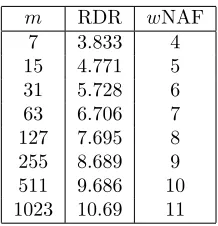
It is then possible to compute D(w) for practical values of wand finally obtain the density of the RDR representation for a given number of drawings. In this work we have computed it forw≤W ≤10 . Results are summarized in Table 4.2. In order to maximize the number of possible digit sets, we fixt=1+m
4
as the number of drawn balls. ThewNAF column corresponds to the (optimal) density of thewNAF representation using as many digits as the RDR. We observe that the difference between the two methods is relatively small. The general loss in terms of density is less than half a bit.
4.2
Precomputation scheme
The first step of our exponentiation scheme consists of computingg±di ford
i ∈ D. Finding an efficient way
to perform this computation is somehow equivalent to finding a short addition chain computing the setD. The problem is trivial whenD =Bm as the chain (1,2,3,5,7,9, . . . , m) is the shortest possible. However
when the di’s are randomly chosen it is harder to find an optimal chain. The naive approach consists of
m RDR wNAF 7 3.833 4 15 4.771 5 31 5.728 6 63 6.706 7 127 7.695 8 255 8.689 9 511 9.686 10 1023 10.69 11
Figure 1: Inverses of the density of the RDR andwNAF usingm+1 4
digits
the computation of multiple powers of a group element. Our case however does not require such a general method. In particular, we know that
• we need to compute thegdi’s for small values ofd
i,
• alldi’s are odd,
• the cardinal ofDis fixed to bm+1 4 c.
Thus we can use a more simple method described next. Let 0 < b < W be a parameter and define
q=bm
2bc:
1. computeX ={g, g2, g3, g5, g7, . . . , g2b−1
},
2. computeY ={g2b, g2·2b, , g3·2b, . . . , gq·2b}, 3. for alldi∈/X, computegdi =xy,(x, y)∈X×Y.
The computation cost is 2b−1 group operations to computeX, qgroup operations to computeY and at
most #Dgroup operations to obtain the gdi’s. The total cost is thus bounded by 2b−1+bm
2bc+ #Dgroup
operations. In the end, we save many operations in the later stage depending on parameter b. Indeed, the proportion of integerdi in X is given by 2
b
m+1. So for instance, with
m+1
4 randomly chosen numbers, our
method saves on average 2b−2group operations.
5
Side-channel Security
The main interest of randomizing the exponentiation process is to provide resistance to side-channel attacks via algorithmic countermeasures. In this section we discuss the security of our method against differential and simple side channel attacks.
5.1
Differential attacks
that those attacks use the facts that the set of digits is known in advance. For instance, the hidden Markov model cryptanalysis used against the Oswald-Aigner randomized exponentiation makes a direct use of the knowledge of the three possible digits 0,1 and −1 to produce the probabilistic state machines used in the cryptanalysis [11].
From that perspective, our method is the first to provide two levels of protection against those attacks. First, the fact that the digit set is randomly chosen prevents a traditional attackers to mount any attack previously mentioned as they directly use the fact that the digit set is know in advance. In order to mount an attack, all possible digit sets must be considered and dealt with in parallel. For that matter, the size of the set can be seen as a security parameter. For instance, using an eight digit recoding (seven of them randomly chosen from{3, . . . ,31}), we obtain a total of 6435 possible digit sets and more than 3×10⁸ for
a sixteen digit recoding. On top of that, the recoding algorithm itself provides randomness as when several digits satisfy the appropriate congruence one is chosen at random. It means that for a given digit set, any integer can have many different recodings.
5.2
Simple side-channel attacks
Simple side-channel attacks aim at obtaining information on the secret key using a single trace. Typically, being able to distinguish squarings from multiplications allows an adversary to recover the secret exponent of any exponentiation using the square-and-multiplyalgorithm. From that perspective, a randomization process does not, by itself, provide any protection. To ensure that an algorithm is secure against such attacks, the standard way is to make the computation as regular as possible. It can be done at the algorithm level, using the Montgomery ladder for instance, or at the group algorithmic level, for example by using unified formulae in the context of elliptic curve cryptography or using block atomicity.
Our algorithm clearly will not have a regular behavior, however that does not signifies that it is vulnera-ble to simple attacks. Indeed, one obviously implements it using one of the previously mentioned arithmetic level countermeasures, but even without them, being able to distinguish between squaring and multiplication does not provide much information on the secret key. Even if the sequence of multiplications and squarings performed by the algorithm is given, one still has to guess which digit has been used at each step. For instance, for a 128-bit security, and therefor a 256-bit exponent, and an eight digit recoding (that is with parameterm= 31 in Table 1), there will be on average 44.6 non-zero digits in the recoding corresponding to so many multiplications in the trace. As there are 8 possible choices for each of these multiplications the total number of combinations is roughly 844.6∼2133.8. This has to be multiplied by the number of possible
digits sets (6435). Trying to recover the original key from an exhaustive search would be more difficult than attacking the system itself.
Remark 3. All previous claims are only based on general considerations. It would be presumptuous to consider our scheme secure and great care must be taken for that matter. Many previous schemes have been claimed to be side-channel resistant and have been broken little time after that. However, because of an extra degree of randomization our approach can potentially provide more protection than those previous methods and can be combined with others in order to, at least, make attackers job harder, for very little computational overhead.
5.3
Related works
hidden Markov model attack seems to be a threat to all of them. Finally, very recently Gu´erini, Imbert and Winterhalter proposed a new recoding method based on exact covering systems of congruences [5]. In some way it is the closest approach to ours as it provides several possible digits, however fixed in advance, at every step of the recoding and seem to provide more randomness and security than the previous approaches. It is also interesting to remark that both methods can be combined as they rely on different aspects of the exponent recoding.
6
Conclusions
In this work we have proposed a generalization of the traditional fractionalwNAF recoding. Our algorithm allows the computation of the representation of an integer using a set of any digits that has 1 in it. We also have given a general formulae to compute the average density of non-zero terms of such representations. We also studied the average density obtained when digits are chosen at random in a given set and suggested a randomized schemes that could be used to provide some additional protection against differential side-channel attacks. It has the advantage of being flexible, as the number of digits and thus the security provided can be chosen at will, and is also efficient as the average density is close to that of the fractionalwNAF using the same number of digits.
The main question that arises is that of the possibility to generalize such recoding even further. In other words, is it possible to eliminate the necessity of having 1 in the digit set? We know that not all numbers can be represented using any digit set, so given a digit setD, is there a condition under which any integer can have aD-representation?
References
[1] A. Brauer. On addition chains. Bulletin of the American Mathematical Society, 45(10):736–739, 1939.
[2] H. Cohen and G. Frey, editors. Handbook of Elliptic and Hyperelliptic Cryptography. Chapman & Hall, 2006.
[3] V. Dimitrov, L. Imbert, and P. K. Mishra. The double-base number system and its application to elliptic curve cryptography. Mathematics of Computations, 77, 2008.
[4] Pierre-Alain Fouque, Fr´ed´eric Muller, Guillaume Poupard, and Fr´ed´eric Valette. Defeating countermea-sures based on randomized bsd representations. In Marc Joye and Jean-Jacques Quisquater, editors,
Cryptographic Hardware and Embedded Systems - CHES 2004, volume 3156 ofLecture Notes in Com-puter Science, pages 312–327. Springer Berlin Heidelberg, 2004.
[5] Eleonora Guerrini, Laurent Imbert, and Th´eo Winterhalter. Randomizing scalar multiplication using exact covering systems of congruences. Cryptology ePrint Archive, Report 2015/475, 2015.
[6] Jae-Cheol Ha and Sang-Jae Moon. Randomized signed-scalar multiplication of ecc to resist power at-tacks. InRevised Papers from the 4th International Workshop on Cryptographic Hardware and Embedded Systems, CHES ’02, pages 551–563. Springer-Verlag, 2003.
[7] D. Hankerson, A. Menezes, and S. Vanstone. Guide to Elliptic Curve Cryptography. Springer, 2004.
[8] M.A. Hasan. Power analysis attacks and algorithmic approaches to their countermeasures for koblitz curve cryptosystems. Computers, IEEE Transactions on, 50(10):1071–1083, Oct 2001.
[9] Kouichi Itoh, Jun Yajima, Masahiko Takenaka, and Naoya Torii. Dpa countermeasures by improving the window method. InCryptographic Hardware and Embedded Systems - CHES 2002, volume 2523 of
[10] Tetsuya Izu and Tsuyoshi Takagi. A fast parallel elliptic curve multiplication resistant against side channel attacks. InPublic Key Cryptography, volume 2274 ofLecture Notes in Computer Science, pages 280–296. Springer Berlin Heidelberg, 2002.
[11] Chris Karlof and David Wagner. Hidden markov model cryptanalysis. InCryptographic Hardware and Embedded Systems - CHES 2003, volume 2779 of Lecture Notes in Computer Science, pages 17–34. Springer Berlin Heidelberg, 2003.
[12] N. Koblitz. Cm-curves with good cryptographic properties. In Advances in Cryptology - CRYPTO, volume 576 ofLNCS, page 279. Springer, February 1992.
[13] P.-Y. Liardet and N. P. Smart. Preventing SPA/DPA in ECC systems using the Jacobi form. In
Cryptographic Hardware and Embedded Systems - CHES, pages 391–401. Springer-Verlag, 2001.
[14] B. M¨oller. Improved techniques for fast exponentiation. In Springer Berlin / Heidelberg, editor, Infor-mation Security and Cryptology — ICISC 2002, volume 2587 ofLNCS, pages 298–312, 2003.
[15] Elisabeth Oswald and Manfred Aigner. Randomized addition-subtraction chains as a countermeasure against power attacks. InProceedings of the Third International Workshop on Cryptographic Hardware and Embedded Systems, CHES ’01, pages 39–50. Springer-Verlag, 2001.
[16] N. Pippenger. On the evaluation of powers and related problems. InFoundations of Computer Science, 1976., 17th Annual Symposium on, pages 258–263, Oct 1976.
[17] E. G. Thurber. On addition chains l(mn)≤l(n)−b and lower bounds for c(r). Duke Mathematical Journal, 40:907–913, 1973.
[18] Colin D. Walter. Breaking the liardet-smart randomized exponentiation algorithm. InProceedings of the 5th Conference on Smart Card Research and Advanced Application Conference - Volume 5, CARDIS’02, pages 7–7, Berkeley, CA, USA, 2002. USENIX Association.
[19] ColinD. Walter. Mist: An efficient, randomized exponentiation algorithm for resisting power analysis. InTopics in Cryptology — CT-RSA 2002, volume 2271 ofLecture Notes in Computer Science, pages 53–66. Springer Berlin Heidelberg, 2002.