
Aurora: Transparent Succinct Arguments for R1CS
Eli Ben-Sasson [email protected]
Technion
Alessandro Chiesa [email protected]
UC Berkeley
Michael Riabzev
[email protected] Technion
Nicholas Spooner [email protected]
UC Berkeley
Madars Virza [email protected]
MIT Media Lab
Nicholas P. Ward [email protected]
UC Berkeley
May 8, 2019
Abstract
We design, implement, and evaluate a zkSNARK for Rank-1 Constraint Satisfaction (R1CS), a widely-deployed NP-complete language that is undergoing standardization. Our construction uses a transparent setup, is plausibly post-quantum secure, and uses lightweight cryptography. A proof attesting to the satisfiability ofnconstraints has sizeO(log2n); it can be produced withO(nlogn)field operations and verified withO(n). At128bits of security, proofs are less than130 kB even for several million constraints, more than20×shorter than prior zkSNARK with similar features.
A key ingredient of our construction is a new Interactive Oracle Proof (IOP) for solving aunivariate analogue of the classical sumcheck problem [LFKN92], originally studied formultivariatepolynomials. Our protocol verifies the sum of entries of a Reed–Solomon codeword over any subgroup of a field.
We also providelibiop, an open-source library for writing IOP-based arguments, in which a toolchain of transformations enables programmers to write new arguments by writing simple IOP sub-components. We have used this library to specify our construction and prior ones.
Contents
1 Introduction 3
1.1 The need for a transparent setup . . . 3
1.2 Our goal . . . 4
1.3 Our contributions . . . 5
1.4 Prior implementations of transparent succinct non-interactive arguments . . . 6
2 Techniques 9 2.1 Our interactive oracle proof for R1CS . . . 9
2.2 A sumcheck protocol for univariate polynomials . . . 10
2.3 Efficient zero knowledge from algebraic techniques . . . 11
2.4 Perspective on our techniques . . . 12
3 Roadmap 14 4 Preliminaries 15 4.1 Codes . . . 15
4.2 Representations of polynomials . . . 15
4.3 The fast Fourier transform . . . 15
4.4 Subspace polynomials . . . 15
4.5 Interactive oracle proofs . . . 16
4.6 Zero knowledge . . . 17
4.7 Reed–Solomon encoded IOP . . . 18
4.8 Univariate rowcheck . . . 20
5 Univariate sumcheck 21 5.1 Zero knowledge . . . 23
5.2 Amortization . . . 24
6 Univariate lincheck 26 7 An RS-encoded IOP for rank-one constraint satisfaction 28 7.1 Zero knowledge . . . 30
7.2 Amortization . . . 32
8 From RS-encoded provers to arbitrary provers 34 8.1 Zero knowledge . . . 37
9 Aurora: an IOP for rank-one constraint satisfaction (R1CS) 40 10 libiop: a library for IOP-based non-interactive arguments 43 10.1 Library for IOP protocols . . . 43
10.2 BCS transformation . . . 43
10.3 Portfolio of IOP protocols and sub-components . . . 44
11 Evaluation 45 11.1 Performance of Aurora . . . 45
11.2 Comparison of Ligero, Stark, and Aurora . . . 45
A Proof of Lemma 5.4 48 B Adaptation of Ligero to the R1CS relation 49 B.1 Interleaved lincheck . . . 49
B.2 Interleaved rowcheck . . . 50
B.3 Interleaved ZKIPCP for R1CS . . . 51
B.4 From encoded IPCP to regular IPCP . . . 55
C Additional comparisons 57 C.1 Comparison of the LDTs in Ligero, Stark, and Aurora . . . 57
C.2 Comparison of the IOPs in Ligero, Stark, and Aurora . . . 57
Acknowledgments 59
1
Introduction
A zero knowledge proof is a protocol that enables one party (theprover) to convince another (theverifier) that a statement is true without revealing any information beyond the fact that the statement is true. Since their introduction [GMR89], zero knowledge proofs have become fundamental tools not only in the theory of cryptography but also, more recently, in the design of real-world systems with strong privacy properties.
For example, zero knowledge proofs are the core technology in Zcash [BCGGMTV14; Zca], a popular cryptocurrency that preserves a user’s payment privacy. While in Bitcoin [Nak09] users broadcast their private payment details in the clear on the public blockchain (so other participants can check the validity of the payment), users in Zcash broadcastencryptedtransaction details andprove, in zero knowledge, the validity of the payments without disclosing what the payments are.
Many applications, including the aforementioned, require that proofs aresuccinct, namely, that proofs scalesublinearlyin the size of the witness for the statement, or perhaps even in the size of the computation performed to check the statement. This strong efficiency requirement cannot be achieved with statistical soundness (under standard complexity assumptions) [GH98], and thus one must consider proof systems that are merely computationally sound, known asargument systems[BCC88]. Many applications further require that a proof consists of a single non-interactive message that can be verified by anyone; such proofs are cheap to communicate and can be stored for later use (e.g., on a public ledger). Constructions that satisfy these properties are known as (publicly verifiable)succinct non-interactive arguments(SNARGs) [GW11].
In this work we present Aurora, a zero knowledge SNARG of knowledge (zkSNARK) for (an extension of) arithmetic circuit satisfiability whose argument size is polylogarithmic in the circuit size. Aurora also has attractive features: it uses a transparent setup, is plausibly post-quantum secure, and only makes black-box use of fast symmetric cryptography (any cryptographic hash function modeled as a random oracle).
Our work makes an exponential asymptotic improvement in argument size over Ligero [AHIV17], a recent zero knowledge non-interactive argument with similar features but where proofs scale as thesquare rootof the circuit size. For example, Aurora’s proofs are30×smaller than Ligero’s for circuits with a million gates (which already suffices for representative applications such as Zcash).
Our work also complements and improves on Stark [BBHR18a], a recent zkSNARK that targets compu-tations expressed as bounded halting problems on random access machines. While Stark was designed for a different computation model, we can still study its efficiency when applied to arithmetic circuits. In this case Aurora’s prover is faster by a logarithmic factor (in the circuit size) and Aurora’s proofs are concretely much shorter, e.g.,20×smaller for circuits with a million gates.
The efficiency features of Aurora stem from a new Interactive Oracle Proof (IOP) that solves aunivariate analogue of the celebrated sumcheck problem [LFKN92], in which query complexity islogarithmicin the degree of the polynomial being summed. This is anexponentialimprovement over the original multi-variate protocol, where communication complexity is (at least)linearin the degree of the polynomial. We believe this protocol and its analysis are of independent interest.
1.1 The need for a transparent setup
In light of this, a different approach was initially used to achieve SNARG implementations with good concrete efficiency [PGHR13; BCGTV13]. This approach, pioneered in [Gro10; GGPR13; Lip13; BCIOP13], relied on combining certain linearly homomorphic encodings with lightweight information-theoretic tools known as linear PCPs [IKO07; BCIOP13; SBVBPW13]; this approach was refined and optimized in several works [BCTV14b; BCTV14a; CFHKKNPZ15; Gro16; BISW17; GM17]. These constructions underlie widely-used open-source libraries [SCI] and deployed systems [Zca], and their main feature is that proofs are very short (a few hundred bytes) and very cheap to verify (a few milliseconds).
Unfortunately, the foregoing approach suffers from a severe limitation, namely, the need for a central party to generate system parameters for the argument system. Essentially, this party must run a probabilistic algorithm, publish its output, and “forget” the secret randomness used to generate it. This party must be trustworthy because knowing these secrets allows forging proofs for false assertions. While this may sound like an inconvenience, it is acolossalchallenge to real-world deployments. When using cryptographic proofs in distributed systems, relying on a central party negates the benefits of distributed trust and, even though it is invoked only once in a system’s life, a party trusted by all users typicallydoes not exist!
The responsibility for generating parameters can in principle be shared across multiple parties via techniques that leverage secure multi-party computation [BCGTV15; BGG17; BGM17]. This was the approach taken for the launch of Zcash [The], but it also demonstrated how unwieldy such an approach is, involving a costly and logistically difficult real-world multi-party “ceremony”. Successfully running such a multi-party protocol was a singular feat, and systems without such expensive setup are decidedly preferable.
Somesetup is unavoidable because if SNARGs withoutanysetup existed then so would sub-exponential algorithms for SAT [Wee05]. Nevertheless, one could still aim for a “transparent setup”, namely one that consists ofpublic randomness, because in practice it is cheaper to realize. Recent efforts have thus focused on designing SNARGs with transparent setup (see discussion in Section 1.4).
1.2 Our goal
The goal of this paper is to obtaintransparent zkSNARKsthat satisfy the following desiderata.
• Post-quantum security. Practitioners, and even standards bodies [NIS16], have a strong interest in crypto-graphic primitives that are plausibly secure against efficient quantum adversaries. This is motivated by the desire to ensure long-term security of deployed systems and protocols.
• Concrete efficiency.We seek argument systems that not only exhibit good asymptotics (in argument size and prover/verifier time) but also demonstrably offer good efficiency via a prototype.
The second bullet warrants additional context. Most argument systems support an NP-complete problem, so they are in principle equivalent under polynomial-time reductions. Yet, whether such protocols can be efficiently used in practice actually depends on: (a) the particular NP-complete problem “supported” by the protocol; (b) the concrete efficiency of the protocol relative to this problem. This creates a complex tradeoff.
Simple NP-complete problems, like boolean circuit satisfaction, facilitate simple argument systems; but reducing the statements we wish to prove to boolean circuits is often expensive. On the other hand, one can design argument systems for rich problems (e.g., an abstract computer) for which it is cheap to express the desired statements; but such argument systems may use expensive tools to support these rich problems.
Our goal is concretely-efficient argument systems forrank-1 constraint satisfaction(R1CS), which is the following natural NP-complete problem: given a vectorv∈Fkand three matricesA, B, C∈
Fm×n, can one augmentvtoz∈Fnsuch thatAz◦Bz=Cz? (We use “◦” to denote the entry-wise product.)
argument systems for it. Moreover, R1CS has demonstratedstrong empirical value: it underlies real-world systems [Zca] and there are compilers that reduce program executions to it (see [WB15] and references therein). This has led to efforts to standardize R1CS formats across academia and industry [Zks].
1.3 Our contributions
In this work we studyInteractive Oracle Proofs(IOPs) [BCS16; RRR16], a notion of “multi-round PCPs” that has recently received much attention [BCGV16; BCFGRS17; BBCGGHPRSTV17; BBHR18b; BBHR18a; BKS18]. These types of interactive proofs can be compiled into non-interactive arguments in the random oracle model [BCS16], and in particular can be used to construct transparent SNARGs. The properties of zero knowledge and proof of knowledge are inherited from the IOP, leading to transparent zkSNARKs.
Building on this approach, we present several contributions: (1) an IOP protocol for R1CS with attractive efficiency features; (2) design, implementation, and evaluation of a transparent zkSNARK for R1CS, based on this IOP; (3) a library for writing IOP-based non-interactive arguments. We now describe each contribution.
(1) IOP for R1CS. We construct a zero knowledge IOP protocol for rank-1 constraint satisfaction (R1CS)
withlinearproof length andlogarithmicquery complexity.
Given an R1CS instanceC= (A, B, C)withA, B, C∈Fm×n, we denote byN = Ω(m+n)the total number of non-zero entries in the three matrices and by|C|the number of bits required to represent these; note that|C|= Θ(Nlog|F|). One can viewN as the number of “arithmetic gates” in the R1CS instance.
Theorem 1.1(informal). There is anO(logN)-round IOP protocol for R1CS with proof lengthO(N)over alphabetFand query complexityO(logN). The prover usesO(NlogN)field operations, while the verifier usesO(N)field operations. The IOP protocol is public coin and is a zero knowledge proof of knowledge.
The core of our result is a solution to aunivariateanalogue of the classical sumcheck problem [LFKN92]. Our protocol (including zero knowledge and soundness error reduction) is relatively simple: it is specified in a single page (see Fig. 5 in Section 9), given a low-degree test as a subroutine. The low degree test that we use is a recent highly-efficient IOP for testing proximity to the Reed–Solomon code [BBHR18b].
(2) zkSNARK for R1CS. We design, implement, and evaluate Aurora, a zero knowledge SNARG of
knowledge (zkSNARK) for R1CS with several notable features: (a) it only makes black-box use of fast symmetric cryptography (any cryptographic hash function modeled as a random oracle); (b) it has a transparent setup (users merely need to “agree” on which cryptographic hash function to use); (c) it is plausibly post-quantum secure (there are no known efficient post-quantum attacks against this construction). These features follow from the fact that Aurora is obtained by applying the transformation of [BCS16] to our IOP for R1CS. This transformation preserves both zero knowledge and proof of knowledge of the underlying IOP. The following theorem is obtained straightforwardly by combining Theorem 1.1 with [BCS16, Theorem 7.1].
Theorem 1.2(informal). There exists a zkSNARK for R1CS that is unconditionally secure in the random oracle model with proof lengthOλ(log2N). The prover runs in timeOλ(NlogN)and the verifier in time
Oλ(N). (Here for simplicity we take the fieldFto have size2Θ(λ)whereλis the security parameter.)
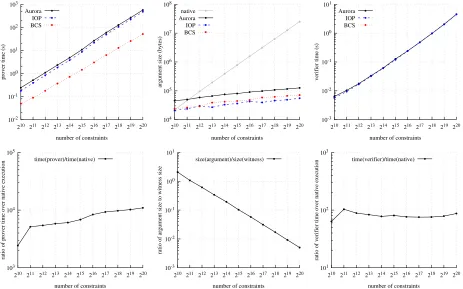
For example, setting our implementation to a security level of 128 bits over a 192-bit finite field, proofs range from40 kBto130 kBfor instances of up to millions of gates; producing proofs takes on the order of
several minutes and checking proofs on the order of several seconds. (See Section 11 for details.)
(3)libiop: a library for non-interactive arguments. We providelibiop, a codebase that enables the
design and implementation of non-interactive arguments based on IOPs. The codebase uses the C++ language and has three main components: (1) a library for writing IOP protocols; (2) a realization of [BCS16]’s transformation, mapping any IOP written with our library to a corresponding non-interactive argument; (3) a portfolio of IOP protocols. We have releasedlibiopunder a permissive software license for the community
(seehttps://github.com/scipr-lab/libiop). We believe that our library will serve as a useful tool in meeting the increasing demand by practitioners for transparent non-interactive arguments.
1.4 Prior implementations of transparent succinct non-interactive arguments
We summarize prior work that has designedand implementedtransparent SNARGs; see Fig. 2.1
Based on asymmetric cryptography. Bulletproofs[BCCGP16; BBBPWM18] proves the satisfaction of an
N-gate arithmetic circuit via a recursive use of a low-communication protocol for inner products, achieving a
proof withO(logN)group elements. Hyrax[WTSTW17] proves the satisfaction of alayeredarithmetic circuit of depthDand widthW via proofs ofO(DlogW)group elements; the construction applies the
Cramer–Damg˚ard transformation [CD98] to doubly-efficient Interactive Proofs [GKR15; CMT12]. Both approaches use Pedersen commitments, and so arevulnerable to quantum attacks. Also, in both approaches the verifier performsmany expensive cryptographic operations: in the former, the verifier usesO(N)group
exponentiations; in the latter, the verifier’s group exponentiations are linear in the circuit’s witness size. (Hyrax allows fewer group exponentiations but with longer proofs; see [WTSTW17].)
Based on symmetric cryptography. The “original” SNARG construction of Micali [Mic00; IMSX15] has
advantages beyond transparency. First, it is unconditionally secure given a random oracle, which can be instantiated with fast symmetric cryptography.2 Second, it is plausibly post-quantum secure, in that there are
no known efficient quantum attacks. But the construction relies on PCPs, which remain expensive.
IOPs are “multi-round PCPs” that can also be compiled into non-interactive arguments in the random oracle model [BCS16]. This compilation retains the foregoing advantages (transparency, lightweight cryp-tography, and plausible post-quantum security) and,in addition, facilitates greater efficiency, as IOPs have superior efficiency compared to PCPs [BCGV16; BCFGRS17; BBCGGHPRSTV17; BBHR18b; BBHR18a].
In this work we follow the above approach, by constructing a zkSNARK based on a new IOP protocol. Two recent works have also taken the same approach, but with different underlying IOP protocols, which have led to different features. We provide both of these works as part of our library (Section 10), and experimentally compare them with our protocol (Section 11). The discussion below is a qualitative comparison.
• Ligero[AHIV17] is a non-interactive argument that proves the satisfiability of anN-gate circuit via proofs
of sizeO(√N) that can be verified inO(N)cryptographic operations. As summarized in Fig. 1, the
IOP underlying Ligero achieves the same oracle proof length, prover time, and verifier time as our IOP. However, we reduce query complexity fromO(√N)toO(logN), which is an exponential improvement,
at the expense of increasing round complexity from2toO(logN). The arguments that we obtain are still
non-interactive, but our smaller query complexity translates into shorter proofs (see Fig. 2).
• Stark[BBHR18a] is a non-interactive argument for bounded halting problems on a random access machine.
Given a programP and a time boundT, it proves thatP accepts withinT steps on a certain abstract
1We omit a discussion of prior works without implementations, or that studynon-transparentsuccinct non-interactive arguments; we refer the reader to the survey of Walfish and Blumberg [WB15] for an overview of sublinear argument systems. We also note that recent work [BBCPGL18] has used lattice cryptography to achieve sublinear zero knowledge arguments that are plausibly post-quantum secure, which raises the exciting question of whether these recent protocols can lead to efficient implementations.
computer (when given suitable nondeterministic advice) via succinct proofs of sizepolylog(T). Moreover,
verification isalsosuccinct: checking a proof takes time only|P|+ polylog(T), which is polynomial in
the size of the statement and much better than “naive verification” which takes timeΩ(|P|+T).
The main difference between Stark and Aurora is the computational models that they support. While Stark supportsuniformcomputations specified by a program and a time bound, Aurora supportsnon-uniform computations specified by an explicit circuit (or constraint system). Despite this difference, we can compare the cost of Stark and Aurora with respect to the explicit circuit model, since one can reduce a givenN-gate
circuit (orN-constraint system) to a corresponding bounded halting problem with|P|, T = Θ(N).
In this case, Stark’s verification time is the same as Aurora’s,O(N); this is best possible because just
readinganN-gate circuit takes timeΩ(N). But Stark’s prover is a logarithmic factor more expensive
because it uses a switching network to verify a program’s accesses to memory. Stark’s prover uses an IOP with oracles of sizeO(NlogN), leading to an arithmetic complexity ofO(Nlog2N). (See Figs. 1 and 2.)
Both Stark and Aurora have argument sizeO(log2N), but additional costs in Stark (e.g., due to switching
protocol round proof length query prover time verifier time type complexity (field elts) complexity (field ops) (field ops)
Ligero IPCP† 2 O(N) O(√N) O(NlogN) O(N) Stark IOP O(logN) O(NlogN) O(logN) O(Nlog2N) O(N) Aurora IOP O(logN) O(N) O(logN) O(NlogN) O(N)
Figure 1: Asymptotic comparison of the information-theoretic proof systems underlying Ligero, Stark, and Aurora, when applied to anN-gate arithmetic circuit.
†An IPCP [KR08] is a PCP oracle that is checked via an Interactive Proof; it is a special case of an IOP.
post argument size verifier non-interactivity name setup quantum? asymptotic N= 106 time technology
[Gro10][GGPR13]
[Lip13][BCIOP13]... various private no
Oλ(1) 128 B Oλ(k)† linear PCP + linear encoding [ZGKPP17a] ZK-vSQL private no Oλ(dlogN) N/A Oλ(N) apply [CD98]-transform to
doubly-efficient IP [GKR15; CMT12] [WTSTW17] Hyrax public no Oλ(dlogN)‡ 50 kB Oλ(N) as above (but using a different
polynomial commitment) [BCCGP16]
[BBBPWM18]
Bulletproofs public no Oλ(logN) 1.5 kB Oλ(N) recursive inner product argument
[AHIV17] Ligero public yes Oλ(
√
N) 4.0 MB Oλ(N) apply [BCS16]-transform to IPCP [BBHR18a] Stark public yes Oλ(log2N) 3.2 MB Oλ(N) apply [BCS16]-transform to IOP this work Aurora public yes Oλ(log2N) 130 kB Oλ(N) apply [BCS16]-transform to IOP
Figure 2: Comparison of some non-interactive zero knowledge arguments for proving statements of the form “there exists a secretwsuch thatC(x, w) = 1” for a given arithmetic circuitCofNgates (and depth d) and public inputxof sizek. The table is grouped by “technology”, and for simplicity assumes that the circuit’s underlying field has size2O(λ)whereλis the security parameter. Approximate argument sizes
are given forN= 106gates over a cryptographically-large field, and a security level of128bits; some
argument sizes may differ from those reported in the cited works because size had to be re-computed for the security level andNused here; also, [ZGKPP17a] reports no implementation.
†Given a per-circuit preprocessing step.
2
Techniques
Our main technical contribution is a linear-length logarithmic-query IOP for R1CS (Theorem 1.1), which we use to design, implement, and evaluate a transparent zkSNARK for R1CS. Below we summarize the main ideas behind our protocol, and postpone to Sections 10 and 11 discussions of our system. In Section 2.1, we describe our approach to obtain the IOP for R1CS; this approach leads us to solve the univariate sumcheck problem, as discussed in Section 2.2; finally, in Section 2.3, we explain how we achieve zero knowledge. In Section 2.4 we conclude with a wider perspective on the techniques used in this paper.
2.1 Our interactive oracle proof for R1CS
The R1CS relation consists of instance-witness pairs((A, B, C, v), w), whereA, B, Care matrices andv, w
are vectors over a finite fieldF, such that(Az)◦(Bz) =Czforz:= (1, v, w)and “◦” denotes the entry-wise product.3 For example, R1CS captures arithmetic circuit satisfaction:A, B, Crepresent the circuit’s gates,v
the circuit’s public input, andwthe circuit’s private input and wire values.4
We describe the high-level structure of our IOP protocol for R1CS, which has linear proof length and logarithmic query complexity. The protocol tests satisfaction by relying on two building blocks, one for testing the entry-wise vector product and the other for testing the linear transformations induced by the matricesA, B, C. Informally, we thus consider protocols for the following two problems.
• Rowcheck: given vectorsx, y, z ∈Fm, test whetherx◦y=z, where “◦” denotes entry-wise product.
• Lincheck:given vectorsx∈Fm, y∈
Fnand a matrixM ∈Fm×n, test whetherx=M y.
One can immediately obtain an IOP for R1CS when given IOPs for the rowcheck and lincheck problems. The prover first sends four oracles to the verifier: the satisfying assignmentzand its linear transformations yA:=Az, yB:=Bz, yC :=Cz. Then the prover and verifier engage in four IOPs in parallel:
– An IOP for the lincheck problem to check that “yA=Az”. Likewise foryBandyC.
– An IOP for the rowcheck problem to check that “yA◦yB=yC”.
Finally, the verifier checks thatzis consistent with the public inputv. Clearly, there existz, yA, yB, yCthat
yield valid rowcheck and lincheck instances if and only if(A, B, C, v)is a satisfiable R1CS instance.
The foregoing reduces the goal to designing IOPs for the rowcheck and lincheck problems.
As stated, however, the rowcheck and lincheck problems only admit “trivial” protocols in which the verifier queries all entries of the vectors in order to check the required properties. In order to allow for sublinear query complexity, we need the vectorsx, y, zto beencodedvia some error-correcting code. We use the Reed–Solomon (RS) code because it ensures constant distance with constant rate while at the same time it enjoys efficient IOPs of Proximity [BBHR18b].
Given an evaluation domainL⊆Fand rate parameterρ∈[0,1],RS [L, ρ]is the set of all codewords
f:L → Fthat are evaluations of polynomials of degree less than ρ|L|. Then, the encoding of a vector
v ∈FSwithS ⊆Fand|S|< ρ|L|isˆv|L∈FLwherevˆis the unique polynomial of degree|S| −1such thatˆv|S=v. Given this encoding, we consider “encoded” variants of the rowcheck and lincheck problems.
3Throughout, we assume that
Fis “friendly” to FFT algorithms, i.e.,Fis a binary field or its multiplicative group is smooth.
4The reader may be familiar with a standard arithmetization of circuit satisfaction (used, e.g., in the inner PCP of [ALMSS98]). Given an arithmetic circuit withmgates andn wires, each addition gatexi ← xj +xk is mapped to the linear constraint
xi=xj+xkand each product gatexi ←xj·xkis mapped to the quadratic constraintxi=xj·xk. The resulting system of equations can be written asA·((1, x)⊗(1, x)) =bfor suitableA∈Fm×(n+1)
2
andb∈Fm. However, this reduction results in a
• Univariate rowcheck(Definition 4.9): given a subsetH ⊆Fand codewordsf, g, h∈RS [L, ρ], check
thatfˆ(a)·gˆ(a)−ˆh(a) = 0for alla∈H. (This is a special case of the definition that we use later.)
• Univariate lincheck (Definition 6.1): given subsetsH1, H2 ⊆ F, codewords f, g ∈ RS [L, ρ], and a matrixM ∈FH1×H2, check thatfˆ(a) =Pb∈H2Ma,b·gˆ(b)for alla∈H1.
Given IOPs for the above problems, we can now get an IOP protocol for R1CS roughly as before. Rather than sendingz, Az, Bz, Cz, the prover sends their encodingsfz, fAz, fBz, fCz. The prover and verifier then
engage in rowcheck and lincheck protocols as before, but with respect to these encodings.
For these encoded variants, we achieve IOP protocols with linear proof length and logarithmic query complexity, as required. We obtain a protocol for rowcheck via standard techniques from the probabilistic checking literature [BS08]. As for lincheck, we do not use any routing and instead use a technique (dating back at least to [BFLS91]) to reduce the given testing problem to asumcheck instance. However, since we are not working with multivariate polynomials, we cannot rely on the usual (multivariate) sumcheck protocol. Instead, we present a novel protocol that realizes a univariate analogue of the classical sumcheck protocol, and use it as the testing “core” of our IOP protocol for R1CS. We discuss univariate sumcheck next.
Remark 2.1. The verifier receives as input an explicit (non-uniform) description of the set of constraints,
namely, the matricesA, B, C. In particular, the verifier runs in time that is at least linear in the number of
non-zero entries in these matrices (if we consider a sparse-matrix representation for example).
2.2 A sumcheck protocol for univariate polynomials
A key ingredient in our IOP protocol is aunivariateanalogue of the classical (multivariate) sumcheck protocol [LFKN92]. Recall that the classical sumcheck protocol is an IP for claims of the form “P
~a∈Hmf(~a) = 0”, wheref is a given polynomial inF[X1, . . . , Xm]of individual degreedandH is a subset ofF. In this protocol, the verifier runs in timepoly(m, d,log|F|) and accessesf at a single (random) location. The
sumcheck protocol plays a fundamental role in computational complexity (it underlies celebrated results such asIP=PSPACE[Sha92] andMIP=NEXP[BFL91]) and in efficient proof protocols [GKR15; CMT12;
TRMP12; Tha13; Tha15; WHGSW16; WJBSTWW17; ZGKPP17b; ZGKPP17a; WTSTW17].
We work with univariate polynomials instead, and need a univariate analogue of the sumcheck protocol (see previous subsection):how can a prover convince the verifier that “P
a∈Hf(a) = 0” for a given
polyno-mialf ∈F[X]of degreedand subsetH ⊆F? Designing a “univariate sumcheck” is not straightforward because univariate polynomials (the Reed–Solomon code) do not have the tensor structure used by the sumcheck protocol for multivariate polynomials (the Reed–Muller code). In particular, the sumcheck protocol hasmrounds, each of which reduces a sumcheck problem to a simpler sumcheck problem with one variable
fewer. When there is only one variable, however, it is not clear to what simpler problems one can reduce. Using different ideas, we design a natural protocol for univariate sumcheck in the cases whereHis an
additive or multiplicative coset inF(i.e., a coset of an additive or multiplicative subgroup ofF).
Theorem(informal). The univariate sumcheck protocol over additive or multiplicative cosets has aO(logd) -round IOP with proof complexityO(d)over alphabetFand query complexityO(logd). The IOP prover uses
O(dlog|H|)field operations and the IOP verifier usesO(logd+ log2|H|)field operations.
We now provide the main ideas behind the protocol, whenHis anadditivecoset inF.
coefficient ofX|H|−1inf is zero. In particular,P
a∈Hf(a) is zero if and only iff has degree less than |H| −1. Thus, the univariate sumcheck problem overHwhend <|H|is equivalent to low-degree testing. The foregoing suggests a natural approach: test thatfhas degree less than|H| −1. Without any help
from the prover, the verifier would need at least|H|queries tof to conduct such a test, which is as expensive
as querying all ofH. However, the prover can help by engaging with the verifier in an IOP of Proximity for
the Reed–Solomon code. For this we rely on the recent construction of Ben-Sasson et al. [BBHR18b], which has proof lengthO(d)and query complexityO(logd).
In our setting, however, we need to also handle the case where the degreedoff is larger than |H|. For this case, we observe that we can split any polynomial f into two polynomials g and h such that f(x) ≡ g(x) +Q
α∈H(x−α)·h(x)withdeg(g) < |H|anddeg(h) < d− |H|; in particular, f and g
agree onH, and thus so do their sums onH. This observation suggests the following extension to the prior
approach: the prover sendsg(as an oracle) to the verifier, and then the verifier performs the prior protocol
withgin place off. Of course, a cheating prover may send a polynomialgthat has nothing to do withf, and
so the verifier must also ensure thatgis consistent withf. To facilitate this, we actually have the prover send hrather thang; the verifier can then “query”g(x)asf(x)−Q
α∈H(x−α)·h(x); the prover then shows
thatf, g, hare all of the correct degrees.
A similar reasoning works when H is a multiplicative coset in F (see Remark 5.6). It remains an interesting open problem to establish whether the foregoing can be extended to any subsetHinF.
Remark 2.2(vanishing vs. summing). The following are both linear subcodes of the Reed–Solomon code:
VanishRS[F, L, H, d] :={f:L→F|f has degree less thandand is zero everywhere onH} ,
SumRS[F, L, H, d] :={f:L→F|f has degree less thandand sums to zero onH} .
Our univariate sumcheck protocol is an IOP of Proximity forSumRS, and is reminiscent of IOPs of Proximity
forVanishRS(e.g., see [BBHR18a]). Nevertheless, there are also intriguing differences between the two
cases. For example, while it is known how to test proximity toVanishRSfor generalH, we only know how
to test proximity toSumRSwhenHis a coset. Additionally, our IOP protocol for R1CS from Section 2.1 can
be viewed as a reduction from checking satisfaction of R1CS to testing proximity toSumRS; we do not know
how to carry out a similar reduction toVanishRS. Indeed, there is an interactive reduction fromVanishRSto SumRS, but no reduction in the other direction is known.
2.3 Efficient zero knowledge from algebraic techniques
The ideas discussed thus far yield an IOP protocol for R1CS with linear proof length and logarithmic query complexity. However these by themselves do not provide zero knowledge.
We achieve zero knowledge by leveraging recent algebraic techniques [BCGV16]. Informally, we adapt these techniques to achieve efficient zero knowledge variants of key sub-protocols, including the univariate sumcheck protocol (see Section 5.1) and low-degree testing (see Section 8.1), and combine these to achieve a zero knowledge IOP protocol for R1CS (see Sections 7.1 and 9).
We summarize the basic intuition for how we achieve zero knowledge in our protocols.
First, we usebounded independence. Informally, rather than encoding a vectorz∈FH by the unique
polynomial of degree|H| −1that matcheszonH, we instead sample uniformly at random a polynomial
of degree, say,|H|+ 9conditioned on matchingzonH. Any set of10evaluations of such a polynomial
Reed–Solomon codewords to be disjoint fromH. Thus, for example, if His a linear space (an additive
subgroup ofF) then we chooseLto be an affine subspace (a coset of some additive subgroup), since the underlying machinery for low-degree testing (e.g., [BBHR18b]) requires codewords to be evaluated over algebraically-structured domains. All of our protocols are robust to these variations.
Bounded independence alone does not suffice, though. For example, in the sumcheck protocol, consider the case where the input vectorz∈FH is all zeroes. The prover samples a random polynomialfˆof degree
|H|+ 9, such thatfˆ(a) = 0for alla∈H, and sends its evaluationf overLdisjoint fromHto the verifier.
As discussed, any ten queries tof result in ten independent and uniformly random elements inF. Observe, however, that when we run the sumcheck protocol onf, the polynomialg(the remainder offˆwhen divided
byQ
α∈H(x−α)) is the zero polynomial: all randomness is removed by the division.
To remedy this, we useself-reducibilityto reduce a sumcheck claim about the polynomialf to a sumcheck
claim about a random polynomial. The prover first sends a random Reed–Solomon codewordr, along with
the valueβ := P
a∈Hr(a). The verifier sends a random challengeρ ∈ F. Then the prover and verifier
engage in the univariate sumcheck protocol with respect to the new claim “P
a∈Hρf(a) +r(a) =β”. Since
ris uniformly random,ρf +ris uniformly random for anyρ, and thus the sumcheck protocol is performed
on a random polynomial, which ensures zero knowledge. Soundness is ensured by the fact that iffdoes not
sum to0onHthen the new claim is true with probability1/|F|over the choice ofρ.
2.4 Perspective on our techniques
A linear-length logarithmic-query IOP for a “circuit-like” NP-complete relation like R1CS (Theorem 1.1) may come as a surprise. We wish to shed some light on our IOP construction by connecting the ideas behind it to prior ideas in the probabilistic checking literature, and use these connections to motivate our construction.
A significant cost in all known PCP constructions with good proof length is usingrouting networksto reduce combinatorial objects (circuits, machines, and so on) to structured algebraic ones;5routing also plays
a major role in many IOPs [BCGV16; BCFGRS17; BBCGGHPRSTV17; BBHR18a]. While it is plausible that one could adapt routing techniques to route the constraints of an R1CS instance (similarly to [PS94]), such an approach would likely incur logarithmic-factor overheads, precludinglinear-size IOPs.
A recent work [BCGRS17] achieves linear-length constant-query IOPs for boolean circuit satisfaction without routing the input circuit. Unfortunately, [BCGRS17] relies on other expensive tools, such as algebraic-geometry (AG) codes and quasilinear-size PCPs of proximity [BS08]; moreover, it is not zero knowledge. Informally, [BCGRS17] tests arbitrary (unstructured) constraints by invoking a sumcheck protocol [LFKN92] on aO(1)-wise tensor product of AG codes; this latter is then locally tested via tools in [BS06; BS08].
One may conjecture that, to achieve an IOP for R1CS like ours, it would suffice to merely replace the AG codes in [BCGRS17] with the Reed–Solomon code, since both codes have constant rate. But taking a tensor product exponentially deteriorates rate, and testing proximity to that tensor product would be expensive.
An alternative approach is to solve a sumcheck problemdirectlyon the Reed–Solomon code. Existing protocols are not of much use here: the multivariate sumcheck protocol relies on a tensor structure that isnot available in the Reed–Solomon code, and recent IOP implementations either use routing [BBCGGHPRSTV17; BBHR18a] or achieve only sublinear query complexity [AHIV17].
Instead, we design a completely new IOP for a sumcheck problem on the Reed–Solomon code. We then combine this solution with ideas from [BCGRS17] (to avoid routing) and from [BCGV16] (to achieve zero
3
Roadmap
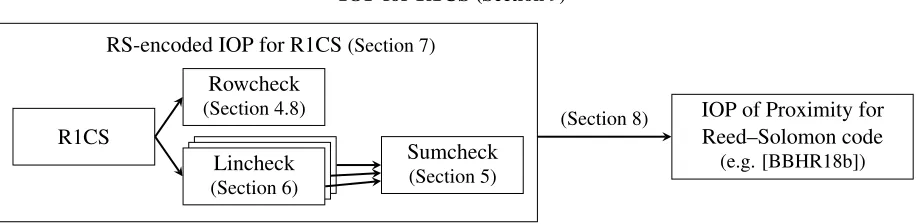
In Section 4 we provide necessary definitions about codes, proof systems, and other notions. Subsequent sections describe subprotocols, presented as Reed–Solomon encoded IOPs, which are IOPs for which soundness only holds against provers whose messages are Reed–Solomon codewords of specified rates, that are later compiled into standard IOPs. Specifically: the sumcheck protocol is in Section 5; the lincheck protocol in Section 6; and the rowcheck protocol in Section 4.8. In Section 7 we combine the rowcheck and lincheck protocols to obtain an RS-encoded IOP for R1CS. In Section 8 we explain how to transform RS-encoded IOPs to standard IOPs, and in Section 9 we apply this transformation to our RS-encoded IOP for R1CS. Fig. 3 summarizes the structure of our IOP for R1CS. Finally, in Section 10 we describe our implementation and in Section 11 we report on its evaluation.
Throughout, we focus on the case where all relevant domains areadditivecosets (affine subspaces) inF. The case where domains aremultiplicativecosets is similar, with only minor modifications (see Remark 5.6). Moreover, while for convenience we limit our discussions to establishing soundness, all protocols described in this paper are easily seen to satisfy the stronger notion of proof of knowledge. Informally, this is because we prove soundness by showing that oracles sent by convincing provers can be decoded to valid witnesses.
R1CS
Rowcheck
(Section 4.8)
Lincheck
(Section 6)
Sumcheck
(Section 5)
IOP of Proximity for Reed–Solomon code
(e.g. [BBHR18b])
RS-encoded IOP for R1CS(Section 7)
IOP for R1CS(Section 9)
(Section 8)
4
Preliminaries
Given a relationR ⊆S×T, we denote byL(R) ⊆S the set ofs∈S such that there existst ∈T with
(s, t)∈ R; fors∈S, we denote byR|s⊆T the set{t∈T : (s, t)∈ R}. Given a setSand stringsv, w∈
Snfor somen∈N, thefractional Hamming distance∆(v, w)∈[0,1]is∆(v, w) := n1|{i:vi 6=wi}|.
4.1 Codes
Interleaved codes. Given linear codes C1, . . . , Cm ⊆ Fn with alphabetF, we denote by Qmi=1Ci ⊆
(Fm)n ≡ Fm×nthe linear “interleaved” code with alphabetFm that equals the set of allm×nmatrices whosei-th row is inCi. IfC1=· · ·=Cm, we writeCmforQmi=1Ci. Since the alphabet isFm, the Hamming distance is takencolumn-wise: forA, A0 ∈Fm×n,∆(A, A0) := n1|{j∈[n] :∃i∈[m]s.t. Ai,j 6=A0i,j}|. The Reed–Solomon code. Given a subsetLof a fieldFandρ∈(0,1], we denote byRS [L, ρ]⊆FLall evaluations overLof univariate polynomials of degree less thanρ|L|. That is, a wordc∈FLis inRS [L, ρ]
if there exists a polynomialpof degree less thanρ|L|such thatca =p(a)for everya∈L. We denote by
RS [L,(ρ1, . . . , ρn)] :=Qni=1RS [L, ρi]the interleaving of Reed–Solomon codes with ratesρ1, . . . , ρn.
4.2 Representations of polynomials
We frequently move from univariate polynomials overFto their evaluations on chosen subsets ofF, and back. We use plain letters likef, g, h, πto denoteevaluationsof polynomials, and “hatted letters”f ,ˆ ˆg,h,ˆ πˆ
to denote corresponding polynomials. This bijection is well-defined only if the size of the evaluation domain is larger than the degree. Formally, iff ∈RS [L, ρ]forL⊆F,ρ∈(0,1], thenfˆis the unique polynomial
of degree less thanρ|L|whose evaluation onLequalsf. Likewise, iffˆ∈F[X]withdeg(f)< ρ|L|, then
fL:= ˆf|L∈RS [L, ρ](but we will drop the subscript when the choice of subset is clear from context).
4.3 The fast Fourier transform
We often rely on polynomial arithmetic, which can be efficiently performed via fast Fourier transforms and their inverses. In particular, polynomial evaluation and interpolation over an (affine) subspace of sizenof a
finite field can be performed inO(nlogn)field operations via an additive FFT [LCH14]. Because in practice
the number of FFTs we perform is important, when discussing complexities we use the notationFFT(F, m) for the cost of a single additive FFT (or IFFT) on a subspace ofFof sizem.
Remark 4.1. Strictly, an additive FFT evaluates a polynomial of degreedon a subspace of sized+ 1. To
evaluate on a larger subspace (of sizen), one can run an FFT over each coset of the smaller space inside the
larger one at a cost of n
d·O(dlogd) =O(nlogd). We will suppress this technicality when it appears, and
upper bound the cost of such an evaluation by an FFT on a subspace of sizen.
4.4 Subspace polynomials
LetFbe an extension field of a prime fieldFp, andHbe a subset ofF. We denote byZH the unique monic
polynomial of degree at most|H|that is zero onH. IfHis an (affine) subspace ofF, thenZH is called an
(affine) subspace polynomial. In this case, there exist coefficientsc0, . . . , ck∈F, wherek:= dim(H), such thatZH(X) =Xp
k
+Pk i=1ciXp
i−1
+c0(ifHis linear thenc0 = 0). See [LN97, Chapter 3.4] and [BCGT13,
type are calledlinearizedbecause they areFp-affine maps: ifH =H0+βfor a subspaceH0⊆Fand shift
β ∈F, thenZH(X)≡ZH0(X)−ZH0(β), andZH0 is anFp-linear map.
4.5 Interactive oracle proofs
The information-theoretic protocols in this paper areInteractive Oracle Proofs(IOPs) [BCS16; RRR16], which combine aspects of Interactive Proofs [Bab85; GMR89] and Probabilistically Checkable Proofs [BFLS91; AS98; ALMSS98], and also generalize the notion of Interactive PCPs [KR08].
Ak-round public-coin IOP haskrounds of interaction. In thei-th round of interaction, the verifier sends
a uniformly random messagemito the prover; then the prover replies with a messageπito the verifier. After krounds of interaction, the verifier makes some queries to the oracles it received and either accepts or rejects.
AnIOP systemfor a relationRwith round complexitykand soundness errorεis a pair(P, V), where
P, V are probabilistic algorithms, that satisfies the following properties. (See [BCS16; RRR16] for details.)
Completeness: For every instance-witness pair(x,w)in the relationR,(P(x,w), V(x))is ak(n)-round
interactive oracle protocol with accepting probability1.
Soundness: For every instancex∈ L/ (R)and unbounded malicious proverP˜,( ˜P , V(x))is ak(n)-round
interactive oracle protocol with accepting probability at mostε(n).
Like the IP model, a fundamental measure of efficiency is the round complexityk. Like the PCP model,
two additional fundamental measures of efficiency are the proof lengthp, which is the total number of
alphabet symbols in all of the prover’s messages, and thequery complexityq, which is the total number of
locations queried by the verifier across all of the prover’s messages.
We say that an IOP system isnon-adaptiveif the verifier queries are non-adaptive, namely, the queried locations depend only on the verifier’s inputs and its randomness. All of our IOP systems will be non-adaptive.
Since the verifier is public coin, its behavior in the interactive part of the protocol is easy to describe. We can therefore think ofV as a randomized algorithm which, given its prior random messages and oracle access
to the prover’s messages, makes queries to the prover’s messages and either accepts or rejects.
The foregoing division allows us to separately consider the randomness and soundness error for these two phases, which is useful for a more fine-grained soundness-error reduction. Letting ri andrq be the
randomness complexities of interaction and query phases respectively, the quantitiesεi andεqsatisfy the
following relation (for all instancesx∈ L/ (R)and malicious proversP˜):
Pr
Pr
r←{0,1}rq[V
π1,...,πk(x, m
1, . . . , mk;r) = 1]≥εq
(m1, . . . , mk)← {0,1}ri
π1, . . . , πk ←( ˜P ,(m1, . . . , mk))
≤εi .
That is, the probability that random messages make V accept with probability at leastεq (over internal
randomness) is at mostεi. In particular, the overall soundness error is at mostεi+εq. Note that an IOP with
εi= 0is a PCP, an IOP withεq= 0is an IP, and an IOP with bothεi=εq= 0is a deterministic (NP) proof.
Given the above, consider a “semi-black-box” example of soundness-error reduction: the interactive phase is run once, and then we repeat the query phase`times with fresh randomness. This yields an IOP with
query complexity`·q, randomness complexityri+`·rq, and soundness errorεi+ε`q, but with thesame
proof length and number of rounds. The running time of the prover is unchanged, and the verifier runs in timeO(`·tV). By comparison, repetition of the entire protocol yields proof length`·pand`·krounds, for
soundness error(εi+εq)`; the prover runs in timeO(`·tP)and the verifier in timeO(`·tV).
Proof of knowledge. The IOP protocols presented in this paper satisfy a stronger notion of soundness
is possible to efficiently extract a witness fromP˜. In order to give a formal definition, we define the quantity
wR(n) := max{|w|: (x,w)∈ R,|x|=n}, the maximum witness length for an instance of lengthn.
Proof of knowledge: There exists a probabilistic polynomial-time algorithmEsuch that for every instancex
and unbounded malicious proverP˜that makesV accept with probabilityµ,EP˜
(x,1wR(n))outputsw
such that(x,w)∈ Rwith probability at leastµ−ε(n).
4.5.1 IOPs of proximity
An IOPof Proximityextends an IOP the same way that PCPs of Proximity extend PCPs. AnIOPP system for a relationRwith round complexityk, soundness errorε, and proximity parameterδis a pair(P, V)that
satisfies the following properties.
Completeness: For every instance-witness pair(x,w)in the relationR,(P(x,w), Vw(x))is ak(n)-round
interactive oracle protocol with accepting probability1.
Soundness: For every instance-witness pair(x,w)with∆(w,R|x)≥δ(n)and unbounded malicious prover ˜
P,( ˜P , Vw(x))is ak(n)-round interactive oracle protocol with accepting probability at mostε(n).
Efficiency measures for IOPPs are as for IOPs, except that we also count queries to the witness. Namely, ifV
makes at mostqwqueries towand at mostqπ queries across all prover messages, the query complexity is q:=qw+qπ. Like with IOPs, we divide public-coin IOPPs into an interaction phase and a query phase. Low-degree testing. For the purposes of this paper, a low-degree test is an IOPP for the Reed–Solomon
relationRRS :={((L, ρ), p) :L⊆F, ρ∈(0,1], p∈RS [L, ρ]}. In this caseεandδare functions ofρ.
4.6 Zero knowledge
The definitions of unconditional (perfect) zero knowledge that we use for IOPs and for IOPPs follow those in [GIMS10; IW14; BCFGRS17]. We first define the notion of a view and of straightline access; after that we define zero knowledge for IOPs and for IOPPs in a way that suffices for our purposes.
Definition 4.2. LetA, Bbe algorithms andx, ystrings. We denote byView (B(y), A(x))theviewofA(x)
in an interactive oracle protocol withB(y), i.e., the random variable(x, r, a1, . . . , an)wherexisA’s input,
risA’s randomness, anda1, . . . , anare the answers toA’s queries intoB’s messages.
Definition 4.3. An algorithmBhasstraightline accessto an algorithmAifB interacts withA, without rewinding, by exchanging messages withAand answering any oracle queries along the way.
We denote byBAthe concatenation ofA’s random tape andB’s output when it has straightline access to A. (SinceA’s random tape could be super-polynomially large,B cannot sample it forAand then output it;
instead, we restrictB to not see it, and we prepend it toB’s output.)
For IOPs, we consider unconditional (perfect) zero knowledge against bounded-query verifiers.
Definition 4.4. An IOP system(P, V)for a relationRis(perfect) zero knowledge against query bound bif there exists a simulator algorithmSsuch that for everyb-query algorithmV˜ and instance-witness pair
(x,w)∈ R,SV˜(x)andView (P(x,w),V˜(x))are identically distributed. (An algorithm isb-queryif, on input x, it makes at mostb(|x|) queries to any oracles it has access to.) Moreover,S must run in time
For zero knowledge against arbitrary polynomial-time adversaries, it suffices forbto be superpolynomial.
Note thatS’s running time is required to be polynomial in the input size|x|and theactualnumber of queries
˜
V makes (as a random variable) and, in particular, may be polynomial even ifbis not. We do not restrictV˜
to make queries only at the end of the interaction; all of our protocols will be zero knowledge against the more general class of verifier that can, at any time, make queries to any oracle it has already received.
For IOPPs, we consider unconditional (perfect) zero knowledge against unbounded-query verifiers.
Definition 4.5. An IOPP system(P, V)for a relationRis(perfect) zero knowledge against unbounded queriesif there exists a simulator algorithmSsuch that for every algorithmV˜ and instance-witness pair
(x,w)∈ R, the following two random variables are identically distributed:
SV ,˜ w(x), qS
and
View (P(x,w),V˜w(x)), qV˜
,
whereqSis the number of queries towmade byS, andqV˜ is the number of queries towor to prover messages
made byV˜. Moreover,Smust run in timepoly(|x|+qV˜(|x|)), whereqV˜(·)isV˜’s query complexity.
4.7 Reed–Solomon encoded IOP
We typically first describe IOPs for which soundness only holds against provers whose messages are Reed– Solomon codewords of specified rates and on which certainrational constraintshold, and later “compile” them into standard IOPs.6 This facilitates focusing on a protocol’s key ideas, and leaves handling provers that
do not respect this restriction to generic tools. We first define what we mean by a rational constraint.
Definition 4.6. Arational constraintis a pair(C, σ)whereC = (N, D),N:F1+` → F,D:F → Fare arithmetic circuits andσ∈(0,1]is a rate parameter. A rational constraint(C, σ)and an interleaved word
f ∈(L→F)`jointly define a codewordC[f] :L→
F, given byC[f](α) := N(α,f1(Dα()α,...,f) `(α)) for allα∈L. A rational constraint(C, σ)issatisfied byf ifC[f]∈RS [L, σ].7
AnReed–Solomon encoded IOP(RS-encoded IOP) for a relationRis a tuple(P, V,(ρ~i)ki=1), whereP
andV are probabilistic algorithms and~ρ1∈(0,1]`1, . . . , ~ρk ∈(0,1]`k, that satisfies the following properties.
Completeness: For every instance-witness pair(x,w)in the relationR,(P(x,w), V(x))is ak(n)-round
interactive oracle protocol, where thei-th message ofP is a codeword ofRS [L, ~ρi], andV outputs a
set of rational constraints that are satisfied with respect to the prover’s messages with probability1.
Soundness: For every instancex ∈ L/ (R) and unbounded malicious prover P˜ whosei-th message is a
codeword of RS [L, ~ρi], ( ˜P , V(x))is a k(n)-round interactive oracle protocol wherein the set of
rational constraints output byV are satisfied with respect to the prover’s messages with probability at
mostε(n).
All RS-encoded IOPs that we consider also satisfy a proof of knowledge property.
Proof of knowledge: There exists a probabilistic polynomial-time algorithmEsuch that for every instancex
and unbounded malicious proverP˜, whosei-th message is a codeword ofRS [L, ~ρi], that makesV
output satisfiable rational constraints with probabilityµ,EP˜(x,1wR(n))outputswsuch that(x,w)∈ Rwith probability at leastµ−ε(n).
A useful complexity measure of a Reed–Solomon encoded IOP is itsmaximum rate, which informally is the maximum over the (prescribed) rates of codewords sent by the prover and those induced by the verifier’s rational constraints. To formally define it, we need to first introduce thedegreeandrateof a circuit.
Definition 4.7. Thedegreeof an arithmetic circuitC:F1+`→Fon input degreesd1, . . . , d`∈N, denoted deg(C;d1, . . . , d`), is the smallest integer e such that for all pi ∈ F≤di[X] there exists a polynomial
q ∈F≤e[X]such thatC(X, p
1(X), . . . , p`(X))≡q(X). Given domainL⊆ Fand ratesρ~∈(0,1]`, the
rateofCisrate(C;~ρ) := deg(C;ρ1|L|, . . . , ρ`|L|)/|L|. (The domainLwill be clear from context.) Note
that if`= 0then the foregoing notion of degree coincides with the usual one (namely,deg(C)is the degree of the polynomial described byC), and the foregoing notion of rate is simplyrate(C) := deg(C)/|L|.
A Reed–Solomon encoded IOP(P, V,(~ρi)ki=1)hasmaximum rate(σ∗, ρ∗)if:
• σ∗is (at least) the maximum among the rates inρ~:= (~ρi)ki=1and the rates in{σ : C∈V , (C, σ)∈C};
• ρ∗is (at least) the maximum amongσ∗and the rates in{rate(N;~ρ), σ+ rate(D) :C∈V , (C, σ)∈C}.
This definition above may appear mysterious, but it is naturally motivated by the proof of Theorem 8.1.
Remark 4.8. The model of RS-encoded IOPs does not forbid the verifier from making queries to messages.
However, in all of our protocols to achieve soundness it suffices for the rational constraints output by the verifier to be satisfied (and so the verifier does not make any queries). For this reason, we do not consider query complexity when discussing RS-encoded IOPs. Naturally, after we “compile” an RS-encoded IOP into a corresponding (regular) IOP, the resulting verifier will make queries to the proof; for details, see Section 8.
4.7.1 Proximity
In an RS-encoded IOP of Proximity(RS-encoded IOPP), soundness must hold only if prover messages are Reed–Solomon codewordsandthe witness is a tuple of Reed–Solomon codewords. Formally, aReed– Solomon IOPP systemfor a relationR ⊆ {0,1}n×RS [L, ~ρ
w]is a tuple(P, V,(~ρi)ki=1), whereP andV are
probabilistic algorithms, that satisfies the properties below. Note that the rational constraints output by the verifier may now also take the witness as input; the definition of maximum rate is modified accordingly.
Completeness: For every instance-witness pair(x,w)in the relationR,(P(x,w), Vw(x))is ak(n)-round
interactive oracle protocol with accepting probability1, where thei-th message ofP is a codeword of
RS [L, ~ρi], andV outputs a set of rational constraints that are satisfied with respect to the witness and
the prover’s messages with probability1.
Soundness: For every instance-witness pair(x,w)withw∈ RS [L, ~ρw]\ R|x
and unbounded malicious proverP˜ whosei-th message is a codeword ofRS [L, ~ρi],( ˜P , Vw(x))is ak(n)-round interactive
oracle protocol wherein the set of rational constraints output byV are satisfied with respect to the
witness and the prover’s messages with probability at mostε(n).
4.7.2 Zero knowledge
The definition of zero knowledge for RS-encoded IOPs (resp., RS-encoded IOPPs) equals that for IOPs (resp., IOPPs). This is because the definitions of RS-encoded IOPs and (standard) IOPs differ only in the soundness condition. Note that while the honest verifiers that we consider never make queries, a malicious verifier may do so. Indeed, wemustallow malicious verifiers to make queries in order to “lift” zero knowledge guarantees from an RS-encoded IOP to a corresponding (regular) IOP, and thereby achieve the notion of zero knowledge against a given query boundbstated in Section 4.6. We further note that the structure of
the compiler that performs this lifting (see Section 8) motivates a definition of query boundbthat can lead
to more efficient constructions. Namely, since all of the prover messages and witnesses are over the same domainL, we merely count the number ofdistinctqueries to this common domain, i.e., if a malicious verifier queries multiple prover messages (or witnesses) at the same positionα∈L, we consider it a single query.
4.8 Univariate rowcheck
We describeunivariate rowcheck, a noninteractive RS-encoded IOPP for simultaneously testing satisfaction of a given arithmetic constraint on a large number of inputs. The next definition captures this.
Definition 4.9(rowcheck relation). The relationRROWis the set of all pairs (F, L, H, ρ,w,c),(f1, . . . , fw)
whereFis a finite field,L, Hare affine subspaces ofFwithL∩H =∅,ρ∈(0,1),w∈N,c:Fw→Fis an arithmetic circuit,f1, . . . , fw∈RS [L, ρ], and∀a∈H c( ˆf1(a), . . . ,fˆw(a)) = 0.
Standard techniques for testing membership in thevanishing subcodeof the Reed–Solomon code [BS08] directly imply a non-interactive RS-encoded IOPP for the above rowcheck relation. Namely, the system of equations{c( ˆf1(a), . . . ,fˆw(a)) = 0}a∈H is equivalent via the factor theorem to the statement “there
existsg∈RS[L,deg(c)ρ− |H|/|L|]such thatgˆ(X)·Q
a∈H(X−a)≡c( ˆf1(X), . . . ,fˆw(X))”. Therefore,
the prover could sendgto the verifier, who could probabilistically check the identity at a random point
ofL, with a soundness error ofdeg(c)ρ. In fact, within the formalism of RS-encoded IOPPs (and given
that L∩H = ∅) there is no need for the prover to send anything: the verifier can simply check that
p∈RS[L,deg(c)ρ− |H|/|L|]for the functionp:L→Fdefined by
∀a∈L , p(a) := c( ˆf1(a), . . . ,fˆw(a)) ZH(a)
.
The maximum rate for the foregoing RS-encoded IOPP is(σ∗, ρ∗) = (max{ρ,deg(c)ρ−|H|/|L|},deg(c)·ρ).
Note that the verifier can simulate oracle access to the functionpwhen given oracle access to the witness
oraclesf1, . . . , fw. Each query toprequires evaluating the arithmetic circuitcand the vanishing polynomial
5
Univariate sumcheck
We describeunivariate sumcheck, an RS-encoded IOPP for testing whether a low-degree univariate polyno-mialfˆsums to zero on a given subspaceH ⊆F. This protocol is a univariate analogue of the multi-variate
sumcheck protocol [LFKN92].
Iffˆhas degree less thand, thenfˆcan be uniquely decomposed into polynomialsˆg,ˆhof degrees less
than|H|andd− |H|(respectively) such thatfˆ≡gˆ+ZH ·ˆh, whereZH is the vanishing polynomial of
H (see Section 4.4). This implies thatP
a∈Hfˆ(a) = P
a∈H(ˆg(a) +ZH(a)·hˆ(a)) = P
a∈Hˆg(a). By
Lemma 5.4 below, this latter expression is equal toβP a∈Ha
|H|−1, whereβ is the coefficient ofX|H|−1in
ˆ
g(X). Note thatP a∈Ha
|H|−1 6= 0since otherwise this would imply that all functions sum to zero onH.
Thus,P
a∈Hfˆ(a) = 0if and only ifβ = 0.
This suggests the following RS-encoded IOPP (actually an RS-encoded PCPP). The prover sendsg,h
(the evaluations ofg,ˆ ˆh). The verifier now must check that (a)fˆ≡ ˆg+ZH ·hˆ, and (b) the coefficient of
X|H|−1ingˆis zero. For both conditions we use the definition of an RS-encoded IOPP: the verifier outputs a
rational constraint specifying that the polynomialfˆ−ZH·ˆhis of degree less than|H| −1, which corresponds
to forcing the coefficient ofX|H|−1to be zero. In the final (non-encoded) IOPP protocol this will correspond
to testing proximity offˆ−ZH·ˆhto a Reed–Solomon code with rate parameter(|H| −1)/|L|.
Below we consider the more general case of testing that the sum equals a givenµ∈F(rather than zero).
Definition 5.1(sumcheck relation). The relationRSUMis the set of all pairs (F, L, H, ρ, µ), f
whereFis a finite field,L, H are affine subspaces ofF,ρ∈(0,1),µ∈F,f ∈RS [L, ρ], andPa∈Hfˆ(a) =µ.
Theorem 5.2. There exists an RS-encoded IOPP (Protocol 5.3) for the sumcheck relationRSUMwith the following parameters:
alphabet Σ = F
number of rounds k = 1
proof length p = |L|
randomness r = 0
soundness error ε = 0
prover time tP = O(|L|log|H|) + 2·FFT(F,|L|) verifier time tV = O(log2|H|)
maximum rate (σ∗, ρ∗) = (ρ, ρ)
.
Protocol 5.3. Letf ∈RS [L, ρ]be the witness oracle, and letfˆbe the unique polynomial of degree at most ρ|L|that agrees withf. The RS-encoded IOP protocol(P, V)forRSUMproceeds as follows.
1. P computes the unique polynomialsˆgandˆhand unique elementβ ∈ Fsuch thatdeg(ˆg) < |H| −1, deg(ˆh)< ρ|L| − |H|, andfˆ(X)≡gˆ(X) +βX|H|−1+ZH(X)ˆh(X).
2. P sendsh:= ˆh|L∈RS[L, ρ− |H|/|L|]toV.
3. V computesξ:=P a∈Ha
|H|−1(this can be done efficiently as explained below), and accepts if and only
ifp∈RS[L,(|H| −1)/|L|]wherepˆ(X) :=ξ·fˆ(X)−µ·X|H|−1−ξ·
ZH(X)ˆh(X). In the formalism of
RS-encoded IOPs (see Section 4.7), this corresponds to the rational constraint(C, σ) := ((N, D),|H|L|−1| )
whereN(X, Z1, Z2) :=ξ·Z1−µ·X|H|−1−ξ·ZH(X)·Z2andD(X) := 1.
Note that the maximum rate in the above protocol (as defined in Section 4.7) isρ.
Lemma 5.4([BC99, Theorem 1], restated). LetHbe an affine subspace ofF, and letˆg(x)be a univariate polynomial overFof degree (strictly) less than|H| −1. Then
X
a∈H
ˆ
g(a) = 0.
We provide a self-contained proof of this statement in Appendix A.
Completeness. Considerf ∈RS [L, ρ]withP
a∈Hfˆ(a) =µ. Then, by definition ofg, hand Lemma 5.4,
µ= X
a∈H
ˆ
g(a) +β·a|H|−1+ZH(a)ˆh(a)
=βξ .
Therefore,
ξ·fˆ(X)−µ·X|H|−1−ξ·ZH(X)ˆh(X)
≡ξ· gˆ(X) +βX|H|−1+ZH(X)ˆh(X)
−µ·X|H|−1−ξ·ZH(X)ˆh(X)
≡ξ·ˆg(X) +ξβX|H|−1−µ·X|H|−1≡ξ·gˆ(X) .
Hencepˆ(X)≡ξ·gˆ(X), and sop∈RS[L,|H|L|−1| ].
Soundness. Considerf ∈RS [L, ρ]withP
a∈Hfˆ(a) =µ
0 6=µ. We show that for anyh∈RS[L, ρ−|H| |L|],
it holds thatp /∈RS[L,|H|L|−1| ]. Suppose towards contradiction thatp∈RS[L,|H|L|−1| ]. Then, by Lemma 5.4,
we have thatP
a∈Hpˆ(a) = 0. But also we have that
X
a∈H
ˆ
p(a) = X
a∈H
(ξ·fˆ(a)−µ·a|H|−1) =ξ(µ0−µ)6= 0
sinceξ6= 0. This is a contradiction.
Efficiency. For computational efficiency of the verifier, we use an additional lemma due to [BC99].
Lemma 5.5([BC99], implicit in the proof of Theorem 1). IfHis an affine subspace ofF, thenPa∈Ha|H|−1
equals the linear term ofZH.
The verifier runs in timeO(log2|H|): its work consists of finding the linear term ofZH, which can be
achieved via a divide-and-conquer algorithm, and evaluatingZH at a single point. The prover runs in time
O(|L|log|H|) + 2·FFT(F,|L|): the polynomial division can be performed by interpolating (one IFFT) over
Lto obtain the coefficients off, running a divide-and-conquer algorithm to obtain theO(log|H|)coefficients
ofZH, performing standard polynomial division to obtainˆh, and computing its evaluationhvia an FFT.
Remark 5.6. The univariate sumcheck relation states thatH, Lare affine subspaces ofF(Definition 5.1). One can define a similar relation where H, Lare multiplicativecosets inF, in which case Theorem 5.2 holds essentially unchanged. The protocol is similar to Protocol 5.3, except thatgˆand ˆh are such that
ˆ
f(X) =X·ˆg(X) +β+ZH(X)ˆh(X). The rational constraint becomes(C, σ) := ((N, D),|H|L|−1| )where
N(X, Z1, Z2) :=|H| ·Z1−µ− |H| ·ZH(X)·Z2,D(X) :=X. Correctness of this protocol follows from
the fact that, ifHis a multiplicative coset,P
5.1 Zero knowledge
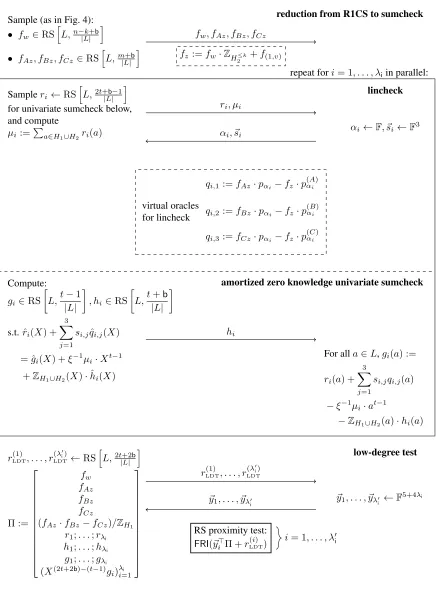
We describe how to modify Protocol 5.3 to achieve zero knowledge; the modification is an adaptation of algebraic techniques from [BCGV16; BCFGRS17]. The prover first sends a random Reed–Solomon codewordq ∈RS [L, ρ]. The verifier then replies with a random “challenge” elementc ∈F. Finally, the prover and verifier engage in Protocol 5.3 with respect to the “virtual” oraclep:=c·f +q, and new target
valuec·µ+P
a∈Hqˆ(a). Sincep is an (almost) uniformly random Reed–Solomon codeword, one can
efficiently simulate the sumcheck prover with inputp. We obtain the following theorem.
Theorem 5.7. There exists an RS-encoded IOPP (Protocol 5.8) for the sumcheck relationRSUM (Defini-tion 5.1), which is zero knowledge against unbounded queries, with the following parameters:
alphabet Σ = F
number of rounds k = 1
proof length p = 2|L|
randomness r = log|F|
soundness error ε = 1/|F|
prover time tP = O(|L|log|H|) + 3·FFT(F,|L|) verifier time tV = O(log2|H|)
maximum rate (σ∗, ρ∗) = (ρ, ρ)
.
Protocol 5.8. Letf ∈RS [L, ρ]be the witness oracle. Let(PSUM, VSUM)be the RS-encoded IOP forRSUM (Protocol 5.3). The zero knowledge RS-encoded IOP(P, V)forRSUMproceeds as follows.
1. P samplesq ∈RS [L, ρ]uniformly at random and sends it toV, along withβ:=P
a∈Hq(a).
2. V samplesc∈Funiformly at random, and sends it toP.
3. P andV invoke PSUM(x0, c·f +q), V c·f+q SUM (x
0)
, wherex0 := (
F, L, H, ρ, c·µ+β).
Proof.
Completeness. Follows from the completeness of univariate sumcheck.
Soundness. Suppose thatP
a∈Hfˆ(a) =α6=µ. Letβ0 := P
a∈Hq0(a), whereq0is sent byP˜ in the first
round. ThenP
a∈H(c·fˆ+q
0)(a) =c·α+β0, which is equal toc·µ+βif and only ifc= β−β0
α−µ, which
happens with probability1/|F|for any fixedβ, β0. Hence with probability1−1/|F|,(x0, c·µ+β)∈ RSUM/ ,
and soundness follows by the soundness of the standard protocol.
Zero knowledge. We describe a simulatorSthat, given straightline access to a (malicious) verifierV˜ and
oracle access to a witness oraclef ∈RS [L, ρ], perfectly simulatesV˜’s view in the real protocol.
1. Sampleqsim ∈RS [L, ρ]uniformly at random and start simulatingV˜.
2. Answer any query tof by queryingf, and answer any query toqby queryingqsim. LetQsim ⊆Lbe
˜
V’s queries toqfrom the beginning of the simulation until the next step.
3. Sendβsim:=Pa∈Hqˆsim(a)toV˜.
4. Receive˜csim ∈FfromV˜.
5. Samplepsim ∈ RS [L, ρ]uniformly at random such that, for every ω ∈ Qsim, psim(ω) = ˜csim ·
f(ω) +qsim(ω)andPa∈Hpsim(a) = ˜csim·µ+βsim; this requires|Qsim|queries tof. (Note that if
|Qsim|> ρ|L|thenpsim≡fˆ+rsim.)

![Figure 15: Parameters of the direct low-degree test and FRI low-degree test when invoked on a functionf : L → F that is δ-far from RS [L, ρ] ⊆ FL](https://thumb-us.123doks.com/thumbv2/123dok_us/7975308.1322492/58.612.168.445.70.134/figure-parameters-direct-degree-test-degree-invoked-functionf.webp)
