A Review of Existing 4-bit Crypto S-box cryptanalysis Techniques and Two
New Techniques with 4-bit Boolean Functions for Cryptanalysis of 4-bit
Crypto S-boxes.
Sankhanil Dey and Ranjan Ghosh. [email protected], [email protected].
Institute of Radio Physics and Electronics1, University of Calcutta.
Abstract. 4-bit Linear Relations play an important role in Cryptanalysis of 4-bit Bijective Crypto S-boxes. 4-bit finite differences also a major part of cryptanalysis of 4-bit substitution boxes. Count of existence of all 4-bit linear relations, for all of 16 input and 16 output 4-bit bit patterns of 4-bit bijective crypto S-boxes said as S-boxes has been reported in Linear Cryptanalysis of 4-bit S-boxes. Count of existing finite differences from each element of output S-boxes to distant output S-boxes have been noted in Differential Cryptanalysis of boxes. In this paper a brief review of these cryptanalytic methods for 4-bit S-Boxes has been introduced in a very lucid and conceptual manner. Two new Analysis Techniques, one to search for the existing Linear Approximations among the input Boolean Functions (BFs) and output BFs of a particular 4-bit S-Box has also been introduced in this paper. The search is limited to find the existing linear relations or approximations in the contrary to count the number existent linear relations among all 16 4-bit input and output bit patterns within all possible linear approximations. Another is to find number of balanced 4-bit BFs in difference output S-boxes. Better the number of Balanced BFs, Better the security.
Keywords. Linear Cryptanalysis, Differential Cryptanalysis, Substitution Boxes, S-boxes, Cryptography, Cryptanalysis.
1. Introduction. Substitution boxes or S-boxes have been a part of block ciphers since the birth of Commercial Computer Cryptography by Horst Feistel in IBM Research [HF71]. A 4-bit S-box contains 16 elements [AT90], if they are unique and distinct then the S-box has been termed as 4-bit Crypto S-box. A 4-bit Crypto S-box contains 16 unique and distinct elements vary from 0 to F in hex and index of each element which are unique and distinct also and vary from 0 to F in hex, also in a monotonically increasing sequential order. The elements of a Crypto 4-bit S-box may be sequential or partly sequential or non-sequential in order [AT90]. The elements of Index of box also construct an identity Crypto box and termed as input S-box. A brief Literature survey of related literatures has been given in sec.2.
In Differential Cryptanalysis of 4-bit Crypto S-boxes the 16 distant input S-Boxes have been obtained by xor operation of each of 16 input Differences varies from 0 to F in hex to 16 elements of input S-box. The 16 distant S-boxes have been obtained by shuffling the elements of original S-box in a certain order in which the elements of input S-boxes have been shuffled in concerned distant input S-boxes. The 16 elements of each S-box and the elements in corresponding position of corresponding distant S-box has been xored to obtain the Difference S-box. The Difference S-Box may or may not be a Crypto S-Box since It may not have all unique and distinct elements in it. The count of each element from 0 to F in Difference S-box have been noted and put in Difference Distribution Table (DDT) for analysis of S-box [HH96][HH02]. The concept has been reviewed in subsec 3.3 of sec. 3.
In this paper a new algorithm using 4-bit BFs for Differential Cryptanalysis of 4-bit S-Boxes have been introduced. An input S-box can be decomposed into four 4-bit Input Vectors (IPVs) with Decimal Equivalents 255 for 4th IPV, 3855 for 3rd IPV, 13107 for 2nd IPV, and 21845 for 1st IPV respectively. Now we complement all IPVs one, two, three and four at a time to obtain 16 4-bit Distant input S-boxes. Each of four Output BFs is shifted according to the Shift of four IPVs of input S-boxes as in four IPVs of Distant input S-Boxes to obtain Distant S-boxes. The four 4-bit BFs of S-boxes are xored bitwise with four 4-bit BFs of Distant S-boxes to obtain four 4-bit Difference BFs. For 16 Distant Output S-boxes there are 64 Difference BFs. Difference BFs are checked for balanced-ness, means utmost uncertainty. The Table in which the balanced-ness of 64 Difference BFs is noted is called as Differential Analysis Table (DAT). The Theory has been elaborated in subsec. 3.4 of sec.3.
S-box are noted. The result is better for a cryptanalysts if the numbers of 8s in the table are less. If numbers of 8s are much more than the other numbers in the table then the 4-bit Crypto S-box is said to be more linear cryptanalysis immune [HH96][HH02].
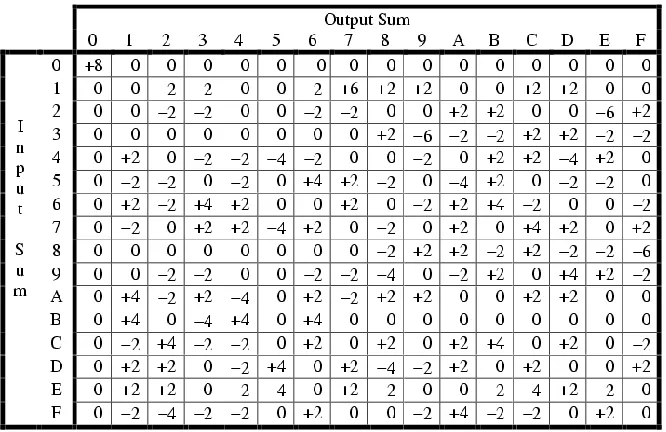
In another look An input S-box can be decomposed into four 4-bit Input Vectors (IPVs) with Decimal Equivalents 255 for 4th IPV, 3855 for 3rd IPV, 13107 for 2nd IPV, and 21845 for 1st IPV respectively. The S-box can also be decomposed into 4, 4-bit Output BFs (OPBFs). Each IPV can be denoted as a input variable of a linear relation and OPBF as a output variable and ‘+’ as xor operation. Linear relations have been checked for satisfaction and 16-bit output variables (OPVs) due to linear relations have been checked for balanced-ness. Balanced OPVs indicates, out of 16 bits of IPVs and OPBFs, 8 bits satisfies the linear relation and 8 bits is out of satisfaction, i.e. best uncertainty. 256 4-bit Linear relations have been operated on 4, 16-bit IPVs and 4, 16-bit OPBFs and 256 OPVs have been generated. The count of number of 1s in OPVs have been put in Linear Approximation Table or LAT and Better the number of 8s in LAT, Better the S-box [HH96][HH02]. The concept has been reviewed in brief in subsec. 4.2. of sec. 4.
In this paper a new technique to find the existing Linear Relations or Linear Approximations for a particular 4-bit S-Box has been introduced. If the nonlinear part of the ANF equation of a 4-bit output BF is absent or calculated to be 0 then the equation is termed as a Linear Relation or Approximation. Searching for number of existing linear relations through this method is ended up with Number of Existing Linear Relations. I.e. the goal to conclude the security of a 4-bit bijective S-Box is attended in a very lucid manner by this method. The method has been described in subsec.4.3. of sec.4.
Result and Analysis of all four algorithms have been given in sec. 5. The conclusion and Acknowledgements have been made in sec.6 and sec.7 respectively. The code in C Programming language to obtain the results, have been given in Appendix.
2. Literature Survey. In this section an exhaustive relevant Literature survey with their specific references has been introduced to crypto literature. In sec 2.1. the relevant topic has been cryptography and cryptology, in sec 2.2. the topic is Linear Cryptanalysis, in sec 2.3 the topic is Differential Cryptanalysis, in sec 2.4 the topic is cryptanalysis of stream ciphers and at last in sec 2.5. the relevant topic is Strict Avalanche Criterion (SAC) of substitution boxes.
2.1 Cryptography and Cryptology. In End of Twentieth Century A bible of Cryptography had been introduced [MP96].The various concepts involved in cryptography and also some information on cryptanalysis had been provided to Crypto-community in Late nineties [BS96].a simplified version of DES. that has the architecture of DES but has much lesser rounds and much lesser bits had also been proposed at the same time. The cipher is also better for educational purposes [SC96].Later in early twenty first century an organized pathway towards learning how to cryptanalyze had been charted [BS00]. Almost at the same time a new cipher as a candidate for the new AES, main concepts and issues involve in block cipher design and cryptanalysis had also been proposed [BS99] also a measure of cipher strength. A vital preliminary introduction to cryptanalysis has also been introduced to cryptanalysts[FM00].at the same time somewhat similar notion as [FM00] but uses a more descriptive approach and focused on linear cryptanalysis and differential cryptanalysis of a given SPN cipher had been elaborated [HH00].Particularly, it discusses DES-like ciphers had been extended with it [SH00]. comparison of modes of operations such as CBC, CFB, OFB and ECB had also been elaborated [PL00].A new cipher called Camelia had been introduced with cryptanalysis to demonstrate the strength of the cipher[AM00].History of Commercial Computer Cryptography and classical ciphers and the effect of cryptography on society had also been introduced in this queue [SS00].The requirements of a good cryptosystem and cryptanalysis had also been demonstrated[LS00].description of Rijndael, the new AES. Provides good insight into many creative cryptographic techniques that increases cipher strength had been included in literature. A bit Later a highly mathematical path to explain cryptologic concepts had also been introduced [PG01]. investigation of the security of Ron Rivest’s DESX construction, a cheaper alternative to Triple DES had been elaborated [KR01]. A nice provision to an encyclopedic look at the design, analysis and applications of cryptographic techniques was depicted later [CY01] and last but not the least a good explanation on why cryptography is hard and the issues which cryptographers have to consider in designing ciphers had been elaborated [BS01].Simplified Data Encryption Standard or S-DES is an educational algorithm similar to Data Encryption Standard (DES) but with much smaller Parameters [ES96][OV02].The technique to analyze S-DES using linear cryptanalysis and Differential cryptanalysis has been of interest of crypto-community [ES96][OV02]. The encryption and decryption algorithm or cipher of twofish algorithm had been introduced to crypto community and a cryptanalysis of the said cipher had also been elaborated in subject to be a part of Advance Encryption Algorithm proposals [BE99].
reported[BC08].Later A Technique to prove security bounds against Linear and Differential cryptanalytic attack using Mixed-Integer Linear Programming(MILP) had also been elaborated[NM12].Later on The strength of Two variants of reduced round lightweight block cipher SIMON-32 and SIMON-48 had been tested against Linear Cryptanalysis and had been presented the optimum possible results[MA15].Almost at the same time The strength of another light weight block ciphers SIMECK had been tested against Linear Cryptanalysis[NB15].The fault analysis of light weight block cipher SPECK and Linear Cryptanalysis with zero statistical correlation among plaintext and respective cipher text of reduced round lightweight block cipher SIMON to test its strength had also been introduced in recent past[XY16].
2.3 Some Old and Recent References on Differential Cryptanalysis. The design of a Feistel cipher with at least 5 rounds that is resistance to differential cryptanalysis had been reported to crypto community [AC97].The exploration of the possibility of defeating differential cryptanalysis by designing S-boxes with equiprobable output XORs using bent functions had been reported once[CA92].The description of some design criteria for creating good Sboxes that are immune to differential cryptanalysis. These criteria are based on information theoretic concepts[DT91]. It was Introduced differential cryptanalysis on a reduced round variant of DES[EA90]and broke a variety of ciphers, the fastest break being of two-pass Snefru[EA91] and also described the cryptanalysis of the full 16-round DES using an improved version of [EA90] [EA92]. It had been shown that there are DES-like iterated ciphers that does not yield to differential cryptanalysis[NK91]and also introduced the concept of Markov ciphers and explain it’s significance in differential cryptanalysis. It has also been Investigated the security of iterated block ciphers and shows how to when an r-round cipher is not vulnerable to attacks[LM91]. It was also proposed that eight round Twofish can be attacked and Investigated the role of key dependent S-boxes in differential cryptanalysis[SM00].It was on the same line with [CA92] but proposed that the input variables be increased and that the S-box be balanced to increase resistance towards both differential and linear cryptanalysis [YT95].Early in this century in previous decade Estimation of probability of block ciphers against Linear and Differential cryptanalytic attack had been reported. Later a new Algebraic and statistical technique of Cryptanalysis against block cipher PRESENT-128 had been reported[MA09].Almost 3 year later A new technique entitled Impossible Differential Cryptanalysis had also been reported[CB12].A detailed Comparative study of DES based on the strength of Data Encryption (DES) Standard against Linear and Differential Cryptanalysis had been reported[RK13]. At last Constraints of Programming Models of Chosen Key Differential Cryptanalysis had been reported to crypto community[DG16].
2.4 Linear and Differential Cryptanalysis of stream ciphers. In late 20th century A Stepping Stone of the Differential-Linear cryptanalysis method, a very efficient method against DES had also been grounded[MS94].The relationship between linear and differential cryptanalysis and presents classes of ciphers which are resistant towards these attacks had also been elaborated[VM95]. Description of statistical cryptanalysis of DES, a combination and improvement of both linear and differential cryptanalysis with Suggestion of the linearity of Sboxes are not very important had been depicted[VS95].Later in 21st century description of analysis with multiple expressions and differential-linear cryptanalysis with experimental results of an implementation of differential-linear cryptanalysis with multiple expressions applied to DES variants had also been proposed[AG00].At the same time the attack on 7 and 8 round Rijndael using the Square method with a related-key attack that can break 9 round Rijndael with 256 bit keys had been described[NF01].In Late or almost end of 20th century The strength of stream ciphers have been tested against Differential Cryptanalytic attack[DG93]. Later The strength of them had also been tested against Linear Cryptanalytic attack[GC94].A separate method of linear cryptanalytic attack had been reported once[MT98].at least 6 years later The strength of stream cipher Helix had been tested against Differential Cryptanalytic attack[FM04].Later The strength stream ciphers Py, Py6, and Pypy had also been tested again st Differential Cryptanalytic attack[HW07].Recently The test of strength of stream cipher ZUC against Differential Cryptanalytic attack had also been reported to crypto community[HW12].
2.5 Strict Avalanche Criterion (SAC) of S-boxes. In beginning Strict Avalanche Criterion of 4-bit Boolean Functions and Bit Independence Criterion of 4-bit S-boxes had been introduced[AW86] and Design of Good S-boxes based on these criteria had also been reported later[CA90].In end of 20th century The construction of secured S-boxes satisfy Strict Avalanche Criterion of S-boxes had been reported with ease[KK91]. The Test of 4-bit Boolean Functions to satisfy higher order strict Avalanche Criterion(HOSAC) have had also been illustrated[TC94].In early twenty first century The analysis methods to Strict Avalanche Criterion(SAC) had been reported. A new approach to test degree of suitability of s-boxes in modern block ciphers had been introduced to crypto-community [IL12]. 16! 4-bit S-boxes had also been tested for optimum linear equivalent classes [OS12].The strength of several block ciphers against several Cryptanalytic attacks had been tested and reported [HA15].Recently the Key dependent S-boxes and simple algorithms to generate key dependent S-boxes had been reported [KK16].An efficient cryptographic S-box design using soft computing algorithms have had also been reported [MA16].In recent past The cellular Automata had been used to construct good S-boxes [MM16].
3. A Brief Review of Differential Cryptanalysis of 4-bit S-boxes and A new Technique With Boolean Functions for Differential Cryptanalysis of 4-bit S-boxes. The given 4-bit Crypto S-box has been described in sub-section 3.1. The relation Between 4-bit Crypto S-boxes and 4-bit BFs has been illustrated in subsec. 3.2., The Differential Cryptanalysis of 4-bit Crypto S-boxes and DDT or Differential Distribution Table has been illustrated in subsec. 3.3. The Differential Cryptanalysis of 4-bit S-boxes with 4-bit BFs has been described in subsec.3.4.
elements of the fixed 1st row are sequential and monotonically increasing where for the 2nd row they can be sequential or partly sequential or non-sequential. Here the given Substitution box is the 1st 4-bit S-box of the 1st S-Box out of 8 of Data Encryption Standard [AT90][NT77][NT99].
Row Column 1 2 3 4 5 6 7 8 9 A B C D E F G
1 Index 0 1 2 3 4 5 6 7 8 9 A B C D E F
2 S-Box E 4 D 1 2 F B 8 3 A 6 C 5 9 0 7
Table.1. 4-bit Crypto S-box.
3.2 Relation between 4-bit S-Boxes and 4-bit Boolean Functions (4-bit BFs). Index of Each element of a 4-bit Crypto S-box and the element itself is a hexadecimal number and that can be converted into a 4-bit bit sequence that are given in column 1 through G of row 1 and row 6 under row heading Index and S-box respectively. From row 2 through 5 and row 7 through A of each column from 1 through G of Table.2. shows the 4-bit bit sequences of the corresponding hexadecimal numbers of the index of each element of the given Crypto S-box and each element of the Crypto S-box itself. Each row from 2 through 5 and 7 through A from column 1 through G constitutes a 16 bit, bit sequence that is a 16 bit long input vectors (IPVs) and 4-bit output BFs (OPBFs) respectively. column 1 through G of Row 2 is termed as 4th IPV, Row 3 is termed as 3rd IPV, Row 4 is termed as 2nd IPV and Row 5 is termed as 1st IPV whereas column 1 through G of Row 7 is termed as 4th OPBF, Row 8 is termed as 3rd OPBF, Row 9 is termed as 2nd OPBF and Row A is termed as 1st OPBF [AT90]. The decimal equivalent of each IPV and OPBF are noted at column H of respective rows.
Row Column 1 2 3 4 5 6 7 8 9 A B C D E F G H. Decimal
Equivalent
1 Index 0 1 2 3 4 5 6 7 8 9 A B C D E F
2 IPV4 0 0 0 0 0 0 0 0 1 1 1 1 1 1 1 1 00255
3 IPV3 0 0 0 0 1 1 1 1 0 0 0 0 1 1 1 1 03855
4 IPV2 0 0 1 1 0 0 1 1 0 0 1 1 0 0 1 1 13107
5 IPV1 0 1 0 1 0 1 0 1 0 1 0 1 0 1 0 1 21845
6 S-box E 4 D 1 2 F B 8 3 A 6 C 5 9 0 7
7 OPBF4 1 0 1 0 0 1 1 1 0 1 0 1 0 1 0 0 42836
8 OPBF3 1 1 1 0 0 1 0 0 0 0 1 1 1 0 0 1 58425
9 OPBF2 1 0 0 0 1 1 1 0 1 1 1 0 0 0 0 1 36577
A OPBF1 0 0 1 1 0 1 1 0 1 0 0 0 1 1 0 1 13965
Table.2. Decomposition of 4-bit input S-box and given S-box (1st 4-bit S-box of 1st S-box out of 8 of DES) to 4-bit BFs.
3.3 Review of Differential Cryptanalysis of 4-bit Crypto S-Boxes [HH96][HH02]. In Differential Cryptanalysis of 4-bit Crypto S-boxes, Elements of 4-4-bit input S-box (ISB) have been xored with a particular 4-4-bit Input Difference (ID) to obtain a Distant input S-box (DISB). The Distant S-boxes (DSB) have been obtained from original S-box (SB) by shuffling the elements of SB in such order in the way in which the elements of ISB have been shuffled to obtain DISB for a Particular ID. Each element of Difference S-box (DFSB) have been obtained by the xor operation of corresponding elements of SB and DSB. The Count of each Hexadecimal number from 0 to F have been put into the concerned cell of Differential Distribution Table or DDT. As the number of 0s in DDT increases, information regarding concerned Output Difference (OD) increases so the S-box has been determined as weak S-box. The 4-bit Sequence of each element of ISB, ID, DISB, DSB, DFSB have been given in BIN ISB, BIN ID, BIN DISB, BIN DSB, BIN DFSB respectively.
The column.1. in Table.3. from row 1 through G shows the 16 elements of ISB in a monotonically increasing sequence or order. The ISB can also be concluded as an Identity 4-bit S-box. The elements of 1st 4-bit S-box, out of 4 of 1st S-Box of Data
Encryption Standard (DES) out of 8, has been considered as S-box (SB), in column 7 from row 1 through G. The elements of ID, DISB, DSB, DFSB has been shown in row 1 through G of column. 3, 5, 9 and C of Table.3 respectively. The 4-bit Binary equivalents of each elements of ISB, ID, DISB, SB, DSB, DFSB, has been shown in row 1 through G of column. 2, 4, 6, 8, A and B of Table.3 respectively.
COL 1 2 3 4 5 6 7 8 9 A B C R
O W
I S B
Bin ISB 4321
I D
Bin ID 4321
D IS B
Bin DISB 4321
S B
Bin OSB 4321
D S B
Bin DSB 4321
Bin DFSB
4321 D FS
B
1 0 0000 B 1011 B 1011 E 1110 C 1100 0010 2
2 1 0001 B 1011 A 1010 4 0100 6 0110 0010 2
3 2 0010 B 1011 9 1001 D 1101 A 1010 0001 7
4 3 0011 B 1011 8 1000 1 0001 3 0011 0010 2
5 4 0100 B 1011 F 1111 2 0010 7 0111 0101 5
6 5 0101 B 1011 E 1110 F 1111 0 0000 1111 F
7 6 0110 B 1011 D 1101 B 1011 9 1001 0010 2
8 7 0111 B 1011 C 1100 8 1000 5 0101 1101 D
9 8 1000 B 1011 3 0011 3 0011 1 0001 0010 2
A 9 1001 B 1011 2 0010 A 1010 D 1101 0001 7
B A 1010 B 1011 1 0001 6 0110 4 0100 0010 2
C B 1011 B 1011 0 0000 C 1100 E 1110 0010 2
D C 1100 B 1011 7 0111 5 0101 8 1000 1101 D
E D 1101 B 1011 6 0110 9 1001 B 1011 0010 2
F E 1110 B 1011 5 0101 0 0000 F 1111 1111 F
G F 1111 B 1011 4 0100 7 0111 2 0010 0101 5
Table.3. Table of Differential Cryptanalysis of 1st 4-bit S-Box of 1st S-Box out of 8 of DES.
3.3.1 S-Box View of Differential Cryptanalysis of 4-bit Crypto S-Boxes.The S-box with a particular input difference or ID from 0 to F in which all elements have the same value ‘B’ in hex, is not a Crypto Box but an S-box and is shown in row 1 through G of column. 3. of Table.3. The Distant input S-box (DISB) is shown in row 1 through G of column.5 of the said table. In DISB each row element from row 1 through G is obtained by the xor operation of the elements in corresponding positions of each element of DISB from row 1 through G of column.1. (ISB) and Column.3. (ID) respectively. In ISB for each row element from row 1 through G of column.1.just in corresponding position from row 1 through G of column.7, there is an element of SB. Now in DISB the elements of ISB have been shuffled in a particular order and In DSB the corresponding elements of SB has also been shuffled in that particular order. Each element of the Difference S-Box or DFSB from row 1 through G of column.C. has been obtained by xor operation of each element in corresponding positions from row 1 through G of column.7. and row 1 through G of column.9. respectively. The repetition of each existing elements in DSB have been counted and put into Difference Distribution Table or DDT. It is shown in Table.4. as follows,
R|C 1 2 3 4 5 6 7 8 9 A B C D E F G H
1 DSB el 0 1 2 3 4 5 6 7 8 9 A B C D E F 2 Count 0 0 8 0 0 2 0 2 0 0 0 0 0 2 0 2
Table.4. Count of repetition of each existing element in DSB.
The count of each existing elements in DFSB have been put into Difference Distribution Table. as follows, in row 2 of Table.5. For Input Difference (ID) = ‘B’ and Output Difference from 0 through F of row 1.
Row 1 Output Difference
1 Input Difference 0 1 2 3 4 5 6 7 8 9 A B C D E F
2 B 0 2 8 0 0 2 0 0 0 0 0 0 0 2 0 2
3.3.2 4-bit binary Pattern View of Differential Cryptanalysis of 4-bit Crypto S-Boxes.The corresponding four bit bit patterns of input S-box elements (ISB) has been shown from row 1 through G of column.2 in Table.3. and termed as Bin ISB. The Particular Input Difference ‘1101’ is shown in each row from 1 through G of column. 4. in Table.3. The Distant 4-bit input bit patterns are shown from row 1 through G of column.6. (Bin DISB) are obtained by the xor operation of the elements in corresponding positions of each element of BIN DISB from row 1 through G of column.2. (Bin ISB) and Column.4. (Bin ID) respectively. In Bin ISB for each element from row 1 through G of column.2. in corresponding position from row 1 through G of column.8, there is an element of Bin SB. Now in Bin DISB the elements of ISB have been shuffled in a particular order and in Bin DSB the corresponding elements of SB has also been shuffled in that particular order. Each element from row 1 through G of column.11. has been obtained by xor operation of each element in corresponding positions from row 1 through G of column.8. and row 1 through G of column.10. respectively. The repetition of each existing elements in Bin DFSB have been counted and put into Difference Distribution Table or DDT. It is shown in Table.6. as follows,
R|C 1 2 3 4 5 6 7 8 9 A B C D E F G H
1 DFSB el 0000 0001 0010 0011 0100 0101 0110 0111 1000 1001 1010 1011 1100 1101 1110 1111
2 Count 0 2 8 0 0 2 0 0 0 0 0 0 0 2 0 2
Table.6. Count of repetition of each existing element in Bin DSB.
The count of each existing elements in Bin DFSB have been put into the Differential Distribution Table. as follows, in row 2 of Table.7a. for Binary Input Difference (Bin ID) ‘1101’ and Output Difference from 0 through F of row 1.
Row 1 Output Difference (In Hex)
1 Input Difference 0 1 2 3 4 5 6 7 8 9 A B C D E F
2 1101 0 2 8 0 0 2 0 0 0 0 0 0 0 2 0 2
Table.7a. The Part of DDT with Input Difference ‘1101’.
The Total DDT or Difference Distribution table for 16 IDs for the given S-box has been shown below in table 7b.
Table.7b DDT
Output Difference
0 1 2 3 4 5 6 7 8 9 A B C D E F
I n p u t D I f f e r e n c e
n
0 16 0 0 0 0 0 0 0 0 0 0 0 0 0 0 0
1 0 0 0 2 0 0 0 2 0 2 4 0 4 2 0 0
2 0 0 0 2 0 6 2 2 0 2 0 0 0 0 2 0
3 0 0 2 0 2 0 0 0 0 4 2 0 2 0 0 4
4 0 0 0 2 0 0 6 0 0 2 0 4 2 0 0 0
5 0 4 0 0 0 2 2 0 0 0 4 0 2 0 0 2
6 0 0 0 4 0 4 0 0 0 0 0 0 2 2 2 2
7 0 0 2 2 2 0 2 0 0 2 2 0 0 0 0 4
8 0 0 0 0 0 0 2 2 0 0 0 4 0 4 2 2
9 0 2 0 0 2 0 0 4 2 0 2 2 2 0 0 0
A 0 2 2 0 0 0 0 0 6 0 0 2 0 0 4 0
B 0 0 8 0 0 2 0 2 0 0 0 0 0 2 0 2
C 0 2 0 0 2 2 2 0 0 0 0 2 0 6 0 0
D 0 4 0 0 0 0 0 4 2 0 2 0 2 0 2 0
E 0 0 2 4 2 0 0 0 6 0 0 0 0 0 2 0
F 0 2 0 0 6 0 0 0 0 4 0 2 0 0 2 0
3.3.3 Pseudo Code for Differential Cryptanalysis of 4-bit Crypto S-boxes and its Time Complexity Analysis.
The Pseudo Code of Algorithm for 4-bit binary pattern view with Time Complexity has been depicted in subsec. 3.3.3.1., the Pseudo Code of algorithm for S-box view with Time Complexity has been depicted in subsec. 3.3.3.2. and The comparison of time complexity of two algos has been given in subsec 3.3.3.3.
3.3.3.1 Pseudo Code of Algorithm of Differential Cryptanalysis 4-bit binary pattern view.
The Pseudo Code has been given as follows,
Start. // Start of Pseudo Code
// Variable Declarations, Two Dimensional Array ISB[4][16] is for 4-bit bit patterns for Input S-box, IDIFF[4][16] is for 4-bit bit patterns of Input Difference, Three Dimensional Array ODIFF[4][16][16] is for all 4-bit bit patterns of Output Difference for 16 IDIFFs.
Step 0A: int ISB[4][16]; int IDIFF[4][16]; int ODIFF[4][16][16];
// Variable Declarations, ISB’[4][16][16] is for 4-bit bit patterns of All elements of 16 distant ISBs. OSB[4][16] is for 4-bit bit
patterns of the given S-box or Output S-box , OSB’[4][16][16] is for 4-bit bit patterns of All elements of 16 distant OSBs, DDT[16][16] is for Difference Distribution Table, and Count[16] is for count of each element in ODIFF for 16 OSBs.
Step 0B: int ISB’[4][16][16]; int OSB[4][16]; int OSB’[4][16][16]; int DDT[16][16]; int Count[16];
// Differential Cryptanalysis Block.
Step 01: For I =1:16 ; For J =1:16 ; For K =1:4; // Start of For Loop I, J, K respectively ISB’[K][I][J] = ISB[K][J]^IDIFF[K][I];
OSB’[K][I][J] = OSB[ISB’[K][I][J]];
ODIFF[K][I][J] = OSB[K][J]^ OSB’[K][I][J];
End For K. End For J. End For I.// End of For loop K, J, I respectively // Generation of Difference Distribution Table.
Step 02: For I =1:16 For J =1:16 For K =1:4 // Start of For Loop I, J, K respectively DDT[I][J]= Count[ISB[K][J]];
End For K. End For J. End For I. // End of For loop K, J, I respectively
Stop. // End of Pseudo Code
Time Complexity of the Given Algorithm. Since Differential Cryptanalysis block contains 3 nested loops so the time Complexity of the Algorithm has been O(n3).
3.3.3.2. Pseudo Code of Algorithm of Differential Cryptanalysis S-Box View.
The Pseudo Code has been given as follows,
Start. // Start of Pseudo Code
// Variable Declarations, One Dimensional Array ISB[16] is for for Input S-box in Hex, IDIFF[16] is for Input Difference in Hex, Three Dimensional Array ODIFF[16][16] is for all Output Difference in Hex for 16 IDIFFs.
Step 0A: int ISB[16]; int IDIFF[16]; int ODIFF[16][16];
// Variable Declarations, ISB’[16][16] is for All elements in Hex of 16 distant ISBs. OSB[16] is for elements in Hex of the given
S-box or Output S-box , OSB’[16][16] is for All elements in Hex of 16 distant OSBs, DDT[16][16] is for Difference Distribution Table, and Count[16] is for count of each element in ODIFF for 16 OSBs.
Step 0B: int ISB’[16][16]; int OSB[16]; int OSB’[16][16]; int DDT[16][16]; int Count[16]. // Differential Cryptanalysis block
Step 01: For I =1:16; For J =1:16; // For Loop I and J respectively. ISB’[I][J] = ISB[J]^IDIFF[I];
OSB’[I][J] = OSB[ISB’[I][J]]; ODIFF[I][J] = OSB[J]^ OSB’[I][J];
End For J. End For I.// End of For Loop J and I respectively.
Step 02: For I =1:16; For J =1:16 // For Loop I and J respectively. DDT[I][J]= Count[ISB[J]];
End For J. End For I. // End of For Loop J and I respectively.
Stop. // End of Pseudo Code
Time Complexity of the Given Algorithm. Since Differential Cryptanalysis block contains 2 nested loops so the time Complexity of the Algorithm has been O(n2).
3.3.3.3 Comparison of Time Complexity of Two views of Differential Cryptanalysis of 4-bit S-boxes.
The Comparison of time complexity of two algos has been given in Table.7C as follows,
View 4-bit BP View S-box View
Time Complexity O(n3) O(n2)
Table.7C. Time Complexity Comparison of Two Algos.
3.4 Differential Cryptanalysis of 4-bit Bijective Crypto S-Boxes using 4-bit BFs. The Procedure to obtain four Input Vectors (IPVs) and Four Output BFs (OPBFs) from the elements of a particular 4-bit Crypto S-box has been described in sec.2.1. The procedure to obtain distant Input Vectors (DIPVs) and Distant Output BFs (DOPBFs) for a particular Input Difference (ID) of the said S-box has been described with example in sec.3.4.1. Generation of Difference 4-bit BFs, Analysis of Algorithm and Generation of Difference Analysis Algorithm in subsec.3.4.2, subsec.3.4.3 and subsec.3.4.4. respectively. The Differential Analysis Table of the given S-box, Pseudo Code of Algorithm with Time Complexity and Comparison of Time complexity of three Algos. have been given in subsec.3.4.5, subsec.3.4.6 and subsec.3.4.7. respectively.
3.4.1. Distant Input BFs (DIBFs) and Distant Output BFs (DOBFs) Generation from IBFs and OBFs for a specific ID. Within 4 bits of binary input difference (Bin ID), 1 in position p means do complement of pth IPV and 0 means no operation on pth IPV. Similarly in the given example 1 in position 4 of Bin ID, as in position 4 from row 1 through G of column 4 of table.3. indicates do complement of 4-bit IPV, IPV4 i.e. CIPV4 and 0 in position 3 as in position 3 from row 1 through G of column 4 of table.3. means no operation on 4-bit IPV, IPV3 (CIPV3) or CIPV3 = IPV3. Similarly 1 in respective positions 2 and 1 as in positions 2 and 1 from row 1 through G of column 4 of table.3. means do complement 4-bit IPV, IPV2 (CIPV2) and do complement of 4-bit IPV, IPV1 (CIPV1) respectively. CIPV4, CIPV3, CIPV2 and CIPV1 for Input S-box (ISB) and Input Difference (ID) have been shown from row 1 through G of column.1. and column.3. of Table.3. respectively.
Here the 4th OPBF has been taken as an example of OPBF and termed as OPBF. Since complement of 4th IPV means
interchanging each 8 bit halves of 16 bit long 4th IPV so The 2, 8 bit halves of OPBF have been interchanged due to complement of 4th IPV. The resultant OPBF has been shown from column 1 through G of row 6 in Table.9. Again No Operation on 3rd IPV
means CIPV3 = IPV3 so resultant OPBF is as same as STEP1 and has been shown from column 1 through G of row 7 in Table.9. Next to it, the complement of 2nd IPV means interchanging each 2 bit halves of each 4 bit halves of each 8 bit halves of resultant
OPBF. The resultant OPBF has been shown from column 1 through G of row 8 in Table.9. Again the complement of 1st IPV means interchanging each bit of each 2 bit halves of each 4 bit halves of each 8 bit halves of resultant OPBF, The resultant OPBF After operation has been shown in column 1 through G of row 9 in Table.9. The Complemented OPBF has been the resultant OPBF of STEP4 and has been shown from column 1 through G of row A in Table.9.
ID 1 0 1 1
Complement C N C C
Table.8. Complement of IPVs Due to a Particular ID
Row | Col 1 2 3 4 5 6 7 8 9 A B C D E F G 1 CIPV4 1 1 1 1 1 1 1 1 0 0 0 0 0 0 0 0 2 CIPV3 1 1 1 1 0 0 0 0 1 1 1 1 0 0 0 0 3 CIPV2 0 0 1 1 0 0 1 1 0 0 1 1 0 0 1 1 4 CIPV1 1 0 1 0 1 0 1 0 1 0 1 0 1 0 1 0 5 OPBF 1 0 1 0 0 1 1 1 0 1 0 1 0 1 0 0 6 STEP1 0 1 0 1 0 1 0 0 1 0 1 0 0 1 1 1 7 STEP2 0 1 0 1 0 1 0 0 1 0 1 0 0 1 1 1 8 STEP3 0 1 0 1 0 0 0 1 1 0 1 0 1 1 0 1 9 STEP4 1 0 1 0 0 0 1 0 0 1 0 1 1 1 1 0 A COPBF 1 0 1 0 0 0 1 0 0 1 0 1 1 1 1 0
Table. 9. Construction of DIBFs and DOBFs. 3.4.2 Generation of Difference Boolean Functions or DBFs for a certain ID.
The DBFs of each OPBF have been generated by bitwise Xor of OPBFs and the corresponding COPBFs. The
corresponding DBFs of OBPF4, OBPF3, OBPF2, OPBF1 are denoted as DIFF4, DIFF3, DIFF2, DIFF1respectively. Generation
of 4th DBF of ID ‘1011’ has been shown in column 1 through G of row 3 of Table.10.
R|C 1 2 3 4 5 6 7 8 9 A B C D E F G 1 OPBF 1 0 1 0 0 1 1 1 0 1 0 1 0 1 0 0 2 COPBF 1 0 1 0 0 0 1 0 0 1 0 1 1 1 1 0 3 DIFF 0 0 0 0 0 1 0 1 0 0 0 0 1 0 1 0
3.4.3 Analysis:
If the DBFs are balanced then the number of bits changed and remains unchanged among corresponding bits of OPBFs and COPBFs is maximum. So uncertainty of determining a particular change in bits is maximum. As the number of balanced DBFs are increased among 64 (=24×4) possible DBFs then the security will increase. The number of 1s or balanced-ness of the above DBF shown from row 1 through G of row 3 of table.10. has been shown in column. 2. of row 2 of table.11.
Table. 11. Balanced-ness of DBFs.
3.4.4 DBFs Generation and Derivation of a Particular Row of Differential Analysis Table (DAT) for a Certain ID. Four IPVs in the order IPV4, IPV3, IPV2 and IPV1 for the S-box given in Table.1. and four CIPVs, CIPV4, CIPV3, CIPV2 and CIPV1 for a certain ID ‘1011’ have been shown from column 1 through G of row 1, 2, 3, 4, 5, 6, 7 and 8
respectively in Table.12.Four OPBFs in the order OPBF4, OPBF3, OPBF2 and OPBF1 for the S-box given in Table.1. and four
COPBFs COPBF4, COPBF3, COPBF2 and COPBF1 for a certain ID ‘1011’ have been shown from column 1 through G of row 9, A, B, C, D, E, F and G respectively in Table.12. The resultant DBFs, DIFF4, DIFF3, DIFF2, DIFF1, have been shown in column 1 through G of row H, I, J, K of Table.12. The number of 1s or Balanced-ness of four DBFs have been shown in row from column.2 through 5 of row 1 in Table.13.
Row|Col 1 2 3 4 5 6 7 8 9 A B C D E F G 1 IBF4 0 0 0 0 0 0 0 0 1 1 1 1 1 1 1 1 2 IBF3 0 0 0 0 1 1 1 1 0 0 0 0 1 1 1 1 3 IBF2 0 0 1 1 0 0 1 1 0 0 1 1 0 0 1 1 4 IBF1 0 1 0 1 0 1 0 1 0 1 0 1 0 1 0 1 5 CIBF4 1 1 1 1 1 1 1 1 0 0 0 0 0 0 0 0 6 CIBF3 0 0 0 0 1 1 1 1 0 0 0 0 1 1 1 1 7 CIBF2 1 1 0 0 1 1 0 0 1 1 0 0 1 1 0 0 8 CIBF1 1 0 1 0 1 0 1 0 1 0 1 0 1 0 1 0 9 OBF4 1 0 1 0 0 1 1 1 0 1 0 1 0 1 0 0 A OBF3 1 1 1 0 0 1 0 0 0 0 1 1 1 0 0 1 B OBF2 1 0 0 0 1 1 1 0 1 1 1 0 0 0 0 1 C OBF1 0 0 1 1 0 1 1 0 1 0 0 0 1 1 0 1 D COBF4 1 0 1 0 0 0 1 0 0 1 0 1 1 1 1 0 E COBF3 1 1 0 0 1 0 0 1 0 1 1 1 0 0 1 0 F COBF2 0 1 1 1 1 0 0 0 0 0 0 1 0 1 1 1 G COBF1 0 0 0 1 1 0 1 1 1 1 0 0 0 1 1 0 H DIFF4 0 0 0 0 0 1 0 1 0 0 0 0 1 0 1 0 I DIFF3 0 0 1 0 1 1 0 1 0 1 0 0 1 0 1 1 J DIFF2 1 1 1 1 0 1 1 0 1 1 1 1 0 1 1 0 K DIFF1 0 0 1 0 1 1 0 1 0 1 0 0 1 0 1 1 Table. 12. Generation of a Particular Row of Differential Analysis Table (DAT).
R|C 1 2 3 4 5
Difference BFs DIFF4 DIFF3 DIFF2 DIFF1
1 No. of ones. 4 8 C 8
Table.13. Balanced-ness of four DBFs.
R|C 1 2
1 Difference BF Total Number of 1s
3.4.5. Differential Analysis Table or DAT. The Balanced-ness of four DBFs for each ID have been shown from column 2 through 5 of row 2 through H of DAT or Table.14.
Table.14. DAT for 1st 4-bit S-Box of 1st S-Box of DES
3.4.6 Pseudo Code for Differential Cryptanalysis of 4-bit Crypto S-boxes and its Time Complexity Analysis.
The Pseudo Code has been given as follows,
Start. // Start of Pseudo Code
// Variable Declarations, One Dimensional Array ISB[16] is for for Input S-box in Hex, IDIFF[16] is for Input Difference in Hex, Three Dimensional Array ODIFF[16][16] is for all Output Difference in Hex for 16 IDIFFs. Bin_ODIFF[4][16][16] is for all 4-bit 4-bit patterns of Output Difference for 16 IDIFFs.
Step 0A: int ISB[16]; int IDIFF[16]; int ODIFF[16][16];
// Variable Declarations, ISB’[16][16] is for All elements in Hex of 16 distant ISBs. OSB[16] is for elements in Hex of the given
S-box or Output S-box , OSB’[16][16] is for All elements in Hex of 16 distant OSBs, DAT[16][16] is for Difference Analysis Table, and Count[16] is for count of each element in ODIFF for 16 OSBs.
Step 0B: int ISB’[16][16]; int OSB[16]; int OSB’[16][16]; int DAT[4][16]; int Count[16].
// Differential Cryptanalysis block
Step 01: For I =1:16; For J =1:16; // For Loop I and J respectively. ISB’[I][J] = ISB[J]^IDIFF[I];
OSB’[I][J] = OSB[ISB’[I][J]]; ODIFF[I][J] = OSB[J]^ OSB’[I][J];
For K=1:4 Bin_ODIFF[K][I][J] = Hex to Binary(ODIFF[I][J]) End For J. End For I.// End of For Loop J and I respectively.
Step 03: For I =1:4; For J =1:16; For K = 1:16 // For Loop I and J respectively. DAT[I][J]= Count[Bin_ODIFF[I][J][K]];
End For J. End For I. // End of For Loop J and I respectively.
Stop. // End of Pseudo Code
Time Complexity of the Given Algorithm. Since Differential Cryptanalysis block contains 2 nested loops so the time Complexity of the Algorithm has been O(n2).
3.4.7 Comparison of Time Complexity of Two views of Differential Cryptanalysis of 4-bit S-boxes and Differential Cryptanalysis with 4-bit BFs.
The Comparison of time complexity of three algos has been given in Table.7C as follows,
View 4-bit BP View S-box View With 4-bit BFs
Time Complexity O(n3) O(n2) O(n2)
Table.15. Time Complexity Comparison of Three Algos.
It can be concluded from the comparison that the Execution Time reduces in S-box view and With 4-bit BFs than the 4-bit Binary Pattern view. So in can be concluded from above review work and new algorithm that the execution time of Differential Cryptanalysis depends upon the view of the algorithm and the S-box view has been proved to be a better algorithm than 4-bit
R|C 1 2 3 4 5
1 ID in Hex DIFF1 DIFF2 DIFF3 DIFF4
2 0 0 0 0 0
3 1 8 8 8 C
4 2 C 8 C 4
5 3 8 8 8 C
6 4 8 C 8 8
7 5 8 8 8 8
8 6 C 8 C 8
9 7 8 C 8 8
A 8 C C C C
B 9 8 8 8 8
C 10 4 8 4 C
D 11 8 C 8 4
E 12 C 4 C 8
F 13 8 8 8 8
G 14 4 8 4 8
binary pattern view algorithm. The With 4-bit BFs Algo has also been proved to be the better one since The DAT table construction is less time consuming than DDT construction since DDT constitutes of 256 entries while DAT constitutes of 64 entries so in can also be concluded from comparison that Differential Cryptanalysis with 4-bit BFs has been proven to be the best algorithm among 3 Algorithms since it takes less execution time among three algorithms.
4. A Brief Review of Linear Cryptanalysis of 4-bit Crypto S-boxes and a new Technique With Boolean Functions for Linear Cryptanalysis of 4-bit Crypto S-boxes or Linear Approximation Analysis. The review of related relevant property of 4-bit BFs, Algebraic Normal form of 4-bit BFs has been illustrated in subsec.4.1. The review of Linear Cryptanalysis of 4-bit Crypto S-boxes has been described in brief in subsec.4.2. At last the new technique to analyze 4-bit S-boxes by 4-bit Linear Approximations or Linear Approximation Analysis has been described in brief in subsec. 4.3.
4.1 A review of Boolean Functions (BF) and its Algebraic Normal Form (ANF)
A 4-bit Boolean Function (BF) accepts 4 bits as input {x1x2x3x4}having 16 combinations of decimal values varying
between 0 and 15 and provides 1-bit output for each combination of input. The input-output relation is given in a Truth Table which provides 16-bit output vector corresponding to four 16-bit input vectors, each one attached to x1, x2, x3 and x4. The 4-bit BF is a mapping from (0,1)4 to (0,1)1and its functional relation, F(x) can be expressed in Algebraic Normal Form (ANF) with 16 coefficients as given in eq. (1) below,
F(x) = a0 + (a1.x1 + a2.x2 + a3.x3 + a4.x4) + (a5.x1.x2 + a6.x1.x3 + a7.x1.x4+ a8.x2.x3 + a9.x2.x4 + a10.x3.x4) +
+ (a11.x1.x2.x3 +a12.x1.x2.x4 + a13.x1.x3.x4+ a14.x2.x3.x4) + a15.x1.x2.x3.x4 … … (1)
where x represents the decimal value or the hex value of 4 input bits represented by {x1x2x3x4}, BF assumes 1-bit output, ‘.’ and
‘+’ represent AND and XOR operations respectively. Here a0 is a constant coefficient, (a1 to a4) are 4 linear coefficients, and (a5
to a15) are 11 nonlinear coefficients of which (a5 to a10) are 6 non-linear coefficients of 6 terms with 2-AND-operated-input-bits,
(a11 to a14) are 4 nonlinear coefficients of 4 terms with 3-AND-operated-input-bits and a15 is a non-linear coefficient of one term
with 4-AND-operated-input-bits. The 16 binary ANF coefficients, from a0 to a15 are marked respectively as anf.bit0 to anf.bit15
in ANF representation and are evaluated from the 16-bit output vector of a BF designated as bf.bit0 to bf.bit15 using the following relations as given in eq.(2),
anf.bit0 = bf.bit0;
anf.bit1 = anf.bit0 + bf.bit8; anf.bit2 = anf.bit0 + bf.bit4; anf.bit3 = anf.bit0 + bf.bit2; anf.bit4 = anf.bit0 + bf.bit1;
anf.bit5 = anf.bit0 + anf.bit1 + anf.bit2 + bf.bit12; anf.bit6 = anf.bit0 + anf.bit1 + anf.bit3 + bf.bit10; anf.bit7 = anf.bit0 + anf.bit1 + anf.bit4 + bf.bit9; anf.bit8 = anf.bit0 + anf.bit2 + anf.bit3 + bf.bit6; anf.bit9 = anf.bit0 + anf.bit2 + anf.bit4 + bf.bit5; anf.bit10 = anf.bit0 + anf.bit3 + anf.bit4 + bf.bit3;
anf.bit11 = anf.bit0 + anf.bit1 + anf.bit2 + anf.bit3 + anf.bit5 + anf.bit6 + anf.bit8 + bf.bit14; anf.bit12 = anf.bit0 + anf.bit1 + anf.bit2 + anf.bit4 + anf.bit5 + anf.bit7 + anf.bit9 + bf.bit13; anf.bit13 = anf.bit0 + anf.bit1 + anf.bit3 + anf.bit4 + anf.bit6 + anf.bit7 + anf.bit10 + bf.bit11; anf.bit14 = anf.bit0 + anf.bit2 + anf.bit3 + anf.bit4 + anf.bit8 + anf.bit9 + anf.bit10 + bf.bit7; anf.bit15 = anf.bit0 + anf.bit1 + anf.bit2 + anf.bit3 + anf.bit4 + anf.bit5 + anf.bit6 + anf.bit7
+ anf.bit8 + anf.bit9 + anf.bit10 + anf.bit11 + anf.bit12 + anf.bit13 + anf.bit14 + bf.bit15 … (2)
The DEBF (Decimal Equivalent of BF) varies from 0 through 65535 and each decimal value is converted to a 16-bit binary output of the Boolean function from bf.bit0 through bf.bit15. Based on the binary output of a BF, the ANF coefficients from anf.bit0 through anf.bit15 are calculated sequentially using eq. (2).
4.2A Review on Linear Cryptanalysis of 4-bit Crypto S-boxes [HH96][HH02]. The given 4-bit Crypto S-box has been described in sub-section 4.2.1. The relation of 4-bit S-boxes with 4 bit BFs and with Linear Approximations are described in sub-section 4.2.2 and 4.2.3 respectively. LAT or Linear Approximation Table has also been illustrated in sec 4.2.4. Agorithm of Linear Cryptanalysis with Time Complexity Analysis has been described in sec.4.2.5.
4.2.1. 4-bit Crypto S-Boxes: A 4-bit Crypto S-box can be written as Follows in Table.16,where the each element of the first row of Table.16, entitled as index, are the position of each element of the S-box within the given S-box and the elements of the 2nd
row, entitled as S-box, are the elements of the given Substitution box. It can be concluded that the 1st row is fixed for all possible Crypto S-boxes. The values of each element of the 1st row are distinct, unique and vary between 0 to F in hex. The values of the each element of the 2nd row of a Crypto S-box are also distinct and unique and also vary between 0 to F in hex. The values of the elements of the fixed 1st row are sequential and monotonically increasing where for the 2nd row they can be sequential or partly
Row Column 1 2 3 4 5 6 7 8 9 A B C D E F G
1 Index 0 1 2 3 4 5 6 7 8 9 A B C D E F
2 S-Box E 4 D 1 2 F B 8 3 A 6 C 5 9 0 7
Table.16. 4-bit Crypto S-box.
4.2.2. Relation between 4-bit S-Boxes and 4-bit Boolean Functions (4-bit BFs). Index of Each element of a 4-bit Crypto S-box and the element itself is a hexadecimal number and that can be converted into a 4-bit bit sequence that are given in column 1 through G of row 1 and row 6 under row heading Index and S-box respectively. From row 2 through 5 and row 7 through A of each column from 1 through G of Table.17. shows the 4-bit bit sequences of the corresponding hexadecimal numbers of the index of each element of the given Crypto S-box and each element of the Crypto S-box itself. Each row from 2 through 5 and 7 through A from column 1 through G constitutes a 16 bit, bit sequence that is a 16 bit long input vectors (IPVs) and 4-bit output BFs (OPBFs) respectively. column 1 through G of Row 2 is termed as 4th IPV, Row 3 is termed as 3rd IPV, Row
4 is termed as 2nd IPV and Row 5 is termed as 1st IPV whereas column 1 through G of Row 7 is termed as 4th OPBF, Row 8 is termed as 3rd OPBF, Row 9 is termed as 2nd OPBF and Row A is termed as 1st OPBF [AT90]. The decimal equivalent of each IPV and OPBF are noted at column H of respective rows.
Row Column 1 2 3 4 5 6 7 8 9 A B C D E F G H. Decimal
Equivalent
1 Index 0 1 2 3 4 5 6 7 8 9 A B C D E F
2 IPV4 0 0 0 0 0 0 0 0 1 1 1 1 1 1 1 1 00255
3 IPV3 0 0 0 0 1 1 1 1 0 0 0 0 1 1 1 1 03855
4 IPV2 0 0 1 1 0 0 1 1 0 0 1 1 0 0 1 1 13107
5 IPV1 0 1 0 1 0 1 0 1 0 1 0 1 0 1 0 1 21845
6 S-box E 4 D 1 2 F B 8 3 A 6 C 5 9 0 7
7 OPBF4 1 0 1 0 0 1 1 1 0 1 0 1 0 1 0 0 42836
8 OPBF3 1 1 1 0 0 1 0 0 0 0 1 1 1 0 0 1 58425
9 OPBF2 1 0 0 0 1 1 1 0 1 1 1 0 0 0 0 1 36577
A OPBF1 0 0 1 1 0 1 1 0 1 0 0 0 1 1 0 1 13965
Table.17. Decomposition of 4-bit input S-box and given S-box (1st 4-bit S-box of 1st S-box out of 8 of DES) to 4-bit BFs.
4.2.3. 4-bit Linear Relations. The elements of input S-box have been shown under column heading ‘I’ and the Input Vectors have been shown under field IPVs (Input Vectors) and subsequently under column headings 1, 2, 3 and 4. The 4th input vector has been depicted under column heading ‘4’, 3rd input vector has been depicted under column heading ‘3’, 2nd input vector has been depicted under column heading ‘2’ and 1st input vector has been depicted under column heading ‘1’. The elements of S-box have been shown under column heading ‘SB’ and the Output 4-bit BFs are shown under field OPBFs (Output Boolean Functions) and subsequently under column headings 1, 2, 3 and 4. The 4th Output BF has been depicted under column heading ‘4’, 3rd Output BF has been depicted under column heading ‘3’, 2nd Output BF has been depicted under column heading ‘2’ and 1st Output BF has been depicted under column heading ‘1’.
I IPVs S
B
OPBFs 4 3 2 1 4 3 2 1
0 0 0 0 0 E 1 1 1 0
1 0 0 0 1 4 0 1 0 0
2 0 0 1 0 D 1 1 0 1
3 0 0 1 1 1 0 0 0 1
4 0 1 0 0 5 0 1 0 1
5 0 1 0 1 9 1 0 0 1
6 0 1 1 0 0 0 0 0 0
7 0 1 1 1 7 0 1 1 1
8 1 0 0 0 2 0 0 1 0
9 1 0 0 1 F 1 1 1 1
A 1 0 1 0 B 1 0 1 1
B 1 0 1 1 8 1 0 0 0
C 1 1 0 0 3 0 0 1 1
D 1 1 0 1 A 1 0 1 0
E 1 1 1 0 6 0 1 1 0
Table. 18. IPVs and OPBFs for given S-Box
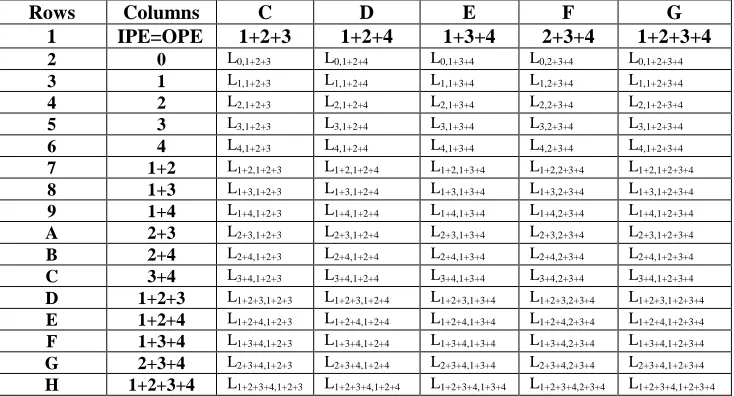
The IPEs or Input Equations are all possible xored terms that can be formed using four IPVs 4, 3, 2 and 1. On the other hand OPEs are possible xored terms that can be formed using four OPVs 4, 3, 2 and 1. All possible IPEs and OPEs are listed under the column and also row heading (IPE = OPE) from row 2 through H and column 1 through G respectively. Each cell is a linear equation equating IPE to OPE. Such as L1+2+4,2+3 is the linear equation formed by IPE ‘1+2+3’ i.e. the xored combination of three
IPVs 1, 2 and 4 and OPE ‘2+3’ i.e. the xored combination of two OPBFs 2 and 3. The 256 possible 4-bit Linear Equations are shown in Table 4.
Rows Columns 1 2 3 4 5 6 7 8 9 A B
1 IPE = OPE 0 1 2 3 4 1+2 1+3 1+4 2+3 2+4 3+4
2 0 L0,0 L0,1 L0,2 L0,3 L0,4 L0,1+2 L0,1+3 L0,1+4 L0,2+3 L0,2+4 L0,3+4
3 1 L1,0 L1,1 L1,2 L1,3 L1,4 L1,1+2 L1,1+3 L1,1+4 L1,2+3 L1,2+4 L1,3+4
4 2 L2,0 L2,1 L2,2 L2,3 L2,4 L2,1+2 L2,1+3 L2,1+4 L2,2+3 L2,2+4 L2,3+4
5 3 L3,0 L3,1 L3,2 L3,3 L3,4 L3,1+2 L3,1+3 L3,1+4 L3,2+3 L3,2+4 L3,3+4
6 4 L4,0 L4,1 L4,2 L4,3 L4,4 L4,1+2 L4,1+3 L4,1+4 L4,2+3 L4,2+4 L4,3+4
7 1+2 L1+2,0 L1+2,1 L1+2,2 L1+2,3 L1+2,4 L1+2,1+2 L1+2,1+3 L1+2,1+4 L1+2,2+3 L1+2,2+4 L1+2,3+4
8 1+3 L1+3,0 L1+3,1 L1+3,2 L1+3,3 L1+3,4 L1+3,1+2 L1+3,1+3 L1+3,1+4 L1+3,2+3 L1+3,2+4 L1+3,3+4
9 1+4 L1+4,0 L1+4,1 L1+4,2 L1+4,3 L1+4,4 L1+4,1+2 L1+4,1+3 L1+4,1+4 L1+4,2+3 L1+4,2+4 L1+4,3+4
A 2+3 L2+3,0 L2+3,1 L2+3,2 L2+3,3 L2+3,4 L2+3,1+2 L2+3,1+3 L2+3,1+4 L2+3,2+3 L2+3,2+4 L2+3,3+4
B 2+4 L2+4,0 L2+4,1 L2+4,2 L2+4,3 L2+4,4 L2+4,1+2 L2+4,1+3 L2+4,1+4 L2+4,2+3 L2+4,2+4 L2+4,3+4
C 3+4 L3+4,0 L3+4,1 L3+4,2 L3+4,3 L3+4,4 L3+4,1+2 L3+4,1+3 L3+4,1+4 L3+4,2+3 L3+4,2+4 L3+4,3+4
D 1+2+3 L1+2+3,0 L1+2+3,1 L1+2+3,2 L1+2+3,3 L1+2+3,4 L1+2+3,1+2 L1+2+3,1+3 L1+2+3,1+4 L1+2+3,2+3 L1+2+3,2+4 L1+2+3,3+4
E 1+2+4 L1+2+4,0 L1+2+4,1 L1+2+4,2 L1+2+4,3 L1+2+4,4 L1+2+4,1+2 L1+2+4,1+3 L1+2+4,1+4 L1+2+4,2+3 L1+2+4,2+4 L1+2+4,3+4
F 1+3+4 L1+3+4,0 L1+3+4,1 L1+3+4,2 L1+3+4,3 L1+3+4,4 L1+3+4,1+2 L1+3+4,1+3 L1+3+4,1+4 L1+3+4,2+3 L1+3+4,2+4 L1+3+4,3+4
G 2+3+4 L2+3+4,0 L2+3+4,1 L2+3+4,2 L2+3+4,3 L2+3+4,4 L2+3+4,1+2 L2+3+4,1+3 L2+3+4,1+4 L2+3+4,2+3 L2+3+4,2+4 L2+3+4,3+4
H 1+2+3+4 L1+2+3+4,0 L1+2+3+4,1 L1+2+3+4,2 L1+2+3+4,3 L1+2+3+4,4 L1+2+3+4,1+2 L1+2+3+4,1+3 L1+2+3+4,1+4 L1+2+3+4,2+3 L1+2+3+4,2+4 L1+2+3+4,3+4
Rows Columns C D E F G
1 IPE=OPE 1+2+3 1+2+4 1+3+4 2+3+4 1+2+3+4
2 0 L0,1+2+3 L0,1+2+4 L0,1+3+4 L0,2+3+4 L0,1+2+3+4
3 1 L1,1+2+3 L1,1+2+4 L1,1+3+4 L1,2+3+4 L1,1+2+3+4
4 2 L2,1+2+3 L2,1+2+4 L2,1+3+4 L2,2+3+4 L2,1+2+3+4
5 3 L3,1+2+3 L3,1+2+4 L3,1+3+4 L3,2+3+4 L3,1+2+3+4
6 4 L4,1+2+3 L4,1+2+4 L4,1+3+4 L4,2+3+4 L4,1+2+3+4
7 1+2 L1+2,1+2+3 L1+2,1+2+4 L1+2,1+3+4 L1+2,2+3+4 L1+2,1+2+3+4
8 1+3 L1+3,1+2+3 L1+3,1+2+4 L1+3,1+3+4 L1+3,2+3+4 L1+3,1+2+3+4
9 1+4 L1+4,1+2+3 L1+4,1+2+4 L1+4,1+3+4 L1+4,2+3+4 L1+4,1+2+3+4
A 2+3 L2+3,1+2+3 L2+3,1+2+4 L2+3,1+3+4 L2+3,2+3+4 L2+3,1+2+3+4
B 2+4 L2+4,1+2+3 L2+4,1+2+4 L2+4,1+3+4 L2+4,2+3+4 L2+4,1+2+3+4
C 3+4 L3+4,1+2+3 L3+4,1+2+4 L3+4,1+3+4 L3+4,2+3+4 L3+4,1+2+3+4
D 1+2+3 L1+2+3,1+2+3 L1+2+3,1+2+4 L1+2+3,1+3+4 L1+2+3,2+3+4 L1+2+3,1+2+3+4
E 1+2+4 L1+2+4,1+2+3 L1+2+4,1+2+4 L1+2+4,1+3+4 L1+2+4,2+3+4 L1+2+4,1+2+3+4
F 1+3+4 L1+3+4,1+2+3 L1+3+4,1+2+4 L1+3+4,1+3+4 L1+3+4,2+3+4 L1+3+4,1+2+3+4
G 2+3+4 L2+3+4,1+2+3 L2+3+4,1+2+4 L2+3+4,1+3+4 L2+3+4,2+3+4 L2+3+4,1+2+3+4
H 1+2+3+4 L1+2+3+4,1+2+3 L1+2+3+4,1+2+4 L1+2+3+4,1+3+4 L1+2+3+4,2+3+4 L1+2+3+4,1+2+3+4
Table.19. 256, 4-bit Linear Equations with input Equations (IPE) and output Equations (OPE). 4.2.4 Linear Approximation Table (LAT) [6].
4.2.5 Pseudo Code of Algorithm with Time Complexity Analysis of Linear Cryptanalysis of 4-bit Crypto S-boxes. The algorithm to execute the linear cryptanalysis for 4-bit Crypto S-boxes following Heys [HH96][HH02] considers 4– bit Boolean variables Ai and Bj whose i and j are the decimal indices varying from 0 to 15 and Ai and Bj are taking corresponding bit values from [0000] to [1111]. The algorithm to fill the (16 x 16) elements of the LAT is,
for(i=0;i<16;i++){ A=0;
for(k=0;k<16;k++) A=A+(Ai0.Xk0+Ai1.Xk1+Ai2.Xk2+Ai3.Xk3)%2; for(j=0;j<16;j++){
B=0;
for(k=0;k<16;k++)B= B+(Bj0.Yk0+Bj1.Yk1+Bj2.Yk2+Bj3.Yk3)%2; Sij = (A+B)%2;
if (Sij==0) Cij++; Nij = Cij – 8;
}
}
Time Complexity of the given Algorithm. Since the Pseudo Code contains two nested loops so the time complexity of the given algorithm has been O(n2).
4.3. Linear Approximation Analysis:
A Crypto 4-bit S-box (1st 4-bit S-box out of 32 4-bit S-boxes of DES) has been described in sub-section 4.3.1. The
Table for four input vectors, Output 4-bit BFs and corresponding ANFs has been depicted in sub-section 4.3.2. The analysis has been described in sub-section 4.3.3. The result of Analysis has been given in sub-section 4.3.4.
4.3.14-bit Crypto S-Boxes: A 4-bit Crypto S-box can be written as Follows in Table.21,where the each element of the first row of Table.21, entitled as index, are the position of each element of the S-box within the given S-box and the elements of the 2nd row, entitled as S-box, are the elements of the given Substitution box. It can be concluded that the 1st row is fixed for all possible Crypto S-boxes. The values of each element of the 1st row are distinct, unique and vary between 0 to F in hex. The values of the each element of the 2nd row of a Crypto S-box are also distinct and unique and also vary between 0 to F in hex. The values of the elements of the fixed 1st row are sequential and monotonically increasing where for the 2nd row they can be sequential or partly sequential or non-sequential. Here the given Substitution box is the 1st 4-bit S-box of the 1st S-Box out of 8 of Data Encryption Standard [AT90][NT77][NT99].
Row Column 1 2 3 4 5 6 7 8 9 A B C D E F G
1 Index 0 1 2 3 4 5 6 7 8 9 A B C D E F
2 S-Box E 4 D 1 2 F B 8 3 A 6 C 5 9 0 7
Table.21. 4-bit Crypto S-box.
4.3.2 Input Vectors (IPVs)-Output BFs (OPBFs)-Algebraic Normal Forms (ANFs). The elements of input S-box have been shown under column heading ‘ISB’ and the Input Vectors have been shown under the field IPVs (Input Vectors) and subsequently under column headings 1, 2, 3 and 4. The 4th input vector has been depicted under column heading ‘4’, 3rd input vector has been depicted under column heading ‘3’, 2nd input vector has been depicted under column heading ‘2’ and 1st input vector has been depicted under column heading ‘1’. The elements of S-box have been shown under column heading ‘OSB’ and the Output 4-bit BFs have been shown under field OPBFs (Output Boolean Functions) and subsequently under column headings 1, 2, 3 and 4. The 4th Output BF has been depicted under column heading ‘4’, 3rd Output BF has been depicted under column heading ‘3’, 2nd
Output BF has been depicted under column heading ‘2’ and 1st Output BF has been depicted under column
heading ‘1’. The corresponding ANFs for 4 OPBFs, OPBF-4th
, OPBF-3rd, OPBF-2nd , OPBF-1st, are depicted under field ‘ANFs’ subsequently under column heading 4, 3, 2 and 1 respectively of Table.22..
ISB IPVs OSB OPBFs ANFs
4321 4321 4321
0 0000 E 1110 1110
1 0001 4 0100 1010
2 0010 D 1101 0011
3 0011 1 0001 1100
4 0100 2 0010 1101
5 0101 F 1111 0110
6 0110 B 1011 0111
7 0111 8 1000 0011
8 1000 3 0011 1010
9 1001 A 1010 0110
A 1010 6 0110 1010
B 1011 C 1100 1000
C 1100 5 0101 0101
D 1101 9 1001 0010
E 1110 0 0000 1010
F 1111 7 0111 0000
Table22. Input and Output Boolean Functions With Corresponding ANF Coefficients of the given S-Box.
4.3.3 Linear Approximation Analysis (LAA). An Algebraic Normal Form or ANF equation is termed as Linear Equation or Linear Approximation if the Nonlinear Part or NP (i.e. The xored value of all product terms of equation 2 for corresponding 4 bit values of IPVs, with column heading 4, 3, 2, 1) is 0 and The Linear part or LP for corresponding 4 bit values of IPVs, with column heading 4, 3, 2, 1 is equal to corresponding BF bit values. The corresponding ANF coefficients of output BFs F(4), F(3), F(2), and F(1) are given under row heading ANF(F4), ANF(F3), ANF(F2) and ANF(F1) respectively from row 2 through 5 and column 4 through J. In which Column 4 of row 2 through 5 gives the value of Constant Coefficient (a0 according to eqn.2.) of
ANF(F4), ANF(F3), ANF(F2) and ANF(F1) respectively. Column 5 through 8 of row 2 through 5 gives the value of respective Linear Coefficients more specifically a1, a2, a3, a4 (according to eqn. 2.) of ANF(F4), ANF(F3), ANF(F2) and ANF(F1). They
together termed as LP or Linear Part of the respective ANF Equation. Column 9 through J of row 2 through 5 gives the value of respective Non-Linear Coefficients more specifically a5 to a15 (according to eqn. 2.) of ANF(F4), ANF(F3), ANF(F2) and
ANF(F1). They together termed as NP or Non-Linear Part of the respective ANF Equation.
R|C 1 2 3 4 5 6 7 8 9 A B C D E F G H I J
1 Co-Effs C LP NP
2 ANF(F4) 1 1 0 1 1 0 0 0 1 0 1 1 0 0 1 0 3 ANF(F3) 1 0 0 1 1 1 1 0 0 1 0 0 1 0 0 0 4 ANF(F2) 1 1 1 0 0 1 1 1 1 1 1 0 0 1 1 0 5 ANF(F1) 0 0 1 0 1 0 1 1 0 0 0 0 1 0 0 0 6 I
D
IPVs S B
F L P
N P
S F
F L P
N P
S F
F L P
N P
S F
F L P
N P
S F
7 4321 4 3 2 1
8 0 0000 E 1 0 0 1 1 0 0 1 1 1 0 0 0 1 0 1 9 1 0001 4 0 0 0 0 1 0 0 1 0 1 0 1 0 0 0 0 A 2 0010 D 1 1 0 0 1 1 0 0 0 1 0 1 1 0 0 1 B 3 0011 1 0 1 1 1 0 1 0 1 0 1 1 1 1 1 0 0 C 4 0100 2 0 1 0 1 0 1 0 1 1 0 0 1 0 1 0 1 D 5 0101 F 1 0 0 1 1 0 1 1 1 0 1 1 1 1 0 0 E 6 0110 B 1 1 1 1 0 1 0 1 1 0 1 1 1 1 0 0 F 7 0111 8 1 0 1 1 0 0 1 1 0 0 0 0 0 1 0 1 G 8 1000 3 0 0 0 0 0 1 0 1 1 0 0 1 1 0 0 1 H 9 1001 A 1 1 0 0 0 0 0 0 1 0 1 1 0 0 1 1 R|C I
D IPVs 4321 S B F 4 L P N P S F F 3 L P N P S F F 2 L P N P S F F 1 L P N P S F I A 1010 6 0 0 0 0 1 1 1 1 1 0 1 1 0 0 1 1 J B 1011 C 1 1 1 1 1 0 1 1 0 0 0 0 0 0 0 0 K C 1100 5 0 0 0 0 1 1 1 1 0 1 1 1 1 1 0 0 L D 1101 9 1 1 0 0 0 0 1 1 0 1 1 1 1 1 0 0 M E 1110 0 0 0 0 0 0 1 0 1 0 1 1 1 0 1 1 1 N F 1111 7 0 1 0 1 1 0 0 1 1 1 0 0 1 1 1 1
Table.23. Linear Approximation Analysis 4.3.4. Result
No. of LA with BF1 No. of LA with BF2 No. of LA with BF3 No. of LA with BF4
7 4 2 8
Total Number of Existing Linear Approximations: 21.
4.3.5 Pseudo Code with Time Complexity Analysis of the Linear Approximation Analysis Algorithm: The Nonlinear Part for the given analysis has been termed as NP. The ANF coefficients are illustrated through array anf[16]. IPVs are termed as x1, x2, x3, x4 for IPV1, IPV2, IPV3, IPV4 respectively. The Pseudo Code of algorithm of the above analysis is given
below,
Start.
Step 1. NP = (anf[5].&x1&x2)^(anf[6]&x1 &x3)+( anf[7]&x1 &x4)+(anf[8] &x2 &x3)+(anf[9]&x2 &x4)+(anf[10]&x3 &x4)(anf[11]&x1 &x2 &x3)+(anf[12]&x1 &x2 &x4)+(anf[13]&x1 &x3 &x4) +(anf[14] &x2 &x3 &x4)+(anf[15]&x1 &x2 &x3 &x4))
Step 2. LP= anf[0] ^(anf[1].&x1)^ (anf[2].&x2)^ (anf[3].&x3)^ (anf[4].&x4). Step 3. if(NP==0&& BF(x1x2x3x4) == LP) then Linear equation.
else Nonlinear equation. Stop.
4.3.6. Comparison of Execution time Complexity of Linear Cryptanalysis of 4-bit Crypto S-boxes and Linear Approximation Analysis of 4-bit S-boxes. The Comparison of time complexity of two algorithms has been given in Table.7C as follows,
View 4-bit LC 4-bit LA
Time Complexity O(n2) O(n)
Table.24. Time Complexity Comparison of Two Algos.
It can be concluded from the comparison that the Execution time reduces in Linear Approximation Analysis than the Linear Cryptanalysis of 4-bit Crypto S-boxes. So in can be concluded from above review work that the execution time of 4-bit LA Algorithm is much less that 4-bit LC Algorithm so 4-bit LA algorithm has been proved to be much better algorithm.
5. Result and Analysis and Security Criterion For all four Algorithms of 4-bit Crypto S-Boxes.
In this section The Analysis Criterion of Differential Cryptanalysis of 4-bit S-boxes has been described in subsection 5.1. and The Analysis Criterion of Differential Cryptanalysis with 4-bit BFs of 4-bit S-boxes has been described in subsection 5.2. The same of Linear Cryptanalysis of 4-bit S-boxes has been illustrated in subsection 5.3 and at last The Analysis Criterion of Linear Approximation Analysis of 4-bit S-boxes has been depicted in subsection 5.4. The Result and Analysis of Results of Four Algorithms on 32 DES 4-bit S-boxes has been described in brief in sec.5.5.
5.1. The Analysis Criterion of Differential Cryptanalysis of 4-bit S-boxes. In Difference Distribution Table there have been 256 cells, i.e. 16 rows and 16 columns. Each row has been for each input difference varies from 0 to F. Each column in each row represents each output difference varies from 0 to F for each input difference. 0 in any cell indicates absence of that output difference for subsequent input difference. Such as 0 in 2nd cell of Table.7.b of relevant DDT means for input difference 0 the corresponding output difference o is absent. If number of 0 is too low or too high it supplies more information regarding concerned output difference. So an S-box is said to be immune to this cryptanalytic attack if number of 0s in DDT is close to 128 or half of total cells or 256. In the said example of 1st DES 4-bit S-box total number of 0s in DDT are 168. That is close to 128. So the S-box has been said to be almost secure from this attack.
5.2. The Analysis Criterion of Differential Cryptanalysis with 4-bit BFs. As total number of balanced 4-bit BFs increases in Difference Analysis Table or DAT the security of S-box increases since balanced 4-bit BFs supplies at most
uncertainty. Since Number of 0s and 1s in balanced 4-bit BFs are equal i.e. they are same in number means determination
of each bit has been at most uncertainty. In the said example of 1st DES 4-bit S-box total number of 8s in DAT are 36. That is close to 32 half of total 64 cells. So the S-box has been said to be almost less secure from this attack.
5.3. The Analysis Criterion of Linear Cryptanalysis of 4-bit S-boxes. In Linear Analysis Table or LAT there are 256 cells for 256 possible 4-bit linear relations. The count of 16 4-bit binary conditions to satisfy for any given linear relation has been put into the concerned cell. 8 in a cell indicate that the particular linear relation has been satisfied for 8 4-bit binary conditions and remain unsatisfied for 8, 4-bit binary conditions. That is at most uncertainty. In the said example of 1st DES 4-bit
S-box total number of 8s in LAT have been 143. That is close to 128. So the S-box has been said to be less secure from this attack.
5.4. The Analysis Criterion of Linear Approximation Analysis of 4-bit S-boxes. The value of nCr has been maximum
when the value of r is ½ of the value of n (when n is even). Here the maximum number of linear approximations is 64. So if the total satisfaction of linear equation is 32 out of 64 then the number of possible sets of 32 linear equations has been the largest. Means if the total satisfaction is 32 out of 64 then the number of possible sets of 32 possible linear equations is 64C32. That is
maximum number of possible sets of linear equations. If the value of total No of Linear Approximations is closed to 32 then it is more cryptanalysis immune. Since the number of possible sets of linear equations are too large to calculate. As the value goes close to 0 or 64 it reduces the sets of possible linear equations to search, that reduces the effort to search for the linear equations present in a particular 4-bit S-box. In this example total satisfaction is 21 out of 64. Which means the given 4-bit S-Box is not a good 4 bit S-Box or not a good Crypt analytically immune S-Box.
If the values of total number of Existing Linear equations for a 4-bit S-Box are 24 to 32, then the lowest numbers of sets of linear equations are 250649105469666120. This is a very large number to investigate. So the 4-bit S-Box is declared as a good 4-bit S-Box or 4-bit S-Box with good security. If it is between 16 through 23 then the lowest numbers of sets of linear equations are 488526937079580. This not a small number to investigate in today’s computing scenario so the S-boxes are declared as medium S-Box or S-Box with medium security. The 4-bit S-Boxes having existing linear equations less than 16 are declared as Poor 4-bit S-Box or vulnerable to cryptanalytic attack.