Converting Acquired Lexical Functional Grammar F-Structure
Annotations and Parsing F-Structures Directly
Natalie Schluter Dublin City University
Dublin 9, Ireland
Josef van Genabith Dublin City University
Dublin 9, Ireland
Abstract
Recent years have seen considerable suc-cess in the generation of automatically ob-tained wide-coverage deep grammars for natural language processing, given reli-able and large CFG-like treebanks. For research within Lexical Functional Gram-mar framework, these deep gramGram-mars are typically based on an extended PCFG parsing scheme from which dependencies are extracted. However, increasing suc-cess in statistical dependency parsing sug-gests that such deep grammar approaches to statistical parsing could be streamlined. We explore this novel approach to deep grammar parsing within the framework of LFG in this paper, for French, showing that best results (an f-score of 69.46) for the established integrated architecture may be obtained for French.
1 Introduction
Recent years have seen considerable success in the generation of automatically obtained wide-coverage deep grammars for natural language pro-cessing, given reliable and large CFG-like tree-banks (for example, (Cahill et al., 2002; Guo et al., 2007; Chrupała and van Genabith, 2006)). For research within Lexical Functional Grammar (LFG) framework, these deep grammars are typi-cally based on an extended PCFG parsing scheme from which dependencies are extracted. However, increasing success in statistical dependency pars-ing suggests that such deep grammar approaches to statistical parsing could be streamlined. In this paper, we explore this novel approach to deep grammar parsing within the framework of LFG in this paper, for French, showing that best results (an f-score of 69.46) for the established integrated architecture may be obtained for French.
This paper presents a mise-en-sc`ene between theoretical dependency syntax and dependency parser practical requirements, anentr´ee en sc`ene for f-structures in the literature for dependency parsing, an approach to representing f-structures in LFG as pseudo-projective dependencies, a first attempt to reconcile parsing LFG and dependency parsing, and, finally, the first treebank-based sta-tistical dependency parsing results for French.
We begin with an brief introduction to LFG, fol-lowed by a presentation of the Modified French Treebank (the data source for this research), and an overview of previous parsing architecture of LFG f-structures (Section 2). Following this, we discuss LFG f-structure dependencies, comparing previously mentioned theoretical frameworks for statistical dependency parsing in the literature and showing their pseudo-projectivity (Section 3). In Section 4 we describe the data conversion involved in this research, and we end with the presentation of results of our experiments and a brief discussion (Section 5).
2 Preliminaries
2.1 Lexical Functional Grammar Basics
LFG is a constraint-based theory of language, whose basic architecture distinguishes two lev-els of syntactic representation : c-structure (constituent structure) andf-structure (functional structure)—c-structures corresponding to tradi-tional constituent tree representation, and f-structures to a traditional dependency representa-tion in the form of an attribute value matrix.1
Like any attribute-value matrix, f-structures are the minimal solution to a set of functional equa-tions such as(f a) =v, wherefis an f-structure, ais some attribute, andvis the value taken by that attribute, possibly another f-structure.
1A detailed introduction to LFG may be found in
These two levels of representation (f-structure and c-structure), for a given phrase, are explic-itly related by a structural mapping, called the f-description, often denoted by φ, which maps c-structure nodes to f-c-structure nodes.
In the LFG framework, this mapping may be given by functional annotations inserted into the c-structure tree, as in Figure 1.
S↑=↓
eeeee\\\\\\\\\\
NP↑subj=↓ VP↑=↓
] ] ] ] ] ] ] ] ] ] ] ] ] ] ]
NNP↑=↓ V↑=↓ NP↑obj=↓
John
↑pred=‘John’
helped
↑pred=‘help’
NNP↑=↓
Mary
[image:2.612.326.517.66.136.2]↑pred=‘Mary’
Figure 1: Annotated C-structure forJohn helped Mary.
The metavariables ↑ and ↓ refer to the f-structure of the mother node and that of the node itself, respectively. So that if node n, is anno-tated↑=↓, thenn’s f-structure is mapped to the same f-structure asn’s mother’s f-structure. Also, ifn has the annotation↑obj=↓, this means that the f-structure associated withnis mapped to the value of the mother’s f-structure obj attribute. LFG also has equations for members of sets, such as↓∈↑adjunct, which states that the node’s f-structure is mapped to an element of the mother’s ADJ attribute.
2.2 Modified French Treebank
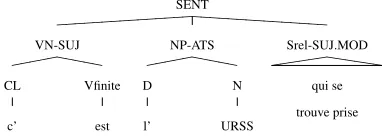
For this research, the treebank adopted is the Mod-ified French Treebank (MFT) (Schluter and van Genabith, 2007). One important feature of the MFT is the extended function tag set, which in-cludes function path tags. Consider the sentence in Example (1), taken directly from the MFT, whose tree structure is given in Figure 2.
(1) C’est It is
[...] [...]
l’URSS the USSR
[...] [...]
qui who
se herself trouve
finds prise taken
‘It is the USSR that finds itself trapped’2
In this example, the Srel constituent takes the functional path tag SUJ.MOD, representing the
2Sentence 8151, file flmf3 08000 08499ep.xd.cat.xml.
SENT
aaaaaaaaaaaaaaa]]]]]]]]]]]]]]]
VN-SUJ
eeeeeYYYYY NP-ATS
eeeeeYYYYY Srel-SUJ.MOD
ddddddZZZZZZ
CL Vfinite D N qui se
trouve prise
c’ est l’ URSS
Figure 2: MFT representation of Example (1).
fact that Srel has the function MOD and is depen-dent on the constituent whose function is SUJ.
For this research, we followed the same random partition as (Schluter and van Genabith, 2008) for the training set (3800 sentences), test set (430 sen-tences), and development set (509 sentences).
2.3 Previous Parsing Architectures of LFG F-Structures
Previously, the technology for treebank-based ac-quisition of multilingual LFG probabilistic parsing resources consisted of three main stages, the basic input for which is a CFG-type treebank. These stages include the construction and application of an f-structure annotation algorithm combined with satisfiability verification, subcategorisation frame extraction, and long-distance dependency extrac-tion. Given the resources produced in these ini-tial stages, four CFG-based probabilistic parsing architectures were developed. Figure 3 shows these parsing architectures, with, in bold grey, the additional probabilistic dependency-based in-tegrated architecture that is being presented here. (For more information on these former CFG-based probabilistic parsing architectures for French, see (Schluter and van Genabith, 2008)).
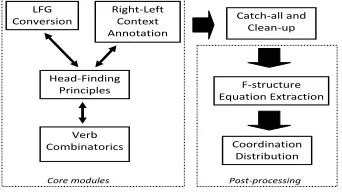
2.3.1 F-Structure Annotation Algorithm For the creation of the dependency bank for French, to be used as training material, we will use f-structures. In the LFG framework, f-structures may be fully specified by f-structure annotated c-structures. The f-structure annotation algorithm outlined in (Schluter and van Genabith, 2008) will be adopted here, to obtain f-structure annotated c-structures. For French, it uses head-finding princi-ples for a given constituent, to annotate MFT trees according to one of four modules:
[image:2.612.107.287.173.280.2]Treebank
Automatic F-structure Annotation
Probabilistic CFG-type
Parsers
LDD Resolution
Subcate-gorisation Frame, LDD
Extraction
Constraint Solver
CFG trees
CFG trees
f-structure equation annotated
CFG parsing
model
Proto f-structures
Proper f-structures
Pipeline
Automatic F-structure Annotation Probabilistic
CFG-type Parsers
SVM Function Tagging
(Function Tag) CFG parsing
model
annotated CFG trees
SVM F-Structure Equation
Tagging
Integrated
Conversion to annotated dependency
treebank
Probabilistic Dependency
Parsers
[image:3.612.121.502.72.239.2]F-structure annotated CFG trees
Figure 3: Overview of treebank-based LFG parsing architectures. The proposed dependency-based ar-chitecture being outlined in this paper is in bold grey.
functional tag ATO may be mapped to ↑ -xcomp=↓,↑-obj=↓-subj.
2. Right-Left Annotation Module: Con-stituent daughters are annotated with respect to the location of the constituent head. The constituent head is simply annotated as the predicate (↑-pred=lemma), or the governor of the predicate (↑=↓).
3. Verb Combinatorics Module: Combina-tions of different verb complexes in the MFT’s constituent VN are resolved to pred-icates with corresponding compound tenses, for a monoclausal f-structural representation of verb phrases.
4. Catch-all and Clean-up Module: Any cor-rection of detected overgeneralisations or miscellaneous annotations (such as sentence type) are carried out.
Verb Combinatorics
Right-Left Context Annotation LFG
Conversion
Head-Finding Principles
Core modules
Catch-all and Clean-up
F-structure Equation Extraction
Coordination Distribution
[image:3.612.113.284.591.687.2]Post-processing
Figure 4: French Annotation Algorithm.
The f-structure annotation algorithm French was evaluated against a hand-corrected gold stan-dard dependency bank. It achieves 98.4% cover-age, with a best preds-only f-score of 99.63 (Table 1).
coord dist precision recall f-score
no 98.57 96.38 97.46
yes 99.49 99.77 99.63
Table 1: Preds-only f-structure annotation algo-rithm performance.
2.3.2 Previous LFG Parsing Results for French
In this paper, because dependency parsers parse relations between actual word-forms and not any other features, we consider only preds-only results for LFG f-structures. That is, we evaluate only along those branches of the f-structures that end in a predicate.
(Schluter and van Genabith, 2008) report pars-ing results for both the integrated and pipeline ar-chitectures, with a best preds-only f-score for the integrated architecture of 67.88.3
3 LFG F-structure Dependencies
In this section, we overview the different target frameworks for the conversion of CFG-like data into dependency tree data (Section 3.1). We then
3The pipeline architecture outperforms the integrated
consider projectivity in light of these conversions, and explain why projectivity need not be a prob-lem in LFG dependency parsing as a result of its the property of pseudo-projectivity (Section 3.2).
3.1 A Comparison of Theoretical Frameworks
In the statistical dependency parsing literature, there are generally two sources of modern linguis-tic theorelinguis-tical justification behind parsing mod-els: the theoretical framework of the Meaning-Text Theory (Mel’ˇcuk, 1998), and the annota-tion guidelines of the Prague Treebank (Hajiˇc et al., 1999). Moreover, software converting phrase-structure style treebanks into dependencies for sta-tistical dependency parsing usually quote these two annotation styles in the treatment of hard cases. Therefore, when statistically parsing LFG f-structures, it is vital to consider what sorts of de-pendencies existing dependency parsers were in-tended to parse.
Meaning-Text Theory (MTT) represents the syntactic organisation of sentences strictly by de-pendencies. Under this framework, syntax is sepa-rated into surface and deep syntactic dependency-based tree representations. The deep-syntactic structure of a sentence has nodes that are seman-tically full lemmata (full lexemes); abstraction is made of any auxiliary or structural lemmata at this level. Also, lemmata are subscripted by the grammatical information (grammemes) expressed by their associated word-form(s), not imposed by government and agreement. Arcs are labeled by a selection of around ten language-independent re-lations. On the other hand, the surface-syntactic structure of a sentence contains all lemmata of the sentence and its arcs are labeled with the names of language-specific surface-syntactic relations, each of which represents a particular construction of the language (Mel’ˇcuk, 2003; Mel’ˇcuk, 1998). Furthermore, communicative functions such as topicorfocus are not associated with a pure syntactic structure in the Meaning-Text Theory (Mel’ˇcuk, 2001).
The Prague Treebank (PT) annotation guide-lines (Hajiˇc et al., 1999) also distinguishes be-tween two levels of dependency-based syntactic representation: analytical and tectogrammatical. These guidelines are written in the spirit of Func-tional Generative Description.4 These two levels
4See, for example, (Hajiˇcov´a and Sgall, 2003) for a
dis-of syntactic representation roughly correspond to those of the Meaning-Text Theory—the analyti-cal level corresponding to the surface-syntax of the MTT and the tectogrammatical level corre-sponding to the deep-syntactic level of the MTT ( ˇZabokrtsk´y, 2005). In the PT, word-forms have attributes for their lemmata as well as for gram-matical and lexical information expressed mor-phologically. The syntactic structure of the tree-bank is given for the analytic level of representa-tion, though work is under way on complement-ing this with a tectogrammatical level of repre-sentation (Sgall et al., 2004). Also similarly to the MTT, communicative structure is not associ-ated with pure syntax in Functional Generative Description, and therefore does not figure among annotations defined for the PT.
LFG does not have a uniform dependency syn-tax, distinguishing between c-structure and f-structure. These two systems contain different sorts of information, represented by means of phrase-structure trees, for the c-structure, and de-pendency dags, for f-structures. The f-structure is an abstract functional syntactic representa-tion of a sentence, thought to contain deeper or more language-independent information than the c-structure (Dalrymple, 2001).
There are several important ways in which f-structures differ from the tree-dependencies out-lined by the literature on dependency syntax within the MTT framework or the annotation guidelines of the Prague Treebank. For instance, included in the f-structure is communicative in-formation, such astopicandfocus, that LFG theorists consider to be grammaticised or syn-tacticised components of information structure). This introduces the notion of long-distance de-pendencies. Moreover, subject and object-raising are represented with re-entrancies at the syntac-tic level in LFG. This creates dags rather than just dependency trees, since some grammatical functions share the same f-structure value; these shared f-structures are calledre-entrancies. Also, f-structure syntax corresponds, in fact, to a sort of mix of surface and deep dependency MTT syn-tax (respectively, a mix of analytic and tectogram-matical syntax). Like a surface dependency syn-tax, some lemmata, like copular verbs, that are not semantically full, appear in f-structures. On the
other hand, like deep dependency syntax, some lemmata that are not semantically full are ex-cluded (for example, for the monoclausal treat-ment of compound tenses of verbs).
Other differences between dependency struc-tures may be found in the notions of grouping and sets. In particular, coordination receives differ-ent treatmdiffer-ents that must be considered. Accord-ing to the PT annotation guidelines, coordination is treated as sets (conjuncts are sister nodes, el-ements of a set of conjuncts). Also, every node of a dependency tree must be associated with a word-form, which makes the coordinating con-junction or punctuation the governor of the set. On the other hand, in the MTT, coordination has a cascaded representation, with the first conjunct as governor. To distinguish between modifiers or arguments of the first conjunct and those of the co-ordinated structure, MTT theorists resort to group-ing: the first conjunct essentially forms a distin-guished group with its modifiers and arguments, much like the notion of constituent (Mel’ˇcuk, 2003). In this sense, the first conjunct grouping is really the governor of the coordination.5 Also ac-cording to the MTT, every node of a dependency tree must be associated with a word-form. But in LFG this is not necessary, in particular, in the rep-resentation of both coordination; coordinated ele-ments, like in the PT, are treated as sets. In dag form, it can be seen that these coordinated struc-tures have anullgovernor; that is, they do not have a governor that corresponds to any word-form as the node has no label. Because today’s statistical dependency parsers cannot handle null elements, some pre-processing will be needed to convert our LFG representation of coordination (Section 4.1). Finally, f-structures may be specified in terms of annotated c-structures with the local meta-variables↑and↓, and grammatical function regu-lar paths. This restricts the structure of dependen-cies actually occurring in LFG f-structure syntax, as we will show in Section 3.2.
3.2 The Breadth of Functional Equations in LFG
LFG’s f-structures often have re-entrancies (or shared sub-f-structures)—two functional equa-tions resolve to take the same (f-structure) value—making them dags, rather than simple
de-5Grouping may be indicated on labels (Nilsson et al.,
2006).
pendency trees. In LFG, the termfunctional un-certaintydescribes the uncertainty in the resolu-tion given a simple grammatical funcresolu-tion, in the definition of the grammar. The set of options for resolution may be finite and given by a disjunc-tion, in which case resolution is down a chain of f-structure nodes of bounded length, or (theoret-ically) infinite in which case they are given by a regular expression (including the Kleene star oper-ator) and resolution is down a chain of f-structure nodes of unbounded length. We note, however, that in statistical parsing of f-structures, the func-tional uncertainty in the resolution of a grammati-cal function will never be infinite, since the data is finite.
3.2.1 Projectivity
Consider a labeled dependency tree (directed tree) T = (V, E, L), whereV is its set of vertices (or nodes), E = {(a, l, b) | a, b ∈ V, l ∈ L} its set of directed edges, andLthe set of labels for edges. Ife= (a, l, b)∈E, we say thata immedi-ately dominatesb; in this case, we say thatais the governor ofb, or thatbis a dependent ona. We say thatv1dominatesvnif there is a chain of arcs
e1, e2, . . . , en−1, such thate1 = (v1, l1, v2), e2 =
(v2, l2, v3), . . . , en−1 = (vn−1, ln−1vn). In this
case, we also say thatvnis a descendent ofv1or
thatv1is an ancestor ofvn.
Anordered tree is a tree having a total order, (V,≤), over its nodes, which for dependency trees is just the linear order of the symbols (or natu-ral language words) in the generated string. An edge e = (a, b) covers nodes v1, v2, . . . , vn if
a≤v1, . . . , vn≤b, orb≤v1, . . . , vn ≤a.
An edge,e = (v1, l, v2), of a tree is said to be
projective if and only for every vertexv covered bye,vis dominated byv1. A treeT is projective
if and only if all its edges are projective (Robin-son, 1970). (Gaifman, 1965) explains that a pro-jective dependency tree can be associated with a dependency tree whose constituents are the projec-tions of the nodes of the dependency tree, showing that projectivity in dependency trees corresponds to constituent continuity in phrase-structure trees.
for which there is a one-to-one correspondence be-tween predicates and original word-forms, these extended definitions may easily be applied.
However, LFG’s treatment of long-distance de-pendency resolution and of subject/object raising is non-projective, illustrate non-projective dags. For French, for example, an interesting non-projective structure is found in enpronouns and NP extraction.
Projectivity in dependency trees or dags is ob-viously a result of the definition of the generating dependency grammar. This is true also of cases that are not LFG re-entrancies. For example, (Jo-hansson and Nugues, 2007) propose a conversion of the Penn Treebank into dependency trees that introduces more projective edges than the conver-sion proposed by (Yamada and Matsumoto, 2003; Nivre, 2006). In addition to long-distance depen-dencies, for example, their representation of gap-ping always introduces non-projective branches (Johansson and Nugues, 2007).
LFG is capable of locally representing non-projective dependencies in phrase structures, which should, by definition, be impossible. This is because the only types of non-projective depen-dencies theoretically represented in LFG are actu-ally pseudo-projectivities.
3.2.2 Non-Projectivity and Pseudo-Projectivity
Dependency trees also model non-projective struc-tures that have no correspondence with any con-stituent trees—that is, they may be non-projective. This added “increase” in power for dependency grammars is shown to be useful for syntactic rep-resentations of certain languages (for example, the cross-serial dependencies of Dutch). However, as (Kahane et al., 1998) explain, pseudo-projective dependency trees may be parsed as projective trees with the aid of a simple transformation.
Consider two non-projective labeled depen-dency trees, T1 = (V, E1, L1) and T2 =
(V, E2, L2).T2is called aliftif one of the
follow-ing conditions hold, for somee = (a, l, b), e0 = (b, l0, c)∈E1.6
1. E2 = (E1− {e, e0})∪ {(a, l : l0, c)}, L2 ⊆
L1∪ {l:l0}, or
2. T3is a lift ofT1andT2is a lift ofT3.
6This definition is equivalent to the one given in (Kahane
et al., 1998), where a lift was defined as in terms of gover-nance forunlabeleddependency trees.
Corresponding to item 1 of the above condi-tions, the action of creating the tree T2 from T1
by removing the edgese, e0 and adding the edge e00, will be referred to aslifting. A labeled ordered dependency treeT is said to bepseudo-projective if there is some liftT0ofT that is projective.
(Kahane et al., 1998) explain that (for unla-beled dependency trees) one may make these def-initions meaningful through the specification of lifting rules of the formLD ↑SG w LG, mean-ing that a node of categoryLD can be lifted to its syntactic governor of category LGthrough a path consisting of nodes of categoryC1, . . . , Cn,
whereCiis among a specific set of categories
(la-bels) (Lw) for all i ∈ {1, . . . , n}. Equivalently,
for a labeled ordered dependency tree, the path w may be specified by a path of labels. In this sense, building a projective tree by means of lift-ing results in arcs with path labels. Projectlift-ing the nodes would result in a sort of annotated c-structure. In this sense, and making abstraction of any contractions resulting from the annotations ↑=↓, lifting is the opposite of the correspondence φfrom c-structure to f-structure.7 Re-entrancies may simply be considered as complex labels. Let us call the transformation opposite to lifting a de-contraction(used to undo the lifting transforma-tion). Since generating an f-structure from an an-notated c-structure involves simple contractions of the form↑=↓and de-contractions, all f-structures are at most pseudo-projective. That means, we do not have to worry about non-projective structures in the parsing of LFG dependencies in f-structures.
4 Transforming Annotated C-Structures into Dependency Trees
To generate dependency trees, rather than using f-structures, we start with annotated c-structures. The motivation for this choice is straightforward: we need only carry out a certain number of con-tractions for the equations ↑=↓ in order to get a projective dependency tree (rather than just a pseudo-projective dependency tree on which we must perform lifts). Moreover, the association of labels for handling re-entrancies is sitting in the annotated tree and does not need to be re-calculated. There are some problems that remain in the result.
7(Kahane et al., 1998) remark that the idea of building a
Firstly, not every terminal will get have a pred-icate annotation. For example, in causative con-structions like for the phrase faire danser (’to make dance’), the word-formfairewould only be annotated with the feature↑ factive= +, not as a predicate. These will simply be turned into f-structures rather than features, by changing an-notations such as these to↑ factive:pred = ‘f aire0.
Another problem is that coordination structures have no governor. These structures must be trans-formed. We choose to follow the annotation guidelines for the PT for this transformation, due to its similarity with LFG analyses. Some coordi-nation structures of the treebank need alternative treatment. In particular, non-constituent coordi-nation and unlike constituent coordicoordi-nation require analyses that are not covered in the those guide-lines. We resort to extended dependency tag sets to treat these cases and retain projectivity.
4.1 Coordination Transformations
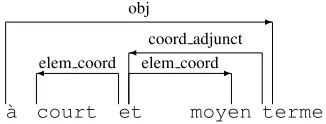
In general, coordination will be transformed in the spirit of the PT annotation guidelines. If there is a coordinating conjunction, then the last of these will be taken as the governor of the coordination, as in the Figure 5. In the case where there is no coordinating conjunction but there is coordination punctuation (like a comma or semicolon), we will take the last of these as the governor. Otherwise we will take the first conjunct of the coordination as the governor and revert to grouping through ex-tended labels.
`
a court et moyen terme
-obj
elem coord elem coord
[image:7.612.323.514.460.511.2]coord adjunct
Figure 5: Dependency graph fora court et moyen terme(‘short and mid-term’).
For non-constituent coordination, the goal is twofold: (1) show that the different elements of each of the conjuncts belong together8 and
8The dependency treatment of coordination outlined by
(Johansson and Nugues, 2007) for the treatment of gapping also introduced ambiguity for the case where there are more than two conjuncts; in this solution, they have removed the relation that the components of gapping are part of a same
(2) show that they are missing something that is present in the first conjunct (done by the function tags). For this reason, the LFG analysis is ideal. However, a surface dependency analysis cannot do this; constituent structure is not simply depen-dency structure that projects lexical units to termi-nals. It shows groupings of elements based depen-dence on a item that is there or not. To do this, we use extended labels, forcing a ”fake” lexical head.
5 Dependency Parsing Results
The parsing architecture works as follows. The an-notation algorithm is applied to MFT trees, creat-ing f-structure annotated trees that are then trans-formed into the projective depenendency represen-tation described in Section 4, using the c-structure with the (only) f-structure equations. A depen-dency parser is then trained on this data, and the test set parsed. The parser output is then trans-formed back to f-structure equations, which are evaluated against the f-structure gold standard.
Two different dependency parsers were used for this research: MST parser (McDonald et al., 2005) and MALT parser (Nivre et al., 2006). Experi-ments were done with the simplified architecture (in which long-distance dependencies are given as complex path equations in training), and in the established architecture (with a separated long-distance dependency resolution task).9The results are given in Tables 2 and 3.
Parser coord dist precision recall f-score
MST no 87.46 54.67 67.28
yes 87.45 54.66 67.27
MALT no 86.23 52.17 65.01
[image:7.612.132.295.511.573.2]yes 86.17 51.95 64.82
Table 2: Simplified Architecture Parsing Results
Parser LDDs coord precision recall f-score resolved dist
MST no no 86.90 57.07 68.89
yes 86.89 57.06 68.88
yes yes 86.48 58.03 69.46
MALT no no 85.98 51.13 64.13
yes 86.02 50.9 63.96
yes yes 86.08 51.62 64.54
Table 3: Parsing Results with Long Distance De-pendency Resolution
element/constituent.
9More information on the difference between these two
[image:7.612.314.528.557.638.2]We observe that best results are obtained by the MST parser when LDD recovery separated and coordination distribution is carried out.
6 Concluding Remarks
In this paper, we have shown that best statistical parsing results for French in the integrated LFG parsing architecture are achievable by extending this architecture for statistical dependency pars-ing. However, best results, in general are still obtained via the original PCFG based LFG pars-ing approach. Future work would look at extend-ing the use of machine learnextend-ing to approximate the integrated parsing architecture, which has been shown to improve results in the PCFG based LFG parsing approach.
Acknowledgments
This research was supported by Science Founda-tion Ireland GramLab grant 04/IN/I527.
References
A. Cahill, M. McCarthy, J. van Genabith, and A. Way. 2002. Automatic annotation of the penn tree-bank with lfg f-structure information. In A. Lenci, S. Montemagni, and V. Pirelli, editors,Proceedings of the LREC 2002 workshop on Linguistic Knowl-edge Acquisition and Representation, Paris. ELRA.
G. Chrupała and J. van Genabith. 2006. Improving treebank-based automatic lfg induction for spanish. InProc. of LFG06, Konstanz, Germany.
Mary Dalrymple. 2001. Lexical Functional Gram-mar, volume 34 ofSyntax and Semantics. Academic Press, San Diego.
Haim Gaifman. 1965. Dependency systems and phrase-structured systems. Information and Con-trol, 8:304–337.
Y. Guo, J. van Genabith, and H. Wang. 2007. Treebank-based acquisition of lfg resources for chi-nese. InProc. of LFG07, Stanford, CA.
J. Hajiˇc, J. Panevov´a, E. Bur´aˇnov´a, Z. Ureˇsov´a, and A. B´emov´a. 1999. Annotations at analytical level. instructions for annotators. Technical report, Prague.
E. Hajiˇcov´a and P. Sgall, 2003. Dependency Syntax in Functional Generative Description, pages 570–592. Walter de Gruyter, Berlin and New York.
R. Johansson and P. Nugues. 2007. Extended constituent-to-dependency conversion. In NODAL-IDA 2007 Conference Proceedings, pages 105–112, Tartu, Estonia.
S. Kahane, A. Nasr, and O. Rambow. 1998. Pseudo-projectivity: a polynomially parsable non-projective dependency grammar. In Proceedings of the 17th international conference on Computational linguis-tics, pages 646–652.
R. McDonald, K. Crammer, and F. Pereira. 2005. On-line large-margin training of dependency parsers. In
Proc. of ACL 2005.
I. Mel’ˇcuk. 1998. Vers une linguistique Sens-Texte. Lec¸on inaugurale. Coll`ege de France, Paris.
I. Mel’ˇcuk. 2001. Communicative Organisation in Natural Language. The Semantic-Communicative Structure of Sentences. Benjamins, Amsterdam and Philadelphia.
I. Mel’ˇcuk, 2003. Levels of Dependency in Linguis-tic Description: Concepts and Problems, volume 1, pages 188–229. Walter de Gruyter, Berlin and New York.
J. Nilsson, J. Nivre, and J. Hall. 2006. Graph transfor-mations in data-driven dependency parsing. InACL ’06: Proceedings of the 21st International Confer-ence on Computational Linguistics and the 44th an-nual meeting of the ACL, pages 257–264.
J. Nivre, J. Hall, and J. Nilsson. 2006. Malt-parser: A data-driven parser generator for dependency parsing. InProceedings of LREC’06.
J. Nivre. 2006. Inductive Dependency Parsing. Springer Verlag.
J. J. Robinson. 1970. Dependency structure and trans-formational rules. 46:259–285.
N. Schluter and J. van Genabith. 2007. Preparing, re-structuring, and augmenting a french treebank: Lex-icalised parsers or coherent treebanks? InProc. of the PACLING 2007, Melbourne, Australia.
N. Schluter and J. van Genabith. 2008. Treebank-based acquisition of lfg parsing resources for french. InProc. of LREC 2008, Marrakech, Morocco.
P. Sgall, J. Panevov´a, and E. Hajiˇcov´a. 2004. Deep syntactic annotation: Tectogrammatical representa-tion and beyond. In A. Meyers, editor,HLT-NAACL 2004 Workshop: Frontiers in Corpus Annotation, pages 32–38, Boston, MASS. Association for Com-putational Linguistics.
Z. ˇZabokrtsk´y. 2005. Resemblances between meaning-text theory and functional generative de-scription. In J.D. Apresjian and L.L. Iomdin, ed-itors, Proceedings of the 2nd International Con-ference of Meaning-Text Theory, pages 549–557, Moscow, Russia. Slavic Culture Languages Publish-ers House.