Towards the Interpretation of Utterance Sequences in a Dialogue System
Ingrid Zukerman and Patrick Ye and Kapil Kumar Gupta and Enes Makalic Faculty of Information Technology
Monash University
Clayton, VICTORIA 3800, Australia
[email protected], {ye.patrick,kapil.k.gupta,emakalic}@gmail.com
Abstract
This paper describes a probabilistic mech-anism for the interpretation of sentence se-quences developed for a spoken dialogue system mounted on a robotic agent. The mechanism receives as input a sequence of sentences, and produces an interpretation which integrates the interpretations of in-dividual sentences. For our evaluation, we collected a corpus of hypothetical requests to a robot. Our mechanism exhibits good performance for sentence pairs, but re-quires further improvements for sentence sequences.
1 Introduction
DORIS (Dialogue Oriented Roaming Interactive System) is a spoken dialogue system under devel-opment, which will eventually be mounted on a household robot. The focus of our current work is onDORIS’s language interpretation module called Scusi?. In this paper, we consider the interpreta-tion of a sequence of sentences.
People often utter several separate sentences to convey their wishes, rather than producing a sin-gle sentence that contains all the relevant informa-tion (Zweig et al., 2008). For instance, people are likely to say “Go to my office. Get my mug. It is on the table.”, instead of “Get my mug on the table in my office”. This observation, which was val-idated in our corpus study (Section 4), motivates the mechanism for the interpretation of a sequence of sentences presented in this paper. Our mecha-nism extends our probabilistic process for inter-preting single spoken utterances (Zukerman et al., 2008) in that (1) it determines which sentences in a sequence are related, and if so, combines them
into an integrated interpretation; and (2) it pro-vides a formulation for estimating the probability of an interpretation of a sentence sequence, which supports the selection of the most probable inter-pretation. Our evaluation demonstrates that our mechanism performs well in understanding textual sentence pairs of different length and level of com-plexity, and highlights particular aspects of our al-gorithms that require further improvements (Sec-tion 4).
In the next section, we describe our mechanism for interpreting a sentence sequence. In Section 3, we present our formalism for assessing the prob-ability of an interpretation. The performance of our system is evaluated in Section 4, followed by related research and concluding remarks.
2 Interpreting a Sequence of Utterances
Scusi? employs an anytime algorithm to interpret a sequence of sentences (Algorithm 1). The algo-rithm generates interpretations until time runs out (in our case, until a certain number of iterations has been executed). In Steps 1–5, Algorithm 1 processes each sentence separately according to the interpretation process for single sentences de-scribed in (Zukerman et al., 2008).1 Charniak’s probabilistic parser2 is applied to generate parse trees for each sentence in the sequence. The parser produces up toN (= 50) parse trees for each sen-tence, associating each parse tree with a probabil-ity. The parse trees for each sentence are then it-eratively considered in descending order of proba-bility, and algorithmically mapped into Uninstan-tiated Concept Graphs (UCGs) — a
representa-1
AlthoughDORISis a spoken dialogue system, our cur-rent results pertain to textual input only. Hence, we omit the aspects of our work pertaining to spoken input.
Algorithm 1Interpret a sentence sequence
Require: SentencesT1, . . . , Tn {Interpret Sentences}
1: for allsentencesTi do
2: Generate parse trees{Pi}, and UCGs{Ui}
3: Generate candidate modes{Mi}
4: For each identifierj inTi, generate candi-date referents{Rij}
5: end for
{Combine UCGs}
6: whilethere is timedo
7: Get{(U1, M1, R1), . . . ,(Un, Mn, Rn)}— a sequence of tuples (one tuple per sen-tence)
8: Generate {UD}, a sequence of declara-tive UCGs, by merging the declaradeclara-tive UCGs in {(Ui, Mi, Ri)} as specified by their identifier-referent pairs and modes
9: Generate {UI}, a sequence of imperative UCGs, by merging each imperative UCG in {(Ui, Mi, Ri)} with declarative UCGs as specified by their identifier-referent pairs and modes
10: Generate candidate ICG sequences{IjI}for the sequence{UI}
11: Select the best sequence of ICGs{II∗}
12: end while
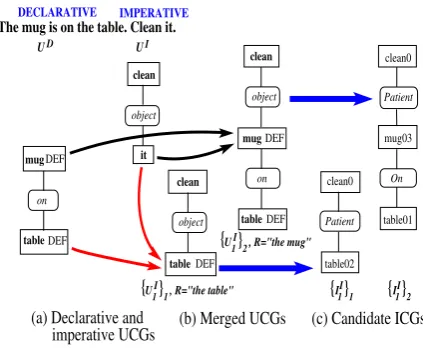
tion based on Concept Graphs (Sowa, 1984) — one parse tree yielding one UCG (but several parse trees may produce the same UCG). UCGs rep-resent syntactic information, where the concepts correspond to the words in the parent parse tree, and the relations are derived from syntactic in-formation in the parse tree and prepositions (Fig-ure 1(a) illustrates UCGs UD and UI generated from the sentences “The mug is on the table. Clean it.”).
Our algorithm requires sentence mode (declar-ative, imperative or interrogative3), and resolved references to determine how to combine the sen-tences in a sequence. Sentence mode is obtained using a classifier trained on part of our corpus (Section 2.2). The probability distribution for the referents of each identifier is obtained from the corpus and from rules derived from (Lappin and Leass, 1994; Ng et al., 2005) (Section 2.3).
At this point, for each sentenceTiin a sequence, we have a list of UCGs, a list of modes, and lists
3Interrogatives are treated as imperatives at present, so in
the remainder of the paper we do not mention interrogatives.
clean0
The mug is on the table. Clean it. IMPERATIVE
(b) Merged UCGs (c) Candidate ICGs (a) Declarative and
imperative UCGs
Figure 1: Combining two sentences
of referents (one list for each identifier in the sen-tence). In Step 7, Algorithm 1 generates a tu-ple(Ui, Mi, Ri)for each sentenceTi by selecting from these lists a UCG, a mode and a referent for each identifier (yielding a list of identifier-referent pairs). Each element in each(U, M, R)tuple is it-eratively selected by traversing the appropriate list in descending order of probability. For instance, given sentences T1, T2, T3, the top UCG forT1 is
picked first, together with the top mode and the top identifier-referent pairs for that sentence (like-wise forT2 and T3); next the second-top UCG is
chosen for T1, but the other elements remain the
same; and so on.
Once the (U, M, R) tuples have been deter-mined, the UCGs for the declarative sentences are merged in the order they were given (Step 8). This is done by first merging a pair of declara-tive UCGs, then merging the resultant UCG with the next declarative UCG, and so on. The idea is that if the declarative sentences have co-referents, then the information about these co-referents can be combined into one representation. For exam-ple, consider the sequence “The mug is on the ta-ble. It is blue. Find it. The mug is near the phone. Bring it to me.” Some of the UCG sequences ob-tained from the declarative sentences (first, second and fourth) are:
4The different notations are because colour (and size) are
The first two sequences contain one declarative merged UCG, and the third contains two UCGs.
In Step 9, Algorithm 1 considers a UCG for each imperative sentence in turn, and merges it with declarative UCGs (which may have resulted from a merger), as specified by the modes and identifier-referent pairs of the sentences in ques-tion. For example, consider the sentence sequence “Find my mug. It is in my office. Bring it.” One of the(U, M, R)-tuple sequences for this instruction set is
{(find-obj-mug-owner-me, imperative, NIL), (it1-in-office-owner-me, declarative,it1-mug),
(bring-obj-it2, imperative,it2-mug)}.
After merging the first two UCGs (imperative-declarative), and then the second and third UCGs (declarative-imperative), we obtain the imperative UCG sequence{U1I,U2I}:
U1I=find-obj-mug-(owner-me & in-office-owner-me) U2I=bring-obj-mug-(in-office-owner-me).
This process enablesScusi? to iteratively merge ever-expanding UCGs with subsequent UCGs, eventually yielding UCG sequences which contain detailed UCGs that specify an action or object. A limitation of this merging process is that the infor-mation about the objects specified in an impera-tive UCG is not aggregated with the information about these objects in other imperative UCGs, and this sometimes can cause the merged imperative UCGs to be under-specified. This limitation will be addressed in the immediate future.
After a sequence of imperative UCGs has been generated, candidateInstantiated Concept Graphs (ICGs) are proposed for each imperative UCG, and the most probable ICG sequence is selected (Steps 10–11 of Algorithm 1). We focus on im-perative UCGs because they contain the actions that the robot is required to perform; these actions incorporate relevant information from declarative UCGs. ICGs are generated by nominating dif-ferent instantiated concepts and relations from the system’s knowledge base as potential realizations for each concept and relation in a UCG (Zukerman et al., 2008); each UCG can generate many ICGs. Since this paper focuses on the generation of UCG sequences, the generation of ICGs will not be dis-cussed further.
2.1 Merging UCGs
Given tuples(Ui, Mi, Ri)and(Uj, Mj, Rj)where j > i, pronouns and one-anaphora inUj are
re-placed with their referent inUi on the basis of the set of identifier-referent pairs inRj (if there is no referent inUifor an identifier inUj, the identifier is left untouched).UiandUjare then merged into a UCGUm by first finding a node nthat is com-mon toUiandUj, and then copying the sub-tree of Uj whose root isninto a copy ofUi. If more than one node can be merged, the node (head noun) that is highest in theUj structure is used. If one UCG is declarative and the other imperative, we swap them if necessary, so thatUiis imperative andUj declarative.
For instance, given the sentences “The mug is on the table. Clean it.” in Figure 1, Step 4 of Algorithm 1 produces the identifier-referent pairs
{(it, mug), (it, table)}, yielding two
intermedi-ate UCGs for the imperative sentence: (1) clean-object-mug, and (2) clean-object-table. The first UCG is merged with a UCG for the declarative sentence using mugas root node, and the second UCG is merged using table as root node. This results in merged UCG sequences (of length 1) corresponding to “Clean the table” and “Clean the mug on the table” ({U1I}1and{U1I}2respectively
in Figure 1(b), which in turn produce ICG se-quences {I1I}1 and {I1I}2 in Figure 1(c), among
others).
2.2 Determining modes
We use the MaxEnt classifier5 to determine the mode of a sentence. The input features to the clas-sifier (obtained from the highest probability parse tree for this sentence) are: (1) top parse-tree node; (2) position and type of the top level phrases under the top parse-tree node, e.g., (0, NP), (1, VP), (2, PP); (3) top phrases under the top parse-tree node reduced to a regular expression, e.g., VP-NP+ to represent, say, VP NP NP; (4) top VP head – the head word of the first top level VP; (5) top NP head – the head word of the first top level NP; (6) first three tokens in the sentence; and (7) last token in the sentence. Using leave-one-out cross valida-tion, this classifier has an accuracy of 97.8% on the test data — a30%improvement over the ma-jority class (imperative) baseline.
2.3 Resolving references
Scusi? handles pronouns, one-anaphora and NP identifiers (e.g., “the book”). At present, we con-sider only precise matches between NP identifiers
5http://homepages.inf.ed.ac.uk/
and referents, e.g., “the cup” does not match “the dish”. In the future, we will incorporate similar-ity scores based on WordNet, e.g., Leacock and Chodorow’s (1998) scores for approximate lexical matches; such matches occurred in 4% of our cor-pus (Section 4).
To reduce the complexity of reference reso-lution across a sequence of sentences, and the amount of data required to reliably estimate prob-abilities (Section 3), we separate our problem into two parts: (1) identifying the sentence being re-ferred to, and (2) determining the referent within that sentence.
Identifying a sentence. Most referents in our corpus appear in thecurrent, previousorfirst sen-tence in a sequence, with a few referents appear-ing in other sentences (Section 4). Hence, we have chosen the sentence classes {current, previ-ous, first, other}. The probability of referring to a sentence of a particular class from a sentence in position iis estimated from our corpus, where i = 1, . . . ,5, > 5 (there are only 13 sequences with more than 5 sentences). We estimate this dis-tribution for each leave-one-out cross-validation fold in our evaluation (Section 4).
Determining a referent. We use heuristics based on those described in (Lappin and Leass, 1994) to classify pronouns (an example of a non-pronoun usage is “It is ModalAdjective that S”), and heuristics based on the results obtained in (Ng et al., 2005) to classify one-anaphora (an exam-ple of a high-performing feature pattern is “oneas head-noun with NN or CD as Part-of-speech and no attachedof PP”). If a term is classified as a pro-noun or one-anaphor, then a list of potential ref-erents is constructed using the head nouns in the target sentence. We use the values in (Lappin and Leass, 1994) to assign a score to each anaphor-referent pair according to the grammatical role of the referent in the target UCG (obtained from the highest probability parse tree that is a parent of this UCG). These scores are then converted to proba-bilities using a linear mapping function.
3 Estimating the Probability of a Merged Interpretation
We now present our formulation for estimating the probability of a sequence of UCGs, which sup-ports the selection of the most probable sequence.
One sentence. The probability of a UCG gener-ated from a sentence T is estimated as described
in (Zukerman et al., 2008), resulting in
Pr(U|T)∝PPPr(P|T)·Pr(U|P) (1)
whereT,PandUdenote text, parse tree and UCG respectively. The summation is taken over all pos-sible parse trees from the text to the UCG, be-cause a UCG can have more than one ancestor. As mentioned above, the parser returns an estimate of Pr(P|T); and Pr(U|P) = 1, since the process of generating a UCG from a parse tree is determinis-tic.
A sentence sequence. The probability of an in-terpretation of a sequence of sentencesT1, . . . , Tn is
Pr(U1, . . . , Um|T1, . . . , Tn) =
Pr(U1, . . .,Un,M1, . . .,Mn,R1, . . .,Rn|T1, . . .,Tn)
wheremis the number of UCGs in a merged se-quence.
By making judicious conditional independence assumptions, and incorporating parse trees into the formulation, we obtain
Pr(U1, . . . , Um|T1, . . . , Tn) = n
Y
i=1
Pr(Ui|Ti)·Pr(Mi|Pi, Ti)·Pr(Ri|P1, . . . , Pi)
This formulation is independent of the num-ber of UCGs in a merged sequence generated by Algorithm 1, thereby supporting the compari-son of UCG sequences of different lengths (pro-duced when different numbers of mergers are per-formed).
Pr(Ui|Ti) is calculated using Equation 1, and Pr(Mi|Pi, Ti) is obtained as described in Sec-tion 2.2 (recall that the input features to the clas-sifier depend on the parse tree and the sentence). In principle, Pr(Mi|Pi, Ti)and Pr(Ri|P1, . . . , Pi) could be obtained by summing over all parse trees, as done in Equation 1. However, at present we use the highest-probability parse tree to simplify our calculations.
To estimate Pr(Ri|P1, . . . , Pi)we assume con-ditional independence between the identifiers in a sentence, yielding
Pr(Ri|P1, . . . , Pi) = ki Y
j=1
Pr(Rij|P1, . . . , Pi)
separated into determining a sentence, and deter-mining a referent in that sentence. We also include in our formulation the Type of the identifier (pro-noun, one-anaphor or NP) and sentence positioni, yielding
Pr(Rij|P1, . . . , Pi) =
Pr(RijrefNPain sentb, Type(Rij)|i, P1, . . . , Pi)
After additional conditionalization we obtain
Pr(Rij|P1, . . . , Pi) =
Pr(Rij refNPa|Rij ref sentb,Type(Rij),Pi,Pb)×
Pr(Rij ref sentb|Type(Rij), i)×Pr(Type(Rij)|Pi)
As seen in Section 2.3, Pr(Type(Rij)|Pi) and Pr(RijrefNPa|Rij ref sentb,Type(Rij),Pi,Pb) are estimated in a rule-based manner, and Pr(Rijref sentb|Type(Rij), i) is estimated from the corpus (recall that we distinguish between sentence classes, rather than specific sentences).
4 Evaluation
We first describe our experimental set-up, fol-lowed by our results.
4.1 Experimental set-up
We conducted a web-based survey to collect a cor-pus comprising multi-sentence requests. To this effect, we presented participants with a scenario where they are in a meeting room, and they ask a robot to fetch something from their office. The idea is that if people cannot see a scene, their in-structions will be more segmented than if they can view the scene. The participants were free to de-cide which object to fetch, and what was in the office. There were no restrictions on vocabulary or grammatical form for the requests.
We collected 115 sets of instructions mostly from different participants (a few people did the survey more than once).6 The sentence sequences in our corpus contain between 1 and 9 sentences, with 74% of the sequences comprising 1 to 3 sen-tences. Many of the sentences had grammatical requirements which exceeded the capabilities of our system. To be able to use these instruction sets in our evaluation, we made systematic manual changes to produce sentences that meet our sys-tem’s grammatical restrictions (in the future, we
6We acknowledge the modest size of our corpus compared
to that of some publicly available corpora, e.g., ATIS. How-ever, we must generate our own corpus since our task differs in nature from the tasks where these large corpora are used.
SMALL OFFICE MAIN OFFICE
PRINTER TABLE CHAIR
BOOKCASE
WINDOW SIDE DESK
FILING CABINET
GLASS MAIN DESK
CABINET
BOOKCASE
JOE’S DESK
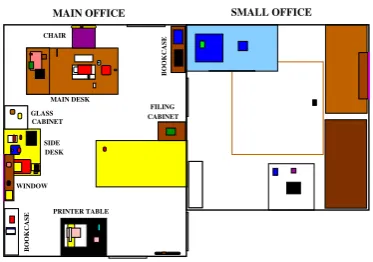
Figure 2: Our virtual environment (top view)
will relax these restrictions, as required by a de-ployable system). Below are the main types of changes we made.
• Indirect Speech Acts in the form of questions were changed to imperatives. For instance, “Can you get my tea?” was changed to “Get my tea”.
• Conjoined verb phrases or sentences were sep-arated into individual sentences.
• Composite verbs were simplified, e.g., “I think I left it on” was changed to “it is on”, and out-of-vocabulary composite nouns were replaced by simple nouns or adjectives, e.g., “the diary is A4 size” to “the diary is big”.
• Conditional sentences were removed.
Table 1 shows two original texts compared with the corresponding modified texts (the changed portions in the originals have been italicized).
Our evaluation consists of two experiments: (1) ICGs for sentence pairs, and (2) UCGs for sen-tence sequences.
Original Get my book“The Wizard of Oz”from my office. It’s green and yellow. It has a picture of a dog and a girl on it. It’s in mydeskdrawer on the right sideof my desk, the second drawer down. If it’s not there, it’s somewhere on my shelves that are on the left side of my office as you face the window.
Modified Get my book from my office. It’s green. It’s in my drawer on the right of my desk.
Original DORIS, I leftmy mug in my officeand I want a coffee. Can yougo into my officeandget my mug. It is on top of the cabinetthat ison the leftsideof my desk.
Modified My mug is in my office. Go into my office. Get my mug. It is on top of the cabinet on the left of my desk.
Table 1: Original and modified text
Experiment 2. Since UCGs contain only syn-tactic information, no additional setup was re-quired. However, for this experiment we need to train our mode classifier (Section 2.2), and esti-mate the probability distribution of referring to a particular sentence in a sequence (Section 2.3). Owing to the small size of our corpus, we use leave-one-out cross validation.
For both experiments,Scusi? was set to gener-ate up to300 sub-interpretations (including parse trees, UCGs and ICGs) for each sentence in the test-set; on average, it took less than 1 second to go from a text to a UCG. An interpretation was deemed successful if it correctly represented the speaker’s intention, which was represented by an imperative Gold ICG for the first experiment, and a sequence of imperative Gold UCGs for the second experiment. These Gold interpretations were manually constructed by the authors through consensus-based annotation (Ang et al., 2002). As mentioned in Section 2, we evaluated only imper-ative ICGs and UCGs, as they contain the actions the robot is expected to perform.
4.2 Results
Table 2 summarizes our results. Column 1 shows the type of outcome being evaluated (ICGs in Ex-periment 1, and UCG sequences and individual UCGs in Experiment 2). The next two columns display how many sentences had Gold interpreta-tions whose probability was among the top-1 and top-3 probabilities. The averagerankof the Gold interpretation appears in Column 4 (“not found” Gold interpretations are excluded from this rank). The rank of an interpretation is its position in a list sorted in descending order of probability (start-ing from position 0), such that all equiprobable in-terpretations have the same position. Columns 5 and 6 respectively show the median and 75%-ile rank of the Gold interpretation. The number of
Gold interpretations that were not found appears in Column 7, and the total number of requests/UCGs is shown in the last column.
Experiment 1. As seen in the first row of Ta-ble 2, the Gold ICG was top ranked in 75.5% of the cases, and top-3 ranked in 85.8%. The aver-age rank of 2.17 is mainly due to 7 outliers, which together with the “not-found” Gold ICG, are due to PP-attachment issues, e.g., for the sentence pair “Fetch my phone from my desk. It is near the key-board.”, the top parses and resultant UCGs have “near the keyboard” attached to “the desk” (in-stead of “the phone”). Nonetheless, the top-ranked interpretation correctly identified the intended ob-ject and action in 5 of these 7 cases. Median and 75%-ile results confirm that most of the Gold ICGs are top ranked.
Experiment 2. As seen in the second row of Ta-ble 2, the Gold UCG sequence was top ranked for 51.3% of the requests, and top-3 ranked for 53.0% of the requests. The third row shows that 62.4% of the individual Gold UCGs were top-ranked, and 65.4% were top-3 ranked. This indicates that when Scusi? cannot fully interpret a request, it can often generate a partially correct interpreta-tion. As for Experiment 1, the average rank of
3.14 for the Gold UCG sequences is due to out-liers, several of which were ranked above30. The median and 75%-ile results show that whenScusi? generates the correct interpretation, it tends to be highly ranked.
Unlike Experiment 1, in Experiment 2 there is little difference between the top-1 and top-3 re-sults. A possible explanation is that in Experi-ment 1, the top-ranked UCG may yield several probable ICGs, such that the Gold ICG is not top ranked — a phenomenon that is not observable at the UCG stage.
Table 2:Scusi?’s interpretation performance
# Gold interps. with prob. in Average Median 75%-ile Not Total
top 1 top 3 rank rank rank found #
ICGs 80 (75.5%) 91 (85.8%) 2.17 0 0 1 (0.9%) 106 reqs.
UCG seqs. 59 (51.3%) 61 (53.0%) 3.14 0 1 36 (31.3%) 115 reqs.
UCGs 146 (62.4%) 153 (65.4%) NA NA NA 55 (23.5%) 234 UCGs
UCG stage, Scusi?’s performance for this exper-iment is worse than for Experexper-iment 1, as there are more grounds for uncertainty. Table 2 shows that 31.3% of Gold UCG sequences and 23.5% of Gold UCGs were not found. Most of these cases (as well as the poorly ranked UCG sequences and UCGs) were due to (1) imperatives with object specifications (19 sequences), (2) wrong anaphora resolution (6 sequences), and (3) wrong PP-attachment (6 sequences). In the near future, we will refine the merging process to address the first problem. The second problem occurs mainly when there are multiple anaphoric references in a sequence. We propose to include this factor in our estimation of the probability of referring to a sen-tence. We intend to alleviate the PP-attachment problem, which also occurred in Experiment 1, by interleaving semantic and pragmatic interpreta-tion of preposiinterpreta-tional phrases as done in (Brick and Scheutz, 2007). The expectation is that this will improve the rank of candidates which are pragmat-ically more plausible.
5 Related Research
This research extends our mechanism for inter-preting stand-alone utterances (Zukerman et al., 2008) to the interpretation of sentence sequences. Our approach may be viewed as an information stateapproach (Larsson and Traum, 2000; Becker et al., 2006), in the sense that sentences may up-date different informational aspects of other sen-tences, without requiring a particular “legal” set of dialogue acts. However, unlike these information state approaches, ours is probabilistic.
Several researchers have investigated proba-bilistic approaches to the interpretation of spo-ken utterances in dialogue systems, e.g., (Pfleger et al., 2003; Higashinaka et al., 2003; He and Young, 2003; Gorniak and Roy, 2005; H ¨uwel and Wrede, 2006). Pfleger et al. (2003) and H ¨uwel and Wrede (2006) employ modality fusion to com-bine hypotheses from different analyzers (linguis-tic, visual and gesture), and apply a scoring
mech-anism to rank the resultant hypotheses. They dis-ambiguate referring expressions by choosing the first object that satisfies a ‘differentiation crite-rion’, hence their system does not handle situa-tions where more than one object satisfies this cri-terion. He and Young (2003) and Gorniak and Roy (2005) use Hidden Markov Models for the ASR stage. However, these systems do not han-dle utterance sequences. LikeScusi?, the system developed by Higashinakaet al.(2003) maintains multiple interpretations, but with respect to dia-logue acts, rather than the propositional content of sentences. All the above systems employ seman-tic grammars, while Scusi? uses generic, statisti-cal tools, and incorporates semantic- and domain-related information only in the final stage of the interpretation process. This approach is supported by the findings reported in (Knight et al., 2001) for relatively unconstrained utterances by users unfa-miliar with the system, such as those expected by DORIS.
Our mechanism is also well suited for process-ing replies to clarification questions (Horvitz and Paek, 2000; Bohus and Rudnicky, 2005), since a reply can be considered an additional sentence to be incorporated into top-ranked UCG sequences. Further, our probabilistic output can be used by a utility-based dialogue manager (Horvitz and Paek, 2000).
6 Conclusion
We have extended Scusi?, our spoken language interpretation system, to interpret sentence se-quences. Specifically, we have offered a procedure that combines the interpretations of the sentences in a sequence, and presented a formalism for es-timating the probability of the merged interpre-tation. This formalism supports the comparison of interpretations comprising different numbers of UCGs obtained from different mergers.
to address some issues pertaining to the integra-tion of UCGs for sentence sequences of arbitrary length. Thereafter, we propose to investigate the influence of speech recognition performance on Scusi?’s performance. In the future, we intend to expandScusi?’s grammatical capabilities.
Acknowledgments
This research was supported in part by grant DP0878195 from the Australian Research Coun-cil.
References
J. Ang, R. Dhillon, A. Krupski, E. Shriberg, and A. Stolcke. 2002. Prosody-based automatic de-tection of annoyance and frustration in human-computer dialog. InICSLP’2002 – Proceedings of the 7th International Conference on Spoken Lan-guage Processing, pages 2037–2040, Denver, Col-orado.
T. Becker, P. Poller, J. Schehl, N. Blaylock, C. Ger-stenberger, and I. Kruijff-Korbayov´a. 2006. The SAMMIE system: Multimodal in-car dialogue. In Proceedings of the COLING/ACL 2006 Interactive Presentation Sessions, pages 57–60, Sydney, Aus-tralia.
D. Bohus and A. Rudnicky. 2005. Constructing accu-rate beliefs in spoken dialog systems. InASRU’05 – Proceedings of the IEEE Workshop on Automatic Speech Recognition and Understanding, pages 272– 277, San Juan, Puerto Rico.
T. Brick and M. Scheutz. 2007. Incremental natural language processing for HRI. InHRI 2007 – Pro-ceedings of the 2nd ACM/IEEE International Con-ference on Human-Robot Interaction, pages 263– 270, Washington, D.C.
P. Gorniak and D. Roy. 2005. Probabilistic grounding of situated speech using plan recognition and refer-ence resolution. InICMI’05 – Proceedings of the 7th International Conference on Multimodal Inter-faces, pages 138–143, Trento, Italy.
Y. He and S. Young. 2003. A data-driven spo-ken language understanding system. In ASRU’03 – Proceedings of the IEEE Workshop on Automatic Speech Recognition and Understanding, pages 583– 588, St. Thomas, US Virgin Islands.
R. Higashinaka, M. Nakano, and K. Aikawa. 2003. Corpus-Based discourse understanding in spoken di-alogue systems. InACL-2003 – Proceedings of the 41st Annual Meeting of the Association for Com-putational Linguistics, pages 240–247, Sapporo, Japan.
E. Horvitz and T. Paek. 2000. DeepListener: Har-nessing expected utility to guide clarification dialog
in spoken language systems. InICSLP’2000 – Pro-ceedings of the 6th International Conference on Spo-ken Language Processing, pages 229–229, Beijing, China.
S. H¨uwel and B. Wrede. 2006. Spontaneous speech understanding for robust multi-modal human-robot communication. In Proceedings of the COL-ING/ACL Main Conference Poster Sessions, pages 391–398, Sydney, Australia.
S. Knight, G. Gorrell, M. Rayner, D. Milward, R. Koel-ing, and I. Lewin. 2001. Comparing grammar-based and robust approaches to speech understanding: A case study. In Proceedings of Eurospeech 2001, pages 1779–1782, Aalborg, Denmark.
S. Lappin and H.J. Leass. 1994. An algorithm for pronominal anaphora resolution. Computational Linguistics, 20:535–561.
S. Larsson and D. Traum. 2000. Information state and dialogue management in the TRINDI dialogue move engine toolkit. Natural Language Engineer-ing, 6:323–340.
C. Leacock and M. Chodorow. 1998. Combining lo-cal context and WordNet similarity for word sense identification. In C. Fellbaum, editor,WordNet: An Electronic Lexical Database, pages 265–285. MIT Press.
H.T. Ng, Y. Zhou, R. Dale, and M. Gardiner. 2005. A machine learning approach to identification and resolution of one-anaphora. InIJCAI-05 – Proceed-ings of the 19th International Joint Conference on Artificial Intelligence, pages 1105–1110, Edinburgh, Scotland.
N. Pfleger, R. Engel, and J. Alexandersson. 2003. Ro-bust multimodal discourse processing. In Proceed-ings of the 7th Workshop on the Semantics and Prag-matics of Dialogue, pages 107–114, Saarbr¨ucken, Germany.
J.F. Sowa. 1984. Conceptual Structures: Information Processing in Mind and Machine. Addison-Wesley, Reading, MA.
I. Zukerman, E. Makalic, M. Niemann, and S. George. 2008. A probabilistic approach to the interpreta-tion of spoken utterances. InPRICAI 2008 – Pro-ceedings of the 10th Pacific Rim International Con-ference on Artificial Intelligence, pages 581–592, Hanoi, Vietnam.