International Journal of Advanced Research in Computer Science RESEARCH PAPER
Available Online at www.ijarcs.info
Content Based Image Retrieval Using Color Mean with Feature Classification
Using Naïve Bayes
Navdeep Kaur
PG Student,
Yadavindra College of Engineering, Talwandi Sabo (Bathinda) [email protected]
Rajbhupinder Kaur
Assistant Professor, Yadavindra College of Engineering,
Talwandi Sabo (Bathinda) [email protected]
Abstract: With the evolution of the Internet, and the availability of image capturing devices such as advanced cameras, picture scanners, the size of advanced image accumulation is expanding quickly. Efficient image searching, browsing and retrieval devices are required by clients from different domains, including remote sensing, fashion, wrongdoing prevention, publishing, medicine, architecture, etc. Here we are extracting color mean features and color standard deviation feature with the proposed method consists of HMMD (Hue Min Max Difference) color plane. It is proved in research work that HMMD along with color mean features and color standard deviation feature is tend to reduced the size of feature vectors, storage space and gives high performance than, RGB-color mean feature. Further, HMMD color space model will be used to improve the feature extraction and improve the precision. At the end, results are presented to show the efficiency of the proposed method.
Keywords: HMMD, CBIR, Feature Extraction, Precision, Recall.
I. INTRODUCTION
In text-based image retrieval, images are labeled or indexed using keywords, subject headings or codes. These keywords become the criteria to search and retrieve images. Text-based is not standardized system because different users use different keywords to search according to their knowledge and understanding. Furthermore, it is not possible to annotate complicated features of an image. Text-Based Image Retrieval requires humans to describe each image manually. Manual annotation of images by human requires large amount of time. This is illogical to exact substantial databases, or to pictures that are created automatically, e.g. from surveillance cameras. It is also not possible for the images which use different synonyms in their descriptions. Content-based image retrieval has been developed to solve the issues connected with text-based image retrieval .The image retrieval is based on content of the image rather than keyword.
The content –based image retrieval works directly with image content rather than text annotations. The word "content" may apply to shapes, colors, textures, or percentage majority of the data which can be inherited from the picture itself. CBIR is valuable because founds that rely surely on metadata have dependent on fixed
patient before giving any solution. In crime prevention, police needs to confirm the face of a criminal by matching his image features with the images in the database. The most important application is the Web. Now, various experimental and commercial CBIR systems are available, and several search engines are tied with CBIR facilities, example Alta Vista, Google and Yahoo. To record the finished projects photos are used in architecture, including exterior and interior shots of creating as well specific features of design. In architecture, photographs are used in architecture to record interior and exterior shots of buildings, design features and to record finished projects. In teaching, visual content is very helpful in giving knowledge to educational industry. In the commerce department, there is need to find out about the trademarks whether they exist in database before using them.
II. RELATED WORK
Harshada Anand Khutwad [1] author proposed the color is mostly extensive used visual for image retrieval. The 3D color values make its decrementation potentiality higher to the one dimensional gray color values of picture. Before choosing a fixed color space, color description have determined first. Returning pictures are based on the color similarity which is adopted by computing color value histogram for an each picture which identifies the size and proportion of pixels. The mean 1st order, the variance second order and skewness is a third order color moments that must have proved to be effective and efficient in displaying color distributions of pictures. Texture is an intuitive and vastly used but there has no specific definition. Liu, Guang-Hai, [2] author proposed that neuron biological and psychophysical studies indicate that human visibility system is more responsive to edge orientation and color. It describes the uniform of color difference b/w edge and colors orientations wrap on rich type of visual data and information. It is more helpful information and works as a vital role in picture understanding and analysis. S. Arivazhagan [3] proposed that wavelet is used to transform a picture from spatial into the frequency domain. The transform displays a superposition function of family of the basis of functions, these are called wavelets. The Wavelet transforms explore the information from signal at distinct scales crossing the signal via high pass filters and low pass. Wavelets provide a good energy compaction and multi solution capability. Wavelets are powerful with the respect to image color shifts. DWT compressed a signal into multiple Wavelet Functions and Basis Functions. The transform of a 2-dimensional picture is also a multi solution method that applies sub-sampling and recursive filtering. Cerra, Daniele [4] proposed a compression-based measure, the (FCD) Fast Compressing of Distance that associate the correctness of NCD by the decreased complexity of PRDC. In an initial offline step, the pictures are quantized in a specific color space or changed into the strings, after the changed to reserve textural information in process; representative, subsequently dictionaries are expressed from an each object. There are some similarities in b/w different images which are calculated by the comparing with an each couple of dictionaries. Soman, Sagar, et al.
[5] proposed the content based photo Retrieval, in which the retrieving process of pictures is based on the visible features like texture, color and shape. The main reasons for the development are various huge picture database, trendy techniques of picture indexing have shown to be laborious, insufficient and time consuming. These old techniques of picture ranging, indexing from the saving of a picture in database and identifying it with a number and keyword, with become obsolete, categorized description. Swapnalini,Pattanaik, [6] proposed that Pictures are manually changed by text descriptors that are used by DBMS to perform photo retrieval. It contains two disadvantages. Firstly, consider a level of human labor which is required for modified annotation. Second one is the annotation incorrectness causing the subject of human perception. To control the above demerits in text retrieval system, and content based picture retrieval was defined in an early 1980s. In the CBIR, pictures are arranged by visual based content, like texture, color, shapes. Youssef, Sherin M. (2012):- In [7] proposed that a texture based feature on the curve let transform. The system makes those employments for bend give convert that shows the newest research result on multi solution analysis. Curve let has proposed for picture de-noising that shown conclusion performance. With combining the merits of the two techniques, picture information is recorded more correctly than spectral methods such as Gabor and wavelet filters. In the implementation of a curve let, combine a vector codebook clustering for color extraction with curvelet-based texture extraction. Sumana, Ishrat Jahan, et al. [8]
proposed a newest texture characteristic based on curve let transform. The method uses curvelet transform that shows the newest research conclusion on multi solution analysis. With the difference of them, the merits of two methods, picture edge information is recorded more correctly than some spectral methods such as Gabor and wavelet filters. The curvelat has proposed for picture noise and display promising performance. As it records linear and edge information correctly, that has shown final results in the recent character recognition.
III. PROPOSED METHOD A. HMMD Color Space Model
space, where the diff component is rated by the intensity value.
B. Naïve Bayesian classifier
It is a quiet probabilistic classifier which efforts by applying the Bayes hypothesis alongside naïve presumptions regarding characteristic freedom. It expects that the value of a particular feature is free about qualities of any other characteristics. This assumption is also called Conditional Independence. Despite the naïve assumption and over simplification, Naïve Bayesian classifiers have demonstrated to be quite useful in complex real world conditions. Naive Bayes classifiers are highly extensible, requiring a number of parameters straight in the number of variables (features/predictors) in a learning obstacle. It is not a single method for practice such classifiers, but a family of calculations in light of a regular basis. The greater part of Naive Bayes classifiers expects that the value of a particular feature is free about qualities of any other characteristics, given the population variable.
The steps involved in proposed methodology are as follows:
Step 1: Image is obtained from training dataset.
Step 2: Calculate the Hue value from image
Step 3: Calculate the Min and Max value from image Step 4: Calculate the HMMD transform for image
Step 5: Features of image is extracted and save it in training file.
Step 6: If this image is the last image, then preprocess the training file and train the classifier, otherwise go to step 1.
Step 7: Now, image is obtained from testing data set. Step 8: Extract the feature of image.
Step 9: If it is the last image then predict the class using trained classifier, otherwise go to step 4.
IV. Results
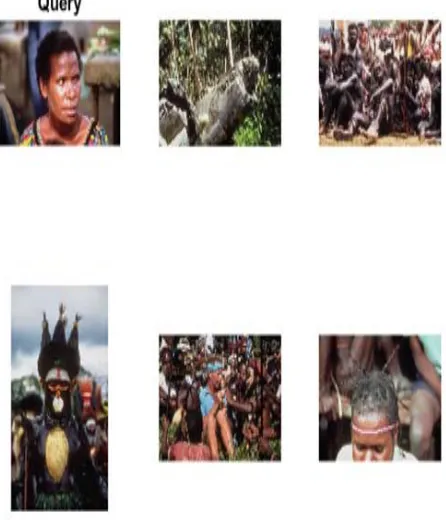
[image:3.612.325.548.64.324.2]In figure 1, The primary image retrieved is same because the question image. This shows the effectiveness of the method which can then be quantified in terms of Precision and Recall and the results can be mentioned in the form of graphs and a comparison result or graph can be displayed.
[image:3.612.320.547.448.642.2]Fig. 1: Retrieved images of peoples using HMMD features based on Query Image.
Figure 2 indicates that the primary image retrieved is same because the question image. This shows the effectiveness of the method which can then be quantified in terms of Precision and Recall and the results can be mentioned in the form of graphs and a comparison result or graph can be displayed.
Fig. 2: Retrieved Images of buses of the query image.
of the method which can then be quantified in terms of Precision
[image:4.612.78.305.105.298.2]Fig. 3: Results for retrieved image of buildings using HMMD feature.
Fig. 4: Results for dinosaur image query using HMMD Feature.
[image:4.612.357.511.343.466.2]The primary image retrieved is same because the question image. This shows the effectiveness of the method which can then be quantified in terms of Precision and Recall and the results can be mentioned in the form of graphs and a comparison result or graph can be displayed.
Fig.5 Precision value comparison graph
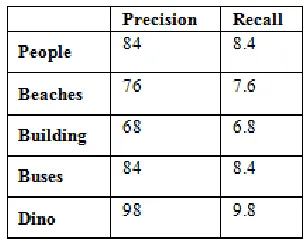
Table:1 Precision Recall for proposed method
The following performance metrics are considered in analyzing the performance of content-based image retrieval
(i) Precision: Precision is used for evaluation of most CBIR systems. Precision is the fraction of returned images that are relevant to the query image. If we denote T as the set of returned images and R as the set of all images relevant to the query image, then precision is given by: Precision = |T∩R| / |T|
(ii) Recall: Recall is the fraction of returned relevant images with respect to the total number of relevant images in the dataset.
Recall = |T∩R| / |R|
[image:4.612.78.301.345.557.2]retrieved images as the precision and recall of each method for each number of retrieved images. The distance is computed between the feature vectors of the query image and the feature vectors saved in the dataset utilizing Euclidian distance. Sort the images according to distances with the smallest distance first. The number of images returned is six in number fixed by the code. The retrieved pictures in the results show that the photographs are relevant to the specified or the question image. The performance metrics in terms of confusion matrix has been planned for the one thousand image Corel dataset that shows that there's a scope of improvement within the existing algorithmic program. The results show a brand new methodology is needed so as to enhance the relevance of the retrieved pictures. The projected work is meant for the development within the retrieval method on the grounds of each quantitative and qualitative information.
Table.2: Precision Recall for base method
V. CONCLUSION
Content based image retrieval is a challenging method for catching pertinent images from a large storage space. In spite of this area has been explored for decades, no method has attained the exactness of human visual observation in recognizing images. Whatever those measure furthermore content of the image database is, a human being can easily perceives images of same category. Overall the performance of content based image retrieval depends on features, characteristic extraction techniques, similarity measures and the size of database. Several feature extraction strategies have been produced to the task of image retrieval. Further, it is proved that by combining different features, the performance can be increased. We have performed performance evaluation of HMMD color model and Naïve Bayes classifier with COREL database for determining the classification rate .It is observed that HMMD is giving desired results. Further, it is seen that in some cases there will be irrelevant images with the result of query image in some cases these irrelevant
images are totally different from query image on basis of color and shape. Still, this is not the required image and hence there is a scope of improvement in the existing algorithm future work consists of using some other color space or improved texture extraction technique.
This method provides an efficient retrieval of images, the computation time for the whole process is on a bit higher side. Therefore, the future work will be focused on reducing the processing time for the feature extraction so that the complete process is fast enough for real time application.
VI. REFERENCES
[1] Bastian Leibe Kristen Grauman. Visual object recognition. In Thomas Dietterich Ronald Brachman, editor, Synthesis Lectures on Artificial Intelligence and Machine Learning. Morgan and Claypool Publishers, 2009.
[2] HarshadaAnandKhutwad, Prof.Mr.RavindraJinaDatta Vaidya. “CONTENT BASED IMAGE RETRIEVAL”, in International Journal of Image Processing and Vision Sciences, Volume 2, 2013, page(s).19-24.
[3] Lin, Chuen-Horng, Rong-Tai Chen, and Yung-Kuan Chan. "A smart content-based image retrieval system based on color and texture feature." Image and Vision Computing 27.6 (2009): 658-665.
[4] Alex Krizhevsky, Ilya Sutskever, and Geoff Hinton.Imagenet classification with deep convolutional neural networks.In Advances in Neural Information Processing Systems 25, pages 1106–1114, 2012.
[5] Herv´eJ´egou, MatthijsDouze, Cordelia Schmid, and Patrick P´erez. Aggregating local descriptors into a compact image representation. In IEEE Conference on Computer Vision and Pattern Recognition (CVPR), pages 3304–3311. IEEE, 2010.
[6] Jun Yue, Zhenbo Li , Lu Liu , and Zetian Fu, “Content-based image retrieval using color and texture fused features”, in Science Direct Journal of Mathematical and Computer Modeling, 2011,Page(s).1121-1127.
[7] Liu, Guang-Hai, and Jing-Yu Yang. "Content-based image retrieval using color difference histogram." Pattern Recognition 46.1 (2013): 188-198.
[8] Jonathan Delhumeau, Philippe-Henri Gosselin, HerveJ´egou, and Patrick P´erez.Revisiting the vlad image representation. In Proceedings of the 21st ACM international conference on Multimedia, pages 653–656. ACM, 2013.