A System for Summarizing and Visualizing Arguments in Subjective
Documents: Toward Supporting Decision Making
Atsushi Fujii
Graduate School of Library, Information and Media Studies
University of Tsukuba
1-2 Kasuga, Tsukuba, 305-8550, Japan [email protected]
Tetsuya Ishikawa
The Historiographical Institute The University of Tokyo 3-1 Hongo 7-chome, Bunkyo-ku
Tokyo, 133-0033, Japan [email protected]
Abstract
On the World Wide Web, the volume of subjective information, such as opinions and reviews, has been increasing rapidly. The trends and rules latent in a large set of subjective descriptions can potentially be useful for decision-making purposes. In this paper, we propose a method for sum-marizing subjective descriptions, specifi-cally opinions in Japanese. We visual-ize the pro and con arguments for a target topic, such as “Should Japan introduce the summertime system?” Users can summa-rize the arguments about the topic in order to choose a more reasonable standpoint for decision making. We evaluate our system, called “OpinionReader”, experimentally.
1 Introduction
On the World Wide Web, users can easily dissem-inate information irrespective of their own spe-cialty. Thus, natural language information on the Web is not restricted to objective and authorized information, such as news stories and technical publications. The volume of subjective informa-tion, such as opinions and reviews, has also been increasing rapidly.
Although a single subjective description by an anonymous author is not always reliable, the trends and rules latent in a large set of subjective descriptions can potentially be useful for decision-making purposes.
In one scenario, a user may read customer re-views before choosing a product. In another sce-nario, a user may assess the pros and cons of a po-litical issue before determining their own attitude on the issue.
The decision making in the above scenarios is performed according to the following processes:
(1) collecting documents related to a specific topic from the Web;
(2) extracting subjective descriptions from the documents;
(3) classifying the subjective descriptions ac-cording to their polarity, such as posi-tive/negative or pro/con;
(4) organizing (e.g., summarizing and/or visual-izing) the classified descriptions so that users can view important points selectively; (5) making the decision.
Because it is expensive to perform all of the above processes manually, a number of automatic meth-ods have been explored. Specifically, a large num-ber of methods have been proposed to facilitate processes (2) and (3).
In this paper, we focus on process (4), and pro-pose a method for summarizing subjective infor-mation, specifically opinions in Japanese. Our method visualizes the pro and con arguments for a target topic, such as “Should Japan introduce the summertime system?”
By process (4), users can summarize the argu-ments about the topic in order to choose a more reasonable standpoint on it. Consequently, our system supports decision making by users.
However, process (5) is beyond the scope of this paper, and remains an intellectual activity for hu-man beings.
We describe and demonstrate our prototype sys-tem, called “OpinionReader”. We also evaluate the components of our system experimentally.
Section 2 surveys previous research on the cessing of subjective information. Section 3 pro-vides an overview of OpinionReader, and
tion 4 describes the methodologies of its compo-nents. Section 5 describes the experiments and discusses the results obtained.
2 Related Work
For process (1) in Section 1, existing search en-gines can be used to search the Web for documents related to a specific topic. However, not all re-trieved documents include subjective descriptions for the topic.
A solution to this problem is to automatically identify diaries and blogs (Nanno et al., 2004), which usually include opinionated subjective de-scriptions.
For process (2), existing methods aim to dis-tinguish between subjective and objective descrip-tions in texts (Kim and Hovy, 2004; Pang and Lee, 2004; Riloff and Wiebe, 2003).
For process (3), machine-learning methods are usually used to classify subjective descriptions into bipolar categories (Dave et al., 2003; Beineke et al., 2004; Hu and Liu, 2004; Pang and Lee, 2004) or multipoint scale categories (Kim and Hovy, 2004; Pang and Lee, 2005).
For process (4), which is the subject of this pa-per, Ku et al. (2005) selected documents that in-clude a large number of positive or negative sen-tences about a target topic, and used their head-lines as a summary of the topic. This is the appli-cation of an existing extraction-based summariza-tion method to subjective descripsummariza-tions.
Hu and Liu (2004) summarized customer re-views of a product such as a digital camera. Their summarization method extracts nouns and noun phrases as features of the target product, (e.g., “picture” for a digital camera), and lists positive and negative reviews on a feature-by-feature basis. The extracted features are sorted according to the frequency with which each feature appears in the reviews. This method allows users to browse the reviews in terms of important features of the target product.
Liu et al. (2005) enhanced the above method to allow users to compare different products within a specific category, on a feature-by-feature basis.
3 Overview of OpinionReader
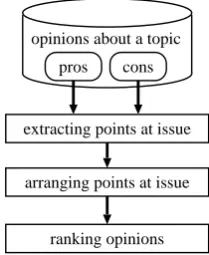
Figure 1 depicts the process flow in Opinion-Reader. The input is a set of subjective descrip-tions for a specific topic, classified according to their polarity. We assume that processes (1)–(3) in
Section 1 are completed, either manually or auto-matically, prior to the use of our system. It is of-ten the case that users post their opinions and state their standpoints, as exemplified by the websites used in our experiments (see Section 5).
While our primarily target is a set of opinions for a debatable issue classified into pros and cons, a set of customer reviews for a product, classified as positive or negative, can also be submitted.
extracting points at issue
arranging points at issue
ranking opinions opinions about a topic
[image:2.595.363.468.198.326.2]pros cons
Figure 1: Process flow in OpinionReader.
Our purpose is to visualize the pro and con ar-guments about a target topic, so that a user can de-termine which standpoint is the more reasonable.
We extract “points at issue” from the opinions and arrange them in a two-dimensional space. We also rank the opinions that include each point at issue according to their importance, so that a user can selectively read representative opinions on a point-by-point basis.
The output is presented via a graphical inter-face as shown in Figure 2, which is an example output for the topic “privatization of hospitals by joint-stock companies”. The opinions used for this example are extracted from the website for “BS debate”1. This interface is accessible via existing Web browsers.
In Figure 2, the x and y axes correspond to the polarity and importance respectively, and each oval denotes an extracted point at issue, such as “information disclosure”, “health insurance”, or “medical corporation”.
Users can easily see which points at issue are most important from each standpoint. Points at issue that are important and closely related to one particular standpoint are usually the most useful in users’ decision making.
By clicking on an oval in Figure 2, users can read representative opinions corresponding to that
point at issue. In Figure 3, two opinions that in-clude “information disclosure” are presented. The opinions on the right and left sides are selected from the pros and cons, respectively. While the pros support information disclosure, the cons in-sist that they have not recognized its necessity.
As a result, users can browse the pro and con arguments about the topic in detail. However, for some points at issue, only opinions from a single standpoint are presented, because the other side has no argument about that point.
Given the above functions, users can easily summarize the main points and how they are used in arguing about the topic in support of one stand-point or the other.
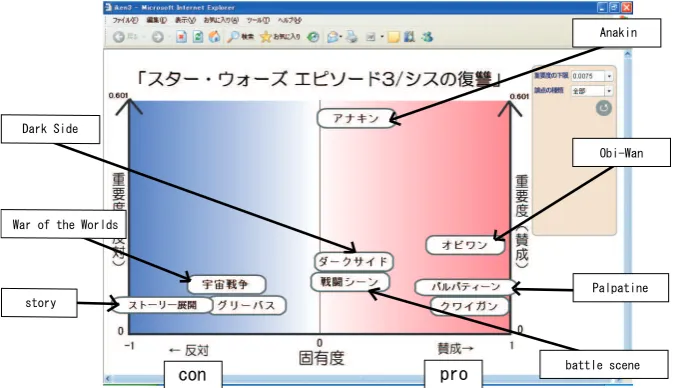
If subjective descriptions are classified into more than two categories with a single axis, we can incorporate these descriptions into our system by reclassifying them into just two categories. Fig-ure 4 is an example of summarizing reviews with a multipoint scale rating. We used reviews with five-point star rating for the movie “Star Wars: Episode III”2. We reclassified reviews with 1–3 stars as cons, and reviews with 4–5 stars as pros.
In Figure 4, the points at issue are typical words used in the movie reviews (e.g. “story”), the names of characters (e.g. “Anakin”, “Obi-Wan”, and “Palpatine”), concepts related to Star Wars (e.g. “battle scene” and “Dark Side”), and comparisons with other movies (e.g., “War of the Worlds”).
Existing methods for summarizing opin-ions (Hu and Liu, 2004; Liu et al., 2005). extract the features of a product, which corresponds to the points at issue in our system, and arrange them along a single dimension representing the impor-tance of features. The reviews corresponding to each feature are not ranked.
However, in our system, features are arranged to show how the feature relates to each polarity. The opinions addressing a feature are ranked according to their importance. We target both opinions and reviews, as shown in Figures 2 and 4, respectively.
4 Methodology
4.1 Extracting Points at Issue
In a preliminary investigation of political opin-ions on the Web, we identified that points at issue can be different language units: words, phrases,
2http://moviessearch.yahoo.co.jp/detail?ty=mv&id=321602
sentences, and combinations of sentences. We currently target nouns, noun phrases, and verb phrases, whereas existing summarization meth-ods (Hu and Liu, 2004; Liu et al., 2005) extract only nouns and noun phrases.
Because Japanese sentences lack lexical seg-mentation, we first use ChaSen3to perform a mor-phological analysis of each input sentence. As a result, we can identify the words in the input and their parts of speech.
To extract nouns and noun phrases, we use handcrafted rules that rely on the word and part-of-speech information. We extract words and word sequences that match these rules. To standard-ize among the different noun phrases that describe the same content, we paraphrase specific types of noun phrases.
To extract verb phrases, we analyze the syntac-tic dependency structure of each input sentence, by using CaboCha4. We then use handcrafted rules to extract verb phrases comprising a noun and a verb from the dependency structure.
It is desirable that the case of a noun (i.e., post-positional particles) and the modality of a verb (i.e., auxiliaries) are maintained. However, if we were to allow variations of case and modality, verb phrases related to almost the same meaning would be regarded as different points at issue and thus the output of our system would contain redundancy. Therefore, for the sake of conciseness, we cur-rently discard postpositional particles and auxil-iaries in verb phrases.
4.2 Arranging Points at Issue
In our system, the points at issue extracted as described in Section 4.1 are arranged in a two-dimensional space, as shown in Figure 2. The x-axis corresponds to the polarity of the points at is-sue, that is the degree to which a point is related to each standpoint. The y-axis corresponds to the importance of the points at issue.
For a point at issue A, which can be a noun, noun phrase, or verb phrase, the x-coordinate,xA,
is calculated by Equation (1):
xA=P(pro|A)−P(con|A) (1)
P(S|A), in whichSdenotes either the pro or con standpoint, is the probability that an opinion ran-domly selected from a set of opinions addressing
3
http://chasen.naist.jp/hiki/ChaSen/
JGCNVJKPUWTCPEG KPHQTOCVKQPFKUENQUWTG
OGFKECNEQTRQTCVKQP RTQHKV
EQP RTQ
KORTQXGOGPV
EQUOGVKEUWTIGT[ EWUVQOGTPGGFU OGFKECNVTGCVOGPV
[image:4.595.110.488.63.259.2]KPHQTOCVKQP
Figure 2: Example of visualizing points at issue for “privatization of hospitals by joint-stock companies”.
[image:4.595.88.491.299.496.2]1RKPKQPUQH2TQ 1RKPKQPQH%QP
Figure 3: Example of presenting representative opinions for “information disclosure”.
1DK9CP #PCMKP
2CNRCVKPG UVQT[
EQP RTQ DCVVNGUEGPG
&CTM5KFG
9CTQHVJG9QTNFU
[image:4.595.117.456.536.730.2]A supportsS. We calculateP(S|A)as the num-ber of opinions that are classified intoS and that includeA, divided by the number of opinions that includeA.
xAranges from−1to 1.Ais classified into one
of the following three categories depending on the value ofxA:
• ifAappears in the pros more frequently than in the cons,xAis a positive number,
• ifAappears in the pros and cons equally of-ten,xAis zero,
• ifAappears in the cons more frequently than in the pros,xAis a negative number.
The calculation of the y-coordinate of A, yA
de-pends on which of the above categories applies to A. If A appears in standpointS more frequently than in its opposite, we defineyAas the
probabil-ity that a point at issue randomly selected from the opinions classified intoSisA.
We calculate yA as the frequency of A in the
opinions classified intoS, divided by the total fre-quencies of points at issue in the opinions classi-fied intoS. Thus,yAranges from 0 to 1.
However, if A appears in the pros and cons equally often, we use the average of the values of yAfor both standpoints.
General words, which are usually high fre-quency words, tend to have high values for yA.
Therefore, we discard the words whose yA is
above a predefined threshold. We empirically set the threshold at 0.02.
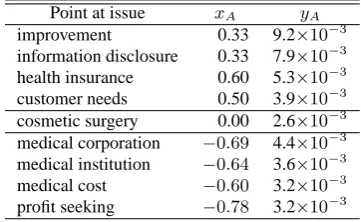
Table 1 shows example points at issue for the topic “privatization of hospitals by joint-stock companies” and their values ofxAandyA. In
Ta-ble 1, points at issue, which have been translated into English, are classified into the three categories (i.e., pro, neutral, and con) according to xA and
are sorted according toyAin descending order, for
each category.
[image:5.595.324.505.117.228.2]In Table 1, “improvement” is the most impor-tant in the pro category, and “medical corporation” is the most important in the con category. In the pro category, many people expect that the qual-ity of medical treatment will be improved if joint-stock companies make inroads into the medical in-dustry. However, in the con category, many people are concerned about the future of existing medical corporations.
Table 1: Examples of points at issue and their co-ordinates for “privatization of hospitals by joint-stock companies”.
Point at issue xA yA
improvement 0.33 9.2×10⁻³ information disclosure 0.33 7.9×10⁻³ health insurance 0.60 5.3×10⁻³ customer needs 0.50 3.9×10⁻³ cosmetic surgery 0.00 2.6×10⁻³ medical corporation −0.69 4.4×10⁻³ medical institution −0.64 3.6×10⁻³ medical cost −0.60 3.2×10⁻³ profit seeking −0.78 3.2×10⁻³
4.3 Ranking Opinions
Given a set of opinions from which a point at is-sue has been extracted, our purpose now is to rank the opinions in order of importance. We assume that representative opinions contain many content words that occur frequently in the opinion set. In our case, content words are nouns, verbs, and ad-jectives identified by morphological analysis.
We calculate the score of a content word w, s(w), as the frequency ofwin the opinion set. We calculate the importance of an opinion by the sum of s(w) for the words in the opinion. However, we normalize the importance of the opinion by the number of words in the opinion because long opin-ions usually include many words.
5 Experiments
5.1 Method
The effectiveness of our system should be evalu-ated from different perspectives. First, the effec-tiveness of each component of our system should be evaluated. Second, the effectiveness of the sys-tem as a whole should be evaluated. In this second evaluation, the evaluation measure is the extent to which the decisions of users can be made correctly and efficiently.
As a first step in our research, in this paper we perform only the first evaluation and evaluate the effectiveness of the methods described in Sec-tion 4. We used the following Japanese websites as the source of opinions, in which pros and cons are posted for specific topics.
(a) BS debate5 (b) ewoman6
5
(c) Official website of the prime minister of Japan and his cabinet7
(d) Yomiuri online8
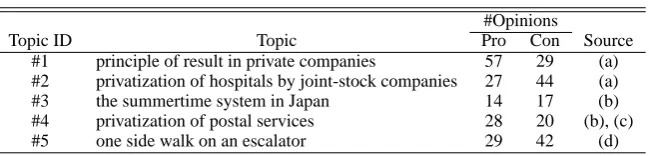
For evaluation purposes, we collected the pros and cons for five topics. Table 2 shows the five top-ics, the number of opinions, and the sources. For topic #4, we used the opinions collected from two sources to increase the number of opinions.
In Table 2, the background of topic #5 should perhaps be explained. When using escalators, it is often customary for passengers to stand on one side (either left or right) to allow other passen-gers to walk past them. However, some people insist that walking on escalators, which are mov-ing stairs, is dangerous.
Graduate students, none of who was an author of this paper, served as assessors, and produced reference data. The output of a method under eval-uation was compared with the reference data.
For each topic, two assessors were assigned to enhance the degree of objectivity of the results. Fi-nal results were obtained by averaging the results over the assessors and the topics.
5.2 Evaluation of Extracting Points at Issue
For each topic used in the experiments, the asses-sors read the opinions from both standpoints and extracted the points at issue. We defined the point at issue as the grounds for an argument. We did not restrict the form of the points at issue. Thus, the assessors were allowed to extract any continuous language units, such as words, phrases, sentences, and paragraphs, as points at issue.
Because our method is intended to extract points at issue exhaustively and accurately, we used recall and precision as evaluation measures for the extraction.
Recall is the ratio of the number of correct an-swers extracted automatically to the total number of correct answers. Precision is the ratio of the number of correct answers extracted automatically to the total number of points at issue extracted au-tomatically.
Table 3 shows the results for each topic, in which “System” denotes the number of points at issue extracted automatically. In Table 3, “C”, “R”, and “P” denote the number of correct an-swers, recall, and precision, respectively, on an assessor-by-assessor basis.
7
http://www.kantei.go.jp/
8http://www.yomiuri.co.jp/komachi/forum/
Looking at Table 3, we see that the results can vary depending on the topic and the assessor. However, recall and precision were approximately 50% and 4%, respectively, on average.
The ratio of agreement between assessors was low. When we used the points at issue extracted by one assessor as correct answers and evaluated the effectiveness of the other assessor in the ex-traction, the recall and precision ranged from 10% to 20% depending on the topic. To increase the ra-tio of agreement between assessors, the instrucra-tion for assessors needs to be revised for future work.
This was mainly because the viewpoint for a tar-get topic and the language units to be extracted were different, depending on the assessor. Be-cause our automatic method extracted points at is-sue exhaustively, the recall was high and the pre-cision was low, irrespective of the assessor.
The ratios of noun phrases (including nouns) and verb phrases to the number of manually ex-tracted points at issue were 78.5% and 2.0%, re-spectively. Although the ratio for verb phrases is relatively low, extracting both noun and verb phrases is meaningful.
The recalls of our method for noun phrases and verb phrases were 60.0% and 44.3%, respectively. Errors were mainly due to noun phrases that were not modeled in our method, such as noun phrases that include a relative clause.
5.3 Evaluation of Arranging Points at Issue
As explained in Section 4.2, in our system the points at issue are arranged in a two-dimensional space. The x and y axes correspond to the polarity and the importance of points at issue, respectively. Because it is difficult for the assessors to judge the correctness of coordinate values in the two-dimensional space, we evaluated the effectiveness of arranging points at issue indirectly.
First, we evaluated the effectiveness of the cal-culation for the y-axis. We sorted the points at is-sue, which were extracted automatically (see Sec-tion 5.2), according to their importance. We eval-uated the trade-off between recall and precision by varying the threshold ofyA. We discarded the
points at issue whoseyAis below the threshold.
Note that while this threshold was used to de-termine the lower bound of yA, the threshold
ex-plained in Section 4.2 (i.e., 0.02) was used to de-termine the upper bound ofyAand was used
Table 2: Topics used for experiments.
#Opinions
Topic ID Topic Pro Con Source
#1 principle of result in private companies 57 29 (a) #2 privatization of hospitals by joint-stock companies 27 44 (a)
#3 the summertime system in Japan 14 17 (b)
#4 privatization of postal services 28 20 (b), (c)
#5 one side walk on an escalator 29 42 (d)
Table 3: Recall and precision of extracting points at issue (C: # of correct answers, R: recall (%), P: precision (%)).
Assessor A Assessor B
Topic ID System C R P C R P
#1 1968 194 58.2 5.7 101 44.6 2.3 #2 1864 66 50.0 1.8 194 60.8 6.3
#3 508 43 48.8 4.1 43 60.5 5.1
#4 949 77 64.9 5.3 96 36.5 3.7
#5 711 91 30.0 3.8 75 18.7 2.0
Table 4 shows the results, in which the precision was improved to 50% by increasing the threshold. In Figure 2, users can change the threshold of im-portance by using the panel on the right side to control the number of points at issue presented in the interface. As a result, users can choose appro-priate points at issue precisely.
Second, we evaluated the effectiveness of the calculation for the x-axis. We evaluated the effec-tiveness of our method in a binary classification. For each point at issue extracted by an assessor, the assessor judged which of the two standpoints the point supports.
If a point at issue whose x-coordinate calculated by our method is positive (or negative), it was clas-sified as pro (or con) automatically. We did not use the points at issue whose x-coordinate was zero for evaluation purposes.
Table 5 shows the results. While the number of target points at issue was different depending on the topic and the assessor, the difference in classi-fication accuracy was marginal.
For each topic, we averaged the accuracy deter-mined by each assessor and averaged the accura-cies over the topic, which gave 95.6%. Overall, our method performs the binary classification for points at issue with a high accuracy.
Errors were mainly due to opinions that in-cluded arguments for both standpoints. For exam-ple, a person supporting a standpoint might sug-gest that he/she would support the other side un-der a specific condition. Points at issue classified incorrectly had usually been extracted from such
contradictory opinions.
5.4 Evaluation of Ranking Opinions
To evaluate the effectiveness of our method in ranking opinions on a point-by-point basis, we used a method that sorts the opinions randomly as a control. We compared the accuracy of our method and that of the control. The accuracy is the ratio of the number of correct answers to the number of opinions presented by the method un-der evaluation.
For each point at issue extracted by an assessor, the assessor assigned the opinions to one of the following degrees:
• A: the opinion argues about the point at issue and is represented,
• B: the opinion argues about the point at issue but is not represented,
• C: the opinion includes the point at issue but does not argue about it.
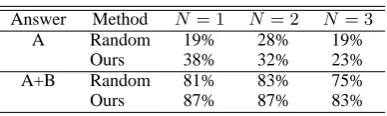
We varied the number of top opinions presented by changing the threshold for the rank of opinions. Table 6 shows the results, in whichN denotes the number of top opinions presented. The column “Answer” refers to two cases: the case in which only the opinions assigned to “A” were regarded as correct answers, and the case in which the opin-ions assigned to “A” or “B” were regarded as cor-rect answers. In either case, our method outper-formed the control in ranking accuracy.
Table 4: Trade-off between recall and precision in extracting points at issue.
Threshold 0 0.002 0.004 0.006 0.008 0.010 Recall 0.48 0.17 0.11 0.04 0.03 0.02 Precision 0.04 0.14 0.21 0.31 0.33 0.50
Table 5: Accuracy for classifying points at issue.
Assessor A Assessor B Topic ID #Points Accuracy (%) #Points Accuracy (%)
#1 113 98.2 45 97.7
#2 33 91.0 118 94.1
#3 21 95.2 26 100
#4 50 92.0 35 91.4
#5 27 96.3 14 100
Table 6: Accuracy of ranking opinions.
Answer Method N = 1 N= 2 N= 3
A Random 19% 28% 19%
Ours 38% 32% 23%
A+B Random 81% 83% 75%
Ours 87% 87% 83%
opinions was high. This suggests that our method is effective in distinguishing opinions that argue about a specific point and opinions that include the point but do not argue about it.
6 Conclusion
In aiming to support users’ decision making, we have proposed a method for summarizing and vi-sualizing the pro and con arguments about a topic. Our prototype system, called “OpinionReader”, extracts points at issue from the opinions for both pro and con standpoints, arranges the points in a two-dimensional space, and allows users to read important opinions on a point-by-point basis. We have experimentally evaluated the effectiveness of the components of our system.
Future work will include evaluating our system as a whole, and summarizing opinions that change over time.
References
Philip Beineke, Trevor Hastie, and Shivakumar Vaithyanathan. 2004. The sentimental factor: Im-proving review classification via human-provided information. In Proceedings of the 42nd Annual
Meeting of the Association for Computational Lin-guistics, pages 264–271.
Kushal Dave, Steve Lawrence, and David M. Pennock. 2003. Mining the peanut gallery: Opinion extraction
and semantic classification of product reviews. In
Proceedings of the 12th International World Wide Web Conference.
Minqing Hu and Bing Liu. 2004. Mining and summa-rizing customer reviews. In Proceedings of the Tenth
ACM SIGKDD International Conference on Knowl-edge Discovery and Data Mining, pages 168–177.
Soo-Min Kim and Eduard Hovy. 2004. Determin-ing the sentiment of opinions. In ProceedDetermin-ings of
the 20th International Conference on Computational Linguistics, pages 1367–1373.
Lun-Wei Ku, Li-Ying Lee, Tung-Ho Wu, and Hsin-Hsi Chen. 2005. Major topic detection and its appli-cation to opinion summarization. In Proceedings of
the 28th Annual International ACM SIGIR Confer-ence on Research and Development in Information Retrieval, pages 627–628.
Bing Liu, Minqing Hu, and Junsheng Cheng. 2005. Opinion observer: Analyzing and comparing opin-ions on the Web. In Proceedings of the 14th
Interna-tional World Wide Web Conference, pages 324–351.
Tomoyuki Nanno, Toshiaki Fujiki, Yasuhiro Suzuki, and Manabu Okumura. 2004. Automatically col-lecting, monitoring, and mining Japanese weblogs. In The 13th International World Wide Web
Confer-ence, pages 320–321. (poster session).
Bo Pang and Lillian Lee. 2004. A sentimental edu-cation: Sentiment analysis using subjectivity sum-marization based on minimum cuts. In Proceedings
of the 42nd Annual Meeting of the Association for Computational Linguistics, pages 264–271.
Bo Pang and Lillian Lee. 2005. Seeing stars: Exploit-ing class relationships for sentiment categorization with respect to rating scales. In Proceedings of the
43rd Annual Meeting of the Association for Compu-tational Linguistics, pages 115–124.
Ellen Riloff and Janyce Wiebe. 2003. Learning extrac-tion patterns for subjective expressions. In
[image:8.595.84.278.288.346.2]