
International Journal of Advanced Research in Computer Science
RESEARCH PAPER
Available Online at www.ijarcs.info
Low Power Mac Protocol in Wban for E-Heath Application
G. Karthik Reddy Assistant professor,
Dept. of Electronics and communication engineering, MLRIT Institutions, Hyderabad, India
Mohammad Abdul Rawoof Assistant professor,
Dept. of Electronics and communication engineering, MLRIT Institutions, Hyderabad, India
Abstract —The work described in this paper describes about the design of a low power (medium access control) MAC protocol for in-body
implant network. It addresses a unique set of requirements for the implant network unlike generic (body area networks) BAN protocols. By choosing a Fitness monitoring application a patient, it has been demonstrated how to exploit disparities inherent in a typical implanted BAN to enable low power operation. A new MAC scheme is being presented here for low power operation by handling the nodes in accordance to power and latency requirements. It also presents a new scheme analytically for deriving the power-optimised (time division multiple access) TDMA frame parameter like beacon interval and life time of a device. Duty-cycle efficiency and the packet error rate are calculated for the in-body wireless channel. Simulation results show that the proposed MAC protocol outperforms best of reported MACs and for low data rate sensors in terms of power consumption.
Keywords— BAN, biomedical implants, duty cycle, MAC layer, power optimization
I. INTRODUCTION
In this era, People put more attention in prevention and early risk detection. As an effort of catching this trend, body area network (BAN) as an emerging technology for providing this kind of health information, has been attracting more attentions recently [1]. A body area network (BAN) is a network of sensor nodes which are either inside body or implanted inside the body. These sensor nodes are the heart of medical devices. These wireless sensor nodes communicates to the outsiders. These devices provide continuous health monitoring and real time feedback to the user or medical personnel [9]. The increase in average life span and healthcare costs have ushered in a wave of innovation of healthcare [2]. These factors along with the advances in miniaturization of electronic devices, sensing, battery and wireless communication technologies have led to the development of wireless body area networks (WBANs). WBANs consist of miniaturized computing devices that are able to gather process and wirelessly transmit sensed data.
The data inside sensor needs to be exchanged either between peer sensors or a central controller. RF technology is generally used for this data exchange.
In early 2002, Federal communications commission (FCC) permitted the use for set of frequencies to be used exclusively by medical implants, under indoor conditions These frequencies form the Medical implant service band (MICS) and are in the range of 402-405MHz [3]. FCC has not specified the access mechanism, protocols etc. for these frequencies [11]. IEEE has launched the IEEE 802.15 Task Group 6 (BAN) in Nov. 2007 to develop a communication standard optimized for low power devices, operating on, in or around the human body to serve a variety of applications including medical and consumer electronics [5][12]. Apart from IEEE TG6, lot of work has been done in developing
efficient MAC protocols by the wireless sensors community and the body area network community.
While the WSN community has developed very energy efficient protocols, the nature of WSN applications, which are typically distributed, de-centralized, co-operative and event detection based, is very different from the typical nature of BAN networks [7]. BAN networks are inherently centralized and have periodic data traffic nature. Furthermore they have peculiar characteristics which make them different from WSNs.
This paper considers different set of varying requirements, priorities, data rates etc. and presents the design of one such protocol which addresses these varied needs. MAC has been designed for an implanted cochlear network for distributed cochlear implant application, one of the most important medical implant applications. In Fitness monitoring of a patient application, a star topology; uplink traffic and asymmetry between master and slave are considered
This paper is organized as follows; in section II Fitness monitoring and its system model are presented. In section III, design of MAC implanted fitness monitoring implant and in section IV ultra low power MAC are compared with other model system.
II. FITNESS MONITORING
The proposed system fitness monitoring consists of five different physiological sensors, subcutaneously implanted inside the human body. These sensors are the physiological inputs to the monitoring device which functions as the master node to these sensors. The fitness monitoring is generally monitored as vital sensors can include several of the ones mentioned below.
Electrocardiography (ECG): It is used to measure the rate and regularity of heartbeats, as well as size and position of the heart chambers. If any damage and effect of any drug drugs to the cardiac system the sensor system regulate them in perfect manner.
Pulse rate (PULSE): It is a personal monitoring device which allows one to measure heart rate in real time or record the heart rate
Blood pressure (B.P): It is the pressure exerted by circulating blood upon the walls of blood vessels, and is one of the principal vital signs
Respiration rate sensor (R.R): It measures the change in pressure that occurs in the chest as the cavity expands and contracts during breathing
Body temperature sensor(Temp): It measures the change of temperature that occurs in human body
A. System Model of Fitness Monitoring
A typical implanted medical device like fitness monitoring contains 5 different types of sensors which monitor various physiological parameters of a patient. The Fitness monitoring BAN uses five sensors implanted inside the human body. These sensors are controlled by the monitoring device functions as the master node. These nodes placed few centimeters away from the nodes. Transmission of data takes place using TDMA. Since each sensors has been allotted specific priority and thus it avoids collision of the data being send by each sensor.
The disadvantage of TDMA is that
i) It requires synchronization after each frame of data so as to keep the sensor node synchronized according to its time slots.
ii) Each node has to send its data within the specified frame slot thus latency of the frame slot is determined by the frame period.
The most important parameter while designing a TDMA based MAC is duty cycling. Duty Cycling is the interval between two transmission slots of node. It also controls the latency and also has a direct effect on power consumption. The basic goal of designing the MAC protocol is power consumption. In order to reduce the power the sleep time of the radio should be reduced. Thus the radio can transmit the data rapidly during the allotted time slot and move to sleep state again.
The problem encountered in the process is that longer the node sleeps, more data is accumulated in the buffer, thus the node has to active for a longer time to send the buffered data to master(fitness monitoring) resulting in greater power consumption. Hence duty cycling of the nodes is necessary to reduce the power consumption.
Having designed the protocol and packet structure, we simulated the network in the network simulation software OMNET++, a popular modular, free, open-source, C++ based, discrete event simulator [10].To gain realistic results, we took the receiver sensitivity to be -90dBm is assumed, the same as that of Chipcon biomedical radio [8]. Initially the network is designed in the .ned file, in the .ned file it discusses about topology, connections and gates between nodes and coordinator. Functionality of .ned file is explained in the .cc file and simulation parameters are mentioned in .ini file, then results are simulated in tkenv file and data transfer between nodes and coordinator are presented in sequence chart of event-log.
III. DESIGN OF MAC
Some of the common objectives in WBAN is to achieve maximum throughput, minimum delay, and to maximize the network lifetime by controlling the main sources of energy waste, i.e., collision, idle listening, overhearing, and control packet overhead. Collision occurs when more than one packet transmits data at the same time. The collided packets have to be retransmitted, which consumes extra energy. The second source of energy waste is idle listening, meaning that a node listens to an idle channel to receive data. The third source is overhearing, i.e., to receive packets that are destined to other nodes. The last source is control packet overhead, meaning that control information are added to the payload. A minimal number of control packets should be used for data transmission.
Medium Access Control (MAC) protocols play an important role in solving aforementioned problems. Generally they are grouped into based and schedule-based MAC protocols. In based MAC protocols such as Carrier Sense Multiple Access/Collision Avoidance (CSMA/CA) protocols, nodes contend the channel to transmit data [4]. If the channel is busy, node defers its transmission until it becomes idle. These protocols are scalable with no strict time synchronization constraint. However, they incur significant protocol overhead. In schedule-based protocols such as Time Division Multiple Access(TDMA) protocols, a channel is divided into time slots of fixed or variable duration. These slots are assigned to nodes and eachnode transmits during its slot period.[6] These protocols are energy conserving protocols. Since the dutycycle of radio is reduced, there is no contention, idle listening and overhearing problems. But these protocols require frequent synchronization.
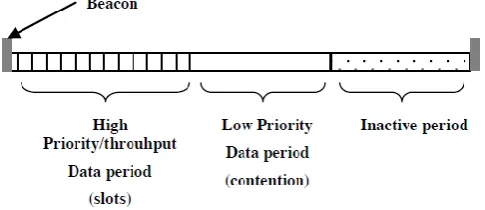
TDMA frame has beacon for synchronizing, slots for high priority and high throughput transmission and a contention period for low priority transmission. Additionally it has an optional inactive part where both master and slave can sleep. Such a frame structure thus combines the best of both CSMA and TDMA schemes. Notice that the contention period is not slotted and nodes which intend to transmit during this period should still have some notion time keeping, so as deducing the starting and the end of contention period.
Fig. 1 Frame structure description
Unlike WSN, BAN sensor events are periodic. Therefore the longer the nodes sleep, more data-samples it has in the buffer. BAN has to be active for proportionately longer time to send the buffered data to master. Hence duty cycling the node reduces power consumption is the only finite advantage. This implies that power consumption is considered to be most crucial parameter of optimisation; there would be a point beyond where sleep state leads to no advantage in power but leads to increase in latency. The above statement is determined analytically and then presented result for each sensor node for fitness monitoring application.
A. Duty cycle interval determination
Let us consider a duty-cycled system having a current consumption of Ion and Isl for on and sleep times respectively. We define tsl, tsu and ttrx as the radio sleep, start-up and transmission times respectively. Then, the average current drawn over the duty cycling period would be:
I
avg = [(t
su+t
trx)*I
on+I
sl*t
sl] / (t
su+t
trx+t
sl) (1)milliseconds [8]. However transmission time, however, depends not only on the rate at which the sensor is sampling the signal, but also on the rate at which data can be sent over the physical layer. We define ‗R‘ to be the sampling data rate (in bits-per-second, bps) and ‗DR‘ to be the data-rate over physical layer. So, the data to be sent after sleep state and the time to send it is given by
Data to send = (
t
su+t
sl)* R bits, R is the data sampling rate;Time to send the data =
t
trx (t
su+t
sl)*(R/DR) (2)For high-rate sensors (high ‗R‘), the time taken to send the data increases as sleep time (tsl) increases. Hence duty cycle efficiency of the sensor node is related to the sampling rate of the inherent sensor. That is, if a very high-rate sensor samples data at a rate comparable to transmission rate, the inherent gains of sleeping for long offset more time is needed to transmit data.
t
su, R, DR,I
on,I
sl are either hardware-defined or sensor-dependent. The values oft
su, R, DR,
I
on,I
sl were taken from the data sheets of the TI-Chicpon CC2430, a popular low power radio [8].Table 1 presents the results for easier comprehension. For high-rate sensors, sleep state beyond 5 or 10 seconds does not lead to any significant reduction in consumption. On the other hand, for low-rate sensors (MV and Temp), the minimum energy is achieved around 100s. Hence, each sensor has a different energy minimum point.
Table 1
Decrease in average current as duty cycle increases for all sensors
Parameters Duty cycle interval
Sensors 0.5s 1s 5s 10s 100s
ECG (μA) 555.19 520.12 484 480 476.2 Pulse (μA) 388.25 359.48 324.59 323.2 321.95 B.P (μA) 171.4 133.74 114.04 99.59 98.36
R.R(μA) 66.82 47.6 38.45 29.825 29.30 Temp (μA) 80 40 8.99 4.99 1.4
The scheduling has been done on priority bases with ECG and Pulse having the highest priority and Temperature (Temp.). sensor having the least. ECG and PULSE sensor will transmit after every 5secs, while B.P and R.R sensor at every 10s and TEMP at every 100s. The beacon interval has been allotted to each sensor as shown below.
Table 2
Sensors table for fitness monitoring
sensors Data rate BI Data stored
in BI
Data stored
in 100s
ECG 6 Kbps 5s 30Kb 360Kb
PULSE 4Kbps 5s 20Kb 160Kb
B.P 1.2Kbps 10s 12Kb 60Kb
R.R 0.24Kbps 10s 2.4Kb 2.4Kb
TEMP 0.002Kbps 100s 0.2Kb 0.2Kb
Total data 586.2Kb
B. Slot size determination
conservative values of PER, overhead and retransmission to arrive at the worst-case scenario to choose the slot interval to be 15ms, Since 15ms was close to the least common multiple of all these sensors.
Table 3
Slot size determination by considering various factors
BI Total
C. Calculations for design of a MAC protocol
Total data after 100s = 582.6 Kb
Transmission Rate of radio = 250 Kbps
Total time for transmission(Radio ON) = 2.33s Sleep time of radio = 100 – 2.33 = 97.47s
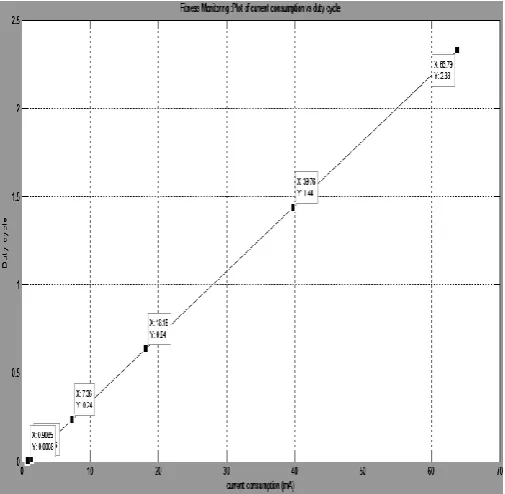
PER=3.1% for Rx sensitivity of -90 dBm Duty cycle = 2.33% parameter like operating sampling rate, RF communication data rate. The complete average communication power Pav and current consumption it shows that current consumption reduces as the duty cycle decreases in this MAC protocol design.
Fig. 2. Duty cycle vs Current Consumption
The indicated vertex in the graph depicts that total current consumption and duty cycle of Fitness monitoring BAN.
IV. PERFORMANCE RESULTS
The work is now compared with the low power TDMA based BAN protocol is simulated by Marinkovic [1]. It is noted that power analysis depends on the underlying hardware, hence radios which are more power-efficient and have faster data rates (hence less ‗on‘ time) tend to give better power consumptions. The radio used [1] have much lower data rate (50kbps respectively) compared to our solution (250kbps). The work now compared with Marinkovic model as mentioned in tabular form below.
Table 4
The table 4 shows the comparison of different parameters with Marinkovic model and duty cycle of Marinkovic model using ADF7020 radio and duty cycle of Marinkovic model using Chipcon CC2430.
Figure 3 shows the duty cycle analysis as the data rate changes over physical layer (use faster radios). As the protocol move towards faster and better radio more gain is acquired (the difference between the two curves increases as radio data-rates get higher). These results have more impact because of the fact that most commercial low-power radios have higher data rates (>200kbps)
Fig. 3. Gain Comparison of our scheme with [1] for different radios: higher gains as radios get faster
V. CONCLUSION
The design of a new MAC layer for Body Area Networks is presented, and the methodology for a specific application: Fitness monitoring has been illustrated. The BAN networks have simulated in the network simulation software OMNET++. Chipcon CC2430 Radio have used for data transmission in all the BAN‘s. The total current consumption of the network have found in various applications. All the BAN applications have compared in MATLAB. Comparing MAC protocol with Marinkovic model (For 1.25 kbps sensor) .This MAC protocol design addresses varying requirements by adopting a TDMA-based approach in which nodes are optimally duty cycled.
REFERENCES
[1] Marinkovic S.J, Popovici E.M, Spagnol C, Faul S and Marnane W.P ,―Energy-Efficient Low duty cycle MAC Protocol for Wireless Body Area Networks‖ IEEE Journal Transactions on
Information Technology in Biomedicine,vol.13, no.6, pp.915-925,
November 2009.
[2] Mark A. Hanson, Harry C. Powell Jr., Adam T. Barth, Kyle Ringgenberg, Benton H.Calhoun, James H.Aylor, and John Lach, University of Virginia on ―Body Area Sensor Networks:
Challenges and Oppprtunities‖ Published by the IEEE
Computer Society, 2009 IEEE Magazine.
[3] Saeed Rashwand, Jelena Misic, and Hamzeh Khazaei, ―IEEE 802.15.6 under Saturation: Some Problems to Be Expected‖ IEEE Journal of communications and networks, vol. 13, no. 2, April 2011
[4] Christos Tachtatzis, Fabio Di Franco, David C. Tracey, Nick F. Timmons and Jim Morrison, ―An Energy Analysis of IEEE 802.15.6 Scheduled Access Modes‖ IEEE Globecom workshops
(GC wkshps) Conference on Communication, Networking and
Broadcasting,pp.1270-1275, 2010.
[5] Benoit Latre, Bart Braem, Ingrid Moerman, Chris Blondia, Piet Demeester on ―A Survey on Wireless Body Area Networks‖
Springer Journal on Wireless Networks,vol.17, pp.1-18,
November 2010.
[6] Sana Ullah , Bin Shen, S.M. Riazul Islam, Pervez Khan, Shahnaz Saleem and Kyung Sup Kwak on ‖A Study of MAC Protocols for WBANs‖, Sensors 2010, 10, pp.128-145,December 2009 [7] Ameen M.A, Ullah N and Kyungsup Kwak , ―Design and
Analysis of a MAC Protocol for Wireless Body Area Network using Wakeup Radio‖ The 11thIEEE International Symposium on
Communications and Information Technologies (ISCIT 2011),
pp.148-153, 2011
[8] Texas instruments, Chipcon CC2430 data sheet
[9] Yang, G. 2005. Body Sensor Networks. Springer Science. [10] [Online] www.omnetpp.org
![Fig. 3. Gain Comparison of our scheme with [1] for different radios: higher gains as radios get faster](https://thumb-us.123doks.com/thumbv2/123dok_us/695301.1077175/5.595.38.282.233.552/gain-comparison-scheme-different-radios-higher-radios-faster.webp)