How Difficult is it to Develop a Perfect Spell-checker?
A Cross-linguistic Analysis through Complex Network Approach
Monojit Choudhury1, Markose Thomas2, Animesh Mukherjee1,
Anupam Basu1, and Niloy Ganguly1
1Department of Computer Science and Engineering, IIT Kharagpur, India
{monojit,animeshm,anupam,niloy}@cse.iitkgp.ernet.in 2Google Inc. Bangalore, India
Abstract
The difficulties involved in spelling er-ror detection and correction in a lan-guage have been investigated in this work through the conceptualization of SpellNet – the weighted network of words, where edges indicate orthographic proximity be-tween two words. We construct SpellNets for three languages - Bengali, English and Hindi. Through appropriate mathemati-cal analysis and/or intuitive justification, we interpret the different topological met-rics of SpellNet from the perspective of the issues related to spell-checking. We make many interesting observations, the most significant among them being that the probability of making a real word error in a language is propotionate to the aver-age weighted degree of SpellNet, which is found to be highest for Hindi, followed by Bengali and English.
1 Introduction
Spell-checking is a well researched area in NLP,
which deals with detection and automatic correc-tion of spelling errors in an electronic text docu-ment. Several approaches to spell-checking have been described in the literature that use statistical, rule-based, dictionary-based or hybrid techniques (see (Kukich, 1992) for a dated but substantial
sur-vey). Spelling errors are broadly classified as
non-word errors(NWE) andreal word errors(RWE). If
the misspelt string is a valid word in the language, then it is called an RWE, else it is an NWE. For ex-ample, in English, the word “fun” might be misspelt
as “gun” or “vun”; while the former is an RWE, the latter is a case of NWE. It is easy to detect an NWE, but correction process is non-trivial. RWE, on the other hand are extremely difficult to detect as it re-quires syntactic and semantic analysis of the text, though the difficulty of correction is comparable to that of NWE (see (Hirst and Budanitsky, 2005) and references therein).
Given a lexicon of a particular language, how hard is it to develop a perfect spell-checker for that language? Since context-insensitive spell-checkers cannot detect RWE and neither they can effectively correct NWE, the difficulty in building a perfect spell-checker, therefore, is reflected by quantities such as the probability of a misspelling being RWE, probability of more than one word being orthograph-ically closer to an NWE, and so on. In this work, we make an attempt to understand and formalize some of these issues related to the challenges of spell-checking through a complex network approach
(see (Albert and Barab´asi, 2002; Newman, 2003)
for a review of the field). This in turn allows us to provide language-specific quantitative bounds on the performance level of spell-checkers.
In order to formally represent the orthographic structure (spelling conventions) of a language, we conceptualize the lexicon as a weighted network, where the nodes represent the words and the weights of the edges indicate the orthoraphic similarity be-tween the pair of nodes (read words) they connect.
We shall call this network theSpelling Network or
SpellNetfor short. We build the SpellNets for three languages – Bengali, English and Hindi, and carry out standard topological analysis of the networks following complex network theory. Through appro-priate mathematical analysis and/or intuitive
fication, we interpret the different topological met-rics of SpellNet from the perspective of difficulties related to spell-checking. Finally, we make sev-eral cross-linguistic observations, both invariances and variances, revealing quite a few interesting facts. For example, we see that among the three languages studied, the probability of RWE is highest in Hindi followed by Bengali and English. A similar obser-vation has been previously reported in (Bhatt et al., 2005) for RWEs in Bengali and English.
Apart from providing insight into spell-checking, the complex structure of SpellNet also reveals the self-organization and evolutionary dynamics under-lying the orthographic properties of natural lan-guages. In recent times, complex networks have been successfully employed to model and explain the structure and organization of several natural and social phenomena, such as the foodweb, pro-tien interaction, formation of language invento-ries (Choudhury et al., 2006), syntactic structure of
languages (i Cancho and Sol´e, 2004), WWW, social
collaboration, scientific citations and many more
(see (Albert and Barab´asi, 2002; Newman, 2003)
and references therein). This work is inspired by the aforementioned models, and more specifically
a couple of similar works on phonological
neigh-bors’ network of words (Kapatsinski, 2006;
Vite-vitch, 2005), which try to explain the human per-ceptual and cognitive processes in terms of the orga-nization of the mental lexicon.
The rest of the paper is organized as follows. Sec-tion 2 defines the structure and construcSec-tion pro-cedure of SpellNet. Section 3 and 4 describes the degree and clustering related properties of Spell-Net and their significance in the context of spell-checking, respectively. Section 5 summarizes the findings and discusses possible directions for future work. The derivation of the probability of RWE in a language is presented in Appendix A.
2 SpellNet: Definition and Construction
In order to study and formalize the orthographic characteristics of a language, we model the lexicon
Λ of the language as an undirected and fully
con-nected weighted graphG(V, E). Each wordw ∈Λ
is represented by a vertex vw ∈ V, and for every
[image:2.612.319.536.53.177.2]pair of vertices vw and vw0 inV, there is an edge
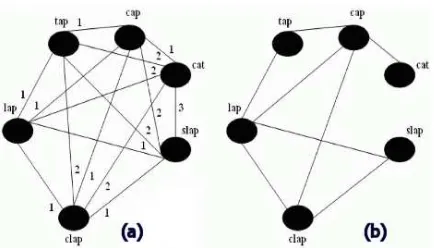
Figure 1: The structure of SpellNet: (a) the weighted SpellNet for 6 English words, (b) Thresholded
coun-terpart of (a), forθ= 1
(vw, vw0)∈E. Theweightof the edge(vw, vw0), is
equal toed(w, w0) – the orthographic edit distance
between w and w0 (considering substitution,
dele-tion and inserdele-tion to have a cost of 1). Each node
vw ∈ V is also assigned a node weight WV(vw)
equal to the unigram occurrence frequency of the
wordw. We shall refer to the graphG(V, E)as the
SpellNet. Figure 1(a) shows a hypothetical SpellNet for 6 common English words.
We define unweighted versions of the graph
G(V, E) through the concept of thresholding as
described below. For a threshold θ, the graph
Gθ(V, Eθ)is an unweighted sub-graph ofG(V, E),
where an edge(vw, vw0)∈Eis assigned a weight 1
inEθif and only if the weight of the edge is less than
or equal toθ, else it is assigned a weight 0. In other
words,Eθ consists of only those edges inE whose
edge weight is less than or equal toθ. Note that all
the edges inEθ are unweighted. Figure 1(b) shows
the thresholded SpellNet shown in 1(a) forθ= 1.
2.1 Construction of SpellNets
The lexica for the three languages have
been taken from public sources. For
En-glish it has been obtained from the website
www.audiencedialogue.org/susteng.html; for Hindi
and Bengali, the word lists as well as the unigram frequencies have been estimated from the mono-lingual corpora published by Central Institute of Indian Languages. We chose to work with the most frequent 10000 words, as the medium size of the two Indian language corpora (around 3M words each) does not provide sufficient data for estimation of the unigram frequencies of a large number of words (say 50000). Therefore, all the results described in this work pertain to the SpellNets corresponding to the most frequent 10000 words. However, we believe that the trends observed do not reverse as we increase the size of the networks.
In this paper, we focus on the networks at three
different thresholds, that is forθ= 1,3,5, and study
the properties of Gθ for the three languages. We
do not go for higher thresholds as the networks
be-come completely connected at θ = 5. Table 1
re-ports the values of different topological metrics of the SpellNets for the three languages at three thresh-olds. In the following two sections, we describe in detail some of the topological properties of Spell-Net, their implications to spell-checking, and obser-vations in the three languages.
3 Degree Distribution
Thedegreeof a vertex in a network is the number of
edges incident on that vertex. LetPk be the
prob-ability that a randomly chosen vertex has degreek
or more thank. A plot ofPkfor any given network
can be formed by making a histogram of the degrees
of the vertices, and this plot is known as the
cumu-lative degree distributionof the network (Newman,
2003). The (cumulative) degree distribution of a net-work provides important insights into the topologi-cal properties of the network.
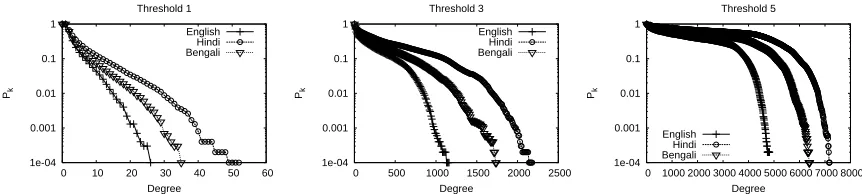
Figure 2 shows the plots for the cumulative
de-gree distribution for θ = 1,3,5, plotted on a
log-linear scale. The log-linear nature of the curves in the semi-logarithmic scale indicates that the distribution is exponential in nature. The exponential behaviour
is clearly visible forθ= 1, however at higher
thresh-olds, there are very few nodes in the network with
low degrees, and therefore only the tail of the curve shows a pure exponential behavior. We also observe
that the steepness (i.e. slope) of thelog(Pk)with
re-spect tokincreases withθ. It is interesting to note
that although most of the naturally and socially oc-curring networks exhibit a power-law degree
distri-bution (see (Albert and Barab´asi, 2002; Newman,
2003; i Cancho and Sol´e, 2004; Choudhury et al.,
2006) and references therein), SpellNets feature ex-ponential degree distribution. Nevertheless, similar results have also been reported for the phonological neighbors’ network (Kapatsinski, 2006).
3.1 Average Degree
Let the degree of the nodevbe denoted byk(v). We
define the quantities – the average degreehkiand the
weighted average degreehkwtifor a given network
as follows (we drop the subscript w for clarity of
notation).
hki= 1
N X
v∈V
k(v) (1)
hkwti= P
v∈V k(v)WV(v) P
v∈V WV(v) (2)
whereN is the number of nodes in the network.
Implication: The average weighted degree of SpellNet can be interpreted as the probability of RWE in a language. This correlation can be derived
as follows. Given a lexiconΛof a language, it can
be shown that the probability of RWE in a language,
denoted byprwe(Λ)is given by the following
equa-tion (see Appendix A for the derivaequa-tion)
prwe(Λ) = X
w∈Λ X
w0∈Λ
w6=w0
ρed(w,w0)p(w) (3)
Letneighbor(w, d)be the number of words inΛ
whose edit distance fromwisd. Eqn 3 can be
rewrit-ten in terms ofneighbor(w, d)as follows.
prwe(Λ) = X
w∈Λ
∞
X
d=1
ρdneighbor(w, d)p(w) (4)
Practically, we can always assume thatdis bounded
English Hindi Bengali
θ= 1 θ= 3 θ= 5 θ= 1 θ= 3 θ= 5 θ= 1 θ= 3 θ= 5
M 8.97k 0.70M 8.46M 17.6k 1.73M 17.1M 11.9k 1.11M 13.2M
hki 2.79 140.25 1692.65 4.52 347.93 3440.06 3.38 223.72 2640.11 hkwti 6.81 408.03 1812.56 13.45 751.24 4629.36 7.73 447.16 3645.37
rdd 0.696 0.480 0.289 0.696 0.364 0.129 0.702 0.389 0.155
hCCi 0.101 0.340 0.563 0.172 0.400 0.697 0.131 0.381 0.645
hCCwti 0.221 0.412 0.680 0.341 0.436 0.760 0.229 0.418 0.681
hli 7.07 3.50 N.E 7.47 2.74 N.E 8.19 2.95 N.E
[image:4.612.143.470.52.200.2]D 24 14 N.E 26 12 N.E 29 12 N.E
Table 1: Various topological metrics and their associated values for the SpellNets of the three languages
at thresholds 1, 3 and 5. Metrics: M – number of edges;hki– average degree;hkwti– average weighted
degree; hCCi – average clustering coefficient; hCCwti - average weighted clustering coefficient; rdd –
Pearson correlation coefficient between degrees of neighbors; hli – average shortest path; D – diameter.
N.E – Not Estimated. See the text for further details on definition, computation and significance of the metrics.
1e-04 0.001 0.01 0.1 1
0 10 20 30 40 50 60
Pk
Degree Threshold 1
English Hindi Bengali
1e-04 0.001 0.01 0.1 1
0 500 1000 1500 2000 2500
Pk
Degree Threshold 3
English Hindi Bengali
1e-04 0.001 0.01 0.1 1
0 1000 2000 3000 4000 5000 6000 7000 8000
Pk
Degree Threshold 5
English Hindi Bengali
Figure 2: Cumulative degree distribution of SpellNets at different thresholds presented in semi-logarithmic scale.
slowly growing function of the word length (Kukich,
1992)). Let us denote this bound byθ. Therefore,
prwe(Λ)≈ X
w∈Λ θ X
d=1
ρdneighbor(w, d)p(w) (5)
Sinceρ < 1, we can substituteρdbyρ to get an
upper bound onprwe(Λ), which gives
prwe(Λ)< ρ X
w∈Λ θ X
d=1
neighbor(w, d)p(w) (6)
The term Pθd=1neighbor(w, d) computes the
number of words in the lexicon, whose edit distance
fromwis atmost θ. This is nothing butk(vw), i.e.
the degree of the nodevw, inGθ. Moreover, the term
p(w) is proportionate to the node weightWV(vw).
Thus, rewriting Eqn 6 in terms of the network
pa-rameters forGθ, we get (subscriptwis dropped for
clarity)
prwe(Λ)< ρ P
v∈V k(v)WV(v) P
v∈V WV(v) (7)
Comparing Eqn 2 with the above equation, we can directly obtain the relation
prwe(Λ)< C1hkwti (8)
whereC1is some constant of proportionality. Note
that for θ = 1, prwe(Λ) ∝ hkwti. If we ignore
the distribution of the words, that is if we assume
p(w) = 1/N, thenprwe(Λ)∝ hki.
Thus, the quantityhkwtiprovides a good estimate
of the probability of RWE in a language.
[image:4.612.89.520.300.397.2]1 10 100
10 100 1000 10000 100000 1e+06
Degree
Frequency Threshold 1
1 10 100 1000 10000
10 100 1000 10000 100000 1e+06
Degree
Frequency Threshold 3
1 10 100 1000 10000
10 100 1000 10000 100000 1e+06
Degree
[image:5.612.95.276.58.184.2]Frequency Threshold 5
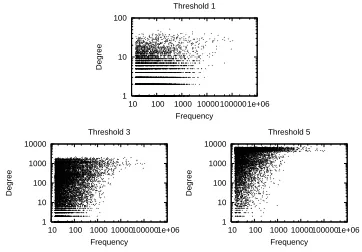
Figure 3: Scatter-plots for degree versus unigram
frequency at differentθfor Hindi
than that of Bengali, which in turn is higher than that of English (Bhatt et al., 2005). Similar trends
are observed at all the thresholds for bothhkwtiand
hki. This is also evident from Figures 2, which show
the distribution of Hindi to lie above that of Bengali, which lies above English (for all thresholds).
The average degree hki is substantially smaller
(0.5 to 0.33 times) than the average weighted
de-gree hkwti for all the 9 SpellNets. This suggests
that the higher degree nodes in SpellNet have higher node weight (i.e. occurrence frequency). Indeed, as shown in Figure 3 for Hindi, the high unigram fre-quency of a node implies higher degree, though the reverse is not true. The scatter-plots for the other languages are similar in nature.
3.2 Correlation between Degrees of Neighbors
The relation between the degrees of adjacent words
is described by thedegree assortativity coefficient.
One way to define the assortativity of a network is through the Pearson correlation coefficient between the degrees of the two vertices connected by an edge.
Each edge (u, v) in the network adds a data item
corresponding to the degrees ofuandvto two data
setsx and y respectively. The Pearson correlation
coefficient for the data setsxandy ofnitems each
is then defined as
r = n
P
xy−PxPy p
[nPx2−(Px)2][nPy2−(Py)2]
Observation: r is positive for the networks in which words tend to associate with other words of similar degree (i.e. high degree with high degree and vice versa), and it is negative for networks in
which words associate with words having degrees in the opposite spectrum. Refering to table 1, we
see that the correlation coefficientrddis roughly the
same and equal to around 0.7 for all languages at
θ = 1. Asθincreases, the correlation decreases as
expected, due to the addition of edges between dis-similar words.
Implication:The high positive correlation coeffi-cients suggest that SpellNets feature assortative mix-ing of nodes in terms of degrees. If there is an RWE
corresponding to a high degree node vw, then due
to the assortative mixing of nodes, the misspelling
w0 obtained fromw, is also expected to have a high
degree. Sincew0has a high degree, even after
detec-tion of the fact thatw0 is a misspelling, choosing the
right suggestion (i.e. w) is extremely difficult
un-less the linguistic context of the word is taken into account. Thus, more often than not it is difficult to correct an RWE, even after successful detection.
4 Clustering and Small World Properties
In the previous section, we looked at some of the de-gree based features of SpellNets. These features pro-vide us insights regarding the probability of RWE in a language and the level of difficulty in correcting the same. In this section, we discuss some of the other characteristics of SpellNets that are useful in predicting the difficulty of non-word error correc-tion.
4.1 Clustering Coefficient
Recall that in the presence of a complete list of valid words in a language, detection of NWE is a trivial task. However, correction of NWE is far from triv-ial. Spell-checkers usually generate a suggestion list of possible candidate words that are within a small edit distance of the misspelling. Thus, correction be-comes hard as the number of words within a given edit distance from the misspelling increases.
Sup-pose that a wordw ∈ Λis transformed intow0 due
to some typing error, such thatw0∈/ Λ. Also assume
thated(w, w0)≤θ. We want to estimate the number
of words in Λ that are within an edit distanceθof
w0. In other words we are interested in finding out
the degree of the nodevw0 inGθ, but since there is
approximate estimate of the same as follows.
Let us conceive of a hypothetical node vw0. By
definition of SpellNet, there should be an edge
con-necting vw0 and vw in Gθ. A crude estimate of
k(vw0) can behkwti ofGθ. Due to the assortative
nature of the network, we expect to see a high corre-lation between the values ofk(vw)andk(vw0), and
therefore, a slightly better estimate ofk(vw0)could
be k(vw). However, as vw0 is not a part of the
net-work, it’s behavior in SpellNet may not resemble that of a real node, and such estimates can be grossly erroneous.
One way to circumvent this problem is to look
at the local neighborhood of the node vw. Let us
ask the question – what is the probability that two
randomly chosen neighbors of vw in Gθ are
con-nected to each other? If this probability is high, then
we can expect the local neighborhood of vw to be
dense in the sense that almost all the neighbors of
vware connected to each other forming aclique-like
local structure. Since vw0 is a neighbor ofvw, it is
a part of this dense cluster, and therefore, its degree
k(vw0)is of the order ofk(vw). On the other hand,
if this probability is low, then even ifk(vw)is high,
the space aroundvw is sparse, and the local
neigh-borhood isstar-like. In such a situation, we expect
k(vw0)to be low.
The topological property that measures the prob-ability of the neighbors of a node being connected
is called theclustering coefficient(CC). One of the
ways to define the clustering coefficientC(v) for a
vertexvin a network is
C(v) = number of triangles connected to vertexv
number of triplets centered onv
For vertices with degree 0 or 1, we put C(v) = 0.
Then the clustering coefficient for the whole
net-workhCCiis the mean CC of the nodes in the
net-work. A corresponding weighted version of the CC
hCCwtican be defined by taking the node weights
into account.
Implication: The higher the value of
k(vw)C(vw)for a node, the higher is the probability
that an NWE made while typingwis hard to correct
due to the presence of a large number of ortho-graphic neighbors of the misspelling. Therefore,
in a way hCCwti reflects the level of difficulty in
correcting NWE for the language in general.
Observation and Inference: At threshold 1,
the values of hCCi as well as hCCwti is higher
for Hindi (0.172 and 0.341 respectively) and Ben-gali (0.131 and 0.229 respectively) than that of En-glish (0.101 and 0.221 respectively), though for higher thresholds, the difference between the CC for the languages reduces. This observation further strengthens our claim that the level of difficulty in spelling error detection and correction are language dependent, and for the three languages studied, it is hardest for Hindi, followed by Bengali and English.
4.2 Small World Property
As an aside, it is interesting to see whether the
Spell-Nets exhibit the so calledsmall world effectthat is
prevalent in many social and natural systems (see
(Albert and Barab´asi, 2002; Newman, 2003) for
def-inition and examles). A network is said to be asmall
worldif it has a high clustering coefficient and if the
average shortest path between any two nodes of the network is small.
Observation: We observe that SpellNets indeed feature a high CC that grows with the threshold. The
average shortest path, denoted byhliin Table 1, for
θ= 1is around 7 for all the languages, and reduces
to around 3 for θ = 3; at θ = 5 the networks are
near-cliques. Thus, SpellNet is a small world net-work.
Implication: By the application of triangle in-equality of edit distance, it can be easily shown that
hli ×θprovides an upper bound on the average edit
distance between all pairs of the words in the lexi-con. Thus, a small world network, which implies a
smallhli, in turn implies that as we increase the error
bound (i.e.θ), the number of edges increases sharply
in the network and soon the network becomes fully connected. Therefore, it becomes increasingly more difficult to correct or detect the errors, as any word can be a possible suggestion for any misspelling. In fact this is independently observed through the
ex-ponential rise inM – the number of edges, and fall
inhlias we increaseθ.
5 Conclusion
In this work, we have proposed the network of ortho-graphic neighbors of words or the SpellNet and stud-ied the structure of the same across three languages. We have also made an attempt to relate some of the topological properties of SpellNet to spelling error distribution and hardness of spell-checking in a lan-guage. The important observations of this study are summarized below.
• The probability of RWE in a language can
be equated to the average weighted degree of SpellNet. This probablity is highest in Hindi followed by Bengali and English.
• In all the languages, the words that are more
prone to undergo an RWE are more likely to be misspelt. Effectively, this makes RWE correc-tion very hard.
• The hardness of NWE correction correlates
with the weighted clustering coefficient of the network. This is highest for Hindi, followed by Bengali and English.
• The basic topology of SpellNet seems to be an
invariant across languages. For example, all the networks feature exponential degree distri-bution, high clustering, assortative mixing with respect to degree and node weight, small world effect and positive correlation between degree and node weight, and CC and degree. However, the networks vary to a large extent in terms of the actual values of some of these metrics.
Arguably, the language-invariant properties of SpellNet can be attributed to the organization of the human mental lexicon (see (Kapatsinski, 2006) and references therein), self-organization of ortho-graphic systems and certain properties of edit
dis-tance measure. The differences across the
lan-guages, perhaps, are an outcome of the specific or-thographic features, such as the size of the alphabet. Another interesting observation is that the phonemic nature of the orthography strongly correlates with the difficulty of spell-checking. Among the three languages, Hindi has the most phonemic and En-glish the least phonemic orthography. This corre-lation calls for further investigation.
Throughout the present discussion, we have fo-cussed on spell-checkers that ignore the context; consequently, many of the aforementioned results, especially those involving spelling correction, are valid only for context-insensitive spell-checkers. Nevertheless, many of the practically useful spell-checkers incorporate context information and the current analysis on SpellNet can be extended for such spell-checkers by conceptualizing a network of words that capture the word co-occurrence pat-terns (Biemann, 2006). The word co-occurrence network can be superimposed on SpellNet and the properties of the resulting structure can be appro-priately analyzed to obtain similar bounds on hard-ness of context-sensitive spell-checkers. We deem this to be a part of our future work. Another way to improve the study could be to incorporate a more realistic measure for the orthographic similarity be-tween the words. Nevertheless, such a modification will have no effect on the analysis technique, though the results of the analysis may be different from the ones reported here.
Appendix A: Derivation of the Probability of RWE
We take anoisy channel approach, which is a
com-mon technique in NLP (for example (Brown et al., 1993)), including spellchecking (Kernighan et al., 1990). Depending on the situation. the channel may
model typing or OCR errors. Suppose that a wordw,
while passing through the channel, gets transformed
to a word w0. Therefore, the aim of spelling
cor-rection is to find the w∗ ∈ Λ (the lexicon), which
maximizesp(w∗|w0), that is
argmax w∈Λ
p(w|w0) = argmax w∈Λ
p(w0|w)p(w)
(9)
The likelihood p(w0|w) models the noisy channel,
whereas the term p(w) is traditionally referred to
as the language model (see (Jurafsky and Martin,
2000) for an introduction). In this equation, as well as throughout this discussion, we shall assume a
uni-gram language model, wherep(w)is the normalized
frequency of occurrence ofwin a standard corpus.
prwe(w), as follows
prwe(w) = X
w0∈Λ
w6=w0
p(w0|w) (10)
Stated differently,prwe(w)is a measure of the
prob-ability that while passing through the channel, w
gets transformed into a form w0, such thatw0 ∈ Λ
andw0 6= w. The probability of RWE in the
lan-guage, denoted by prwe(Λ), can then be defined in
terms of the probabilityprwe(w)as follows.
prwe(Λ) = X
w∈Λ
prwe(w)p(w) (11)
= X
w∈Λ X
w0∈Λ
w6=w0
p(w0|w)p(w)
In order to obtain an estimate of the likelihood
p(w0|w), we use the concept of edit distance(also
known as Levenstein distance (Levenstein, 1965)). We shall denote the edit distance between two words
wandw0byed(w, w0). If we assume that the
proba-bility of a single error (i.e. a character deletion,
sub-stitution or insertion) isρand errors are independent
of each other, then we can approximate the likeli-hood estimate as follows.
p(w0|w) =ρed(w,w0) (12)
Exponentiation of edit distance is a common mea-sure of word similarity or likelihood (see for exam-ple (Bailey and Hahn, 2001)).
Substituting forp(w0|w)in Eqn 11, we get
prwe(Λ) = X
w∈Λ X
w0∈Λ
w6=w0
ρed(w,w0)p(w) (13)
References
R. Albert and A. L. Barab´asi. 2002. Statistical
mechan-ics of complex networks. Reviews of Modern Physics,
74:47–97.
Todd M. Bailey and Ulrike Hahn. 2001. Determinants of wordlikeness: Phonotactics or lexical neighborhoods?
Journal of Memory and Language, 44:568 – 591.
A. Bhatt, M. Choudhury, S. Sarkar, and A. Basu. 2005. Exploring the limits of spellcheckers: A
compara-tive study in bengali and english. InProceedings of
the Symposium on Indian Morphology, Phonology and Language Engineering (SIMPLE’05), pages 60–65.
C. Biemann. 2006. Unsupervised part-of-speech
tag-ging employing efficient graph clustering. In
Pro-ceedings of the COLING/ACL 2006 Student Research Workshop, pages 7–12.
P. F. Brown, S. A. D. Pietra, V. J. D. Pietra, and R. L. Mercer. 1993. The mathematics of statistical machine
translation: Parameter estimation.Computational
Lin-guistics, 19(2):263–312.
M. Choudhury, A. Mukherjee, A. Basu, and N. Ganguly. 2006. Analysis and synthesis of the distribution of consonants over languages: A complex network
ap-proach. In Proceedings of the COLING/ACL Main
Conference Poster Sessions, pages 128–135.
G. Hirst and A. Budanitsky. 2005. Correcting real-word
spelling errors by restoring lexical cohesion. Natural
Language Engineering, 11:87 – 111.
R. Ferrer i Cancho and R. V. Sol´e. 2004. Patterns in
syntactic dependency networks. Physical Review E,
69:051915.
D. Jurafsky and J. H. Martin. 2000. An Introduction
to Natural Language Processing, Computational Lin-guistics, and Speech Recognition. Prentice Hall.
V. Kapatsinski. 2006. Sound similarity relations in
the mental lexicon: Modeling the lexicon as a
com-plex network. Speech research Lab Progress Report,
27:133 – 152.
M. D. Kernighan, K. W. Church, and W. A. Gale. 1990. A spelling correction program based on a noisy
chan-nel model. In Proceedings of COLING, pages 205–
210, NJ, USA. ACL.
K. Kukich. 1992. Technique for automatically correcting
words in text. ACM Computing Surveys, 24:377 – 439.
V. I. Levenstein. 1965. Binary codes capable of
cor-recting deletions, insertions and reversals. Doklady
Akademii Nauk SSSR, 19:1 – 36.
M. E. J. Newman. 2003. The structure and function of
complex networks. SIAM Review, 45:167–256.