Coling 2008: Proceedings of the workshop on Multi-source Multilingual Information Extraction and Summarization,pages 25–32 Manchester, August 2008
MultiSum
Query-Based Multi-Document Summarisation
Michael Rosner Dept. Artificial Intelligence
University of Malta [email protected]
Carl Camilleri Dept. Artificial Intelligence
University of Malta [email protected]
Abstract
This paper describes a generic, open-domain multi-document summarisation system which combines new and exist-ing techniques in a novel way. The sys-tem is capable of automatically identify-ing query-related online documents and compiling a report from the most use-ful sources, whilst presenting the result in such a way as to make it easy for the re-searcher to look up the information in its original context.
1 Introduction
Although electronic resources have several in-herent advantages over traditional research me-dia, they also introduce several drawbacks, such as Information Overload (Edmunds and Morris, 2000),which has become synonymous with the in-formation retrieval phase of any research-related task. Another problem which is directly related to the one just described is that of Source Iden-tification (Eppler and Mengis, 2004). This refers to the problem of having relevant results intermin-gled with results that are less relevant, or actually irrelevant.
Lastly, the researcher usually has to also manu-ally traverse the relevant sources of information in order to form an answer to the research query.
These problems have led to the study of vari-ous areas in computing, all of which aim to try and minimise the manual effort of information retrieval and extraction, one of which is Multi-Document Summarisation (MDS).
The core aim of any MDS system is that of pro-cessing multiple sources of information and out-putting a relatively brief but broad report or
sum-c
2008. Licensed under the Creative Commons Attribution-Noncommercial-Share Alike 3.0 Unported li-cense (http://creativecommons.org/licenses/by-nc-sa/3.0/). Some rights reserved.
mary. Uses of MDS systems vary widely, from summarisation of closed-domain documents, such as news documents (Evans et al., 2004), to aggre-gation of information from several sources in an open domain.
2 Aims and Objectives
MDS techniques can be used in various tools that may help addressing the problems described in Section 1. On the other hand, a brief study of the relevant literature indicates that the majority of the work done in this area concerns closed-domains such as news summarisation, which is perhaps the reason why such tools have not yet become more popular. The objectives of this study are thus twofold.
• The primary objective is that of design-ing, implementing and evaluating an open-domain, query-based MDS system which is capable of compiling an acceptably-coherent report from the most relevant online sources of information, whilst making it easy for the reader to access the full source of information in its original context.
• A secondary objective of this study is Search Engine Optimisation (SEO): We require the system to produce summaries which, if pub-lished on the Internet, would be deemed rel-evant to the original query by search en-gine ranking algorithms. This is measured by keyoword density in the summary. Suc-cess on this objective addresses the problem of Source Identification since the summary would at the very least serve as a gateway to the other relevant sources from which it was formed.
the quality of output, as measured by a number of different linguistic and non-linguistic criteria (see Section 5). We have adopted a number of novel techniques to address this such as
• Multi-Layered Architecture
• Sentence Ordering Model
• Heuristic Sentence Filtering
• Paragraph Clustering
3 Background
3.1 Search Engine Ranking Criteria
Search engine ranking algorithms vary, and are continuously being optimised in order to provide better and more accurate results. However, some guidelines that outline factors which web masters need to take into account have been established (cf. Google (2007), Vaughn (2007)).
When ranking documents for a particular search query, ranking algorithms take into account both
on-page and off-page factors. Off-page factors comprise mainly the number and quality of in-bound links to a particular page, whilst on-page factors comprise various criteria, most important of which is the relevance of the content to the search query.
3.2 Multi-Document Summarisation
Several different approaches and processes have been developed in automatic MDS systems. These vary according to the problem domain, which usu-ally defines particular formats for both input and output. However, five basic sub-systems of any MDS system can be identified (Mani, 2001).
1. Unit Identification During this first phase, input documents are parsed and tokenised into “units”, which can vary from single words to whole documents, according to the application problem.
2. Unit Matching (Clustering) The second stage involves grouping similar units together. In the context of MDS, similar units usu-ally mean either identical or informationusu-ally- informationally-equivalent strings (Clarke, 2004), with the purpose of discovering the main themes in the different units and identify the most salient ones.
3. Unit FilteringThe filtering stage eliminates units residing in clusters which are deemed to be non-salient.
4. CompactingDuring this phase, it is often as-sumed that different clusters contain similar units. Thus, a sample of units from different clusters is chosen.
5. Presentation/Summary Generation The last phase of the MDS process involves using the output from the Compacting stage, and generating a summary. Usually, na¨ıve string concatenation does not produce coherent summaries and thus, techniques such as named entity normalisation and sentence ordering criteria are used at this stage.
3.3 Clustering Techniques
As outlined in Section 3.2, MDS often makes use of clustering techniques in order to group together similar units. Clustering can be defined as a pro-cess which performs “unsupervised classification of patterns into groups based on their similarity” (Clarke, 2004).
A particular clustering technique typically con-sists of three main components:
1. Pattern Representation
2. Similarity Measure
3. Clustering Algorithm
The very generic nature of our problem domain requires a clustering technique which is both suit-able and without scenario-dependant parameters. Fung’s algorithm (Fung et al., 2003), comprising a pre-processing stage and a further three-phase core process, uses the following concepts, and is briefly described in Figure 1.
ItemSet A set of words occurring together within a document. An ItemSet composed of k words is called ak-ItemSet.
Global Support The Global Support of a word item is the number of documents from the docu-ment collection it appears in (cf. docudocu-ment fre-quency).
Cluster Support The Cluster Support of a word item is the number of documents within a cluster it appears in.
1. Pre-Processing - stem, remove stop words and convert to TFxIDF represen-tation
2. Discover Global Frequent ItemSets 3. For each Global Frequent ItemSet (GFI)
create a corresponding cluster, contain-ing all documents that contain all items found within the GFI associated with each cluster. This GFI will act as a “la-bel” to the cluster.
4. Make Clusters Disjoint
Figure 1: Hierarchical Document Clustering Using Frequent Itemsets
Frequent ItemSet An ItemSet occurring in a pre-determined minimum portion of a document collection. The pre-defined minimum is referred to as the Minimum Support, and is usually deter-mined empirically according to the application.
Global Frequent ItemSet An ItemSet which is frequent within the whole document collection. The words within a Global Frequent ItemSet are referred to as Global Frequent Items, whilst the minimum support is referred to as the Minimum Global Support.
Cluster Frequent ItemSet An ItemSet which is frequent within a cluster. In this context, the minimum support is referred to as the Minimum Cluster Support.
With these definitions, it is now possible to de-scribe into more detail the core non-trivial phases of the algorithm.
3.3.1 Discovering Global Frequent ItemSets
From the definition of an ItemSet, it can be con-cluded that the set of ItemSets is the power set of all features1within the document collection. Given
even a small document collection, enumerating all the possible ItemSets and checking which of them are Global Frequent would be intractable. In order to discover Global Frequent ItemSets, the authors recommend the use of the Apriori Candidate Gen-eration algorithm, a data mining algorithm pro-posed by Agrawal and Srikant (1994). This
algo-1Features here constitute distinct, single words found in the whole document collection. In practice, stemming is ap-plied before feature extraction.
rithm defines a way to reduce the number of candi-date frequent ItemSets generated. The generation algorithm basically operates on the principle that, given a set of frequentk-1-ItemSets, a set of can-didate frequentk-ItemSets can be generated such that each candidate is composed of frequent k-1 -ItemSets.
Agrawal and Srikant (1994) also mention a sim-ilar algorithm proposed by Mannila et al. (1994). As illustrated in Figure 2, this algorithm consists of first generating candidates, and then pruning the result based on a principle similar to that men-tioned.
3.3.2 Making Clusters Disjoint
The purpose of the last phase of the algorithm is converting a fuzzy cluster result to its crisp equiva-lent. In order to identify the best cluster for a doc-ument contained in multiple clusters, the authors define the scoring function illustrated in the equa-tion of Figure 3, wherex is a global and cluster-frequent item indocj,x0 a global frequent butnot
cluster frequent item indocj, andn(x)a weighted
frequency (TF.IDF) of featurexindocj.
Using this function, the best cluster for a partic-ular document is that which maximises the score. In case of a tie, the most specific cluster (having the largest number of labels) is chosen.
4 Procedure
The system was designed in two parts, namely a simple web-based user interface and a server pro-cess responsible for iterating sequentially over user queries and performing the content retrieval and summarisation tasks. The following sections de-scribe the various sub-systems that compose the server process.
4.1 Content Retrieval
The Content Retrieval sub-system is responsible for retrieving web documents related to a user’s query. This is done simply by querying a search engine and retrieving the top ranked documents2.
Although throughout the course of this study the system was configured to use only Google as its document source, the number of search engines that can be queried is arbitrary, and the system can
2It was empirically determined that retrieving the top 30 ranked documents achieved the best results. Considering less documents meant that, in most scenarios, main relevant sources were missed, whilst considering more documents caused the infiltration of irrelevant information
1. Join
Ck={X∪X0|X, X0 ∈Lk−1,|X∩X0|=k−2} 2. Prune
Ck={X ∈Ck0 |Xcontainskmembers ofLk−1}
Figure 2: Candidate Generation Algorithm by Mannila et al. (1994)
Score(Ci ←docj) =
X
x
n(x)×cluster support(x)−X x0
n(x0)×global support(x0)
Figure 3: Definition of Scoring Function
be given a set of parameters to query a particular search engine.
4.2 Content Extraction
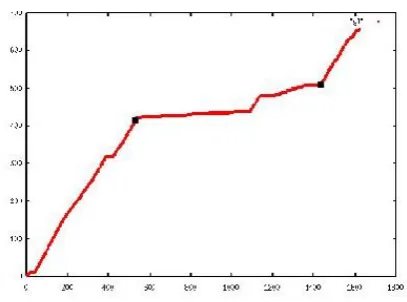
The Content Extraction module is responsible for transforming the retrieved HTML documents into raw text. However, a simple de-tagging process is not sufficient. This module was designed so as to be able to identify the main content of a web document, and leave out other clutter such as nav-igation menus and headings. Finn et al. (2001) in-troduce a generic method to achieve this, by trans-lating the content extraction problem to an optimi-sation problem. The authors observe that, essen-tially, an HTML document consists of two types of elements, that is, actual text and HTML tags. Thus, such a document can easily be encoded as a binary stringB, where 0 represents a natural word, whilst 1 represents and HTML tag. Figure 4 shows a typ-ical graphtyp-ical representation obtained when cumu-lative HTML tag tokens are graphed against the cumulative number of tokens in a typical HTML document.
Finn et al. (2001) suggest that, typically, the plateau that can be discerned in such a graph con-tains the actual document content. Therefore, in order to extract the content, the start and end point of the plateau (marked with black boxes in Figure , and referred to hereafter asiandjrespectively) must be identified.
The optimisation problem now becomes max-imisation of the number of HTML tags below i
and abovej, in parallel with maximisation of the number of natural language words betweeniand j. The maximisation formula proposed by the au-thors is given by Equation 1.
Figure 4: Total HTML Tokens VS Total Tokens (Finn et al., 2001)
Ti,j = i−1
X
n=0 Bn+
j
X
n=i
(1−Bn)+ NX−1
n=j+1
(1−Bn) (1)
Our Content Extraction module is further de-composed into three sub-modules. The first is a pre-processing module, which parses out the body of the HTML document, and removes superfluous content such as scripts and styling sections. The second and core sub-module consists namely of an implementation of the content extraction method introduced by Finn et al. (2001), which is pri-marily responsible for identifying the main con-tent section of the input document. The last post-processing module then ensures that the output from the previous sub-modules is converted to raw text, by performing an HTML detagging process-ing and also insertprocess-ing paragraph marks in places where they are explicit cf. HTML <p> tag) or where an element from a predefined set of HTML text break delimiters occurs.
4.3 Summarisation
The overall design of the core summarisation mod-ule is loosely based upon the two-tiered MDS architecture introduced by Torralbo et al. (2005) The following sections map our system to a sim-ilar two-tiered architecture, and explain how each module operates.
Document Identification
Document Identification is trivial, since docu-ments are explicitly defined by the content retrieval module, the output of which is basically a set of query-related text documents.
Document Filtering
The job of Document Filtering is partially done at the very beginning by the search engine. How-ever, our system further refines the document col-lection by pre-processing each document, apply-ing a noise3removal procedure, stemming and stop
word and rare word removal. Each document is then converted to a bag of words, or the Vector Space Model, where each word is associated with its corresponding TF•IDF measure. Any docu-ment which, after pre-processing, ends up with an empty bag of words, is filtered out from the doc-ument collection. Furthermore, in order to ensure the robustness of the system especially in subse-quent intensive processing, documents which are longer than 5 times the average document length are truncated.
Paragraph Identification
As outlined in Section 4.2, the Content Extrac-tion sub-system inserts paragraph indicators in the text wherever appropriate. Thus, the paragraph identification phase is trivial, and entails only split-ting the content of a document at the indicated po-sitions.
Paragraph Clustering and Filtering
In contrast to the technique of Torralbo et al. (2005), a paragraph filtering module was intro-duced in order to select only the most informa-tive, query-related paragraphs. To achieve this, we implemented the clustering technique out-lined in Section 3.3 in order to obtain clusters of thematically-similar paragraphs, using the Global Frequent ItemSet generation technique from Man-nila et al. (1994) and setting the Minimum Global
3“Noise” refers to any character which is not in the En-glish alphabet.
1. For each paragraphpk
(a) Initialise the target summarySumk
as an empty text (b) Letp=pk
(c) Remove the first sentencesfromp, and add it at the end ofSumk.
(d) Calculate the similarity between s
and the first sentence of all the para-graphs, using the size of the inter-section of the two vectors of words as a similarity metric.
(e) Let p be the paragraph whose first sentence maximises the similarity, and go back to step (c) with that paragraph. If the best similarity is 0, stop.
2. Choose the longest one of thekdifferent summaries.
Figure 5: Summary Generation Algorithm (Tor-ralbo et al., 2005)
Support and Minimum Cluster Support parameters to 35 and 50 respectively.
The filtering technique then consists of simply choosing the largest cluster. This is based on the intuition that most of the paragraphs having the central theme as their main theme will get clus-tered together. Therefore, choosing the largest cluster of paragraphs would filter out irrelevant paragraphs. This paragraph filtering method may filter out paragraphs which are actually relevant, however, we rely on the redundancy of informa-tion usually found in informainforma-tion obtained from the web. Thus, the paragraph filtering gives more importance to filtering out all the irrelevant para-graphs.
Summary Generation
The role of the summary generation module is to generate a report from a cluster of paragraphs. We based our summary generation method on that used by Torralbo et al. (2005), which is illustrated in Figure 5. However, in order to make it more applicable to our problem domain and increase the output quality, we introduced some improvements.
maximises the probability given the previous sen-tence. The sentence ordering model, based on a method of probabilistic text structuring introduced by Lapata (2003), is trained upon the whole doc-ument collection. We used Minipar (Lin, 1993), a dependency-based parser, in order to identify verbs, nouns, verb dependencies and noun depen-dencies. Using counts of these features and Sim-ple Good-Turing smoothing (Gale and Sampson, 1995), we were able to construct a probabilistic sentence ordering model such that, during sum-mary generation, given the previous sentence, we are able to identify the sentence which is the most likely to occur from the pool of sentences appear-ing at the beginnappear-ing of the remainappear-ing paragraphs.
Sentence Filtering We also introduced at this stage a method to filter out sentences that decrease the coherency and fluency of the resultant sum-mary. This is based on two criteria:
1. Very low probability of occurrence
If the most likely next-occurring sentence that is chosen and removed from a paragraph still has a very low probabilistic score, it is not added to the output summary.
2. Heuristics
We also introduce a set of heuristics to filter out sentences having a wrong construction or sentences which would not make sense in a given context. These heuristics include:
(a) Sentences with no verbs
(b) Sentences starting with an adverb and occurring at a paragraph transition within the summary
(c) Sentences occurring at a context switch4
within the summary and starting with a word matched with a select list of words that usually occur as anaphora
(d) Malformed sentences (including sen-tences not starting with a capital letter and very short sentences)
5 Evaluation
5.1 Automatic Evaluation 5.1.1 Coherence Evaluation
In order to evaluate the local coherence of the re-ports generated by the system, we employed an
au-4Context Switchrefers to scenarios where a candidate sen-tence comes from a different document than that of the last sentence in the summary.
tomatic coherence evaluation method introduced by Barzilay and Lapata (2005)5. The main
objec-tive of this part of the evaluation phase was to de-termine the effect on output quality when param-eters are varied, namely the minimum cluster sup-port parameter for the clustering algorithm, and the key phrase popularity.
From this evaluation, we empirically deter-mined that the optimum minimum cluster support threshold for this application is 50, whilst the qual-ity of the output is directly proportional to the key-word popularity.
5.1.2 Keyword Density Evaluation
Here we focused on determining whether the secondary objective was achieved (cf. section 2).
We measured the frequency of occurrence of the keyword phrase within the output, or more specifi-cally, the keyword density. The average key phrase density achieved by the system was 1.32%, when taking into account (i) the original keyword phrase and its constituent keywords, and (ii) secondary keyword phrases and their constituents.
5.2 Manual Quality Evaluation
In order to measure the quality of the output and determine whether the objectives of the study was achieved, three users were introduced to the sys-tem and asked to grade the syssys-tem, on a scale of 1-5, on several criteria. Table 1 illustrates the re-sults obtained from this evaluation.
6 Conclusions
6.1 Interpretation of Results
In this section we will identify some conclusions elicited from the results obtained from the evalua-tion phase and illustrated in Secevalua-tion 5.
Automatic Coherence Evaluation The auto-matic coherence evaluation tests, although, in this application, the level of “coherence” indicated did not match that of manual evaluation, provided nonetheless a standard by which different outputs from the system using different parameters and ap-plication scenarios could be compared. From the results, we could empirically determine that the optimal value for the cluster support parameter was around 50%. Furthermore, unsurprisingly, the sys-tem tends to produce output of a higher quality
5Data required to set up the automatic coherence eval-uation model was available from the author’s website http://people.csail.mit.edu/regina/coherence/.
Grammaticality Non-Redundancy Referential Clarity Focus Structure Naturalness Usefulness
Average 3.62 2.21 4.03 4.28 3.27 2.76 4.78
Table 1: Results of Manual Evaluation
in scenarios where the keyword phrase is popular, and thus more data is available.
SEO Evaluation From an SEO perspective, it was predictable that the system would produce query-related text, since its data source is ob-tained from query-related search engine results. However, the resulting average keyword density achieved is significant, and is at a level which is totally acceptable by most search engine ranking algorithms6.
Manual Quality Evaluation Due to limited re-sources, the results of the manual evaluation pro-cedure were not statistically significant since only three users were involved in evaluating six sum-maries. However, allowing for a factor of sub-jectivity, some conclusions could still be elicited, namely:
1. The system did not perform well enough to have its output rated as high as a manual sum-marisation procedure. This can be concluded from the low rating on the outputNaturalness
criterion, as well as from the presence of re-peated and irrelevant content in some of the output summaries.
2. The system performed acceptably well in generating reports that were adequately co-herent and high-level enough to give an overview of concepts represented by users’ queries. This can be concluded from the av-erage scores achieved in theFocusand Refer-ential Claritycriteria.
3. The evaluators were also asked to give a grade indicating whether this system and similar tools would actually be useful. A positive grade was obtained on this criterion, indicat-ing that the system achieved the MDS objec-tive, enabling users to get a brief overview of the topic as well as facilitating document identification.
When comparing these results to those achieved by Torralbo et al. (2005), we can elicit two main conclusions:
6Very high keyword density (more than a threshold of 2% - 5%) is usually considered as a spammy technique known as keyword stuffing.
1. Although our system achieved lower rank-ings on the Non-Redundancy, Structure and
Grammaticality criteria, these rankings were not unacceptable. We could attributed this to the more generic domain in which our sys-tem operates, where it is not possible to in-troduce fixed heuristics such as those used by Torralbo et al. (2005) for avoiding repeated information by replacing a term definition by its corresponding acronym. Such heuristics tend to be relevant in the context of such a term definition system.
2. Our system achieved higher grades on the
Referential ClarityandFocuscriteria. Given the fact that the system of Torralbo et al. (2005) retrieves results from search engines in a similar way used by our system, the im-provement Focus might be attributed to the fact that our paragraph filtering methodol-ogy tends to perform well in selecting only the most relevant parts of the document base. Furthermore, the improved grade achieved in the Referential Clarity criterion might arise from the more advanced sentence ordering methodology used, as well as to the different heuristic-based sentence filtering techniques employed by our summary generation mod-ule.
6.2 Limitations
The main limitation is that the quality of the output is very susceptible to the quality and amount of re-sources available. However, we also noticed a se-vere fall in quality where results were largely com-posed of business-oriented portals, which tend to lack textual information. Furthermore, the output summary is largely dictated by the results of search engines. Therefore, the queries submitted to the system must be formulated similarly to those sub-mitted to search engines, since the system would fail to generate a focused summary for queries which, when submitted to traditional search en-gines, return irrelevant results.
introduce performance bottlenecks by imposing a batch-processing regime.
6.3 Final Conclusions
Our system combines several existing techniques in a novel way. New techniques, such as our Heuristic-Based Sentence Filtering algorithm, are also introduced.
The primary objective of creating an MDS was achieved albeit with limited “coherency”. How-ever, our system was considered a useful research tool - supporting the hypothesis that a partially co-herent but understandable report with minimum effort is arguably better than a perfectly coherent one, if the latter is unrealistically laborious to pro-duce.
The secondary SEO objective was also achieved, to the extent that the system generated query-related content that has a natural level of key phrase density. Such content has the potential of being considered query-related also by search engine ranking algorithms, if published within the right context.
7 Future Work
There remains much is to be done. We propose:
• To increase the output quality and natural-ness by focusing on an a sub-system for anaphora identification and resolution which would complement our probabilistic sentence ordering model.
• To widen the scope by applying the system to sources of information other than web docu-ments.
• To convert our batch-processing system to an interactive one by incorporating all the re-quired tools within the same environment.
References
Agrawal, R. and Ramakrishnan Srikant. 1994. Fast algorithms for mining association rules in large
databases. InVLDB’94, Proc. of 20th International
Conference on Very Large Data Bases, Sept. 1994, Santiago de Chile, Chile, pages 487–499. Morgan Kaufmann.
Barzilay, R. and M. Lapata. 2005. Modeling local
coherence: an entity-based approach. InACL ’05:
Proc. 43rd Annual Meeting of the ACL, pages 141– 148, Morristown, NJ, USA. ACL.
Clarke, J. 2004. Clustering techniques for multi-document summarisation. Master’s thesis, Univer-sity of Sheffield.
Edmunds, A. and A. Morris. 2000. The problem of information overload in business organisations: a
re-view of the literature. Int. Journal of Information
Management, 20(1):17–28.
Eppler, M.J. and J. Mengis. 2004. The Concept of Information Overload: A Review of Literature from Organization Science, Accounting, Marketing, MIS,
and Related Disciplines. The Information Society,
20(5):325–344.
Evans, D.K., J.L. Klavans, and K.R. McKeown. 2004. Columbia Newsblaster: Multilingual News
Summa-rization on the Web. Proc. HLT Conference and the
NAACL Annual Meeting.
Finn, A., N. Kushmerick, and B. Smyth. 2001. Fact or fiction: Content classification for digital libraries. In DELOS Workshop: Personalisation and Recom-mender Systems in Digital Libraries.
Fung, B.C.M., K. Wang, and M. Ester. 2003. Hier-archical Document Clustering Using Frequent
Item-sets. Proc. of the SIAM International Conference on
Data Mining, 30.
Gale, W.A. and G. Sampson. 1995. Good-Turing
Fre-quency Estimation Without Tears. Journal of
Quan-titative Linguistics, 2(3):217–237.
Google. 2007. Google Webmaster Guidelines.
http://www.google.com/support/webmasters /bin/answer.py?answer=35769.
Lapata, M. 2003. Probabilistic text structuring:
Ex-periments with sentence ordering. Proc. of the 41st
Meeting of the ACL, pages 545–552.
Lin, Dekang. 1993. Principle-based parsing without
overgeneration. InMeeting of the ACL, pages 112–
120.
Mani, I. 2001. Automatic Summarization.
Computa-tional Linguistics, 28(2).
Mannila, Heikki, Hannu Toivonen, and A. Inkeri Verkamo. 1994. Efficient algorithms for discov-ering association rules. In Fayyad, Usama M. and
Ramasamy Uthurusamy, editors, AAAI Workshop
on Knowledge Discovery in Databases (KDD-94), pages 181–192, Seattle, Washington. AAAI Press. Torralbo, R., E. Alfonseca, A. Moreno-Sandoval, and
J.M. Guirao. 2005. Automatic generation of
term definitions using multidocument
summarisa-tion from the Web. InProc. Workshop on Crossing
Barriers in Text Summarisation Research, RANLP Borovets.
Vaughn. 2007. Google Ranking Factors
- SEO Checklist.
http://www.vaughns-1-pagers.com/internet/google-ranking-factors.htm.