Original Research Article
A study on pattern of placentation in post caesarean pregnancy
Deepthi P. S.*, Neena Devasia
INTRODUCTION
During the past few decades the world wide incidence of caesarean births has increased markedly. Approximately 1 out of 4 women will have a caesarean delivery and it is the most frequently performed surgical procedure in the United States.1,2 World wide variation exists in rates for
caesarean delivery; currently range from 10-40% of all deliveries, whereas WHO has suggested that there is no increase in health benefits associated with caesarean rates more than 10-15%.3 About 1/3rd of the caesarean sections
are repeat procedures. Repeat caesarean sections are associated with increased morbidity, but little has been done to investigate the complications that are specifically associated with repeat caesarean sections. Perhaps the greatest risk to future pregnancies is an increase in disorders caused by abnormal placentation including placenta previa, placenta accreta.3
Placenta previa may be associated with placenta accreta or one or more of its advanced forms like placenta increta or percreta which occur when the placenta becomes
ABSTRACT
Background: It appears that the rate of caesarean delivery has been increasing over the past two decades. Various western studies have shown that with previous caesarean section, increased risk of placenta previa, adherent placenta, and greater incidence of antepartum haemorrhage. Nonetheless, the extent to which previous caesarean delivery predisposes women to the development of placenta previa is unclear from earlier studies. Also, there are not many Indian studies regarding the association of placenta previa and previous caesarean section. This study aims to find the association between prior caesarean delivery and subsequent development of placenta previa and adherent placenta.
Methods: A descriptive study was conducted on 600 antenatal women with post cesarean pregnancy in a tertiary care centre. Similar number of women with previous normal delivery was included in comparison group and placental location was studied. Those patients with previous caesarean were further divided into those with placenta previa and without previa to study the determinants of previa in those with previous caesarean section.
Results: Placenta previa was found in 2.8% of the study group compared to 1.2% of comparison group. Adherent placenta was found only in post caesarean group. In the post caesarean group, the incidence of anterior previa was 41.2% compared to posterior previa (29.3%). In those with post cesarean pregnancy, determinants of placenta previa found were multiparity (35.3%), previous history of abortions (35%), multiple previous caesarean sections (29.4%), interpregnancy interval <2 years (35.29%).
Conclusions: In post cesarean pregnancy, the risk of placenta previa is 2 times compared to those with a previous normal delivery. Anterior previa occurred with sufficient frequency in post-caesarean pregnancy to warrant ultrasonic placentography prior to surgical entry into lower segment. When the combination of previous caesarean and placenta previa occurs the risk of adherent placenta is 17.6%.
Keywords: Placenta previa, Previous caesarean section, Risk factors DOI: http://dx.doi.org/10.18203/2320-1770.ijrcog20202711
Department of Obstetrics and Gynecology, Govt. Medical College, Vandanam, Alappuzha, Kerala, India
Received: 11 April 2020
Revised: 22 May 2020
Accepted: 28 May 2020
*Correspondence:
Dr.Deepthi P. S.,
E-mail: [email protected]
abnormally adherent to the myometrium rather than the decidua. Approximately 50% of pregnancies complicated by accreta are proceeded by caesarean delivery in a prior pregnancy. Significant haemorrhage and severe maternal morbidity and mortality at the time of delivery are common in cases of placenta accreta.
Freidricksen and co-workers (1999) reported a 25% hysterectomy rate in women undergoing repeat caesarean for a previa compared with only 6% in those undergoing primary caesarean for placenta previa.4 Earlier studies
have also shown that lower anterior uterine segment implantations occur with sufficient frequency in patients who had undergone caesarean previously, to warrant ultrasonic placentography prior to surgical re-entry of lower uterine segment.5,6
The aims of the study were to find out the pattern of placentation in post-caesarean pregnancy and to identify the frequency of placenta previa and adherent placenta in post caesarean pregnancy. The secondary objective was to study the determinants of placenta previa in post caesarean pregnancy.
METHODS
The study was conducted in a tertiary care centre in Kerala for a period of 1 year after obtaining clearance of Ethical committee. Applying the prevalence of placenta previa in total number of deliveries as 1.6% and a precision value of 0.2 for a power of 80%, the total no of deliveries to be studied was calculated as 5000. Considering the repeat caesarean section of 120 per 1000 deliveries the total of post-caesarean cases to be studied was concluded to be 600.
Inclusion criteria
• Singleton pregnancies with gestational age >32 weeks.
Exclusion criteria
• Multigravidas without prior caesarean delivery
• Multiple pregnancy.
Statistical analysis
Data collected were entered in to master sheets and analysed using computer software, SPSS version 16. Data are expressed in its frequency and percentage. To elucidate the associations and comparisons between different parameters chi square test and fishers exact test were used as non-parametric test. For all statistical evaluations, a probability value of <0.05 was considered significant.
RESULTS
Placenta previa was found in 2.8% that is 17 of the study group compare to 1.2%, that is 7 of the comparison group. It was statistically significant with 2 times risk.
Figure 1: Placenta previa in %.
Table 1: Prevalence of placenta previa in previous CS and previous normal delivery.
Placenta previa Previous CS Previous normal delivery
No. Percentage No. Percentage
Yes 17 2.8% 7 1.2%
No 583 97.2% 593 98.8%
X2=4.25, p value=0.03, odds ratio=2.47.
Table 2: Distribution of types of placenta previa in cases of prior caesarean delivery.
Type of previa No. % of previa
Type 1anterior 2 11.76%
Minor Type 2 anterior 3 17.6%
Type 2 posterior 2 11.76%
Type 3 anterior 2 11.76%
Major Type 3 posterior 3 17.6%
Type 4 central 5 29.4%
0 20 40 60 80 100 120
PREV CS PREV ND
Table 3: Distribution of adherent placenta in previous CS versus previous normal delivery.
Adherent placenta Previous CS Previous normal delivery
No. Percentage No. Percentage
Yes 3 0.5% 0 0%
No 597 99.5% 600 0%
p value = 0.12.
Table 4: Distribution according to parity.
Parity Previa Non-previa
No. Percentage No. Percentage
PARA 1 11 64.7% 513 87.99%
≥PARA 2 6 35.3% 70 12.0%
χ2=8.08, p value=0.004, OR=4.
Table 5: History of placenta previa in previous pregnancy.
Previous placenta-previa Previa Non-previa
No. Percentage No. Percentage
Present 2 11.7% 0 0%
Absent 15 88.2% 581 100%
Fisher exact p value=0.000.
Table 6: Distribution according to abortions.
Abortions Previa Non-previa
No. Percentage No. Percentage
Yes 6 35.3% 98 16.8%
No 11 64.7% 485 83.2%
χ2=3.93, p value=0.047, OR=2.7.
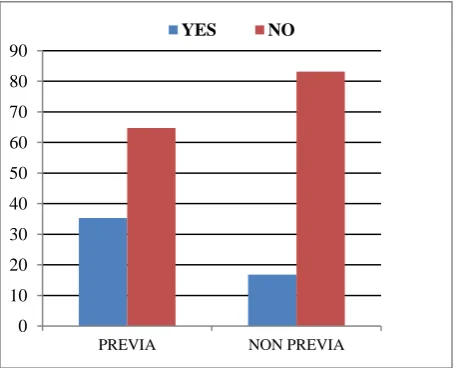
Figure 2: History of abortions in %.
According to type of placenta previa type 4 or central previa was the most common type. Altogether anterior previa occurred at a frequency of 41.2% compared to posterior previa which was 29.36%. Central previa occurred in 29.4%. Total major previa were 58.7% and minor previa was 41.7% in the study group.
Placental adherence was found only in previous caesarean group which constituted 0.5% of previous CS group.
Comparison within those with prior caesarean section
Majority comes in the para 1 group. In those with placenta previa, multipara (≥para 2) were more (35.3%) compared to those without previa (12%) and is statistically significant.
Previous history of placenta previa was present in 11.7% of patients with previa where as it was not present in those without previa. Chi square and Odds ratio cannot be calculated because of a zero value.
In both groups majority did not have a history of abortion. In those with placenta previa history of abortion was more 35.3% (6 out of 17) compared to 16.8% (98 out of 583) of those without previa and is statistically significant.
History of curettage was present in 66.6% (4 out of 6) of those with previa compared to 25.5% (25 out of 98) and it was statistically significant.
0 10 20 30 40 50 60 70 80 90
PREVIA NON PREVIA
Multiple sections were more in previa group (29.4%) compared to 8.9% in those without previa which was statistically significant with a p value of 0.004.
History of wound infection is more (29.4%) in those with placenta previa compared to 6.1% in those without previa which was statistically significant.
Table 7: Distribution according to curettage.
H/O Curettage Previa Non-previa
No. Percentage No. Percentage
Yes 4 66.6% 25 25.5%
No 2 33.3% 73 74.48%
Fisher exact p value=0.049, OR=5.84.
Table 8: Distribution according to number of prior caesarean delivery.
No. of prior CS Previa Non-previa
No. Percentage No. Percentage
2 5 29.4% 52 8.9%
1 12 70.6% 531 91.1%
χ2=8.05, p value=0.004, OR=4.25.
Table 9: Distribution according to history of wound infection following previous caesarean delivery.
H/O Wound infection Previa Non-previa
No. Percentage No. Percentage
Yes 5 29.4% 35 6.1%
No 12 70.6% 548 93.9%
χ2=14.52, p value=0.0003, OR=6.52.
Table 10: Distribution according to inter pregnancy interval (IPI).
Inter pregnancy interval Previa Non-previa
No. Percentage No. Percentage
≤24 months 6 35.29% 80 15.7%
>24 months 11 64.7% 503 84.3%
χ2=6.25, p value=0.012, OR=3043.
Inter pregnancy interval of less than 2 years were more (35.29%) in those with placenta previa compared 15.7% of those without previa and is statistically significant (3 times).
DISCUSSION
Total of 600 women with one or more previous caesarean section were enrolled in the study population, and placental location studied. They were compared with equal number of women with only previous normal deliveries.
Placental location
Results showed that posterior upper uterine segment occurred with highest frequency in both groups followed by anterior upper uterine segment implantation and fundal implantation. Placenta previa was found in 2.8% of patients with previous caesarean section and 1.29% in
those without previous caesarean section (Table 1). The bar diagram (Figure 1) represents the same data.
Study conducted by Nzeh et al, showed similar frequencies with posterior upper segment of 36.2% followed by anterior upper segment and fundal implantations, each had a frequency of 19.1%.6 Placenta
previa was 5.3% in those with previous caesarean section. In a similar study by Filipov E et al, placenta previa was found in 3.9% in patients with previous caesarean sections compared to 0.45% in those without previous caesarean section.7 In contrast, another study by John C et
al, found that there was no difference in the placental location when a comparison is made between surgically scarred uterus and non-violated uterus.5
Distribution of type of previa
occurrence of major previa has been found more in study group than in the comparison group (Table 2). Clark et al, proposed the higher incidence of clinically observed placenta previa at term is caused by the failure of adherent placenta in the study population. However, this occurrence was statistically non-significant. Anterior previa occurred with sufficient frequency (41.2%) to warrant ultrasonic placentography prior to surgical entry of the lower uterine segment.
Age distribution
In the study group, 35.3% of the women with placenta previa were older than 30 years, as compared to 16.8% of women without previa. This study clearly identifies that increasing maternal age is strongly associated with placenta previa, with an Odd's ratio of 2.7. This is comparable to the study by Williams et al8 who found that women who were 30 years of age or older were more than twice as likely to have pregnancies complicated by placenta previa as compared with, women who were 20-29 years of age (adjusted odds ratio, 2.0-2.7).
Parity association was statistically significant. In other words, the association between caesarean delivery and placenta previa grows stronger as parity increases.
Though most studies have found an association of placenta previa in grand multipara this study did not have any grand multipara. This may be because study hospital being a tertiary care centre more cases with placenta previa are being referred to us.
This is similar to the observations made by Gilliam et al, that although one caesarean delivery did not significantly increase the likelihood of placenta previa in a primiparous woman, subsequent deliveries, whether vaginal or caesarean, and caesarean deliveries in particular, do increase the likelihood of placenta previa in future pregnancy.
Association with prior abortion
Among those with placenta previa 35.3% (6 out of 11) had history of abortions compared to 16.8% (98 out of 485) of those without previa. This implies 2.7 times relative risk of placenta previa in those with history of
abortion (Table 6). The bar diagram (Figure 2) represents the same data.
In those with abortion the risk increases if there was a history of curettage (Table 7). But an association with multiple abortions was not found significant in this study. This may be because of the small sample size.
Study by Ananth et al, noted that the relative risk for placenta previa was 1.6 (95% confidence interval 1 to 2.6) for women with at least one prior spontaneous abortion while women with a history of induced abortion had a relative risk of 1.7 (95% CI, 1.0-2.9).9 Additionally
with the use of vital records, Zhang and Savitz reported that the risk of placenta previa was 1.6 for women with one abortion (either spontaneous or induced), 2.3 for those with 2 and 3.7 for those with 3 or more abortions.
Recurrence risk of placenta previa
In those with placenta previa, 11.7% had a history of placenta previa in previous pregnancy as compared to 0.3% of those without previa (Table 5). Study by Monica G10 showed that placenta previa has a recurrence rate of 2.4% which is 8-fold high as compared to rate of placenta previa among all births.
Distribution according to number of caesarean sections
In this study, 29.4% of those with placenta previa had 2 prior caesarean sections compared to 8.9% of those without placenta previa and is statistically significant. No one in this study had more than 2 previous caesarean sections (Table 8). This signifies that in those with previous caesarean section the risk of placenta previa is more as the number of caesarean sections increases
This is similar to that proposed by Clark et al, that single caesarean delivery increases the risk by 0.65%, 2
Indication for previous caesarean section
Cephalopelvic disproportion and failed induction were the most common indications for previous caesarean section in both groups. This indicates that the indication for previous caesarean section has no particular association with the occurrence of placenta previa in subsequent pregnancy.
Association with post-operative wound infection in previous delivery
because all abdominal wound infection may not be associated with uterine infection.
Association with interpregnancy interval
In this study a short inter pregnancy interval of less than 2 years was significantly associated with placenta previa (Table 10). Similar results have been found by Getahun et al, that in women with first caesarean delivery, there is increased risk of placenta previa in pregnancy conceived within 2 years.11 post caesarean pregnancy to warrant ultrasonic placentography prior to surgical entry into lower segment.
• When the combination of previous caesarean and placenta previa occurs the risk of adherent placenta is 17.6%.
• From this study it is also evident that irrespective of whether scarred or non-scarred uterus the most common site of placental implantation is posterior upper segment.
• In those with previous caesarean section, maternal age more than 30 years, higher parity, previous history of abortion, multiple caesarean sections are the risk factors which contribute to the occurrence of placenta previa, other risk factors observed in this study are history of postoperative wound infection in previous pregnancy and short interpregnancy interval of less than 2 years Thus authors may conclude that pregnant women with previous caesarean delivery must be regarded as high risk for placenta previa and must be monitored carefully.
Recommendations
• There is urgent need to reduce the caesarean section rate as the chance of major placenta previa with its problem are more in post caesarean pregnancy.
• Routine placental localization specifically looking for adherent placenta with the aid of doppler is important in post caesarean pregnancy.
• Complete asepsis and standard precautions and protocols are to be followed for all cases of caesarean section.
ACKNOWLEDGMENTS
Authors would like to thank Dr. C. Nirmala, Dr. Adma Harshan, department of obstetrics and gynecology for the valuable suggestions and guidance.
Funding: No funding sources Conflict of interest: None declared
Ethical approval: The study was approved by the Institutional Ethics Committee
REFERENCES
1. Martin JA, Hamilton BE, Sutton PD, Ventura SJ, Menacker F, Munson ML. Births: final data for 2003. National Vital Statistics Reports. 2005;54:1-116.
2. Meikle SF, Steiner CA, Zhang J, Lawrence WL. A national estimate of the elective primary caesarean delivery rate. Obstet Gynecol. 2005;105:751-6. 3. Rosen T. Placenta accreta and cesarean scar
pregnancy: overlooked costs of the rising cesarean section rate. Clin Perinatol. 2008;35(3):519-29. 4. Cunningham GF, Gent NF, Kennelt J, Larry C. Gil
Strap and associates Williams Obstetrics 22nd
edition; 2004:35:19-20.
5. Hisley JC, Mangum C. Placental location in pregnancies following caesarean section. J Clin Ultrasound. 1982;10:427-28.
6. Nzeh, Adetoro. Value of ultrasonic placental localization in pregnancy after caesarean section. Cent Afr J Med. 1990;36:193-5.
7. Filipov E, Ruseva R. The location of the placenta in pregnant women with one or more past caesarean sections Akush Ginekol. 1995;34(3):7-8.
8. Williams MA, Mittendorf R. Increasing maternal age as a determinant of placenta previa. More important than increasing parity? J Reprod Profors Med. 1993;38:425-8.
9. Ananth CV, Smulian JC, Vintzileos AM. The association of placenta previa with history of caesarean delivery and abortion: meta-analysis. Am J Obstet Gynecol. 1997;177:1071-8.
10. Monica G, Lilja C. Placenta praevia, maternal smoking and recurrence risk. Acta Obstet Gynaecol Scand. 1995;74(5):341-5.
11. Getahun D, Oyelese Y, Hamisu CV, Ananth. Previous caesarean delivery and risks of placenta previaband placental abruption. Obstet Gynecol. 2006;107:771-8.
Cite this article as: Deepthi PS, Devasia N.A study on pattern of placentation in post caesarean