198
Retrieving Business Applications using Open Web API’s
Web Mining – Executive Dashboard Application Case Study
A.V.Krishna Prasad1 Dr.S.Ramakrishna2
1
Associate Professor Department of Computer Science MIPGS Hyderabad,A.P. India Email: [email protected]
2
Professor Department of Computer Science S.V.University Tirupathi A.P. India
Email: [email protected]
Abstract—Web mining is new area of research in information technology; so many business applications that utilize data mining and text mining techniques to extract useful business information on the web have emerged from web searching to web mining. It is important for students to acquire knowledge and hands on experience in web mining during their education. In order to effectively utilize the power of web, information technology professional need to have sufficient knowledge and experience in various web technologies and applications. Recently many large companies such as Google, Microsoft, Amazon, e-Bay have opened access to their services and data through Application Programming Interfaces (APIs). In education, these APIs provide an ideal playground for students to acquire a valuable experience in leveraging the APIs to build interesting web mining applications. With the advent of the World Wide Web, many business applications that utilize data and text techniques to extract useful business information on the Web have evolved from Web searching. This paper reports on an experience using open Web Application Programming Interfaces (APIs) that have been made available by major Internet companies (e.g., Google, Amazon, and eBay) in a project to teach Web applications. The observations of the performance and a survey of the APIs show that we achieve project objectives and acquire valuable experience in leveraging the APIs to build interesting Web applications. We build website called “Executive DashBoard” an e-business idea: provide a platform for users to gather specifically useful information for their special products to sell or buy. DashBoard could provide complete production information, such as retail prices on Amazon, auction prices and seller details on eBay, and hot news of certain items from Google.
Keywords— data mining, information systems, web mining,
open web APIs, education.
I. INTRODUCTION
Standing on the Giant’s shoulder, we can always look further and more widely.[1] Encouraged by the promising access huge, open data warehouses of Amazon, eBay, and Google, came to a creative e-business idea: provide a platform for users to gather specifically useful information for their special products to sell or buy. In
order to make our dream come true, we did our all efforts to establish a powerful website to fulfill the potential requirements of our target users and named it “DashBoard”. We expect our product, DashBoard, could provide complete production information, such as retail prices on Amazon, auction prices and seller details on eBay, and hot news of certain items. In the future, DashBoard will become an all purpose community not only to serve general Internet users but also to provide bring manufacturers and other businesses important information.
According to above brainchild, we consider following five perspectives to construct the business model of DashBoard: target customers, services provided, potential business partners, information resources and financials. Our target customers are users who want to compare prices before buying, which prefer buying products online, and who prefer applications which emphasis community interaction. Moreover, we provide services including product information gathered from eBay and Amazon, Google searches related to customers’ wish items and the consuming trend information.
As to potential business partners, we expect to collaborate with e-market places such as Yahoo! Auction, and online retailers as well as Walmart.com. In addition, we will get information resources from e-Bay, Amazon, Google, and our business partners. The financial opportunities in the platform would be positioned on different business values. Basically, in the short term, we may attract some advertisements and our statistics information to sustain the operation overhead of DashBoard.
199
II. LITERATURE REVIEWA. Existing System,
Each research design includes ways of collecting information, such as, analyzing the contents of documents, conducting an opinion survey, observing people’s behavior, administering tests, or carrying out an experiment. Similarly our research work also has many related surveys done. There are many websites which give product details and online shopping facilities to the users. In spite of all these few web applications still don’t provide user expectation results and the exploitation the information might take place.[2]
How to expand the market is always one of the most concerned issues in business. The initiative of procuring customers’ wishes has been proved to be one of the most efficient ways to understand what the market needs, and this has been widely adopted in business. Based on the customers’ wish-lists, business distributes to them their product information via various channels, like email, personalized dynamic web content.
This strategy, on one hand, provides business a useful channel for advertising; on the other hand, customers get informed about those products they are interested in. Tons of businesses have integrated this method in their marketing strategies, like www.Half.com.
No matter how innovative techniques the aforementioned businesses apply to make full use of customers’ wish-lists, they share one thing in common - they are trying to sell what they want to sell. However, our project set out to provide a quite different kind of service to customers who enter in our website, where they can really enjoy the pleasure of being served like God.
B. Proposed System
After overall business model of DashBoard is initiated, some important research challenges should be overcome. These challenges could be categorized in three topics, friendly user interface, web-service APIs, and their integration.
Friendly User Interface:
Because Dashboard is design for supplicated Internet users as well as aged and young users, it is very important for Dashboard to build up a friendly environment to serve multi-aged users. Therefore, there are three major issues of user interface.
First, the operation processes of Dashboard should be very easy to use, and there should be some clear instruction to guide users with diverse information literacy to perform powerful functionality of Dashboard. Second, interesting and lovely interface is critical for Dashboard to attractive more traffic. Last, well-design interface should combine and present all functionality in Dashboard.
Therefore, in Dashboard, lots of easily understandable pictures and figures will be used to teach first time users how to operate functions so users do not spend much time to do “try-and-error”. Meanwhile, lively interface will promote the reputation of Dashboard significantly. Web Services API’s:
According to initial plans, there are three APIs which are implemented in Dashboard and these APIs come from Amazon, Google, and eBay. Basically, APIs of each web-service provider need to be tested because there could be some conflictions between APIs and system architecture.
Moreover, the combination of different APIs provided by different web-service providers should be paid more attention. For instance, how to integrate different data formats of heterogeneous APIs is critical technical issue to solve.
In order to achieve the planned functions, some Amazon APIs, such as customers’ wish-list retrieval and item search, are implemented in Dashboard. Furthermore, available auction search of eBay API is used to provide users valuable auction details. As to Google’s APIs, new search is important to be adopted to search hot news related to products.
III. ANALYSIS
Features of our project
The dashboard application is designed to allow users, such as business executives, to easily retrieve product information and reviews from multiple sources. Business executives may want to use the program to quickly review information about products they sell, as well as products sold by competitors. Other individuals, who are shopping for information about a product before making a purchase, can also benefit from the application.[3] The featuring of the project depends upon the modules that are set in our project.
The form for the user to enter the search criteria. Amazon search
Google search to the epinions.com domain EBay search
Writing the results to the browser The form:
A user is able to fill in a search criteria and click a Search option on the screen.
Amazon search:
The Amazon.com API is called to retrieve the first result in the electronics department that contains the specified search criteria. The URL corresponding to the page is then retrieved so the physical Amazon.com page can be loaded into the browser for display.
Google search to the epinions.com domain
The Google API is called to retrieve the first result on the epinions.com domain that contains the specified search criteria. By limiting the Google search to the epinions.com domain, the first result is likely to be an exact or close match to the actual search criteria. After the URL is identified by Google, the contents of the physical Epinions page can be loaded into the browser for display.
EBay search
200
Writing the results to the browserThe results from the Amazon.com, Google, and eBay APIs are displayed in a single browser window so the user can simply scroll down to view the search results.
From the literature survey done of this research we can come to a conclusion that there are many problems faced by the existing online shopping web applications and hence our new proposed model will surely solve those problems up to certain level. Here by we conclude by saying our project would serve several web applications in improving their way of approach in providing services in an efficient way.
The View of the Architecture
Software architecture essentially forms the skeleton of the information system. It is mainly concerned with the implementation aspects, depicted in a layered form established to represent the messages, communication, information flow among the packages, modules, subsystems and finally components through the well defined interfaces. [4-7]
Dashboard is an application written in .NET. Users access the application through a web browser (i.e. Fire fox, Internet Explorer), and the web browser uses HTTP requests to interface with our application, which is hosted in a visual studio background. Dashboard connects to EBay, Google and Amazon via Web Services. Using SOAP calls, the application is able to dynamically request and receive information from each site. (Refer to Figure 1 which shows the architecture of the entire application)
Figure 1. The architecture of the entire application
The above figure shows the architecture of our application. The user interacts with the browser. The browser interacts with the application using HTTP requests and responses. The application on the backend interacts with the APIs Google, Amazon and eBay using SOAP.
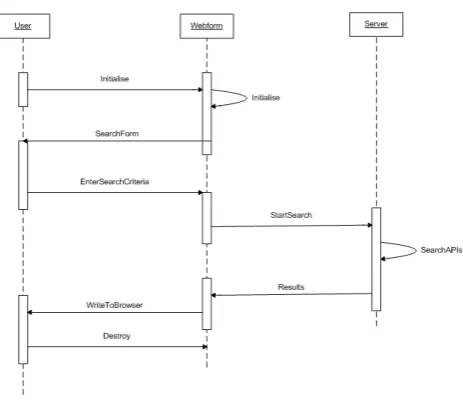
Sequence diagram of application Refer to Figure 2 which shows the sequence diagram of the application.
Figure 2. Sequence diagram of the entire application
This is the first screen we get after successful execution of the application. It is the user interface. We designed the interface to its simplest form. It consists of a text box where the user has to enter the search criteria. There is a button which on click goes to the next screen.(Refer to Figure 3 which shows the first screen shot of the application)
Figure 3. Initial Screen shot of the application
On click of the search button the user is directed to the results page. Here as we can see we first get the results from amazon.com.
201
Figure 4. Search for Apple ipod mini
Below the results from amazon.com the user view the results from “epinions.com” for the same item as shown. The results from “epinions.com” are accessed via google.com. (Refer to Figure 5)
Figure 5. Results of Searching
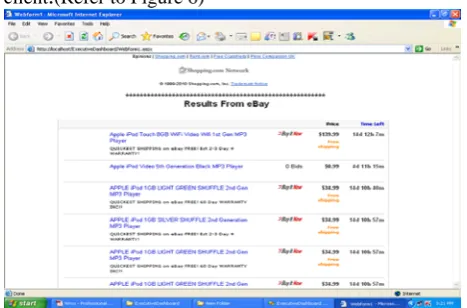
This is the final phase of the application where the results from eBay are displayed for the search item. As in our example “Apple iPod mini”.
This is the end of implementation phase as all the screens show the fulfillment of the requirements of the client.(Refer to Figure 6)
Figure 6. Final Results of Implementation
CONCLUSIONS AND FUTUR WORK
We are so glad to see what we have achieved after a long semester effort- a business website with an innovative business idea, comprehensive and considerate service, friendly and warm interface, most importantly, the optimistic huge market value. This is from a cooperative and hard working team. At the beginning period of our project, we proposed several different plans, and each sounded very reasonable, but we respected each other’s idea, and discussed without biased in order to choose out the best one.
During the designing period, we all tried to do what he or she could do, and no one talked about if the work distribution was fair or not. Furthermore, we helped each other out, and never retained anything within him or her. We learned from each other, and encouraged each other whenever we felt depressed. Due to the lack of practical experience in developing complete systems, we did feel a lot of pain during the process for this project, as we always came up more requirements than planned while having to make the schedule. But the best thing was we had never given up, and we came to know that things can be more perfect but never be completely perfect. The result was we were very happy to see the good responses from the professor and our classmates during the demo. We sincerely hope that all the users of “Dashboard” realize their wishes as we did.
In order to continue our great dream of Dashboard, we, of course, will put more efforts in it so we have some future plans to create more value-added functions, design more interesting interfaces, and even integrating more APIs of web-services. The major future plans are summarized in the following directions.
APIs
Web Services is still a new technology, a novelty that applications (Web or Desktop) are just starting to use. Most likely, this technology will evolve and change rapidly. To take advantage of new features and bug fixes, Dashboard will also need to update to newer versions on a regular basis. Also, because of time limitations, for now the Dashboard application can only search for items on eBay and Amazon. Future development may allow users to actually buy items or post items for auction in eBay. A key idea of Dashboard is to allow users to see buyer demand before auctioning items, and to find out which items are popular, and likely to receive more bids. It only seems only natural to also allow users to quickly auction an item where they never have to leave our interface, and may then be tempted to use a competing application’s software.
User Interface
202
interface will show all of the interesting functions basedon different customers.
Meanwhile, the platform will dynamically show different information and functions for different customers based on their individual interests and settings. In briefly, we hope we can provide a personalized space for our customers to enjoy all of information what they want.
For details of implementations source code (pseudo code) and documentation please refer to the web site
http://sites.google.com/site/kpresearchgroup
ACKNOWLEDGMENT
The authors wish to thank the following for implementing these concepts: B.Naveena Devi, V.Lavanya, Sri latha, Sri Harsha, Shika Tagore, Anand Kumar, Kadali and Srija.
REFERENCES
[1] Li Lan, Rong Qiao-mei “Research of Web Mining Technology Based on XML”, IEEE International Conference on Network Security, Wireless Communications and Trusted Computing, Vol.2, pp. 653-656, 2009.
[2] Susac, D. (2003), Web Usage Mining and SQL Server 2000, ASP Today,
[3] ftp://ftp.asptoday.com/AspToday/Articles_20020923_01_1 .zip
[4] Jespersen, S.E., Thorhauge, J., Pedersen, T.B., (2002), A Hybrid Approach to Web Usage Mining, Technical Report, Department of Computer Science, Aalborg University [5] Liu, B. (2007), Web Data Mining, Springer - Verlag, New
York, ISBN - 13: 9783540378815
[6] professional development with open web APIs text book [7] Jose Miguel Gago, Carlos Juiz “Web Mining Service