ISSN 2286-4822 www.euacademic.org
Impact Factor: 3.1 (UIF)
DRJI Value: 5.9 (B+)
Three Dimensional Integrated Circuit (3d IC):
An Overview
C.S. MOHAMMED SHAUL HAMMED ALI
MS (VLSI and ESD) JNTU, Hyderabad, (AP) India
Abstract:
A three-dimensional Integrated circuit (3d IC) is a chip in which two or more layers of dynamic electronic mechanics are coordinated both vertically and horizontally into a single circuit. The promising three-dimensional (3d) assimilation technology is one of the emerging solutions to conquer the boundaries in interconnect scaling, accordingly offering a chance to proceed with execution upgrades utilizing CMOS technology. As the manufacture of 3d incorporated circuits has gotten reasonable, creating CAD instruments and structural systems are basic for the fruitful selection of 3d Integration technology. In this article, we first give a short definition about 3d IC, and it’s important. Then brief some advantages, dis-advantage, benefit and challenges of 3D IC. And lastly present the architecture and manufacturing technology performance of 3D IC Technology.
Key words: 3DIC concept, Importance, Benefit & Challenge, 3D IC architecture, performance of 3D IC
Introduction
have turned into a significant execution and power bottleneck. As the technology scales, results are required that can conquer the confinements of wiring necessities for present and future chip plans. A three-dimensional integrated circuit is a chip in which two or more layers of active electronic components are integrated both vertically and horizontally into a single circuit. It offers an alluring answer for conquering the hindrances to interconnect scaling, along with offering a chance to proceed with execution upgrades utilizing CMOS engineering, with a littler structure element, higher integration thickness, and the backing for the realization of mixed technology chips.
The vast development of Information & communication industry is relying upon VLSI circuits with expanding usefulness and execution at least cost and power dissemination and 2d Ics create different gate delays and interconnection delay. In order to minimize these delays and total power consumption these technologies have been introduced, at first Intel introduced 80 core chip in 2007 in which run the frequency of 1.4GHz.
Concept of 3 D IC
The large development of computer and information technology industry is completely relying on VLSI circuits with expanding functionality and execution at least cost and power dissipation and 2D ICs create different gate delays and interconnection delay. In order to reduce these delays and total power consumption, 3D IC technology is introduced. From the beginning Intel presented a 80core chip in 2007 which run at the recurrence of 1.4 Ghz.
concept that can fundamentally enhance interconnect performance, increase transistor packing density, reduce chip area and power dissipation. In 3D design structure the entire chip “Si” is divided by the number of layers of oxide and metal to form transistor.
Importance of 3D IC
It is important to clarify that multiple-die packages have been around for a number of years. What is meant by “3D IC.” Technologies such as wire-bonded system -in package (SiP) and multi-chip module (MCM) have been used since the 1990s to refer to packages in which numerous die is mounted on a typical substrate. With packaging- package (PoP), one section may be mounted on an alternate part.
Wire holding limits Sip execution, acquire space, and consumes important power. A silicon interposer layer can give much better, and a lot of debt to die interconnection. A silicon interposer might incorporate TSVs to give associations between die on both sides, or between upper metal layers and extra backside metal layers. The utilization of a silicon interposer with side-by-side die is regularly alluded to as "2.5d" stacking.
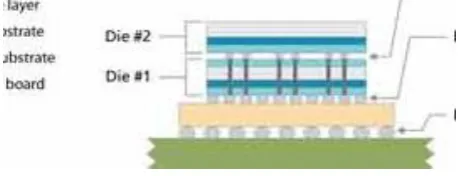
Stacked die designs are as of now utilized for huge memories today. On the other hand, the true estimation of 3d Ics will be acknowledged when heterogeneous die is bundled together for instance logic plus memory, or analog/RF plus MEMS.
the entire chip "Si" is divided by the amount of layers of oxide and metal to structure transistor.
Figure 1 3D IC with two die
Advantage of 3D IC
3D IC is offering many potential advantages compared to traditional, 2d Socs. A portion of the key advantages as follows
Reduced mixed-signal challenges
3D die stacks can leave analog and RF circuitry at a mature process node, such as 90nm or 130nm, where proven IP is available and manufacturing challenges are reduced.
Sensitive analog circuitry and noisy digital circuitry can now be kept separate.
Increased performance, lower power
Shorter interconnect delays allow faster interconnect speeds and wider busses between logic and memory, helping meet bandwidth requirements.
Power and latency are reduced because big I/Os are no longer needed.
Miniaturization, making 3D ICs appealing for compact mobile devices.
Proven die-level IP can be used, taking the concept of “IP reuse” to an entirely new level.
Digital and analog circuits can be formed with better noise performance
Expanded memory capacity
Bus turn around time will reduce (Improved bus efficiency)
Active termination power reduction ; Lower power consumption
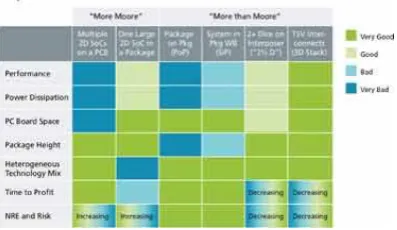
Figure 2 shows a comparison of several different implementation choices, including 3D stacks with TSVs on the far right.
Figure 2: 3D ICs with TSVs offer the best performance, power, and density characteristics.
Disadvantage of 3D IC
The followings are some disadvantages as follows: Higher cost
It drill holes/Fill plug by metal/Put bumps Thinning
Handling/Align
2 types of die (Master and Slave)
Benefits and Challenges of 3D Integration
the supply chain for the production of 3D SICs is fixed. The next paragraphs outline these benefits and challenges and set the stage to understand why chip stacking is considered so important a step in integration as well as the remaining challenges that need to be addressed before this technology can become mainstream.
Benefits
Heterogeneous Integration
Typical consumer devices include a number of heterogeneous functionalities, like processing, sensing, memory, data transmission, which cannot be incorporated in a single die, because the underlying process technologies need to be optimized for the individual purposes. Chip stacking offers an alternative to board-level connectivity and system- in package solutions which suffer from reduced interconnection density between the functionalities and increased board footprint, hence cost. Does can be manufactured in different process technologies, even in different foundry lines or by completely different vendors and can be bonded at a later stage by a third party. This enables, for example, to stack DRAM memory on logic processing or analog and RF functionalities with baseband processing on a single chip. The increased interconnection density opens up new opportunities for efficient system integration.
High Degree of Integration in a small form factor
amount of z-axis real estate, the chips need to be less than a couple of millimeters thick. Moreover, consumer electronics manufacturers are pushing chip vendors to increase the functionality per chip in order to reduce the component count on the printed circuit board and cost as a result. Stacking of thinned chip is the only technology available currently that can densely pack more functionality than ever before into a very thin package. This may be the key to enable the next wave of consumer electronics miniaturization.
Improved Power Consumption
other. This enables a severe of a planar die can now be placed on top of each other. This enables a severe reduction of interconnect lengths which directly translates to reduced power consumption or even faster data transmission if necessary.
Cost Benefits
will complement traditional CMOS to enable the next stores of scaling for the semiconductor industry.
Technical Challenges
The potential benefits of chip stacking are too lucrative to ignore, Semiconductor companies, research centers and universities are spending significant time in an effort to address the following reaming technical challenges and make chip stacking a reality.
Process Steps
Stacking multiple chips, obviously require additional process steps. These steps can be clustered into three main functions, namely through silicon via (TSV) etching and filling, thinning and bonding. TSVs are the vertical interconnections between the different die, they connect an interconnect of the die where they are created to an interconnect on the die just below in order to establish an electrical connection. Creating them requires to etch holes through the silicon substrate in the appropriate die during its manufacturing and to later fill these holes up with conductive material. Thinning refers to a process step that thins the wafer with the TVSs to a thickness ranging from few tens of micrometers to a few hundred micrometers. This is an essential step in order to create a 3D SIC with a small thickness. The third important step is bonding were die are bonded together in pairs. This requires the careful alignment of the two die and their bonding such that the TSVs will land at the correct places to establish electrical connections with the lower die.
Operating Temperature
dissipated fast enough the temperature of the die increases, leading to problems such as increased leakage currents in the transistors and reliability degradation. Stacking of multiple die affects the power consumption density and the capability of the chips to dissipate heat. The power density increases because multiple die are thinned and bonded together in a small volume. The capability to dissipate this heat depends on the materials used in the chips and the package. In a stacked IC, the heat has to be potentially dissipated through another die. The difference in heat conductivity needs to be understood and evaluated. The fact that the die in the stack is thinned before bonding adds another level of complication; thicker die can spread heat much better than thin ones along their horizontal plane. One school of thought believes that this increase in power density can lead to a temperature increase in the overall die stack. Another school believes that even in conventional planar chips the temperature problems are encountered in small hotspots; hence, the problem is essentially similar. It is clear that some research is needed to compare the heat dissipation capabilities of conventional vs stacked integrated circuits in the context of their packages and to assess the impact of how and where heat is generated on the operating temperature of the die.
Mechanical Stability
connection may be jeopardized. Mechanical stress that builds up this source can have subtler effects as well. Stress engineering has been widely used in deep sub-micron technology nodes to improve the electrical properties of transistors. Mechanical stress due to thermal expansion can interfere with the stress carefully engineered in the transistor channel to destroy the on-currents of transistors. Another major source of problems is the handling of the thinned wafers. After thinning, wafers are so thin that they actually become flexible. Extreme care needs to be taken to make sure they are transferred from on a process step to the other without damaging them. The current solution for handling such wafers is to attach them to supporting carrier wafers, but even the operations of bonding and de-bonding them to and from the carrier wafers may create mechanical issues.
Testing
to efficiently test it. Partitioning the system functionality in multiple separate die can increase the complexity of such techniques, this impact needs to be better understood.
Bonding Strategies
Three ways exist to perform the bonding that creates chip stacks: wafer to wafer, die to wafer, and die to die, Each of these alternatives has clear advantages and disadvantages. Wafer to wafer bonding is the fastest, since multiple stacks are created at once, but the different die in the stack have to exactly the same shape of size. Die to wafer bonding is an intermediate solution where one wafer has been diced and individual die is bonded on the second wafer. This makes alignment more difficult, but it enables stacking of die with different physical dimensions and allows to pretest the die and to create stacks of functional die. Die to die bonding offers the most freedom to the foundry to mix and match operating die to create chip stacks. It is the least preferred approach, however, since it increases production time and cost significantly. Depending on the type of product any of the aforementioned approaches may be useful. Even wafer to wafer bonding which may result
Architecture for 3D IC
Although 3-D integration shows promise, significant challenges associated with the efficient circuit design and operation have hampered its adoption and further development. The most important issue in 3-D IC is heat dissipation. The thermal problem has already had an impact on the reliability and performance of high-performance 2-D ICs. The problem is aggravated in 3-D ICs, principally for two reasons: the devices are more packed, which results in higher power density; and the insulating dielectric layers between the device layers have much lower thermal conductivities than silicon. Furthermore, the third dimension brings both flexibility and difficulties to physical design algorithms. The existing 2-D metrics cannot be simply extended to generate similar metrics for 3-D designs. Take wavelength as an example: a bounding-cube'' might not have enough accuracy for wirelength estimation because of the existence of huge obstacles in z-direction. Also, a 3-D IC physical design problem is usually of higher complexity, with a much enlarged solution space due to the multiple device layer structure. Efficient 3-D physical design tools, including 3-D floorplanning, placement and routing tools, that are specifically designed to take the thermal problem into consideration, are essential to 3-D IC circuit design.
Figure-3 Architecture of 3D IC Design
Figure-4 Manufacturing technology for 3D IC
For Building 3D IC, there are 4 ways as follows:
Monolithic
of dynamic transistor circuitry. Follow by finishing the transistors utilizing etch and deposition forms. This monolithic 3d-IC innovation has been examined at Stanford University under a DARPA-sponsored grant
Figure-5 Monolithic
Wafer-on-Wafer
In this method the components of electronic are based on two or more semiconductor wafers, which are then adjusted, reinforced, and diced into 3d ICs. Each wafer might be thinned before or after bonding. Vertical associations are either incorporated with the wafers before bonding or else made in the stack after bonding. These "through-silicon vias" (Tsvs) pass through the silicon substrate(s) between dynamic layers and/or between a dynamic layer and an outer bond pad. Wafer-on-wafer bonding can reduce yields, since if any 1 of N chips in a 3d IC are blemished, the whole 3d IC will be imperfect. Also, the wafers must be the same size, yet numerous exotic materials (e.g. III-Vs) are made on much littler wafers than CMOS logic or DRAM (commonly 300 mm), complicating heterogeneous integration.
Die-on-Wafer
are adjusted and fortified onto die sites of the second wafer. As in the wafer-on-wafer system, thinning and TSV creation is performed either before or after bonding. Extra dice may be added to the stacks before dicing.
Figure-6 Die on Wafer
Die-on-Die
In this method, electronic parts are based on different dice, which are then adjusted and bonded. Thinning and TSV creation may be carried out before or after bonding. One advantage of die on die is that every segment die could be tried in the first place, so that one bad die does not destroy a whole stack. Moreover, each one die in the 3d IC might be binned beforehand, so they could be blended and matched to upgrade power consumption and performance (e.g. Matching various dice from the low power methodology corner for a mobile application).
Performance of 3D IC
In addition, one can determine maximum system performance as a function of the number of device layers. Maximum performance depends on power dissipation constraints. In the presence of power constraints, there are global technology scaling optima that yield maximum computation (for example, if devices are scaled too far, leakage consumes too much of the power). Simple models of device and system dependencies have been developed, and optimizations have been performed. These layering models ignore the impact of blockage due to signals passing through a device layer. As depicted in Figure 3 the results show significant potential advantage for 3D integration, with performance, increasing roughly as the square root of the number of circuit layers that are stacked. For these data points, device characteristics (i.e Vdd,VT,tox, gate length, mean FET width, wire half-pitch, and repeater spacing) have all been optimized for maximum performance where performance is calculated as Performance ¼ total number of logic switching events per second in a processor core.
Conclusion
technology can be widely adopted and become a market success. It is a relief to interconnect driven IC design.
REFERENCES
Cong, Jason. 2014. “3-D IC Physical Design and 3-D Architecture Exploration.docx.” Accessed August 15. Das, Shamik, Anantha Chandrakasan, and Rafael Reif.
“Performance of 3d Ic.pdf.” In Boston, Massachusetts, USA: ACM.
Dinesh, Kumar. 2011. “3D ICs”. Kukas: Jaipur Engineering College, accessed on 14/08/2014, http://www.slideshare.net/DineshKumar189/3d-ics#. Falkenstern, Paul, Yao Wen Chang, and Yu Wang. 2014.
“Three-Dimensional Integrated Circuits (3D IC) Floorplan.pdf.” Accessed August 15. IEEE.
Lee, Hsien-Hsin S., and Krishnendu Chakrabarty. 2014. “Test Challenges for 3D Integrated Circuits.” IEEE, IEEE Design & Test of Computers, 26–35. Accessed August 13. Lim, Sung Kyu. 2012. Design for High Performance, Low Power, and Reliable 3D Integrated Circuits. Springer Science & Business Media.
Maxfield, Max, and Editor. 2014. “Monolithic 3D IC Technologies.docx.” Accessed May,2014
Maxfield, Max. 2014. “Monolithic 3D IC Technologies | EE Times.” EETimes. Accessed July 15. http://www.eetimes.com/author.asp?section_id=36&doc_i d=1320241.
Papanikolaou, Antonis, Dimitrios Soudris, and Riko Radojcic. 2010. Three Dimensional System Integration: IC Stacking Process and Design. Springer Science & Business Media.
International Symposium on Physical Design, 63–64. ISPD ’14. New York, NY, USA: ACM. doi:10.1145/2560519.2565870.
Shen, (Bill) William Wu. 2014. “3DIC System Design Impact, Challenge and Solutions.” In Proceedings of the 2014 on International Symposium on Physical Design, 63–64. ISPD ’14. New York, NY, USA: ACM. doi:10.1145/2560519.2565870.
Trik, Mohammad, Boukan Behzad i, Babak Ansari, Siavash Emtiyaz, Shilan Rahmani Azar, and Fardin Mohammadi Darvandi. 2014. “An Overview of 3d Ic.pdf.” Research Journal of Recent Sciences 3 (6): 96–104.
Woychik, Charles G. 2014. “Real 3D IC Solutions.” In San Jose. Accessed December 8.
Wu, Banqiu, Ajay Kumar, and Sesh Ramaswami. 2011. 3D IC Stacking Technology. McGraw Hill Professional.
Xie, Yuan, Jingsheng Jason Cong, and Sachin Sapatnekar. 2009. Three-Dimensional Integrated Circuit Design: EDA, Design and Microarchitectures. Springer Science & Business Media.