Western University Western University
Scholarship@Western
Scholarship@Western
Electronic Thesis and Dissertation Repository
12-7-2012 12:00 AM
The Reasonable Effectiveness of Mathematics in the Natural
The Reasonable Effectiveness of Mathematics in the Natural
Sciences
Sciences
Nicolas Fillion
The University of Western Ontario
Supervisor
Robert W. Batterman
The University of Western Ontario Joint Supervisor John L. Bell
The University of Western Ontario Graduate Program in Philosophy
A thesis submitted in partial fulfillment of the requirements for the degree in Doctor of Philosophy
© Nicolas Fillion 2012
Follow this and additional works at: https://ir.lib.uwo.ca/etd
Part of the Epistemology Commons, Logic and Foundations of Mathematics Commons, Numerical Analysis and Computation Commons, and the Philosophy of Science Commons
Recommended Citation Recommended Citation
Fillion, Nicolas, "The Reasonable Effectiveness of Mathematics in the Natural Sciences" (2012). Electronic Thesis and Dissertation Repository. 997.
https://ir.lib.uwo.ca/etd/997
THE REASONABLE EFFECTIVENESS OF MATHEMATICS IN THE NATURAL SCIENCES
(Spine title: The Reasonable Effectiveness of Mathematics)
(Thesis Format: Monograph)
by
Nicolas Fillion
Graduate Program in Philosophy
A thesis submitted in partial fulfillment of the requirements for the degree of
Doctor of Philosophy
The School of Graduate and Postdoctoral Studies The University of Western Ontario
London, Ontario, Canada
THE UNIVERSITY OF WESTERN ONTARIO SCHOOL OF GRADUATE AND POSTDOCTORAL STUDIES
CERTIFICATE OF EXAMINATION
Supervisors Examiners
Robert W. Batterman Robert M. Corless
John L. Bell William L. Harper
Christopher Smeenk
Mark Wilson
The thesis by
Nicolas Fillion
entitled:
The Reasonable Effectiveness of Mathematics
is accepted in partial fulfillment of the requirements for the degree of
Doctor of Philosophy
Date
Abstract
One of the most unsettling problems in the history of philosophy examines how mathematics can be used to adequately represent the world. An influen-tial thesis, stated by Eugene Wigner in his paper entitled “The Unreasonable Effectiveness of Mathematics in the Natural Sciences,” claims that “the mira-cle of the appropriateness of the language of mathematics for the formulation of the laws of physics is a wonderful gift which we neither understand nor de-serve.” Contrary to this view, this thesis delineates and implements a strategy to show that the applicability of mathematics is very reasonable indeed.
I distinguish three forms of the problem of the applicability of mathemat-ics, and focus on one I call the problem of uncanny accuracy: Given that the construction and manipulation of mathematical representations is pervaded by uncertainty, error, approximation, and idealization, how can their apparently uncanny accuracy be explained? I argue that this question has found no sat-isfactory answer because our rational reconstruction of scientific practice has not involved tools rich enough to capture the logic of mathematical modelling. Thus, I characterize a general schema of mathematical analysis of real sys-tems, focusing on the selection of modelling assumptions, on the construction of model equations, and on the extraction of information, in order to address contextually determinate questions on some behaviour of interest. A concept of selective accuracy is developed to explain the way in which qualitative and quantitative solutions should be utilized to understand systems. The qualita-tive methods rely on asymptotic methods and on sensitivity analysis, whereas the quantitative methods are best understood using backward error analysis. The basic underpinning of this perspective is readily understandable across scientific fields, and it thereby provides a view of mathematical tractability readily interpretable in the broader context of mathematical modelling. In addition, this perspective is used to discuss the nature of theories, the role of scaling, and the epistemological and semantic aspects of experimentation. In conclusion, we argue for a method of local and global conceptual analysis that goes beyond the reach of the tools standardly used to capture the logic of science; on their basis, the applicability of mathematics finds itself demystified.
[T]here is no philosophy that is not founded upon knowledge of the phenomena, but to get any profit from this knowledge it is absolutely necessary to be a mathematician.
Daniel Bernoulli (1700-1782)
The goal we must always keep in sight is to strive to reach a secure judgment regarding the foundations of a science [. . . ]. But to penetrate the sciences at all, study of special problems is certainly indispensable.
Karl Weierstrass (1815-1897)
There’s no sense in being precise when you don’t even know what you’re talking about.
John von Neumann (1903-1957)
Although this may seem a paradox, all exact science is dominated by the idea of approximation.
Acknowledgements
This thesis is the result of a long process, and it would not have been actualized in any possible world were it not for the constant help, support, and opportunities brought to me by remarkable people who deserve my wholehearted gratitude. My first tips of the hat go to my co-supervisors, Robert W. Batterman and John L. Bell, two exceptional persons and exceptional scholars who have provided me with con-stant encouragement and inspiration. Their different, com-plementary styles resulted in a very fruitful arrangement.
In academia, it is hard to find professors energetically on the prowl for their students’ best interest, above and beyond what professor duties require. I have had the chance to have Bob Batterman doing that for me. Bob sup-ported and encouraged my efforts to acquire a stronger background in applied mathematics, even if it was a source of troubles, worries, and hindrances, and he inspirited me with a way of doing philosophy of science. For that, for the countless hours of discussions, for the great practical pieces of advice, for your moral and material support, and for accepting to supervise me, thank you.
Many thanks are also due to the three other members of the examination committee. From my first term at Western, I have sought to emulate the quality and breadth of the work of Bill Harper. Perhaps more importantly, Bill has been a model of enthusiasm, congeniality, and good-heartedness. I owe a mountain of thanks to Rob Corless at least as big as the book that we have written together. Rob gave me a working knowledge of applied mathematics without which this thesis would not have been possible. For all the hours invested in me, for the opportunities you brought me, and for your constant help, and support, thank you. In addition to those with whom I have had the chance to work with directly at Western, I would like to thank Mark Wilson, who has had a huge influence on my work. Mark’s Bunyanesque pink book and our conversations about related topics have completely changed my thesis project and my approach to philosophy of science.
I consider it both a duty and a great pleasure to thank all my friends, especially the remarkable people in the philosophy department at Western. In particular, I am inordinately indebted to the philosophers of science and mathematics and to the members of the Rotman institute. You make Western an incredibly stimulating environment. In particular, Erik Curiel, Bill De-mopoulos, Robert Moir and James Overton have inspired various parts of this work (perhaps without knowing it!). Also, I would like to thank my family, and particularly my parents, for their continual support and encouragement.
Contents
Certificate of Examination ii
Abstract iii
Epigraph iv
Acknowledgements v
List of Tables ix
List of Figures ix
1 Introduction: The Unreasonable Effectiveness of
Mathemat-ics as a Philosophical Problem 1
1.1 Three Central Philosophical Questions on Mathematics . . . . 2 1.2 Three Problems about the Applicability of Mathematics . . . 7 1.2.1 The Problem of Mixed Sentences . . . 8 1.2.2 The Problem of Unexpected Applicability . . . 10 1.2.3 The Problem of Uncanny Accuracy . . . 12 1.3 Rational Reconstruction and the Epistemology of Science . . . 15 1.3.1 Philosophical Stakes in Rational Reconstruction . . . . 15 1.3.2 Reconstruction Tools and the Problem of Uncanny
Ac-curacy . . . 20 1.3.3 Local and Global Analysis of of Concepts . . . 24 1.4 Summary of this Chapter and Outline of the Dissertation . . . 28
2 The Logic of Mathematical Modelling 31
2.1 The Mathematical Study of Real Systems . . . 32 2.2 Deriving Model Equations from Modelling Assumptions . . . . 37 2.2.1 Model Construction Recipes . . . 38 2.2.2 Two Examples: Kepler’s Two-body Problem and the
2.3 Idealization and Tractability of Models . . . 49
2.4 Effective Management of Representations . . . 53
2.5 Comparing Mathematical Representations . . . 65
2.5.1 Six Senses in which Models Represent . . . 66
2.5.2 Qualitative Behaviour and Selective Accuracy . . . 68
2.5.3 Universal Behaviour . . . 74
2.6 Summary . . . 84
3 Model, Theories, and Experimentation 87 3.1 Model and Theories . . . 88
3.1.1 Scale, Tractability, and Levels of Theories . . . 88
3.1.2 The Structure of Theories: Characterizing Laws and Other Mathematical Principles . . . 95
3.2 Experimental error and the mathematics of uncertainty . . . . 100
3.2.1 Accuracy, Error, and Uncertainty of Measurement . . . 101
3.2.2 The Mathematics of Uncertainty . . . 109
3.3 Summary . . . 115
4 The Solution of Model Equations and the Interpretability of the Results 117 4.1 Types of Exact Solutions and Their Virtues . . . 119
4.2 Numerical Solutions of Problems and Mathematical Tractability 126 4.3 Types of Error in Mathematical Modelling . . . 130
4.4 Backward Error Analysis . . . 133
4.5 Summary . . . 144
5 Conclusion: Demystifying the Applicability of Mathematics 146
A The “theory of measurement” 150
Bibliography 154
List of Tables
1.1 Some influential philosophical answers to questions Q1 and Q2 6
1.2 Three problems of applicability . . . 14
2.1 Six senses of ‘goodness’ of a model or representation . . . 67
3.1 Examples of random and systematic error . . . 106
A.1 Example of scales and admissible transformations . . . 152
List of Figures
1.1 Cubic problem at the origin of imaginary numbers . . . 121.2 Manifold structure . . . 26
1.3 Analytic continuation . . . 27
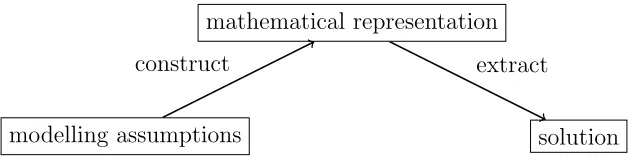
2.1 Schema of mathematical analysis of abstract systems . . . 35
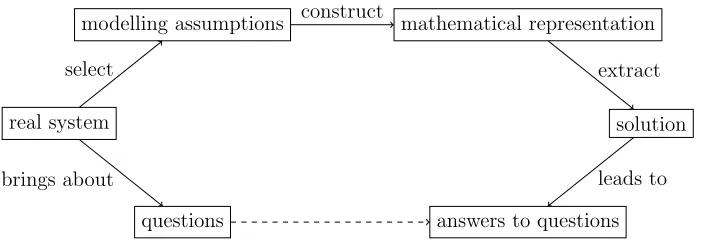
2.2 Schema of mathematical analysis of real systems . . . 37
2.3 The six simple machines . . . 38
2.4 Non-monotonicity of the derivation of differential equations . . 42
2.5 Time series x(t) for Kepler’s two body problem . . . 46
2.6 A configuration of an ideal lever . . . 47
2.7 Relation of the torque about an axis to the applied force . . . 48
2.8 A real lever . . . 51
2.9 Balancing factors in mathematical modelling . . . 52
2.10 A low resolution bitmap image with 12×12 pixels . . . 54
2.11 Bitmap image of a mandrill face in 8-bit gray shades . . . 56
2.14 Semilog-y plot of the size of the singular values . . . 60
2.15 Matrices as transformations of the unit circle . . . 62
2.16 Sensitivity analysis and aspect ratio of ellipses . . . 62
2.17 Sensitivity analysis and the singular-value decomposition . . . 63
2.18 Equation (2.10) is an extremely robust differential equation . . 70
2.19 Qualitative change in the solution of ˙x=x2−t . . . . 71
2.20 An example of bifurcation analysis for linear ODEs . . . 73
2.21 Phase portrait of the Lorenz system . . . 74
2.22 The logistic map for different values of the parameter µ . . . . 75
2.23 Geometrical features of the maps f and f2 . . . 77
2.24 Relation between the slopes of f and f2 . . . . 77
2.25 Bifurcation diagram of maps exhibiting period-doubling . . . . 79
2.26 Flow action of a renormalization operator in mechanics . . . . 82
3.1 Scaling of a beam . . . 89
3.2 An incorrect use of mathematics to an uncertain value . . . . 109
4.1 A way of getting to a number . . . 120
4.2 Venn diagram of the types of exact solutions . . . 121
4.3 Simple pendulum . . . 123
4.4 Oscillator with stiffness linearly increasing with t . . . 124
4.5 Floating-point numbers . . . 132
4.6 Qualitative difference resulting from small value change . . . . 137
4.7 Error in the evaluation of the Airy function . . . 138
4.8 Backward error analysis: The general picture . . . 139
Chapter 1
Introduction: The Unreasonable
Effectiveness of Mathematics as
a Philosophical Problem
Inquiries into the nature of mathematics as a science of its own and into its role in empirical science have a venerable tradition. Many of the ideas underlying the philosophical systems of Plato, Aristotle, Descartes, Leibniz, Kant, Mill, Frege, Husserl, Russell, Carnap, et al., have found their origin in disquisitions on this topic. The problem that is perhaps the most unsettling examines how mathematics can be used to adequately represent the world, given that mathematics displays a kind of exactness and necessity that appears to be in sharp contrast with the contingent character of worldly facts.
Pin-cock (2009), Steiner (1989, 2002), and Wilson (2000). The philosophers and mathematical scientists who have written on the problem of the applicability of mathematics have emphasized many different aspects relevant to their own fields of expertise. Since it would lead us in too many orthogonal directions, it will be impossible to begin our investigation with a systematic review of the literature. However, it is possible to begin with a conceptual articulation of the problem. Accordingly, in this first chapter, I will articulate the problem of the applicability of mathematics (1) by relating it to other philosophical ques-tions about mathematics (in section 1.1), (2) by describing the one instance of the problem I intend to address (in section 1.2), and (3) by explaining how the quest for a solution to that problem relates to fundamental questions in epistemology and philosophy of science (in section 1.3).
1.1
Three Central Philosophical Questions on
Mathematics
genuine knowledge, and attempt to progressively improve our understanding of what a correct justification is by examining those disciplines. Thus, follow-ing this strategy, the notion of justification that plays an essential role in our concept of knowledge is to be abstracted from particular instances of genuine knowledge.1
In this respect, mathematical disciplines have played a role quite distinct from the others. In the Republic (ca. 380 BC : book VI), Plato suggested that mathematics is the highest form of knowledge and—each for their own reasons—most natural philosophers in the tradition have shared this assess-ment. More than anything else, it has been claimed that if anything is to be considered knowledge, mathematics is. In this way, mathematical knowledge is typically regarded as an archetypal or paradigmatic case of genuine knowledge. In order to understand the significance of mathematics as an archetypal object of study for epistemology, something has to be said about what math-ematics is. This, however, has proved to be an exacting challenge. As von Neumann (1947) remarked, when addressing this very question, a “discussion of the nature of any intellectual effort is difficultper se—at any rate, more dif-ficult than the mere exercise of that particular effort.” As a result, the question has proved to be very controversial; indeed, it is not much of an exaggeration to say that it has received as many different answers as there are philosophers of mathematics. This being said, I will briefly sketch the typical approach to this question in order to better situate and differentiate the problem addressed by this dissertation.
For mathematics as for other kinds of knowledge, the first natural questions to ask are what this knowledge is about and how this knowledge is acquired. If we consider mathematical statements such as
S1. 31071 < π <317 (Archemedean approximation of π)
S3. eiπ+ 1 = 0, (Euler’s Identity)
it is important to determine what makes these statements genuine claims to knowledge and how we can ascertain the genuine character of these knowledge claims. Accordingly, two questions have traditionally occupied the centre of the stage:
Q1. What are mathematical objects?
Q2. How do we (or can we) obtain knowledge of those objects?
For instance, one might maintain along a classical empiricist line that mathe-matics is about empirical objects and that mathematical knowledge is acquired by experience only, just like any other kind of knowledge. This answer has been predominantly rejected, for it seems that the two questions above demand an answer which will differ from empirical knowledge claims such as
S4. All Cretans are liars.
S5. Hesperus is Phosphorus.
S6. Venus is the only planet in our solar system that rotates counter-clockwise.
To begin with, mathematical statements such as S1–S3 seem to be true in-dependently of the physical world. Moreover, it seems that mathematical knowledge can be obtained a priori. As Strawson explains,
[t]hat means that you can see that it is true just lying on your couch. You don’t have to get up off your couch and go outside and examine the way things are in the physical world. (reported in Sommers, 2003)
Furthermore, mathematical objects transcend experience, since objects such as 101010
[t]he laws of mathematics, as far as they refer to reality, are not certain, and as far as they are certain, do not refer to reality.
Philosophers have often made claims in the same spirit:
[t]he exactness of mathematics is an abstract logical exactness which is lost as soon as mathematical reasoning is applied to the actual world. (Russell, 1968 : 110)
[. . . ] the apparent contrast between the indefinite flux of sense-impressions and the precise and timeless truths of mathematics has been among the earliest perplexities and problems not of the philosophy of mathematics only, but of philosophy in general. (K¨orner, 1986 : 9)
As a result, mathematical knowledge seems to have a different logical status, to demand a different type of justification, and to have different semantic grounds. In response to these exigencies, many intricate solutions to the first two questions have been proposed; some influential proposals are listed in table 1.1, together with the main difficulties they face. More recent studies in philosophy of mathematics have developed at a more abstract level—by focussing on the notions of sets, proof systems, structures, and categories— in order to take account of the transformation of mathematics that began in the middle of the nineteenth century. Nonetheless, it has not fundamentally altered the questions on which philosophy of mathematics focuses.2
An important third question is often found entangled with these two. We apply mathematics to many real-world problems, both in science and in ev-eryday life. In evev-eryday life, our use of mathematics assists us in counting, accounting, planning, etc., by providing us with efficient conceptual tools on the basis of which we can make sound decisions. Moreover, as we will amply discuss in this dissertation, we also use mathematics in the sciences with the purpose of knowing how the world works. This leads us to a third question concerning the epistemological import of mathematics:
Q3. What grounds are there for the applicability of mathematics to the physical world, whereby applications generate new empirical knowl-edge?
Position Answer to Q1 Answer to Q2 Main difficulty Naive empiricism empirical
ob-jects
experience no necessary truths
Platonism otherworldly universals impossible (recollection) assumes transmigration of souls
Ante rem realism otherworldly universals
special intu-ition
problem of epistemic ac-cess
Nominalism (or post rem realism)
abstracted concepts
abstraction knowledge-dependent & limited scope
In rerealism (or “Aris-totelian” realism)
in re univer-sals
abstraction limited scope & not parsi-monious
Fictionalism no object stipulation not all conventions are mathematically equal
Table 1.1: Some influential philosophical answers to questions Q1 and Q2.
This question introduces the problem of the applicability of mathematics on which this dissertation will focus. Insofar as it demands us to construct a bridge between mathematical statements and statements about the physical world, this question introduces a whole new set of difficulties that bring the philosophy of mathematics to “a treacherous frontier, where theorizing about the nature of thought, language, and the world must come together” (Avigad, 2007).
It is important to point out that, even if those three questions are essen-tially different, they cannot be treated in a completely independent manner. In some cases, certain types of answer to questions Q1 and Q2 make it rela-tively straightforward to satisfactorily account for aspects of the applicability of mathematics—e.g., empiricism, nominalism, and in re realism—whereas other types of answers make it more difficult—e.g., Platonism and fictional-ism. The converse relation also obtains: some satisfactory accounts of the applicability of mathematics make it difficult to provide satisfactory answers to the first two questions—e.g., naive empiricism. In fact, it is precisely this tension that, in my opinion, has proved to be the most vexing problem in traditional philosophy of mathematics.
has nonetheless some importance. Philosophers have most often started with a certain conception of pure mathematics (answering Q1 and Q2) and then attempted to extend it to applied mathematics. Now, if one suspects that the conceptions of pure mathematics in question might be at least partly responsi-ble for the conceptual difficulties inherent in the proresponsi-blem of applicability, then one must reverse the order. Many works in the recent literature have favored such a reversal. For instance, Wilson (2006) has argued that one must study the efficient descriptive strategies developed by applied mathematicians to un-derstand how concepts in general work, and Maddy (2008) has argued that one should not think of the philosophy of pure mathematics independently of the philosophy of applied mathematics. The general idea is finely epitomized by Emch & Liu (2002 : 39):
A superficial commentator might be tempted to advance that some—or even much—of pure mathematics is established in a “context-free” manner; we ar-gue, in contrast to this caricatural view, that much of the appeal and integrity of the sciences [. . . ] depends on the fact that their practitioners have to take into account the necessity of traveling back and forth between different “con-texts.”
For this reason, my dissertation will prioritize Q3, without assuming specific answers to Q1 and Q2.
1.2
Three Problems about the Applicability
of Mathematics
1.2.1
The Problem of Mixed Sentences
In fact, we do not only formulate purely mathematical statements similar to S1–S3 and essentially empirical statements similar to S4–S6 above. Question Q3 is forced upon us by the existence of a third kind of knowledge claim, such as
S7. P(it will rain tomorrow) = 70%
S8. F= dp
dt =ma=−kx (Newton’s 2
nd law and Hooke’s law)
S9. P V =nRT (Perfect gas law)
S10. ρ �
∂v
∂t +v· ∇v �
=−∇p+∇T+f (Navier-Stokes equation)
Sentences of this kind involve both empirical concepts and mathematical con-cepts; they are neither exclusively about mathematical nor about worldly ob-jects. I will call such statements mixed sentences.3 Typically, statements of
applied mathematics and of the mathematical sciences—such as mathematical physics, biology, economics, etc.—are of this type.
The problem of mixed sentences, as I call it here, focuses on providing semantic conditions meant to account for the meaningfulness of mixed sen-tences. One normally provides semantic rules of interpretation for sentences (often via truth-conditions) by determining conditions for the evaluation of the basic relations of predication, implication, identity, and other similar basic relations. However, providing a semantics for mixed sentences introduces some additional difficulties, as the basic relations range over different domains—of physical and of mathematical objects. For instance, our normal understanding of sentences such as “humans are mortal” is that if an arbitrary object is a human, then it also is mortal. There is a relation of inclusion. However, if we consider sentences such as “physical space is non-Euclidean,” we are not
in fact claiming that physical space is one of the mathematical objects called non-Euclidean spaces. As opposed to what such a literal interpretation would suggest, the assertion should not be interpreted as saying that some physical objects are mathematical objects, but rather that they share certain features. Accordingly, the problem of mixed sentences seeks a set of interpretation rules that will correctly articulate how features can be shared by mathemat-ical objects and worldly objects, despite their very different nature. Many approaches have been developed to address this problem. A natural approach is to base those rules on a theory of abstraction. On the one hand, by ex-plaining how our cognitive faculties abstract mathematical concepts from our experience, we can articulate how structures can be shared by physical and mathematical objects in cognitive terms. On the other hand, many proposals have been made to characterize the rules of interpretation on the basis of a log-ical (rather than cognitive) notion of abstraction. In fact, modern philosophy of mathematics is tightly connected with the efforts of Dedekind, Cantor, and Frege to formulate how mathematical objects can in some way be considered abstract correlates of empirical objects. Dummett (1991 : p. 293) explains the role of this problem in Frege’s philosophy:
Frege’s objective was to destroy the illusion that any miracle occurs [in appli-cations]. The possibility of the applications was built into the theory from the outset; its foundations must be so constructed as to display the most general form of those applications, and then particular applications will not appear a miracle.
The approaches based on a logical notion of abstraction have been developed in many ways. The idea behind them is to elaborate on the notion of shared structure in terms of morphisms relating empirical and mathematical systems. Typically, those are taken to be homomorphism or isomorphism (see, e.g., Appendix A for a Suppesian instance of this approach).
particular, discussions of the interpretability of mixed sentences don’t say much about situations in which the problems with applicability are not about the conditions of meaningfulness of mixed sentences, but about cases in which we have a multitude of meaningful mathematical representations that we would like to assess and mutually compare with respect to their accuracy.
1.2.2
The Problem of Unexpected Applicability
A second aspect of the problem of applicability has been emphasized in many publications, perhaps most famously in Wigner’s paper on “the unreasonable effectiveness of mathematics in the natural sciences” (Wigner, 1960). He ar-gues that the “miracle of the appropriateness of the language of mathematics for the formulation of the laws of physics is a wonderful gift which we neither understand nor deserve.” The claims made in this paper are very evocative, but they are nevertheless hard to interpret, for Wigner addresses a collection of entangled problems. I will in what follows isolate two of these problems; in this section, I begin with the problem of unexpected applicability, as I call it. Wigner adopts a view of mathematical concepts and objects that many mathematicians share. According to this view, the concepts of mathematics must be separated into two classes. On the one hand, we have the concepts of elementary arithmetic (e.g., natural, rational, and irrational numbers) and those of elementary geometry (e.g., the ratio of the circumference of a circle to its diameter); these “describe entities which are directly suggested by the actual world” (p. 2). On the other hand, we have the more advanced concepts of mathematics (e.g., complex numbers, algebras, linear operators, Borel sets) for which this is not the case. According to Wigner, these “were so devised that they are apt subjects on which the mathematician can demonstrate his ingenuity and sense of formal beauty” (p. 3). In slightly different terms, he says that the more advanced concepts “are defined with a view of permitting ingenious logical operations which appeal to our aesthetic sense [. . . ]” (p. 3).4
He elaborates on the case of the complex numbers since they “provide a par-ticularly striking example for the foregoing” (p. 3). He provides the following explication:
Certainly, nothing in our experience suggests the introduction of these quan-tities. Indeed, if a mathematician is asked to justify his interest in complex numbers, he will point, with some indignation, to the many beautiful theorems in the theory of equations, of power series and of analytic functions in gen-eral, which owe their origin to the introduction of complex numbers. (Wigner, 1960 : p. 3)
Against the background of the assumption that the more advanced concepts of mathematics are introduced for the sake of exhibiting formal beauty, he asks: why are those more advanced concepts so effective for the formulation of the laws of physics?
This question introduces new aspects of the problem of applicability, es-pecially for mathematical objects constructed and studied with no intended applications. How can it be that concepts of this sort find unexpected applica-bility in physics, sometimes in fundamental places? The main instance of this phenomenon that Wigner discusses is the unexpected applications of matrix algebra in quantum mechanics. According to him, it is miraculous that there are regularities at all “despite the baffling complexity of the world,” it is a miracle that we can discover them, and it is also a miracle that mathemati-cal concepts introduced for aesthetic reasons turn out to unexpectedly apply (sometimes at a very fundamental level).
It is certainly not easy to provide an answer to this problem. One strat-egy for dealing with it would consist in denying the very view of advanced mathematics that it presupposes. Thus, we may ask: is it true that nothing in our experience suggests introducing complex numbers? A widespread story, according to whichi=√−1 is introduced by mathematicians to algebraically close the real numbers (in which the polynomial equation x2+ 1 = 0 has no
solution), lends credibility to the aesthetic account favored by Wigner. How-ever, as Needham (1997) explains, it is the solution of intuitively meaningful
intersection of y =x3
and y =−0.3x+ 1
Figure 1.1: Intuitively meaningful cubic problem at the origin of imaginary numbers. The root is real, but its computation using Cardano’s method re-quires imaginary numbers.
problems such as finding the roots of x3 = 3px+ 2q that historically required
introducing complex numbers (see figure 1.1).5 This was required for the use
of the computational method known at the time—the Cardano method. Thus, it is practically important cubic problems, and not the fancy of mathemati-cians craving to exert ingenuity, that historically justified introducing complex numbers.
It is possible, however, that there may remain parts of mathematics for which Wigner’s assumption will still hold. However, the problem of unexpected applicability will be mostly solved if one could show that the main examples appealed to in the literature can be handled in a way similar to that of the complex numbers. However, I will not focus on this aspect of applicability either, but rather on another one that is complementary to both this one and to the problem of mixed sentences.
1.2.3
The Problem of Uncanny Accuracy
There is a third important aspect of the problem of applicability of mathemat-ics that Wigner introduces in contradistinction to the problem of unexpected applicability. Here is how he introduced it:
The observation which comes closest to an explanation for the mathematical concepts’ cropping up in physics which I know is Einstein’s statement that the
only physical theories which we are willing to accept are the beautiful ones. It stands to argue that the concepts of mathematics, which invite the exercise of so much wit, have the quality of beauty. However, Einstein’s observation can at best explain properties of theories which we are willing to believe and has no reference to the intrinsic accuracy of the theory. (Wigner, 1960 : p. 7)
Thus, in addition to the considerations from the last section, there is a funda-mental story to tell about the intrinsic accuracy of mathematical representa-tions. As Wigner (1960 : p. 8) explains,
[i]t is important to point out that the mathematical formulation of the physi-cist’s often crude experience leads in an uncanny number of cases to an amaz-ingly accurate description of a large class of phenomena. This shows that the mathematical language has more to commend it than being the only lan-guage which we can speak; it shows that it is, in a very real sense, the correct language.
The uncanny accuracy that Wigner describes extends to all aspects of math-ematical modelling and theorizing. Mathmath-ematical representations are often based on crude experience, but they are also based on intrinsic limitations regarding what can be mathematically achieved. In this respect, computer simulations and numerical approximations introduce an additional dimension to the problem of uncanny accuracy. Hamming has a nice example of this:
My first real experience in the use of mathematics to predict things in the real world was in connection with the design of atomic bombs during the Second World War. How was it that the numbers we so patiently computed on the primitive relay computers agreed so well with what happened on the first test shot at Almagordo? There were, and could be, no small-scale experiments to check the computations directly. [. . . ] this was not an isolated phenomenon— constantly what we predict from the manipulation of mathematical symbols is realized in the real world. (Hamming, 1980 : p. 82)
Problems of Applicability Examples of Solution Candidate
Mixed Sentences Theory of cognitive abstraction, theory of log-ical abstraction, theory of shared structures in terms of morphisms
Unexpected Applicability Einsteinian aesthetic discrimination, accounts of pre-established harmony, “tinted glasses” perspectivism, theory of embodied mind Uncanny Accuracy A concept of differential mathematical fitness
Table 1.2: Three problems of applicability and corresponding solution candi-dates.
Given that the effective construction and manipulation of mathematical representation is pervaded by uncertainty, error, and approximation, how can their apparently uncanny accuracy be explained?
Chapter 2, chapter 3, and chapter 4 will describe the circumstances in which uncertainty, error, and approximation creep into our practice of mathematical modelling, and how they are handled.
To end this subsection, I would like to emphasize that this problem differs significantly from the other two problems of applicability (see table 1.2). The first two problems focus on the conditions of possibility for meaningfully using mathematics to gain knowledge about the real world.6 This third problem
is not asking how mathematical representations can meaningfully be built. Rather, it starts from the fact that applied mathematicians do, as a matter of fact, use mathematics to fruitfully gain knowledge of the world. However, it stresses the fact that—seemingly against all odds—the ingredients used to
cook up accurate representations are themselves lacking in accuracy in essential ways. Thus, the problem consists in explaining how to compare the virtues of different mathematical representations, and how to explain the success of those that have a comparative advantage. As I will explain later, I believe that a satisfactory solution to this problem consists in the specification of a concept of differential mathematical fitness that explains how the accuracy of our mathematical representations is not so uncanny after all. In the next section, I will explain in what respects this problem is not the exclusive turf of applied mathematicians, but also touches on deep philosophical problems.
1.3
Rational Reconstruction and the
Episte-mology of Science
Accordingly, this dissertation will furnish an account of why mathematics ap-plies so successfully to the real world, despite apparently compelling a priori reasons that it should not. I now turn to a discussion of the philosophical methodology that appears to be proper for the resolution of this problem. Ac-cordingly, the objective of this section is to delineate a philosophically sound methodology for this investigation, in a way that reveals how I intend my theses and arguments to be interpreted.
1.3.1
Philosophical Stakes in Rational Reconstruction
its point is to explain the reliability of scientific knowledge and to delimit its scope. Epistemology aims to provide grounds for evaluating what knowledge claims are in fact genuine knowledge; in particular, what claims, hypotheses, models, theories, methods should be considered scientifically warranted. Epis-temology does not, as a result, take as its objects the actual thought processes of scientists, the actual words used by scientists, or even what scientists take their own activity to be. Rather it envisages a better scenario in which the claims, hypotheses, models, theories, and methods are accounted for not by fortunate mistakes, serendipity,etc., but rather by a rationally compelling pre-sentation they ought to have. Thus, to use the term introduced by Carnap (1928), the object of the epistemology of science is a rational reconstruction of science. The question, then, is:
What aspects, if any, of scientific practice should bear on our normative, ideal image of science?
In particular, is thede facto omnipresence of idealization, approximation, and error a mere contingency that has little place in a rational reconstruction, or should it occupy a prominent place? Based on an examination of the practice of applied mathematicians, I will argue for the latter.
Nonetheless, my approach seeks to formulate a normative rather than a strictly descriptive discourse on science. That this is the objective of epis-temology is, in my opinion, not controversial,7 but there have been multiple debates regarding the relation between facts and norms in philosophy of sci-ence.8 The essence of the controversy stems from the fear of committing the
is-ought fallacy decried by Hume (1739 : Book III). As it happens to be the case, our paradigm for thinking about norms are the rules that prescribe action by determining what is to be considered legal or not, e.g., ‘one ought not to cross an intersection when the light is red.’ In such cases, there is a very clear
7Some philosophers would disagree, especially if ‘normative’ is assimilated with ‘prescrip-tive,’ i.e., with the enunciation of dictates to scientists. However, the normative aspect of epistemology also includes evaluative and comparative claims that are surely normative in character.
direction of fit: if someone crosses the intersection on a red light, it does not invalidate the law. Thus, particular actions are immaterial to whether the law stands or not. Since epistemology is also normative, it would seem to make it impossible to infer what should be considered science from what scientists actually do, as I suggest, for that would involve the same is-ought fallacy.
At the same time, most philosophers of science would grant that our ra-tionally reconstructed ideal of science should stand in some relation of corre-spondence to actual science.9 According to Brown (1980), this sort of situation
leads many philosophers of science to a “schizophrenic attitude” toward the relation between facts and norms in philosophy of science. As he explains:
On the one hand, they want their philosophical accounts of how science ought to be done to do justice to typical scientific practice; but on the other hand, they want to avoid any confusion of historicalfacts with philosophicalnorms. (Brown, 1980 : p. 236)
The objection leads us to a schizophrenic attitude to the extent that it assumes that there is no acceptable way to philosophically rationalize inferences from facts about typical scientific practice to aspects of our normative ideal of sci-ence,i.e., that it always involves the is-ought fallacy. If this fear of committing the is-ought fallacy were sound, then it would represent a serious objection to the methodology I propose.10
As I have argued, the fact that there is omnipresence of approximation, error, and uncertainty in science motivates the study of the problem of the un-canny accuracy of mathematics without first answering the first two problems of applicability nor even the first two problems of philosophy of
mathemat-9This idea is clearly expressed by Reichenbach (1938 : p. 6): “In spite of its being per-formed on a fictive construction, we must retain the notion of the descriptive task of epis-temology. The construction to be given is not arbitrary; it is bound to actual thinking by the postulate of correspondence.”
ics. I consider it to soundly motivate an epistemological investigation, since the observations and analyses made would positively alter (at the very least complement) our ideal epistemological image of science. If, however, no such inference can be made, this motivation would be in jeopardy. To disperse such qualms, I will begin with a discussion of what I intend the normative aspect of my dissertation to be, in relation to the idea of rational reconstruction.
The dimension of the rational reconstruction process that generates an ob-ject of study suitable for a properly epistemological analysis of knowledge is often presented as an invective to distinguish the context of discovery from the context of justification. Here, discovery and justification should not be thought of as two temporally distinct processes—first, you discover something and then later you justify it—since the typical development of science involves alternating phases of discovery and justification that inform one another. As emphasized by Salmon (1970), there might be overlap between the two con-texts. The distinction between the contexts is one between processes of dis-covery versus methods of justifications. The phrase “methods of justification” denotes what satisfactorily establishes knowledge claims, independently of the beliefs of the historical actors. Clearly, what is to be included in the context of justification is determined by what methods and tools are considered ratio-nal; different choices might result in different organizations of what belongs to what context.
The role of philosophy of science, from this point of view, is to determine by philosophical analysis what should count as satisfactorily establishing knowl-edge claims, that is, what counts as a rational method of justification. It is important to emphasize that which methods of justification are rationally ad-missible is not god-given; there is room for disagreement about justification, which may be rationally discussed by philosophers. It is in this respect that facts about actual science may have normative import:
philosophical reasoning hadgone astray than to suppose that modern science is logically misconceived. (Salmon, 1970 : emphasis added)
This explains the normative relevance of actual scientific practice. Historical episodes confirm or disconfirm views on how rational reconstruction ought to be done because, if we use reconstructive tools that are misguided or insuffi-ciently far-reaching, our assessment of historically important scientific events can turn out to be wrong:
It would be a travesty to maintain, in any simple-minded way, that the histo-rian of science is concerned only with matters of discovery, and not with mat-ters of justification. In dealing with any significant case, say the replacement of an old theory by a new hypothesis, the historian will be deeply interested in such questions as whether, to what extent, and in what manner the old theory has been disconfirmed [. . . ]. Such historical judgments—whether a particular historical development was or was not rationally justified on the basis of the evidence available at the time—depend crucially upon the historian’s under-standing of the logic of confirmation and disconfirmation. (Salmon, 1970 : 391)
To make his point, Salmon argues that the hypothetico-deductive model of confirmation cannot account for the rationality of important historical events. Under this view, confirmation is a process of deduction of observational con-sequences from hypotheses (together with initial conditions and auxiliary hy-potheses) and of verification of whether the predictions (or retrodictions) in fact obtain. However, this approach does not provide the conceptual machin-ery necessary “for claiming that either of these laws is any better confirmed by the available evidence than any one of the infinitude of alternatives” (p. 393). Consequently, “it stands in dire need of supplementation” (p. 393). On that basis, we can make normative assessments of reconstructive toolboxes based on the discrepancy between the normative work that it is supposed to do and some facts about scientific practice.
conse-quences of alternative hypotheses (i.e., the likelihood of the evidence given the alternative hypotheses) and initial plausibility judgements of each of the al-ternatives (which the Bayesian approach captures with its priors). Moreover, he maintains that such factors are essentially absent from the hypothetico-deductive reconstruction schema.
The case I present here parallels Salmon’s case.11 Indeed, to make correct
judgements on the use of mathematics in science, it is necessary to have a cor-rect understanding of the “logic” of model construction and model assessment. However, as I will argue in the next subsection, the standard logical reconstruc-tions fall short of this task. Thus, a revision or supplementation of the logical reconstructive tools is in order. If we were not carefully considering expand-ing the field of admissible reconstructive methods, almost all of mathematical sciences would be wrongly considered methodologically unsound. Thus, this dissertation is intended as a reflective study on the methods of mathematical reasoning actually used in applied mathematics, supplemented by normative conclusions regarding our ideal image of science.
1.3.2
Reconstruction Tools and the Problem of Uncanny
Accuracy
The uncanny accuracy of mathematics has been claimed to be miraculous in the sense that it does not seem to admit of any rational explanation. How-ever, as I have explained in the previous subsection, the line between what is rationally justifiable (or explicable) and what is not depends on the admissible resources that we grant for the reconstruction of scientific practice. One way to articulate the problem, then, is that the a priori reasons that make it hard to understand how mathematics applies so well (despite the fact that errors of all sorts are an intrinsic part of the way in which scientists represent the world and of the way in which they reason about concepts) result from an insufficiently
rich way of rationally reconstructing scientific and mathematical knowledge. Accordingly, in order to demystify the allegedly miraculous character of the applicability of mathematics, insofar as the problem of uncanny accuracy is concerned, we need to suitably modify the catalogue of methods admissible for the rational reconstruction of the concepts of science and mathematics.
The first thing to emphasize is that the methodology advocated here is called rational reconstruction, and not logical reconstruction, for a reason. Logical methods are undoubtedly rational when properly utilized, but logical analysis does not exhaust the field of rational justifications. However, per-haps because of its origins in the works of Carnap, the term ‘rational recon-struction’ is often assumed to refer to a strict endeavor of logical analysis.12
As a matter of fact, many if not most of the influential reconstructions of aspects of scientific practice rely on the idea that scientific representations (whether they are theories or models) are sets of first-order sentences and that the relation between sentences is essentially determined by the standard proof-systems. It is key to influential works on the structure of theories (e.g., Carnap, 1936, 1966), the problem of confirmation (e.g., Hempel, 1945; Popper, 1959), models of explanation (e.g., Hempel & Oppenheim, 1948; van Fraassen, 1980; Kitcher, 1989; Strevens, 2004), inter-theory relations (e.g., Oppenheim & Putnam, 1958; Nagel, 1961), and the notion of law (e.g., Hempel, 1945; Mackie, 1973). But these simple logical schemata are unlikely to offer the ap-propriate resources to deal with the pervasiveness of error in the construction and assessment of mathematical representations.13
The first respect in which those resources are not suitable is that the con-ditions of applications of those schemata require the premises to be true, or approximately true.14 However, there are important aspects of the scientific
methodology that are swept under the rug when one assumes that premises are true or approximately true, for a very large part of the applied
mathemat-12For instance, Hoyningen-Huene (2006 : p. 126) explains that for the logical empiricists, “justification ultimately uses as exclusive means formal logics and basic/protocol sentences.” 13I do not mean to suggest, by this comment, that they are unsuitable for the reconstruc-tion ofany aspect of scientific practice.
ical work is concerned precisely with finding criteria to determine when such an assumption can be made. If one tries to understand normatively the prac-tice of mathematical modeling, then the assumption of (approximate) truth amounts to begging the question, since it is exactly what one tries to show. As a result, those reconstruction schemata cannot assist us in determining which errors are approximations. Those errors might have been required either for the construction of the model or for the solution of the model; but in either cases, we need to determine which errors are approximations. The distinction between error and approximation is usually overlooked in the philosophical literature and yet, it is one of the most important in applied mathematics.
A second objectionable aspect of logical schemata, given the problem with which we concern ourselves, is that these formal methods are too definite, in the sense that they do not tolerate well—at least in their basic form—radical changes in well-definedness or in the conditions of applications of concepts depending on the type or the domain of application. In fact, if one wants to understand the application of mathematics in a quite general way, it is important to consider contexts of assessment so varied in their nature and circumstances that a purely schematic account is unlikely to do the work. As Wilson (2006 : 26-27) explains:
This observation—that we must continually devise unexpected stratagems to further our slow linguistic advance upon the world—represents a vital les-son from applied mathematics from which we can all benefit. Many working philosophers, however, greatly underestimate the inferential difficulties that frequently prevent us from reasoning readily from premises to practical conclu-sions. Through one swift swipe of unjustified optimism, the practical obstacles that force conceptual evaluation to turn complex in real circumstance become removed from view. If, as is the wont of many professional philosophers, one deals exclusively in schemata (“theoryT,” “premisesP,” “conclusionC,” etc.), one can pass an entire career without ever experiencing the retarding obstinacies of real practicality.
applica-tion where these seem unsuited.
Finally, if the schematic logical methods were taken to be the exclusive tools for our study, we would lack the required flexibility. As I will argue, it is not any mathematics that applies equally well, but rather some specific type of mathematics. As Truesdell (1966 : 86) says, “[t]he first aim of modern philosophy is to describe and study natural phenomena by the most fit mathe-matical concepts.” Accordingly, we should try to identify not what is common to how all concepts work, but rather try to articulate the idea of differential mathematical fitness of concepts.15
I will argue that the sort of considerations involved are not based on the notion of satisfaction by means of which the standard logical semantics are defined. An important feature of the discussion will be that the strictly logical analysis of conceptual and theoretical content camouflages important difficul-ties, including drastic differences between the behaviour of different types of mathematical concepts. Accordingly, it is important to take a step back, and not start our analysis from the schemata in question. Rather, one should look at the recipes of model construction: what steps and what ingredients are required to construct a model, and how the various operations in such recipes are justified. They involve forms of perturbation analysis that go far beyond the basic model theory and the basic statistical/probabilistic methods of more standard reconstructions. It is precisely in this sense that, just as did Salmon, this dissertation will revise and complement our reconstructive toolbox, and thereby affect our normative image of science.
This being said, it is still possible that, in the end, the two reconstructionist approaches will end up sharing the same global conceptions of science. To what extent this will be the case is, in my opinion, a conceptual question of a mathematical type that has not yet been addressed. Most of philosophy of science has shown little interest in this sort of question. This question should be addressed. But until it is, we should see the value in both reconstructionist approaches.
1.3.3
Local and Global Analysis of of Concepts
In addition to having philosophical implications for our normative ideal of science, the study of the problem of uncanny accuracy has consequences for the way in which philosophers envisage conceptual analysis. I have already criticized some mainstream methods that underlie some approaches to the re-construction of scientific practice. In this subsection, I sketch the alternative mode of conceptual analysis that the next chapters will support. This per-spective on concepts was developed by Wilson (2006). Wilson’s methodology is to draw lessons from applied mathematics for the way we do philosophy.
The view of reconstruction discussed above relies on the classical picture of concepts, as Wilson (2006) calls it. It is a view of conceptual content that has been developed at the turn of the twentieth century by philosophers (most notably Frege and Russell) and scientists pressed to solve important method-ological problems in their fields of inquiry. It was designed to accomplish some practical work by guiding our use of terms of conceptual evaluation.16 Here
are the three defining elements that characterize the classical theory:17
1. we can determinatively compare different agents with respect to the de-gree to which they share “conceptual contents”;
2. that initially unclear “concepts” can be successively refined by “clear thinking” until their “contents” emerge as impeccably clear and well-defined;
3. that the truth-values of claims involving such clarified notions can be regarded as fixed irrespective of our limited abilities to check them. These appear irreprochable if we associate meaning and conceptual content with truth conditions. The most problematic point with the classical picture is the way in which it depicts what grasping a concept is. Wilson’s
[. . . ] unhappiness with the classical point of view lies in the fact that it paints
16A recurrent theme in Wilson (2006) is that, with hindsight, our task as philosophers is to assess the classical picture based on how well it accomplishes the work it promised to accomplish, and to suggest alternatives where it fails. This results in a very application-focused approach to problems of philosophical logic that permeate philosophy of science and philosophy of mathematics.
an implausible portrait of human intellectual capacity and practicality, not that its somewhat hazy descriptive vocabulary can’t be adapted to any situa-tion that comes down the pike. (Wilson, 2006 : xvii)
What is it to grasp a concept? Classically, a concept has been grasped when it does not suffer any indetermination, in the sense of the third thesis above. Moreover, by the second thesis, one can always reach such a state of well-definedness if one thinks sufficiently clearly:
These classical proposals for making corrections in our intellectual course were quite optimistic in character, maintaining that any diligent thinker can, if she only sets her mind to the task, permanently avoid the strange conceptual snares into which scientific topics otherwise fall. (Wilson, 2006 : 7)
As a result, when one grasps the content of a concept, one is supposed to have a complete mastery of its truth conditions as well as of its tractability conditions.18 However, as we will see, this is exaggerated: analyzing a concept
requires more than meditating on the definition of a concept and its logical consequences. As it turns out, tracing the truth conditions and the implica-tions of concepts is a computationally challenging task.
So, what direction should we take? Many twentieth century philosophers have sensed something wrong with the classical picture and proposed various diagnoses. Most of their proposals have consisted in revisionary pictures of what it is to “grasp a concept” or to “understand a trait.”19 The idea is
that what is objective in the meaning of a concept (i.e., its content) is not determined by its alignment to the world. We should rather seek the locus of objectivity elsewhere. In this respect, standard proposals are that the objective character of conceptual content should be sought in the linguistic practices of a community of competent speakers, in the causal connections between speech acts and events in the world, in a web of beliefs that runs across scientific disciplines, etc. I share with Wilson the view that, in an important way, these 18This convergence reminds us of Laplace’s demon (Laplace, 1819), whose epistemic state is so perfect that it transparently reflects its ontological underpinnings.
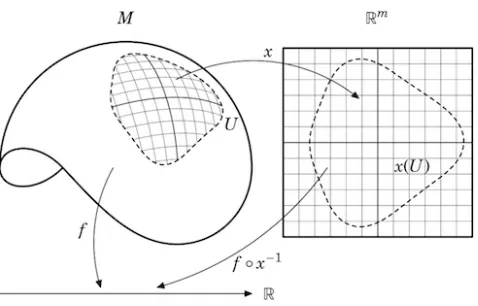
Figure 1.2: Manifold structure.
proposals throw the baby out with the bathwater. To find out whether we have committed this blunder, Wilson (2006 : 3) proposes this intuitive criterion:
We will have told the story of concepts wrongly if it doesn’t turn out to be one where our usual forms of conceptual evaluation emerge as appropriate and well foundedmost of the time.
Concepts arise from practice and allow us to solve problems efficiently, in much the way that the classical picture describes. However, they sometimes fail to be as well-behaved as the classical picture would lead us to believe.
As a result, I will seek a different strategy. Employing two analogies from differential geometry, I will adopt the position that concepts are locally clas-sical, but not necessarily globally.20 The idea is that if we make conceptual
analysis a primarily local endeavour, we do not have to change the locus of attributes; we rather need to understand how its various ranges of applica-tions relate to the inner workings of the terms of conceptual evaluation. The classical picture only breaks down (and does so only some of the time) when we are trying to extend the use of these concepts to regions not planned for in the first place.
With this as a motivation, I will discuss terms of conceptual evaluation in analogy to the treatment of geometrical properties in a mathematical structure
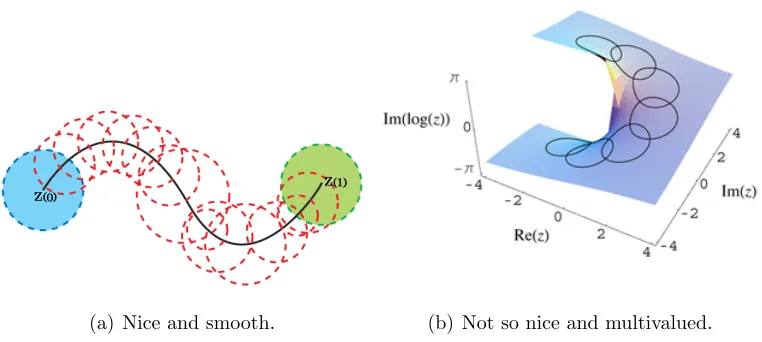
(a) Nice and smooth. (b) Not so nice and multivalued.
Figure 1.3: Analytic continuation.
called “manifold.” See figure 1.2. If we start with a vast region of application
M, we focus on thelocal behaviour of the concept over a partU. In a manifold, even if the global structure can take many forms, the local one is always Euclidean. In analogy, even if the global behaviour of a concept can take many refractory forms, the local behaviour, i.e., the behaviour that has to do with well-understood applications, is classical. In a manifold structure, we try to connect these locally Euclidean neighbourhoods to do more heavy duty differential geometry by means ofatlases. Similarly, as Wilson (2006) explains in his chapters 6 and 7, we connect our various local patches by constructing theory facades.
remain just as good. In such cases, we can extend our understanding of the function to determine what we would find out at z(1). However, the story is not always as even-textured (see figure 1.3(b)). To begin with, there might be competing continuations of our local understanding of a concept. The locality of our original domain of application can also hide a nonlinearity that makes extrapolation unreliable. For that matter, there might not be any coherent continuation to a given region. Such troubling situations relate to what Wil-son (2006) describes under the colourful labels “multi-sheetedness,” “cracked reasoning,” “physics avoidance,” etc.
From this point of view, there is a conceptual underdetermination with respect to “analytic” continuation. I will argue that, if this is problematic from the point of view of a convinced adherent to the classical picture, it is beneficial to our understanding of which mathematics applies well. These considerations emphasize that not all concepts are alike in their inner work-ings, i.e., individual features of some particular kinds of concepts determine a non-universal way in which they are glued to the world. As a result, it is reasonable to expect that not all mathematical concepts will apply equally well. By characterizing and classifying such strange conceptual behaviours, we will then understand better in which way the world refuses to cooperate with our conceptual expectations. We will likewise have a notion of differential mathematical fitness providing reasons for which some mathematical concepts apply so well (while others do not). Importantly, this view respects the fact that successful concept application is something that requires caution and is not something that can be expected to be epistemologically transparent.
1.4
Summary of this Chapter and Outline of
the Dissertation
In summary, this chapter has made the following points:
typically relegates questions on the applicability of mathematics to a sec-ondary role, this dissertation explores the consequences of giving them priority.
C1.2 The problem of the applicability of mathematics comprises at least three different problems demanding essentially different answers. Whereas the mainstream philosophical literature has mostly ignored what I call the problem of uncanny accuracy, this dissertation focuses on it.
C1.3 The problem of uncanny accuracy demands as an answer a concept of differential mathematical fitness that explains the circumstances in which mathematics can be expected to apply well (or not). It is unlikely that this concept will be captured by the syntactic and semantic tools of logic standardly employed in philosophy of science.
C1.4 To demystify the applicability of mathematics, one needs to have the means to capture its rationality. Accordingly, it is imperative to supple-ment the philosophical toolbox used to rationally reconstruct scientific practice with methods and concepts apt to discuss accuracy (which are based on error theory, sensitivity analysis, and perturbation theory).
C1.5 Mainstream philosophical views on the reconstruction of scientific prac-tice rely on the classical view of concepts, which relies on a naively optimistic view of what it is to grasp a concept. A view of concepts that distinguishes local and global conceptual analysis will better capture the challenges involved in the application of concepts.
Chapter 2
The Logic of Mathematical
Modelling
This chapter examines the logic of model construction and model evaluation— or just logic of (mathematical) modelling for short.1 In chapter 1, I have argued
that understanding the operations involved in the construction of models and in the evaluation of their accuracy is the most important aspect of scientific methodology to properly reconstruct in order to demystify the unreasonable effectiveness of mathematics.
In section 2.1, I will make explicit what operations are involved in the con-struction of a mathematical model of a real system. In the remaining sections, I delineate patterns of analysis used to address the main difficulties related to the assessment of mathematical representations of real systems. Section 2.2 explains the way in which model equations are derived from modelling assumptions by means of model construction recipes. Section 2.3 explains the interdependence between the selection of modelling assumptions and the tractability of model equations. Those two sections make clear that the logic of modelling has an essential pragmatic component. Section 2.4 draws on this
fact and identifies good modelling practices with effective strategies for in-formation management. Finally, section 2.5 clarifies the senses and conditions under which a model can be considered to successfully represent a real system.
2.1
The Mathematical Study of Real Systems
The construction of a mathematical representation of a real system always involves some degree of idealization. Many definitions of ‘idealization’ exist in the literature, but here I simply use this term whenever a literally false statement (that is no tautologically so) is involved. Under such a definition, the omnipresence of idealization is incontrovertible, as Truesdell (1960 : 31) elegantly explains:
Any mathematical theory of physics must idealize nature. That much of nature is left unrepresented in any one theory, is obvious; less so, that theory may err in adding extra features not dictated by experience. For example, the infinity of space is itself a purely mathematical concept, and all theories within this space must share in the geometrical idealization already implied.
This sort of idealization is characteristic of all types of representation, and is by no means limited to mathematical representation. According to theOxford Dictionary, a representation (in the sense relevant here) is “the description or portrayal of someone or something in a particular way.” A given thing could be represented in multiple ways depending on the choice of medium; such media could be, e.g., a picture, a wooden scale model, a set of English sentences, or a set of mathematical equations. Any representation using a medium that differs in kind from the thing represented introduces a degree of idealization. This fact only reminds us that a good representation cannot merely duplicate the thing represented, but that it must rather encapsulate the relevant information.2 Different types of representation complement each
other when different information is needed.
Given that our objective is to delineate the circumstances that make the use of mathematics so successful, in what follows we restrict our attention to mathematical representations and their effective use in the natural sciences. A natural starting point is to examine the way in which bodies are represented in mechanics to make them amenable to a mathematical study. Malvern (1976 : 1) depicts the situation as follows:
The theory of mechanics, like all physical theories, deals, however, not with actual physical materials but with various idealized physical models of real materials, models capable of being represented by mathematical equations that can be solved to make predictions of the motions and deformations of the physical model material.
In classical mechanics, three different kinds of “idealized bodies” (or ideal-ized “building blocks”) are employed to represent physical systems (see, e.g., Malvern, 1976; Wilson, 1998):
1. particles or mass-points;
2. rigid bodies;
3. deformable continuous bodies, or deformable bodies for short.3
Each of those types of idealized bodies gives rise to a specific approach to classical mechanics. In each case, there corresponds a branch of mathematical physics that studies the mathematical properties of systems of bodies of this type (respectively, mass-point mechanics, rigid body mechanics,4 and
contin-uum mechanics). However, as a matter of fact, there are no such things in reality as a mass-point particle or a perfectly rigid body; all real physical bod-ies occupy some space and are to some extent deformable. Moreover, based on
size was that of the Empire, and which coincided point for point with it. The following Generations, who were not so fond of the Study of Cartography as their Forebears had been, saw that that vast Map was Useless, and not without some Pitilessness was it, that they delivered it up to the Inclemencies of Sun and Winters. In the Deserts of the West, still today, there are Tattered Ruins of that Map, inhabited by Animals and Beggars; in all the Land there is no other Relic of the Disciplines of Geography.”