Scholarship@Western
Scholarship@Western
Electronic Thesis and Dissertation Repository
5-9-2012 12:00 AM
Game Challenge: A Factorial Analysis Approach
Game Challenge: A Factorial Analysis Approach
Ian J. Fraser
The University of Western Ontario
Supervisor Dr. Katchabaw
The University of Western Ontario Joint Supervisor Dr. Mercer
The University of Western Ontario Graduate Program in Computer Science
A thesis submitted in partial fulfillment of the requirements for the degree in Master of Science © Ian J. Fraser 2012
Follow this and additional works at: https://ir.lib.uwo.ca/etd
Part of the Artificial Intelligence and Robotics Commons, and the Other Computer Sciences Commons
Recommended Citation Recommended Citation
Fraser, Ian J., "Game Challenge: A Factorial Analysis Approach" (2012). Electronic Thesis and Dissertation Repository. 563.
https://ir.lib.uwo.ca/etd/563
This Dissertation/Thesis is brought to you for free and open access by Scholarship@Western. It has been accepted for inclusion in Electronic Thesis and Dissertation Repository by an authorized administrator of
Approach
(Thesis Format: Monograph) by
Ian James Fraser
Graduate Program in Computer Science
Submitted in partial fulllment of the requirements for the degree of
Master of Science
School of Graduate and Postdoctoral Studies The University of Western Ontario
London, Ontario, Canada
June 9, 2012
c
School of Graduate and PostDoctoral Studies
CERTIFICATE OF EXAMINATION
Supervisor
Dr. Michael Katchabaw Co-Supervisor
Dr. Robert Mercer
Examiners
Dr. Michael Bauer Dr. Jacquelyn Burkell Dr. Kamran Sedig
The thesis by
Ian James Fraser
entitled
Game Challenge: A Factorial Analysis Approach
is accepted in partial fulllment of the requirements for the degree of
Master of Science
June 9, 2012 Date
Dr. Sylvia Osborn
Video games that customize to a player's experience level and abilities have the po-tential to allow a broader range of players to become engaged and maintain interest as they progress in experience level. A game that uniquely customizes the player's experience could attract additional demographics to gaming, which will result in a distinct edge in marketability and potential revenue. This thesis examines a sub-section of adaptive gaming systems from the perspective of identifying game factors that alter the level of diculty. Our focus is to provide a solution useful to both research and commercial gaming communities by developing a system that simulates results oine yet can be integrated into online play. While online performance is the main goal of an adaptive system, the oine simulation provides several benets. Oine simulation allows the elimination of insignicant factors from inclusion in the training and evolution phase of machine learning algorithms. In addition it provides commercial games with a useful tool or method for performing game balancing and level tuning. To test our approach we designed a test-bed version of the game Pac-Man. The experimental testbed alters environment variables to evaluate their eect on a set of selected response variables. Observing the results of several response vari-ables provides the potential to represent multiple player states, though our focus is on controlling the diculty for a player. The testbed will simulate the actions of both Pac-Man and the ghosts over a variety of dierent settings and strategies. The evaluation of a factor's signicance and its eect size are calculated using a factorial analysis approach. This method allows the identication of factors relevant to both individual strategies, and the set of all player strategies. Finally, as a proof of concept for both the online and adaptation prospects of this method, we developed a proto-type adaptive system. Utilizing the relevant factor eects calculated in the factorial analysis, the prototype adapts to control the progress of the game towards targeted response variable intervals.
of Challenge, Level of Diculty, Game Metrics, Adaptive Game System, Gameow
Foremost, I would like to express my gratitude to my supervisors, Dr. Michael Katchabaw and Dr. Bob Mercer, for their patience, guidance and wisdom throughout my studies. From the beginning of my studies, their knowledge, expertise and fore-sight has guided my research into exciting and innovative areas that will contribute to the future of gaming. I am thankful for the assistance, feedback, critical analysis and the numerous other contributions my supervisors provided me. Most of all, I'm thankful to my supervisors for helping me nd the perfect area of study. Performing research in an area that naturally blends my interest and abilites has helped me stay motivated and truly enjoy this experience. This experience has helped me develop into a stronger individual and inspired me to continue as a researcher.
I would like to express a special thanks to Dr. Charlie Goldsmith, without whom this research would not have been possible. Dr. Goldsmith helped our research progress past the commercial software size limitations and aided in validating and reinforcing the strength of our statistical analysis. Dr. Goldsmith's contributions and statistical expertise were invaluable and his knowledge, creativity, instruction and dedication are inspiring.
Finally, I am thankful to my family for their limitless support.
Certicate of Examination ii
Abstract iii
Acknowledgements v
1 Introduction 1
1.1 Overview . . . 1
1.2 Background . . . 3
1.3 Thesis Focus . . . 6
1.4 Proposed Solution . . . 8
1.5 Outline . . . 11
2 Background 12 2.1 Player Enjoyment . . . 12
2.1.1 Immersion . . . 12
2.1.2 Flow . . . 13
2.1.3 Telepresence . . . 15
2.1.4 Feedback . . . 15
2.1.5 GameFlow . . . 17
2.1.6 Problems in Game Play . . . 19
2.1.7 Challenge and Diculty . . . 21
2.2 Player Types . . . 23
2.2.1 Casual to Core Players . . . 24
2.2.4 Emotional Motivation . . . 29
2.2.5 Temperament Theory . . . 30
2.2.6 Demographics Game Design 1 (DGD1) . . . 31
2.2.7 Summary of Player Types . . . 32
2.3 Adversarial Algorithms . . . 34
2.3.1 Flocking Algorithm . . . 34
2.3.2 Minimax Algorithm . . . 36
2.3.3 SSS-AB* . . . 38
2.4 Machine Learning . . . 40
2.4.1 Articial Neural Networks (ANN) . . . 41
2.4.2 Genetic Algorithms . . . 43
2.4.3 Neuroevolution . . . 44
2.4.4 Reinforcement Learning . . . 44
3 Related Work 46 3.1 User-System Experience (USE) Model . . . 46
3.2 Adaptive Game System (AGS) . . . 48
3.2.1 Auto-Dynamic Diculty (ADD) . . . 50
3.3 Measuring Player State . . . 51
3.3.1 Player Skill Level . . . 51
3.3.2 Emotional State (Aective Gaming) . . . 53
3.4 Game Adjustments . . . 54
3.4.1 Types of Adjustments . . . 54
3.4.2 Player Characteristics . . . 54
3.4.3 Game and Level Design . . . 55
3.4.3.1 Inventory Control . . . 56
ments . . . 58
3.4.4.2 Genetic Algorithm Approaches . . . 59
3.4.4.3 Neural Network Approaches . . . 60
3.4.4.4 Neuroevolution Approaches . . . 61
3.4.4.5 Reinforcement Learning Approaches . . . 63
3.4.4.6 Dynamic Scripting . . . 64
4 Experimental Testbed Design 68 4.1 Adaptive Gaming Architecture Design Overview . . . 68
4.2 Overview of Testbed Game Design . . . 70
4.2.1 Original Pac-Man Game Description . . . 70
4.2.2 Research Testbed . . . 71
4.2.3 Object Loading . . . 73
4.3 Game Factors . . . 74
4.3.1 Agent Factors . . . 74
4.3.2 Bonus Factors . . . 76
4.3.3 Algorithm Factors . . . 78
4.4 Player Algorithms . . . 79
4.4.1 SSS-AB* . . . 79
4.4.2 Pac-Man Weighted (PW) Heuristics . . . 82
4.5 Ghost Algorithms . . . 84
4.5.1 The Flocking Algorithm . . . 85
4.5.2 Ghost Weighted (GW) Heuristics . . . 87
4.6 Performance Measures . . . 88
4.6.1 Proactive Measures . . . 89
4.6.2 Reactive Measures . . . 92
4.7.2 Adaptive Pac-Man . . . 94
4.7.3 Heuristics . . . 96
4.7.4 Limitations . . . 97
5 Experiments 99 5.1 Factorial Design . . . 99
5.1.1 Calculating Variation . . . 102
5.1.2 2kr Factorial Design with Replications . . . 102
5.1.3 Calculating Lack of Fit . . . 103
5.1.4 Factorial Analysis and Experiment Design . . . 104
5.2 Experimental Environment . . . 107
5.2.1 Response Variables . . . 107
5.2.2 Factorial Analysis Customizations . . . 108
5.2.3 Model Evaluation . . . 110
5.2.4 Statistical Signicance . . . 110
5.2.5 Game Signicance . . . 111
5.2.6 Comparative Evaluation . . . 111
5.2.7 Adaptive System . . . 112
5.3 Results . . . 112
5.3.1 Model Evaluation . . . 114
5.3.1.1 SSS_FLOCK Model . . . 114
5.3.1.2 SSS_GW Model . . . 115
5.3.1.3 PW_FLOCK Model . . . 116
5.3.1.4 PW_GW Model . . . 117
5.3.2 Statistical Signicance . . . 118
5.3.2.1 SSS_FLOCK Terms . . . 119
5.3.2.1.3 SSS_FLOCK Ghosts Eaten Terms . . . 124
5.3.2.1.4 SSS_FLOCK Levels Completed Terms . . . 126
5.3.2.1.5 SSS_FLOCK Power-Pellets Collected Terms 128 5.3.2.1.6 SSS_FLOCK Repeated Squares Terms . . . 130
5.3.2.1.7 SSS_FLOCK Score Terms . . . 132
5.3.2.1.8 SSS_FLOCK Steps Terms . . . 134
5.3.2.1.9 SSS_FLOCK Tokens Collected Terms . . . 136
5.3.2.1.10 SSS_FLOCK Summary . . . 138
5.3.2.2 SSS_GW Terms . . . 138
5.3.2.2.1 SSS_GW Close Calls Terms . . . 139
5.3.2.2.2 SSS_GW Fruit Collected Terms . . . 142
5.3.2.2.3 SSS_GW Ghosts Eaten Terms . . . 144
5.3.2.2.4 SSS_GW Levels Completed Terms . . . 146
5.3.2.2.5 SSS_GW Power-Pellets Collected Terms . . 148
5.3.2.2.6 SSS_GW Repeated Squares Terms . . . 150
5.3.2.2.7 SSS_GW Score Terms . . . 152
5.3.2.2.8 SSS_GW Steps Terms . . . 154
5.3.2.2.9 SSS_GW Tokens Collected Terms . . . 156
5.3.2.2.10 SSS_GW Summary . . . 158
5.3.2.3 PW_FLOCK Terms . . . 159
5.3.2.3.1 PW_FLOCK Close Calls Terms . . . 159
5.3.2.3.2 PW_FLOCK Fruits Collected Terms . . . . 160
5.3.2.3.3 PW_FLOCK Ghosts Eaten Terms . . . 161
5.3.2.3.4 PW_FLOCK Levels Completed Terms . . . 162
5.3.2.3.5 PW_FLOCK Power-Pellets Collected Terms 163 5.3.2.3.6 PW_FLOCK Repeated Squares Terms . . . 164
5.3.2.3.8 PW_FLOCK Steps Terms . . . 167
5.3.2.3.9 PW_FLOCK Tokens Collected Terms . . . 167
5.3.2.3.10 PW_FLOCK Summary . . . 167
5.3.2.4 PW_GW Terms . . . 168
5.3.2.4.1 PW_GW Close Calls Terms . . . 170
5.3.2.4.2 PW_GW Fruits Collected Terms . . . 171
5.3.2.4.3 PW_GW Ghosts Eaten Terms . . . 171
5.3.2.4.4 PW_GW Levels Completed Terms . . . 173
5.3.2.4.5 PW_GW Power-Pellets Collected Terms . . 173
5.3.2.4.6 PW_GW Repeated Squares Terms . . . 174
5.3.2.4.7 PW_GW Score Terms . . . 176
5.3.2.4.8 PW_GW Steps Terms . . . 177
5.3.2.4.9 PW_GW Tokens Collected Terms . . . 178
5.3.2.4.10 PW_GW Summary . . . 179
5.3.3 Game Signicance . . . 181
5.3.3.1 Game Signicance of Response Close Calls . . . 183
5.3.3.2 Game Signicance of Response Fruit Collected . . . . 184
5.3.3.3 Game Signicance of Response Ghosts Eaten . . . . 185
5.3.3.4 Game Signicance of Response Levels Completed . . 186
5.3.3.5 Game Signicance of Response Power-Pellets . . . . 187
5.3.3.6 Game Signicance of Response Repeated Squares . . 188
5.3.3.7 Game Signicance for Response Score . . . 189
5.3.3.8 Game Signicance of Response Steps . . . 189
5.3.3.9 Game Signicance of Response Tokens . . . 190
5.3.4 Separated Terms Comparison . . . 191
5.3.4.3 Comparison of PW_FLOCK Separated Terms . . . 194
5.3.4.4 Comparison of PW_GW Separated Terms . . . 201
5.3.5 Comparison of Algorithm Performance . . . 211
5.3.5.1 Comparison of SSS-AB* and Ghost Algorithms . . . 211
5.3.5.2 Comparison of Flocking and Player Algorithms . . . 213
5.3.5.3 Comparison of Pac-Man Weighted (PW) and Ghost Algorithms . . . 218
5.3.5.4 Comparisons to Ghost Weighted (GW) and Player Al-gorithms . . . 225
5.4 Experimental Environment Summary . . . 227
5.4.1 Model Evaluation Summary . . . 227
5.4.2 Factorial Analysis Summary . . . 228
6 The Adaptive System 231 6.1 Term Loading for Adaptive Pac-Man . . . 231
6.2 Response Variable Selection . . . 233
6.3 Heuristics . . . 236
6.4 Results . . . 239
6.5 Adaptive System Summary . . . 240
7 Conclusion and Future Work 243 7.1 Contributions . . . 243
7.2 Future Work . . . 245
7.2.1 Factorial Analysis . . . 245
7.2.2 Online User Observation . . . 246
7.2.3 Adaptive Game System . . . 248
A Factor Eects 253
A.1 SSS_FLOCK Factor Eects . . . 253
A.1.1 SSS_FLOCK Close Calls Model Terms . . . 254
A.1.2 SSS_FLOCK Fruits Eaten Model Terms . . . 255
A.1.3 SSS_FLOCK Ghosts Eaten Model Terms . . . 256
A.1.4 SSS_FLOCK Levels Completed Model Terms . . . 257
A.1.5 SSS_FLOCK Power-Pellets Collected Model Terms . . . 258
A.1.6 SSS_FLOCK Repeated Squares Model Terms . . . 259
A.1.7 SSS_FLOCK Score Model Terms . . . 260
A.1.8 SSS_FLOCK Steps Model Terms . . . 261
A.1.9 SSS_FLOCK Tokens Collected Model Terms . . . 262
A.2 SSS_GW Factor Eects . . . 263
A.2.1 SSS_GW Close Calls Model Terms . . . 264
A.2.2 SSS_GW Fruits Eaten Model Terms . . . 265
A.2.3 SSS_GW Ghosts Eaten Model Terms . . . 266
A.2.4 SSS_GW Levels Completed Model Terms . . . 268
A.2.5 SSS_GW Power-Pellets Collected Model Terms . . . 269
A.2.6 SSS_GW Repeated Squares Model Terms . . . 270
A.2.7 SSS_GW Score Model Terms . . . 271
A.2.8 SSS_GW Steps Model Terms . . . 272
A.2.9 SSS_GW Tokens Collected Model Terms . . . 273
A.3 PW_FLOCK Factor Eects . . . 274
A.4 PW_GW Factor Eects . . . 274
B Model Error 275 B.1 SSS_FLOCK Model Error . . . 275
B.3 PW_FLOCK Model Error . . . 282
B.4 PW_GW Model Error . . . 282
C Proof of Concept Statistics 284 C.1 SSS_FLOCK Mean Performance Per Life . . . 284
C.2 SSS_GW Mean Performance Per Life . . . 285
C.3 PW_FLOCK Mean Performance Per Life . . . 285
C.4 PW_GW Mean Performance Per Life . . . 286
D Regression Equations (Prototype) 287 D.1 PW_FLOCK Regression Equation . . . 287
D.2 PW_GW Regression Equation . . . 287
E Response Variables Descriptive Statistics 289 E.1 SSS_FLOCK Descriptive Statistics . . . 289
E.2 SSS_GW Descriptive Statistics . . . 290
E.3 PW_FLOCK Descriptive Statistics . . . 290
E.4 PW_GW Descriptive Statistics . . . 291
F Eects Descriptive Statistics 292 F.1 Close Calls Factor Eects Descriptive Statistics . . . 292
F.2 Fruit Eaten Factor Eects Descriptive Statistics . . . 292
F.3 Ghosts Eaten Factor Eects Descriptive Statistics . . . 293
F.4 Levels Completed Factor Eects Descriptive Statistics . . . 293
F.5 Power-Pellets Collected Factor Eects Descriptive Statistics . . . 293
F.6 Repeated Squares Factor Eects Descriptive Statistics . . . 294
F.7 Score Factor Eects Descriptive Statistics . . . 294
Bibliography 296
Vita 303
Chapter 1
Introduction
1.1 Overview
and tuning each level. Diculty levels are determined to be appropriate based on testing by game testers and may not represent a diverse or introductory selection of players. The signicant amount of time spent by game testers, level designers, and programmers can be quite costly for companies, and the end result may still not provide an adequate learning curve for new players. Allowing the player to manually switch between diculty levels allows them to ease their own progression in the game. However, it can result in a number of problems from disrupting the immersion of the game by having to go switch the diculty rating, to having the player trying to accurately judge their own level of play as well perform an accurate assessment of unseen tasks and opponents. An alternative method used in commercial games such as God of War is to ask the player if they wish to have the diculty level lowered after a set number of deaths. This option does not have the ability to increase the diculty and can frustrate players by suggesting they need to decrease the diculty when they simply wish to try again.
and adapts to a players' needs. Adaptable game systems have been proposed as a possible solution to accommodate the growing variation of player's needs, preferences and abilities. The traditional game process rarely allows for adaptability within their games as a means of retaining or attracting a wider spectrum of users. The lack of adaptation is partially due to the additional cost, tight time-lines of projects and the believed additional required testing. However, as the process of customizing the game to the player matures, it should be capable of easing new players into the mechanics of gameplay, while providing challenging levels for experienced users. The wider the spectrum of players introduced to a game along with the positive adaptation of the player's experience should provide enough motivation to outweigh the initial costs of the system. Since it has been shown that games are often purchased on other players' recommendations [11], a game that has the ability to adapt to human players' strategies and abilities will provide a customized experience while keeping players engaged in game play. Ideally, adaptive games will attract additional demographics to their games, which will result in a distinct edge in marketability and potential revenue.
1.2 Background
aptly terming their extension GameFlow. In terms of game development the most signicant components of GameFlow are: challenge, player skills, control, clear goals and feedback. These are the components game designers have the most control over, and thus provide the best opportunities in the game for customization to produce GameFlow.
The User-System Experience (USE) model further discussed in Section 3.1, is a model specically for video games which emphasizes the relationship between a user and a system with the focus of producing Flow or other immersive states. This model forms the basis for our design to produce the desired level of interaction, but it lacks the required level of detail in terms of describing adaptive game systems. Adaptive game systems can adapt to two broad categories of problems: usability problems and playability problems. Section 2.1.6 briey introduces the types of usability issues, although usability issues are important to adaptive game systems, they are beyond the scope of this thesis and our focus will remain on playability issues. The majority of commercial and academic research has focused on adaptation to playability issues from the perspective of altering the level of challenge of the game. The level of chal-lenge is one of the main components in several psychological models that describe im-mersion. Adequately challenging the player in an engaging fashion can contribute to the player being within an immersive state during gameplay. In addition, alterations to the level of challenge are expected by players as part of the natural progression of the game and can be accomplished in a natural and seamless fashion. In order to be successful at producing an immersive experience in a player, the adaptive sys-tem must monitor the player's performance, make adjustments throughout the game and monitor the eect of those adjustments. The process of an adaptive game sys-tem altering the level of challenge is a portion of a concept known as auto-dynamic diculty.
to avoid frustration that can cause newer users to give up on games. In addition, it may enhance the challenge for regular players, who are experienced with game genres, and have higher skill levels and expectations. Research in the area of auto-dynamic diculty has generally focused on the challenge component of GameFlow and has approached the topic from two main perspectives: adaptation to the game environment or adaptive articial intelligence (AI). An example method of game en-vironment adaptation is an object quantity control approach [25], which alters the frequency of items or opponents the player will encounter in an area of the game. Us-ing this method a game may alter the probability of ndUs-ing extra health if the player's health is constantly low. In adaptive articial intelligence(AI), the game agents alter the quality of their decisions based on the player's current level of diculty. The term agents refers to characters in the game, which can include the player or other characters known as non-playable characters. Non-playable characters (NPC's) are characters in the game which the player has no control over, they can be opponents, allies or neutral to your character. In adaptive AI if the player is experiencing bore-dom, the game agents should choose moves that produce higher levels of challenge, thus increasing the diculty of the game, likewise they should select less challenging moves when the player is at a level of diculty beyond the player's ability [5].
1.3 Thesis Focus
Our research will focus on adaptable game systems, in which user interaction with the game is described via the USE model. The USE model focuses on the interaction between user and game with the goal of optimizing the player's experience. However, the USE model is a general model of interaction which does not directly focus on adaptable games. To rene our research goals, we focus on a higher resolution model known as the adaptable game system model (AGS) discussed in Section 3.2. The AGS model easily integrates into the USE model to demonstrate how adaptation can occur with the goal of promoting an engaged and immersed player. The AGS model, proposed by Charles and Black [13], indicates that an adaptive game system needs to accomplish the following online tasks:
• Player modeling which attempts to discover and classify a player's type and
needs.
• Online adaptation of the game environment in response to a player's needs. • A monitoring system that evaluates the eectiveness of the adaptation. • Dynamic player remodeling.
[9]. However, our research will focus on within-subject design, which attempts to understand the player's current state. Our research will consider each experiment independent of transition those we will only be considering the player's current state. As previously mentioned, auto-dynamic diculty is described as the task of altering the diculty of the game online in order to match the player's skill level. A game with auto-dynamic diculty will adjust the game to an easier setting if the player is continuously having diculty completing a task, and increase the diculty as the player masters dierent game skills [30]. Choosing to adapt the level of diculty in our game focuses the player's needs solely in relation to requiring a higher or lower level of challenge. Thus our research can focus on factors which aect the level of challenge in either a positive or negative fashion. The majority of current research has focused on the level of challenge as the primary target for adaptive games. Nearly all current research denes positive or negative modication to the level of challenge in terms of a single response variable such as score or health. Our research will in-clude a larger number of response variables from which the level of challenge could be dened, and positive or negative modication could be made. Throughout our research, the term the level of challenge refers to our selected set of response vari-ables or a subset of which could be used to estimate the level of challenge provided by the game. Using multiple response variables allows adaptation to occur not sole based on a single observable metric such as score, but could adapt based on a combi-nation of metrics. Having multiple response variables provides a more complete view of how the adaptive process is eecting the player's experience. In addition the use of multiple response variables allows a more diverse set of potential actions when adap-tation is required and allows the adaptive process to balance and control other player preferences. Recent researchers have had relative success in using combinations of response variables from a session to predict frustration, challenge and fun [56]. Thus an aspiration of this project is that future work could progress towards combinations of response variables for producing improved emotional states of players.
how a player will react in specic situations, their tolerance for frustration, history of previous challenges, successes, and failures, as well as other preferences. Creating a player model not only requires the prediction long-term behaviour or strategies but also requires having a model of short-term behaviour which might simply be tempo-rary adjustments based on strategy or temperament. However, having an adequate player model for all of this information still requires altering the diculty of a game to challenge and accommodate these player preferences. As the eectiveness of adapta-tion can be measured without the use of accurate player models, in that we can adapt the game and then observe the reaction without knowledge of a player's preferences, we decided to focus on measuring adaptation, and leave the larger problem of online dynamic player modeling for future research. This thesis will examine the eective-ness of alterations to the non-playable characters (NPC's) and the game environment against a set of varied player strategies. To accomplish the larger goal of an adaptive game system, it is rst essential to understand how alterations to variables of the game will aect the player's performance.
Throughout our research we will focus on several goals, the main focus will be to produce a method capable of contributing to current research techniques in adaptive games, as well being useful to commercial games for level balancing. The method-ology used will identify game factors which provide signicant impact to a set of response variables relating to the level of challenge. In order to successfully adapt to the player's level of challenge, we must understand which game factors impact the response variables and the direction and degree of their impact.
1.4 Proposed Solution
game factors which aect the level of challenge is an oine approach, but an important role for our oine approach is that it should be capable of being integrated or used in combination with an online method with minimal eect on the online performance requirements. A critical issue with designing an adaptive gaming system is user-testing and collecting information about the eects of the game on each potential player. Our research will use a within-subject design which attempts to understand the player's performance under a variety of settings, but this is not accomplished with online users. Instead, we will attempt to simulate a wide range of dierent player strategies through static behaviours and attempt to identify factors which impact those static strategies. The ability to identify factors which impact the level of challenge is useful to current research in game communities as a preprocessing step, as game factors which are not important to the level of challenge can be omitted before training and online adaptation of NPC's strategies.
To experiment with our proposed research goals we require a testbed environment; we have chosen Pac-Man as our testbed game. Pac-Man is a well known game with a simple graphical interface, which is easy to learn and to become involved in, yet is a dicult game to master. Pac-Man is commonly used in adaptive game research due to the simplicity of its interface and game rules, while providing the ability to integrate complex strategies and team behaviors. Due to Pac-Man's wide use in the research community, adaptive game design results and methods could be compared to and reused in other research. Our Pac-Man testbed must be capable of adapting game factors in both an oine and online setting. To accomplish this, the testbed was altered to allow game factors and allowable levels for those factors to be loaded via les. In addition the testbed required a system to keep track of important events and information. We developed a logging system for the experiment to log statistical and event information for multiple game systems in an XML format, eventually to be used in calculating response variable information. Finally, we altered the testbed to simulate game play utilizing the selected game factors, agent movements and actions and logged the results.
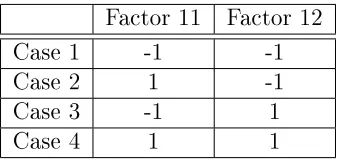
determine the eect size of all game factors and their interaction which will utilize a 2k
factorial analysis which is further described in Section 5.1. The factorial design allows us to observe factor interactions, as well as individually factor values. Observing the results of factor interactions allows us to discover any emergent eects that may unexpectedly occur. The rst stage will also calculate a statistical model which indicates the amount of variance described in Pac-Man's performance.
We will specify desired target ranges for a response variable which could represent possible player preferences in future research. We will design a set of heuristics to estimate the player's progression during gameplay and the level of change required to meet the target range. Using the factor eects information from the experiment phase of our research, our system will select factors settings adequate to the level of requested change for the player.
1.5 Outline
Chapter 2
Background
This chapter focuses on introducing the necessary multidisciplinary concepts in order to study adaptive games. Section 2.1 introduces models explaining how players expe-rience the game. Section 2.2 reviews reasons players play games and the classication of their gaming needs. Section 2.3 introduces algorithms for performing adversar-ial searches and group behavior. Finally, Section 2.4 introduces machine learning techniques utilized in current research.
2.1 Player Enjoyment
This section introduces the idea of immersion and the psychological model for optimal immersion, known as Flow. This section introduces key traits and terms from Flow and their application in game design. Finally, we summarize the research of this model applied to rating player enjoyment in video games.
2.1.1 Immersion
Bartle, co-creator of multi-user dungeons (MUD), describes immersion in terms of games as Immersion is the quality of being your virtual self [9]. The progression of becoming your virtual self, begins with two separate systems: the player and the avatar. The avatar is the player's character represented in the game world. Eventu-ally, the player begins to identify with the avatar and recognizes himself as a character in the game. Finally, the game character becomes a persona which is the representa-tion of his virtual self [9].
components; sensory, challenge-based and imaginative immersion. Their model, the SCI (sensory, challenge, imaginative) model, was formed based on questionnaires of young players, and stated that players could have dierent levels of participation in each of the three components. Participation and engagement in at least one of the three components was the requirement for producing a state of immersion for younger players. As an example, a game like Pac-Man could be immersive solely on challenge but possibly also imaginative.
Immersion is a dicult state to measure, as it must be implicitly studied while the player is in the state. Self-reports often cause the player to leave a state of immersion and direct focus away from the task an individual is immersed in [17]. This has led some researchers to attempt to purposely break the player's state of immersion in attempts to better understand it. Cheng and Cairns [17] provided an experiment in which once players were suspected of being immersed the realism of the game would be completely altered. Their experiment included changes to the environment graphics and behavior of game physics. Cheng and Cairns provided surprising results, in that large alterations to the game did not aect the player's experience. In fact, several of the participants did not recall the changes being made until prompted in post game reviews [17].
2.1.2 Flow
1. A task to be completed.
2. The ability to concentrate on the task at hand. 3. Concentration is possible because of clear goals. 4. Task provides immediate feedback.
5. A sense of control over actions.
6. A deep but eortless involvement that removes awareness of the frustration of everyday life.
7. Concern for self disappears, but reemerges stronger afterwords. 8. Sense of time is altered.
Every element listed above does not need to be present to produce a state of Flow, a subset of several of these elements may be enough to induce Flow in an individual.
2.1.3 Telepresence
Telepresence is an immersion model of experience like Flow, but is based on a more passive experience. It can be used in situations where challenge, and player skills are less applicable. Telepresence is described as an experience of presence in an environ-ment by means of a communication[11], and individuals are usually responsive and sensually involved in the system. Telepresence is thought to account for immersion when an individual is not in a state of Flow [11]. An example of a situation in which people are likely to experience telepresence is when they are watching a movie.
2.1.4 Feedback
In terms of games, the player should constantly and consistently be receiving feedback whether it is from the player's avatar responding to game-pad input or feedback relating to the player's progression through the game. In Section 2.2 we will discuss how dierent player types require dierent amounts of feedback about their game progression. Detailed feedback can be dicult to provide when the player strays from the normal game path; unfortunately these are the players that likely require additional feedback. Another issue that arises from a player deviating from the normal game path is whether they are enjoying their exploration or whether they are simply unsure of what to do next. Players who are exploring will nd feedback indicating they are going the wrong direction to be an unnecessary intrusion into their game playing.
may result in the player feeling as though their opponent will always catch up, which can result in the player externalizing match up results to luck or unfair play.
Figure 2.2: Represents a version of a stalemate game where players produces small leads but fail to progress to a winning state. Adapted from [1].
However, using too much positive feedback may result in an unbalanced game. Consider a situation in which a player is always given direction and the means to accomplish their goals; in this scenario the game can become too easy or limit oppor-tunity to explore. Negative feedback is the opposite of positive feedback: a player's achievements result in the game diculty increasing. Negative feedback naturally oc-curs as a player progresses through a game; the next level of a game is typically more dicult than the last. Negative feedback controls positive feedback and vice-versa. However, negative feedback can cause stalemates and large swings in the challenge of the game if performed improperly.
still able to almost draw even but taking the lead on fewer occasions [1]. This derives a back and forth type of game, which provides the illusion of winning to both players, where both players feel they are capable of winning if they just make a few minor adjustments. This helps players develop emotional attachment to the game, and promotes tweaking strategies to achieve victory.
Figure 2.3: An ideal game progression where each player has the opportunity to win until eventually one player takes a controlling lead. Adapted from [1].
2.1.5 GameFlow
Flow was later directly applied to modeling player enjoyment in games by Sweetser and Wyeth. In their paper, Sweetser and Wyeth took the eight original components of Flow and dened each component in greater detail in terms of player requirements and game play [47].
1. The task to be completed is the game.
2. The game should immediately grab users' attention.
4. A player has control over their actions in the game, as well some sense of control over the direction of the game.
5. Goals throughout the game should be clear. 6. Immediate feedback should be given to the player.
7. Immersion in the game should be deep but eortless, and reduce the sense of self and time.
8. Social interactions should be supported through cooperative and competitive interactions among players.
model has been applied to predicting player enjoyment in real time strategy (RTS) games. The results were similar in comparison to those of expert game reviews [47].
2.1.6 Problems in Game Play
In terms of GameFlow, designers have control over the level of challenge, control, producing clear goals and feedback. Designers will face two types of issues in con-trolling these components, the rst being usability and the second being playability. We will briey introduce some issues relating to usability here, which are included for completeness but are not discussed further. Usability problems are issues where the game is fully functional, yet lacks appropriate communication to the user of how to easily accomplish desired tasks [8]. A common usability problem that occurs in games is when a player is unsure of where to go next within the game world, often due to a lack of clear goals and feedback. According to Zap and colleagues [59], usability problems can be subdivided into four groups: knowledge base, intellectual, exible and sensorimotor. In terms of games knowledge, problems occur when the player is given an inadequate amount of information to complete a task or progress in the game. Within the GameFlow model, knowledge usability problems occur in games due to a lack of clear goals or appropriate feedback of controls to achieve goals [48].
to the player and it is unclear whether the task has been successfully completed. Flexible usability problems can be further divided into three groups: habit, omis-sion and recognition problems. Habit problems occur when a player performs an action in the wrong context. An example is when a game does not utilize a stan-dard genre control scheme and the player presses the stanstan-dard scheme button instead of the game specic button for an action. Habit problems are caused by controls but can also be caused by lack of feedback indicating to the player that the game does not follow standard implementation. Omission usability problems occur when a player omits a routine portion of a scheme or task. Omission problems tend to occur when the player's skill level is above the level of challenge of a simple task or when feedback fails to draw player attention to a task. Finally, recognition problems occur when feedback is dicult to distinguish between other symbols or other goals. An example might be when the player is asked to collect an item, and he is shown a small blurry image which may be confused with a number of other items in the game
Lastly sensorimotor issues relate to the player being capable of successfully com-pleting the required motor-skill. Sensorimotor issues can arise due to a lack of player skill, control issues or as a result of poor game interface design. However, in terms of usability sensorimotor issues usually relate to diculty experienced by many indi-viduals, and thus is less related to a player's level of skill.
player's experience, so players facing this issue should investigate alternative games. Curiosity playability problems occurs when a player has been involved with a task for an extended period of time and begins to feel bored due to lack of new tasks or actions. Essentially, it occurs when the player feels they have learned a task to their level of satisfaction, and yet are unable to progress in the game. Challenge problems occur when the level of challenge is either too high or too low for the player's level of skill.
The majority of usability problems that aect GameFlow are related to controls, clear goals, and adequate feedback. Having an intuitive and exible game does not make the game fun. It helps the player get involved in the game and avoid unin-tentional frustration or demotivating the player. Ultimately, playability is the most important issue for game designers. In terms of playability, curiosity and challenge problems are of greater importance to the level of diculty of the game. Although control problems can disrupt a player's sense of ow, it is good game design practice to allow the player to skip situations in which they do not have control such as tuto-rials or story sections. Fantasy problems are likely the result of a player not enjoying a genre of games or the story of a particular game. In either case this is an extremely dicult problem to solve. Challenge problems are the main focus of auto-dynamic-diculty research to date. The key to challenge problems is to keep the player's level of diculty in a range in which they are excited yet do not feel overwhelmed by the game. Finding a player's accepted range of diculty means understanding the player's preferences and goals. To understand these, we will investigate player types. Understanding player types will also help us solve the curiosity problem. If we are capable of identifying the player's level of tolerance for repetition and frustration, we can identify when a player is likely becoming bored or frustrated with the given task and provide aid to allow for progression.
2.1.7 Challenge and Diculty
for producing immersion, and is one of the major component of Flow in games [21]. The eld of adaptive games denes the level of challenge as the amount of information an individual has to process, proportional to the rate of new information. Within this denition new information may simply refer to objects which are moving or are dynamic in the game. Challenge is often measured on two dimensions: the speed required to perform a task, and the level of cognitive involvement [21]. From the denition of challenge, we can observe that as a player gains experience with a game there is less new information to absorb, thus the level of challenge decreases.
The level of diculty of the game refers to the level of the challenge relative to the player's level of skill. This denition highlights that a game may have a steady level of challenge between a set of players, and provide dierent levels of diculty to each player. Thus in order to alter the level of diculty we must perform adjustments to the level of challenge in relation to the player's skills.
Figure 2.4: When a player begins a new game they must learn new skills to participate in the game. The challenge level remains steady as the player masters these skill, as a result the dicult of the game decreases. Before the player becomes bored from repetitive tasks, new obstacles must be introduced such that additional learning is required, which promotes interest. This process continues throughout the game and is known as the desired progression of diculty. Adapted from [6].
2.2 Player Types
to identify player types.
2.2.1 Casual to Core Players
The ability to dedicate a high level of concentration to a particular task plays an important role to the development Flow; with this in mind a key consideration for game designers is the amount of time a player is willing to invest in playing the game at any one period of time. Ip and Adams [26] proposed fteen weighted factors that attempt to separate users into the casual-to-core player spectrum. These factors include: personal investment, tolerance to frustration, engagement with the game and other players, and goal oriented personalities. This creates a scale known as the casual to core gamer dedication. Ip and Adams [26] hypothesize the existence of ve categories along this scale. These categories are presented in largest to smallest gamer population size respectively: ultra casual/non gamer, casual, transitional/moderate, hardcore and ultra-hardcore. Although research is still lacking in the probability of transitioning between categories, the scale does illustrate a largely untapped market of potential gamers in the middle of the casual and hardcore categories.
2.2.2 Myers-Briggs Typology
The Myers-Briggs typology is a psychological model for classifying individuals based on personality traits [11]. The model consists of four pairs of traits:
1. Introversion and Extroversion
Extroverts tend to be motivated by social interaction, and tend to have an act rst think later type attitude. Introverts tend to be motivated internally, and enjoy one-to-one communication.
2. Sensing and Intuition
3. Thinking and Feeling
Thinkers are task oriented, and enjoy logic, facts and are comfortable with conict. Feelers focus on the consequences to other people, and are unsettled by conict.
4. Judging and Perceiving
Judgers are planners, who focus on one task at a time. Perceivers enjoy multi-tasking, freedom, variety and exibility.
An individual's personality is composed of a percentage of each of the eight traits, however the dominant trait of each pair is used to t them into one of sixteen groups. As an example, a person may be extroverted, sensing, judging and perceiving also known as ESJP. From the sixteen groups, it is hypothesized that the hardcore player type is characterized by introverted, thinking and judging an I_TJ trait set, and that sensing or intuition have less eect on the hardcore to casual player relation [11].
From the casual to core spectrum, the hardcore cluster is the smallest in population size, yet is thought to have the largest impact on the gaming industry. This is believed to be true because hardcore players are more likely to review games, play and purchase new games and thus propagate more information about potential games to the rest of the market [11, 26].
The Myers-Briggs typology also illustrates how players prefer information dis-played to them. The sense and intuition dichotomy illustrates how dierent people enjoy learning and solving problems. This is important for developing tutorials, puz-zles, game challenges as well as setting the pace of the game. Players with a dominant sensing trait make up 70% of the population and are often more patient with repeated material, are less comfortable with abstract material and rely on their common sense to solve problems [11]. This indicates that sensing people are likely to prefer straight forward tutorials, as to comfort their ease into new situations. Likewise, the puzzles and challenges of the game should be directed towards knowledge and skills acquired during tutorials or game play. The intuition character trait, represents people who are more comfortable with abstract ideas and enjoy drawing their own conclusions. People with a dominant intuition trait would nd the straight forward tutorial monotonous and restrictive to their overall enjoyment. Intuition individuals are more comfortable with unseen challenges and situations, they require less feedback than do sensing individuals [11].
the motivations of a player is that it allows the game to adjust rewards for completing objectives and goals. As an example, if the player is a feeling type, they could be rewarded with a feedback tool such as a beacon for a map, whereas a thinking player may be rewarded with a dierent weapon [11].
The judging and perceiving dichotomy provides insight into the motivation of the player from a goal-orientation perspective. The perceiving player generally plays to improve his own skills at a particular task, and thus are more comfortable within a less structured game model. On the other hand, judging players tend to prefer a straight forward path focusing on the task at hand, and are motivated by the overall completion of the game [11].
Finally, the combination of thinking-judging player is more focused and enjoys conict and challenge. Its counterpart the feeling-perceiving player sees having easy fun as the key motivational factor, and is less tolerant to frustration. The thinking-judging player type is often associated with the hardcore player type from the Ip and Adams study [26].
2.2.3 Bartle's Player Types
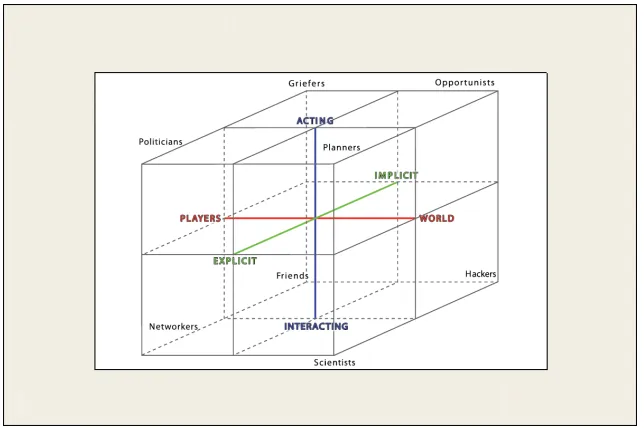
Bartle's player types [9] help describe the general motivation of a player. It shows which types of actions the player currently nds fun within the context of the virtual world. A player's decisions are divided between their relation to other players or the world, and between actions or interactions. Thus, the original Bartle model consisted of four types of players: killers, achievers, explorers and socializers.
Although Bartle's model was widely accepted, it lacked an explanation for three major situations: distinct subgroups within a player type, transitions made between player types and it provided no explanation for immersion. Thus, Bartle proposed a slightly modied model that contained a new dimension implicit and explicit. Im-plicit actions are done without thought of consequence. Whereas exIm-plicit actions are performed in terms of an overall plan. The inclusion of a third dimension lead to solutions for all three states problems with the model.
Figure 2.5: Bartle's original model describing player multiple player types. Adapted from [10].
type over time, new models for player progression were formed between types. A total of four sequences were produced that describe a player transition from being a new player to being a consistent player. The four sequences are:
1. Main Sequence = Griefer -> Scientist -> Planner -> Friend
2. Socializer Sequence = Griefer -> Politician -> Networker -> Friend 3. Explorer Sequence = Opportunist -> Scientist -> Planner -> Hacker 4. Minor Sequence = Opportunist -> Networker -> Planner -> Friend
Figure 2.6: The adapted version of Bartle's player types model which includes a new dimension to explain player progression. Adapted from [10].
with. Finally, achievers are players who enjoy accomplishing goals provided within the game, they are divided into opportunists and planners. Planners enjoy being told the next goal to accomplish, whereas opportunists enjoy nding their own way to the goal and are more comfortable with improvisation needed for their plan [10].
2.2.4 Emotional Motivation
Laz-zaro's study is that it highlights the fact that player types can change dynamically and more frequently than is proposed in the original Bartle model; this illustrates a constant need to remodel the player model.
2.2.5 Temperament Theory
Temperament theory deals with understanding the patterns of behavior for an in-dividual. It attempts to classify people not as a consistent personality type or as a pattern of perception, but as a summation of dierent dispositions to situations. Whereas Myers-Briggs looks at how an individual thinks, temperament theory in-vestigates how they behave. For our purposes, temperament theory breaks down Myers-Briggs to four types of temperaments: rational, idealist, artisan and guardian, each with an associated skill set and tendencies towards problem solving [11].
The rational temperament comes from the Myers-Briggs intuition and thinking at-tributes. Rationalists utilize a strategic skill set, this involves planning and executing plans to meet dened goals [11].
The idealist temperament is based on the intuition and feeling attributes of Myers-Briggs. Idealists utilize diplomatic skill sets and are empathetic towards other players and try to resolve conicts in the game. These players become immersed in character and story development [11].
The artisan temperament is based on the sensing and perceiving attributes of Myers-Briggs. This group tends to enjoy managing a situation and executing plans. They tend to enjoy a faster paced game in which they can perform immediate action [11].
The guardian temperament is based on the sensing and judging attributes of Myers-Briggs. The guardian skill set is referred to as a logistical skill set. It often involves protecting and ensuring the needs of other characters. This group enjoys organizing groups and tasks while trying to improve eciency with the organization [11].
are geared towards promoting Flow in the corresponding player types.
2.2.6 Demographics Game Design 1 (DGD1)
The Demographics Game Design 1 (DGD1) is research done by International Hobo Ltd to identify demographic preferences and player types [1]. Building on the frame-work of the Myers-Briggs personality types, the DGD1 identies four types of player styles: conqueror, manager, wanderer and participants.
the DGD1 model.
The Wanderer is a combination of the diplomatic and tactical skill set, correspond-ing to Bartle's Explorer and feelcorrespond-ing and perceivcorrespond-ing in Myers-Briggs. Wanderers are players who enjoy a large amount of freedom and prefer a unique experience. They are less focused on winning or defeating a game, and more on just having easy fun. This group is more opposed to games with perfect world information, and tend to enjoy games of mimicry. Wanderers enjoy solving issues, without an overall plan but more as the problems present themselves. Due to an interest in a unique experience they are more opposed to repetitive tasks. In this group, Flow is produced when players can choose their own pace, and perform simple tasks in an assortment of situations. There is little known about dierences in play preferences between the hardcore to casual relationship of wanderers [11]. The idealist temperament is heavily found in the wanderer player type, but is also found in the participant group.
The Participant is a combination of diplomatic and logistical skill set, correspond-ing to Bartle's Socializer and feelcorrespond-ing and judgcorrespond-ing in Myers-Briggs. Participants are the largest group in the general population, yet are the least represented in the DGD1 study. They enjoy games for the social factor, to participate and be social. Little information is available about this player type, except that they mostly play for so-cial reasons. This particular group is thought to be interested in heavily character or story-based games. This group is easily frustrated with dicult challenges, as they enjoy problems that can be adequately solved in the moment [11].
International Hobo Ltd is currently in the early stages of a second generation of the demographic design known as DGD2. This research is based on temperament theory described in the previous section, as opposed to the Myers-Briggs.
2.2.7 Summary of Player Types
Figure 2.7: Summary of player types, organized into sets based on similar traits from personality research.
motivation in order to highlight situations where the player has changed game session goals. For instance, a player who is normally a killer type could enter into the game solely for the purpose of exploration. During this instance, the player's goal would not be for hard fun but easy fun, thus the player model would not be correct, given his emotional motivation.
Similarly, both Myers-Briggs and temperament theory likely play a role in map-ping player behavior to their player type preferences. As Myers-Briggs investigates a player's personality and how they think, it should provide insight into a concrete personality base. While temperament theory views how an individual behaves, it may provide insight into instances of behavior that are irregular from a normal player. As previously mentioned DGD2 is in the early stages of research for mapping tempera-ment theory to player types. The results of the DGD2 are highly anticipated because player behavior is easier to monitor than thought, which will improve the ability to classify players based on similar behavior. Whether patterns that emerge from monitoring player behavior are capable of matching or indicating game preferences remains to be seen.
2.3 Adversarial Algorithms
This section introduces non-learning algorithms for describing behavior in game agents. The ocking algorithm, discussed in Section 2.3.1, is only utilized for representing movement of groups of non-playable characters. On the other hand the minimax and SSS-AB* algorithms can be used to represent the optimal performance of the player or non-playable characters.
2.3.1 Flocking Algorithm
paper, the last two forces are recent additions to the ocking algorithm [12].
• Cohesion: A force to bring individual boids closer together. • Alignment: A force to direct boids in the same direction.
• Separation: A force causing boids to steer away from one another. • Hunger: A force to direct a boid towards a specic goal.
• Obstacle avoidance: A force to direct a boid from a solid object.
These forces acting in unison dictate the movements and behaviors of a ock. Flocking algorithms are of interest to game designers because they provide an aesthetically natural method of movement for large groups of objects. They also provide a method of creating multi-agent predator tactics. Including the last two forces, hunger and obstacle avoidance, creates a ock with an intended goal such as tracking an opponent and avoiding obstacles [12].
as a short range separation or long range separation. As a short range separation visible boids are given a maximum value in which separation is still rewarded. In this case the reward becomes bell curved in that positions which are too close to the mean position of the ock and positions too far from the ock are awarded low scores, while moves within this interval are awarded higher values. For long range separation the active boid simply receives a higher score for moving further from the mean position. The hunger force can be used with a dened goal. Higher scores are awarded the closer the active boid moves towards this hunger goal. Similarly, this force could be used to avoid being eaten by another prey object by awarding low scores for moving closer to objects we would like to avoid. While hunger forces deal with obtaining or avoiding goals, obstacle avoidance simply deals with avoiding collision with obstacles that are visible. If a boid's alignment is towards an obstacle then that movement will receive a lower score, whereas movement which is towards open areas will be rewarded higher scores. The score from each force is then normalized, and the move which has the highest score after the summation of all normalized forces is selected. This process is performed for each boid in the ock during a turn.
2.3.2 Minimax Algorithm
The number of states in the minimax algorithm grows exponentially, and can quickly become too large a search space to examine exhaustively. An easy way to reduce the search space size is by setting a maximum depth for the search. Once we arrive at the maximum depth, we utilize an evaluation function to evaluate the current state of the game for the player. Alpha-beta pruning is another technique for reducing the number of states to check without eecting the overall result of the game tree. Alpha-beta allows the branching factor, which is the number of branches to be searched to be reduced from b to √b [38]. Alpha-beta pruning works by storing a max
(alpha) and a min(beta) value at each level of the tree. If the player is attempting to maximize score at this level of the tree and a value lower than alpha is returned, the rest of that branch can be safely pruned without aecting the result. Likewise, when the player is predicting the opponents move, and are attempting to minimize score any value returned above the beta value for a min level will be pruned.
that score, so the next branch is expanded which results in a score of 2. Similarly to part 3), the rest of the opponent moves can be safely trimmed as we know the player is going to choose his rst possible move at A. Utilizing minimax without alpha-beta pruning would have resulted in every node being examine in order from left to right. With alpha-beta pruning we managed to avoid examining three nodes which is quite a considerable improvement for this small example.
Figure 2.8: A tree described in the minimax and SSS-AB* examples.
2.3.3 SSS-AB*
an open sorted list of states. The overhead of sorting negates some of the value of visiting fewer states. Lastly, the algorithm has larger memory requirements due to sorting, and storing additional states [33].
These three problems where solved by the algorithm SSS-AB*. The SSS-AB* algorithm works in two parts. The rst part is the SSS* which continues looping until the current maximum value matches the maximum value of the previous upper bound. Each call produces an upper bound for the visited nodes in the game tree, where only nodes below the previous maximum are expanded. Once consecutive calls to SSS-AB* have matching upper bounds, the value of the game tree has been found. The SSS*-AB works as a series of calls to a special case of Alpha-Beta. The special case of Alpha-Beta occurs when alpha is initially set to innity-1 and beta is set to innity. This results in all of the successor branches of a max state being expanded while only the rst min state is expanded. The resulting upper limit found by Alpha-Beta is used as a new value of Alpha (subtracting 1), thus only values equal to or above alpha will be expanded. This results in branches that produced the upper limit being expanded rst, while values that are below the upper bound are pruned immediately. Since each call to Alpha-Beta searches the critical path (the path to produce the latest upper bound), it expands additional min states until it nds a lower state or has exhausted all successor states. This expansion of min states continues at higher levels of the tree until it is shown that no min state will produce a lower result [33].
highest achievable bound which is lower than the previous upper bound of innity. In part 2) we set the upper bound to 4 and run the algorithm again, which means that min states will now be evaluated until they are below this upper limit or until all leaf nodes have been expanded. SSS-AB* travels down the rst move of the player and opponent again utilizing a save table to avoid recalculating this previously visited state of which resulted the path A-B-4. It then expands the second move from min state A which results in a score of 5, this is above the upper bound score thus the next node must be expanded which results in a score of 3 which is below the upper bound, so we end our search on that branch. In part 3) state C and D are expanded to check whether a score of 4 is possible. When it checks state C we immediately retrieve a value of 2 which is lower than the upper bound, so we do not expand further. Expanding the second move from state D it receives a score of 2 which is also below the score 4. The SSS-AB* recurses with the maximum value below the limit which is a value of 3, which the SSS* part of the algorithm checks against the previous upper bound of 4. Since the previous and new upper bound do not match the alpha-beta returns and checks that the critical path and nd that no more nodes are available to be expanded from State A and thus 3 is capable of being achieved. This example shows how SSS-AB* traverses the tree, although the true benet of this algorithm is not displayed in this example it does illustrate that SSS-AB* has expanded the same number of nodes as alpha-beta pruning. However SSS-AB* can result in additional costs via the need to recreate positional information of nodes. An example of this occurs in part 2) where we must recreate the critical path to check the second path from state B, when we had already created the majority of the environment to check the critical path in part 1).
2.4 Machine Learning
for learning complex behaviors and relationships. Section 2.4.2 introduces genetic algorithms which mimic the evolutionary process at an accelerated rate to produce a variety of solutions. Section 2.4.3 introduces an approach called neuroevolution which utilizes a combination of articial neural networks and genetic algorithms. The nal section will introduce reinforcement learning which saves results from a trial and error approach to nd rewarding trails.
2.4.1 Articial Neural Networks (ANN)
Neural nets are a method of mathematically modeling a function. Based on the biological neural net each articial neural net is composed of a set of layers, each layer contains multiple neurons or nodes. A neuron has an input, an output and a weight associated with it. When a neuron is given an input value, it combines it with that node's weight and may use an evaluation function to produce an output [39]. For simplicity Figure 6 illustrates a basic feed-forward neural network where only one hidden layer is shown, although multiple hidden layers may be used. Other types of neural networks allow data to travel in bidirectional fashion or using loops, however our discussion will focus only on feed-forward neural networks. In Figure 2.9 a circle represents a neuron or node and an arrow represents an output that is used as input for another neuron. This neural net is composed of three layers, an input layer, a hidden layer and an output layer.
Initially, information is passed to the input layer of the neural network. Each neuron in the input layer is evaluated and its output is passed to the hidden layer as input which is used in conjunction with the connection weight to compute the value of evaluation function. The corresponding hidden layer output is then multiplied by a connection weight and passed to the output layer, as a result for this set of input.
Figure 2.9: Example layout of ANN, adapted from [39].
unsupervised learning. In supervised learning an input is given, and the desired out-put is known. The connection weights are adjusted to minimize the error between the input and output. In unsupervised learning we are given input but no corresponding output, instead the goal is to minimize a cost function dependent on the task.
2.4.2 Genetic Algorithms
Genetic algorithms are a machine learning technique used to explore a range of pos-sible solutions in a domain [39]. A genome is a list of all the attributes that may aect learning for a particular agent. A population is a group of agents each contain-ing their own genome. Each population utilizes a subset of the current population to evolve the next generation. Members of a population are evaluated based on a tness function. The tness function denes what behaviors will be rewarded and thus choose behaviors that are improving in terms of your dened goals. Members of the population are then selected to breed based on a selection method. A variety of selection methods exist; examples are an elitist approach where the highest tness function scores are chosen rst, or a roulette wheel where an individuals chances of being selected are proportional to their tness score [39].
However, strictly cloning members of a population from one generation to the next does not provide a range of results. Thus breeding strategies and mutation may occur from one generation to the next. An example of a breeding strategy is called cross over, where a portion of an ospring's genome set is received from one parent and another portion of their genome is from another parent. During the breeding phase, mutations can occur which alter attributes of the genome set to values that are not found in any of their parents genome set [39]. Mutation causes a further deviation from the parents genome and the population set, which allows for new genomes to be explored.
2.4.3 Neuroevolution
Neuroevolution is a combination of neural networks and genetic algorithms. Neu-roevolution is an ideal way of training both neural net weights and topology (TWEANNS) at the same time without manual adjustment [45]. In neuroevolution, the weights and topology of the neural net are part of the genome set where they are reproduced and mutated as any other information in a genetic algorithm would be. Neuroevolution combines many of the advantages and disadvantages of both machine learning algo-rithms. The combination of the two algorithms is especially useful in cases where paired input output test data are not available for supervised learning [2]. A few re-cent studies have even shown neuroevolution to be more powerful than reinforcement learning in domains that are continuous or contain hidden state information [2].
2.4.4 Reinforcement Learning
Reinforcement learning is described as learning how to map situations to actions so as to maximize a numerical reward [46]. An agent has a set of states and set of possible actions within each state. The agent then attempts to choose the set of actions that will provide the largest reward. The algorithm uses a trial and error approach to nav-igate through the environment. The agent must decide between traveling old paths (exploitation) to obtain a reward and exploring new paths that may lead to dier-ent rewards. While navigating through an environmdier-ent a reinforcemdier-ent agdier-ent must attempt to develop a policy that maximizes their reward [31]. Thus reinforcement learning provides a method of comparing the trade-o of long-term and short-term goals, while maintaining online performance.
Chapter 3
Related Work
This section reviews current research on improving user experience within video games. Our review begins with a general model of user interaction within virtual en-tertainment known as the User-System Experience (USE) model. Section 3.2 delves into a rened area compatible with the USE model, which is a framework for adap-tive game systems (AGS). The AGS framework focuses specically on challenge and curiosity playability problems that were previously discussed in Section 2.1.6. Section 3.2.1 provides an introduction to the discussion and goals for auto-dynamic diculty. Section 3.4 introduces methods of adapting the game system from a perspective of playability. The nal section provides a detailed review of the three types of game adjustments: player characteristics, level design and non-playable characters.
3.1 User-System Experience (USE) Model
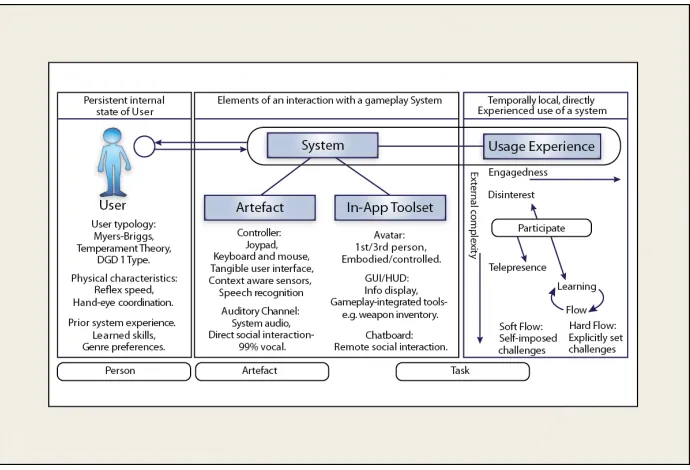
The USE model provides an overview of how the user interacts with the system and provides insight into opportunities for adaptation from a usability and playability perspective. The USE model is capable of describing multiple types of usage expe-riences such as when the participation is low yet the individual is still interested in the game they may experience a state of telepresence. Unlike other models, the USE models accounts for disinterest, participation, telepresence and variation in the level of Flow. The USE model seen in Figure 3.1 is composed of three main components: the internal state of the user, elements of gameplay system and the usage experience.
Figure 3.1: The USE model separates computer and game system interaction into three sections: the player, interaction with the game system and the experience pro-duced. Adapted from [14].

![Table 5.1: Example 22 Design Experiment Table [27]](https://thumb-us.123doks.com/thumbv2/123dok_us/7781318.1285410/117.612.245.404.249.360/table-example-design-experiment-table.webp)