Optisystem based CATV System-Performance
Improvement by Using External
Light-Injection Technique
S.Adithyan
1, S.Srinath
2U.G. Student, Department of EEE, C. Abdul Hakeem College of Engineering & Technology, Vellore, Tamilnadu,
India1
Final Year Student, B.Tech, Department of ECE, Vellore Institute of Technology, Vellore, Tamilnadu, India2
ABSTRACT: Cable Television (CATV) is designed with erbium-doped amplifier-repeated system that uses an external light – injection technique and a directly modulated wave using amplitude modulation. The external light – injection technique can greatly enhance the frequency response of the laser diode, and hence improve the overall performance of the fibre optical CATV system. It implemented using Optiwave Optisystem 10.0.
KEYWORDS: External Light–Injection Technique, Semiconductor Lasers, Optical Communication, Directly Modulated Transmitter.
I.INTRODUCTION
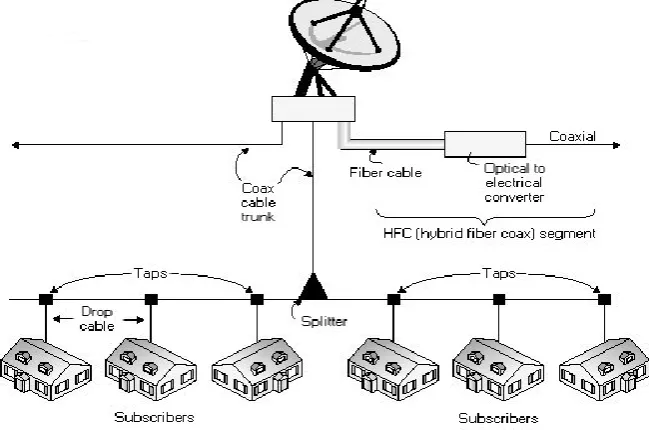
CATV is a shared cable system that uses a tree-and-branch topology in which multiple households within a neighborhood share the same cable. Cable television is a system of distributing television programs to subscribers via radio frequency (RF) signals transmitted through coaxial cables or light pulses through fiber-optic cables. The abbreviation CATV is often used for cable television. It originally stood for Community Access Television or Community Antenna Television, from cable television's origins in 1948, in areas where over-the-air reception was limited by distance from transmitters or mountainous terrain, large "community antennas" were constructed, and cable was run from them to individual homes.
II.RELATED WORK
Lu et al [7] developed a CATV system Based on Lower-Frequency Sidemode Injection-Locked Technique with an injection power level of 4.8 dBm.
Wen et al [8] proved that Injection-locking enhances the resonance frequency of the laser and the electrical feedback achieves strong resonance at the base-rate frequency of the injected data streams.
Our paper is based on directly modulated transport system which employs the external light-injection technique. The external light-injection technique greatly enhances the frequency response of the laser diode, and thus improves the overall performance of the fibre optical CATV system. The idea is implemented using Optisystem 10.0 and we analyse how the output power varies with and without the external light-injection technique. Using external light-injection technique we are analysing how the output power varies with 3dBm, 4dBm, 5 dBm and 8 dBm external injected power.
III.INTODUCTION TO THE EXTERNAL-LIGHT INJECTION TECHNIQUE
and more fast and efficient. Most of the interest exists in broadband network services to deliver a variety of products to consumers, such as Internet access, telephony, interactive TV, and video on demand. But due to its cost efficiency, we need to find a better way to do that. When we send any optical signal, we find there is some loss in the transmission and hence there is the loss in data. So to increase the fibre transmission distance, achieve high quality for the given system and increase the performance is the ultimate goal of the fibre optical cable television (CATV) transport systems. However, nonlinear distortions introduced by laser chirp, fibre dispersion effects can degrade the system performance as well as limit the maximum transmission distance. Till now many techniques have been devised to circumvent these problems, but many of them just increase the complexity of the system. In a recent study, external light-injection technique has been employed in a hybrid radio–fibre system to improve the bit-error-rate performance but it has not been employed as a system-performance improvement technique in an analog light wave system. We suggest that the external light injection technique can be used to meet all the goals of CATV system efficiently. The external light-injection technique can greatly enhance the frequency response of the laser diode. It is expected to have good performances in analog fibre optical CATV systems.
IV.THE CATV NETWORK
V. SIMULATION DESIGN
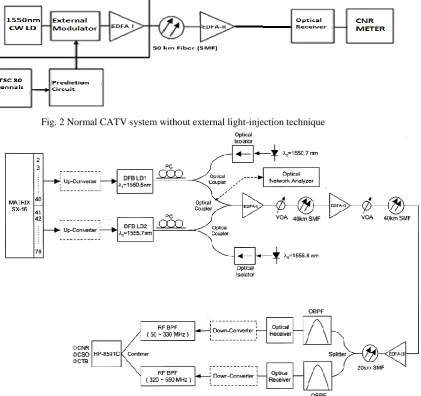
Our proposed directly modulated transport system employs the external light-injection technique. Without external light injection (Fig 3), CH 2-40 (ranging from 55 – 320 MHz) are directly fed into the first Continuous Wave (CW) laser diode and CH 41-78 (325 – 550 MHz) are directly fed into the second one. The CATV frequency bands are up-converted to the first microwave frequency bands (14.75 – 15.25 GHz) and then fed into the Continuous Wave (CW) laser diodes. The second CATV frequency bands are up-converted to the second microwave frequency bands (18.25 – 18.75 GHz) and then fed into the CW laser diodes. The central wavelengths of the two CW laser diodes are 1550.5nm and 1555.7nm, respectively. Without external light injection, the relative intensity noise (RIN) of the two CW laser diodes is about -170 dB/Hz. With external light injection, the RIN of the two DFB laser diodes are lower than -170 dB/Hz. Light is injected in the counter propagation direction through an optical isolator and a 3-dB optical coupler. The wavelengths of the injected light are 1550.7nm and 1555.6nm, respectively. In the system the optical power was coupled into the EDFA - I by a 2x1 optical coupler. After a 50 km single-mode fibre (SMF) transmission, the received optical signal was split by a 1x2 optical splitter, went through two separate optical band pass filters in order to select the appropriate wavelength, and detected using two broad-band analog optical receivers. This system can be used to increase the power of the sent signal to a larger extent while maintaining the efficiency at the same time.
Fig. 2 Normal CATV system without external light-injection technique
VI. SIMULATION, RESULT AND DISCUSSION
When the power injected into the laser diode is increased, the power launched into the EDFA-I is also increased. This is due to the fact that the external light injection will reduce the laser diode threshold current and hence increase the optical output power of the laser diode. The higher the input power launched into the EDFA, the better the CNR performance we can obtain in the system.
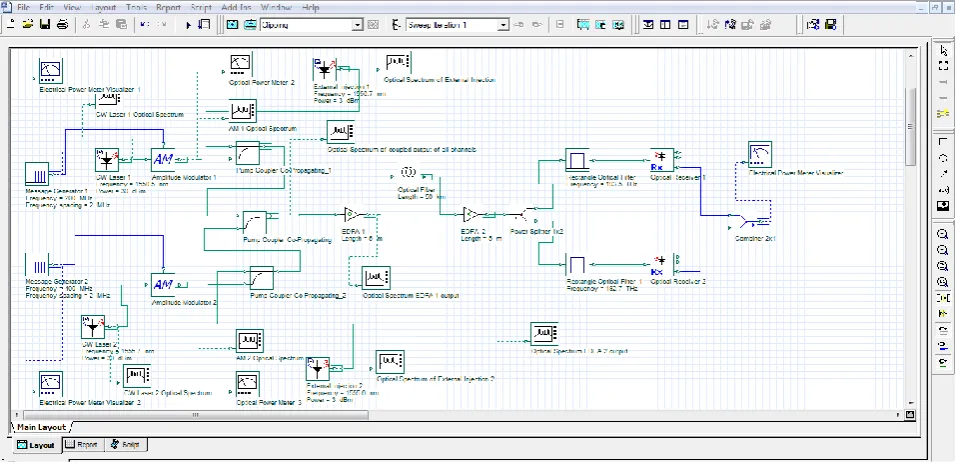
Fig. 4 CATV system without external light-injection technique simulated using Optisystem 10.0
INPUT POWER (dBm)
INJECTED POWER (dBm) OUTPUT POWER (dBm)
30 None 2.34
30 3 4.45
30 4 5.21
30 5 6.53
30 8 8.34
Table. 1 Output to Injected Power Variation
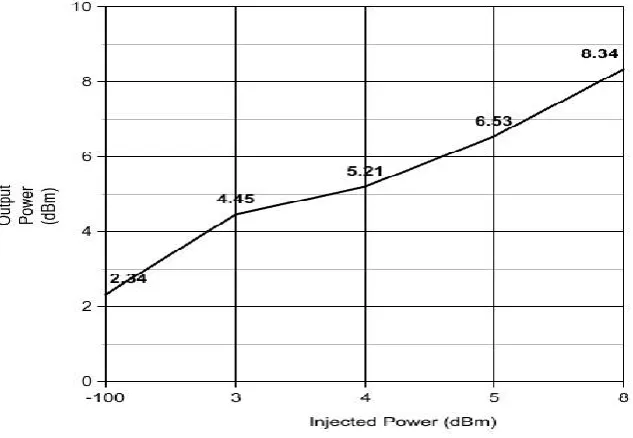
In the normal case (without light injection) by using the 30dBm source light the electrical power output of the system is 2.34dBm . By using the 3dBm, 4dBm, 5 dBm and 8 dBm external light injection technique the electrical power output is 4.45dBm, 5.21dBm, 6.53 dBm and 8.34 dBm respectively.
A plot of „Injected Power‟ vs „Output Power‟ is shown below. This plot concludes that as injected power through the external light injection technique is increased then the output power also increases.
Fig. 5 Graphical Variation of Output to Injected Power
The output power as seen through a „Electrical Power Meter Visualizer‟ for a CATV system without external light injection is shown below.
The output power as seen through a „Electrical Power Meter Visualizer‟ for a CATV system employing external light injection (3dBm injection) is shown below.
Fig. 7 Electrical Power Output (With 3dBm Injection)
The output power as seen through a „Electrical Power Meter Visualizer‟ for a CATV system employing external light injection (4dBm injection) is shown below.
Fig. 8 Electrical Power Output (With 4dBm Injection)
The output power as seen through a „Electrical Power Meter Visualizer‟ for a CATV system employing external light injection (5dBm injection) is shown below.
Fig. 9 Electrical Power Output (With 5dBm Injection)
The output power as seen through a „Electrical Power Meter Visualizer‟ for a CATV system employing external light injection (8dBm injection) is shown below.
VII.CONCLUSION
We propose and demonstrate a directly modulated AM- CATV EDFA-repeated system that uses the external light-injection technique to improve the systems‟ performance. The external light-light-injection technique greatly enhances the frequency response of the laser diode, and thus improves the overall performance of the fibre optical CATV system. The efficiency of the CATV system can be further increased by feeding the customers using the optical fibre i.e. fibre to home in place of coaxial cable. This can increase the efficiency by 10 times as compared to normal co-axial cable.
REFERENCES
[1] D. Piehler, C. Y. Kuo, J. Kleefeld, and C. Gall, “Nonlinear intermodulation distortion in an optically amplified analog video transport system with dispersion compensation fiber,” in Eur. Conf. Opt. Communications, Paper WeP.02, pp. 3217–3220, 1996.
[2] J. Helms, “Intermodulation and harmonic distortions of laser diodes with optical feedback,” J. Lightwave Technol., vol. 9, pp. 1567–1575, Nov.1991.
[3] S. H. Lee, J. M. Kang, I. H. Choi, and S. K. Han, “Linearization of DFB laser diode by external light-injected cross-gain modulation for radio-over-fiber link,” IEEE Photon. Technol. Lett., vol. 18, no. 14, pp. 1545–1547, Jul. 15, 2006.
[4] Y. Hong and K. A. Shore, “Locking characteristics of a side-mode injected semiconductor laser,” IEEE J. Quantum Electron., vol. 35, no. 11, pp. 1713–1717, Nov. 1999.
[5] S. K. Mondal, B. Roycroft, P. Lambkin, F. Peters, B. Corbett, P. Townsend, and A. Ellis, “A multiwavelength low-power wavelength- locked slotted Fabry–Pérot laser source forWDMapplications,” IEEE Photon. Technol. Lett., vol. 19, no. 10, pp. 744–746, May 15, 2007.
[6] X. J. Meng, T. Chau, and M. C. Wu, “Experimental demonstration ofmodulation bandwidth enhancement in distributed feedback lasers with external light injection,” Electron. Lett., vol. 34, pp. 2031–2032, 1998.
[7] Lu, H.-H., Patra, A. S., Tzeng, S.-J., Peng, H.-C., and Lin, W.-I., “ Improvement of Fiber-Optical CATV Transport Systems Performance Based on Lower-Frequency Sidemode Injection-Locked Technique.”, IEEE Photonics Technology Letters 20, 351-353, 2008.
[8] Attygalle, M., and Wen, Y. J. ,“Injection-locked Fabry-Perot laser with electronic feedback for clock recovery from high-speed OTDM signals.” IEEE Photonics Technology Letters 18, pp. 478-480, 2006.
[9] Choi, K. M., Baik, J. S., and Lee, C. H. ,“ Broad-band light source using mutually injected Fabry-Perot laser diodes for WDM-PON.”, IEEE Photonics Technology Letters 17,pp. 2529-2531, 2005.
[10] Hann, S., Kim, D. H., and S., P. C. ,“ Uni-lambda bidirectional 10/1.25 GbE access service based on WDM-PON.”, Electronics Letters 40, pp.194-195, 2004.
[11] Ni, Y., Zhang, L., An, L., Peng, J., and Fan, C., “ Dual-core photonic crystal fiber for dispersion compensation.”, IEEE Photonics Technology Letters 16, pp. 1516-1518, 2004.
[12] Lu, H.-H., Huang, H.-H., Su, H.-S., and Wang, M.-C., “ Fiber Optical CATV System-Performance Improvement by Using External Light-Injection Technique.” , IEEEPhotonics Technology Letters 15,pp. 1017-1019, 2003.
[13] Kaszubowska, P. Anandarajah, and L. P. Barry, “Improved performance of a hybrid radio/fiber system using a directly modulated laser transmitter with external injection,” IEEE Photon. Technol. Lett., vol.14, pp. 233–235, Feb. 2002.
[14] H. H. Lu, C. T. Lee, and C. J. Wang, “Dispersion compensation in externally modulated transport system using chirped fiber grating as well as large effective area fiber,” Opt. Eng., vol. 40, pp. 656–657, 2001.
[15] Srinath, S. "Performance Analysis of 2.5 Gbps GPON.", International Journal of Advanced Research in Electrical, Electronics and Instrumentation Engineering , Vol.3 , Issue.6, pp:10148-10155, June,2014,.
[16] L. P. Shen, W. P. Huang, G. X. Chen, and S. S. Jian, "Design and optimization of photonic crystal fibers for broad-band dispersion compensation," IEEE Photon. Technol. Lett., vol. 15, pp. 540-542, 2003.
[17] Y. J. Wen, C.-J. Chae, and H. F. Liu, “Time-domain polarization interleaving of signal to allow polarization-insensitive all-optical clock recovery,” IEEE Photon. Technol. Lett., vol. 17, no. 6, pp. 1304–1306, Jun. 2005.
[18] H. H. Lu, C. L. Ying, W. I. Lin, Y. W. Chuang, Y. C. Chi, and S. J. Tzeng, “CATV/ROF transport systems based on light injection/optoelectronic feedback techniques and photonic crystal fiber,” Opt. Commun., vol. 273, pp. 389–393, 2007.
[19] J. L. Thomas, “Cable Television Proof-Of-Performances,” in Hewlett- Packard Professional Book, ch. 8, pp. 158–193,1998. [20] S. Kawanishi, “High bit rate transmission over 1 Tbit/s,” IEICE Trans. Commun., vol. E84-B, no. 5, pp. 1135–1141, 2001.
BIOGRAPHY