Available online:
https://edupediapublications.org/journals/index.php/IJR/
P a g e | 1962Dynamic Update and Dispute Arbitration for Data Auditing in Cloud
Kaipa Lahari & Dr.C.Gulzar
1M.Tech Student, Department of CSE, Dr.K.V.Subba Reddy Institute of Technology, Kurnool, A.P 2Assoc.Prof, Department of CSE, Dr.K.V.Subba Reddy Institute of Technology, Kurnool, A.P
Abstract:- Cloud computing is a computing-infrastructure and software model for enabling ubiquitous access to shared pools of configurable resources (such as computer networks, servers, storage, applications and services), which can be rapidly provisioned with minimal management effort, often over the Internet. Cloud computing allows users and enterprises with various computing capabilities to store and process data either in a privately-owned cloud, or on a third-party server located in a data center - thus making data-accessing mechanisms more efficient and reliable. Cloud computing relies on sharing of resources to achieve coherence and economy of scale, similar to a utility. Storage outsourcing turned into a rising trend with the advent of the cloud computing, advancing the secure remote data auditing to be the future research area. Other than this research considers the problem of data dynamics support, public verifiability and dispute arbitration simultaneously. The data dynamics problem in auditing is solved by presenting an index switcher to preserve a mapping between block indices and tag indices and eradicate the passive outcome of block indices in the tag computation without incurring much overhead. We provide fairness guarantee and dispute arbitration in our scheme, which ensures that both the data owner and the cloud cannot misbehave in the auditing process or else it is easy for a third-party arbitrator to find out the cheating third-party. The framework is reaching out by executing the data dynamically and reasonable discretion on gatherings in the future.
1.INTRODUCTION
Information outsourcing is a key use of distributed computing, which calms cloud clients of the substantial weight of information administration and framework support, and gives quick information get to autonomous of
physical areas. Be that as it may, outsourcing information to the cloud achieves numerous new security dangers. Firstly, in spite of the intense machines what's more, solid security systems gave by cloud benefit suppliers (CSP), remote information still face organize assaults, equipment disappointments and managerial blunders. Besides, CSP may recover capacity of infrequently or never got to information, or even conceal information misfortune mischance for notoriety reasons. As clients no longer physically have their information and thusly lose coordinate control over the information, coordinate work of customary cryptographic primitives like hash or encryption to guarantee remote information's respectability may prompt
to numerous security escape clauses.
Available online:
https://edupediapublications.org/journals/index.php/IJR/
P a g e | 1963information without down stacking them locally, which is named as block less verification. With evaluating plans, clients can intermittently communicate with the CSP through evaluating conventions to check the rightness of their outsourced information by confirming the uprightness evidence registered by the CSP, which offers more grounded trust in information security since client's own decision that information is in place is significantly more
persuading than that from specialist
organizations. For the most part talking, there are a few slants in the advancement of evaluating plans.
Data auditing schemes can assist cloud users to check the reliability of their remotely stored data without downloading them locally, which is termed as blocks verification. With auditing schemes, users can occasionally interact with the CSP through auditing protocols to check the precision of their outsourced data by authenticating the integrity proof computed by
the CSP, which compromises stronger
confidence in data security since the user’s own conclusion that data intact is much greater than that from service providers. Normally speaking, there are numerous trends in the evolution of auditing schemes. First of all, prior auditing schemes frequently require the CSP to generate a deterministic proof by accessing the whole data file to perform an integrity check, e.g., schemes in [1], [2] use the complete file to perform modular exponentiations. Such simple solutions suffer high computation overhead on the server side. Hence they lack efficacy and realism when dealing with large-size data. Represented by the “sampling” method in ” Proofs of Retrievability” (PoR) [3] model and” Provable Data Possession” (PDP) [4] model, earlier schemes [5], [6] tend to provide a probabilistic proof by accessing part of the file,
which clearly enhances the auditing efficacy over former schemes. Secondly, some auditing regimes [3], [7] provide private verifiability that necessitates only the data owner who has the secretive key to accomplishing the auditing task, which may overload the owner due to its inadequate computation capability. Ateniese el al. [4] was the first to recommend public verifiability in auditing schemes. In contrast, public auditing systems [5], [6] permit anyone who has the public key to accomplishing the auditing, which makes it promising for the auditing task to be surrogate to an external third party auditor (TPA). A TPA can accomplish the reliability check on behalf of the data owner and honestly report the auditing results to him [8]. Thirdly, PDP [4] and PoR [3] anticipate auditing static data that are occasionally updated. Upon each update action, we assign a new tag index for the functioning block and update the mapping between tag indices and block indices. Such a layer of indirection between block indices, Band tag indices imposes block validation and avoids tag re-computation of
blocks after the operation position
instantaneously. As a result, the efficacy of handling data dynamics is significantly improved. Additionally in public auditing
consequence, a data owner always
Available online:
https://edupediapublications.org/journals/index.php/IJR/
P a g e | 1964very collective requisite for cloud applications. In auditing schemes could only deal with static data, their feasibility and scalability will be restricted. On the other hand, direct extensions of these static data oriented schemes to provision dynamic update may cause other security threats, as explained in [6]. To our knowledge, only schemes in [6], [9], [10] provide built-in support for fully data effective operations, but they are inadequate in providing information dynamics provision, public verifiability, and auditing efficacy concurrently. From these developments, it can be seen that providing probabilistic proof, public verifiability and data dynamics support are three most crucial characteristics in auditing schemes. Amongst them, providing data dynamics maintenance is the most thought-provoking. This is because most existing auditing schemes intend to push in a block’s index into its tag computation, which functions to validate challenged blocks. Nonetheless, if we insert or delete a block, block indices of all consecutive blocks will change, and then tags of these blocks have to be recomputed. This is intolerable because of its high computation overhead. We address this problem by discriminating between tag index and block index (indicate block position) and trust an index switcher to keep a mapping between them. Upon each apprises operation, we assign a new tag index for the functioning block and apprise the mapping between tag indices and block indices. Such a layer of indirection between block indices, band tag indices imposes block verification and evades tag re-computation of blocks after the task position concurrently. As a result, the efficacy of management data
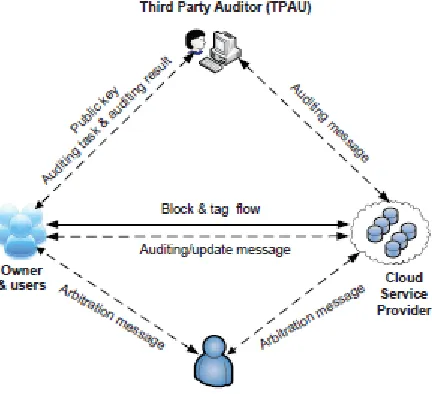
dynamics is significantly improved. Also, a public auditing consequence, a data owner always representatives his auditing tasks to a TPA which is reliable from the owner but not inevitably by the cloud. Present research commonly assumes an honest data owner in their security models, which has an innate inclination toward cloud users. Though, the fact is, not only the cloud but also cloud users, have the intention to occupy in dishonest behaviors. So, it is of grave significance for an auditing scheme to deliver objectivity assurance to settle possible differences between the two parties. Zheng et al. [11] suggested a reasonable PoR scheme to prevent an unfair client from accusing an honest CSP; nevertheless their scheme only recognizes isolated auditing. Kupccu [12] suggested common arbitration protocols with automated expenses using the fair sign of exchange protocols [13]. Our work also accepts the idea of signature exchange to guarantee the metadata accuracy and protocol justice, and we focus on combining effective data dynamics support and fair argument arbitration into a single auditing scheme. To address the equality difficult in auditing, we present a third party arbitrator(TPAR) into our threat model, which is a professional institute for struggles arbitration and is trustworthy and paid by both data owners and the CSP. Since a TPA can be observed as a delegator of the data owner and is not essentially trusted by the CSP, we discriminate between the roles of auditor and arbitrator. Furthermore, we accept the idea of signature discussion to ensure
metadata accuracy and provide dispute
Available online:
https://edupediapublications.org/journals/index.php/IJR/
P a g e | 1965Figure 1: The System Model
2. LITERATURE SURVEY
This section dissects the issue of checking the uprightness of records put away on remote servers. Since servers are inclined to fruitful assaults by pernicious programmers, the consequence of straightforward uprightness checks keep running on the servers can't be trusted. On the other hand, downloading the records from the server to the confirming host is unfeasible. Two arrangements are proposed, in view of test reaction conventions. To provide the data Integrity auditing, different schemes were provided some of them be: C.Erway, A.Kupcu, and R.Tamassiaand Illinois [9] For maintaining the integrity of static files they proposed the provable data possession technique. In this technique, the client preprocesses the data and then sends it to an untrusted server for storage, while keeping a small amount of metadata. The client later asks the server to prove that the stored data has not been tampered or deleted. When the dynamic files are considered the Dynamic provable data possession(DPDP) was
Available online:
https://edupediapublications.org/journals/index.php/IJR/
P a g e | 1966able to just use the cloud storage as if it is local, without worrying about the need to verify its integrity. J.Yuan and S.Yu [17] They stated a proof of retrievability (POR) is a short proof by a file system (prover) to a client (verifier) that a target file F is intact, in the sense that the customer can fully recover it. As PORs incur lower communication complexity than the transmission of itself, they are an attractive building block for high-assurance remote storage systems. Framework for the design of PORs is conceived in this scheme. This technique enables individuals and organizations to verify the integrity of their outsourced data on the untrusted server (e.g., public cloud storage platform). While existing POR schemes have focused on various practical issues, they still have limitations either the communication cost is linear in the number of elements in a data block, or the public verifiability is not supported. Such limitations cause these POR schemes to suffer from a severe scalability issue regarding data file size or user number for practical use. B.Wang, B.Li, and H.li [16] B.Wangetal[16] stated a novel privacy-preserving mechanism that supports public auditing on shared data stored in the cloud presents how to preserve identity privacy from the TPA, because the identities of signers on shared data may indicate that a particular user in the group or a special block in shared data is a higher valuable target than others. To audit, the integrity of shared data in the cloud with static groups is considered in this scheme. It means the group is pre-defined before shared data is created in the cloud and the membership of users in the group is not changed during data. Ayad F. Barsoum and M. Anwar Hasan[18] PDP schemes have been presented for multiple copies of static data, by this work, it implemented PDP scheme directly dealing with multiple copies of dynamic data. When verifying multiple data copies, the overall system integrity
check fails if there are one or more corrupted copies. To address this issue and recognize which copies have been corrupted, a map-based provable multi-copy dynamic data possession (MB-PMDDP) scheme is proposed. This scheme provides an adequate guarantee that the CSP stores all copies that are agreed upon in the service contract. Moreover, the scheme supports outsourcing of dynamic data, i.e., it supports
block-level operations such as block
modification, insertion, deletion, and append. The authorized users, who have the right to access the owner’s file, can seamlessly access the copies received from the CSP. In this work, encoding the data to be outsourced is not done.
3. FAIR ARBITRATION SCHEME
Available online:
https://edupediapublications.org/journals/index.php/IJR/
P a g e | 1967appropriately as recommended contract more often than not, yet he may attempt to pass the honesty check without having the right information. Then again, the proprietor additionally has the thought process to charge a legitimate CSP dishonestly, e.g., a noxious proprietor deliberately guarantees information debasement regardless of the reality despite what might be expected with the goal that he can get a remuneration from the CSP. Subsequently, the debate between the two gatherings is unavoidable to a specific degree. So an authority for question settlement is basic for a reasonable examining plan. We augment the danger demonstrate in existing open plans by separating between the examiner (TPAU) and the judge (TPAR) and putting distinctive trust suspicions on them. Since the TPAU is primarily an assigned gathering to check customer's information respectability, and the potential question may happen between the TPAU and the CSP, so the mediator ought to be a fair-minded outsider who is diverse to the TPAU. On the TPAR, we think of it as legitimate yet inquisitive. It will carry on genuinely more often than not yet it is additionally inquisitive about the substance of the reviewing information, in this way the security assurance of the inspecting information ought to be considered.
3.1 Module Description
3.1.1 Data Upload and Encryption: To efficiently upload an encrypted data with the cloud. A semi-trusted proxy can transform an encryption of a message to another encryption of the same message without knowing the message. To user upload our files for our selected location of the database. Every user can upload their data are the Encrypted format to store the data base. Then user wants to use the file download and view our file for Decrypted format using secret keys.
3.1.2 Data Distribution: The mutual
information is marked by a gathering of clients. Hence, the question between the two gatherings is unavoidable to a specific degree. So a mediator for debate settlement is key for a reasonable reviewing plan. We amplify the danger demonstrate in existing open plans by separating between the evaluator (TPAU) and the referee (TPAR) and putting diverse trust suspicions on them. Since the TPAU is primarily an assigned gathering to check customer's information respectability, and the potential debate may happen between the TPAU and the CSP, so the referee ought to be an objective outsider who is different to the TPAU. As for the TPAR, we consider it honest-butcurious. It will behave most of the time honestly, but it is also curious about the content of the auditing data. Thus the privacy protection of the auditing data should be considered. Note that, while privacy protection is beyond the scope of this paper, our scheme can adopt the random mask technique proposed for privacy preservation of auditing data or the ring signatures in to protect the identity privacy of signers for data shared among a group of users.
Available online:
https://edupediapublications.org/journals/index.php/IJR/
P a g e | 19683.1.4 Join Group: Related to these schemes, our work is the first to combine public verifiability, data dynamics support and dispute arbitration concurrently. Supplementary additions to both PDPs and Pors. Announced a mechanism for data integrity auditing under the multi server scenario, where data are encoded with network code. Ensure data possession of multiple replicas across the distributed storage scenario. They also integrate forward error-correcting codes into PDP to provide robust data possession utilize the idea of proxy resignatures to provide efficient user revocations, where the shared data are signed by a group of users.
4. CONCLUSION
In this paper, we study the need for a fair and dynamic auditing scheme to avoid a deceitful client reproving an honest CSP. However, their scheme only realizes private auditing and is challenging to be prolonged to support public auditing. Compared to these schemes, our work is the first to combine public verifiability, data dynamics support and dispute arbitration instantaneously. The system is extended by employing the data dynamically and fair arbitration on groups in future.
5. REFERENCES
1. Y. Deswarte, J. J. Quisquater, and A. Saïdane, “Remote integrity checking,” In Integrity and internal control in information systems VI, Springer US, 1-11 (2004).
2. D. L. Gazzoni Filho, and P. S. L. M. Barreto, “Demonstrating data possession and uncheatable data transfer,” IACR Cryptology ePrint Archive 2006, 150 (2006).
3. A. Juels, and B. S. Kaliski Jr, “PORs: Proofs of retrievability for large files,” In Proceedings
of the 14th ACM conference on Computer and communications security, Acm, 584-597 (2007).
4. G. Ateniese, R. Burns, R. Curtmola, J. Herring, L. Kissner, Z. Peterson, and D. Song, “Provable data possession at untrusted stores,” In Proceedings of the 14th ACM conference on Computer and communications security, Acm, 598-609 (2007).
5. H. Shacham, and B. Waters, “Compact proofs of retrievability,” In International Conference on the Theory and Application of Cryptology and
Information Security, Springer Berlin
Heidelberg, 90-107 (2008).
6. Q. Wang, C. Wang, J. Li, K. Ren, and W. Lou, “Enabling public verifiability and data dynamics for storage security in cloud computing,” In European symposium on research in computer security, Springer Berlin Heidelberg, 355-370 (2009).
7. M. A. Shah, R. Swaminathan, and M. Baker, “Privacy-Preserving Audit and Extraction of Digital Contents,” IACR Cryptology EPrint Archive 186 (2008).
8. C. Wang, K. Ren, W. Lou, and J. Li, “Toward publicly auditable secure cloud data storage services,” IEEE network 24, (2010).
9. C. C. Erway, A. Küpçü, C. Papamanthou, and
R. Tamassia, “Dynamic provable data
possession,” ACM Transactions on Information and System Security (TISSEC) 17, (2015).
Available online:
https://edupediapublications.org/journals/index.php/IJR/
P a g e | 196911. Q. Zheng, and S. Xu, “Fair and dynamic proofs of retrievability,” In Proceedings of the first ACM conference on Data and application security and privacy, ACM, 237-248 (2011).
12. A. Küpçü, “Official arbitration with secure cloud storage application,” The Computer Journal 58, 831-852 (2015).
13. N. Asokan, V. Shoup, and M. Waidner, “Optimistic fair exchange of digital signatures,”
IEEE Journal on Selected Areas in
communications 18, 593-610 (2000).
14. C. Wang, Q. Wang, K. Ren, and W. Lou, “Privacypreserving public auditing for data storage security in cloud computing,” In Infocom, 2010 proceedings ieee, 1- 9 (2010).
15. C. Wang, S. S. M Chow, Q. Wang, K. Ren, and W. Lou, “Privacy-preserving public auditing for secure cloud storage,” IEEE transactions on computers 62, 362- 375 (2013).
16. B. Wang, B. Li, and H. Li, “Oruta: Privacypreserving public auditing for shared data in the cloud,” In Cloud Computing
(CLOUD), 2012 IEEE 5th International
Conference on, 295-302 (2012).
17. J. Yuan, and S. Yu, “Proofs of retrievability with public verifiability and constant communication cost in cloud,” In Proceedings of the 2013 international workshop on Security in cloud computing, ACM, 19-26 (2013).