International Journal of General Medicine 2016:9 123–131
International Journal of General Medicine
Dove
press
submit your manuscript | www.dovepress.com 123
O R I G I N A L R E S E A R C H open access to scientific and medical research
Open Access Full Text Article
Get the most from your data: a propensity score
model comparison on real-life data
Dennis Ferdinand1
Mirko Otto2
Christel Weiss1
1Department of Biomathematics and Medical Statistics, 2Department of Surgery, University Medical Center Mannheim (UMM), University of Heidelberg, Mannheim, Germany
Purpose: In the past, the propensity score has been in the middle of several discussions in terms of its abilities and limitations. With a comprehensive review and a practical example, this study examines the effect of propensity score analysis of real-life data and introduces a simple and effective clinical approach.
Materials and methods: After the authors reviewed current publications, they applied their insights to the data of a nonrandomized clinical trial in bariatric surgery. This study examined weight loss in 173 patients where 127 patients received Roux-en-Y gastric bypass surgery and 46 patients sleeve gastrectomy. Both groups underwent analysis in terms of their covariate dis-tribution using Mann–Whitney U and c2 testing. Mean differences within excess weight loss in native data were examined with Student’s t-test. Three propensity score models were defined and matching was performed. Covariate distribution and mean differences in excess weight loss were checked with Mann–Whitney U and c2 testing.
Results: Native data implied a significant difference in excess weight loss. The propensity score models did not confirm this difference. All models proved that both surgical procedures were equal, due to their weight-loss induction. Covariate distribution improved after the matching procedure in terms of an equal distribution.
Conclusion: It seemed that a practical clinical approach with outcome-related covariates as a propensity score base is the ideal midpoint between an equal distribution in covariates and an acceptable loss of data. Nevertheless, propensity score models designed with clinical intent seemed to be absolutely suitable for overcoming heterogeneity in covariate distribution.
Keywords: nonrandomized clinical trial, statistics, logistic regression, study design, balancing score
Introduction
Propensity score models are quite popular in modern clinical research practice. While the randomized clinical trial (RCT) is the method of choice when it comes to clinical studies, it might occur that they are not suitable or applicable for various reasons, eg, financing or ethics. In this case, one might perform a non-RCT to test a hypothesis.1
Unfortunately, this study design can lead to heterogeneity in covariate distribution between two therapy groups, which makes it difficult to compare between the outcomes of therapy A versus B. Propensity score models are a simple tool to solve this problem and generate unbiased data.2
In 1983, Rosenbaum and Rubin introduced the propensity score as a new balancing score.2 The propensity score unifies all known covariates from a patient in one score
Correspondence: Dennis Ferdinand Department of Biomathematics and Medical Statistics, Universitätsmedizin Mannheim (UMM), 13–17 Ludolf-Krehl-Strasse, Mannheim 68167, Germany Email [email protected]
Journal name: International Journal of General Medicine Article Designation: ORIGINAL RESEARCH Year: 2016
Volume: 9
Running head verso: Ferdinand et al
Running head recto: Propensity score model comparison on real-life data DOI: http://dx.doi.org/10.2147/IJGM.S104313
International Journal of General Medicine downloaded from https://www.dovepress.com/ by 118.70.13.36 on 22-Aug-2020
For personal use only.
This article was published in the following Dove Press journal: International Journal of General Medicine
17 May 2016
Dovepress
Ferdinand et al
value between 0 and 1. Calculated by logistic regression, the propensity score is a patient’s likelihood of receiving a specific therapy, considering his or her covariates. Covariates in this context are actually all the characteristics a patient has, like blood type, weight, height, age, and sex, and also nonmedical aspects, such as education and leisure activities.2,3
With the knowledge of all patients’ propensity scores, there are various ways to use them in further analysis. Common applications are nearest-neighbor matching and stratifica-tion.4 Nearest-neighbor matching, for instance, compares
two individuals from separate groups with the most similar propensity score values in terms of their outcome. Patients without a match are dropped.
Since its introduction, there has been great discussion on which covariates should be considered in propensity score calculation, the calculation methods, the abilities and quality of propensity score results, and many other aspects of this tool. Stürmer et al5 argued that there is no factual evidence
for superiority of the propensity score compared to tradi-tional multivariate-outcome models. Hahn6 even claimed
that the propensity score reduces the efficiency of outcome examinations. Bryson et al7 reduced the role of the propensity
score to a simple average treatment-effect analysis method without further advantages. On the other hand, Cattaneo8
posited that propensity score models are superior to common multivariate-adjustment methods, especially when there are fewer than eight covariates included. However, in stating that there are legitimate reasons for using the propensity score, one might have a closer look at studies that examine more specialized and detailed applications in clinical research settings. Regularly used for binary-treatment comparisons, there are now approaches for multiple-treatment settings, as they are quite closer to reality, eg, when it comes to dose adaptation within a medical treatment group.9 Unfortunately,
most propensity score evaluations are performed with Monte Carlo studies instead of real-life data.
One of the most critical issues in implementing propen-sity score analysis is the question of which covariates should be part of the model. While Rubin10 stated that propensity
score models should be exhaustive and contain all available covariates, there are various voices against this procedure. Augurzky and Schmidt11 supported Rubin’s thesis, claiming
that this would lead to the true average treatment effect. As shown by Austin et al,12 propensity score models based on
outcome-relevant covariates might be a better tool. While models based on all covariates lead to a holistic propensity score, there is a significant reduction in matching pairs, because it becomes less probable to find a fitting match for
a patient from group A in group B. Using just covariates that are significant within the logistic regression does not seem to be a suitable approach. Models based on this calculation are far too vague, even though one will find the lowest patient dropouts here. D’Agostino and D’Agostino13 also stated
that there is clinical evidence to include these insignificant covariates.
Another aspect to consider is the choice of the best-fitting matching method. While Frölich14 could not find a
signifi-cant difference in validity, Augurzky and Schmidt11 showed
that there is a significant loss of data due to patient dropout within nearest-neighbor matching, especially compared to stratification with quartiles. Furthermore, stratification would also lead to a reduced standard error. There are many more possibilities of matching methods, some of which were mentioned by Rosenbaum and Rubin,2 like Mahalanobis or
caliper matching. Those very special calculation methods are not part of this examination.
In respect of all those contrary arguments, the purpose of this study was to examine what kind of influence differ-ent propensity score models have on real non-RCT data and how they distinguish from one another in terms of outcome and data structure. Furthermore, we wanted to compare the outcome of this analysis to our native data and to findings in similar RCTs.
Materials and methods
Data
For our research purposes, we used a non-RCT by Otto et al.15 A total of 173 patients were recruited to compare the
weight-loss effects of sleeve gastrectomy versus Roux-en-Y gastric bypass; 127 patients decided to receive bypass surgery, and 46 patients received sleeve gastrectomy. To become part of this study, patients had to be older than 18 years and fulfill the criteria of body mass index (BMI) >40 kg/m2 or BMI
>35 kg/m2 in combination with comorbidity.
In general, patients could choose between both therapy options, but there was a clear recommendation for sleeve gastrectomy with patients who suffered from gastroesopha-geal reflux disease, psychiatric diseases, who needed dialysis, or had a BMI >60 kg/m2.
The surgical procedure was performed with a standard technique and laparoscopically. Roux-en-Y gastric bypass was applied with an antecolic Roux limb of 150 cm and a 50 cm biliopancreatic limb. For the sleeve gastrectomy, the calibration of the gastric sleeve was done with a 42-French bougie, inserted along the lesser gastric curvature. Linear sta-pling went from 5 cm proximal to the pylorus to the angle of
International Journal of General Medicine downloaded from https://www.dovepress.com/ by 118.70.13.36 on 22-Aug-2020
Dovepress Propensity score model comparison on real-life data
Hiss. In cases of bleeding or inadequate staples, the stapling line got oversewn.
Follow-up was performed in an outpatient clinic after 6 weeks, 18 weeks, 6 months, 9 months, and 12 months. For comparison, presurgical baselines were measured 1 day before the intervention. Measured data included body composition using the bioelectrical impedance-analysis tool Nutriguard-MS (Data Input GmbH, Darmstadt, Ger-many) and Nutri Plus software. The relevant criterion for this study was excess weight loss (EWL). EWL is defined as the percentage loss of overweight. We performed native statistic analysis with SAS version 9.3 (SAS Institute Inc, Cary, NC, USA).
Propensity score analysis
In a first step in order to perform propensity score analysis, we checked both therapy groups for heterogeneity within the distribution of their covariates, specifically their sex, height, overweight, BMI, percentage body fat, absolute body water, dry mass, extracellular mass, body cell mass, basal metabo-lism, phase angle, albumin, glucose, cholesterol, triglycer-ides, creatinine, leukocytes, erythrocytes, and Quick’s value. For this purpose, we used Mann–Whitney U tests and the c2
test. Given the native data, we also performed two-sample t-tests with all relevant EWL percentages.
Afterward, we defined three different propensity score models that we used for statistical analysis. These three models were based on the most popular ways to choose included covariates. The first model contained just outcome-related covariates, and the second model was based on all covariates in order to calculate an exhaustive score. The third model contained just significant covariates in logistic regression. Within this analysis, we defined significance as P<0.05. We identified outcome-related covariates by reviewing current scientific publications and discussion with bariatric surgeons. This model included sex, overweight, BMI, percentage body fat, body cell mass, basal metabo-lism, phase angle, glucose, and creatinine. Calculation of the exhaustive propensity score includes sex, height, over-weight, BMI, percentage body fat, absolute body water, dry mass, extracellular mass, body cell mass, basal metabolism, phase angle, albumin, glucose, cholesterol, triglycerides, creatinine, leukocytes, erythrocytes, and Quick’s value.16–22
To identify significant covariates, we used logistic regres-sion with backward elimination. Therefore, we used BMI and creatinine as the covariates of choice.
Using the defined propensity score models, we performed a logistic regression to calculate propensity score values
for each patient and each model. Knowing these values, we started the matching procedure. In respect of the recent discussion on the best method of data adjustment with propensity scores, we decided to perform nearest-neighbor matching with a maximum difference of 5% in propensity scores between both matching partners and stratification by quartiles.
After propensity score adjustment, we checked both therapy groups again for heterogeneity in covariates with Mann–Whitney U tests and performed two-sample t-tests for every model and adjustment procedure to examine the differ-ence in mean EWL. We performed all statistical analysis with SPSS version 22 for Mac OS X (IBM, Armonk, NY, USA).
Results
Native data
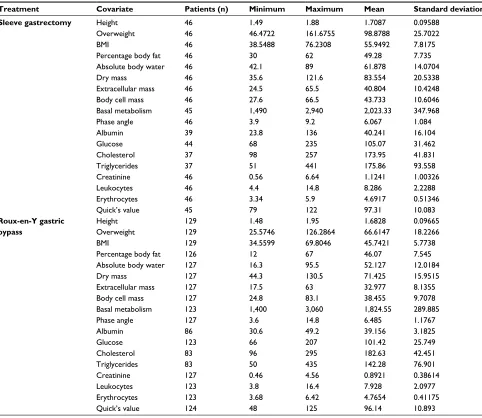
Student’s t-test (Table 1) proved that there was a significant difference in EWL between the therapy groups after 18 weeks and 1 year. As emphasized earlier, one has to con-sider heterogeneity within the groups’ covariate distribution. Mann–Whitney U tests and c2 testing indicated that the
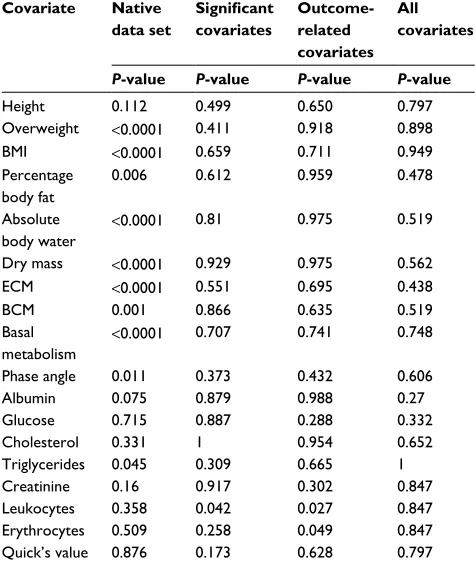
groups contained an unequal distribution for the following covariates, as shown in Table 2: overweight, BMI, percent-age body fat, absolute body water, dry mass, extracellular mass, body cell mass, basal metabolism, phase angle, and triglycerides. The P-value of the c2 test for the distribution
of sex was 0.174.
Propensity score analysis with
significant covariates
This model led to an outcome comparison between 54 patients: 27 matching pairs. The mean propensity score for sleeve gastrectomy was 0.4442 and for Roux-en-Y gastric bypass was 0.8391. Values in parentheses are minima and maxima. After the matching procedure had been performed, mean values were 0.5691 (0.029–0.9571) for sleeve gastrec-tomy and 0.5802 (0.0191-0.9668) for Roux-en-Y gastric bypass (Table 3). Table 4 shows that heterogeneous distri-bution in covariates was reduced to leukocytes. Student’s t-tests for mean differences in EWL showed no significant difference between the groups after matching.
Propensity score analysis with
outcome-related covariates
Containing 48 patients, or 24 matching pairs, this model led to a mean propensity score of 0.3976 for sleeve gastrectomy and 0.8539 for Roux-en-Y gastric bypass
International Journal of General Medicine downloaded from https://www.dovepress.com/ by 118.70.13.36 on 22-Aug-2020
Dovepress
Ferdinand et al
before we performed matching. Afterward, these values were 0.5608 (0.1479–0.9593) and 0.572 (0.1277–0.9925) (Table 3). Unequally distributed covariates remained within the number of leukocytes and erythrocytes. Again, t-tests for mean EWL between the therapy groups showed no significant difference.
Propensity score analysis with all
covariates
With the highest loss of data, this model contained 22 patients in eleven matching pairs. Mean propensity score values before
matching were 0.2991 for sleeve gastrectomy and 0.8526 for Roux-en-Y gastric bypass. Compared to our other models, this was the biggest difference between mean propensity scores, which also indicated relevant heterogeneity in covariate distri-bution between the therapy groups. After our matching proce-dure, these values adapted to 0.7196 (0.2476–0.9729) for sleeve gastrectomy and 0.725 (0.267–0.9936) for Roux-en-Y gastric bypass (Table 3). The exhaustive propensity score model was the only one without any residual observed heterogeneously distributed covariate. As seen earlier, the t-test for mean pro-pensity score values showed no significant difference for EWL.
Table 1 Student’s t-test for mean differences in native data
Statistical model Outcome Levene’s test for equal variance (upper line: equal variance)
Student’s t-test for mean differences
95% confidence interval
P-value P-value Mean difference Lower Upper
Native data EWL 6 weeks 0.179 0.171 –0.0962 –0.2345 0.0421
0.107 –0.0962 –0.2136 0.0212
EWL 18 weeks 0.093 0.011 –0.1515 –0.2684 –0.0346
0.002 –0.1515 –0.2441 –0.059
EWL 6 months 0.192 0.058 –0.1652 –0.336 0.0055
0.034 –0.1652 –0.3177 –0.0128
EWL 9 months 0.264 0.06 –0.2071 –0.4229 0.0088
0.049 –0.2071 –0.4128 –0.0014
EWL 12 months <0.0001 0.007 –0.2882 –0.4963 –0.0801
0.001 –0.2882 –0.4614 –0.115
Propensity score with significant covariates (BMI, creatinine)
EWL 6 weeks 0.255 0.382 –0.0855 –0.1091 0.2801
0.382 –0.0855 –0.1096 0.2806
EWL 18 weeks 0.342 0.311 –0.0917 –0.0884 0.2719
0.312 –0.0917 –0.0887 0.2722
EWL 6 months 0.528 0.633 –0.0618 –0.1964 0.3199
0.633 –0.0618 –0.1967 0.3202
EWL 9 months 0.258 0.942 –0.0107 –0.2805 0.3019
0.942 –0.0107 –0.2809 0.3023
EWL 12 months 0.014 0.159 –0.2165 –0.0877 0.5208
0.16 –0.2165 –0.0883 0.5214
Propensity score with outcome-related covariates
EWL 6 weeks 0.0436 0.2529 –0.1426 –0.3906 0.1053
0.2542 –0.1426 –0.392 0.1068
EWL 18 weeks 0.4016 0.3209 –0.0613 –0.1843 0.0617
0.3244 –0.0613 –0.1866 0.064
EWL 6 months 0.6461 0.7301 0.0517 –0.2483 0.3518
0.7301 0.0517 –0.2484 0.3519
EWL 9 months 0.7753 0.5968 –0.0986 –0.4712 0.274
0.5968 –0.0986 –0.4713 0.274
EWL 12 months 0.111 0.5037 –0.108 –0.4305 0.2145
0.5039 –0.108 –0.4312 0.2152
Propensity score with all covariates
EWL 6 weeks 0.0043 0.1326 –0.3342 –0.7788 0.1104
0.1474 –0.3342 –0.808 0.1396
EWL 18 weeks 0.9795 0.7601 –0.0568 –0.4394 0.3259
0.7601 –0.0568 –0.4394 0.3259
EWL 6 months 0.9393 0.8611 –0.0383 –0.4895 0.4128
0.8611 –0.0383 –0.4896 0.4129
EWL 9 months 0.506 0.8158 0.074 –0.5799 0.7279
0.8158 0.074 –0.58 0.728
EWL 12 months 0.029 0.2816 –0.2988 –0.8621 0.2645
0.2833 –0.2988 –0.8668 0.2692
Abbreviations: EWL, excess weight loss; BMI, body mass index.
International Journal of General Medicine downloaded from https://www.dovepress.com/ by 118.70.13.36 on 22-Aug-2020
Dovepress Propensity score model comparison on real-life data
Table 2 Comparison between both therapy groups
Treatment Covariate Patients (n) Minimum Maximum Mean Standard deviation
Sleeve gastrectomy Height 46 1.49 1.88 1.7087 0.09588
Overweight 46 46.4722 161.6755 98.8788 25.7022
BMI 46 38.5488 76.2308 55.9492 7.8175
Percentage body fat 46 30 62 49.28 7.735
Absolute body water 46 42.1 89 61.878 14.0704
Dry mass 46 35.6 121.6 83.554 20.5338
Extracellular mass 46 24.5 65.5 40.804 10.4248
Body cell mass 46 27.6 66.5 43.733 10.6046
Basal metabolism 45 1,490 2,940 2,023.33 347.968
Phase angle 46 3.9 9.2 6.067 1.084
Albumin 39 23.8 136 40.241 16.104
Glucose 44 68 235 105.07 31.462
Cholesterol 37 98 257 173.95 41.831
Triglycerides 37 51 441 175.86 93.558
Creatinine 46 0.56 6.64 1.1241 1.00326
Leukocytes 46 4.4 14.8 8.286 2.2288
Erythrocytes 46 3.34 5.9 4.6917 0.51346
Quick’s value 45 79 122 97.31 10.083
Roux-en-Y gastric bypass
Height 129 1.48 1.95 1.6828 0.09665
Overweight 129 25.5746 126.2864 66.6147 18.2266
BMI 129 34.5599 69.8046 45.7421 5.7738
Percentage body fat 126 12 67 46.07 7.545
Absolute body water 127 16.3 95.5 52.127 12.0184
Dry mass 127 44.3 130.5 71.425 15.9515
Extracellular mass 127 17.5 63 32.977 8.1355
Body cell mass 127 24.8 83.1 38.455 9.7078
Basal metabolism 123 1,400 3,060 1,824.55 289.885
Phase angle 127 3.6 14.8 6.485 1.1767
Albumin 86 30.6 49.2 39.156 3.1825
Glucose 123 66 207 101.42 25.749
Cholesterol 83 96 295 182.63 42.451
Triglycerides 83 50 435 142.28 76.901
Creatinine 127 0.46 4.56 0.8921 0.38614
Leukocytes 123 3.8 16.4 7.928 2.0977
Erythrocytes 123 3.68 6.42 4.7654 0.41175
Quick’s value 124 48 125 96.14 10.893
Abbreviation: BMI, body mass index.
Table 3 Propensity score comparison after matching
Propensity score model Treatment Patients (n) Minimum Maximum Mean Standard deviation
Significant covariates Sleeve gastrectomy 27 0.029 0.9571 0.5691 0.2525
Roux-en-Y gastric bypass 27 0.0191 0.9668 0.5802 0.2545
Outcome-related covariates Sleeve gastrectomy 24 0.1479 0.9597 0.5608 0.2498
Roux-en-Y gastric bypass 24 0.1277 0.9925 0.572 0.2571
All covariates Sleeve gastrectomy 11 0.2746 0.9729 0.7196 0.2239
Roux-en-Y gastric bypass 11 0.267 0.9936 0.725 0.2197
Summary
In contrast to our native data, which contained significant heterogeneity in covariate distribution, all propensity score models led to the result that there was actually no significant difference in EWL between sleeve gastrectomy and Roux- en-Y gastric bypass. This conclusion is similar
to the findings of Peterli et al,23 who performed an RCT
to examine the weight loss between these therapy options. The outcome within all propensity score models based on non-RCT was equal to the results of an actual RCT, while the native non-RCT analysis showed a significant difference.
International Journal of General Medicine downloaded from https://www.dovepress.com/ by 118.70.13.36 on 22-Aug-2020
Dovepress
Ferdinand et al
Table 4 Mann–Whitney U tests Covariate Native
data set
Significant covariates
Outcome-related covariates
All covariates
P-value P-value P-value P-value
Height 0.112 0.499 0.650 0.797
Overweight <0.0001 0.411 0.918 0.898
BMI <0.0001 0.659 0.711 0.949 Percentage
body fat
0.006 0.612 0.959 0.478
Absolute
body water <0.0001
0.81 0.975 0.519
Dry mass <0.0001 0.929 0.975 0.562
ECM <0.0001 0.551 0.695 0.438
BCM 0.001 0.866 0.635 0.519
Basal metabolism
<0.0001 0.707 0.741 0.748
Phase angle 0.011 0.373 0.432 0.606
Albumin 0.075 0.879 0.988 0.27
Glucose 0.715 0.887 0.288 0.332
Cholesterol 0.331 1 0.954 0.652
Triglycerides 0.045 0.309 0.665 1
Creatinine 0.16 0.917 0.302 0.847
Leukocytes 0.358 0.042 0.027 0.847
Erythrocytes 0.509 0.258 0.049 0.847
Quick’s value 0.876 0.173 0.628 0.797
Abbreviations: BMI, body mass index; ECM, extracellular mass; BCM, body cell mass.
must be emphasized. Also, data collection during the first patient contact in a prestudy setting and during the clinical study needs to be focused. Only with a reliable and holistic data set is there a chance to compare both therapy groups as objectively as possible.
In conclusion, we showed that there is no need to apply highly specialized statistical methods for reliable calcula-tions, as recent literature often might imply. The key advan-tage of propensity score analysis is its simplicity if adequate preparation is done.
Discussion
Our work proved that propensity score analysis is actually able to eliminate heterogeneity within covariate distribu-tion in patients of non-RCTs. Nevertheless, one needs to consider the impact of dropouts on the P-value. With rising standard deviation and decreasing sample size, the t-test is more likely to be significant. Due to this possible bias, it is necessary to interpret these findings in a holistic statisti-cal analysis. Therefore, it might be useful to plan future studies with an increased number of patients. In our case, we accepted this because of our predetermined limited resources and an additional clinical consideration of our data afterward. We did not observe critical issues in terms of propensity score usage. Some former studies implied that these might occur within choosing the right covariates or comparative tests. It just seems to be important to prepare statistical analysis with meticulous data collection and perform a holistic selection for outcome-related covariates. As seen in our work, propensity score models based on all available covariates led to absolute homogeneous covariate distribution but were accompanied by a tremendous loss of data. A useful trade-off we chose was propensity score calculation based on outcome-related covariates. Residual heterogeneous distributions should be critically examined for their influence on the study. Our data showed a remaining imbalance between the therapy groups in respect to their amounts leukocytes and erythrocytes. There is actually no reason to see an impact of these factors on EWL. Observed patient dropouts in the outcome-related propensity score model stood in a rational connection to bias reduction. Concerning patient dropouts, one might argue that patients without matches referring to their extreme propensity score values also do not reflect the regular potential target audience for the specific therapy, which narrows the influ-ence of this loss of data.
A definite advantage of this work lies within the holistic comparison of various propensity score models on a real-life Differences within our models were seen in their ability
to eliminate heterogeneity in covariate distribution and the loss of data. Residual heterogeneous distribution in covariate distribution might still be a reason for confounding, but is very unlikely, especially when using propensity score calcula-tion with outcome-related covariates. Within other models, it is necessary to discuss their effect on the outcome. The more covariates we included in the models, the fewer the residual heterogeneous covariates, but the larger the loss of data in terms of matching dropouts. It seems adequate to balance both effects by including just covariates that might have an effect on the observed outcome. Therefore, it is necessary to emphasize preclinical preparation as an important consid-eration in planning a non-RCT if one wants to include pro-pensity score analysis. Reviewing literature and discussing pathophysiologic pathways, which might affect the outcome beyond medical aspects, are the main points in forming the best-fitting propensity score model.
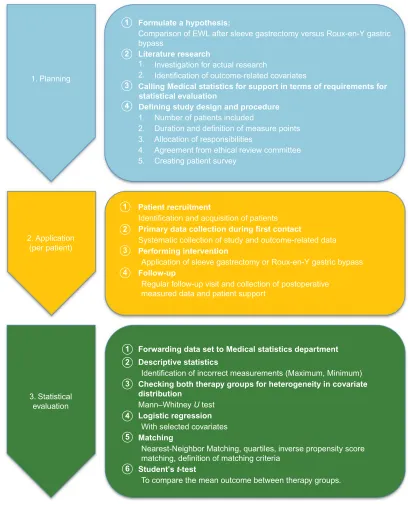
This scheme for organizing a non-RCT with propensity score analysis is shown in Figure 1. We marked sections that have to receive special attention when it comes to propensity score matching. To calculate adequate propensity scores, one needs to identify all outcome-related covariates. Reviewing actual research literature and discussing extramedical aspects
International Journal of General Medicine downloaded from https://www.dovepress.com/ by 118.70.13.36 on 22-Aug-2020
Dovepress Propensity score model comparison on real-life data
Figure 1 Suggestion for an optimized clinical trial procedure including propensity score matching. Abbreviation: EWL, excess weight loss.
Formulate a hypothesis:
Patient recruitment
Performing intervention
Forwarding data set to Medical statistics department
3. Statistical evaluation 2. Application
(per patient) 1. Planning
Descriptive statistics
Checking both therapy groups for heterogeneity in covariate distribution
Matching
Student's t-test Logistic regression
Identification of incorrect measurements (Maximum, Minimum)
Mann–Whitney U test
With selected covariates
Nearest-Neighbor Matching, quartiles, inverse propensity score matching, definition of matching criteria
To compare the mean outcome between therapy groups. Follow-up
Primary data collection during first contact Literature research
Calling Medical statistics for support in terms of requirements for statistical evaluation
Defining study design and procedure
Comparison of EWL after sleeve gastrectomy versus Roux-en-Y gastric bypass
1. 2.
Investigation for actual research
1. Number of patients included
2. Duration and definition of measure points 3. Allocation of responsibilities
4. Agreement from ethical review committee
Identification and acquisition of patients
Systematic collection of study and outcome-related data
Application of sleeve gastrectomy or Roux-en-Y gastric bypass
Regular follow-up visit and collection of postoperative measured data and patient support
Identification of outcome-related covariates
5. Creating patient survey 1
2
3
4
1
1 2
3
4
5
6 3 2
4
database. Earlier works often focused on specific and very complex statistical procedures while using Monte Carlo data sets. Furthermore, this work emphasized the central role of data collection, which is the key aspect when it comes to reliable propensity score analysis.
Also, with regard to keeping data as native as possible, we did not use oversampling for our calculations. Oversam-pling uses a patient various times as matching partner for different members of the other therapy group. We decided to stay as near to a natural study environment as possible.
Methodologically, we were restricted, as we had to work with a preexisting non-RCT. Therefore, we had no influence on data collection. Also, we analyzed mean differences for EWL with t-tests and did not use tools like inverse probability of treatment weighting using the propensity scores or caliper analysis. These advanced statistical methods seemed not suitable for our goal of proving the efficiency and simplicity of propensity score models.
Unfortunately, we only had the capacity to perform these calculations with one study. For further
examina-International Journal of General Medicine downloaded from https://www.dovepress.com/ by 118.70.13.36 on 22-Aug-2020
Dovepress
Ferdinand et al
tion, it would be very interesting to analyze these simple propensity score implementations for a wide range of non-RCTs. By doing so, we might get a deeper understanding of chances going along with propensity score matching, and it might appear that these simple models especially are the perfect match for non-RCT analysis. Talking about validating and establishing propensity scores in statistical examinations, we also have to ask whether there is a neces-sity to perform RCTs. From an ethical and economical point of view, there are a lot of arguments against RCTs, like their higher organizational effort and difficult recruit-ment of patients. Of course, there is no way to simulate natural conditions as perfectly as appears in a RCT, but as in every other aspect of science, we should consider tools like propensity scores a valuable compromise. By doing so, it seems suitable to set a standardized framework for propensity score analysis in terms of covariate selection and matching procedures in regard to comparability and transparency.
Acknowledgments
The authors developed this study in cooperation with Dr Mirko Otto from the Department of General Surgery at University Medical Center Mannheim, Dr Marc Schmittner from the Department of Anesthesia, and with the supervi-sion of Professor Christel Weiss, chief of the Department for Medical Statistics and Biomathematics. This work is part of the doctoral research of Dennis Ferdinand, student and MD candidate at the University of Heidelberg.
Disclosure
The authors report no conflicts of interest in this work.
References
1. Dannehl K. Experimental study versus non-experimental study: the non-experimental (non-randomized) study as a methodological com-promise. In: Abel U, Koch A, editors. Nonrandomized Comparative Clinical Studies. Düsseldorf: Symposion; 1998:41–52.
2. Rosenbaum PR, Rubin DB. The central role of the propensity score in observational studies for causal effects. Biometrika. 1983;70(1):41–55.
3. Brookhart MA, Schneeweiss S, Rothman KJ, Glynn RJ, Avorn J, Stürmer T. Variable selection for propensity score models. Am J Epidemiol. 2006;163(12):1149–1156.
4. Rubin DB, Thomas N. Matching using estimated propensity scores: relating theory to practice. Biometrics. 1996;52(1):249–264.
5. Stürmer T, Joshi M, Glynn RJ, Avorn J, Rothman KJ, Schneeweiss S. A review of the application of propensity score methods yielded increas-ing use, advantages in specific settincreas-ings, but not substantially different estimates compared with conventional multivariable methods. J Clin Epidemiol. 2006;59(5):437–447.
6. Hahn J. On the role of the propensity score in efficient semipa-rametric estimation of average treatment effects. Econometrica. 1998;66(2):315–331.
7. Bryson A, Dorsett R, Purdon S. The Use of Propensity Score Matching in the Evaluation of Active Labour Market Policies. London: Department for Work and Pensions; 2002.
8. Cattaneo MD. Efficient semiparametric estimation of multi-valued treatment effects under ignorability. J Econom. 2010;155(2):138–154. 9. Feng P, Zhou XH, Zou QM, Fan MY, Li XS. Generalized propensity
score for estimating the average treatment effect of multiple treatments.
Stat Med. 2012;31(7):681–697.
10. Rubin DB. Estimating causal effects from large data sets using propen-sity scores. Ann Intern Med. 1997;127(8 Pt 2):757–763.
11. Augurzky B, Schmidt CM. The propensity score: a means to an end. 2001. Available from: http://papers.ssrn.com/sol3/papers.cfm?abstract_ id=270919. Accessed April 5, 2016.
12. Austin PC, Grootendorst P, Anderson GM. A comparison of the abil-ity of different propensabil-ity score models to balance measured variables between treated and untreated subjects: a Monte Carlo study. Stat Med. 2007;26:734–753.
13. D’Agostino RB Jr, D’Agostino RB Sr. Estimating treatment effects using observational data. JAMA. 2007;297(3):314–316.
14. Frölich M. Finite-sample properties of propensity score matching and weighting estimators. Rev Econ Stat. 2004;86(1):77–90.
15. Otto M, Elrefai M, Krammer J, Weiss C, Kienle P, Hasenberg T. Sleeve gastrectomy and Roux-en-Y gastric bypass lead to comparable changes in body composition after adjustment for initial body mass index. Obes Surg. 2016;26(3):479–485.
16. Chagnac A, Weinstein T, Herman M, Hirsh J, Gafter U, Ori Y. The effects of weight loss on renal function in patients with severe obesity. J Am Soc Nephrol. 2003;14(6):1480–1486.
17. Cottam DR, Schaefer PA, Shaftan GW, Velcu L, Angus LD. Effect of surgically-induced weight loss on leukocyte indicators of chronic inflammation in morbid obesity. Obes Surg. 2002;12(3):335–342. 18. Folsom AR, Qamhieh HT, Wing RR, et al. Impact of weight loss on
plasminogen activator inhibitor (PAI-1), factor VII, and other hemo-static factors in moderately overweight adults. Arterioscler Thromb. 1993;13(2):162–169.
19. Kyle UG, Genton L, Pichard C. Low phase angle determined by bioelectrical impedance analysis is associated with malnutrition and nutritional risk at hospital admission. Clin Nutr. 2013;32(2):294–299. 20. Layman DK, Boileau RA, Erickson DJ, et al. A reduced ratio of
dietary carbohydrate to protein improves body composition and blood lipid profiles during weight loss in adult women. J Nutr. 2003;133(2): 411–417.
21. Norman K, Stobäus N, Pirlich M, Bosy-Westphal A. Bioelectrical phase angle and impedance vector analysis – clinical relevance and applicabil-ity of impedance parameters. Clin Nutr. 2012;31(6):854–861. 22. Pelleymounter MA, Cullen MJ, Baker MB, et al. Effects of the obese
gene product on body weight regulation in ob/ob mice. Science. 1995;269(5223):540–543.
23. Peterli R, Borbély Y, Kern B, et al. Early results of the Swiss Multicentre Bypass or Sleeve Study (SM-BOSS): a prospective randomized trial comparing laparoscopic sleeve gastrectomy and Roux-en-Y gastric bypass. Ann Surg. 2013;258(5):690–695.
International Journal of General Medicine downloaded from https://www.dovepress.com/ by 118.70.13.36 on 22-Aug-2020
Dovepress
International Journal of General Medicine
Publish your work in this journal
Submit your manuscript here: https://www.dovepress.com/international-journal-of-general-medicine-journal
The International Journal of General Medicine is an international, peer-reviewed open-access journal that focuses on general and internal medicine, pathogenesis, epidemiology, diagnosis, monitoring and treat-ment protocols. The journal is characterized by the rapid reporting of reviews, original research and clinical studies across all disease areas.
The manuscript management system is completely online and includes a very quick and fair peer-review system, which is all easy to use. Visit http://www.dovepress.com/testimonials.php to read real quotes from published authors.
Dove
press
Propensity score model comparison on real-life data
International Journal of General Medicine downloaded from https://www.dovepress.com/ by 118.70.13.36 on 22-Aug-2020