Adaptive WENO Schemes
for Singular in Space and Time Solutions
of Nonlinear Degenerate Reaction-Diffusion Problems
Stefka Dimova1,aand Yonita Mihaylova1,b
1Faculty of Mathematics and Informatics, Sofia University "St. Kliment Ohridski", Bulgaria
Abstract. The numerical solution of nonlinear degenerate reaction-diffusion problems often meets two kinds of difficulties: singularities in space – finite speed of propagation of compact supports’ initial perturbations and possible sharp moving fronts, where the solution has low regularity, and singularities in time – blow-up or quenching in finite time. We propose and implement a combination of the sixth-order WENO scheme of Liu, Shu and Zhang [SIAM J.Sci.Comput.33, 939–965 (2011)] with an adaptive procedure to deal with these singularities. Numerical results on the mathematical model of heat structures are shown.
1 Introduction
It is well known that the solutions of nonlinear evolution problems may develop singularities even from smooth initial data. These singularities arise from the nonlinear mechanism of the modeled process.
One of the challenges to deal with is the localization of the process in space due to the finite speed of propagation of the compact supports’ initial perturbations. Another challenge is the possible sin-gularity in time – blow-up of the solution [3]. On the model of heat structures [2] – reaction-diffusion equations with power nonlinearities, we show how to deal with these challenges. To construct a nu-merical scheme, which has high order accuracy in the smooth regions and nonoscillatory behavior near to the sharp fronts of the solution, the sixth-order WENO procedure of Liu, Shu and Zhang [1] is used. To deal with the three types of the blow-up behavior of the solutions, namely, regional, total and single-point blow-up, we use the fact that the self-similar blow-up solutions of this model are attractors of its solutions for large classes of initial data. An adaptive procedure, consistent with the self-similarity law, is implemented in the cases of single-point blow-up (decreasing the step-size in space) and total blow-up (increasing the step-size). The high accuracy and the nonoscillatory behavior of the implemented numerical schemes are illustrated for all three cases of blow-up.
The outline of the paper is as follows. Section 2 describes the problem on which the proposed technique is explained. The main steps of the implemented WENO algorithm are summarized in Section 3. The strategy of the mesh adaptation is exposed in Section 4. Section 5 shows the numerical results for the three typical cases of blow-up.
2 The problem
The proposed numerical method is presented on the simplest 1D heat model [2]
ut=(uσux)x+uβ, x∈R+, t>0, (1)
ux(t,0)=0, u(t,∞)=0, uσux=0 ifu=0. (2) Hereu(t,x) is the temperature of the heat-conducting medium, whose heat-conductivity coefficient
uσ, σ > 0,and the volume sourceuβ, β >1,are power functions of the temperature. A variety of real processes are described well by this model – from combustion processes in hot plasmas to that in stars. It is well known [3], that forβ > 1 the equation (1) admits blow-up self-similar solutions (s.-s.s.)us(t,x) of the kind
us(t,x)=ϕ(t)θ(ξ)=(1−t/T0)− 1
β−1θ(ξ), (3)
ξ=x/ψ(t)=x(1−t/T0)− β−σ−1
2(β−1) , (4)
whereT0 < ∞is the blow-up time and limt→T0−supx∈RNus(t,x) = +∞.The space xand the time t
(through the functionψ(t)) are connected in the similarity variableξ.The self-similar functionθ(ξ) satisfies the nonlinear degenerate boundary-value problem:
−(θσθ)+ β−σ−1
2(β−1)T0
ξθ+ 1
(β−1)T0
θ−θβ=0, (5)
θ(0)=0, θ(∞)=0, θσθ=0, if θ=0. (6)
It is seen from (3) that the s.-s.s.us(t,x) corresponds to the initial dataθ(x):us(0,x)=θ(x).
Without loss of generality (because of the similarity) we can put (β−1)T0 =1 in (5). Then the blow-up time of the solution of the problem (1), (2) with initial dataθ(x), found in the computations, must be close toT0=1/(β−1). This will serve as an internal criteria for the accuracy of solving both the self-similar problem (5), (6) and the evolution problem (1), (2).
Because the s.-s.s.us(t,x) is an attractor of the solutions of the problem (1), (2) for wide classes of initial data (see [3] and the references therein), it determines the basic regimes of combustion of the nonlinear medium. They depend on the relation between the powersσandβ, i.e., on the competition between the heat diffusion and the source.
Ifβ=σ+1, at the asymptotic staget→T0−(ttends toT0from below) the solution blows up at every point of a finite region and this is calledregional blow-up. This is the unique case, when the exact solution of the problem (5), (6) is known:
θ(ξ)=
2(σ+1) σ+2 cos
2 πξ Ls
1/σ
, Ls=2π
σ+1 σ , θ
L s 2
=0. (7)
The process is localized on the so called fundamental lengthLs.
Ifβ < σ+1, at the asymptotic staget→T0−the solution blows up at the whole space: for fixed ξandt→T0−:x=ξ
1−Tt
0
β−σ−1 2(β−1) → ∞.
The process is not localized, this is called total blow-up.
Ifβ > σ+1, for fixedξandt→T0−:x=ξ
1−Tt
0
β−σ−1 2(β−1)
→0.The process is localized, this is called single point blow-up.
3 WENO schemes for nonlinear degenerate reaction-diffusion equations
The idea of the method and the main steps for its implementation will be given on a more common 1D equation
ut=(b(u))xx+q(u), u≥0, b(u)≥0, q(u)≥0. (8) Let· · ·<xi<xi+1<xi+2 <· · ·, xi+1−xi= Δxbe a regular mesh in space. The aim is to construct a semidiscrete approximation of equation (8)
dui(t)
dt =
ˆ
fi+1 2 −
ˆ
fi−1 2
Δx2 +q(ui(t)), (9) such that
ˆ
fi+1 2 −
ˆ
fi−1 2
Δx2 =(b(u))xx x=xi +O
Δxk
is ahigh order approximationof (b(u))xx at the pointsx = xi,where the solution is smooth, and generatesnonoscillating approximations, where the solution or its derivatives are discontinuous.
Nonoscillating approximationsmeans, that the oscillations are of order OΔxk.For such ap-proximation of the second derivative we use the technique proposed in [1]. The main steps of the implemented algorithm are as follows.
1. Use a symmetric 6-pointbig stencil,S ={xi−2, . . . ,xi+3}to approximate the numerical flux ˆfi+1 2
and construct linear scheme of orderk =6, which is stable, has the desired order for smooth solutions, but should be oscillatory at the points of discontinuity.
2. Use three consecutive four-pointsmall stencils Sm = {xi−2+m, . . . ,xi+1+m}, m = 0,1,2,and construct linear schemes of fourth order of accuracy and numerical fluxes ˆfi(+m1)
2
.
3. Findthe linear weights,the constantsdm, such that
ˆ
fi+1 2 =
2
0 dmfˆi(+m1)
2
.
4. Because in conservative approximations of the flux negative coefficientsdmalways exist [4], [1], split them into positive and negative parts by using the technique from [5], [1].
5. Find thenonlinearweightsωm,
ˆ
fi+1 2 =
2
0
ωmfˆ(m) i+1 2.
(10)
so to keep the high order of accuracy and to achieve nonoscillatory behaviourby using
smoothness indicators[6], [7], [1].
The final semidiscrete problem consists of equation (9), where the fluxes (10) are used, and the initial conditionsui(0)=u0(xi).It is an ODE system of the kindut=L(u).To solve itthe third order
TVD method of type Runge-Kutta[8] is used:
u(1) =un+tL(un), u(2) =3
4u n+1
4u (1)+1
4tL(u (1)),
u(n+1)= 1
3u n+2
3u (2)+2
3tL(u (2)).
The time-steptis chosen so as theCFL condition for stabilityto be fulfilled:
max u |b
(u)| t
4 Mesh adaptation consistent with the self-similar law
As said in Section 2, the s.-s.s.us(t,x) is an attractor of the solutions of the problem (1), (2) for wide classes of initial datau(0,x) = u0(x) ≥ 0,supp u0 < ∞, x ∈ R+.It is natural to incorporate the
structure of the s.-s.s. when designing the numerical method. The basic idea is the following. If the problemut =Luadmits self-similar solution of the kindus(t,x)=ϕ(t)θ(ξ), ξ=x/ψ(t),the function ϕ(t) determines the amplitude of the solution and the self-similar functionθ(ξ) – the “frozen” profile, the space-time structure of the solution. By using the connection betweenϕ(t) andψ(t) from (3),(4) we exclude the unknown blow-up timeT0and find
ξ=xΓ(t)p, Δξ= ΔxΓ(t)p, p=(β−σ−1)/2, Γ(t)=maxxu(t,x) maxxu0(x).
Having in mind the relation betweenξandxfor the s.-s.s.us(t,x) :
• β < σ+1 : ξ→0 whent→T0−; • β > σ+1 : ξ→ ∞ whent→T0−,
we apply the followingstrategy for adaptation.
LetΔx(k)be the step inxatt=tkandΔx(0)=h 0.
Forβ < σ+1 (total blow-up)we choose the step inxso that the step inξbe bounded from below:
h0/λ≤Δξ(k)= Δx(k)Γ(t)p; (11)
forβ > σ+1 (single-point blow-up)we choose the step inxso that the step inξbe bounded from above:
Δξ(k)= Δ
x(k)Γ(t)p≤λh0. (12)
In the computations we have usedλ=0.5.
5 Numerical results
The methods described in Section 2 and Section 3 are implemented inC++. Many experiments were made for problem (1), (2) with different medium parametersσ >0 andβ >1.Here we present the three typical cases of regional, total and single point blow-up.
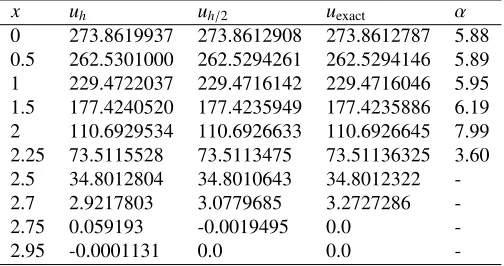
Regional blow-up. In figure 1, left, the evolution in time of the exact solution θ(x) (7) of the self-similar problem (5), (6) forβ=σ+1 =3 is shown. The solution grows over the fundamental length (7), the fronts become very sharp and one can see only one visible negative value. The blow-up time ˜T0 = 0.499999990 found in the computations is an excellent approximation of the exact one T0 = 1/(β−1) = 0.5. The computations are performed in the interval [0,4] > [0,Ls/2] using a constant stepx=2−5.
The real order of convergence
α(x)=ln uexact(x)−uh(x)
uexact(x)−uh/2(x) /ln 2
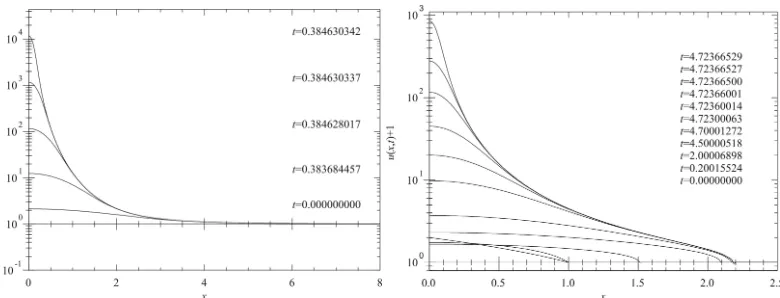
Figure 1.Evolution in time of self-similar initial data forβ=σ+1=3,left, and forβ=2.4< σ+1=3,right.
Table 1.σ+1=β=3,order of convergence, computed at timet=0.499990,Ls≈2.72,h=1/32,0≤x≤4
x uh uh/2 uexact α
0 273.8619937 273.8612908 273.8612787 5.88
0.5 262.5301000 262.5294261 262.5294146 5.89
1 229.4722037 229.4716142 229.4716046 5.95
1.5 177.4240520 177.4235949 177.4235886 6.19
2 110.6929534 110.6926633 110.6926645 7.99
2.25 73.5115528 73.5113475 73.51136325 3.60
2.5 34.8012804 34.8010643 34.8012322
-2.7 2.9217803 3.0779685 3.2727286
-2.75 0.059193 -0.0019495 0.0
-2.95 -0.0001131 0.0 0.0
-Total blow-up.In figure 1, right, the evolution of the self-similar functionθ(ξ),found numerically as a solution of the self-similar problem (5), (6) forβ=2.4 < σ+1=3,is shown. The method for solving the N-dimensional radially symmetric variant of the self-similar problem involving the com-bination of the continuous analog of the Newton method with the finite element method is described in [9]. Again the blow-up time ˜T0 = 0.714269. . ., found in the computations, is very close to the exact one,T0 = 1/(β−1) = 0.(714285).The initial interval in xis [0;l0 = 5] withx0 = 0.025. When the condition (11) is violated orli−xf r(t) becomes less than 4xi,we double the computational interval and the stepsize inx:li+1=2li, xi+1 =2xiand the intermediate points are omitted. Thus the mesh remain equidistant, which is obligatory for the conservative approximation of the flux, and the number of the computational points does not increase. In the computation shown in figure 1, right, the consecutive steps are 0.025,0.05,0.1,0.2,0.4,0.8 and the number of mesh points is 200. In spite of the so sharp fronts, there are no visible oscillations.
Figure 2.Evolution in time of self-similar initial data forβ=3.6> σ+1=3 (left), and non-self-similar ones forβ=4> σ+1=3.(right).
xm+1≤xi≤xland refine the mesh in the interval 0≤x≤xm,by adding midpoints between every two old mesh points. We find the values of the approximate solution in the new points by interpolation on the small stencils and continue the computations on the refined mesh in the interval 0≤x≤xm.For this experiment four refinements are made up toxlast=0.0015625.
In figure 2, right, the evolution of the non-self-similar finite support initial data for parameters β=4> σ+1=3 is shown. There are no visible oscillations near to the finite fronts.
Conclusions. The results achieved in the 1D case promise the generalization of the technique implemented here to be successful in the radially symmetric and in the essentially 2D case, e.i., for the more complicated models of the heat structures [2].
Acknowledgements
The work of the first author is supported by the National Science Fund of BMSE under grant I02/9/2014 and by the Science Fund of Sofia University under grant 75/2015.
References
[1] Y. Liu, C.-W. Shu, M. Zhang, SIAM J.Sci.Comput.33, 939–965 (2011)
[2] Stefka Dimova, Milena Dimova, Daniela Vasileva, Springer Proceedings in Mathematics & Statis-tics45, 157–184 (2013)
[3] A. A. Samarskii, V. A. Galaktionov, S. P. Kurdyumov, A. S. Mihailov,Blow-up for quasilinear parabolic equations, (De Gruyter Expositions in Mathematics 19, Valter de Gruyter, Berlin, 1995) [4] B. Merryman, J.Sci.Comput.19, 309–322 (2003)
[5] J. Shi, C. Hu, C.-W. Shu, J. Comput. Phys.175, 108–127 (2002) [6] G. Jiang, C.-W. Shu, J. Comput. Phys.126, 202–228 (1996) [7] C.-W. Shu, Lecture Notes in Math.1697, 325–432 (1998) [8] C.-W. Shu, S. Osher, J. Comput. Phys.77, 439–471 (1988)