FABRIC DEFECT DETECTION USING IMAGE
PROCESSING TECHNIQUE
Miss. Pallavi A. Patil
1Dr. M. S. Kumbhar
2 1,2Department of Electronics and Telecommunication Engineering, Rajarambapu
Institute of Technology (India)
ABSTRACT
There is need for short life cycle for production as fashion industry is getting developed day by day. Currently it is observed that most of the work related to fault detection of fabric is done manually. To avoid this, this paper presents, fabric defect detection, which is based on image processing technique by using Raspberry pi controller. Camera module is used to capture images of fabric which will be used for processing.
Keywords— Raspberry Pi 2, USB Camera Module ,IR Proximity Sensor, Display
I. INTRODUCTION
At present the quality of fabric inspection process for textile fabrics is mainly performed by manually. However, the process of manual inspection is limited by tediousness and doziness. In industry, it is observed that about 70% of fabric defects were detected by the well qualified and trained inspectors. Now days there is need for development of automatic fabric defect detection system, which results in the high quality product with high speed. So researchers have started to study and develop methods for automatic inspection of fabric defect detection. Automated inspection of textile fabrics has attracted a lot of attentions in recent years. It is also found that about 90% plain fabric defects could be detected manually and easily. So in this paper we proposed an automated system for Fabric Defect Detection using image processing Technique.
II. RELATED WORKS
Haiqin Zuo, Yu jie Wang, Xue zhi Yang, Xin Wang have published a paper entitled, “Fabric Detect Detection Using Texture Enhancement ” in 20125th International Congress On Image and Signal Processing (CISP
2012).To locate defect regions of fabric ,proposed system based on computer vision, plays an important role. Various Approaches for Fabric defect detection have been proposed in the past two decades. The texture analysis techniques for Fabric defect are proposed. [1]
Jayashree Vadin and Shaila Subbaraman have published a paper entitled, “Modeling of Plain Weave Fabric Structure and Its use in Fabric Defect Identification”. A proposed work is carried out in two parts. In first part, machine integration and hardware development methods were discussed while in second part software framework is designed. For evaluation of the system a database of 54 industrial fabric images is collected to achieve detection rate of 100% with minimal pseudo alarm rate [2]
studies. In this study, deep learning which distinguishes with multilayer architectures and reveals high achievements is applied to fabric defect detection. [3]
Xin Wang, Nicolas D. Georganas, and Emil M. Petriu have presented a paper entitled “Fabric Texture Analysis Using Computer Vision Techniques”. They have presented low-cost computer vision practices to measure the texture characteristics like yarn counts, surface roughness of woven fabric. According to the obtained test results, authors have proved that FDFFT is a reliable and rapid parameter for measurement of fabric roughness based on 3-D surface data. [4].
Aiguo Song, Yezzhen Han, Haihua Hu, and Jianqing Li have presented a paper on, “A Novel Texture Sensor for Fabric Texture Measurement and Classification”. The authors have presented a different design of a surface texture sensor by imitating human active texture perception by touch. The experiments carried out by authors showed that texture sensor used is effective to notice the feature signals of fabric surface textures, which are appropriate for the RBF networks to classify the various fabrics. [5].
Dorian Schneider and Dorit Merhof have presented a paper on, “High precision on-loom yarn density measurement in woven fabrics”. A vision-based inspection system to measure woven fabric yarn densities during production is presented. A proposed work consists of a combination of basic and custom-made image processing techniques. It allows to spot single wefts and warps in fabric images. [6].
III. SYSTEM DESCRIPTION
Fig. 1 Block Diagram of proposed work
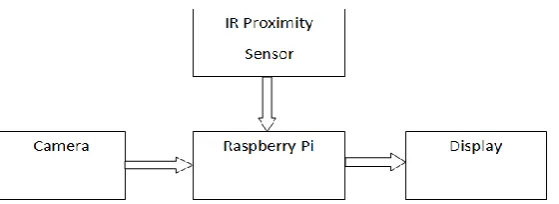
As shown in Fig. 1 block diagram of proposed system, Raspberry Pi 2 is interfaced with IR proximity sensor which is used to detect presence of cloth. USB webcam is connected to USB port of raspberry pi 2. It is used to capture image of cloth. Display is used to show detected faults. Image captured through webcam is stored in raspberry pi 2 and using Canny Edge Detection algorithm faults or defects in cloths can be calculated.
3.1 Raspberry Pi 2
Fig. 2 -Raspberry Pi 2
-
Fig. 3 Experimental Setup
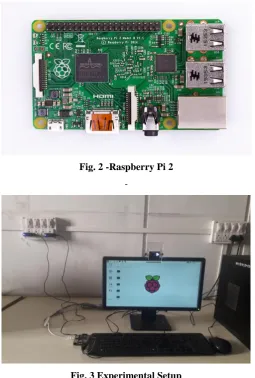
Fig. 3 shows the experimental setup for proposed system. It shows interfacing of webcam with Raspberry Pi 2.
(a)Faultless Fabric (b) Missing yarn
(c) Broken Fabric (d) Roughness of Fabric
3.2 Faultless Fabric
Fig.4 (a) shows the plane fabric images with no fault.
3.3 Missing yarn
One yarn is missing as shown and the difference between faultless fabric and missing yarn of the fabric is shown in fig. 4(b).
3.4 Brocken Fabric
Fabric is having hole and the difference between faultless fabric and broken fabric is shown in fig. 4(c).
3.5 Roughness of Fabric
Fabric is having some rough part and the difference between faultless fabric and Roughness is shown in fig. 4(d).
IV. RESULTS
Fig. 5 Flowchart
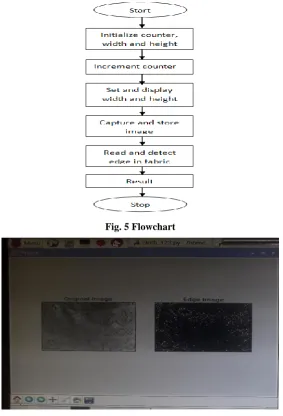
Fig. 6 shows the Edge Detection of single yarn on capturing the image. Using camera, image was captured and stored in memory. After performing algorithm i.e. edge detection algorithm above results were acquired. It shows the edges of fabric. Thus by doing so fault can be detected.
The software design includes, Firstly, camera and time is initialized. Count is set to zero. While count is less than 5 then initialize width and height to 640 and 480 respectively. Also count is incremented unless it reaches value 5. Set width and height of camera. Then camera is initialized and video is captured images. And these images are saved as file”str(count)+jpg”. Then height and width of display is set. Then 5 images are captured and between them 1sec delay is been given and camera is stopped.
The minimum requirement of camera for capturing the image is 512 by 512 pixels, with 8 bit per pixel Memory required = 0.25 megabytes
Images from video camera arrive at 5 images, or frames with 1 second delay. Data Rate = 6.55 million per second
The stored images read by Python2 software and various analysis is done to identify. After identification defects they are classified into various classes by comparing with the non defected fabric image database.
After the Saved images are called using import cv2 instruction and numpy is used for numerical calculation. Image is read using its name and then on that image canny edge detection algorithm is performed. Image is plotted as 121 i.e. 1 row, 2 column and first position. Resultant image is edge detection of single yarn in binary scale format and displayed on output window.
The input of the image is RGB (red, green, blue) intensity is minimum for 0 and maximum 255. Further it is converted to gray scale image. The intensity of gray scale image is 0 to127. So output is in binary image. The binary image intensity is 0 and 1. After the edge detection then next step is fabric defect detection. On the images are filtered using GUI (Graphical User Interface).
V. CONCLUSIONS
The USB Camera is successfully interfaced with Raspberry pi model. USB Camera captures Fabric images successfully. Trajectory of yarn is also detected properly. Samples of Missing yarn are collected. Broken Fabric and Roughness of fabric are also detected.
VI. ACKONWLEDGEMENT
I take pleasure to present my work done in image processing and Raspberry Pi controller. I would like to express my deep sense of gratitude to my supervisor Dr. Mahesh Kumbhar, for his valuable suggestions. I am thankful to him for providing me opportunity to do this project work and constant guidance throughout this work
REFERENCES
[1] HaiqinZuo, Yujie Wang, Xuezhi Yang, XinWang , Fabric Detect Detection Using Texture Enhancement ,5th International Congress On Image and Signal Processing, 2012, 876-880.
[2] Jayashree Vadin and Shaila Subbaraman, Modelling of Plain Weave Fabric Structure and Its use in Fabric Defect Identification, IEEE 5th International Symposium on Telecommunications, 2010,132-137.
[4] Xin Wang, Nicolas D. Georganas, and Emil M. Petriu, Fabric Texture Analysis Using Computer Vision Techniques, IEEE Transactions On Instrumentation and Measurement, 2011, 44-56.
[5] Aiguo Song, Yezhen Han, Haihua Hu, and Jianqing Li, A Novel Texture Sensor for Fabric Texture Measurement and Classification, IEEE Transactions On Instrumentation And Measurement, 2014, 1739-1747.
[6] Dorian Schneider and Dorit Merhof, High precision on-loom yarn density measurement in woven fabrics, IEEE Transactions, 2014, 1-5.