1041 | P a g e
Analysis of Queuing to Customers Management in Banking
System using Simulation
Amritpal Kaur
1, Dr.Williamjeet Singh
21,2
Punjabi University Patiala, Punjab(India)
ABSTRACT
Queuing theory could be applied to a number of operational situations where it is difficult to accurately
predict the arrival rate of customers and service rate or time of service of facilities. Simulation is
commonly used for the analysis of queuing. Queuing models using simulation offers the predictor with a
powerful tool to design and evaluate the performance of queuing systems. The designing of Queuing
models aimed at the balance of customer services and economic considerations. The key parameters to
measure the system performance are the length of the waiting line, server utilization, and delays of
customers. In this paper, we will study the concepts of queuing theory in banks using simulation method.
This paper will review the previous researches and studies, done over the queuing system in banks and
other areas.
Keywords— Banking System and Queuing models, Simulation, Queuing Theory, Queuing System,
Customer Management, Arena Simulation.
I. INTRODUCTION
1.1.
Queuing system
The term „Queuing theory‟ is used to define a specialized mathematical theory of queues or waiting lines. Queue become the general phenomenon in our day to day life. When customers who demand service have to wait because of the lower number of servers available, then queues are formed. Another reason for the formation of the queue is when the facility takes more than the prescribed time for serving the customers or unable to work efficiently. But no one like to wait for a long time to attain the services.
1042 | P a g e 1.1.1 Linear Queuing: It is used in the retail applications. In the linear queuing system, one patron is ready to
serve another as soon as previous is finished. In such system, there is only one cashier and one line. Fast food restaurants and other small stores employ this system for effective customer service assurance. 1.1.2 Single Line Queuing system: This queuing system is based on the concept of “first come, first served”
theory. It ensures that the coming customers are served by the check-out station which is first available. 1.1.3 Virtual Queuing: There is no physical line of customers in the virtual queuing system. The system either
identify customers upon arrival or when the customer checks in. They received the ticket and asked to meet the service provider at some specific time. They do not need to stand in “line.” The customer can perform their other tasks such as fill out form, carry personal conversations, etc. while waiting for their turn.
1.2.
Customer Management
It is part of the large assessment of customer behavior and customer satisfaction to determine the optimum queue management plan for any given industry or location. Customer Management is a large process that includes all the parts of customer service from the time customer arrive at the location to the completion of their service. The customer service can be effective through the Customer Flow Management (CFM). Therefore, it is highly essential for the organization to analyze the entire customer flow process and to decrease the time of every part of the process to as small as possible. An especially business where there are face-to-face dealings with the customers, such as in restaurants, banks, retail stores, government service office, financial service providers and hospitals, can boost their bottom line and level of customer satisfaction by effectively implementing the customer service practices.
It is very important for the organizations to access their current situation while implementing the Customer Flow Management (CFM). The organizations need to gather the data on the following for implementing Customer Management :
1.2.1The number of customers that arrive in one day.
1.2.2The average time customer has to wait for receiving the service. 1.2.3A number of “open” service points at a specific time.
1.2.4The information about the peak customer time.
1.2.5Customer feedback and identifiable patterns regarding the productivity of the staff that serves the customers.
1.3.
Motivation and objectives:
This study explains the existing queuing system, techniques of queuing system and tools that are used in different aspects. This analysis is compulsory to make it possible to know which methods of queuing system and tools have been covered in past research period (from 2000 to 2017) in different sectors and helps to identify gaps.
1043 | P a g e
II. RESEARCH METHODOLOGY
The research methodology is consisting of different stages.
The first stage involves that how many papers covers different areas where queuing system is used. The second stage is concerned with establishing a classification scheme described.
The third stage involves distribution of papers over the years.
2.1
Arena Simulation
Arena Simulation is used to design a model of a proposed or existing system. Arena simulation is helpful to represent model characteristics with its important qualities of proposed system. Arena simulation includes some steps to perform the simulation of the model. Arena simulation is based on the Discrete event simulation to design the model of complex systems and processes. These steps are:
2.1.1 Construct a model to simulate. 2.1.2Simulate the model using parameters. 2.1.3Experimentation of constructed model. 2.1.4Interpret the simulation results.
2.2.
Queuing system in banks
The competition in the banking sector has become more intense because of regulatory imperatives of global banking and also because of customer‟s awareness of their rights. Customers in banks have become highly demanding because they need high quality, low priced and fast service delivery. Queuing system in banks is an approach which includes lining up of customers in the bank to be served by a bank employee on each server. While in service time, customers normally move to the server for one or more inquiries. This obstruction result into the delay in providing services to other customers. It becomes one of the challenges to the banks to reduce the waiting time for customers. Banks need to implement Queuing models in order to remain competitive. Queuing systems could help banks to minimize the waiting time through appropriate queue management which will also maximize throughput.
2.3.
Search Strategy
Search strategies and screening process follows the following steps: 2.3.1 Sources of information
IEEE Xplore (http://ieeexplore.ieee.org) Science Direct (www.sciencedirect.com) ACM Digital Library(www.acm.org/dl)
1044 | P a g e 2.3.2. Study Selection
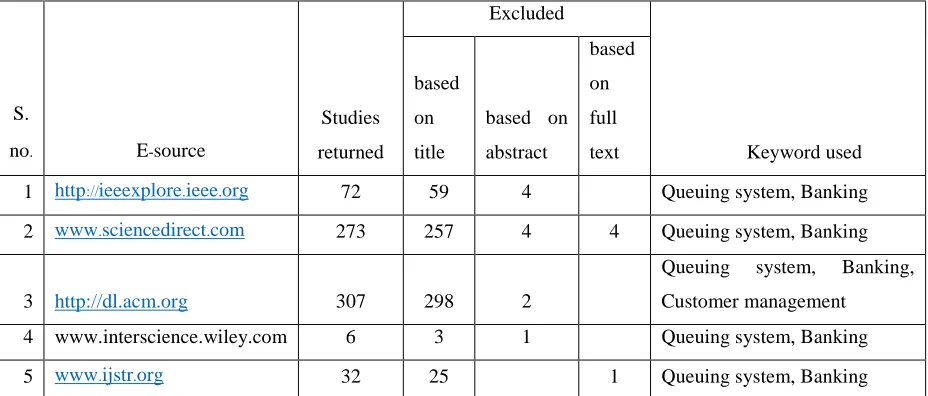
The search engine in the above electronic database hits number of studies, articles. Research papers published by journals, conference proceedings and workshops are thought to be worthy and reliable. Keyword based search is employed to select the most relevant works. The keywords used are “Queuing system”, “Banking”. The criteria used for exclusion of a research paper include unpublished papers, non-English papers, text-books, Master and Doctoral dissertations, non-peer-reviewed papers. In result shows the distribution of paper from 2000 to 2017. Table 1 shows the defined search strategy and number of results obtained. From the returned studies, firstly irrelevant studies are excluded on the basis of title. Certain studies could not be estimated from the title, and then their abstract is considered. If even abstract is not evident then after reading the full text of papers, irrelevant studies are excluded. In some library search when huge amount of studies returned then apply some advanced search.
Table 1 Search Selection
S.
no. E-source
Studies returned
Excluded
Keyword used based
on title
based on abstract
based on full text
1 http://ieeexplore.ieee.org 72 59 4 Queuing system, Banking
2 www.sciencedirect.com 273 257 4 4 Queuing system, Banking
3 http://dl.acm.org 307 298 2
Queuing system, Banking, Customer management
4 www.interscience.wiley.com 6 3 1 Queuing system, Banking
5 www.ijstr.org 32 25 1 Queuing system, Banking
2.4.
Establishing a Classification Scheme
1045 | P a g e
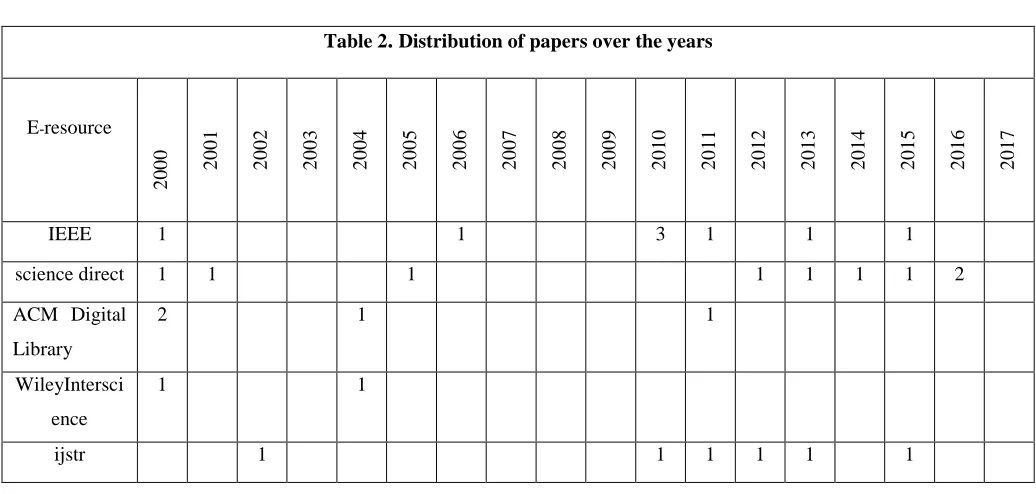
2.5 Distribution of papers
Table 2. Distribution of papers over the years
E-resource
2
0
0
0
2001 2002 2003 2004 2005 2006 2007 2008 2009 2010 2011 2012 2013 2014 2015 2016 2017
IEEE 1 1 3 1 1 1
science direct 1 1 1 1 1 1 1 2
ACM Digital Library
2 1 1
WileyIntersci ence
1 1
ijstr 1 1 1 1 1 1
III. CLASSIFICATION SCHEME
The selected papers describe the different tools and techniques used in queuing system.
3.1. Tools and Techniques used
Tools and techniques used for Queuing systems in previous researches.
Table 3- Method/Techniques used in Simulation
Sr. No. Method/Techniques used in Simulation
1 Automatic Queuing system using Simulation with scheduling algorithm 2 Multiple-channel queuing
model with Poisson Arrival and Exponential Service Times (M/M/S) 3 Multi-server Queuing Model
4 Case study and implementation of JIT (Just-in-time) using G/D/1 queuing model for mandir 5 Queuing system of bank based on BPR(business process reengineering)
6 Simulation Models
7 Integrated simulation combining process-driven and event-driven models
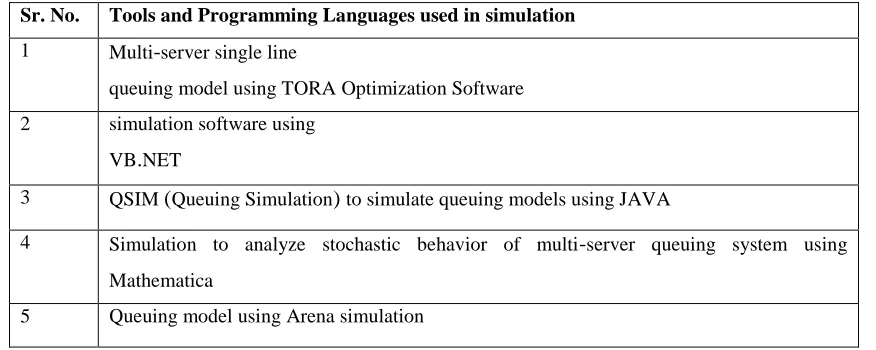
1046 | P a g e Table 4-Tools and Programming Languages used in simulation
Sr. No. Tools and Programming Languages used in simulation
1 Multi-server single line
queuing model using TORA Optimization Software 2 simulation software using
VB.NET
3 QSIM (Queuing Simulation) to simulate queuing models using JAVA
4 Simulation to analyze stochastic behavior of multi-server queuing system using Mathematica
5 Queuing model using Arena simulation
2.5. Attributes of a queuing system that affect its execution, for instance, queuing requirements of a bank
will rely on factors like:
2.5.1. How do clients arrive in the Bank? Are client entries all the more amid morning and night time? Or, on the other hand, is the client movement all the more reliably appropriated
2.5.2. How much time do customers spend in the bank? Do customers typically leave the bank in a settled measure of time? Does the customer service time vary with the type of customer?
2.5.3. How many service desk does the bank have for overhauling customers?
Table 5 Classification based on key parameters
Arrival Process The probability density distribution that decides the customer arrivals in the system.
Service Process The probability density distribution that that decides the client service times in the system
Number of Servers The number of servers accessible to service the customers.
III. COMPARATIVE ANALYSIS
1047 | P a g e Mohammad Shyfur, M. S. (2013) designed a multiple-channel queuing model with Poisson Arrival and Exponential Service Times (M/M/S) by considering the total cost of waiting time as an input to obtain a minimum waiting cost of the system. From this comparative analysis, we can say that applying queuing theory to get an optimization of services is of important theoretical as well as practical significance.
IV. FINDINGS
This section briefly describes the findings of reviewed methods and techniques used to evaluate and increase the performance of Queuing systems in various fields. Our findings show that improving customer management could significantly improve economic and social benefits. To understand how to improve efficiency, minimize the cost of services, it is necessary to use Queuing theory to develop a Queuing model to optimize the services on banks.
V. DISCUSSION
The objective of this paper was to review the concepts of Simulation and Queuing theory in banking systems. The review of previous studies was based on the various queuing model factors such as the average time that customers spend in a queue and the actual service delivery time, and hence examined the impact of wastage time and cost related to it. Throughout this paper, it is clear that customer service is one of the most important factors of Customer Management in banking. Arbitrary arrival categorized the customerand required for immediate access to services.
VI.CONCLUSION / FUTURE SCOPE
Queuing model of a system using simulation is a conceptual interpretation with an aim to distinguish those factors which relate to the system‟s performance to fulfill service demands with random occurrences and durations. In this paper, we reviewed the concepts of Queuing models in banking systems using Simulation. This paper included the study of existing queue systems . We investigated the impact of wasting time on the system performance and how to improve the efficiency of the system operations. Based on this review, we will further design a model for the Queuing system for customer management in banks. The results of the findings gathered from the previous researches performed over Queuing systems are shown in this paper. These findings will be used in the future research to analyze the system performance of proposed Queuing model for banks.
REFERENCES
[1] Simulation of Banks Queuing System Based on WITNESS. 201O International Conference on Computer Application and System Modeling (ICCASM 2010)
1048 | P a g e [3] Optimal service channel reconfiguration based on multi-agent simulation. Proceedings of the 2008 Winter
Simulation Conference S. J. Mason, R. R. Hill, L. Mönch, O. Rose, T. Jefferson, J. W. Fowler eds
[4] Efficient parallel queuing system simulation: Proceedings of the 2006 Winter Simulation Conference L. F. Perrone, F. P. Wieland, J. Liu, B. G. Lawson, D. M. Nicol, and R. M. Fujimoto, eds.
[5] Design and Development of Microcontroller Based Electronic Queue Control Systems: Proceeding of the 2011 IEEE Students' Technology Symposium 14-16 January, 2011, lIT Kharagpur.
[6] Optimal Scheduling Problem for Taiwan’s Post Office Counters and Manpower: Gwo-Liang Liao, Wen-Hsin Chiang Department of Information Science and Management Systems, National Taitung University, 684 Chunghua Rd., Sec. 1, Taitung, Taiwan, ROC
[7] Modeling and Simulation of a Bank Queuing System: 2013 Fifth International Conference on Computational Intelligence, Modelling and Simulation.
[8] Simulation and Analysis of a Bank Queuing System: C. Mbohwa Faculty of Engineering and the Built Environment University of Johannesburg, South Africa.
[9] Queuing Models to Improve Port Terminal Handling Service Xu Jingjing*, Liu Dong School of Management, Wuhan University of Technology, Wuhan, P.R. China, 430070 Randhawa,
[10] Priority queuing in an operating system Ali Derbala: Faculty of Science, Mathematics Department, University of Blida, BP 270, Route de Soumaa, Blida, Algeria.
[11] A new procedure to estimate waiting time in GI/G/2 system by server observation Jaejin Jang!,*, Jungdae Suh", C. Richard Liu# !School of Industrial and Information Systems Engineering, Hankuk University of Foreign Studies, Yong-In 449-791, South Korea.
[12] Application of Simulation Technique in Queuing Model for ATM Facility:International journal of applied engi neering research, dindigul Volume 1, No 3, 2010
[13] Automatic Queuing Model for Banking Applications: (IJACSA) International Journal of Advanced Computer Science and Applications, Vol. 2, No. 7, 2011
[14] Solving Of Waiting Lines Models in the Bank Using Queuing Theory Model the Practice Case: Islami Bank Bangladesh Limited, Chawkbazar Branch, Chittagong: Mohammad Shyfur Rahman chowdhury*, Mohammad Toufiqur Rahman and Mohammad Rokibul Kabir.
[15] Case Study on Queuing : Kawaljit Singh Randhawa Assistant Professor, Mechanical Engineering Department, CHARUSAT University, Gujarat, India
[16] [16] A Study of Waiting And Service Costs of A Multi-Server Queuing Model In A Specialist Hospital:International journal of scientific & technology research volume 1, issue 8, september 2012
[17] [17] Application Of Queuing Theory In Banking Sector: Nityangini Jhala1, Pravin Bhathawala2
1049 | P a g e [19] [19]Scheduling in a queuing system with asynchronously varying service rates: Probability in the Engineering
and Informational Sciences, 18, 2004, 191–217 Printed in the USA
[20] [20]Modeling and Analysis of Queuing Systems in Banks: (A case study of Ghana Commercial Bank Ltd. Kumasi Main Branch) Wallace Agyei, Christian Asare-Darko, Frank Odilon
[21] [21] Integrated simulation combining process-driven and event-driven models VS Kesaraju* and FW Ciarallo [22] Saxena, P., & Sharma, L. ( 2013). Simulation Tool for Queuing Models: QSIM. International Journal of
Computers & Technology, 5(2), 74-79.
[23] Hao, T., &Yifei, T. ( 2011). Study on Queuing System Optimization of Bank Based on BPR. Procedia
Environmental Sciences, 10, 640-646.
[24] Application of Queuing Model to Patient Flow in Emergency Department. Case Study: Hajnal Vassa, Zsuzsanna K. Szabob
[25] 12th global congresson manufacturing and management, gcmm 2014 A Case Study of Just-In-Time System in Service Industry A. S. Aradhye1 , S. P. Kallurkar2
[26] Study on Queuing System Optimization of Bank Based on BPR: 2011 3rd International Conference on Environmental Science and Information Application Technology (ESIAT 2011)
[27] Traffic micro-simulation model for design and operational analysis of barrier toll stations: Department of Public Works, College of Engineering, Cairo University, Giza, Egypt