The
Parallel
Asynchronous
Differential
Evolution
Method
as a Tool to Analyze Synchrotron Scattering Experimental Data
from Vesicular Systems
Evgeniya Zhabitskaya1,2,a, Elena Zemlyanaya1,2, Mikhail Kiselev1,2, and Andrey Gruzinov3
1Joint Institute for Nuclear Research, Joliot-Curie 6, 141980 Dubna, Russia 2Dubna State University, University str. 19, 141980 Dubna, Russia
3National Research Center «Kurchatov Institute», Moscow, Russia
Abstract.
In this work we use an Asynchronous Differential Evolution (ADE) method to estimate parameters of the Separated Form Factor (SFF) model which is used to investigate a struc-ture of drug delivery Phospholipid Transport Nano System (PTNS) unilamellar vesicles by experimental small angle synchrotron X-ray scattering spectra (SAXS). We compare the efficiency of different optimizing procedures (OP) for the search for the SFF-model parameters. It is shown that the probability to find the global solution of this problem by ADE-methods is significantly higher than that by either Nelder-Mead method or a Quasi-Newton method with Davidon-Fletcher-Powell formula. The parallel realization of ADE accelerates the calculations significantly. The speed-up obtained by the parallel realization of ADE and results of the model are presented.
1 Introduction
Differential Evolution (DE) [1] is an efficient algorithm to solve global optimization problems. Recent
progress in the development of DE is summarized in the book [2] and in the review article [3]. The
Asynchronous Differential Evolution (ADE) method [4] incorporates classical DE mutation, crossover
and selection operations into a parallel steady-state strategy. It is well suited for parallel optimization. ADE with independent restart [5] automatically adapts the population size to the complexity of the problem. ADE with a restart and adaptive correlation matrix [6] (ADE-ACM) automatically adapts to the landscape of the optimized objective function.
In [7, 8] the method of separated form factors (SFF) is adapted for the analysis of experimental data on small angle synchrotron X-ray scattering (SAXS) to polydispersed population of dimiros-toilphosphatidilholin (DMPC) unilamellar vesicles (ULVs), placed in an aqueous solution of sucrose. In this work we employ this method for the analysis of SAXS spectra from the drug delivery Phospho-lipid Transport Nano System (PTNS) [9]. Parameters of the SFF model are estimated with the help of ADE method. The calculations have been also made using other popular minimization algorithms in
order to compare the efficiency of different approaches.
2 Materials and methods, mathematical model and numerical algorithm
The PTNS samples for the SAXS measurements were prepared via dilution of lyophilized PTNS in such a way that to have 20%, 25%, 30% and 35% of maltose concentration in water. The mea-surements were performed at room temperature at the DICSI station of the Kurchatov Synchrotron
Radiation Source in Moscow, Russia. The scattering intensitiesIexp.(q) of photons from liophylized
PTNS solutions in water are measured as a function of the scattering vectorq=4πsinθ2/λ, whereθ
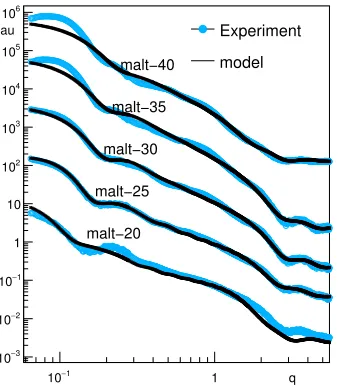
is the photon scattering angle. Experimental data are shown in Fig. 1 by light circles. The plot is the
subtraction of the PTNS intensity and the corresponding buffer intensity from maltose solution.
In the data analysis we employ an approach based on the SFF method [7]. In this framework the macroscopic cross-section of the polydispersed vesicular population is of the form
dΣ
dΩ(q)=n I0FˆsFˆbSF, (1)
whereI0is the intensity of the incident beam,nis the number of vesicles in unit volume,SF(q;R,n)
is the structural factor1. Considering the polydispersity of the vesicular radii like in [7, 8]2and taking
into account the fluctuations of the parameters of the internal structure of the bilayer3, the form factor
of the population of spherical vesicles ˆFsand the form-factor of the bilayer ˆFbare:
ˆ
Fs(q;R,m) =
Rmax
Rmin
Fs(q,R)G(R,R,m)dR Rmax
Rmin
G(R,R,m)dR, (2)
ˆ
Fb(q,Θb,kfl) =
K
−K
Fb(q,Θb(Θb,kfl, ξ))f(ξ)dξ
K
−K
f(ξ)dξ. (3)
The form factor of the spherical surface with radiusRis Fs(q;R) = (4πR2sin(qR)/qR)2. The form
factor of the symmetric lipid bilayer isFb(q,Θb) =( +d/2
−d/2 ρc(x) cos(qx)dx)
2. The contrast function
ρ(x;Θb) is described by the parameters of the internal structure:Θb={d,D,L, ρH}.
In view of the incoherent background (IB) and spectrometer resolution, the macroscopic cross section takes the form:
I(q)= dΣ
dΩ(q)+
1
2Δ
2d 2dΣ
dΩ(q)
dq2 +IB, (4)
whereIBis the parameter of incoherent background,Δ2=3.6·10−7cm2is the second momentum of
the spectrometer resolution function.
The fit of the experimental data was carried out by minimizing the objective function describing the discrepancy between the theoretical and experimental values of the intensity
f(Θ)=
N
j=1
I(qj,Θ)−Iexp(qj) σ2(q
j)
2
, Θ∗=Arg min
Θi
f(Θ), (5)
1The structural factor considers inter-vesicular interaction. In the Debye approximationS(q;R,n)= 1−8Vν ν
sin(2qR) 2qR
, whereVν=4πR3/3 is the vesicle volume,ν=1/nis the volume of the solvent per one vesicle.
2The polydispersity of vesicular population is described by the asymmetric Schulz distribution G(R,R,m) =
Rm/m!(m+1/R)m+1exp[−(m+1)R/R],whereRis the average radius of the vesicles,mis the polydispersity
parame-ter. In the calculations belowRmin=1 nm,Rmax=8.1 nm.
3In the calculations presented below, it is assumed that the difference in the values of parameters of the internal structure
is due to the fluctuation of the thickness of the membrane. Then the components ofΘbin the integral in Eq. (3) are, respec-tively:d=d(1+kflξ),D=D
1+Ddkflξ
,L=L1−dLkflξ
1
−
10 1 q au
3
− 10
2
− 10
1
− 10
1 10
2
10
3
10
4
10
5
10
6
10
Experiment
malt−20 malt−25
malt−30 malt−35
malt−40 model
d1
r0
rL
d
D
rH
L
rM
h s
Figure 1. SAXS spectra from the PTNS vesicles in 20–40%(w/w) maltose solution in water. Circles — ex-periment, solid line — theory.
Figure 2. Structure of a phospholipid unilamellar vesicle with radius R and the “two-step” scattering length density (contrast function) ρ(x;Θb) across bi-layer; Θb = {d,D,L, ρH}; parametersρ0, ρM, ρL are fixed.
Table 1.The boundaries of the search area and the coordinates of the minima for the two step SFF model. Accuracy in the table is equal to the last significant digit. The number of data points isN=1000.
Model R,
nm m
l, nm
s, nm
h,
nm kfl
ρH,
×1010
cm−1
nI0,
×1018
cm−3
IB,
×10−3
a.u. Vν
ν f
∗
min(Θ∗) N
Θmin
i 8.0 5.0 0.01 0.0 0.8 10−5 10.1 10−4 −100 0.02
Θmax
i 25.0 30.0 1.50 3.50 1.0 0.2 14.0 10−1 100 0.08
PTNS-20 21.9 12.9 0.322 1.33 0.900 0.2 12.7 0.0024 2.34 0.07 1.008
PTNS-25 17.1 20.3 0.100 1.14 1.00 0.147 11.4 0.0172 3.76 0.08 0.318
PTNS-30 14.3 16.9 0.403 1.07 0.820 0.106 11.4 0.0264 2.15 0.02 0.531
PTNS-35 13.1 14.1 0.000 1.09 0.819 0.095 11.3 0.0421 1.99 0.02 1.70
PTNS-40 10.6 9.34 0.184 1.71 0.977 0.2 12.6 0.0267 1.27 0.02 1.80
whereNis the number of experimental points,σis the error estimations, the set of the varied
param-eters isΘ ={R,m,l,s,h,kfl, ρH,nxI0,IB,Vν/ν}.
3 Comparison of the effectiveness of ADE, ADE-ACM, Nelder-Mead
simplex and quasi-Newtonian with Davidon-Fletcher-Powell formula
optimization methods
To find the minimum (5), different methods of optimization have been used: in addition to the
vari-ous strategies of ADE [4, 5] and ADE with Adaptive Correlation Matrix (ADE-ACM) [6] methods, there are the Nelder–Mead simplex method [10] and the quasi-Newtonian method with Davidon– Fletcher–Powell formula [11, 12]. As part of the ROOT-Minuit program [13], these methods are called SIMPLEX and MIGRAD, respectively.
The permissible search area for all the optimization procedures (OPs) has been set as: Θj ∈
[Θmin
j ,Θmaxj ]. TheΘminj andΘmaxj values are presented in 2ndand 3rdlines of the Table 1. The points
for the initial approximation are uniformly distributed in this area for all methods tested. The
ADE-method is used in two ways. (i) ADE rand/rand/1/bin strategy: in this case, the values have
been set for the scaling factor as F = 0.9 and for crossoverCr = 0.9. (ii) ADE-ACM strategies
rand/rand/1/acmandlinworst/current-to-pbest/1/acm. In both cases, the initial population isNinit
p =32, the restart criteria isΔxk=10−12, the minimum required accuracy of localization (exit criteria)
isΔf =10−2(see [5] for details). In the settings of SIMPLEX and MIGRAD methods the maximum
number of the function evaluations allowed were increased in comparison with the default settings4.
The calculations were repeated by each methodnt=100 times.
The minimal values of the function fmin∗ (Θ∗) for each model have been found at the pointsΘ∗,
the coordinates of which are given in lines 4 – 8 of Table 1. Note that some of the SFF parameters are in significant correlation in the vicinity of the minimum. Moreover, each problem has several local minima. This complicates the process of minimization.
A comparison of the effectiveness of ADE, ADE-ACM, SIMPLEX and MIGRAD methods is
shown in Fig. 3. On the horizontal axis the difference between the best value founded by ith
opti-mizing procedure fi∗(Θ) and the minimal obtained value fmin∗ (Θ∗) is laid. On the vertical axis we
give the percentage of attempts with the same or better result received by each of the methods used. Table 2 shows the summarized results obtained by each method. The probability of finding the so-lution by SIMPLEX method was found to be 1 – 2% (see col. 3 of Table 2). Most often, this method diagnoses convergence at points far from the global minimum and stops further calculations. The
probability of finding the solution5of the problem by MIGRAD is close to 40% .
At the same time, all the tested strategies of ADE converged to the global minimum with
a probability of more than 70%, and the most successful (DE/rand/rand/1/acm) — with a
prob-ability of more than 90%. Note that this probability could be further enhanced by increasing
the maximum number of function evaluations allowed. The use of the adaptive crossover can in-crease the probability of finding the global minimum significantly. The use of “fast track” strategy
DE/linworst/current-to-pbest/1/acmreduces the average number of function evaluations approxi-mately three times, but this strategy has a larger probability of ending calculations in one of the local minima.
Thus, in dealing with this problem, ADE are to be preferred to the classical ones for several reasons. First, ADE and ADE-ACM are robust global minimum search methods. They end the calcu-lations with a larger probability at the minimum of the problem, while the search using SIMPLEX and
MIGRAD ended at the minimum with a chance of 1±1% and 43±7%, respectively. The probability
of finding the global minimum by ADE-R depending on the chosen strategy varied fromp=73±5%
4MaxFunctionsCalls=300 000, which is enough for these programs to finish computations before the MaxFunctionsCalls
is reached.
5Assuming that the minimum has been founded ifδΔ2=f∗
i(Θ)−fmin∗ (Θ∗)
2
Table 2.Efficiency of the optimization procedures (OP), based on different optimization methods.†Ninit
p =32.
The percentage of successful (δΔ = fi∗(Θ)−fmin∗ (Θ∗)≤1) attempts, average number of function
evaluationsNFEand median number of function evaluations MedNFEfor each method.
Method MIGRAD SIMPLEX ADE
† ADE-ACM†
rand/rand/1/bin rand/rand/1/acm linworst/curtopbest/1/acm
δΔ2≤1 43% 1% 73% 93% 76%
NFE 3650±140 3500±170 29000±3000 89000±7300 20600±900
MedNFE 3120±270 3650±370 16760±1500 50000±34000 18500±1100
f−f
5
−
10 10−410−310−210−1 1 10 102 103 104
n
0 20 40 60 80
100 DE/rand/rand/1/bin, Np=32 DE/rand/rand/1/acm, Np=32 DE/linworst/current−to−pbest/1/acm, Np=32 SIMPLEX
MIGRAD
Nproc
1 10 102
speed−up
1 10
2
10 speed−up T
speed−up tau
Figure 3. Comparison of the effectiveness of various OP solving SFF for PTNS-30 problem. Horizontal axis: the difference between the best value, found byithOP f∗
i(Θ)
and the global minimum fmin∗ (Θ∗); vertical axis: percent-age of attempts with same or better result, received by the methods. DE−rrbmeansDE/rand/rand/1/binmethod;
DE−rra means DE/rand/rand/1/acm; DE−lwa means
DE/linworst/current-to-pbest/1/acm; SIM. means SIM-PLEX; MIG. means MIGRAD.
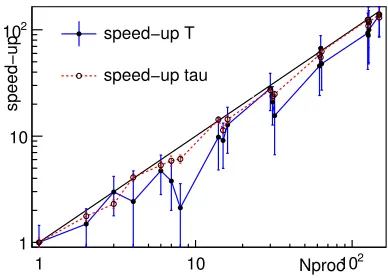
Figure 4. Acceleration of parallel computing (speed-up) depending on the number of calcu-lating processors Nproc used. Solid line — re-sultant acceleration — decrease in mean whole calculation timeT; dashed line — acceleration for mean time of one calculation of the objective functionτ.
(forDE/rand/rand/1/bin) top=93±3% (forDE/rand/rand/acm). On the other hand, if necessary, to find the secondary minima, preliminary ADE-produced results during calculations can be used.
As a direct (without the use of derivatives) method, ADE continues calculations and finds solutions in situations where quasi-Newton Davidon-Fletcher-Powell’s method diagnoses inability of further searches, and the simplex method completes the calculations and does not come close to the minimum.
4 ADE speed-up for parallel computation
The average number of function evaluationsNFEfor ADE and ADE-ACM larger than that for
clas-sical methods. However, the use of parallel computations significantly reduces the actual time-out of
the ADE methods [14] (see Fig. 4). The effectiveness of MPI-based6 parallel implementation of the
ADE algorithm have been tested on the multi-processor cluster CICC (LIT, JINR Dubna).
The calculations of the SFF model for PTNS-30 with two-step density approximation have been
repeatedly run for different numbers of computational nodes:Nproc∈[2,150].
Since the ADE algorithm is non-deterministic, the number of function evaluations required to achieve a certain accuracy is varying and its average value is slightly increasing with the increase of the number of parallel processors used.
Fig. 4 shows nearly linear speed-up up toNproc=150 nodes involved in parallel computing. The
solid line shows the resultant acceleration. The dotted line shows speed-up per one calculation of the
objective function. This acceleration is associated with maxNFEstopping criteria.
5 Conclusions
The parameters of a polydispersed population of unilamellar vesicles PTNS, including the internal structure of the lipid bilayer of vesicles membrane have been estimated by the ADE-method. The optimization procedures implemented on the basis of ADE and ADE-ACM methods were compared with the OPs, implemented on the basis of commonly used methods SIMPLEX and MIGRAD. It is shown that the probability of obtaining a correct solution to the optimization problem by the ADE methods considerably exceeds the probabilities for the SIMPLEX and MIGRAD methods. The speed up in parallel MPI-based calculations has been estimated. Thus, it is shown that ADE is well suited for the parallel computation of the vesicular systems parameter estimations.
References
[1] Price K. V. and Storn, R.V., J. of Global Optimization11, 341–359 (1997)
[2] Price K.V., Storn R.M., Lampinen J.ADifferential Evolution: A Practical Approach to Global Optimiza-tion. Springer (2005)
[3] Das S., Suganthan P.N., IEEE Trans. Evol. Comput.15, 4–31 (2011)
[4] Zhabitskaya E.I. and Zhabitsky M.V., Lecture Notes in Computer Science7125, 328–333 (2012) [5] Zhabitskaya E. and Zhabitsky M., Lecture Notes in Computer Science8236, 555–561 (2013)
[6] Zhabitskaya E.I. and Zhabitsky M.V.,Proceeding of the 15th Annual Conference on Genetic and Evolu-tionary Computation, (USA, New York, 2013) 455–462
[7] Kiselev M.A., Zemlianaia E.V., Zhabitskaia E.I. and Aksenov V.L., Crystallography Reports60, 143–147 (2015)
[8] Zhabitskaia E.I., Zemlianaia E.V. and Kiselev M.A., Vestnik Rossijskogo universiteta druzhby narodov, seriia: Matematika. Informatika. Fizika2, 253–259 (2014)
[9] Kiselev M.A., Zemlyanaya E.V., Ipatova O.M., Gruzinov A.Yu., Ermakova E.V., Zabelin A.V., Zhabitskaya E.I., Druzhilovskaya O.S. and Aksenov V.L., Journal of Pharmaceutical and Biomedical Analysis114, 288–291 (2015)
[10] Nelder J.A. and Mead R., Computer J.7, 308–313 (1965)
[11] Davidon W.C., A.E.C. Res. and Develop. Report ANL-5990(Argonne National Laboratory. Argonne; Illinois, 1959) p. 21
[12] Fletcher R. and Powell M.J.D., Comput. J.6, 163–168 (1963)