UK A
NNUITANTS
Published by
The Institute for Fiscal Studies
7 Ridgmount Street
London WC1E 7AE
Tel 020 7291 4800
Fax 020 7323 4780
[email protected]
www.ifs.org.uk
© Institute for Fiscal Studies, December 1999
ISBN 1-903274-06-0
UK Annuitants
James Banks and Carl Emmerson
1Institute for Fiscal Studies
— An E.S.R.C Research Centre —
December 1999
Paper presented at the conference on ‘UK Annuities and Retirement: Challenges and Policy Options’ organised by the Centre for Pensions and Social Insurance, 7 December 19992
Introduction
There is a vast literature discussing the various options by which contributions might generate entitlements within various pension systems. This debate also covers the optimal balance between pension rights accruing on a pay-as-you-go basis and on a funded basis. Arguably the more neglected area of debate has been the way in which benefits can be drawn within various systems.3 This may have been because of the predominance of unfunded systems historically and the fact that in such systems benefit entitlements are typically set as part of overall government policy. But with the gradual movement towards private funded schemes (seen all around the globe in countries such as the United Kingdom, Hungary, Poland, Chile and Argentina to name but a few), the
1
Address for correspondence: Institute for Fiscal Studies, 7 Ridgmount Street, London, WC1E 7AE; email
[email protected] or [email protected].
Acknowledgements: This research is funded by the ESRC Centre for the Microeconomic Analysis of Fiscal Policy at IFS. Cofunding has been provided by the Leverhulme Trust as part of the research programme ‘The changing distribution of consumption, economic resources and welfare of households’ (project reference F/368/J). The authors are very grateful to the Financial Division of NOP Research Group for providing the Financial Research Survey data used in this study. Data from the Family Resources Survey, made available by the Office for National Statistics through the ESRC Data Archive, have been used by the permission of the Controller of Her Majesty’s Stationery Office. Responsibility for the interpretation of data, and any subsequent errors, is the authors’ alone.
2
See http://insider.econ.bbk.ac.uk/psi/conferences/annuity1299.htm for more details of the conference. The slides from the presentation of this briefing note are available at:
http://www.ifs.org.uk/research/pensionsandsavings/birkbeck/sld001.htm.
3
debate about the form in which benefits may be taken is becoming increasingly important. The availability of annuity investments and the potential returns provided by such investments are an important consideration.
In the UK, individuals with a defined contribution pension scheme, such as an approved personal pension, are forced to annuitise 75 per cent of their pension fund between the ages of 50 and 75. While only a small number of individuals currently receive income from such an annuity, this number will grow in future as growing numbers of individuals with a personal pension reach retirement. Hence issues such as the return provided by annuities, whether or not individuals should be subject to mandatory annuitisation, and the design of any alternative income draw-down arrangements are likely to become more important policy issues in future. This debate is particularly well-publicised at the present time since the recent decline in long-term interest rates has highlighted the way in which annuity risk can affect the ‘adequacy’ of pension saving in providing for retirement income.
Several factors are likely to affect the value-for-money offered by annuities. One is the level of administrative charges. Murthi, Orszag and Orszag (1999) investigate this using data from the UK and provide some evidence that these costs are low, at least relative to the charges on personal pensions.4 Another important factor will be the degree to which those individuals purchasing annuities tend to be those with higher-than-average life expectancies and hence are ‘bad risks’ from the insurance firms’ point of view. Finkelstein and Poterba (1999), again using UK data, show that those individuals who purchase compulsory annuities have, on average, longer life expectancies than the UK population.5 In addition, they show that those individuals who purchase voluntary annuities tend to live longer than compulsory annuitants. This is perhaps not surprising, given the evidence that individuals with higher levels of wealth have, on average, longer life expectancies.6
Given the non-random selection of individuals into the market for annuities, the characteristics of this group and how they compare with the general population are of particular interest. In particular, the degree to which future generations of annuitants will vary from the general population provides an insight into the degree to which the non-random selection is likely to persist in the future. In this briefing note, we start by describing the UK annuity market in slightly more detail, before presenting some evidence from the Family Resources Survey on the characteristics of current annuitants and how they vary from the general population. In addition, we look at how individuals
4
Murthi, M., Orszag, M. and Orszag, P. (1999), ‘The value for money of annuities in the UK: theory, experience and policy’, Working Paper no. 9-99, Centre for Pensions and Social Insurance, Birkbeck College, London. This is available at http://insider.econ.bbk.ac.uk/pensions/papers/UKannuities.pdf.
5
Finkelstein, A. and Poterba, J. (1999), ‘Selection effects in the market for individual annuities: new evidence from the United Kingdom’, Working Paper no. 7168, National Bureau of Economic Research. This is available at
http://papers.nber.org/papers/W7168.
6
with compulsory annuities differ from those who have purchased an annuity voluntarily. We then go on to look at some evidence from the General Household Survey and the Financial Research Survey to look at the characteristics of future annuitants.
The UK Annuity Market
The government recently published what it described as ‘a radical reform of the whole pension system’.7 There were no proposals, however, for changes to the way in which savings held in a personal pension, or for that matter any other defined contribution pension scheme including a stakeholder pension, could be received. Individuals with pensions savings in this form will continue to be forced to annuitise the majority of their private pensions savings.
Among the current generation of the retired, those currently with annuities are mainly individuals who have defined contribution occupational pensions and Section 226 pensions, the precursor to personal pensions which were aimed at the self-employed and those employees whose employer did not provide a defined benefit occupational pension. In future, as a result of the 1986 Social Security Act allowing individuals to ‘opt out’ of SERPS into a defined contribution pension scheme and the subsequent popularity of both approved personal pensions and occupational defined contribution pension plans, many more individuals will reach retirement with pensions savings in this form.8
Anyone who has opted out of SERPS into a personal pension will have accumulated a fund from the contracted-out rebate paid into their fund by the government, and also any additional savings that they may have made. The element of their pension fund that comes from the contracted-out rebate will have to be converted into a ‘protected rights’ annuity between the ages of 60 and 75. A protected rights annuity is one that pays the same rate for both men and women, i.e. insurance firms are not allowed to offer better terms to men despite their lower life expectancy.9 Such rules therefore build in redistribution, on average, from men to women, from rich to poor and from single adults to married couples.
Any individual who has made additional voluntary savings into their pension fund is, on retirement, allowed to withdraw 25 per cent of this as a tax-free lump sum. The remaining 75 per cent of the fund has to be used to purchase a ‘compulsory’ annuity
7
Department of Social Security (1998), A New Contract for Welfare: Partnership in Pensions, Cm. 4179, DSS, London: http://www.dss.gov.uk/hq/pubs/pengp/index.htm. For an assessment of the initial proposals, see Disney, R., Emmerson, C. and Tanner, S. (1999), Partnership in Pensions: An Assessment, Commentary no. 78, Institute for Fiscal Studies, London: http://www.ifs.org.uk/research/pensionsandsavings/partnership.shtml.
8
For a discussion of the 1986 Social Security Act, see, for example, Budd, A. and Campbell, N. (1998), ‘The roles of the public and private sectors in the UK pension system’, in Feldstein, M. (ed.), Privatizing Social Security, National Bureau of Economic Research, Chicago University Press, Chicago. An earlier draft of this paper is available at http://www.hm-treasury.gov.uk/pub/html/docs/misc/pensions.html. For a discussion of the popularity of personal pensions, see Disney, R. and Whitehouse, E. (1992), The Personal Pensions Stampede, Institute for Fiscal Studies, London.
9
sometime between the ages of 50 and 75.10 Unlike with protected rights annuities, insurance firms are allowed to offer higher annuity rates to men than to women, reflecting their lower life expectancy. Individuals are, however, given various options for how to annuitise this part of their pensions savings. For example, they may purchase annuities that are fixed in nominal terms, indexed to prices, escalating or linked to some investment. In addition, annuities can be purchased on either a single- or a joint-life basis.11 Those choosing to defer annuitisation are allowed to make annual income withdrawals of between 35 and 100 per cent of an amount calculated (in Government Actuary annuity rate tables) to be that which an annuity purchased with the fund would have provided. If the individual dies before they have annuitised their fund, the remaining balance is subject to tax of 35 per cent and is then bequeathable.12 This makes the income draw-down arrangements particularly attractive to anyone with a bequest motive.13
In addition to protected rights and compulsory annuities, individuals may also choose to purchase an annuity voluntarily on the open market. This may be particularly attractive for older individuals wanting to consume both the interest and the capital from any savings while ensuring that their funds are not eroded before they die.
According to the Association of British Insurers (ABI) statistics, payments to the holders of annuity contracts in 1996 were some £3.9 billion.14 This amount is growing over time, mainly due to the increase in popularity of Section 226 pension schemes during the 1980s resulting from the growth in self-employment. Also, in future, more and more individuals will retire with pensions from occupational defined contribution and personal pension plans since they were only first allowed as an alternative to SERPS in 1988.
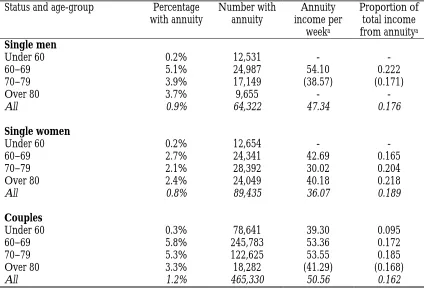
Table 1, using data from the Family Resources Survey (FRS), shows that only a small percentage of the UK population is currently in receipt of annuity income. However, there is evidence here of higher levels of coverage among 60- to 69-year-olds than there is among older age-groups. For example, 5.1 per cent of single men aged 60 to 69 have income from an annuity compared with 3.7 per cent of older single men. For those in receipt of annuity income, it does, however, tend to be an important income source. Average receipt among single men was £47 per week, among single women £36 per week and among individuals in couples £51 per week. Among single men, higher average
10
Prior to the 1995 Finance Act, annuitisation had to be done at the time of retirement. For a full description of both protected rights and compulsory annuities in the UK, see, for example, Murthi, M., Orszag, M. and Orszag, P. (1999), ‘The value for money of annuities in the UK: theory, experience and policy’, Working Paper no. 9-99, Centre for Pensions and Social Insurance, Birkbeck College, London. This is available at
http://insider.econ.bbk.ac.uk/pensions/papers/UKannuities.pdf.
11
For a description of compulsory annuity options, see, for example, McDonald, O. (1999), Income in Retirement: Are Annuities the Answer?, Association of Unit Trusts and Investment Funds, London. This is available at
http://www.investmentfunds.org.uk/pressreleases/1999archive/annuities.pdf.
12
For more details of the draw-down arrangements, see Section 65.2 and 65.5 (vii) of Tolleys (1999), Income Tax 1999–00, Tolley Publishing Company Limited, Croydon.
13
See Khorasee, M. Z. (1996), ‘Annuity choices for pensioners’, Journal of Actuarial Practice,vol. 4, no. 2, pp. 229–55.
14
levels of receipt were found among younger age-groups, probably as a result of real economic growth making younger cohorts, on average, richer. A different pattern is found by looking at single women, probably due to older single women consisting of greater numbers of widowed women who have inherited their deceased partner’s annuity. Looking at the amount of annuity income as a percentage of total income, we find that it tends to be higher among older single women, which is due to them being, on average, poorer.
Table 1. Importance of private annuity income in the UK
Status and age-group Percentage
with annuity Number withannuity income perAnnuity weeka
Proportion of total income from annuitya
Single men
Under 60 0.2% 12,531 -
-60–69 5.1% 24,987 54.10 0.222
70–79 3.9% 17,149 (38.57) (0.171)
Over 80 3.7% 9,655 -
-All 0.9% 64,322 47.34 0.176
Single women
Under 60 0.2% 12,654 -
-60–69 2.7% 24,341 42.69 0.165
70–79 2.1% 28,392 30.02 0.204
Over 80 2.4% 24,049 40.18 0.218
All 0.8% 89,435 36.07 0.189
Couples
Under 60 0.3% 78,641 39.30 0.095
60–69 5.8% 245,783 53.36 0.172
70–79 5.3% 122,625 53.55 0.185
Over 80 3.3% 18,282 (41.29) (0.168)
All 1.2% 465,330 50.56 0.162
aAnnuity income is the average among all those with some annuity income. Single parentheses denote
sample sizes of less than 50. Sample sizes of less than 25 are not reported.
Source: Family Resources Survey 1996–97 and 1997–98. See Appendix A for more details.
The accuracy of the Family Resources Survey data can be checked by comparing aggregate data with the amount suggested by the FRS. This is done by grossing up the number of annuities in receipt and the average amount received. The FRS sample implies a total annual annuity income of around £1.5 billion, which contrasts to aggregate annuity income of £2.1 billion, once receipt from defined contribution occupational pension schemes is ignored since it is not classified as annuity income in the FRS. Given the complexity of the income source, and some undersampling of the wealthy as would be expected in a household survey, this seems a reasonable degree of accuracy.
Characteristics of Annuitants and Non-Annuitants
adults per year, we still need to pool two years of data (1996–97 and 1997–98) to generate sufficiently large cell sizes for the analysis of what are small groups of the population. Table B.1 in Appendix B provides details of the sample sizes from the FRS. Table 2 summarises the main findings from looking just at those aged 50 and over. Tables B.3 to B.10 in Appendix B present these results in more detail.
Table 2. Characteristics of annuitants and non-annuitants
Without annuity With annuity All
% of married men aged 50+ 94.8 5.2
-% of married women aged 50+ 98.1 1.9
-% of single men aged 50+ 96.5 3.5
-% of single women aged 50+ 97.9 2.1
-% educated beyond minimum
50–59 24.9 42.4 25.1
60–69 16.0 32.5 16.8
70–79 11.4 26.0 12.0
80+ 11.3 33.5 11.9
All 50+ 18.1 32.1 18.6
Median household income (£ p.w.)
50–59 345 417 345
60–69 248 295 250
70–79 202 250 203
80+ 200 235 201
All 50+ 262 288 263
% who are outright owner-occupiers
50–59 30.8 54.4 31.1
60–69 56.5 74.7 57.5
70–79 58.5 84.3 59.6
80+ 53.0 81.3 53.9
All 50+ 46.3 75.3 47.2
% with savings >£20,000
50–59 26.3 55.9 26.6
60–69 30.4 59.8 31.9
70–79 23.6 58.6 25.0
80+ 18.5 59.4 19.7
All 50+ 26.2 58.9 27.2
% with savings <£8,000
50–59 48.7 33.1 48.5
60–69 41.7 23.3 40.8
70–79 45.7 20.1 44.6
80+ 48.7 24.2 48.0
All 50+ 46.1 23.7 45.4
Source: Family Resources Survey 1996–97 and 1997–98, over-50s only. See Appendix A and Tables B.7 to B.10 in Appendix B for more details.
had an annuity were educated beyond the compulsory school-leaving age, compared with just 11 per cent of individuals without an annuity. The median level of income of those with an annuity was also higher than that of those without. Looking at all the over-50s, this effect appears quite small – £288 per week among those with an annuity compared with £262 per week among those without. However, this is because individuals with an annuity are, on average, older, and older individuals are, again on average, poorer. Comparing individuals within each age-group shows much larger differences in median income. For example, among 60- to 69-year-olds, median income among those with an annuity is £295 per week, nearly £50 per week more than the median income among those without an annuity.
Table 2 also shows that those individuals with an annuity are more likely to own their property outright. Multivariate analysis shows that, conditional on not owning their property outright, individuals with an annuity were more likely to have a mortgage than those without an annuity. Annuitants were also found to have, on average, much higher levels of financial assets. Just under 60 per cent of individuals with an annuity had wealth of over £20,000, compared with just 26 per cent of those without an annuity.
Characteristics of Compulsory and Voluntary Annuitants
The FRS questionnaire also allows us to do some analysis of the characteristics of those who purchased an annuity voluntarily. We define a voluntary purchase as one that was not made from funds drawn from an occupational or a personal pension. This is shown in Table B.2 in Appendix B. Since individuals may use the tax-free lump sum from these private pension schemes to purchase a voluntary annuity, the figures are likely to understate the true number of voluntary purchases in our data. However, for the purposes of this analysis, this will tend to reduce rather than increase any differences in characteristics found. Since only a relatively small number of individuals in the data were found to have a voluntary annuity, we pool four years of FRS data and use multivariate analysis looking at all four waves of the FRS. However, some bivariate results are shown in Appendix B, Tables B.11, B.12 and B.13.
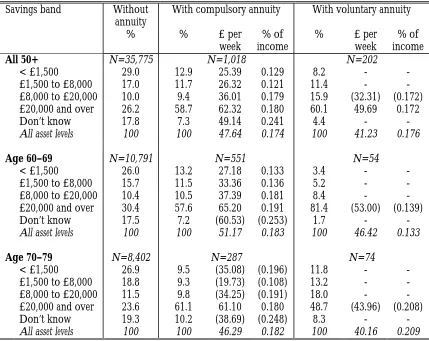
confirms the finding by Finkelstein and Poterba that selection into the voluntary annuity market is stronger than selection into the compulsory market.15
In Table 3, we present a detailed breakdown of the split between voluntary and compulsory annuitants, by age and level of savings. For each type of annuitant, we report the proportion in each savings category. For each of these groups, we also report the average level of annuity income and the average share of total income received from annuities. Because the number of voluntary annuitants is small, we are forced to omit certain cells of the table where there are particularly low sample sizes (we choose to use a value of 25).
Table 3. Financial assets and importance of annuity income among both compulsory and voluntary annuitants
Savings band Without
annuity With compulsory annuity With voluntary annuity
% % £ per
week income% of % £ perweek income% of
All 50+ N=35,775 N=1,018 N=202
< £1,500 29.0 12.9 25.39 0.129 8.2 -
-£1,500 to £8,000 17.0 11.7 26.32 0.121 11.4 -
-£8,000 to £20,000 10.0 9.4 36.01 0.179 15.9 (32.31) (0.172) £20,000 and over 26.2 58.7 62.32 0.180 60.1 49.69 0.172
Don’t know 17.8 7.3 49.14 0.241 4.4 -
-All asset levels 100 100 47.64 0.174 100 41.23 0.176
Age 60–69 N=10,791 N=551 N=54
< £1,500 26.0 13.2 27.18 0.133 3.4 -
-£1,500 to £8,000 15.7 11.5 33.36 0.136 5.2 -
-£8,000 to £20,000 10.4 10.5 37.39 0.181 8.4 -
-£20,000 and over 30.4 57.6 65.20 0.191 81.4 (53.00) (0.139)
Don’t know 17.5 7.2 (60.53) (0.253) 1.7 -
-All asset levels 100 100 51.17 0.183 100 46.42 0.133
Age 70–79 N=8,402 N=287 N=74
< £1,500 26.9 9.5 (35.08) (0.196) 11.8 -
-£1,500 to £8,000 18.8 9.3 (19.73) (0.108) 13.2 - -£8,000 to £20,000 11.5 9.8 (34.25) (0.191) 18.0 - -£20,000 and over 23.6 61.1 61.10 0.180 48.7 (43.96) (0.208)
Don’t know 19.3 10.2 (38.69) (0.248) 8.3 -
-All asset levels 100 100 46.29 0.182 100 40.16 0.209
Note: Numbers in parentheses refer to cells where the sample size is less than 50. Sample sizes of less than 25 are not reported.
Source: Family Resources Survey 1996–97 and 1997–98, over-50s only. See Appendix A and Tables B.3, B.5, B.10 and B.12 in Appendix B for more details.
Although annuitants are more likely to come from higher wealth brackets (as shown also in Table 2), amongst all ages this is no more true for voluntary than for compulsory annuitants. However, amongst 60- to 69-year-old voluntary annuitants, the proportion
15
Finkelstein, A. and Poterba, J. (1999), ‘Selection effects in the market for individual annuities: new evidence from the United Kingdom’, Working Paper no. 7168, National Bureau of Economic Research. This is available at
with savings of over £20,000 is much higher (81.4 per cent) than in other groups. This suggests that a more detailed breakdown of the correlations between annuity ownership, annuity income and wealth, not possible in the FRS data, may be interesting, particularly for more recently retired cohorts. Looking at those with compulsory annuities, 60- to 69-year-olds tend to have higher levels of annuity income than older cohorts, although expressed as a proportion of total income the levels are similar. Finally, the table also shows that, amongst compulsory annuitants, where we have adequate observations to distinguish a relationship between wealth levels, annuities tend to account for an increasing proportion of total income for more wealthy households.
Characteristics of Future Annuitants in the UK
While we have shown that the average characteristics of those currently holding annuities are very different from those of the population as a whole, this does not necessarily mean that this will continue to be the case in future. One possibility is that the popularity of personal pensions since 1988 will mean that the ‘typical’ annuitant in future will look more like an individual drawn at random from the UK population. Currently, 27 per cent of men and 20 per cent of women working full-time are members of a personal pension. However, as Figure 1 shows, coverage varies considerably between socio-economic groups. Coverage is lowest among unskilled manual workers, with just 20 per cent of men and 12 per cent of women currently members of a personal pension. This contrasts to personal pension membership of one in three men and one in four women who are employers or managers.
Figure 1. Personal pension coverage among full-time employees, by gender and socio-economic group
0 10 20 30 40 50
Professional Employers and managers Intermediate non-manual Junior non-manual Skilled manual Semi-skilled manual Unskilled manual
per cent
Men Women
Note: Includes all employees aged 16 and over excluding those in youth training and employment training.
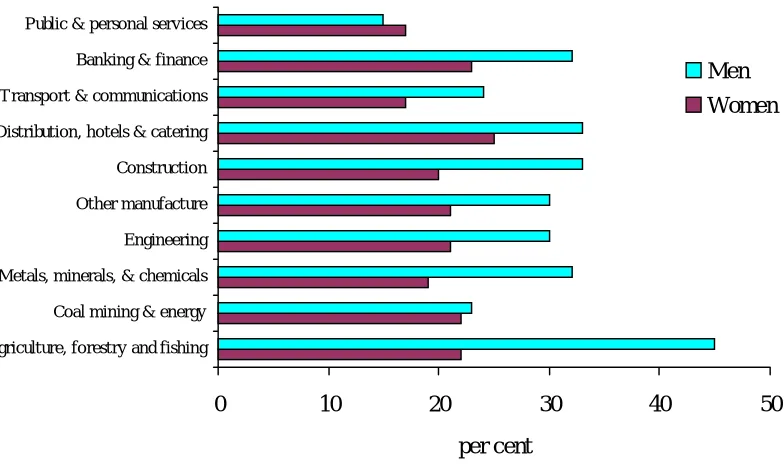
Figure 2 shows the equivalent figures for full-time men and women by different industry classifications. Coverage among men is highest for those working in agriculture, forestry and fishing (45 per cent) and among women for those working in distribution, hotels and catering (25 per cent). Personal pension coverage is lowest among both men and women in the public sector (15 and 17 per cent respectively) mainly due to higher levels of membership of occupational pension schemes than any other industry.
Figure 2. Personal pension coverage among full-time employees, by gender and industry group.
0 10 20 30 40 50
Agriculture, forestry and fishing Coal mining & energy Metals, minerals, & chemicals Engineering Other manufacture Construction Distribution, hotels & catering T ransport & communications Banking & finance Public & personal services
per cent
Men Women
Note: Includes all employees aged 16 and over excluding those in youth training and employment training.
Source: Office for National Statistics (1998), Living in Britain: Results from the 1996 General Household Survey, The Stationery Office Limited, London. Pooled data from the General Household Survey, 1994 to 1996, are used.
Using evidence from the Financial Research Survey, more details of which can again be found in Appendix A, we can look at the average levels of financial wealth of those with a personal pension compared with those without. Figure 3 (with more details in Table B.14 in Appendix B) shows that the median level of financial wealth among those with a personal pension is substantially higher than that held by those without a personal pension. For example, among 40- to 49-year-olds, the median level of (non-pension) financial wealth among those without a personal pension is £750 compared with £1,950 among those with a personal pension. This suggests that, in future, those individuals purchasing an annuity with their pension fund will, on average, still be wealthier than the average for their cohort.16 This, coupled with the evidence that those with higher levels of wealth tend to live longer, means that this selection will keep the future price of annuities above the level that would be suggested by the UK mortality tables.
16
Figure 3. Median non-pension financial wealth, by age and personal pension status
0 2,000 4,000 6,000 8,000 10,000
20-29 30-39 40-49 50-59 60-69 All
No personal pension With personal pension
Source: Financial Research Survey, January 1997 to July 1998. See Appendix A and Table B.14 in Appendix B for more details.
Conclusions
We have shown that those individuals in the UK who have purchased an annuity tend to have much higher levels of savings, are more educated and are more likely to own their own homes than those who have not purchased an annuity. This provides an indication of the amount of selection into the annuities market, with these individuals being considered as ‘bad risks’, i.e. having longer life expectancies than those suggested by the UK population tables. We have also shown that those who purchased an annuity voluntarily have, on average, even more years of education and even higher levels of savings than compulsory annuitants. Figures from the General Household Survey supplemented with the Financial Research Survey suggest that future generations of annuitants will continue to be, on average, wealthier than those without an annuity. That is, although there is some evidence of selection in the current market for annuities, this may not be fully reduced as a result of the introduction of mandatory annuitisation requirements. We expect that future annuitants will continue to be wealthier than average because of selection into the personal pension market.
essential to understand the policy options in what will be an increasingly important area. They would, for example, allow work to look at the extent to which the wealthiest individuals are more likely to purchase escalating annuities, which provide the highest returns to those with the longest life expectancies.
An important issue with the UK pension system, and particularly the current debate, is that it has not been made clear what the arguments for making individuals annuitise their pension savings are. If they are related to the incentives that individuals have to spend their savings (possibly on housing wealth) and then becoming dependent on means-tested benefits, then it should be remembered that, as we have shown, these individuals are typically wealthy. They are unlikely to want to retire on an income equivalent to just 20 per cent of average male earnings (which is the current level of the Minimum Income Guarantee). In any case, this would only be an argument for individuals having to annuitise sufficient wealth to ensure that they could never become dependent on means-tested benefits (although with potential long-term care expenditures on the horizon, such a level may be difficult to compute). Another possible argument for compulsory annuitisation is one of paternalism, i.e. individuals may spend the money and then later regret it. While this may be an argument for making the working population save for their retirement, it is a harder argument to make for those individuals who have already saved voluntarily for their own retirement. In future, given that more and more individuals will be reaching retirement with savings in a personal pension scheme, and the apparent lack of good argument for state intervention, there may be more pressure on the government to relax its mandatory annuitisation rules further. A detailed analysis of the development of annuity markets will be required to inform policy options and policy debate, and such analysis would be helped by more detailed data in this area.
Appendix A. Data Description
The Family Resources Survey (FRS)
The Family Resources Survey is an annual survey of around 26,000 households containing approximately 45,000 individuals in Great Britain. We use data from the FRS from 1994–95 to 1997–98, which is the latest year for which data are available. In addition to its large sample size, the FRS is particularly useful for this analysis because it contains an extremely detailed amount of information on an individual’s income sources. Unfortunately, it contains very little information on an individual’s wealth, with just a banded question on financial assets being asked. In addition, while we know whether individuals receive annuity income, we do not know what kind of annuity this is, i.e. whether it is indexed or not and whether it has been written on a single- or a joint-life basis. Another important consideration is that, as with any household-based survey, it excludes the institutional population. Hence the analysis excludes those resident in, for example, nursing accommodation who are likely to be among the poorest in society and may well form a reasonable proportion of older age-groups.
The Financial Research Survey (FRS-NOP)
held, with banded data on balances for most, as well as specific brand and product information for almost all. The survey also has demographic variables relating to the household of which the individual is a member, some data on incomes and summary information on other financial products, such as pensions, mortgages and insurance.
Appendix B. Additional Tables
In two years of data, Table B.1 shows that we have 382 individuals reporting that they received income from an annuity and 900 saying that they had income from a personal pension. Hence in total 1,282 individuals receive income from an annuity product. Unfortunately, those with income from a defined contribution occupational pension seem unlikely to be included as having annuity income.
Table B.1. Percentage of individuals with income from various ‘pension’ sources
‘Pension’ source % Pop. Obs.
Occupational pension scheme 10.40 11,726,567 11,934 Widow’s occupational pension 1.93 2,173,823 2,246
Personal pension scheme 0.78 879,845 900
Annuity 0.34 382,854 382
Receives no pension income 87.28 98,386,209 72,310
Total 100 112,730,884 86,920
Notes: Due to just under 1% of the sample having income from more than one of the above sources, the columns will not sum precisely to the stated totals. Population numbers are for two years.
Source: Family Resources Survey 1996–97 and 1997–98; authors’ calculations. See Appendix A for more details.
Table B.2 shows that the 382 individuals reporting that they had annuity income were asked how they purchased the annuity. Of those, 168 stated that they purchased the annuity using funds from a private pension scheme. While we assume that this was a compulsory purchase, it is possible that they are referring to the use of the tax-free lump sum. By assuming that this is not the case, we have 214 voluntary annuitants.
Table B.2. How annuity was purchased
% Pop. Obs.
Using funds from an occupational pension scheme 26.8 102,508 100 Using funds from a personal pension scheme 17.3 66,113 68
Neither of the above 56.0 214,233 214
Total 100 382,854 382
Note: Population numbers are for a two-year period
Source: Family Resources Survey 1996–97 and 1997–98; authors’ calculations. See Appendix A for more details.
Table B.3. Average weekly amounts received from annuitised wealth, by age
Age-group Compulsory Voluntary All
Mean Median Mean Median Mean Median
Under 50 38.02 5.29 34.39 17.74 36.61 9.91
50–59 44.57 12.66 33.69 16.88 43.09 15.61
60–69 53.26 21.86 45.34 17.68 52.54 21.86
70–79 49.84 23.01 41.06 26.08 48.05 23.52
Over 80 29.95 14.49 43.66 20.05 36.66 19.16
All 49.54 20.71 41.40 20.23 48.13 20.71
Note: Figures shown are gross of tax. Annuity income from 1996–97 has not been inflated. Inflation between January 1996 and January 1997 was only 2.8 per cent.
Source: Family Resources Survey 1996–97 and 1997–98; authors’ calculations. See Appendix A for more details.
Table B.4. Average weekly amounts received from annuitised wealth, by age and family type
Age-group Single Couple
Mean Median Mean Median
Under 50 38.79 9.91 35.43 10.36
50–59 53.72 9.59 40.35 16.11
60–69 48.47 20.11 53.36 21.86
70–79 33.24 21.29 53.55 24.55
Over 80 34.15 17.26 41.29 23.93
All 40.78 19.18 50.56 21.46
Note: Figures shown are gross of tax. Annuity income from 1996–97 has not been inflated. Inflation between January 1996 and January 1997 was only 2.8 per cent.
Source: Family Resources Survey 1996–97 and 1997–98; authors’ calculations. See Appendix A for more details.
Table B.5. Proportion of household income coming from annuities, by age and family type
Age-group Single Couple All
Mean Median Mean Median Mean Median
Under 50 0.125 0.034 0.073 0.030 0.091 0.030
50–59 0.142 0.057 0.101 0.041 0.110 0.042
60–69 0.194 0.139 0.172 0.106 0.176 0.114
70–79 0.191 0.142 0.185 0.118 0.187 0.123
Over 80 0.192 0.137 0.168 0.095 0.184 0.114
All 0.183 0.129 0.162 0.090 0.168 0.102
Note: Total income has been inflated to January 1997 prices but annuity income has not. In any case, inflation between January 1996 and January 1997 was only 2.8 per cent. Any values less than 0 have been set to zero, and values greater than 1 have been set to 1.
Table B.6. Percentage of individuals with annuity income, by age-group and family type
Age-group Percentage with an annuity
Single Couple All
Under 50 0.1 0.1 0.1
50–59 1.2 1.0 1.0
60–69 3.6 5.8 5.3
70–79 2.5 5.3 4.1
80 and over 2.7 3.3 2.9
All 0.8 0.1 0.1
Source: Family Resources Survey 1996–97 and 1997–98; authors’ calculations. See Appendix A for more details.
Table B.7. School-leaving age of those with and without annuity income
Age-group Proportion leaving at compulsory leaving age
Proportion educated up to 18
Proportion educated beyond 18 Without
annuity
With annuity
Without annuity
With annuity
Without annuity
With annuity
Under 50 0.590 0.327 0.206 0.261 0.204 0.412
50–59 0.751 0.576 0.123 0.202 0.126 0.222
60–69 0.840 0.675 0.091 0.145 0.069 0.180
70–79 0.886 0.740 0.072 0.130 0.041 0.131
Over 80 0.887 0.665 0.073 0.174 0.040 0.161
All 0.666 0.664 0.170 0.156 0.164 0.180
Source: Family Resources Survey 1996–97 and 1997–98; authors’ calculations. See Appendix A for more details.
Table B.8. Equivalised net weekly household income of those with and without annuity income
Age-group Equivalised household income (median, £/week) Without annuity With annuity All
Under 50 305.94 300.43 305.93
50–59 344.75 417.44 345.41
60–69 248.09 294.76 250.18
70–79 201.94 250.21 203.42
Over 80 199.80 235.05 200.59
All 290.62 288.63 290.60
Note: Household income equivalised to that of a married couple; see McClements, D. (1977), ‘Equivalence scales for children’, Journal of Public Economics, vol. 8, pp.191–210, for precise details of the equivalence scale used. Income is net of all taxes, including local taxes. Income inflated to January 1997 prices using the RPI.
Table B.9. Housing tenure of those with and without an annuity
Age-group Property owner-occupied (outright)
Property with a mortgage Without
annuity
With annuity
Without annuity
With annuity
Under 50 0.078 0.431 0.598 0.399
50–59 0.308 0.544 0.491 0.387
60–69 0.565 0.747 0.179 0.153
70–79 0.585 0.843 0.064 0.034
Over 80 0.530 0.813 0.048 0042
All 0.204 0.740 0.489 0.151
Source: Family Resources Survey 1996–97 and 1997–98; authors’ calculations. See Appendix A for more details.
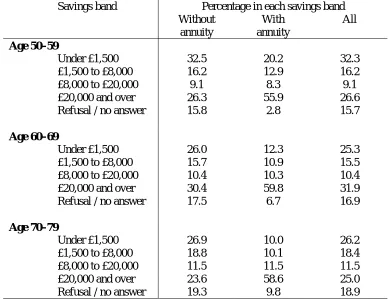
Table B.10. Total amount of savings
of those with and without annuity income, by selected age-groups
Savings band Percentage in each savings band Without
annuity
With annuity
All
Age 50–59
Under £1,500 32.5 20.2 32.3
£1,500 to £8,000 16.2 12.9 16.2
£8,000 to £20,000 9.1 8.3 9.1
£20,000 and over 26.3 55.9 26.6
Refusal / no answer 15.8 2.8 15.7
Age 60–69
Under £1,500 26.0 12.3 25.3
£1,500 to £8,000 15.7 10.9 15.5
£8,000 to £20,000 10.4 10.3 10.4
£20,000 and over 30.4 59.8 31.9
Refusal / no answer 17.5 6.7 16.9
Age 70–79
Under £1,500 26.9 10.0 26.2
£1,500 to £8,000 18.8 10.1 18.4
£8,000 to £20,000 11.5 11.5 11.5
£20,000 and over 23.6 58.6 25.0
Refusal / no answer 19.3 9.8 18.9
Table B.11. School-leaving age
of those with compulsory and voluntary annuities
Age-group Proportion leaving at compulsory leaving age
Proportion educated up to 18
Proportion educated beyond 18 Forced Voluntary Forced Voluntary Forced Voluntary
Under 50 0.463 0.110 0.074 0.560 0.464 0.330
50–59 0.611 0.355 0.205 0.183 0.184 0.462
60–69 0.688 0.544 0.140 0.200 0.172 0.256
70–79 0.754 0.683 0.107 0.221 0.139 0.097
Over 80 0.765 0.561 0.068 0.284 0.166 0.155
All 0.692 0.533 0.134 0.258 0.174 0.208
Source: Family Resources Survey 1996–97 and 1997–98; authors’ calculations. See Appendix A for more details.
Table B.12. Equivalised household income of those with compulsory and voluntary annuities
Age-group Equivalised household income (median, £/week)
Compulsory Voluntary All
Under 50 252.51 366.28 300.43
50–59 415.62 523.49 417.44
60–69 280.68 391.43 294.76
70–79 247.35 237.60 250.21
Over 80 235.88 231.67 235.05
All 283.45 301.47 288.63
Note: Household income equivalised to that of a married couple; see McClements (1977) for precise details of the equivalence scale used. Income is net of all taxes, including local taxes. Income inflated to January 1997 prices using the RPI.
Source: Family Resources Survey 1996–97 and 1997–98; authors’ calculations. See Appendix A for more details.
Table B.13. Housing tenure
of those with compulsory and voluntary annuities
Age-group Property owner-occupied (outright)
Property with a mortgage Compulsory Voluntary Compulsory Voluntary
Under 50 0.396 0.488 0.329 0.512
50–59 0.527 0.654 0.401 0.294
60–69 0.735 0.860 0.159 0.093
70–79 0.849 0.819 0.026 0.068
Over 80 0.821 0.805 0.046 0.037
All 0.731 0.779 0.155 0.131
Table B.14. Individual financial wealth, by age and personal pension status
Percentile of the wealth distribution:
10 25 50 75 90
Mean financial
wealth
Number of observations Financial wealth
Age 20–29
PP=1 0 100 700 2,500 7,600 3,126 956
PP=0 0 0 100 750 3,750 1,673 9,885
Age 30–39
PP=1 0 200 1,750 4,650 13,000 5,756 1,861
PP=0 0 0 450 2,500 7,500 3,362 14,011
Age 40–49
PP=1 0 200 1,950 9,150 23,050 10,051 1,721
PP=0 0 0 750 4,200 14,650 5,791 11,890
Age 50–59
PP=1 0 750 3,950 15,200 38,000 15,743 1,283
PP=0 0 0 1,750 9,250 26,450 10,282 10,786
Age 60–69
PP=1 0 1,750 8,950 24,900 75,000 23,277 249
PP=0 0 0 1,750 14,950 34,450 13,296 10,856
All
PP=1 0 200 1,750 7,700 22,475 9,389 6,070
PP=0 0 0 750 4,050 16,750 6,752 57,428
Note: PP=1 — has personal pension; PP=0 — does not have personal pension.