1252 | P a g e
Mobile Cloud Computing: Overview & Current Research
Challenges
L. Pallavi
1, A. Jagan
2, B. Thirumala Rao
31
Research Scholar, Department of CSE, K L University, Vaddeswaram
2
Professor, Department of CSE, BVRIT, Narsapur
3
Professor, Department of CSE, K L University, Vaddeswaram
ABSTRACT
Today cell phones are turning into a basic part for human-life in their day-to-day activities. According to recent studies it was mentioned that Mobile Cloud Computing (MCC) will be incorporated by most of the corporate and tele-communication sectors to meet their business requirements effectively. In MCC, the mobile devices will interact with the cloud across a network for providing required information to the user. Mobile devices can be any of smart phones, PDA’s, laptops, Tablet PC’s etc… Cloud can be defined as a data storage area where the data can be stored. This article provides overview of Mobile Computing, Cloud Computing, Mobile Cloud Computing, and Challenges in Mobile Cloud Computing (MCC) and Research areas in Mobile Cloud Computing (MCC).
Keywords:
Mobile Computing, Cloud Computing, Mobile Cloud Computing, Challenges in Mobile
Cloud Computing (MCC), Research Areas in Mobile Cloud Computing (MCC)
I.
INTRODUCTION TO MOBILE CLOUD COMPUTING
The merging of both mobile computing and cloud computing can be known as mobile cloud computing. Mobile cloud computing technology can be inherited from the cloud computing technology.
Because of the bringing up in number of mobile devices such as smart phones, PDA’s, laptops, tablet PC’s, the mobile cloud computing technology innovation is turned out to be one of the best most potential and effective innovation sooner rather than later. In this section we will see in brief about mobile computing, cloud computing and mobile cloud computing.
1.1.
Mobile Computing
1253 | P a g e
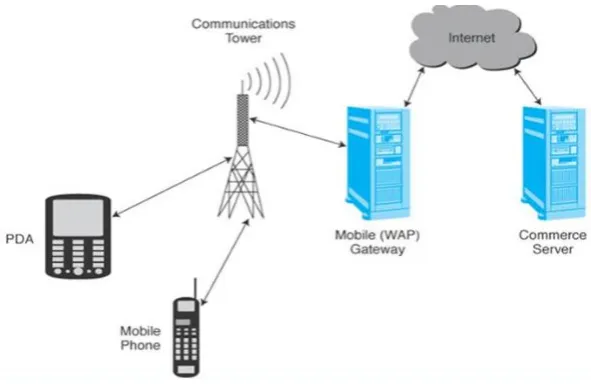
Figure 1: Mobile Computing
A. Qualities of Mobile Computing
The Qualities of Mobile Computing are listed below,
a) Mobility: Portable devices moving within a fixed or a mobile network is referred to as mobility.
b) Portability: In MC it is easy for mobile devices to move from one learning environment into another learning environment.
c) Social Interactivity: Data transfer or sharing of data between the users is termed as social interactivity.
d) Connectivity: Ability to connect within a network for some time irrespective of movement of devices in any environment.
B. Issues in Mobile Computing
a)Battery life: Mobile devices operate or depend entirely on battery power.so expensive batteries need to be used.
b)Low bandwidth: The networks for mobile devices will be within the range of cellphone towers. Even though the WLAN’s are inexpensive they were available within limited range.
c)Networking: Users can move from one place to another place i.e., user may move outside the network which may result in loss of data transmission.
d)Hardware: Mobile devices with low capacity limit the applications to be developed.
e)Security:This is considered as the major threat in mobile computing. As huge number of networks is connected within a line, there is a possibility that one can directly attack the VPN.
1254 | P a g e
1.2.
Cloud Computing
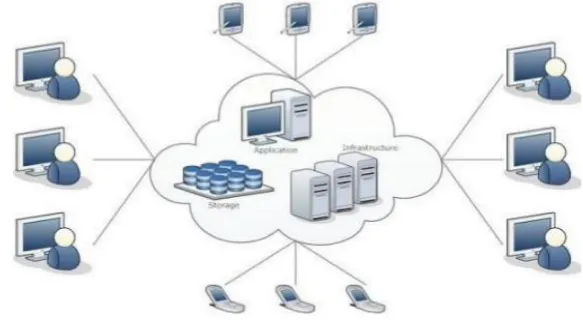
Cloud Computing is one of the kind of putting away and calculating i.e., computing to handle the applications where computing resources can be shared instead of local servers or personal computers. The virtual space where users can deploy their applications is termed as Cloud. Cloud is a collection of interconnected severs where developers can run, deploy their applications, store and retrieve the data. The computing performed on the cloud is referred to as cloud computing. The cloud model supplies 5 qualities, 4 deployment models and 3 service models.
Figure 2: Cloud Computing
A.Qualities of Cloud Computing:
Cloud Computing provides the following 5 basic Qualities,
a)On-demand self-service: Each service provider can provide computer services such as e-mail, applications, network services, storage services without the use of human intervention.
b)Wide network access: The efficiencies which are accessible over the system can be connected by utilizing standard instruments that advance use by heterogeneous thin or thick customers, for example, phones, tablets, portable workstations, work stations.
c)Resource pooling: The examples of resources include storage, processing, network capacity. By using multi tenancy model the service providers can provide services based on customer demands irrespective of different real and practical resources which were attached and reattached dynamically.
d)Rapid Elasticity: Based upon consumer needs the efficiencies available for provisioning were more and can be purchased at any time in any quantity.
1255 | P a g e
B. Deployment Models of Cloud Computing
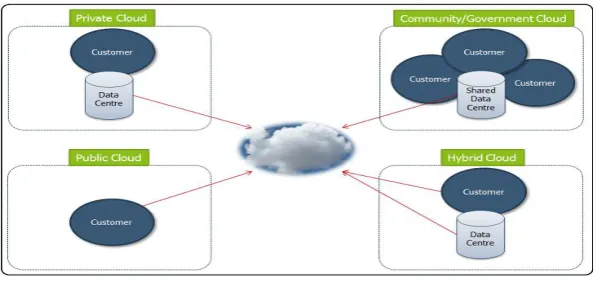
The deployment models of Cloud Computing describes who owns, manages and responsible for the services. These can be categorized mainly into four types which are as follows,
a) Public Cloud: In this type of model the administrations and applications were given by the specialist co-ops to the public across the network by an organization. It is also termed as External cloud. It is less secure. Examples include Amazon Web services (AWS) and Microsoft Azure.
b) Private Cloud: The private cloud allows the access to system and services solely for that organization. It is also termed as Internal Cloud. It offers greater security as a result of its private nature. Examples include Intel, Hewlett Packard (HP) and Microsoft who has their own internal private clouds.
c)Hybrid Cloud: This foundation comprises of at least two mists (public, private (or) group) where diverse elements are bound together by offering the advantages of various organization models.
d)Community Cloud: It enables the frameworks and administrations to be available among gathering of associations. Framework can be shared between different associations inside a particular group either hosted internally or externally.
Figure 3: Cloud Computing Deployment Models
C.Service Models of Cloud Computing
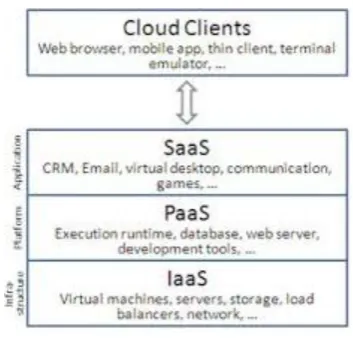
Cloud providers provides services and they are categorized into three ways,
a)Software-as-a-Service (SaaS): This layer is the First layer in the cloud service model from top-bottom representation. This layer contains cloud clients provides software for rent to the users. Examples for this type of service were g-mail, face book, twitter, yahoo, etc…
b)Platform-as-a-Service (PaaS): This layer is the second layer provides a development environment for application developers.Developers provide the code and the providers provide a way to upload the code into the internet. Examples for this type of service were Google App Engine, Microsoft Azure, etc…
1256 | P a g e
their application programming on the cloud foundation. Examples for this type of service were Virtual machine, server, storage, network, etc…
Figure 4: Cloud Service Models
D.Issues in Cloud Computing
a) Security Issues: Security issue is a major concern for the cloud. The security issues can be any of physical, operational or programmatic security.
b) Data Issues: The issues related to data can be data usage, data backup, data loss, data integrity and data theft. c) Performance issue: There may be loss in the company’s revenue when there will be poor performance related to applications. With the increase numbers of resources in the cloud or in order to improve the application performance administrators can use the scalability technique where they can either do it vertically or horizontally based on the resource constraint.
d) Design Issues: The design issues may include energy management, novel cloud architectures, and software licensing.
e) Right Issues: The real location of your data, responsibility of data, intellectual property rights were considered to be legal issues.
1.3.
Mobile Cloud Computing
The MCC forum defines MCC as follows [3]:
1257 | P a g e
Aepona [4] depicts MCC as another worldview for versatile applications whereby the information handling and capacity are moved from the cell phone to effective and brought together processing stages situated in mists. These unified applications are then gotten to over the remote association in light of a thin local customer or web program on the cell phones.
On the other hand, MCC can be characterized as a blend of versatile web and CC [5, 6], which is the most famous instrument for portable clients to get to applications and administrations on the Internet.
Cell phones needn't bother with an effective setup i.e., CPU speed and memory limit since all the confounded calculations will be handled in the cloud.
A.Architecture of MCC
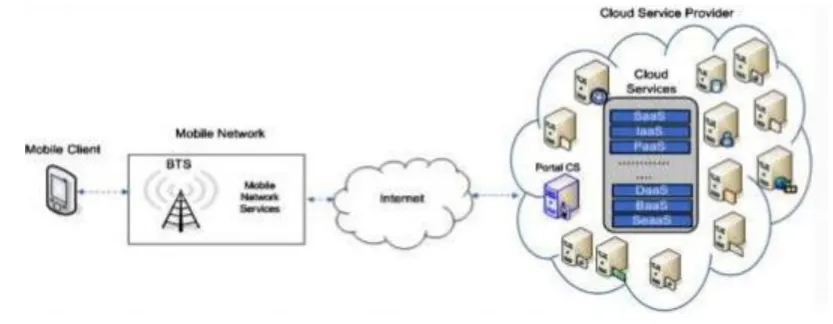
From the concept of MCC, the general architecture of MCC can be shown in Figure 5[7].
Figure 5: Mobile Cloud Computing Architecture
1258 | P a g e
B. Qualities of MCC
a)Multi tenancy: The application is used to share the hardware resources, and how the users can influence utilization of single application and database to occurrence.
b)Scalability: Service providers can easily expand or add a service which offers scalability to the mobile users. c)Availability: As we are using cloud computing technology, the services will be available to the users all the time even when they will be moving.
d)Reliability: There is a less chance in the loss of data or applications where these can be stored in the cloud on mobile devices.
e)Dynamic provisioning: The resources can be added on demand dynamically instead of advance reservation. f)Ease of integration: With the help of cloud computing technology, many services from various specialist organizations can be coordinated to meet the versatile client's requests.
C.Models of MCC
The MCC service models can be categorized in view of the parts and relations between the cell phones and the distributed computing elements. MCC makes use of the cloud computing services such as platform-as-a-service (PaaS), infrastructure-as-a-service (IaaS), software-as-a-service (SaaS). MCC services can be classified into three categories as follows mobile as a service broker (MaaSB)
a)Mobile as a Service Consumer (MaaSC): This is originated from the conventional client server model with the help of virtualization, by employing access control mechanism and cloud computing technology. In this type of service mobile devices are the consuming services.
b)Mobile as a Service Provider (MaaSP): MaaSP is not the same as the MaaSC where the part of cell phone is given by specialist co-op rather than benefit customer.
c)Mobile as a Service Broker (MaaSB): MaaSB can be considered as an expansion to MaaSP where the MaaSB gives systems administration and information sending administrations for other cell phones or detecting hubs. In this sort of model the cell phone can likewise be an entryway or intermediary which can give arrange benefits by utilizing distinctive correspondence approaches like 3G, 4G, 5G, Bluetooth and WiFi.
The mobile clouds were similar to cloud computing deployment models such as mobile public/private/community/hybrid clouds.
II.
CHALLENGES IN MOBILE CLOUD COMPUTING
A.Mobile Communication Issues:
a)Low bandwidth: One of the major issues in MCC. The available bandwidth is distributed among various mobile devices. It’s three times slow when compared to wired networks.
1259 | P a g e
c)Heterogeneity: It might be difficult to satisfy MCC requirements by handling wireless connectivity with heterogeneous networks.
B. Computing Issues
One of the fundamental highlights of MCC is calculation offloading. Offloading isn't generally successful in sparing vitality. It is basic to decide if to offload and which bits of the administration codes to offload. There are two sorts of offloading procedures which can be talked about as takes after,
a)Offloading in a static environment b)Offloading in a dynamic environment
C.Security Issues
The security is the major concern for both mobile users and data present in the cloud.
a) Security for Mobile users: Cell phones can be presented to various security dangers like malevolent codes and their helplessness. Cell phones coordinated with global positioning system (GPS) gadget, they can cause protection issues for endorsers.
b) Security for data in Clouds:By using this cloud computing technology even though both mobile users and application developerswere benefitted they needto be careful while dealing with information as far as uprightness, verification and advanced rights.
D.Privacy Issues
Mobile users give their private data which incorporates their present area. This turns into an issue when the enemy thinks about the users delicate data.
E. Alteration of Networks
MCC should be perfect with various stages as the MCC is utilized as a part of various working framework driven stages like android, apple ios and Windows telephone. IRNA (Intelligent Radio Network Access) system deals with the execution of various versatile stage systems.
III.
APPLICATIONS OF MOBILE CLOUD COMPUTING
The following are the applications of Mobile Cloud Computing,
i. Mobile Commerce: Mobile devices using this application provide various business models for commerce. Examples include mobile shopping, mobile advertising, etc…
ii. Mobile Healthcare: On demand services can be provided by hospitals and healthcare organizations on the clouds by using Mobile healthcare.
1260 | P a g e
iv.Mobile Learning: This concatenates e-learning and mobility. Limitations with traditional m-learning includes low transmission rate, low cost of device and constrained instructive assets. Cloud based m-learning can comprehend these constraints.
IV.
RESEARCH AREAS IN MOBILE CLOUD COMPUTING
Several research direction works are going in the development of MCC by dealing with different issues as exhibited in the segment. In any case, there are still a few disadvantages which should be tended to. This segment talks about a few open research issues bearings in the improvement of MCC.
A portion of the testing open research issues headings in versatile distributed computing are given beneath. a) Latency
b) Low Bandwidth
c) Network Access Management d) Quality Of Service
e) Pricing
f) Service Convergence g) Standard Interface h) Energy Efficiency i) Security And Privacy j) Better Service k) Task Division l) Data Delivery
m)Mobility And Resource Discovery n) Mobility And Cloud Session Connectivity o) Overhead Due To Use Of Cloud
p) Reliability q) Scalability r) High Availability
s) Overhead Due To Use Of Cloud
V.
CONCLUSION
1261 | P a g e
and Models, Challenges of Mobile Cloud Computing; Applications of Mobile Cloud Computing; Research Issues in Mobile Cloud Computing.
REFERENCES
[1.] Challenging Issues and Limitations of Mobile Computing: Deepak G et al,Int.J.ComputerTechology&Applications,Vol 3 (1),177-181
[2.] http://en.wikipedia.org/wiki/Mobile_communication [3.] http://www.mobilecloudcomputingforum.com/.
[4.] White Paper. Mobile Cloud Computing Solution Brief. AEPONA, 2010.
[5.] Christensen JH. Using RESTful web-services and cloud computing to create next generation mobile applications, In Proceedings of the 24th ACM SIGPLANconference companion on Object orientedprogramming systems languages and applications(OOPSLA), 2009; 627–634.
[6.] Liu L, Moulic R, Shea D. Cloud service portal for mobile device management, In Proceedings of IEEE7th International Conference on e-Business Engineering(ICEBE), 2011; 474.
[7.] A Survey of Mobile Cloud Computing: Architecture, Applications, and Approaches Hoang T. Dinh, Chonho Lee, DusitNiyato, and Ping Wang
[8.] Mobile Cloud Computing Service Models: A User Centric Approach JEEVAN J,RAMLING HALMANDGE,PUSHPALATHA S
[9.] http://www.slideshare.net/noumanashrafawan/mobile-cloud-computing-55534661
[10.]https://aboutdigitalcertificate.wordpress.com/2014/03/10/5-top-challenges-in-mobile-cloud-computing-2/ [11.]https://en.wikipedia.org/wiki/Mobile_cloud_computing
[12.]Mobile Cloud Computing :A survey by Niroshinie Fernando, SengW.Loke, WennyRahayu [13.]Research on Mobile Cloud Computing: Review, Trend and Perspectives Han Qi, Abdullah Gani [14.]http://www.sciencedirect.com/science/article/pii/S0167739X12001318