Research
|
Web exclusive
This article has been peer reviewed.
Can Fam Physician 2011;57:e68-73
Accepting new patients
What does the public think about Ontario’s policy?
Roger Chafe
PhDAndreas Laupacis
MDWendy Levinson
MDAbstract
Objective To gauge the public’s opinion of the College of Physicians and Surgeons of Ontario’s (CPSO’s) policy on how primary care physicians should accept new patients.
Design Deliberative citizens’ council.
Setting Toronto, Ont.
Participants Twenty-five public members of the Toronto Health Policy Citizens’ Council.
Methods A 2-day council session was held, during which the new policy was presented and council members heard from experts with various perspectives on the issues involved. Council members then deliberated and developed recommendations concerning the policy.
Main findings Council members agreed that a first-come, first-served policy was an appropriate method for family physicians to use when accepting new patients. They thought the policy’s exception, which allows physicians not to accept patients based on a lack of clinical competency in an area, should be clarified in order to avoid it being used as an excuse to inappropriately screen patients. Counsel members also encouraged the CPSO to publicize its policy as widely as possible, so that potential patients undergoing screening in the future will recognize that this goes against the CPSO’s policy and can take appropriate action if they wish.
Conclusion How family physicians accept new patients into their practices is a sensitive issue. The CPSO policy provides guidance on how new patients should be admitted, which, if it is appropriately enacted, seems reasonable to informed members of the public.
Editor’s kEy points
• Because many Canadians have difficul
-ties in securing regular family physicians,
how primary care physicians accept new
patients when openings become available
in their practices is an important social
issue.
• A citizens’ council that examined the College of Physicians and Surgeons of Ontario’s (CPSO’s) policy on accepting patients agreed that a first-come, first-served approach was appropriate for family physicians to use when accepting new
patients.
• Counsel members encouraged the CPSO to publicize its policy as widely as possible,
so that potential patients who believe they
underwent inappropriate screening know
what the standards are and can appeal to
Cet article a fait l’objet d’une révision par des pairs.
Can Fam Physician 2011;57:e68-73
Accepter de nouveaux patients
Ce que le public pense des politiques ontariennes
Roger Chafe
PhDAndreas Laupacis
MDWendy Levinson
MDpoints dE rEpèrE du rédactEur
• Comme plusieurs canadiens ont de la difficulté à se trouver un médecin de famille régulier, la façon dont les médecins de première ligne acceptent de nouveaux patients lorsqu’une place se libère dans leur clinique est une question socialement importante.
• Après avoir pris connaissance des politiques du Collège des médecins et chirurgiens d’Ontario (CMCO) au sujet de la prise en charge de patients, un conseil de citoyens a convenu qu’une approche « premier arrivé premier servi » était celle que le médecin de famille doit utiliser pour accepter de nouveaux patients.
• Les membres du conseil ont incité le CMCO à publiciser sa politique le plus largement possible, afin que les patients qui estimeraient ne pas avoir été correctement sélectionnés connais
-sent les règles existantes et puissent en appeler au CMCO s’ils le désirent.
Résumé
Objectif Déterminer ce que le public pense des politiques du Collège des médecins et chirurgiens d’Ontario (CMCO) sur la façon dont les médecins de première ligne devraient accepter de nouveaux patients.
Type d’étude Une assemblée délibérante de citoyens.
Contexte Toronto, Ontario.
Participants Vingt-cinq membres du public du Conseil des citoyens de Toronto sur les politiques de la santé.
Méthodes Lors d’une session de 2 jours, on a présenté les nouvelles politiques et les membres du conseil ont entendu des experts discuter de différents aspects des questions à l’étude. Ils ont ensuite délibéré et formulé des recommandations au sujet de ces politiques.
Principales observations Les membres du conseil ont convenu qu’une politique de type « premier arrivé, premier servi » était la méthode à utiliser lorsqu’un médecin de famille acceptait de nouveaux patients. Ils estimaient que les exceptions à cette politique qui permettent à un médecin de refuser des patients sous prétexte d’un manque de compétence dans un domaine donné devraient être clarifiées pour éviter que cela serve d’excuse pour exclure certains patients de façon inappropriée. Ils ont aussi incité le CMCO à publiciser ses politiques le plus largement possible, afin que les patients qui participeront à une sélection semblable dans le futur puissent s’apercevoir que cela va à l’encontre des politiques du CMCO et décident de prendre les mesures appropriées s’ils le désirent.
Conclusion La façon dont les médecins de famille acceptent nouveaux patients dans leur clinique est un sujet délicat. Les politiques du CMCO donnent des directives à ce sujet, lesquelles
Research
|
Accepting new patients
I
n 2009, the College of Physicians and Surgeons of Ontario (CPSO) introduced a policy on how Ontario family physicians should accept new patients into their practices.1 The new policy was partly motivatedby reports that family physicians were increasingly rely-ing on screenrely-ing tools and interviews to select patients.2
When complaints about some of these practices were referred to the Ontario Human Rights Commission, the CPSO acted by creating the new policy.3 The new
CPSO policy states that physicians should follow a first-come, first-served principle and discourages inter-viewing or screening patients before establishing a patient-physician relationship. The policy does allow for limitations of clinical competence and scope of practice to be permissible grounds for not accepting patients as long as decisions to accept or refuse new patients on this basis are made in good faith. If family physicians do choose to limit their scope of practice, the limits on the type of patients who are being accepted need to be com-municated to all patients who are considering establish-ing a patient-physician relationship. The CPSO policy also allows for patients in greater need of care to be given priority. Patients who believe a physician has vio-lated this policy can now file a complaint, which will be investigated by the college.
The CPSO’s policy appears to go further in restricting the discretion of family physicians to select new patients than the guidelines offered by other provin-cial colleges.4-7 It has also been criticized by a
num-ber of stakeholders. The Ontario Medical Association (OMA) argues that family physicians themselves are in the best position to manage how their practices accept new patients.8 The OMA points to the fact that there
are a number of existing codes that already restrict the factors physicians can consider in selecting new patients. For example, the Canadian Charter of Rights and Freedoms, the Ontario Human Rights Code, and the Canadian Medical Association’s Code of Ethics all prohibit selecting new patients on the basis of race, ethnic origin, citizenship, religious affiliation, sex, sex-ual orientation, age, family status, or disability.9-11
The OMA also argues that it is unclear how the new policy will affect other health care initiatives aimed at increasing primary care access for specific patient populations (eg, those with complex mental illness12)
or reducing wait times (part of Ontario’s Wait Time Strategy13). The OMA contends that as the new policy
was originally written, “physicians who accept Wait Time Strategy (WTS) patients on a priority basis could be at risk of a finding of professional miscon-duct.”8 The CPSO later clarified that the policy does
allow physicians to accept patients in accordance with these provincial initiatives.2 Concerns have also been
expressed that using a first-come, first-served approach will result in new practices being overwhelmed
with patients with complex medical and psychiatric conditions, so that younger family physicians might not be able to maintain the proper balance of patients required to run an effective practice.14 It has even been
argued that the new policy will result in some family physicians no longer offering comprehensive care14
or refusing to accept new patients altogether, “further worsen[ing] the family doctor shortage” in Ontario.15
Because many Canadians have difficulties in secur-ing regular family physicians, how physicians accept new patients when openings become available in their practices is an important social issue. How physicians accept new patients also raises a number of difficult eth-ical questions, including what factors physicians should legitimately be allowed to consider in selecting new patients. Although it is of direct concern to patients, there appears to be little consideration given to what the public thinks a reasonable policy should be in this area. The purpose of this project was to gauge the public’s opinion of the new CPSO policy.
MEtHods
We devoted a session of the Toronto Health Policy Citizens’ Council (THPCC) to considering the new CSPO policy. The THPCC has been established as part of a wider research project examining public engagement in health policy, and it consists of 25 members of the public (11 men and 14 women) who were randomly selected by an independent third-party to ensure a diverse group in terms of age, sex, and cultural and socioeconomic back-grounds.16 The council members range in age from their
early 20s to their late 60s. The purpose of the council is to have citizens who do not have particular vested inter-est in health care deliberate and comment on important, value-sensitive health care issues. None of the council members are employed in health-related occupations. Council members are remunerated for participating in council sessions. Research ethics approval for the entire research project was granted by the Research Ethics Board of St Michael’s Hospital in Toronto, Ont.
The council members were asked to deliberate on the following 2 questions:
• Do you think that the CPSO policy “Accepting New
Patients” is reasonable?
• If yes, how would you make it better? If not, what fun -damental changes should be made?
a period of time, and to come to an informed and con-sidered position.17 Deliberative methods are becoming a
more established way of engaging members of the pub-lic in health popub-licy questions. The National Institute for Health and Clinical Excellence in the United Kingdom has had a standing citizens’ council for a number of years.18,19 The Government of Ontario has recently
estab-lished a citizens’ council to advise on policies relating to drugs.20
The council meeting began with the citizens receiv-ing copies of the CPSO, followed by presentations from 3 experts on the topic, each expert offering a different perspective on the issues involved. First, a family phys-ician described the current patient selection process in his practice. He explained how the CPSO policy would affect his practice and the practices of his colleagues. He pointed out that it was often not physicians but their office staff members who had more control over who entered the practice. He believed that his ability to con-trol the makeup of his practice was what had allowed him to practice for such a long time. He stated that the new policy was going to increase the stress on family doctors, decrease the attractiveness of working as a doctor in Ontario, and ultimately decrease access for patients.
A representative from the CPSO presented the ration-ale for establishing the new policy: screening is unfair to patients; it marginalizes the people most in need of care or those who have the greatest difficulty accessing care; and it is unfair to other doctors who feel compelled to accept unwanted patients.21 He also discussed how the
practice of screening patients was becoming more com-mon for new medical graduates.
Finally, a representative from the Ontario College of Family Physicians discussed some of the limitations her organization saw with the CPSO policy. She explained the following concerns: the policy would cause some family physicians to stop accepting new patients; there were not any good data showing there was even a prob-lem with patients being inappropriately screened; and new doctors are particularly careful about ensuring they have the skills and experience to treat the people they see, which could be put at risk if they do not have dis-cretion over whom they treat. The 3 presenters then answered questions from the council members. An invi-tation was sent to the OMA to send a representative to present to the citizens’ council, but the organization did not participate.
The council members were then randomly divided into 3 small groups to discuss the questions presented to them. Each group was moderated by a member of the research team, whose role was to encourage every member’s voice to be heard and to answer any factual questions that arose over the course of the deliberations, while abstaining from injecting personal opinions about
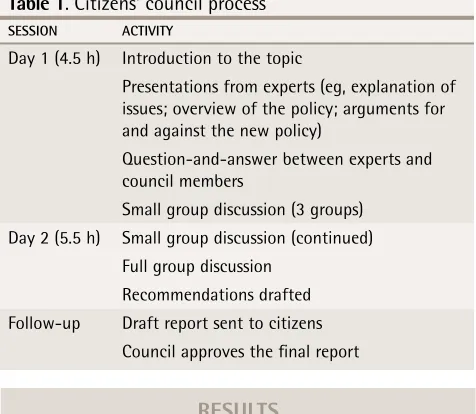
the topic. At the end of the second day, the entire coun-cil met to hear the results of the deliberations of the 3 small groups and to further discuss the topic as a whole group. At the end of this discussion, the council mem-bers developed their recommendations concerning the 2 questions they were asked. Detailed notes on the entire council meeting were taken by the research team and were used to formulate a draft report. The presentations and all group discussions were recorded and transcribed to allow for further analysis. The draft report was sent to all council members for review. During the next coun-cil meeting, the councoun-cil members, as a group, approved the revised final report as being an accurate reflection of their findings.22 The entire process is outlined in Table 1.
rEsuLts
Is a policy needed?
The citizens’ discussion covered a range of issues. It was initially recognized by the citizens that there would be no need for a policy about accepting patients if there were not a shortage of family physicians in Ontario. The citi-zens thus recommended that ensuring that all Ontarians have access to family physicians should remain a pri-ority of the Ontario Ministry of Health and Long-Term Care. Some citizens questioned the need for any pol-icy on accepting new patients, as most discriminatory screening is already restricted by the Ontario Human Rights Code. One citizen said, “This [policy] just seems like motherhood.” On the other hand, other citizens (or their relatives and friends) had experienced what they thought was inappropriate screening and argued that the CPSO policy would reinforce to Ontario physicians that most screening of new patients is inappropriate.
The citizens had a good deal of sympathy for the situation faced by family physicians and recognized that the new policy might place added burdens on some physicians. Some of the citizens said that they would
table 1
. Citizens’ council process
sessIon ACtIvIty
Day 1 (4.5 h) Introduction to the topic
Presentations from experts (eg, explanation of issues; overview of the policy; arguments for and against the new policy)
Question-and-answer between experts and council members
Small group discussion (3 groups) Day 2 (5.5 h) Small group discussion (continued)
Full group discussion Recommendations drafted Follow-up Draft report sent to citizens
Research
|
Accepting new patients
likely feel uncomfortable if they had no discretion over which people they accepted as clients in their busi-nesses, and acknowledged that some types of patients are likely difficult to treat and counsel. There was a good deal of discussion about the rights of physicians to limit their practices, but the citizens ultimately believed that patients’ rights to access health care trumped phys-icians’ discretion to tailor their practices, and that a clear policy was needed regarding how primary care physicians accepted new patients.
What principle should the policy embody?
Given that access to care was believed to be a fun-damental right and that a policy about accepting new patients was needed, the citizens agreed that first-come, first-served was an appropriate principle to use when accepting patients into a practice. While it is possible that family physicians could use initial surveys or inter-views that are in accordance with the existing human rights codes (eg, for the purposes of informing patients about a particular focus of the practice), there was con-cern that these methods might be used to inappropri-ately screen patients. The citizens believed that the first-come, first-served approach was likely the most effective way to remove suspicions that inappropriate screening has occurred. The citizens also commented that violations of the first-come, first-served approach were easier to investigate, if there was suspicion that a physician was violating the policy.
Clinical competency
The CPSO’s policy states that “clinical competence and scope of practice are permissible grounds for limiting patient entry into a practice.”1 The council members
were concerned that this opt-out clause could be used as an excuse for inappropriate screening. They raised the example of a family physician who might say that he or she was not competent to provide care to a patient with HIV or an elderly patient with severe heart fail-ure simply to avoid serving certain types of complex patients. While recognizing that advances in medical knowledge and the aging population place demands on family physicians to keep current, the council members believed that family physicians practising in Ontario should be able to competently care for almost all types of patients, with help from other colleagues and specialists as needed. Therefore, they thought that clinical competency should rarely be used as a reason for selecting patients. The citizens recommended that the CPSO policy should be more explicit about what is covered by this opt-out clause, so that it cannot be used to undermine the intent of the overall policy.
the policy in effect
Council members recognized that good judgment was
important when practising and enforcing the CPSO pol-icy. For example, the council members believed that it was appropriate for a family physician to preferentially accept a patient with clearly greater medical needs or to accept dependants of current patients before accepting other patients. Council members thought that while a policy was needed in this area, most family physicians in Ontario already accept patients on an appropriate basis, and that in enacting this new policy the CPSO needs to ensure that it does not overburden practices that are already appropriately accepting new patients. The citi-zens were concerned that Ontarians are not as aware of the CPSO’s policy as they should be. They encouraged the CPSO to publicize this policy as widely as possible, so that potential patients undergoing screening in the future will recognize that this goes against the CPSO’s policy and can take appropriate action if they wish. They also thought the policy and its underlying principles should be taught in medical schools and as part of resi-dency curricula, as it is often new physicians who have the bulk of openings for new patients.
discussion
Because it funds and is the ultimate user of the health care system, the public should clearly have a role in the policy-making process around most health care issues. Public engagement in policy making can lead to better understanding and increase the trust the public has in the health care system. Moreover, in the context of com-plex, value-laden policy decisions, public engagement can enhance the quality of decisions by bringing to the deliberations the full range of relevant value considera-tions. A deliberative citizens’ council has been shown to be an effective means of getting informed public input on complicated health policy issues.23
that a first-come, first-served approach is appropriate, the council members also recognized that the CPSO needed to be reasonable in its actual application of the policy.
Conclusion
To the best of our knowledge, the citizens’ council described here represents the first time the Canadian public has been engaged about how physicians should accept new patients. We recognize that our public engagement exercise only involved one group of citi-zens. Further public engagement is needed to confirm the public’s opinion about how physicians accept new patients, particularly in other provinces where colleges have proposed different policies or which currently lack clear guidance in this area. We do think that the public’s perspective on this issue is important and needs to be represented in formulating appropriate policies. We also hope that our successful example of engaging the public on this issue will encourage further public engagement about policies related to physician practices that have a direct effect on patients.
Dr Chafe is Director of Pediatric Research and Assistant Professor at Memorial University of Newfoundland in St John’s. Dr Laupacis is Executive Director at Li Ka Shing Knowledge Institute of St Michael’s Hospital and Professor in the Department of Health Policy, Management and Evaluation and the Department of Medicine at the University of Toronto in Ontario. Dr Levinson is Sir John and Lady Eaton Professor and Chair in the Department of Medicine at the University of Toronto.
Contributors
All authors contributed to the concept and design of the study; data gathering, analysis, and interpretation; and preparing the manuscript for submission.
Competing interests
None declared
Correspondence
Dr Roger Chafe, Memorial University of Newfoundland, Division of Pediatrics, 300 Prince Phillip Dr, St John’s, NL A1B 3V6; e-mail [email protected]
references
1. College of Physicians and Surgeons of Ontario. Policy statement #1-09. Accepting new patients. Toronto, ON: College of Physicians and Surgeons of Ontario; 2009. Available from: www.cpso.on.ca/policies/policies/default. aspx?ID=2506. Accessed 2010 Aug 5.
2. College of Physicians and Surgeons of Ontario [website]. Council updates. April 23, 2009. Toronto, ON: College of Physicians and Surgeons of Ontario; 2009. Available from: www.cpso.on.ca/whatsnew/councilupdates/default. aspx?id=3190. Accessed 2010 Aug 5.
3. Ontario Human Rights Commission. Submission of the Ontario Human Rights Commission to the College of Physicians and Surgeons of Ontario regarding the draft policies relating to establishing and ending physician-patient relationships. Toronto, ON: Ontario Human Rights Commission; 2008. Available from: www. ohrc.on.ca/en/resources/submissions/surgeons. Accessed 2010 Aug 5. 4. College of Physicians and Surgeons of Alberta. Physician-patient
relation-ships. CPSA guideline. Edmonton, AB; 2005. Available from: www.cpsa.ab.ca/ Libraries/Policies_and_Guidelines/Physician-Patient_Relationships.sflb. ashx. Accessed 2010 Aug 5.
5. College of Physicians and Surgeons of Newfoundland and Labrador [web-site]. Advisory. Requiring prospective patients to complete medical question-naires. St John’s, NL: College of Physicians and Surgeons of Newfoundland and Labrador; 2008. Available from: www.cpsnl.ca/default.asp?com=Polici es&m=340&y=&id=40. Accessed 2010 Aug 5.
6. College of Physicians and Surgeons of Saskatchewan [website]. Physician-patient relationships. Saskatoon, SK: College of Physicians and Surgeons of Saskatchewan; 2010. Available from: www.quadrant.net/cpss/resource/ relationships.html. Accessed 2010 Aug 5.
7. College of Physicians and Surgeons of British Columbia. Establishing a patient-physician relationship. Vancouver, BC: College of Physicians and Surgeons of British Columbia; 2009. Available from: www.cpsbc.ca/files/u6/Establishing-a-Patient-Physician-Relationship.pdf. Accessed 2010 Aug 5.
8. Ontario Medical Association. Health policy reports. CPSO draft policy. Accepting new patients. Toronto, ON: Ontario Medical Association; 2008. Available from: www.oma.org. Accessed 2010 May 10.
9. Government of Canada [website]. Canadian Charter of Rights and Freedoms. Part I of the Constitution Act, 1982. Ottawa, ON: Government of Canada; 2010. Available from: http://laws.justice.gc.ca/eng/charter/Charter_index.html. Accessed 2010 Aug 5.
10. Government of Ontario [website]. Human Rights Code. RSO 1990, Chapter H19. Toronto, ON: Government of Ontario; 2011. Available from: www.e-laws.gov.on.ca/html/statutes/english/elaws_statutes_90h19_e.htm. Accessed 2010 Aug 5.
11. Canadian Medical Association. CMA code of ethics. Ottawa, ON: Canadian Medical Association; 2004. Available from: http://policybase.cma.ca/ PolicyPDF/PD04-06.pdf. Accessed 2010 Aug 5.
12. Fleury MJ, Bamvita JM, Tremblay J. Variables associated with general practitioners taking on serious mental disorder patients. BMC Fam Pract
2009;10(10):41.
13. Government of Ontario [website]. Ontario’s wait time strategy. Toronto, ON: Government of Ontario; 2005. Available from: www.news.ontario.ca/opo/ en/2005/05/ontarios-wait-time-strategy.html. Accessed 2010 Aug 5. 14. Wetmore S. Building an effective and satisfying family practice. Toronto, ON:
Ontario College of Family Physicians; 2009. Available from: www.ocfp. on.ca/local/files/Communications/Ltr2Mbrs/2009/Inside_Out___65.pdf. Accessed 2010 May 10.
15. Coalition of Family Physicians of Ontario. CPSO council passes new policy on accepting new patients. Toronto, ON: Coalition of Family Physicians of Ontario; 2008. Available from: www.cofp.com/about.asp. Accessed 2010 May 10. 16. Toronto Health Policy Citizens Council [website]. Toronto, ON: Toronto
Health Policy Citizens Council; 2009. Available from: www.toronto healthpolicycitizenscouncil.ca/. Accessed 2010 Aug 5.
17. Canadian Health Services Research Foundation [website]. Public engagement (part II): how do deliberative processes achieve meaningful public engagement?
Ottawa, ON: Canadian Health Services Research Foundation; 2011. Available from: www.chsrf.ca/other_documents/insight_action/html/ia49_e.php. Accessed 2010 Aug 5.
18. Davies C, Wetherell M, Barnett E. Citizens at the centre. Deliberative participa-tion in healthcare decisions. Bristol, UK: The Policy Press; 2006.
19. Rawlins MD, Culyer AJ. National Institute for Clinical Excellence and its value judgments. BMJ 2004;329(7459):224-7.
20. Ontario Ministry of Health and Long-Term Care. Citizens’ council. Toronto, ON: Ontario Ministry of Health and Long-Term Care; 2011. Available from: www.health.gov.on.ca/en/public/programs/drugs/councils/citizens_ council.aspx. Accessed 2010 Aug 5.
21. Zuliani P. Accepting new patient policy. Toronto, ON: College of Physicians and Surgeons of Ontario; 2008. Available from: www.torontohealth policycitizenscouncil.ca/html/documents/presentations/zuliani_Dec08. pdf. Accessed 2010 Aug 5.
22. Toronto Health Policy Citizens’ Council. Report #4—the College of Physicians and Surgeons of Ontario’s “accepting new patients policy.” Toronto, ON: Toronto Health Policy Citizens Council; 2009. Available from: www.toronto
healthpolicycitizenscouncil.ca/html/documents/reports/4_cpso_new_ patients_policy.pdf. Accessed 2010 Aug 5.