A Secure and Efficient
Key Exchange Protocol for Mobile Communications
Fuw-Yi Yang and Jinn-Ke Jan*
Department of Applied Mathematics, National Chung Hsing University,
Taichung 402, Taiwan, R.O.C., Email: [email protected]
*
Department of Computer Science, National Chung Hsing University,
Taichung 402, Taiwan, R.O.C., Email: [email protected]
Abstract
This paper proposes a key exchange protocol with mutual authentication, which
requires only 0.1 modular multiplications for online computations. This online
computation is ten times faster than that of conventional protocols. The message size
of the proposed protocol is about half (50%~66%) that of the previous protocols. In
addition to its efficiency in online computation and bandwidth, the paper provides a
formal proof to guarantee the security of the proposed protocol. Possessing of both
secure and efficient properties makes the proposed protocol suitable for the low power
mobile communications.
1. Introduction
The L-MAKEP (linear mutual authentication key exchange protocol) proposed in
[1] is a key exchange protocol specially designed for the wireless communications
between a low power mobile device (client) and a powerful base station (server). The
goal of the L-MAKEP is to make the computational complexity as efficient as
possible at the client end without decreasing the strength of security. Consequently,
the server sides do most of the computations. It is a good idea in the environment of
the wireless communications, especially in the case of a lower power client end.
However, there are flaws in L-MAKEP. The scheme in [2] successfully mounted an
A scenario of unknown key-share attack proposed in [3-4] is as follows. Assume that
an account holder U (user U) initiates a session communication with a bank server S,
and an adversary E mounts an unknown key share attack on this session. As a result of
the attack, user U believes that a session key is shared with the server S and server S
believes that the session key is shared with the adversary E. Although adversary E
does not obtain the session key, this attack could cause problem. For example, if user
U initiates the protocol to deposit an electronic fund in his account, the deposit will
eventually be made to the adversary E’s account. The protocol L-MAKEP and its
improvement in [2] are also insecure under the attack of middle-man as shown by the
scheme in [7]. The work in [7] also proposes an improved protocol to resist the
attacks of middle-man and unknown key-share; we call the protocol I-MAKEP.
This paper proposes an efficient and secure key exchange protocol for mobile
communications. Although both participants are authenticated through the public key
cryptography, the online computational cost for client side is only 0.1 modular
multiplications. This computational complexity is ten times faster than that of the
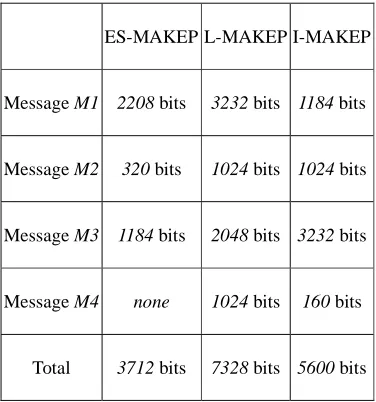
protocols L-MAKEP and I-MAKEP. The message size for the proposed protocol is
3712 bits while the message size for the protocol L-MAKEP is 7328 bits and for the
protocol I-MAKEP is 5600 bits (Section 3 will show the details.). Moreover, the
proposed protocol consists of only three messages while L-MAKEP and I-MAKEP
consist of four messages (two round trips). The savings in computations, bandwidth,
and messages is valuable for key exchange protocols, especially in the environment of
wireless communications with low power mobile devices. In addition, the paper
provides a formal proof to show that breaks the security of the proposed protocol is to
solve the difficulty of the factoring problem. Thus the proposed protocol not only
resists to the attacks mentioned above but also resists to other potential attacks.
The organization of this paper is as follows. Section 2 presents the new protocol
and describes the notation used in the paper. Section 3 compares the computational
cost and message size between the proposed protocol, L-MAPEP, and I-MAKEP. In
Section 4, the security of the new protocol is investigated and proven. Finally, Section
2. Protocol proposed
This section presents an efficient and secure key exchange protocol with mutual
authentication (ES-MAKEP). The protocol is inspired by the concept of chameleon
hash function in [8]. We first describe the cryptographic settings for the protocol.
Let εPK() denote an asymmetric encryption function and δSK() be the corresponding
decryption function. Similarly, EK() represents a symmetric encryption function and
DK() is the decryption function so that m = DK(EK(m)). Both the encryption functions
εPK() and EK() are assumed to be secure in the model of adaptive chosen ciphertext
attack [9-11]. In this attack model, an adversary is given a decryption oracle to
decrypt the ciphertexts adaptively chosen by the adversary except the one that he is
trying to decrypt. The identification of a client entity U (user U) is denoted by IDU
and the identification of a server S is represented by IDS. Server S has a private key
SKS and the corresponding public key PKS. The public key and secret key of user U
are selected in the following way. User U randomly chooses four large prime numbers
p, q, p’, and q’ such that p = 2 p’ + 1 and q = 2 q’ + 1. Then, he or she randomly
selects an element g of order λ(n) from the multiplicative groupZn*, where n = p q and
λ(n) = lcm(p - 1, q - 1). Thus user U has the private key (p, q) and the public key (g,
n). In addition, x || y denotes that string x concatenates string y, |n| represents bit
length of n, r∈R G denotes that r is a random number selected from the set G, and l
indicates the length of session keys, e.g. 160 bits for a typical value suggested in [12].
The following steps describe the details of the protocol ES-MAKEP.
1. User U randomly selects three numbers rUK, rUR and rUF, i.e. rUK, rUF∈R {0, 1}l and
rUR∈R Zλ(n). Compute the quantities C1rUK=εPKS(rUK) and CMT = UF UR r r
g || mod
n, i.e. encrypt the random number rUK and calculate the commitment of rUF and rUR.
Then, user U sends server S message M1 = { UK r
C1 , CMT, IDU} to ask for initiating
a new session.
2. On receiving the message M1, server S decrypts the ciphertext UK r
C1 to obtain rUK. S
⊕ rUK, and encrypts the random number rUK, i.e.C2rUK= EσSU (rUK). Then, server
S sends M2 = {rSK, C2rUK} to challenge user U.
3. Upon receiving the challenge message M2, U calculates the session key σUS = rUK ⊕ rSK and decrypts the ciphertextC2rUKto obtain a random number r’UK, i.e. r’UK =
US
Dσ (
UK r
C2 ) =
US
Dσ (
SU
Eσ (rUK)). Note that σSU is equal to σUS if messages M1
and M2 are successfully transmitted. User U authenticates server S by checking rUK
= r’UK. After authenticating server S, U constructs a response message as follows.
3.1. Compute the quantities SF = h(rUK, rSK, IDU, IDS) and C3 = EσSU (IDU).
3.2. Solve for SR in equation (1).
2|n| rUF + rUR = 2 |n|
SF + SR mod λ(n)
SR = 2|n| (rUF - SF)+ rUR mod λ(n) (1)
U sends the response message M3 = {C3, SR} to server S.
4. S computes the quantities SF = h(rUK, rSK, IDU, IDS) and CMT’ =gSF||SR mod n. S authenticates user U by verifying CMT = CMT’ .
For easy reading, the message flows are listed below.
U S: M1 = {
UK r
C1 , CMT, IDU}, whereC1rUK=εPKS(rUK)and CMT = UF UR r r
g || .
S U: M2 = {rSK,C2rUK}, whereC2rUK=EσSU(rUK)and σSU = rUK ⊕ rSK.
U S: M3 = {C3, SR}, where C3 =EσSU(IDU), 2 |n|
rUF + rUR = 2 |n|
SF + SR and SF =
h(rUK, rSK, IDU, IDS).
3. Performance
For each step in the protocols ES-MAKEP, L-MAKEP, and I-MAKEP, the
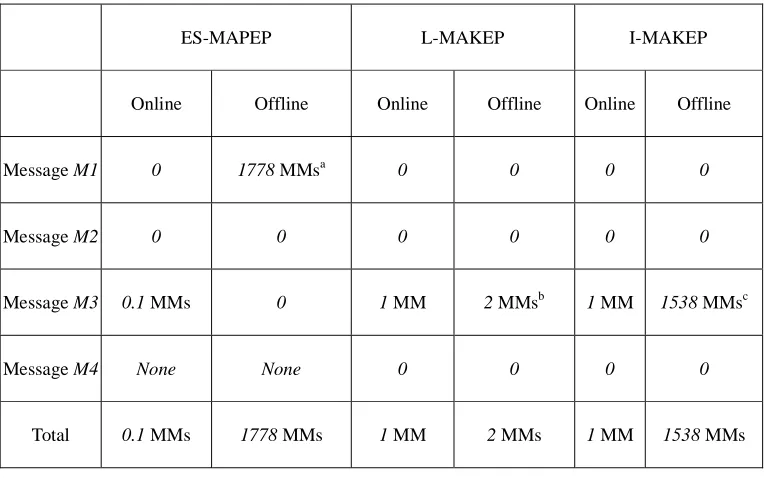
computations and message sizes are displayed in Table 1, 2 and 3. The cost of
computations is further divided into two parts: online and offline computations. To
simplify the estimation of message sizes and computations, we have assumed that the
asymmetric encryption is a 1024-bit RSA encryption with a low exponent public key
encoding. Also, the cost of additions, hash operations, and symmetric encryption and
decryption are not included. For a practical cryptographic settings [12], |n|= 1024 bits
and |rUF| = |SF| = 160 bits, the computational cost (software implementation) for
solving SR is estimated to be only about 0.1 modular multiplications of two 1024-bit
numbers modulo a 1024-bit modulus [8]. Note that computing SR involves only a
reduction of a 1184-bit number to a 1024-bit number while computing a modular
multiplication of two 1024-bit numbers requires a conventional multiplication and a
reduction of a 2048-bit number to a 1024-bit number. For easy comparison, the
message flows of protocols L-MAKEP and I-MAKEP are listed below.
The message flows of L-MAKEP: The server S has published a public key PKS, large
prime p and a primitive element g∈Z*p.
U S: M1 = {IDU,ga2i−1,ga2i, SigTA(IDU,ga2i−1,ga2i )}, where a2i-1, a2i ∈R Zp-1, and
SigTA(m) is a signature of a trusted authority (TA) on the message m. Server S
should verify the signature SigTA(IDU,ga2i−1,ga2i ).
S U: M2 = {rS}, where rS∈R Zp-1.
U S: M3 = {x, y}, where x = PK (rU) S
ε , y = (a2i-1(x ⊕ rS) + a2i) mod (p – 1), and rU
∈R {0, 1}160. User U computes the response message M3 and server S verifies it
by checking gy = ga2i−1(x⊕rS) ga2i mod p.
S U: M4 = {Eσ(x)}, where σ = rU⊕ y.
The message flows of I-MAKEP: The server S has private key (d, p, q) and public key
(e, g, N), where p, q are two large primes, N = p × q, g has maximum order in the
groupZ*N, φ(N) = (p - 1) (q - 1), gcd(e, φ(N)) = 1, and e × d = 1 mod φ(N). The user
U uses the pair (IDU, v) to register at server S and receives a certificate y = (v - IDU)d
mod N, where v = g-x mod N and x ∈R ZN is the secret key of U.
U S: M1 = {IDU, y}. Server S verifies M1 by checking v = ye + IDU mod N.
S U: M2 = {rS}, where rS∈R ZN.
U S: M3 = {u, t, s}, where u = gw mod N, t = (k) S PK
ε , s = w + x h(rS, t, u), and w
by checking u=vh(rS,t,u)gs mod N.
S U: M4 = {h(k)}.
As shown in Table 1, the client’s online computations for ES-MAKEP, L-MAKEP,
and I-MAKEP are 0.1, 1, and 1 MMs, respectively. Although L-MAKEP requires
only two MMs for offline computation, this protocol requires a trusted authority to
issue several commitments, which are the sources of the middle-man attack described
in [7]. Table 2 and Table 3 show that among the three protocols, ES-MAKEP has the
most efficient in computations and the least requirement in bandwidth and messages.
Table 1: Client’s computations in protocols ES-MAKEP, L-MAKEP, I-MAKEP
ES-MAPEP L-MAKEP I-MAKEP
Online Offline Online Offline Online Offline
Message M1 0 1778 MMsa 0 0 0 0
Message M2 0 0 0 0 0 0
Message M3 0.1 MMs 0 1 MM 2 MMsb 1 MM 1538 MMsc
Message M4 None None 0 0 0 0
Total 0.1 MMs 1778 MMs 1 MM 2 MMs 1 MM 1538 MMs
a. Computing UK r
C1 = PK (rUK)
S
ε requires 2 MMs and computing CMT =grUF||rURrequires 1.5 *
(160 + 1024) = 1776 MMs, where MM denotes modular multiplications of two 1024-bit numbers
modulo 1024-bit modulus.
b. Encryption requires 2 MMs (assume RSA encryption and public key PKS = 3).
Table 2: Server’s computations in protocols ES-MAKEP, L-MAKEP, I-MAKEP
ES-MAKEP L-MAKEP I-MAKEP
Online Offline Online Offline Online Offline
Message M1 1536 MMs 0 2 MMsd 0 2 MMse 0
Message M2 0 0 0 0 0 0
Message M3 1776 MMsf 0 3456 MMsg 0 3333 MMsh 0
Message M4 None None 0 0 0 0
Total 3312 MMs 0 3458 MMs 0 3335 MMs
d. Verification requires 2 MMs (assume TA uses RSA cryptosystem and verification key e = 3). e. Computational cost of encryption requires 2 MMs (public key e = 3).
f. Computing CMT’ =gSF||SRrequires 1.5 * (160 + 1024) = 1776 MMs.
g. Decryption requires 1.5 * 1024= 1536 MMs and verification requires 1.25 * 1.5 * 1024 = 1920 MMs, by the technique of simultaneous multiple exponentiations [13].
h. Decryption requires 1.5 * 1024= 1536 MMs and verification requires 1.17* 1.5 * 1024= 1797 MMs.
Table 3: The message sizes of protocol ES-MAKEP, L-MAKEP, I-MAKEP
ES-MAKEP L-MAKEP I-MAKEP
Message M1 2208 bits 3232 bits 1184 bits
Message M2 320 bits 1024 bits 1024 bits
Message M3 1184 bits 2048 bits 3232 bits
Message M4 none 1024 bits 160 bits
4. Security analysis
In the followings, subsection 4.1 proves that the proposed protocol ES-MAKEP is
a mutual authentication protocol (Theorem 1 and 2) and has resistance to those
attacks proposed in [2, 7] , subsection 4.2 proves that the protocol is a secure protocol
(Lemma 3, 4, and 5).
4.1 ES-MAKEP is a mutual authentication protocol
Theorem 1. Protocol ES-MAKEP correctly authenticates user U.
Proof. If user U knows the secret key (p, q), then U can compute the quantity λ(n) =
lcm(p - 1, q – 1), solve for SR in (1) and construct the response message M3 = {C3,
SR}. Since 2|n| rUF + rUR = 2|n| SF + SR mod λ(n), the equation grUF||rUR=gSF||SRmod
n is obtained. Thus server S successfully authenticates user U.
Assume that an adversary E does not now the private key (p, q) of user U and
successfully impersonates the user U, then E has generated the quantities SF and SR
such that grUF||rUR= gSF||SRmod n. Thus equation (2) is obtained.
R F UR
UF r S S
r
g || − || = gw = 1 mod n (2)
Equation (2) implies that w is a multiple of λ(n). Since λ(n) = lcm(p - 1, q - 1) and φ(n)
= (p – 1)(q – 1), then φ(n) divides (2w). The algorithm in [14] shows that the
factorization of n can be computed efficiently, if any multiple of φ(n) is known. The
public key n thus can be factored by the adversary E using the algorithm in [14]. This
conclusion contradicts the intractable assumption of factoring problem. Therefore, if
server S successfully authenticates user U, then U knows the private key (p, q). □
Theorem 2. Protocol ES-MAKEP correctly authenticates server S.
Proof. If server S knows the secret key SKS, then S can decrypt the ciphertext C1rUKto
obtain rUK, calculate the session key σSU = rUK ⊕ rSK, and generate the ciphertext
UK r
C2 =E (rUK)
SU
σ . On receiving rSK, U calculates the session key σUS = rSK ⊕ rUK,
Clearly, the quantity recovered by decrypting the ciphertext UK r
C2 will be equal to
the quantity of stored rUK.
With overwhelming probability, S knows the secret key SKS, if user U authenticates
server S as legal. Namely, only S can decrypt the ciphertext UK r
C1 to obtain the
random number rUK. This result is derived from the security of the encryption
functions εPK() and EK(), which is assumed to be secure against the adaptive chosen
ciphertext attack. Therefore, server S is successfully authenticated by U if and only if
S knows the secret key SKS. □
The attacks described in [2, 7] are performed by modifying messages intercepted
from previous sessions. Thus by Theorem 1 and 2, the protocol ES-MAKEP is
resistant to them.
4.2 ES-MAKEP is a secure protocol
This subsection investigates the security of the protocol ES-MAKEP. We adopt the
security measure and those attack model used in [15-16]. Assume that an adversary
with total control over the communication channels can mount parallel attacks, and is
told the previous session keys. A key exchange protocol is secure if the following
requirements are satisfied.
1. If both participants honestly execute the protocol, then the session key is σ = σUS =
σSU.
2. No one can calculate the session key σ except participants U and S.
3. The session key is indistinguishable from a truly random number.
Lemma 3. Protocol ES-MAKEP satisfies the first security requirement.
Proof. After mutually authenticating, both participants have agreed on the random
numbers rUK and rSK by Theorem 1 and Theorem 2. Therefore, σ = σUS = rUK⊕ rSK =
σSU.
Proof. User U generates the random number rUK and constructs the ciphertext
UK r
C1 =εPKS(rUK). The encryption functions εPK() and EK() are secure. Thus, only U
and S know the quantity of rUK. Therefore, only participants U and S can calculate the
session key σ = σUS = σSU = rUK⊕ rSK.
Lemma 5. Protocol ES-MAKEP satisfies the third security requirement.
Proof. The proof is straightforward, since both the numbers rUK and rSK are randomly
selected from the set {0, 1}l.
5. Conclusions
The paper has proposed a secure and efficient key exchange protocol. The proposed
protocol outperforms the previous protocols L-MAKEP and I-MAKEP in the message
round, message size, server’s computations and client’s online computation. These
advantages make it most suitable for the environment of low power mobile
communications. However, all the protocols ES-MAKEP, L-MAKEP, and I-MAKEP
do not have the property of perfect forward secrecy. This strength of security requires
that even the long term secret key is compromised, the session keys should remain to
be safe. As can be seen from the first step in Section 2, the random number rUK and
session key σSU is computed if server’s secret key is revealed. This suggests further
research in providing a key exchange protocol with the perfect forward secrecy and all
advantages of ES-MAKEP.
References
1. D. S. Wong and A. H. Chan: “Mutual authentication and key exchange for low
power wireless communications,” Military Communications Conference, 2001.
MILCOM 2001. Communications for Network-Centric Operations: Creating the
Information Force, IEEE, Vol. 1, 2001, pp. 39-43
2. K. Shim, “Cryptanalysis of mutual authentication and key exchange for low power
wireless communications,” IEEE Communications Letters, Vol. 7, No. 5, pp.
3. S. Blake-Wilson, D. Johnson, and A. Menezes, “Unknown key-share attacks on the
station-to-station (STS) protocols”, The Second International Workshop on Practice
and Theory in Public Key Cryptography--PKC’99, LNCS 1560, pp. 154-170, 1999.
4. W. Diffie, P. van Oorschot, and M. Wiener, “Authentication and authenticated key
exchanges,” Designs, Codes and Cryptography, Vol. 2, pp. 107-125, 1992.
5. J. Baek and K. Kim, “Remarks on the unknown key share attacks,” IEICE
Transactions on Fundamentals, Vol. E83-A, No. 12, pp. 2766-2769.
6. B. S. Kaliski, Jr., “An unknown key-share attack on the MQV key agreement
procotol,” ACM Transactions on Information and System Security, Vol. 4, No. 3, pp.
275-288, 2001.
7. J. K. Jan and Y. H. Chen, “A new efficient MAKEP for wireless communications,”
In Proceedings of the 18th International Conference on Advanced Information
Networking and Application (AINA’04), IEEE, Volume 2, pp. 347-350, 2004.
8. A. Shamir and Y. Tauman, “Improved online/offline signature schemes,” Advances
in Cryptology-CRYPTO’01, LNCS 2139, pp. 355-367, 2001.
9. C. Rackoff, and D. Simon, “Non-interactive zero-knowledge proof of knowledge
and chosen ciphertext attack,” Advances in Cryptology- CRYPTO’91, LNCS 576,
pp. 433-444, 1991.
10. M. Bellare, A. Desai, D. Pointcheval, and P. Rogaway, “Relations among notions
of security for public key encryption schemes,” Advances in Cryptology-
CRYPTO’98, LNCS 1462, pp. 26-46, 1998.
11. D. Dolev, C. Dwork, and M. Naor, “Non-malleable cryptography,” Proc. of the
twenty third annual ACM symposium on theory of computing, ACM press, pp.
542-552, 1991.
12. A. Lenstra and E. Verheul, “Selecting cryptographic key sizes”, The Third
International Workshop on Practice and Theory in Public Key Cryptography
(PKC2000), LNCS 1751, pp. 446-465, 2000.
13. A. J. Menezes, P. C. van Oorschot and S. A. Vanstone, Handbook of Applied
14. G. Miller, “Riemann’s Hypothesis and tests for primality,” Journal of Computer
and System Sciences, ACM, Vol. 13, pp. 300-317, 1976.
15. M. Bellare and P. Rogaway, “Entity authentication and key distribution,”
Advances in Cryptology- CRYPTO’93, LNCS 773, pp. 232-249, 1993.
16. R. Canetti and H. Krawczyk, “Analysis of key-exchange protocols and their use
for building secure channels,” Advances in Cryptology- EUROCRYPT’01, LNCS