O N T H E THEORY OF SPECIATION INDUCED BY
TRANSPOSABLE ELEMENTS
LEV R. GINZBURG,* PAUL M. BINCHAM+ AND SINJAE YOO* *Department
of
Ecology and Evolution and +Department of Biochemistry, State University .fNew York, Stoney Brook, New York 1 I794 Manuscript received November 14, 1983
Revised copy accepted January 25, 1984
ABSTRACT
A simple methematical model describes the invasion of panmictic, sexually reproducing populations by a newly introduced transposon. T h e model places important constraints on the properties that transposons must have to success- fully invade a population and describes the kinetics with which such an invasion will occur. Invasibility conditions serve as a basis for new, detailed scenarios whereby transposon-mediated depression in fitness produces reproductive iso- lation of populations. These scenarios, in turn, lead to several speculations concerning the role of transposons in evolution.
mechanism was recently suggested (BINGHAM, KIDWELL and RUBIN 1982)
A
whereby transposable elements causing various degrees of hybrid sterility could be responsible for speciation (see ROSE and DOOLITTLE 1983, for a general review). T h e proposed scenario in its simplest form consists of two steps:1. T h e genomes of two geographically isolated populations are independ- ently ”contaminated” by different transposable elements. These “infections” spread in their respective populations in spite of the loss in fitness shown by the appropriate individuals carrying the transposon. (This loss of fitness in the well-characterized cases of the P-M and I-R dysgenic systems consists of sub- stantially reduced fertility among some individuals carrying the transposons in question.)
2.
Effective reproductive isolation of these two populations (speciation) fol- lows even if they become subsequently sympatric as a result of a loss of fitness of hybrids due to the cumulative effects of a combination of unrelated trans- posable elements.We consider here a simple mathematical model of the spread of a transpos- able element in a large sexually reproducing, panmictic population. Under the conditions of the model, we find that a transposable element will invade a population even if it reduces the fitness of hybrid individuals carrying it pro- vided that the fitness loss is not greater than a certain critical value. This critical value is, in turn, determined by the “infectivity” of the transposon. Our model also predicts the kinetics of the invasion of a natural population by a
332 L. R. GINZBURG, P. M. BINGHAM AND S . Y O 0
transposon. We discuss the implications of the results of our analysis to models of reproductive isolation of populations induced by transposable elements.
THE MODEL
T h e model is a conventional deterministic one-locus, two-allele system de- scribing the evolution of a panmictic population and amended by a description of the transposition process. A gamete is assumed to be either “infected” by the transposable element or not infected. (Notice that transposition is probably duplicative in the cases of many, if not all, transposons. T h e assumption that the transposon-bearing gamete can infect the nontransposon-bearing gamete without undergoing alteration itself is thus justified.) This approximation of a population as having only two types of gametes does not, of course, take into account the dynamics of the copy number within a genome, nor does it take into account recombination and the multilocus character of the process. We discuss, however, reasons for believing that the model is a valuable and pre- dictive approximation.
We assume that a noninfected gamete becomes infected with the probability (infection or transposition rate), (0
<
/3<
l), when paired in a zygote with the infected gamete. Two alternative assumptions will be made for the loss of fitness in hybrids. In one case, the loss [reduction of fitness from 1 to (1-
S ) ] occurs only in the female dysgenic individual (analogous to the Z-R system; seeBREGLIANO and KIDWELL 1982 for a review). In the other case, the same loss
occurs independently of the sex of the dysgenic individual (analogous to the P-M system, BREGLIANO AND KIDWELL 1982). T h e P-M-motivated model is
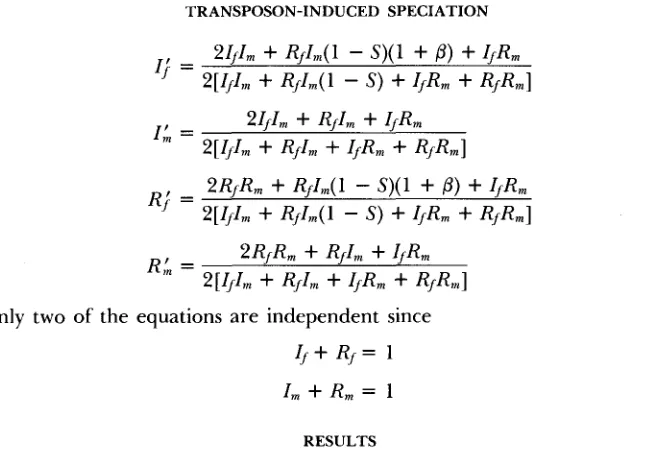
composed of the following set of recurrent equations:
P j =
P; =
M j =
M, =
where Pr and P, are frequencies of the P-carrying gametes within the female and male subpopulations and M, and M,,, are complementary frequencies of noninfected gametes within two sexes. Frequencies are normalized within sexes
so that
P/
+
M, = 1P,
+
M , = 1Unprimed symbols represent generation k , whereas primed symbols represent generation k
+
1.21fIm
+
R/Im(l-
S ) ( 1+
p)
+
IfR, I’ = 2[IfIm
+
RfIm(l-
S )+
IfR,+
RfR,]I ; =
R’ = 2[IfIm
+
RfIm(1-
S )+
IfRm+
R/Rm]21/Im
+
RfI,+
IjR,2[I’Im
+
R/Im+
IfRm+
R/Rm]2RfR,
+
R/Im(l-
S ) ( 1+
p)
+
IfR,2RfR,
+
RjI,+
IfR, RA =2[IfIm
+
R/Im+
I/Rm+
RfRm]Only two of the equations are independent since
If
+
Rf = 1I ,
+
R , = 1RESULTS
We first consider invasibility conditions. It is easy to show (APPENDIX I) that in the first model, the condition for the spread of the transposable element is
For the second model,
T h e shaded area in
(3)
S
p > I _ s
p>=
the similar condition is (see APPENDIX 11)
(4)
S
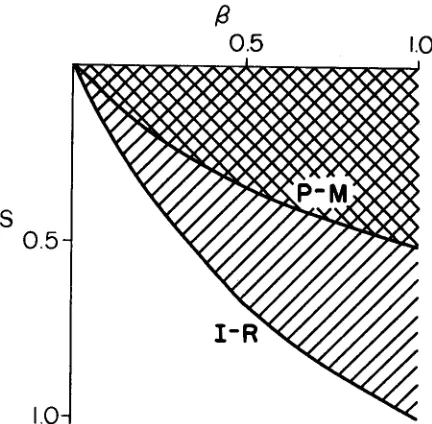
Figure 1 shows the combinations of the transposition rate,
p,
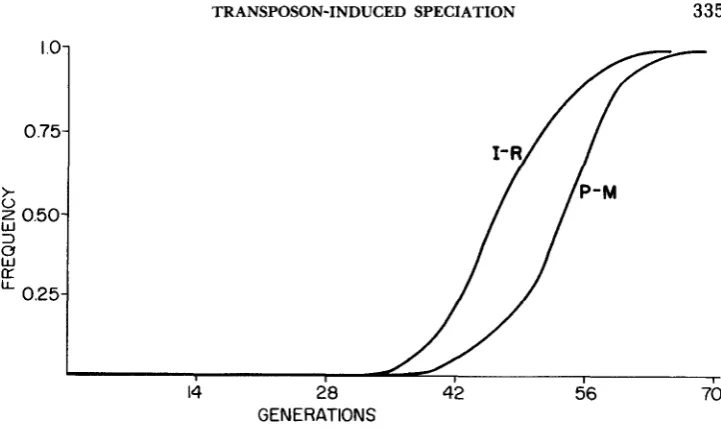
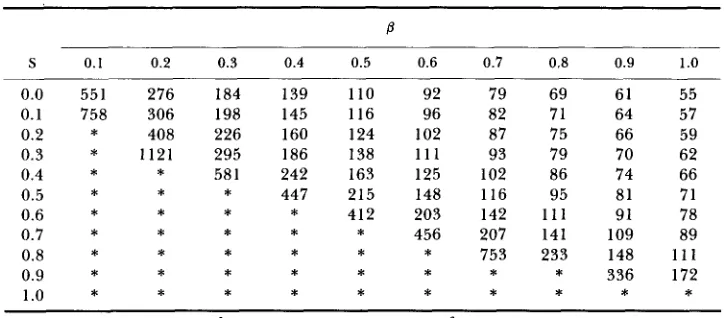
and the fitness loss, S, for which the spread of the new element is possible. A typical curve of the spread of the new element in a population is shown in Figure 2.Table 1 gives the time of the spread of a new element as a function of two parameters,
p
and S, evaluated from the P-M model. Asterisks denote combi- nations when spread is impossible. T h e same kind of results for the I-R model can be seen in Table 2. T h e process is somewhat faster in the case of the I-R model, but it is extremely fast in both cases. For parameters very close to the noninvasibility boundary, a typical curve shows a very low frequency for about 90% of the time with noticeable growth over a very short period of the order of 50-70 generations.When the combination of parameters, /3 and S, tends to the borderline of allowable combinations set by inequalities (3) and (4), the time of fixation tends to infinity. Practically, as Tables 1 and 2 show, except for a very narrow region immediately surrounding the noninvasibility boundary, it takes typically of the order of 100 generations for a new transposable element to be fixed in a population of 1,000,000 individuals. T h e process is clearly very rapid.
334 L. R.
S
0.5
I
.o
GINZBURG, P. M. BINGHAM AND S. Y O 0
B
0.5
1.0
FIGURE 1 .-Conditions of invasibility of a transposable element for the P-M and I-R models. Shaded area corresponds to the combination of parameters /3 and s that allow invasion. The conditions are clearly more strict for the P-M system. Note that independently of /3, the P element cannot invade if the loss of fitness is greater than 50% (s = 0.5). This is intuitively reasonable since, with maximal infectivity (/3 = l), the number of element-carrying gametes doubles at each generation. With an overall loss of more than 50% of offspring, heterozygote disadvantage over- rides infectivity and the element is lost.
vasion, (3) and
(4),
are, therefore, to be viewed as necessary but not sufficient for invasion of a real, finite population. This results from the fact that our model assumes infinite population size, whereas in finite populations it is pos- sible for a newly invading element to be lost as a result of purely stochastic processes.A much more complex model involving drift in finite populations developed by WALSH (1982), in which meiotic drive works as a formal equivalent of our transposition process, produces a probable rapid fixation in cases of extreme meiotic drive.
GENERATIONS
FIGURE 2.-Typical curves for the spread of transposable elements through a population. Two curves for the P-M and I-R models are shown for the same values of parameters s = 0.1 and @ =
0.9 within invasibility conditions for both models. If an initial frequency of is the starting point, less than 70 generations are required on each model (68 for the P-M case and 6 4 for I-R) for the element to reach a frequency of 99.9999% (l-104). Note that the process can be practi- cally invisible for approximately half of this time period. When parameters and s are chosen closer to the borderline of invasibility conditions, the “practically invisible” portions of the invasion curve can become quite long. T h e “visible” portion of the curve appears very similar for a variety of
combinations of parameters.
TABLE 1
Time of the spread of a new transposable element evaluated from the P-M model (in generations)
S
0.0 0.1 0.2 0.3 0.4 0.5 0.6
B
0.1 0.2 0.3 0.4 0.5 0.6 0.7 0.8 0.9 1 .o
551 276 184 139 110 92 79 69 61 55
* 421 232 164 128 105 89 78 68 61
644 264 176 135 110 93 81 72
*
*
*
*
499 243 168 131 109 93*
*
* **
*
1051 321 202 152*
*
*
*
*
*
*
*
*
*
*
*
*
*
*
*
*
*
*
*
*
*
0.7
*
*
*0.8
*
*
*
*
*
*
*
*
*
*
0.9
*
*
*
1.0 * * *
*
*
*
*
*
*
*
*
*
*
*
*
*
*
* *
*
*
*
*
*Initial frequency, Po = IO+; final frequency, Pfirul = (1-10-6).
in this context than are those that produce more substantial degrees of hybrid fitness loss (and that, consequently, must be associated with higher levels of infectiousness to exist).
336 L. R. GINZBURG, P. M. BINGHAM AND S. Y O 0 TABLE 2
Time of the spread of a new transposable element evaluated from the I-R model
s 0 .0 0.1 0.2 0.3 0.4 0 .5 0.6 0.7 0.8 0 .9 1
.o
0.1 551 758 ~ *
*
**
**
* **
0.2 0.3
276 306 408 1121 *
*
*
*
*
*
* 184 198 226 295 58 1*
0.4 0.5
139 110 145 116 160 124 186 138 242 163 447 215
*
412*
**
*
* * **
0.6 92 96 102 1 1 1 125 148 203 456*
**
0.7 79 82 87 93 102 116 142 207 753 **
0.8 69 71 75 79 86 95 1 1 1 141 233 __*
* 0.9 61 64 66 70 74 81 91 109 148 336*
1 .o
55 57 59 62 66 71 78 89 1 1 1 172
*
Initial frequency, I,, = final frequency I,,, = (1-10-6).
elements in natural Drosophila rnelanogaster populations suggests a period of invasion of the order of 20-30 yr. Moreover, the work of BERG (1982) on the mutability peaks in the natural populations of D . melanogaster support the ret- rospective studies of KIDWELL (1983). In particular, the two periods when mutation rates in natural fly populations were an order of magnitude higher than at other times (first in the 1930s and second in the 1960s) coincide with the periods of apparent invasion of the P element and I element reported by
KIDWELL. Strong increases in mutability associated with the hybridization of some strains differentiated with respect to a transposable element are well established (see BINGHAM, KIDWELL and RUBIN 1982; RUBIN, KIDWELL and
BINGHAM 1982 and references therein). T h e reasons for believing that the P element transposon has recently invaded the wild D . melunoguster population have been recently reviewed by BINGHAM, KIDWELL and RUBIN (1982) and by
KIDWELL (1983).
T h e kinetics of apparent invasion of
D.
melanogaster by the P and I element transposons (KIDWELL 1983) are in good agreement with those that our model predicts.THE MODEL AND SPECIATION
Although this model is conceptually simple, it may be unnecessarily restric- tive in requiring numerous independent invasions (or losses). T h e requirement for numerous invasions can be eliminated in at least two new scenarios by allowing simple alternatives to assumptions implicit in this earlier model.
T h e following general considerations are important as background to these two new scenarios. A number of cases are well characterized in which inter- species hybrids are partially fertile. Thus, actual initial isolating mechanisms associated with speciation may give rise to incomplete hybrid sterility in some cases. T h e scenarios we describe allow transposon-mediated sterility to produce stable, partial reproductive isolation. Furthermore, we note that gene flow between two populations can be prevented even if hybrids are formed and are partially fertile if the hybrid is sufficiently less fit than either of the parental populations. Under these circumstances, alleles at loci relatively tightly linked to alleles responsible for depression in hybrid fitness (transposon copies in the cases to be described) cannot flow from one population to the other. [The reader is referred to BAZYKIN (1969) and SLATKIN (1973) for discussions of formation of stable hybrid zones resulting from heterozygote inferiority.]
T h e first implicit assumption leading to a requirement for numerous inva- sions for reproductive isolation was that the fitness depression (S) in hybrids is not affected by environmental factors and is constant throughout the range of the population. However, the behavior of the relatively well-characterized P- M and I-R systems in Drosophila suggests that this assumption may not be generally correct in the case of ectothermic organisms. In particular, P-M dysgenic hybrids are often completely sterile at relatively high temperatures (greater than ca. 27") but usually show very little sterility below ca 22". On the other hand, I-R dysgenic hybrids are most severely sterile at relatively low temperatures (ca. 18') but show relatively little sterility above ca. 22".
338 L. R. GINZBURG, P. M. BINGHAM AND S. Y O 0
A second assumption that led BINGHAM, KIDWELL and RUBIN (1982) to require numerous invasions to produce reproductive isolation supposes that transposon families act independently of one another, both with respect to transposition frequency and to depression in fitness in the appropriate hybrids. A new class of mechanisms allowing pairs (or small numbers) of newly invading transposon families to reproductively isolate populations without any one of them alone causing full sterility (S = 1) results from relaxing this assumption. One can imagine that two transposons interact such that, when one is present in a hybrid dysgenic for the other, the severity of the associated fitness depres- sion (S) is greater than or the infectivity
(p)
for either of the elements is less than in a comparable dysgenic hybrid that lacks the other element. No detailed precedent for this kind of epistatic interaction is known to us, but cross-reac- tions involving transposases or regulatory proteins of two transposon families with a relatively recent common ancestor is easy to imagine. Under this set of circumstances, any member of such an interacting set of transposons might invade a noninfected population while being unable to invade a population in which another member of the interacting set is already present. In the case of epistatic interactions of this sort, if invasions of a population by each of two such interacting elements are initiated effectively simultaneously, the invaded population will ultimately be divided into two isolated subpopulations corre- sponding to the portions of the population occupied by one or the other element. It is noteworthy that this scenario can produce fully sympatric spe- ciation.It has been frequently suggested that two subpopulations isolated by post- mating barriers will sometimes diverge from one another as a result of char- acter displacement, thus producing fully isolated species pairs. (This tendency is sometimes, though apparently inappropriately, referred to as the Wallace effect”; see LITTLEJOHN 1981 for a review.) Although views on the importance
of this kind of reinforcement process in real populations differ, such a mech- anism seems plausible. RAPOPORT (1982, pp. 118-123) reports that about one- half of mammalian subspecies boundaries (apparently stable hybrid zones) in North America occur in the absence of a discernible environmental rationale. Perhaps mechanisms of the sort discussed earlier can account for some fraction of these cases of stable hybrid zones. We further note that, although the idea that stable boundaries between subspecies may be preserved by hybrid inferi- ority is not new, our suggestion that hybrid inferiority resulting from the existence of subspecies-specific transposon families may be responsible for such stable hybrid zones is apparently new.
SPECULATIONS ON A GENERAL VIEW OF EVOLUTION
associated with hybrid sterility and, if they are responsible for at least some speciation events, those speciation events are likely to be frequent.
We wish to note several specific implications of this hypothesis that have apparently not been pointed out previously.
First, the history of a particular line of descent may consist not of very rare speciation events, as has traditionally been supposed, but rather extremely frequent speciation events. We might be faced with the problem of why there are so few species rather that of why there are so many (FELSENSTEIN 1981).
Most events of the sort discussed earlier will produce two reproductively iso- lated populations that are not otherwise diversified. This, in turn, is expected to lead either to differentiation of the two populations motivated by intense competition (character displacement) or to the elimination of one of the two now isolated lines of descent by such competition (competitive exclusion). If, as may be expected, the latter outcome is more common than the former, then the history of a line of descent should be thought of as consisting of very frequent cycles of speciation followed by competitive exclusion.
Second, it has been frequently noted that transposon insertion may be an important source of mutation in various populations (BINGHAM, KIDWELL and
RUBIN 1982; RUBIN, KIDWELL and BINGHAM 1982; KARESS and RUBIN 1982; ZACHAR and BINGHAM 1982; BENDER et al. 1983; KIDD, LOCKETT and YOUNG 1983). If, as expected, rates of mutation are substantially elevated as a result of invasion of the very same transposon families that will ultimately lead to the division of the invaded population into two distinct lines of descent, then transposons may be responsible both for the creation of new, reproductively isolated lines of descent and for the creation of the variability that occasionally allows both of those isolated lines to survive as a result of character displace- ment. If this, in fact, occurs then transposons can be accurately said to be central actors in the generation of potential species.
340 L. R. GINZBURG, P. M. BINGHAM AND S. Y O 0
which form viable but sterile hybrids and in which germline genetic transfor- mation is now possible.
We are grateful to W. EANES, D. FUTUYMA, M. SLATKIN, J. AJIOKA, J. POWELL and A. TEM-
PLETON for helpful discussions. This work was supported by National Institutes of Health grant GM32003 to P. M. B. and by National Science Foundation grant DEB-81 11013 t o L. R. G. This is Contribution no. 484 of the Program in Ecology and Evolution at the State University of New York at Stony Brook.
LITERATURE CITED
BAZYKIN, A. D., 1969 Hypothetical mechanism of speciation. Evolution 23: 685-687.
BENDER, W., M. A. AKAM, P. A. BEACHY, F. KARCH, M. PEIFER, E. B. LEWIS, and D. S. HOGNESS, Molecular genetics of the bithorax complex in Drosophila melanogaster. Science 221: 23- 1983
28.
BERG, R. L., 1982 Mutability changes in Drosophila melanogaster populations of Europe, Asia and North America and probably mutability changes in human populations of the USSR. Jpn. J.
Genet. 57: 171-183.
BINGHAM, P. M., M. G. KIDWELL and G. M. RUBIN, 1982 T h e molecular basis of PM hybrid dysgenesis: the role of the P element, a P-strain-specific transposon family. Cell 2 9 995-1004.
Hybrid dysgenesis determinants. pp. 363-410. In: Mobile Genetic Elements, Edited by J. A. SHAPIRO. Academic Press, New York.
Skepticism toward Santa Rosalia, or why are there so few kinds of animals. Evolution 35: 124-138.
A small tandem duplication is responsible for the unstable
T h e Notch locus of Drosophila melanogaster.
Reproductive isolation: a critical review. In: Evolution and Speciation: Essays in Honor of M . J. D. White, Edited by W. R. ATCHLEY and D. WOODRUFF. Cambridge University Press, London.
Areography. Pergamon Press, Elmsford, New York. BREGLIANO, J-C. and M. G. KIDWELL, 1983
FELSENSTEIN, G., 1981
KARESS, R. and G. M. RUBIN, 1982
white-ivory mutation in Drosophila. Cell 3 0 63-73.
KIDD, S., T . J. LOCKETT and M. W. YOUNG, 1983 Cell 34: 421-433.
LITTLEJOHN, M. J., 1981
RAPOPORT, E. K., 1982
ROSE, R. R. and W. F. DOOLITTLE, 1983 Molecular mechanisms of speciation. Science 2 2 0 157-
T h e molecular basis of P-M hybrid 162.
RUBIN, G. M., KIDWELL, M. G. and BINGHAM, P. M., 1982 dysgenesis: the nature of induced mutations. Cell 29: 987-994.
SLATKIN, M., 1973
WALSH, J. B., 1982
ZACHAR, Z. and P. M. BINGHAM, 1982
Gene flow and selection in a cline. Genetics 75: 733-756.
Rate of accumulation of reproductive isolation by chromosomal rearrange-
Regulation of white locus expression: the structure of
Corresponding editor: J. R. POWELL ments. Am. Nat. 1 2 0 510-532.
mutant alleles at the white locus of Drosophila melanogaster. Cell 3 0 529-541,
APPENDIX I
Consider the first equation of system (1) and assume that the initial frequencies of the P element are low in both sexes. Since P: = Pi, we can also assume that they are equal to each other:
Disregarding the second order terms in t we obtain approximately
c
+
€(l-
s)(l+
8) - € ( l+
(1-
s)(l+
8))P; = -
2(e
+
c(1-
s)+
1-
2 4 2(1-
ts) We then obtain the invasibility condition from the inequalityAPf = Pi
-
Pf > 0 or€ ( l
+
( 1 - s)(l+
8)) > 241-
cs)=
2c 1+
( 1 - s)(l+
8) > 2( 1
-
s)(l+ 8)
> 1B > k
APPENDIX I1
Consider the system of two recurrent equations (2) and assume that the initial frequencies are low in both sexes. Since 1, # I,, we cannot assume that these two frequencies are equal:
If = €/, I, = €m.
Disregarding second-order terms in cf and e,, we can obtain the linearized system around the point, I, = 0, I , = 0:
-
s)(l + 8) + e/2
1; =
Th e condition of invasibility is simply the condition of instability of the zero equilibrium. In other words, we require that at least one of the roots of the characteristic equation
is greater than 1. We have
8
+
2 f 48'+
4(1-
s)B+
4(1-
s)4
x1.2 =
T h e larger root,
0
+
2+
v'P2+
4(1-
s)p+
4(1-
3)4
x =
should be greater than 1 . We have, therefore,