THE GENETICS OF A SMALL AUTOSOMAL REGION OF
DROSOPHZLA M E L A N O G A S T E R CONTAINING THE STRUCTURAL
GENE FOR ALCOHOL DEHYDROGENASE.
AFFECTING THE EXPRESSION OF HAIRLESS
111. HYPOMORPHIC AND HYPERMORPHIC MUTATIONS
MICHAEL ASHBURNER
Department of Genetics, Uniuersity of Cambridge, Cambridge, England Manuscript received December 10, 1983
Revised copy accepted April 14, 1982
ABSTRACT
A lethal locus (1(2)br7;35B6-10), near Adh on chromosome arm 2 L of D. melanogaster, is identified with Plunkett’s dominant suppressor of Hair- less ( H ) . Of eight new alleles, seven act as dominant suppressors of H , the eighth is a dominant enhancer of H . One of the suppressor alleles is both a leaky lethal and a weak suppressor of H . Confirming NASH (1970), deletions of 1(2)br7 are dominant suppressors, and duplications are dominant en- hancers of H . A simple model is proposed to account for the interaction of
1(2)br7 and H , assuming that amorphic (or hypomorphic) alleles of E(2)br7 suppress H and that hypermorphic alleles enhance H .
p u s and allele specific suppressor and enhancer mutations are well known in Drosophila melanogaster, although there is little evidence for any particu- lar example of the molecular basis of the specific interaction between suppressor
(or enhancer) and suppressed (or enhanced) alleles ( see KAUFMAN, TASAKA and SUZUKI (1973) for review). NASH (1970) described the dominant suppres- sion of the phenotype of Hairless by a deficiency of chromosome arm 2L that included a previously identified dominant suppressor of Hairless ( S u ( H ) )
.
In the same paper NASH also gave evidence that duplications for the same chromo- some region act as dominant enhancers of the Hairless phenotype. In this paper I present a further analysis of the suppression and enhancement of Hairless by S u ( H ) and its alleles and show that a lethal allele of S u ( H ) can act as a domi- nant enhancer of Hairless.MATERIALS A N D METHODS
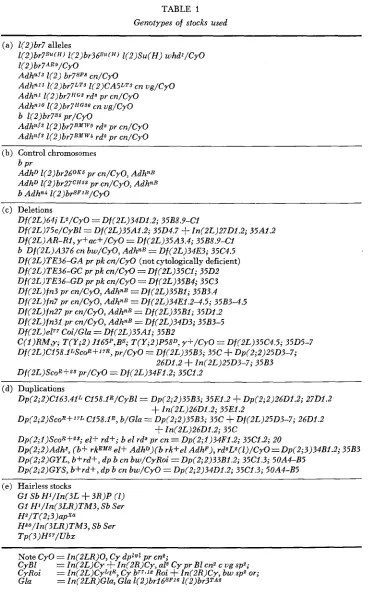
Four alleles of the third chromosome dominant mutation Hairless were used in this study. Both H i and HZ are old alleles and were included by PLUNKETT (1926) in his classic study of Hairless. Both are of spontaneous origin. The H I allele was on a third chromosome marked
448 M. ASHBURNER
in93D2.3 (HENIKOFF 1980), I can only presume that T p ( 3 ) H 5 7 and H57 are independent
mutational events. A deletion of 92CD t o 93F;WA is phenotypically Hairless (LINDSLEY et
al. 1972) while e deletions extending proximal to 93A5-Bl (i.e., Df(3R)e200.25&) are not
said to be H . H is, then, presumably between 92CD and 93B. Ha* was discovered by chance during this study (by G. IIARRINGTON) and was induced by treatment of males with 4500 R
of gamma rays. It is cytologically normal. All H alleles are recessive lethal and lethal inter se. Other stocks are listed in Table 1.
The phenotype of H flies was scored by counting the occupancy of the 411 major dorsal head and dorsal thoracic macrochaetae, i.e., the anterior, middle and posteriosr orbitals (AO, MO, PO), the anterior and posterior ierticals (AV, PV), the acellars (0), the postverticals (PVt), the presuturals (PSt), the upper and lower humerals (UH, LH), the anterior and posterior noto- pleurals (AN, P N ) , the anterior and posterior postalars (AP, PP), the anterior and posterior supraalars (AS, PS), the anterior and posterior dorsocentrals (AD, PD) and the anterior and posterior scutellars (ASc, PSc).
RES U LT S Phenotypes of Hairless
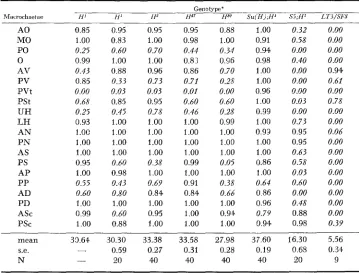
PLUNKETT (1926) described the pattern of bristle loss i n flies heterozygous for either H 1 or H8. Both genotypes are characterized by the absence of specific major bristles, although the bristle sockets usually remain. It is striking that the pattern of bristle loss in H 1 remains very similar to that described by PLUNKETT more than 50 years ago (Table 2 ) . H I / + heterozygotes usually lack 10 to 15
bristles: the PO, PVt, UH, PP and AD are the preferred sites of loss. The phenotypes of the three other H alleles are very similar; all show a loss of 7 to 12 bristles per fly and the pattern of loss in all three alleles resembles that of H'.
Table 2 also shows the pattern of bristle loss in suppressed and enhanced H I .
I n addition to their effects on macrochaetae, all H alleles are recessive lethal, remove microchaetae (for example, the acrostichial rows) and have a n effect on wing veination, most obvious as a shortening of the L5.
Neither S u ( H ) nor any of its lethal alleles show any phenotype other than recessive lethality i n the absence of H (but see below with regard to the LT3 and BMW4 alleles). Besides affecting the expression of H , all alleles of S u ( H )
tend to enhance the wing-vein phenotype of H alleles.
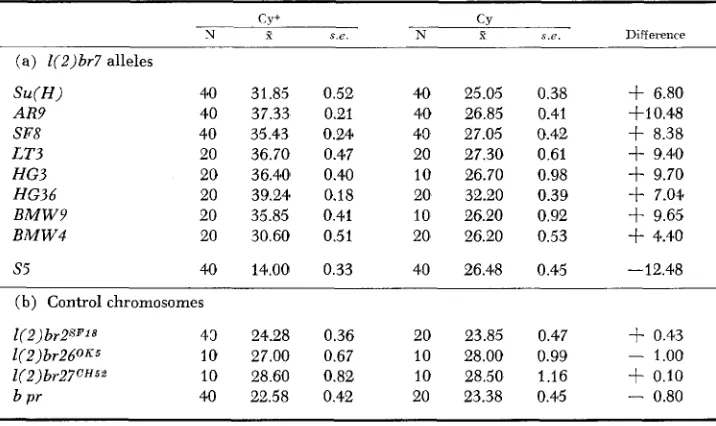
Table 2 shows that Su(H)/+;H/+ heterozygotes have seven to ten more bristles than their Cy/+;H/+ siblings (see also Table 3). On the other hand, enhanced H genotypes have 10 to 15 fewer bristles than their Cy/+;H/+ sib- lings, and a far more extreme loss of microchaetae on the thorax.
TABLE 1 Genotypes of stocks used ( a ) 1(2)br7 alleles
l(2) br7su ( H ) l ( 2 ) br36su ( H ) 1(2)Su(H) whdl / C y 0
l(2) br7ARg/CyO
AdhUf3 l ( 2 ) br7sF8 cn/CyQ
Adhnll 1(2)br7LTS 1(2)CA5LT3 cn ug/CyO Adhnl 1(Z)br7HGs rds pr cn/CyO
AdhnlO 1(2)br7HG96 en ug/CyO b 1(2)br7ss pr/CyO
Adhufs 1(2)br7BhfTV9 rds pr cn/CyO A d h u f s 1(2)br7BMW4 rds pr cn/CyO
(b) Control chromosomes b P r
AdhD l(Z)br260K5 pr cn/CyO, AdhnB AdhD 2(2)br27CH52 pr cn/CyO, AdhnB b Adhn4 1(2)b+IB/CyO
(c) Deletions
Df(ZL)64i Lg/CyO = Df(ZL)3401.2; 35B8.9-Cl
Df(ZL)75c/CyBl = Df(ZL)35A1.2; 3504.7 f In(2L)27Dl.2; 35A1.2 Df(2L)AR-RI, y+uc+/CyO = Df(ZL)35A3.4; 35B8.9-Cl
b Df(2L)A376 c n bw/CyO, AdhnB = Df(2L)34E3; 35C4.5 Df(ZL)TE36-GA pr pk cn/CyO (not cytologically deficient) Df(ZL)TE36-GC pr pk c n / C y 0 = Df(ZL)35Cl; 3 5 0 2 Df(2L)TE36-GD pr pk cn/CyO = Df(2L)35B4; 35C3 Df(2L)fn3 pr cn/CyO, AdhnB = Df(ZL)35B1; 35B3.4 D f ( 2 L ) f n 7 pr cn/CyO, AdhnB = Df(ZL)34E1.2-4.5; 35B3-4.5 Df(2L)fn27 pr cn/CyO, A d h n B = Df(ZL)35BI; 3501.2 D f ( Z L ) f n 3 1 pr cn/CyO, AdhnB = Df(ZL)34D3; 35B3-5 D f ( 2 L ) e P Coi/Glu = D f ( 2 L ) 3 5 A l ; 35B2
C(I)RM,y; T ( Y ; 2 ) J165P,BS; T(Y;2)P58D, y+/CyO
Df(ZL)CI58.1LScoR+17R, pr/CyO = Df(2L)35B3; 35C f Dp(2;2)25D3-7; Df(ZL)ScoR+ss pr/CyO = Df(ZL)34B1.2; 35C1.2
Df(ZL)35C4.5; 3505-7 2601.2 f ln(2L)25D3-7; 35B3
(d) Duplications
Dp(2;2)C163.41L C158.lR/CyB1 = Dp(2;2)35B3; 35E1.2 f Dp(2;2)26D1.2; 2701.2 Dp(2;2)ScoRfI7L C158.IR, b/Glu = Dp(2;2)35B3; 35C f Df(ZL)25D3-7; 2601.2 Dp(2;I)ScoRf"; el+ rd+; b e l rds pr e n = Dp(2;1)34F1.2; 35C1.2; 20
Dp(2;2)Adh3, (b+ rkEMs el+ AdhD)(b &+el AdhF), rd8L*(l)/CyO = Dp(2;3)3481.2; 35B3 Dp(Z;Z)GYL, b+rd+, dp b c n bw/CyRoi = Dp(2;2)33B1.2; 35C1.3; 50A4-B5
Dp(Z;Z)GYS, b+rd+, dp b c n bw/CyO = Dp(2;2)34D1.2; 35C1.3; 50A4-B5
GI Sb H ' / l n ( 3 L f 3R)P (1) G I H l / l n ( 3 L R ) T M 3 , Sb Ser H*/T(2;3)apXa
HaO/In(3LR)TM3, Sb Ser Tp(3)H57/Ubx
+
In(2L)26Dl.Z; 35E1.2+
In(2L)26D1.2; 35C(e) Hairless stocks
Note C y 0 = In(2LR)O, C y dplvl pr cng; CyBl
CyRoi Glu
= I n ( 2 L ) C y
+
In(ZR)Cy, U P C y pr Bl cn2 c ug sps;45 0 M. A S H B U R N E R TABLE 2
Pattern of Loss of macrochaetae from the dorsal head and thorax in Hairless gmotypes Genotype'
hfxrochuetae H I [I' I P IP I P S u ( H j : H ' Si;H' LT3/SFX
A 0 0.85 0.95 0.95 0.95 0.88 1.00 0.32 0.00
MO 1.00 0.83 1.00 0.98 1.00 0.91 0.58 0.00
PO 0.25 0.60 0.70 0.44 0.34 0.94 0.00 0.00
0 0.99 1.00 1.00 0.83 0.96 0.98 0.40 0.00
AV 0.43 0.88 0.96 0.86 0.70 1.00 0.00 0.94
PV 0.85 0.33 0.73 0.71 0.25 1.00 0.00 0.61
PVt 0.00 0.03 0.03 0.01 0.00 0.96 0.00 0.00
PSt 0.68 0.85 0.95 0.60 0.60 1.00 0.03 0.78
UH 0.25 0.45 0.78 0.46 0.28 0.99 0.00 0.00
LH 0.93 1.00 1.00 1.00 0.99 1.00 0.73 0.00
AN 1.OC 1.00 1.00 1.00 1.00 0.93 0.95 0.06
P N 1.00 1.00 1.00 1.00 1.00 1.00 0.95 0.00
AS 1.00 1.00 1.00 1.00 1.00 1.00 0.63 0.00
PS 0.95 0.60 0.38 0.99 0.05 0.86 0.58 0.00
AP 1.00 0.98 1.00 1.00 1.00 1.00 0.03 0.00
PP 0.55 0.43 0.69 0.91 0.38 0.64 0.60 0.00
AD 0.60 0.80 0.84 0.84 0.66 0.86 0.00 0.00
PD 1.00 1.00 1.00 1.00 1.00 0.96 0.48 0.00
ASc 0.99 0.60 0.95 1.00 0.94 0.79 0.88 0.00
PSC 1.00 0.88 1.00 1.00 1.00 0.94 0.98 0.39
mean 33.61. 30.30 33.38 33.58 27.98 37.60 16.30 5.56
s.e. - 0.59 0.27 0.31 0.28 0.19 0.68 0.33
N -
eo
40 40 40 40 20 9The first HI column is data calculated from Plunkett (1926) Table 1 column 9. The second HI column is the present data from a GL Sb HI stock. Bristle sites with less than 80% occupancy are in italics. The fiIzal column illustrates the fact that L(Z)br7L" escapers (in this case L(2)br7LTS/1(2)br7""8) have a different pattern of bristle loss from enhanced H phenotypes (compare, for example the AV, PV and PSt sites, all with a higher occupancy in LT3/SF8 escapers than in S5; HI despite the far lower mean bristle number in the former genotype). on rare occasions, given viable escapers with some other S u ( H ) alleles; and BMW4, a leaky lethal. The LT3 escapers (6/586 with Su(H), 11/614 with SF8, lethal with AR9, BMW9, HG36, HG3 and S5), have an extreme mutant phenotype: their wings and halteres are similar to those of an extreme vestigial allele; their eyes, although large, have a rough glazed appearance and the flies are almost acheatous, having fewer than ten macrochaetae per fly. The acro- stichial hairs, and other microchaetae (e.g., frontals, interocellars)
,
are reduced in number and disturbed in arrangement. The tarsal claws are also much re- duced in LT3 escapers. Similar flies have been seen when LT3 is heterozygous with S u ( H ) - deletions (Table 5 ) . The resemblance between the bristle pheno- type of LT3 escapers and Hairless is superficial; the pattern of bristle loss is quite different in these genotypes (Table 2). The BMW4 allele is clearly leaky. When heterozygous with Su(H) it survives at 20% of its expected frequency (47/653); similarly B M W 4 is semilethal with AR9, SF8, BMW9 and HG36,HAIRLESS E X P R E S S I O N I N DROSOPHILA
TABLE 3
Effects of 1(2)br7 alleles and control chromosomes on the expression of H’+
45 1
c y + CY
N X s.e. N x s . e . Difference
(a) l(2)br7 alleles
Su ( H )
A R9 SF8 L T 3 HG3 HG36 B M W 9 B M W 4
40 31.85 0.52 40 37.33 0.21 40 35.43 0.24 20 36.70 0.47 20 36.40 0.40 20 39.24 0.18 20 35.85 0.41 20 30.60 0.51
s5 40 14.00 0.33
40 25.05 0.38 40 26.85 0.41 40 27.05 0.42 20 27.30 0.61 10 26.70 0.98 20 32.20 0.39 10 26.20 0.92 20 26.20 0.53
40 26.48 0.45
+
6.80+I 0.48 f 8.38 f 9.40 f 9.70 f 7.0) f 9.65 f 4.40
-12.48
(b) Control chromosomes
l ( 2 ) br2SF18 43 24.28 0.36 20 23.85 0.47 $- 0.43
l(2) br260K5 10 27.00 0.67 10 28.00 0.99 - 1.00
1(2)br27cH5* 10 28.60 0.82 10 28.50 1.16
+
0.10b p r 40 22.58 0.42 20 23.38 0.45
-
0.80* Both Cy/+;Gl Sb H / f and Cy+/+;Gl Sb H/+ siblings from a cross of &‘Cy;
+/+
x
f/+; G1 ?b H!ln(3L f 3 R ) P were scored for bristle number.t
The viability of all 1(2)br7/+;Gl Sb H/+ genotypes was normal with the exception ofHG36 whose relative viability with G l S b H was only 4% rather than the expected 25%
(N = 632). However this allele was not semilethal with H*, H57 or H**, and the reason f o r its interaction with respect t o viability with G1 Sb H has not been studied.
between BMW4 and other S u ( H ) alleles have vestigial wings (and halteres), eyes that are somewhat reduced and rough, but normal bristles. Thus the BMW4 escaper phenotype is far less extreme than that of LT3. The wing phenotype of these escapers is not due to a mutant vg locus.
I n a small experiment to recover new lethal alleles of S u ( H ) after EMS treat- ment of b pr males, one lethal chromosome (in 403) was recovered. Unlike all other lethal alleles of S u ( H ) , this chromosome (85) acts as a dominant en- hancer of Hairless.
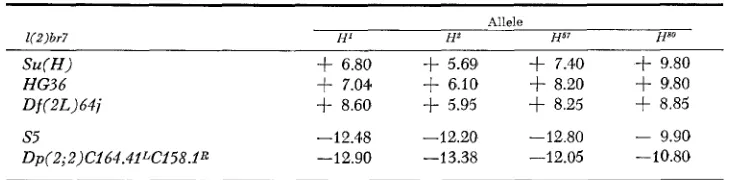
As indicated in Table 3, all lethal alleles of S u ( H ) , with the notable exception of S5, act as dominant suppressors of H and do so to a degree quantitatively similar to that of S u ( H ) itself, adding between seven and ten bristles per fly to the H phenotype. The effects of the new lethal alleles of Su(H)-including S5 -on H 8 ,
H 7
and H S o are similar to their effects onH f
(Table 4). The suppres- sion of H by the leaky allele BMW4 is less than that by the other alleles (Table 4; a repeat cross gave a suppression of H’ by f 4 . 0 bristles.452 M. ASHBURNER
TABLE 4
Effects of 1(2)br7 mutations on the expression of H alleles* Allele
1(2)br7 H' H I H 5 7 Ha"
SUCH)
HG36
D f ( 2 L ) 64j
f 6.80
+
5.698+
7.40 f 9.80+
7.04+
6.10+
8.20+
9.80f 8.60 f 5.95
+
8.25+
8.85s5 -12.48 -12.20 -12.80 - 9.90
Dp (2; 2 ) C l 64.4lLCl58 'i.R -12.90 -13.38 -12.05 -10.80
~ ~ ~ ~~~~~
* Shown as the difference in bristle number between mutation/+;H/f and Cy/+;H/f
siblings
.
At least 20 flies counted per cross.head eversion and the beginning of eye pigmentation. L T 3 and BMW4/Df flies often die as pharate adults or very soon after eclosion.
Since not all lethal alleles of Su(H) are suppressors of
H ,
we refer to this locus as Z(2)br7 (WOODRUFF and ASHBURNER 1979b).Mapping of 1(2)br7: Following GRELL'S discovery (in LINDSLEY and GRELL 1968) that S u ( H) / Df ( 2L) 6 4j heterozygotes are lethal WOODRUFF and ASH- BURNER (1979b) crossed several deficiencies that overlapped Df(2L)64j with
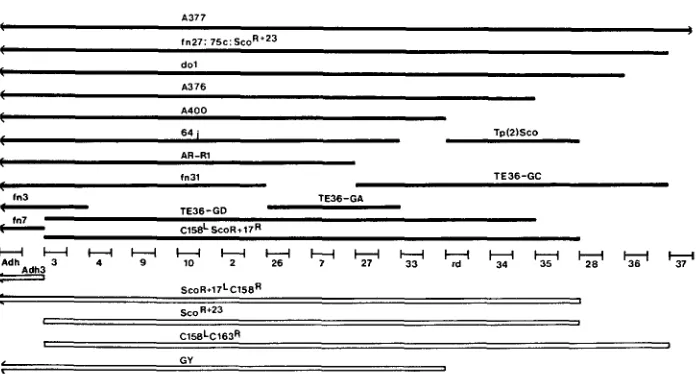
S u ( H ) and its lethal alleles then available and showed that the cytological posi- tion of S u ( H ) was between bands 35B3 and 35B10 (see also NASH 1970). Since then many new deletions in region 35 have become available, in particular, several that overlap the right hand part of Df (2L)64j; these allow better genetic and cytological mapping of 1(2)br7 to 35B6-9. The present map of this small region is shown in Figure 1. No deficiency end points that separate 1(2)br7 from Z(2)br26 have been recovered, but these two loci complement fully for viability and E(Z)br26 alleles have no effect on the expression of
H
(Table 3).I mapped SF8 by recombination with l(2) br4AR1, a lethal complementation group that maps 0.46 map units proximal to Adh (2:50.1). The ARI-SF8 dis- tance was 0.25 map units ( n
=
7189) putting 1(2)br7 at approximately 50.8(using the Adh position as reference).
Heterozygotes between l ( 2 ) br7 alleles and l(2 ) br7- deletions are invariably quite lethal-except for LT3 which rarely escapes, and then only over Df ( 2 L ) TE36-iGA, and B M W 4 which occasionally escapes (28/4355), over various dele- tions. The phenotypes of LT3 JDf and BMW4JDf escapers resembles those, described above, of L T 3 /1(2)br7 and BMW4/1(2)br7 respectively.
Deficiencies and H expression
Nearly 70 different deficiencies for various parts of section 35 of chromosome arm 2 L have been tested for their effects on the expression of H . Without excep- tion, those that include 1(2)br7 act as dominant suppressors of H , and those that are Z(2)br7+ do not. Some representative data is shown in Table 5.
Duplications and H expression
HAIRLESS EXPRESSION IN DROSOPHILA 453
A377
tn27: 7 5 c : S ~ o ~ * ' ~
dol
A376
A 4 0 0
6 4 j Tp(2)Sco
( #
< < < ( <
_._._
C15EL S c 0 R + 1 7 ~FIGURE 1 .-Genetic map of the 1(2)br7 region. With the exception of reduced (rd) and A d h all of the loci are known from recessive lethal alleles. The deletions are described in Table 1 except Df(2)A377 (= Df(2L)34FI.4; 35F1.4), Df(2L)A400 (= Df (2L)35Al.4; 35BI0) and Df(2L)Sco,
a deletion synthesized as a crossover between Tp(2)Sco (= Sco) and a wild-type homolog by
G. MARONI (unpublished). The proximal limits of Dp(2;1)ScoR+IS and its corresponding de- ficiency (Df(ZL)ScoR+2s) differ. The TE36-G deletions were induced (with gamma rays) by selecting the loss of a w + rst+ transposing element inserted in 1(2)br27. Df(2L)AR-RI was synthesized from the deletion T ( Y ; Z ) A80D; T(Y;2)R15P (WOODRUFF and ASHBURNER 1979a). The Df(2L)fn's were formaldehyde-induced ( O'DONNELL et al. 1977) and the D f ( 2 L ) A ' s X-ray-induced (AARON 1979), both series selected as ADH negatives. The region between Adh and 1(2)br37 is approximately 35B2.3 to E1.2. The l(2)br's are indicated only by their num- bers. Solid bars are deletions, open bars duplications. D f ( 2 L ) e W shares its proximal break- point with Df(2L)fn7.
duplications acted as dominant enhancers of Hairless; they were Dp(2;Z) A d h 2 and T(2;3)DpAdhZ described as Dp(2;2)32D3;35CI and Dp(2;2)35A;35D re- spectively. Unfortunately, E ( H ) and Dp(2;2)Adh2 are lost, and our stock of T(2;3)DpAdhl, although T(2;3)33E9;89A3.7 is not duplicated on 2 L , nor is it an enhancer of H .
However, four new duplications for region 35 have been made or identified.
D p
(2;2) C163.41 LC158 .I R and Dp(2;2)ScoR +i17LC158 .I are exchange products between In(2L)C158.1 (= In(2L)26D1.2;35B3) and In(ZL)CI63.41 (=In(2L) 27D2.2;34E1.2) or I ~ { Z L ) S C O ~ + ~ ~ (= In(2L)25D3.7;35C) respectively. Dp(2;I) ScoR +. 23 is a segregant from T(2;I)ScoR + z3, an X-ray-induced revertant ofScutoid that is, cytologically, Df
(2L)34FI.2;35CI.2;T(2;1)
34FI.2;35C1.2;20. The X-linked duplication appears, in polytene nuclei, as a small banded chromo- some fragment usually associated with the nucleolus. The duplicated segregant is both male and homozygous-female viable and fertile. Dp(2;2)GY was foundby YANNOPOULOS et al. (1981) as an apparent male double crossover between
a d p b c n bw chromosome and the M r element Mr.23.5. In fact it was not a regular crossover, but it did contain a duplication of b+ (from the Mr.23.5 chromosome) inserted into the marker chromosome at
50A4-B5
( YANNOPOULOS454 M. ASHBURNER TABLE 5
Effect of deficiencies for region35 on the expression of H and viability of 1(2)br7 heterozygotes’
D f / $ H I + C y / ? ; I I / + Difference DJ/I(2)br7
Heterozygote hT s.e. N s s.e.
D f (2L)64i 20
Df(ZLj75c 40
Df (2L) AR-RI 25
Df (2L)A376 20
D f ( 2 L ) fn27 20 Df(ZL)Cl58.i~ScoRf17K 33 Df ( 2 L ) TE36-GA 20 Df ( 2 L ) TE36-GD 20
37.80 iz 0.50 36.25 i 0.33 37.3220.35 35.85 t 0.64 34.95 f 0.28 35.88 i 0.30 34.70 k 0.44 34.05 ‘0.54 D f (ZLIfn3 25 28.04f 0.45 D f ( 2 L ) f n 7 25 27.04 f 0.35
Df(2L)e177 40 29.98 i 0.31
Df(2L)fn31 40 25.73iz0.35
Df ( 2 L ) Jl65DPI581’ 20 25.55 f 0.53 D i ( 2 L ) TE36-GC 20 24.29 t 0.61
20 29.20 i 0.90 20 23.55 i0.44 25 25.88k0.38 20 29.90 f 0.53 20 29.90t0.51 40 31.71 iz0.43 10 28.20 t 0.93 20 24.45 i 0.61. 25 28.3220.49 25 28.84k0.43 40 29.38 f 0.29 40 27.30 f 0.37 10 24.90i0.52
20 24.58 & 0.52
+
8.60 f12.70 +11.44+
5.95+
5.05 f 4.17+
6.50 -5 9.60- 0.28 - 180
+
0.60 - 1.57+
0.65 - 0.290/3620 0/2619 0/2452 0/334 0/414 0/211 53/3050+ 0/585 893/2831 317/1142 333/1210 860/3130 291/921$ -
* See Table 1 for deficiency break points. Bristle data is a comparison of the Cy/+; G1 Sb H / f and Of/+; G1 Sb H / + siblings from crosses of Cy/Df x G1 Sb H / I n ( 3 L + 3 R ) P . Viability data is summed over several 1(2)br7 alleles and i s from crosses of D f / C y x 1(2)br7/Cy. It is expressed as the number of Df/Z(Z)br7 flies over total progeny number. Data from B M W 4 crosses not included.
+
All escapers from crosses with LT3, see text.$ S u ( H ) / D f ( Z L ) TE36-GC are lethal due to 1(2)br36S11(1g), a second lethal on the S u ( H ) chromosome included in Df(ZL)TE36-GC; data from this cross are not included.
and is now in two forms, one ( D p ( 2 ; 2 ) G Y L ) is 21-50A4/35C1.3-33B1.2/ 50B1.5-60 and the other ( D p ( 2 ; Z ) G Y S ) is 21-50A4/35C1.3-34D1.2/50B1.5-60. With respect to their interaction with H , the long and short forms of Dp(2;Z)GY behave similarly.
Since the region 35 breakpoints of component inversions of the two In(2L)- C158.1 crossovers (i.e., In(2L)CZ58.1 itself, In(2L)C163.42 and I n ( 2 L ) S c o R f l 7 ) have also been used to construct synthetic deficiencies the precise genetic limits of these two duplications are known (Figure 1 )
.
Similarly, the genetic limits of D ~ ( ~ ; Z ) S C O ~ + ~ ~ were determined by finding which lethals and deficiencies this X-linked duplication can cover (Figure 1 ).
The proximal limit of the Dp(2;2)-GY’s lie between 1(2)br33 and 1(2)br34 determined by crossing Df(2L)75c Dp(2;2)GY / C y 0 to representative lethal alleles of loci included within Df(2L)- 75c.
All four duplications act as strong enhancers of HI and, with respect to Dp(2;2)C163.41LC158.ZR (at least), of the other three H alleles (Table 6 ) . For D p ( 2 : 2 ) S ~ o ~ + ~ ~ ~ C 1 5 8 . 2 ~ its reciprocal exchange product, i.e., Df(2L)C158.IL- S C O ~ + ‘ ~ ~ , is a suppressor of H . Df(2L)ScoR+”.’ is also a dominant suppressor of
H . Flies that carry both the ScoR + 2 3 duplication and the corresponding deletion
have a normal H phenotype.
HAIRLESS EXPRESSION I N DROSOPHILA 455
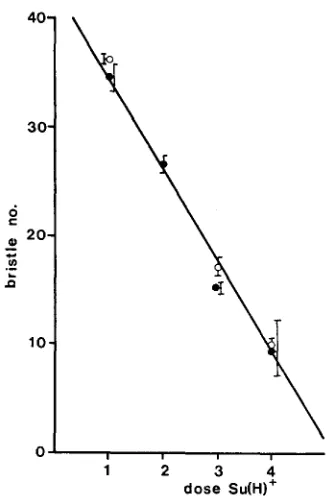
Table 6 Dp/Dp;+/+;H/+ flies have a very extreme H phenotype, with only 9 to 10 bristles per fly, A similar phenotype is seen i n flies carrying one dose of the duplication on their X chromosome and the enhancer of H allele 2(2)br7S5 on chromosome 2 (Table 6 ) . A graph of the number of doses of Su(H)+ and their effect on H expression is linear (Figure 2). The enhancing allele of Z(2)br7 (S5) acts quantitatively, as if it were a duplication for Su(H)+ and the suppressing alleles (except B M W 4 ) as if they were Su(H) deletions (see below).
All of the four duplications have a very slight effect on bristle number in the absence of a n H allele; for example, Dp(2;2)GYL/Dp(2;2)GYS flies have a mean of 39.96 2 0.02 ( n
=
80) bristles per fly. It is difficult to know whether or not this very slight reduction in bristle number is biologically “significant.” Two facts suggest that it may be: in wild-type flies the number of dorsal head and thoracic macrochaetae is remarkably constant, and in all the duplications studied here it is the PVt bristle that is lost, one of the most “sensitive” sites for loss in H genotypes.As a control I used (Table 6) GRELL’S (NASH, 1970) Dp(2;2)Adh3, a dupli- cation whoce genetic limits have not been determined but which, cytologically, does not extend proximal to 35B3. It is not a n enhancer of H ; in fact, as NASH (1970) also found, it acts as a slightly dominant suppressor of H .
A final comment is needed regarding the enhancer of H allele, Z(2)br7s5. Since S5 has an effect on H similar to duplications for Su(H)+, it might be argued that it is itself an EMS-induced duplication. The polytene chromosomes of S5 appear to be quite normal and S5 does not affect exchange in the b-pr region but these data are not, of course, conclusive. However, were S5 to be a duplication for Su(H)+, its lethality with Su(H)- deletions and other Z(2)br7 alleles would not be expected: Table 7 shows that these are not properties of other duplications that include this locus, although the lethality of S u ( H ) with D p ( 2 ; 2 ) S ~ o ~ + l ~ ~ C 1 5 8 . 1 ~ is unexpected. Neither parental inversion is lethal with Su(H).
DISCUSSION
Lethal alleles of E(2)br7 act as dominant suppressors of Hairless; all except
B M W 4 do so to approximately the same extent, adding between seven and ten bristles per fly. Deficiencies that include 1(2)br7 have a similar phenotypic ef-
fect. These data suggest that Su(H) and its suppressor alleles are amorphic al- leles. This conclusion is strengthened by the properties of BMW4-an allele of
S u ( H ) that is clearly leaky with respect to its lethal phenotype. It is also a weaker suppressor of H than any of the strong lethal alleles.
45
6 M. ASHBURNER2
\ rt .s v,B
k?
';s5
" 2
w r :
4
.s
m b n
4 2
H b . @2 \ .-
:
Us
. . a-1 Q 'tc \ v, U&
irl4
F, ' ^- a t
5 2 2
2 2 3
3 % 3
? a
; 2 t
=
8 .-z +
0,
2
' ^il h o t - $ + m
- 2 s
x
"" %2
? " +3 ; g
Lu
O z *:
z
$ 3
4
2 %
G b
g +
Ua ;
$
z +
E
$
cc
$
s y z
g ? s
+ 2 $
2 x 3
3 s :
C S t
< ; z
& 2 2
!i
E t
$ ; +
.*d
$i,r
5
'G+.+,.2
0 a 3+" - m k m
.-.
.::a$q
6
aks"
g
,.&
a . z S O msG-*
z>+
2%
m82
0 % .;.r-
4
$3
2 -2?--. L k . -Ez
3 r: ( 4 m + qmr am s
2
-
26S2
X ; C l G w c 3
.-
& &s: .Ae - . z
+
a
- +
m c
g .-
L
.-
k 2- 2 s
w d
a .z c3
...
@ w
O W + Q
HAIRLESS EXPRESSION I N DROSOPHILA
40-
30-
0 0 20-
-
).v)
.-
Ln
10-
45
7O J I I
1 2 3 4
dose SdH)+
FIGURE %T--he relationship between bristle number of H I / + flies and the number of doses of the 1(2)br7+ allele. 1(2)br7+/- data: open circle, mean (+ s.e.) of 12 counts of various 1(2)br7/+ genotypes. 1(2)br7+/1(2)br7 + data, mean (+ s.e.) of 52 control genotypes. 1(2)br7+/1(2)br7 +/1(2)br7+ data, open circle, mean (+- s e . ) of 11 different counts of
Dp(2)br7+/+, closed circle, mean (+ s.e.) of 13 different counts of 1(2)br7ss/+. 1(2)br7+/ 1(2)br7+/1(2)br7+/1(2)br7+, open circle, mean (and range) of two different counts of Dp(2;Z)ScoR +"/Dp(2;1)ScoR +es;+/+, closed circle, mean (and range) o f two different counts of Dp(2;I)Sc&+Zs/+; l(2)br7s5/+. Line fitted by eye.
understandable, since the commonest consequence of mutation would be ex- pected to be a loss of function. The fact that S5 is lethal with the suppressor alleles makes it unlikely that this is simply a small 1(2)br7+ duplication.
A consequence of the discovery of dominant enhancers of Hairless that are not overt duplications is that this phenotype cannot, by itself, be used as a cri- terion for duplications in region 35.
TABLE 7
The viability of 1(2)br7s"(H) and 1(2)br7s5 with 1(2)br7f duplications
S U j H ) s5
Ci63.41LC15 8 .IR/CyO 297/747 158/425
ScoR+~7LC158.1R/Gla 0/131 78/295
Dp(Z;Z)GYL/CyRoi 194/574 15 1 /373
Dp (2;I)ScoR +2~/Dp(Z;I)ScoR +- 2s; f / f 60/307 136/320
458 M. ASHBURNER
The nature of the interaction between 1(2)br7 and H remains, in molecular terms, as enigmatic as ever. Formally the H f and 1(2)br7+ products could act antagonistically on a process involved in bristle development. Hairless is haplo- insufficient (LINDSLEY et al. 1972) and almost recessive in H/ H + / H + triploids (GOWEN 1933). If, as these data suggest, Hairless is an amorph, then the wild type “balance” between the H + a n d 1(2)br7+ products could be restored in
H
flies by mutation of 1(2)br7+ to an amorphic or hypomorphic allele or by dele- tion of one wild-type 1(2)br7 locus. Conversely, mutation of 1(2)br7 + to an allele that produces a greater amount of its product, or its duplication, would result in a n enhanced antagonism and a more severe Hairless phenotype. A simple version of this hypothesis (Figure 3 ) is that 1(2)br7+ and H f act sequentially during development, the product of 1(2)br7+ being the substrate f o r the H t
reaction. The accumulation of the intermediate (i.e., the 1(2)br7+ product) that would result from mutation of H+ to H would, in that case, be responsible for the H phenotype. This accumulation would be relieved by mutation of 1(2)br7 to a less active allele but aggravated by its mutation to a more active allele or its duplication.
This scheme is not entirely satisfactory because it disregards the fact that 1(2)br7 alleles do not affect the recessive lethality of H alleles; nor does it ac- count for the lethality of heterozygotes between suppressor and enhancer alleles of 1(2)br7.
Another example of allelic enhancers and suppressors may be Su(S) and E(S).
Deficiencies for the region between the distal breakpoints of Zn(2L)Cy and Zn(2L)t (i.e., Df(2L)22D1.2;22D3-E1) act as dominant suppressors of Star. LEWIS (1945) indicated that the reciprocal exchange product, that is, the du- plication for the same region, enhanced the expressio;i of Star. A dominant en- hancer of Star ( E ( S ) ) is known, but since it occurred on Zn(2L)Cy its precise genetic relationship to the region between the In(2L)Cy and In(2L)t break- points is unclear.
The Medical Research Council of London is thanked for financial support for this work, which forms part of the genetic analysis of the Adh region of the Drosophila genome. I thank
E. H. GRELL, HANS GLOOR, SYDNEY AARON, W. SOFER and GEORGE YANNOPOULOS for stocks;
B
-
C
-
A
br7+ H +
FIGURE 3.-A simple model for Hairless: A is the substrate for the S u ( H ) + reaction; B is its product, which serves as the substrate for the H + reaction. The accumulation of B results in the H phenotype ( H ) , which will be relieved by mutation of S u ( H ) + to an amorphic allele
H A I R L E S S EXPRESSION I N D RO S O P H I LA 459
and m y colleague D. GUBB for the Df{ZL)TE36 deficiencies. I also thank R. C. WOODRUFF for
help in the early stages of this work and TREVOR LITTLEWOOD, PAM ANGEL and GLYNNIS
HARRINGTON for excellent technical help.
L I T E R A T U R E C I T E D
AARON, C. S., 1979 X-ray induced mutations affecting the level of the enzyme alcohol dehy-
drogenase in Drosophila melanogaster: Frequency and genetic analysis of null-enzyme
mutants. Mutation Research 63: 127-137.
BRIDGES, C. B. and T. H. MORGAN, 1923 The third-chromosome group of mutant characters
of Drosophila melanogaster. Carnegie Institute of Washington. Pub. 327. 251 pp.
GOWEN, J. W., 1933 Constitutional effects on the Hairless gene in diploid and triploid Dro-
sophila. Amer. Nat. 67: 178-180.
HENIKOFF, S., 1980 A more conventional view of the “ebony” gene. Dros. Inf. Service 5 5 :
61-62.
KAUFMAN, T. C., S. E. TASAKA and D. J. SUZUKI, 1973 The interaction of two complex loci,
LEWIS, E. B., 1945 The relation of repeats to position effect in Drosophila melanogaster.
LINDSLEY, D. L. and E. H. GRELL, 1968 Genetic variations of Drosophila melanogaster. Car-
negie Inst. Washington Pub. 627. 427 pp.
LINDSLEY, D. L., L. SANDLER, B. S. BAKER, A. T. CARPENTER, R. E. DENELL, J. C. HALL, P. A.
JACOBS, G. L. C. MIKLOS, P. A. DAVIS, R. C. GETHMANN, R. W. HARDY, A. HESSLER, S. M.
MILLER, H. NOZAWA, D. M. PARRY and M. GOULD-SOMERO, 1972 Segmental aneuploidy
and the genetic gross structure of the Drosophila genome. Genetics 71: 157-184.
The mutational basis for the “allelic” modifier mutants, Enhancer and Sup-
pressor of Hairless, of Drosophila melanogaster. Genetics 64: 471-499.
Genetic and cytogenetic anal-
ysis of the Adh region in Drosophila melanogaster. Genetics 86: 553-566.
The interaction of genetic and environmental factors in development.
A comparison of banding patterns in
salivary gland chromosomes of two species of Drosophila. Genetica 39: 165-192.
The genetics of a small autosomal region of
Drosophila melanogaster containing the structural gene for alcohol dehydrogenase. I.
Characterization of deficiencies and mapping of Adh and visible mutations. Genetics 92 :
117-132. -, 1979b 11. Lethal mutations in the region. Genetics 92: 133-149.
Differences in
the induction of specific deletions and duplications by two male recombination factors iso-
lated from the same Drosophila natural population. Mutation Research 83 : 383-393.
Corresponding editor: T. C. KAUFMAN
zeste and bithorax in Drosophila melanogaster. Genetics 75: 299-321.
Genetics 30: 137-166.
NASH, D., 1970
O’DONNELL, J., H. C. MANDEL, M. KRAUSS and W. SOFER, 1977
PLUNKETT, C. R., 1926
VAN BREUGEL, F. M. A., A. RAY and H. GLOOR, 1968
WOODRUFF, R. C. and M. ASHBURNER, 1979a
J. EXP. ZOO^. 46: 181-2M.