Spectral methods to approximate the likelihood for irregularly spaced spatial data
1Montserrat Fuentes
Mimeo Series 2568 -
SUMMARYLikelihood approaches for large irregularly spaced spatial datasets are often very difficult, if not infeasible,
to use due to computational limitations. Even when we can assume normality, exact calculations of the
likelihood for a Gaussian spatial process observed at n locations requiresO(n3) operations. We present a
version of Whittle’s approximation to the Gaussian log likelihood for spatial regular lattices with missing
values and for irregularly spaced datasets. This method requiresO(nlog2n) operations and does not involve
calculating determinants. Due to the edge effect the estimated covariance parameters using this approximated
likelihood method are efficient only in one dimension. To remove this edge effect, we introduce data tapers.
In spatial statistics, data tapers are often the tensor product of two one-dimensional tapers. However, we
generally need more tapering for the corner observations. Thus, we introduce here a new spatial data taper,
a circular taper, that gives more tapering to the corner observations. Therefore, with less overall tapering,
we get the amount of smoothing that we need without losing so much information. We present simulations
and theoretical results to show the benefits and the performance of the data taper and the spatial likelihood
approximation method presented here for spatial irregularly spaced datasets and lattices with missing values.
1M. Fuentes is an Associate Professor at the Statistics Department, North Carolina State University (NCSU), Raleigh, NC 27695-8203, and a visiting scientist at the US Environmental Protection Agency (EPA). Tel.:(919) 515-1921, Fax: (919) 515-1169, E-mail: [email protected].
1
Introduction
Statisticians are frequently involved in the spatial analysis of huge datasets. In this situations, calculating
the likelihood function, to estimate the covariance parameters or to obtain the predictive posterior density, is
very difficult due to computational limitations. Even if we can assume normality, calculating the likelihood
function involvesO(N3) operations, whereN is the number of observations.
However, if the observations are on a regular complete lattice, then it is possible to compute the likelihood
function with fewer calculations using spectral methods (Whittle 1954, Guyon 1982, Dahlhaus and K¨usch,
1987, Stein 1995, 1999). These spectral methods are based on the likelihood approximation proposed by
Whittle (1954). Whittle’s approximation is for Gaussian random fields observed on a regular lattice without
missing observations. In practice, very often the data will be irregularly spaced or will not be on a complete
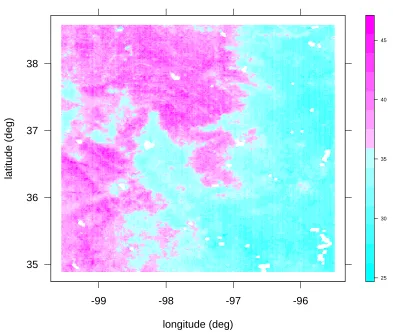
regular lattice. Even for satellite data (Figure 1), the observations might actually be on a lattice but due to
clouds or other phenomenon, there are generally missing values, so we could not use Whittle’s approximation
to the likelihood.
Spectral methods for irregular time series have been studied, e.g. by Parzen (1963), Bloomfield (2000),
Neave (1970), Clinger and Van Ness (1976), and Priestly (1981, p. 585), in the context of estimating the
periodogram of a time series. But, nothing has been done yet in terms of introducing spatial likelihood
approximation methods using spectral tools for irregularly spaced spatial datasets. In a spatial setting is
worth to mention the simple likelihood approximation introduced by Vecchia (1988), by partition the data
into clusters, and assuming that the clusters are conditionally independent. Pardo-Ig´uzquiza et al. (1997)
wrote a computer program for Vecchia’s approximation method. However, there have not been efforts to
evaluate the effect of Vecchia’s approximation to the spatial Gaussian likelihood on the estimated parameters
(Lark, 2002, Stein et al., 2004). Stein et al. (2004) adapted Vecchia’s approach to approximate the restricted
likelihood of a Gaussian process, and discussed the computational challenges to obtain the derivatives of the
approximated likelihood and restricted likelihood functions. A similar clustering framework for likelihood
ap-proximation was presented by Caragea (2003), in which the clusters were assumed conditionally independent
after conditioning on the cluster mean. For Markov fields, a coding method for parameter estimation was
autonormal processes.
We present here powerful spectral methods to handle lattice data with missing values and irregularly
spaced datasets. We obtain a representation of the approximated likelihood function in the spectral domain
to estimate covariance parameters. This approach can be used for estimation and also for Bayesian spatial
prediction. We use our method to approximate the likelihood function in the predictive posterior density,
and we study the impact of the likelihood approximation on the Bayesian inference made.
Spatial tapering is crucial in two and higher dimensional problems where there are a large number of
edge observations. The relative edge effect in two dimensions is the reason why the Whittle approximation
is not efficient (Guyon, 1982). We propose here a new data taper, a circular taper, that gives more tapering
to the corner observations. Thus, with less overall tapering, we get the amount of smoothing that we need
without losing so much information.
This paper is organized as follows. In Section 2 we introduce the notion of periodogram, spectral density
and the Whittle’s approximation to the Gaussian likelihood. In Section 3, we present an approach to
approximate the likelihood for Gaussian lattice processes with missing values. In Section 4, we propose a
method to approximate the Gaussian likelihood for irregularly spaced datasets. Section 5 describes a new
data taper function for spatial data, that we called ”rounded tapering”. We finish with a discussion.
2
Spectral Domain
2.1
Spectral Representation of a Stationary Spatial Process
A random field Z in R2 is called weakly stationary, if it has finite second moments, its mean function is
constant and it possesses an autocovariance function C, such that C(x−y) = cov{Z(x), Z(y)}. If Z is weakly stationary random field with autocovarianceC, then we can represent the process in the form of the
following Fourier-Stieltjes integral:
Z(x) =
R2exp(ix
Tω)dY(ω) (1)
where Y are random functions with uncorrelated increments, (see Yaglom (1987), Cram´er and Leadbetter
35 36 37 38
-99 -98 -97 -96
longitude (deg)
latitude (deg)
Brightness Temperature
25 30 35 40 45
Figure 1: AVHRR data (1km×1km resolution), 140,000 pixels. The data represent satellite brightness temperature
(◦C) on June 19, 1996 in the Sourthern Great Plains. In white we have the missing values (due to clouds and lakes).
the integral (1), is called the spectral representation ofZ(x), andY(ω),withω∈R2, is called the spectral process associated toZ. The spectral representation describes the harmonic analysis of a general stationary
processZ(x), i.e. its representation in a form of a superposition of harmonic oscillations. Using the spectral representation ofZ and proceeding formally,
C(x) =
R2exp(ix
Tω)F(
dω) (2)
where the functionF is a nonnegative finite measure and it is called the spectral measure or spectrum for
Z. The spectral measureF is the mean square value of the processY,
E{|dY(ω)|2}=dF(ω).
If F has a density with respect to Lebesgue measure, this density is the spectral density, f, which is the
Fourier transform of the autocovariance function:
f(ω) = 1 (2π)2
R2exp(−ix
Tω)C( x)dx.
Subject to the condition
R2|C(x)|dx<∞ thenF has a density,f.
By Bochner’s Theorem, the function C is an autocovariance if and only if it can be represented as in
(2), whereF is a positive finite measure. Thus, the spatial structure ofZ could be analyzed with a spectral
approach or equivalently by estimating the autocovariance function.
We study now parametric models for the spectral density f. A class of practical variograms and
auto-covariance functions for continuous stationary processesZ can be obtained from the Mat´ern class (Mat´ern,
1960) of spectral densities
f(ω) =φ(α2+ω2)(−ν−d2) (3)
with parametersν >0,α >0 andφ >0, wheredis the dimensionality of Z. Here, the vector of covariance
parameters is θ = (φ, ν, α). The parameter α−1 can be interpreted as the autocorrelation range. The
smootherZ would be, andφis proportional to the the varianceσ2timesα2ν.The corresponding covariance
function for the Mat´ern class is given in (22) with a different parameterization. For further discussion about
the Mat´ern class see Stein (1999, pp. 48-51).
IfZis observed only at uniformly spaced spatial locations ∆ units apart, the spectrum of observations of
the sample sequenceZ(∆x),forx∈Z2,is concentrated within the finite frequency band−π/∆≤ω< π/∆ (aliasing phenomenon).
The spectral densityf∆of the process on the lattice can be written in terms of the spectral densityf of
the continuous processZ as
f∆(ω) =
Q∈Z2 f
ω+2πQ
∆
. (4)
forω∈Π2∆= [−π/∆, π/∆]2.
2.2
Periodogram
We estimate the spectral density of a lattice process, observed in a grid (n1×n2),with the the periodogram,
IN(ω) = (2π)−2(n1n2)−1
n1
s1=1 n2
s2=1
Z(s) exp{−isTω}
2
. (5)
We compute (5) for ωin the set of Fourier frequencies 2πf/nwheref/n=
f1
n1,
f2
n2
, andf ∈JN, for
JN ={−(n1−1)/2, . . . , n1− n1/2} × {−(n2−1)/2, . . . , n2− n2/2}. (6)
We define a spectral window,
W(ω) = 2
j=1
sin2 njωj
2
sin2 ωj
2
forω= (ω1, ω2) = 2πf/nandf ∈JN\{0}, we have
E(IN(ω)) = (2πN)−2
(−π,π]2f∆(θ)W(θ−ω)dθ,
where f∆(ω) is the spectral density of the process on the integer lattice. Asn1 andn2 increase,W places
more mass near the origin, (0,0), so that if the spectral densityf∆() is smooth in a neighborhood ofω, then
IN(ω) will be approximately an unbiased estimate forf∆(ω). Figure 2 shows the spectral window,W,in the
at other frequencies. These side lobes can lead to substantial bias inIN(ω) as an estimator off∆(ω) since
they allow the value off∆() at frequencies far fromωto contribute to the expected value. This phenomenon
is calledleakage.
The leakage can also extend to distant frequencies. For example, far away frequencies with relatively high
power compared to neighboring frequencies can be completely submerged by leakage from distant frequencies
with much higher power. If the side lobes ofW were substantially smaller, we could reduce this source of bias
for the periodogram considerably. Tapering is a technique that effectively reduces the side lobes associated
with the spectral window.
Thus, we use a data taper to prevent the leakage from far away frequencies that could have quite a lot
of power. We form the producth(s)Z(s, t) for each value ofs= (s1, s2), where{h(s)}is a suitable sequence of real-valued constants called a data taper. The traditional tapers used for two dimensional data are the
tensor product of two one-dimensional data tapers:
hM(j) =h1(j1)h2(j2),
where j= (j1, j2), 1≤j1≤n1 and 1≤j2≤n2.
For instance, h1() could be am-cosine taper (Dahlhaus and K¨unsch, 1987), where 1≤m < n1 2,
h1(j1) =
⎧ ⎪ ⎪ ⎪ ⎪ ⎪ ⎪ ⎨ ⎪ ⎪ ⎪ ⎪ ⎪ ⎪ ⎩
1
2{1−cos(π(j1m−1/2))} 1≤j1≤m
1 m+ 1≤j1≤n1−m
h1(n1−j1+ 1) n1−m+ 1≤j1≤n1.
(7)
We define h2() in a similar way, and we form the product of the two data tapers to obtain, hM(), the
multiplicative data taper for two dimensional data.
Every time we do tapering we lose information. A multiplicative data taper defines a rectangle inside
the grid (in Figure 3 the black rectangle represents the border of the grid and we define a blue rectangle
inside), and gives small weight (close to 0) to the observations in the border of the grid (the black rectangle),
weight 1 to the observations inside the (blue) rectangle, and a weight,hM(),that goes smoothly from 1 to
0 to the observations in between the rectangle and the border of the grid (i.e in between the blue and the
Frequencies
Spectral Window
0.0 0.5 1.0 1.5 2.0 2.5 3.0 3.5
0.0
0.2
0.4
0.6
0.8
1.0
Figure 2: Spectral window along the vertical axis. The horizontal axis shows the frequencies, while the
vertical axis shows the spectral window along the vertical axis for the periodogram (without tapering), for
unnecessarily. We will present in this paper (Section 5) a new class of data tapers that will overperformed
the classic multiplicative taper, by not losing so much information and efficiently reducing the bias.
2.3
Likelihood function
For large datasets calculating the determinants that we have in the likelihood function can be often infeasible.
Spectral methods could be used to approximate the likelihood and obtain the maximum likelihood estimates
(MLE) of the covariance parameters: θ= (θ1, . . . , θr).
Spectral methods to approximate the spatial likelihood have been used by Whittle 1954, Guyon 1982,
Dahlhaus and K¨usch, 1987, and Stein 1995, 1999, among others. These spectral methods are based on
Whittle’s (1954) approximation to the Gaussian negative log likelihood:
N (2π)2
logf(ω) +IN(ω)f(ω)−1 (8)
where the sum is evaluated at the Fourier frequencies,IN is the periodogram andf is the spectral density of
the lattice process. The approximated likelihood can be calculated very efficiently by using the fast Fourier
transform. This approximation requires onlyO(N log2N) operations. Simulation studies conducted by the
author seem to indicate that N needs to be at least 100 to get good estimated MLE parameters using
Whittle’s approximation.
The asymptotic covariance matrix of the MLE estimates of θ1, . . . , θris
⎧ ⎨ ⎩
2 N
1 4π2
[−π,π]
[−π,π]
δlogf(ω1) δθj
δlogf(ω2) δθk
dω1dω2
−1⎫⎬
⎭
jk
(9)
this is much easier to compute that the inverse of the Fisher information matrix.
Guyon (1982) proved that when the periodogram is used to approximate the spectral density in the
Whit-tle likelihood function, the periodogram bias contributes a non-negligible component of the mean squared
error (mse) of the parameter estimates for 2-dimensional processes, and for 3-dimensions this bias dominates
the mse. Thus, the MLE parameters of the covariance function based on the Whittle likelihood are only
efficient in one dimension, but not in two and higher dimensional problems. Though, they are consistent.
Guyon demonstrated that this problem can be solved by using a different version of the periodogram, an
Rounded Taper vs. Multiplicative Taper
1.- Mult. Taper
2.- Rounded Taper
Figure 3: Multiplicative taper and rounded taper. The area of the rectangle is the same as the area of the
rounded region. Line 1: Multiplicative Data Taper, gives weight 1 to the observations inside the rectangular
region, and a weight hM() that goes smoothly from 1 to zero to the observations outside the rectangular
region. Line 2: Rounded Data Taper, gives weight 1 to the observations inside the rounded region, and a
Dahlhaus and K¨unsch (1987) demonstrated that tapering also solves this problem.
3
Incomplete lattices
In this Section we introduce spectral methods to approximate the likelihood for spatial processes observed
on incomplete lattices. In our approach, as a first step we fill-in with zeros the values of the process
at the locations in this grid where we have no data (e.g. Marcotte, 1996), to then efficiently calculate
the periodogram using FFT. We study the asymptotic properties of the estimated periodogram and the
potential impact of this approximation on the likelihood approximation, prediction and inference made for
spatial data.
Consider a random field Y observed on a rectangle PN ={1, . . . , n1} × {1, . . . , n2} of sample size N =
n1n2. We write Y(x) =g(x)Z(x), whereZ is the spatial lattice process under study with spectral density fZ. We assumeZis a weakly stationary real-valued Gaussian process having mean zero, sumable covariance,
and finite moments, butZ is not directly observed. Rather we observe,Y, an amplitude modulated version
ofZ for the observations on the grid, wheregis defined as:
g(xj) =
⎧ ⎪ ⎪ ⎨ ⎪ ⎪ ⎩
0 ifZ(xj) is missing at locationxj
1 ifZ(xj) is observed at locationxj.
(10)
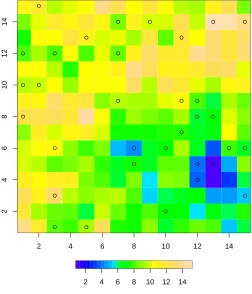
As an example, consider the simulated image in Figure 4, the circles represent the locations where we have
missing values. The processZ of interest is not observed at those locations. Our filter functiong would be
zero at those locations and 1 everywhere else.
We propose the following estimate of the spectral density of Z,
˜ IZ(ω) =
1 H2(0)|
N
i=1
(Y(xi)−g(xi) ˜Z) exp{−iωxi}|2
whereHj(λ) = 2π
N
i=1gj(xi)eiλ Tx
i, thenH2(0) = 2πN
i=1g(xi)2, and
˜ Z=
N
i=1
Y(xi)
/
N
i=1
g(xi)
.
Ifg(xi) = 1 for allxiinPN, thenY ≡Z on the lattice, and ˜IN reduces to the standard definition of the
2 4 6 8 10 12 14
2
4
6
8
10
12
14
2 4 6 8 10 12 14
Let us study the asymptotic properties of this estimate offZ, asN → ∞(increasing domain asymptotics).
The expected value of ˜IZ is:
E[ ˜IZ(ω)] =
π
−π
π
−πfZ(ω−φ)|H1(φ)|
2dφ. (11)
Thus,E[ ˜IZ(ω)] is a weighted integral offZ(ω). Asymptotically,
E[ ˜IZ(ω)] =fZ(ω) +O(N−1). (12)
This result is obtained by using (3.12) in Brillinger (1970), since ˜IZ(ω) is the periodogram of a tapered
version ofZ.
Sharp changes in g make its Fourier transform and the squared modulus of its Fourier transform
ex-hibit side lobes. Therefore a lot of scatter missing values create very large side lobes in (11), and even if
asymptotically the bias is negligible by (12), for small samples this bias could have some impact.
We obtain now the asymptotic variance for ˜IZ,
var{I˜Z(ω)}=|H2(0)|−2H2(0)2+H2(2ω)2fZ(ω)2+O(N−1). (13)
This can be proven by applying Theorem 5.2.8 in Brillinger (1981) to ˜IZ(ω).
The quantity multiplying fZ in the expression (13) for the asymptotic variance is greater than 1 when
we have missing values, and it is 1 when there is no missing values. Thus, a large number of missing values
would increase the variance of the estimated spectrum.
We use now the estimated spectrum ˜IZ to approximate the likelihood of the spatial process Z. By
proposition 1 in Guyon (1982) we have that our estimated likelihood,
LZ =
N (2π)2
j∈JN
logfZ(2πj/n) + ˜IZ(2πj/n) (fZ(2πj/n))−1
,
(asN → ∞) converges to the exact likelihood ofZ
LZ =
1
2log|ΣN|+Z
TΣ−1 N Z,
we have
EPθ sup
k=0,1,2supθ |L (k)
Z − L( k)
Z |=O(max(n1, n2)). (14)
3.1
Simulation study
We simulate a spatial lattice (15× 15), with 15% missing values. The location of the missing values are
represented by circles in Figure 4. The simulated process of interest is a stationary Gaussian spatial process
with an exponential covariance functionC,
C(h) =σe−|h|/ρ
the sill parameter (σ) is 2, and the range (ρ) 3. We calculate ˜IZ, and obtain the approximated likelihood
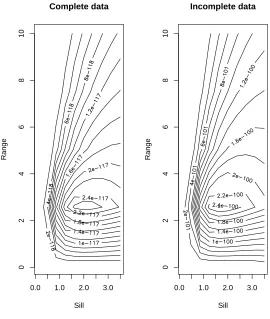
function. Figure 5 shows a contour-plot for the likelihood function of the range and sill parameters using
the spectral approach introduced here (filling up with zeros the missing values). Figure 5 compares the full
spectral likelihood for the complete lattice (without missing values) to the approximated likelihood for the
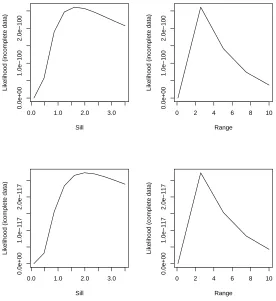
incomplete lattice using the approach presented here. With the filling-up approach we tend to be a little
bit over-optimistic for the sill parameter, this is more clear in the next Figure, (Figure 6), in which we see
a faster decay of the likelihood function as we move away from the pseudo-MLE for the sill. But, overall
the estimated pseudo-MLEs for the sill and range, are practically the same for the incomplete and complete
datasets and right on target (Figures 5 and 6). With datasets that had more than 20% missing values these
results this did not hold any longer.
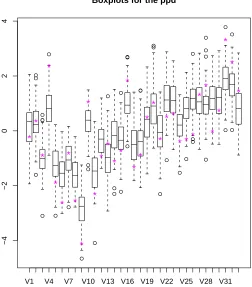
We also study the impact of this approximation on the Bayesian inference made about the data. Figure
7 shows the predictive posterior distributions (ppd) at the locations where we have missing values, using the
approach presented here to approximate the likelihood. The prior for the range is a uniform on the interval
[0,20], and the prior for the sill is
P(σ2)∝1/σ2.
The true value is represented in Figure 7 by a star. The approximated likelihood method does not seem
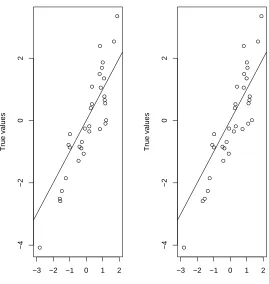
to have an impact on the estimated center of the ppd (this is more clear in Figures 8 and 9). However,
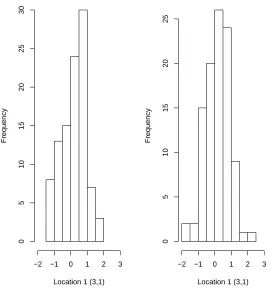
as we can appreciate in Figure 8, our method seems to underestimate slightly the spread of the ppd. The
obtained ppd based on the approximated likelihood method introduced here has variance of .50 at location
(row=3,column=1) in our image, while the variance of the ppd based on the exact likelihood function is
Complete data
Sill
Range
0.0 1.0 2.0 3.0
02468
1
0
Incomplete data
Sill
Range
0.0 1.0 2.0 3.0
02468
1
0
Figure 5: Contour plot for the likelihood. Left: using the complete dataset and the Whittle approximation. Right:
using the approach presented here for incomplete datasets (with 15% missing values). Truth: Range is 3, Sill is 2.
the circles, versus the mean of the ppd using the exact likelihood and using the approximated likelihood for
incomplete lattices introduced here. We can not appreciate a difference in the center (mean) of the ppd.
4
Likelihood for irregularly spaced data
Assume Z is a continuous Gaussian spatial process of interest, observed at M irregularly spaced locations,
andfZ is the stationary spectral density ofZ. We define a processY at locationxas the integral of Z in a
block of area ∆2 centered atx,
Y(x) = ∆−2
0.0 1.0 2.0 3.0
0.0e+00
1.0e−100
2.0e−100
Sill
Likelihood (incomplete data)
0 2 4 6 8 10
0.0e+00
1.0e−100
2.0e−100
Range
Likelihood (incomplete data)
0.0 1.0 2.0 3.0
0.0e+00
1.0e−117
2.0e−117
Sill
Likelihood (icomplete data)
0 2 4 6 8 10
0.0e+00
1.0e−117
2.0e−117
Range
Likelihood (complete data)
Figure 6: Profile likelihoods using Whittle approximation for the complete dataset on a regular lattice (bottom row)
V1 V4 V7 V10 V13 V16 V19 V22 V25 V28 V31
−4
−2
0
2
4
Boxplots for the ppd
* *
* *
*
* *
*
* *
* *
*
* *
*
* *
* *
* * *
* ** **
* *
*
*
*
Figure 7: Boxplots for the predictive posterior distribution at the locations where we have missing data. The star
PPD using approx. likelihood
Location 1 (3,1)
Frequency
−2 −1 0 1 2 3
0
5
10
15
20
25
30
PPD using true likelihood
Location 1 (3,1)
Frequency
−2 −1 0 1 2 3
0
5
10
15
20
25
Figure 8: Predictive posterior distribution at location (3,1) for the irregular dataset with 15% missing values. Left:
Using the approach presented here (mean:0.19, var:0.5, we are overoptimistic). Right: Using the exact likelihood
−3 −2 −1 0 1 2
−4
−2
0
2
Mean of ppd (approximated likelihood)
True values
−3 −2 −1 0 1 2
−4
−2
0
2
Mean of ppd (true likelihood)
True values
Figure 9: True values versus the mean of the predictive posterior distribution. Left: using the approximated
where foru= (u1, u2) we have,
h(u) =
⎧ ⎪ ⎪ ⎨ ⎪ ⎪ ⎩
1 if|u1|<∆/2,|u2|<∆/2
0 otherwise.
Then, Y is also a stationary process with spectral densityfY given by:
fY(ω) = ∆−2|Γ(ω)|2fZ(ω),
whereω= (ω1, ω2) and Γ(ω) =h(u)e−iωu= [2sin(∆ω1/2)/ω1][2sin(∆ω2/2)/ω2]. For small values of ∆, fY(ω) is approximatelyfZ(ω),since we have:
lim ∆→0∆
−2|Γ(ω)|2= 1.
By (15),Y(x) can be treated as a continuous spatial process defined for allx∈D. But, here we consider the processY only on a lattice (n1×n2) of sample sizeN =n1n2, i.e. the values of xin (15) are the centroids of theN grid cells in the lattice, having spacing ∆ between neighboring sites (see Figure 10). Then, we have
that the spectral density of the lattice processY is,
f∆,Y(ω) =
Q∈Z2
|Γ(ω+ 2πQ/∆)|2fZ(ω+ 2πQ/∆). (16)
In practice, we truncate the sum in (16) after 2N terms, we include in the Appendix (A.1) the justification.
The idea is to apply Whittle likelihood to f∆,Y, written in terms of fZ. Therefore, we can obtain the
MLE for the covariance/spectral density parameters ofZby writing the likelihood of the processY. It might
help the reader to interpret this key idea in the spatial domain rather than the spectral domain.
• Basic idea: interpretation in the spatial domain.
The covariance for the block averages (the lattice processY) is defined as
cov(Y(xj1), Y(xj2)) =
∆−4
Bj1
Bj2
cov(Z(u), Z(v))dudv=
∆−4
Bj1
Bj2
* * * * * * * * * * * * * * * * * * * * * * * * * * * * * * * * * * * * * * * * * * * * * * * * * * * * * * * * * * * * * * * * * * * * * * * * * * * * * * * * * * * * * * * * * * * * * * * * * * * * * * * * * * * * * * * * * * * * * * * * * * * * * * * * * * * * * * * * * * * * * * * * * * * * * * * * * * * * * * * * * * * * * * * * * * * * * * * * * * * * * * * * * * * * * * * * * * * * * * * * * * * * * * * * * * * * * * * * * * * * * * * * * * * * * * * * * * * * * * * * * * * * * * * * * * * * * * * * * * * * * * * * * * * * * * * * * * * * * * * * * * * * * * * * * * * * * * * * * * * * * * * * * * * * * * * * * * * * * * * * * * * * * * * * * * * * * * * * * * * * * * * * * * * * * * * * * * * * * * * * * * * * * * * * * * * * * * * * * * * * * * * * * * * * * * * * * * * * * * * * * * * * * * * * * * * * * * * * * * * * * * * * * * * * * * * * * * * * * * * * * * * * * * * * * * * * * * * * * * * * * * * * * * * * * * * * * * * * * * * * * * * * * * * * * * * * * * * * * * * * * * * * * * * * * * * * * * * * * * * * * * * * * * * * * * * * * * * * * * * * * * * * * * * * * * * * * * * * * * * * * * * * * * * * * * * * * * * * * * * * * * * * * * * * * * * * * * * * * * * * * * * * * * * * * * * * * * * * * * * * * * * * * * * * * * * * * * * * * * * * * * * * * * * * * * * * * * * * * * * * * * * * * * * * * * * * * * * * * * * * * * * * * * * * * * * * * * * * * * * * * * * * * * * * * * * * * * * * * * * * * * * * * * * * * * * * * * * * * * * * * * * * * * * * * * * * * * * * * * * * * * * * * * * * * * * * * * * * * * * * * * * * * * * * * * * * * * * * * * * * * * * * * * * * * * * * * * * * * * * * * * * * * * * * * * * * * * * * * * * * * * * * * * * * * * * * * * * * * * * * * * * * * * * * * * * * * * * * * * * * * * * * * * * * * * * * * * * * * * * * * * * * * * * * * * * * * * * * * * * * * * * * * * * * * * * * * * * * * * * * * * * * * * * * * * * * * * * * * * * * * * * * * * * * * * * * * * * * * * * * * * * * * * * * * * * * * * * * * * * *
Figure 10: Simulation: Irregularly spaced observations. We grid the observations in a 10×10 grid, with an average
of 10 observations per grid.
where Cθ(u−v) is the covariance for the continuous underlying processZ, andθ are the covariance parameters. The continuous processZ is defined in terms of a pointwise covarianceCθ(h), but we then use the previous expression to derive the covariances of the block averagesY(xi), i= 1, . . . , N,in terms of the pointwise covarianceCθThis is then used to define a likelihood function for the parameters of the
covariance function for the processZ in terms of the likelihood function ofY(x1), Y(x2), . . . , Y(xN).
To calculate the likelihood of Y, we first need to estimate f∆,Y. With that purpose in mind we define
YN as,
YN(x) = 1/nx
si∈Jx
h(si−x)Z(si), (17)
where forx= (x1, x2),
Jx={s= (s1, s2),|x1−s1|<∆/2,|x2−s2|<∆/2}, (18)
and the cardinal of this set is|Jx|=nx. For locationsx,such thatnx= 0,the value ofYN(x) is not known.
As the observations become more dense, the covariance of YN converges to the covariance of Y, see
Appendix (A.1). However, the approximation ofYN toY works worse in grid cells with very few observations.
g1(x) = nx/n, with n the mean of the nx values. This g1 function plays a similar role to the g weight function (10) in the incomplete grid scenario.
We defineIg1YN(ω) the periodogram for the tappered processg1(x)YN(x),
Ig1YN(ω) =|H2∗(0)|−1
n1
s1=1 n2
s2=1
g1(s)YN(s) exp{−isTω}
2
, (19)
whereHk∗(λ) = 2πNj=1gk
1(xj)eiλ
Tx j.
The peridogramIg1YN(ω) is an asymptotically unbiased estimate off∆,Y. The bias is of orderO(N−1) +
O(¯n−1), where ¯nis the average of then2xvalues (¯n=Nj=1n2xj/N):
E[Ig1YN(ω)] =f∆,Y(ω) +O(N
−1) +O(¯n−1),
the proof of this result is included in the Appendix (Theorem 1).
Thus, as long as O(N/¯n)≤O(1) we have that (see Appendix, Theorem 2)
LY =
N (2π)2
j∈JN
logf∆,Y (2πj/n) +Ig1YN(2πj/n) (f∆,Y (2πj/n))
−1, (20)
converges toLY = 12log|ΣN|+YTΣ−N1Y (exact likelihood forY), the order of convergence (in the sense of
(14)) isN1/2.
IfM is the total number of observations of the processZ, the calculation ofLY requiresO(N log2N+M)
operations rather thanO(M3) for the exact likelihood of Z. We chooseN ≤M2/3 (with the equality only
when there are not many empty cells) to satisfyO(N/¯n)≤O(1). If we haveN=M2/3,then the number of
operations to obtain the likelihood function is O(M2/3log
2M).
4.1
Simulation
We simulate 1000 observations of a Gaussian spatial process with a stationary exponential covariance
(range=.25 and sill =1). We grid the observations in a 10× 10 lattice, and we obtain an average of 10
observations per grid. Figure 10 shows the grid and Figure 11 the empirical semivariogram for the gridded
process and for the original data. The gridded process clearly shows a smaller sill (less variance) and larger
range. We want to emphasize the fact that in our approach we do not estimate the parameters of the block
covariance for the gridded process, what we do is to write this block covariance (or the corresponding
0.0 0.2 0.4 0.6
0.0
0.2
0.4
0.6
0.8
1.0
distance
semivariance
Empirical semivariogram for gridded data
0.0 0.2 0.4 0.6
0.0
0.2
0.4
0.6
0.8
1.0
distance
semivariance
Empirical semivariogram for original data
Figure 11: Empirical semivariogram for original data and gridded data. Truth: Exponential covariance, nugget=0,
range =.25, sill =1.
parameters of the point-covariance of Z. Figure 12 shows the true semivariogram forZ and the empirical
semivariogram with a confidence envelope, obtained simulating 1000 versions of the processZ, the upper and
lower limits (dashed-lines) show the maximum and minimum values of the empirical semivariograms for the
1000 simulated Gaussian processes with an exponential covariance (range=.25 and sill=1). The variogram
with the true MLE parameters (green line) is showed practically on top of the true variogram. Our approach
gives the red dotted-line in Figure 12, just slightly below the true semivariogram.
4.2
Modified version of the approximated likelihood function
The approach presented in this Section for irregularly spaced datasets performs well when there is no nugget
effect (measurement error). But, we could improve the estimation of the nugget and also the smoothness
parameter (that explains the degree of differentiability ofZ, see Stein (1999)) by adding to the likelihood
function ofY information about the behavior of the processZ(si) within grid cells.
Thus, we randomly choosemblocks (no more than 10%-15% of the blocks) and treat them as ifnxi = 0
(i.e. we give them weight zero). We do not use the information from thesemblocks inLY, the log-likelihood
forY.
0.0 0.2 0.4 0.6 0.8
0.0
0.5
1.0
1.5
2.0
distance
semivariance
Figure 12: True semivariogram (solid line in blue, sill 1 and range .25) with an envelope, exact MLE (green line).
Estimated MLE with our spectral method (red dotted-line).
as independent):
LY + m
j=1 1
2log|Σj|+Z
T
jΣ−j1Zj, (21)
where Zj is a vector with the nxj observations within block j, and Σj is the covariance within the block
written in terms ofCθ(h) (covariance ofZ). The calculation of (21) is very fast, since the blocks are small, approximately of orderM1/3.
4.3
Simulation
We simulate 1000 observations of a Gaussian spatial process with a stationary Mat´ern covariance (nugget=
.25, range=.25, smoothness parameter =3, and partial sill =1):
C(h) =σ0I(h) + σ1 2ν−1Γ(ν)(2ν
1/2|
h|/ρ)νKν(2ν1/2|h|/ρ), (22)
where Kνs is a modified Bessel function and θ = (σ0, ν, σ1, ρ). I(h) is an indicator function, it takes the
value 1 when h= (0,0), and it is zero otherwise. The nugget parameter is σ0 (microscale variation). The parameterρmeasures how the correlation decays with distance; generally this parameter is called therange.
degree of smoothness of the processZ. The higher the value ofνthe smootherZwould be; e.g. whenν =12,
we get the exponential covariance function. In the limit asν→ ∞we get the Gaussian covariance.
We grid the observations in a 10×10 lattice (as in Figure 10). Figure 13 presents the empirical
semivar-iogram for the gridded process and for the original data. The gridded process clearly does not capture the
microscale variation, and estimates the nugget as zero. This still remains a problem when we write this block
covariance (or the corresponding spectrum) in terms of the point-covariance parameters of the continuous
underlying processZ.
The following results show the improvement in the nugget estimation by adding to the likelihood of
the gridded process,LY in (20), the information within blocks (using 10 blocks, randomly selected) using
expression (21). In Table 1, the nugget is estimated as 0, using the gridded process, and it is estimated as .3
(with standard error .23) using expression (21). Regarding the smoothness parameter, which is always very
difficult to estimate, the exact MLE is .7. We estimate this parameter as 5 using the information within 10
blocks. We should note that the spectral likelihood method for the gridded process (LY) seems to estimate
well the range and partial sill parameters and also their standard errors (s.e.). The standard errors are
obtained using expression (9). The s.e. for the range and smoothness parameters are underestimated using
LY, but when we add the information in 10% of the blocks we estimate better not only these parameters
but also the uncertainty about them.
Parameters: Nugget Partial Sill Range Smoothness
TRUTH .25 1 .25 3
MLE (exact likelihood) .24 (.2) .9 (.2) .5 (.25) .7 (3.5)
MLE (Spectral gridded) 0 (.1) .8 (.2) .12 (.2) 1 (2.1)
MLE (Spectral combining) .3 (.23) .8 (.27) .4 (.3) 5 (4.8)
Table 1. Estimated covariance parameters, the values in parenthesis are standard errors.
In the next Section we introduce a new data taper. Tappering does not help to improve the asymptotic
order of approximation of the spectral likelihood to the exact likelihood. But, it does help to obtain better
pseudo-MLE parameters, by reducing the bias in the empirical covariance and periodogram due to the edge
0.0 0.2 0.4 0.6 0.8
0.0
0.5
1.0
1.5
distance
semivariance
Variogram for gridded data
0.2 0.4 0.6 0.8 1.0 1.2
0.0
0.5
1.0
1.5
distances
variogram
Variogram for original data
Figure 13: Empirical semivariogram. Truth: Matern covariance, smoothness=3, range=.25, partial sill=1,
nugget=.25
5
New data taper
The periodogram,IN, defined in (5) in terms of the processZ, it is also the discrete Fourier transform of the
biased estimate of the covariance, the sample covariancecN(k) =N−1
(Zs−Z)(Z¯ s+k−Z) where¯ N is the
total number of observations and ¯Z the sample mean, rather than the unbiased version (Guyon, 1982). No
matter how largeN becomes, the periodogram always involves the tailof the sample covariance, which is a
poor estimate of the corresponding theoretical covariance, since in this region the sample covariance is based
on just a small number of pairs of observations. One of the advantages of tapering is the reduction of the bias
due to the boundary effect on the sample covariance. Edge effects are a serious problem in spatial statistics
because the number of boundary points increases with the dimension. Thus, we generally need more tapering
for the corner observations. A rounded taper gives more tapering to the corner observations, so with less
overall tapering, we get the amount of smoothing that we need without losing so much information.
We propose here a ”rounded taper”. First, we introduce some notation and we define new coordinates
(r1, r2)∈−n1 2,n21
×−n2
2 ,n22
in terms of (s1, s2)∈[0, n1]×[0, n2],
r2=|s2−(n2−1)/2|,
d=
[r1−(n1/2−)]2+ [r2−(n2/2−)]2,
S={(r1, r2), s.t. r1>(n1/2−) and r2>(n2/2−)}.
We give now a partition of the grid in terms of the new coordinates (r1, r2)∈−n1 2,n21
×−n2
2 ,n22
(see
Figure 3), because centering the observations in this way makes it easier to define the rounded taper,
A={(r1, r2), s.t. r1≤n1/2− and r2> n2/2−δ}
B ={(r1, r2), s.t. r2≤n2/2− and r1> n1/2−δ}
C={(r1, r2), s.t. r1≤n1/2−δ and r2< n2/2−, or
r1≤n1/2− and r2< n2/2−δ}
D={(r1, r2), s.t. (r1, r2)∈S and d∈[−δ, ]}
E={(r1, r2), s.t. (r1, r2)∈S and d≥}
F ={(r1, r2), s.t. (r1, r2)∈S and d≤−δ}
Finally, we present the weight function,hR(),that defines the rounded data taper,
hR(r1, r2) =
⎧ ⎪ ⎪ ⎪ ⎪ ⎪ ⎪ ⎪ ⎪ ⎪ ⎪ ⎪ ⎪ ⎪ ⎪ ⎪ ⎪ ⎪ ⎪ ⎨ ⎪ ⎪ ⎪ ⎪ ⎪ ⎪ ⎪ ⎪ ⎪ ⎪ ⎪ ⎪ ⎪ ⎪ ⎪ ⎪ ⎪ ⎪ ⎩ 1 2
1−cos
π(n2/2−r2)
δ
for (r1, r2)∈A,
1 2
1−cos
π(n1/2−r1)
δ
for (r1, r2)∈B,
1 for (r1, r2)∈C orF,
1 2
1−cos
π(−d)
δ
for (r1, r2)∈D,
0 for (r1, r2)∈E.
(23)
The parametersδ and define the rounded data taper. The parameterδ ∈[0, n/2], with n= min(n1, n2),
plays the same role asmin the multiplicative taper (7), and the parameter∈[0, n/2] defines the rounded
region (see Figure 14).
Figure 3, illustrates the difference between the two data tapers. The black rectangle represents the border
of the site. The rounded data taper gives weight 1 to the observations inside the magenta curve, whereas
weight 1 only to the observations inside the blue rectangle. Therefore, we generally lose more information
with a multiplicative data taper, if we equalize the amount of tapering in the corners.
Figure 15 shows the spectral windows on a decibel scale along the vertical axis (ω1= 0). The idea is to
select a data taper so thatW() is uniformly small at frequencies far from 0. Note that the spectral windows
corresponding to the two data tapers have significantly smaller side lobes thanW() with no taper. However,
notice that the widths of the main lobes of these spectral windows are slightly larger: we have suppressed
the side lobes in the windows at the expense of wider main lobes. The spectral window for the rounded
taper, at almost all frequencies along the vertical axis, is much smaller than the spectral window for the
multiplicative.
Figure 16 shows the spectral windows on a decibel scale along the diagonal (ω1=ω2). We see in Figure
15 that the rounded taper has a slightly broader main lobe. Along the diagonal the side lobes for both tapers
are much smaller than along the axes (compare Figures 15 and 16), and the differences between the two
tapers are also smaller along the diagonal. Thus, even if the side lobes are slightly larger for the rounded
data taper along the diagonal, overall the spectral window for the rounded data taper has better properties
(smaller side lobes) than the spectral window for the multiplicative taper.
In summary, tapering is an operation that replaces the spectral window of the periodogram with one
having better side lobe properties, which is a useful method for reducing the bias due to leakage in direct
spectral estimators. A useful characterization of spectral density functions, f,is in terms of theirdynamic
range,which we define by the ratio
10 log10
maxωf(ω) minωf(ω)
,
the dynamic range of a white noise process is 0. The bias in the periodogram for processes with high dynamic
range can be attributed to the side lobes of the spectral window. Thus, tapering is particularly important
for spectral densities with large dynamic range.
The asymptotic properties of the estimated covariance parameters (in terms of efficiency and consistency)
using Whittle’s likelihood and applying the data taper presented in this paper are the same as the ones
Rounded Taper
C
F F
F F
A
A
B B
D D
D D
E E
E E
Figure 14: Rounded taper. The weight in the regions F and C is 1, the weight in the regions E is 0, and
the weight in the regions A, B, and D is a cosine functionhR() that goes smoothly from 1 to 0. The two
parameters that define the rounded tapering are , andδ. The parameter is the radius of the circle that
Frequencies
log10(Spectral Windows)
0.0 0.5 1.0 1.5 2.0 2.5 3.0 3.5
-15
-10
-5
0
5
1.-No tapering 2.-Multiplicative taper 3.-Rounded taper
Figure 15: Spectral windows along the vertical axis. The horizontal axis shows the frequencies, while the
vertical axis shows the spectral window along the vertical axis (ω1= 0) on a decibel scale; for the periodogram
(line 1), for the periodogram applying amultiplicativedata taper (line 2), and for the periodogram applying
Frequencies
log10(Square spectral windows)
0 1 2 3 4 5
-20
-15
-10
-5
0
5
1.-No tapering
2.-Multiplicative taper
3.-Rounded taper
Figure 16: Spectral windows along the diagonal. The horizontal axis shows the frequencies, while the vertical
axis shows the spectral window along the diagonal (ω1 =ω2) on a decibel scale; for the periodogram (line
1), for the periodogram applying a multiplicativedata taper (line 2), and for the periodogram applying a
samples the rounded taper helps to reduce the bias in the periodogram of the spectral likelihood function.
6
Discussion
In this paper we introduce likelihood approximation methods for lattice data with missing values and for
irregularly spaced datasets. We use a spectral framework that offers enormous computational benefits. There
are other alternative spectral approaches for irregularly sampled processes that are more computationally
expensive:
• a spectral likelihood based on a periodogram for irregularly sampled processes obtained using
general-ized prolate spheroidal sequences (Bronez, 1988),
• the EM algorithm (Dempster, Laird, and Rubin 1977), which is a very well-known technique to find
maximum likelihood estimates in parametric models with incomplete data. In the EM algorithm, we
could first impute the values of the process at the locations in the grid where we have no data and
then calculate the complete-data likelihood using spectral methods. We would need to iterate through
these two steps.
The spectral likelihood approach presented here is attractive because of its simplicity and because is very
computationally efficient and fast compared to any other known likelihood approximation method for spatial
data that gives consistent estimates.
The weight function g introduced here to handle incomplete lattices, could have more sophisticated
structures than the one used in this paper. For instance, instead of just taking values 1 and 0,g could go
smoothly from 1 to 0 using a cosine function or a spline function to capture better the transition zones in the
areas with missing values. This can be particularly helpful when we have missing values clustered together,
e.g. clouds in AVHRR satellite data.
The new spatial data taper introduced in this paper, does not improve the asymptotic properties of the
estimated covariance/spectrum parameters, but with finite samples it helps to reduce the periodogram bias
due to the edge effect and therefore produces more reliable estimates. Any tapering technique is defined in
parameters. If the objective is spatial prediction, cross validation is often used to determine the values of
the taper parameters. The two parameters in the rounded data taper proposed here are andδ, and they
can be chosen such that they minimize the relative mean squared error (rmse) of the estimated periodogram.
The rmse is the mse of the periodogram divided by the squared of spectral density,f2.The mean and the
asymptotic variance of the periodogram for a tapered process are presented in Section 3, and can be used
to approximate the mse. We suggest using a plug-in approach and replace f with the periodogram in the
expression for the mse.
7
Appendix
A.1
Truncation of f∆,Y:
Let us assume that for large frequencies (as |ω| → ∞) the spectral density of a continuos spatial process
Z satisfies:
fZ(ω)∝ |ω|−α, withα >2. (24)
The spectral densities models generally used for continuous spatial process (i.e. Mat´ern) satisfy condition
(24). Under this condition we need to prove that the residual term in the expression forf∆,Y given in (16),
when we truncate the sum the sum after 2N terms, is negligible compared to O(N−1), which is the bias of
our estimated function off∆,Y (Section 4).
The spectral density of the lattice process Y,f∆,Y(ω) forω∈[−π/∆, π/∆]2, is defined in (16) in terms
offZ. Here we study the order of the residual termR,
f∆,Y(ω) =
Q∈NY
|Γ(ω+ 2πQ/∆)|2fZ(ω+ 2πQ/∆) +R(ω, NY) (25)
whereNY ={(q1, q2)∈Z2;−n1< q1< n1,−n2< q2< n2}.We have that, +∞
q1=n1 +∞
q2=n2
|Γ(ω+ 2π(q1, q2)/∆)|2fZ(ω+ 2π(q1, q2)/∆)≤
+∞
π/∆+2πn1/∆
+∞
π/∆+2πn2/∆|
ω1|−1|ω2|−1|ω12+ω22|−α/2dω1dω2=O(N−α/2).
Similarly, we have,
−∞
q1=−n1
−∞
q2=−n2
|Γ(ω+ 2π(q1, q2)/∆)|2fZ(ω+ 2π(q1, q2)/∆)≤
π/∆−2πn1/∆
−∞
π/∆−2πn2/∆
−∞ |ω1| −1|ω
2|−1|ω21+ω22|−α/2dω1dω2=O(N−α/2).
(27)
Therefore, the order of convergence to zero of the residual term in (25) is faster than O(N−1),which is
the bias ofIg1YN (defined in (19)), and it is our estimate off∆,Y.
A.2 Theorem 1:
Consider a continuous weakly stationary spatial process Z observed at M locations in a domain D of
interest. We define two lattice processes Y (as in (15)) and YN (as in (17)), both written in terms of the
process Z, and defined on a latticen1×n2 coveringD, with spacing ∆ between neighboring observations.
We definef∆,Y, the spectral density of the processY. We proposeIg1YN, defined in (19), as an estimate of
f∆,Y. AsN → ∞and ¯n→ ∞, where ¯n=N1
in2xi andnxi is the number of observations of the processZ
in the grid celli, we have,
E[Ig1YN(ω)] =f∆,Y(ω) +O(N
−1) +O(¯n−1).
Proof of Theorem 1:
Ig1YN(ω) =|H ∗
2(0)|−1
n1
s1=1 n2
s2=1
g1(s)YN(s) exp{−isTω}
2 .
First, we need to study the convergence of the second order moments ofYN to the ones of the processY
as the observations become more dense, i.e. as eachnxi→ ∞.AssumeCθ(h) is the stationary covariance of the processZ at a distanceh, with parametersθ. We have
cov(YN(x1), YN(x2)) =
1 nx1nx2
si∈Jx1
sj∈Jx2
Cθ(si−sj),
whereJxis defined in (18), and
cov(Y(x1), Y(x2)) = ∆−2 h(u−x1)h(v−x2)Cθ(u−v)dudv= ∆−2
B∆
B∆
where B∆ = [−12∆,12∆]2. Clearly the covariance of Y is stationary. By the expressions above for the
covariance functions ofYN andY, we have that the covariance of YN between pointsx1 andx2, coverges to
cov(Y(x1), Y(x2)) asnx1 → ∞andnx2 → ∞. The order of convergence isO(n−x11n−x21).
Thus, it is straighforward to see that the order of converge of the covariance of the tapered processg1YN
to the covariance ofg1Y isO(n−1n−1),(naverage of the nxi values). Then,
E[g1(x1)YN(x1)g1(x2)YN(x2)] =E[g1(x1)Y(x1)g1(x2)Y(x2)] +O(n−1n−1),
uniformly in x1,x2. This is a uniform convergence, because C is a uniformly bounded function, since we assume that the variance ofZ is finite.
Thus, since
E[Ig1YN(ω)] =|H2∗(0)|−1
n1
s1=1 n2
s2=1
g1(s)YN(s) exp{−isTω}
2 ,
we have,
E[Ig1YN(ω)] =E[Ig1Y(ω)] +N(ω) (28)
whereIg1Y is the periodogram of the tapered processg1Y. AsN → ∞,E[Ig1Y(ω)] in the expression above
converges uniformly tof∆,Y(ω),
E[Ig1Y(ω)] =f∆,Y(ω) +O(N−1),
and the residual termN(ω) in expression (28) is of the following order,
N(ω)≤ |H2∗(0)|−1
n1
s1=1 n2
s2=1
1
n2exp{−is
Tω}
2
=O(¯n−1).
Therefore,
E[Ig1YN(ω)] =f∆,Y(ω) +O(N−1) +O(¯n−1).
A.3
Let us assume that the spectral density of the lattice process Y (as in (15)), f∆,Y with parameters θ,
(a.1)f∆,Y(ω) is rational with respect toeiω, without zeros or poles,
(a.2)the second derivative off∆,Y inθ is continuous in θ.
All classical spectral density models satisfy these two conditions.
Theorem 2:
Assume the order of convergence to zero of ¯nasN→ ∞, is at leastO(N−1). This means,O(N/¯n)≤O(1).
Then, under conditions(a.1)-(a.2), we have that,
LY =
N (2π)2
j∈JN
logf∆,Y (2πj/n) +Ig1YN(2πj/n) (f∆,Y (2πj/n))
−1, (29)
converges toLY = 12log|ΣN|+YTΣ−N1Y (exact likelihood function for the lattice processY), and ifn1and
n2 are of the same order, the rate of approximation (in the sense of (14)) isN1/2.
Proof of Theorem 2:
By conditionO(N/¯n)≤O(1),the proposed peridogram function,Ig1YN, approximates the spectral
den-sity f∆,Y with a bias of the same order (Theorem 1) than if we use Ig1Y, the periodogram of a tapered
version ofY. Then, by Proposition 1 in Guyon (1982). In which the convergence of the spectral Whittle
likelihood function for a tapered process g1Y,to the exact likelihood ofY is proven. We obtain that (29)
holds and the order isN1/2.
Acknowledgements
This research was sponsored by a National Science Foundation grant DMS 0353029. The author would
like to thank Michael Stein, at the University of Chicago, for providing invaluable suggestions for the taper
function introduced in Section 5.
References
Besag, J.E. (1974). Spatial interaction and the statistical analysis of lattice systems (with discussion).
J. R. Statist. Soc. B36, 76-86.
Bessag, J.E. and Moran P.A.P. (1975). On the estimation and testing of spatial interaction in Gaussian
Bronez, T. P. (1988). Spectral estimation of irregularly sampled multidimensional processes by
gener-alized prolate spheroidal sequences. IEEE Transactions on Acoustics, Speech, and Signal Processing, 36, 1862-1873.
Caragea, P. (2003). Approximate Likelihoods for Spatial Processes. Ph.D. Dissertation at UNC.
http://www.stat.unc.edu/postscript/rs/caragea.pdf
Clinger, W. and Van Ness, J. W. (1976). On unequally spaced time points in time series. Ann. Statist.
4, 736-745.
Cram´er, H. and Leadbetter, M. R. (1967). Stationary and related stochastic processes. Sample function
properties and their applications. Wiley, New York.
Dahlhaus, R. and K¨usch,H. (1987), Edge effects and efficient parameter estimation for stationary random
fields. Biometrika,74877-882.
Bloomfield (2000). Fourier Analysis of Time Series. Wiley, New York.
Brillinger, D. R. (1970).The frequency analysis of relations between stationary spatial series,Proceedings
of the Twelfth Biennial Seminar of the Canadian Mathematical Congress,(ed. R. Pyke), Montreal, Canadian
Math. Congress, 39-81.
Brillinger, D. R. (1981). Time Series: Data Analysis and Theory. Expanded edition. Holden-Day, Inc,
San Francisco.
Guyon, X. (1982). Parameter estimation for a stationary process on a d-dimensional lattice. Biometrika,
69, 95–105.
Marcotte, D. (1996). Fast variogram computation with FFT.Computers and Geosciences,22, 1175-1186. Mat´ern, B. (1960). Spatial variation. Medded. Stat. Skogsforkskinst, 49, 5. Second ed. (1986), Lectures
Notes in Statistics 36, New York: Springer.
Neave, H.R. (1970). Spectral analysis of a stationary time series using initially scarce data. Biometrika,
57, 111-122.
Pardo-Iguzquiza, and Dowd (1997). AMLE3D: a computer program for the inference of spatial covariance
parameters by approximate maximum likelihood estimation. Comput. Geosci., 23, 793-805.
Ser. A,25, 383-392.
Priestley, M. B. (1981). Spectral Analysis and Time Series. Academic Press, London.
Stein, M. L. (1995). Fixed domain asymptotics for spatial periodograms. Journal of the Americal
Statistical Association,90, 1277-1288.
Stein, Chi and Welty. (2004). Approximating likelihoods for large spatial data sets. Journal of the Royal
Statistical Society, Series B.66, 275-296.
Stein, M. L. (1999). Interpolation of Spatial Data: some theory for kriging. Springer-Verlag, New York.
Vecchia (1988). Estimation and model identification for continuous spatial processes. Journal of the
Royal Statistical Society, Series B.50, 297-312.
Whittle, P. (1954). On stationary processes in the plane,Biometrika,41, 434-449.
Yaglom, A. M. (1987). Correlation theory of stationary and related random functions. Springer-Verlag,