Experimental Study of Eco-friendly
Wire-Cut Electrical Discharge Machining
Processes
Arul Dass james.D
1, Dr.Boopathi.S
2PG Student, Department of Mechanical Engineering, Bannari Amman Institute of Technology, Sathyamangalam, India1
Assistant Professor, Department of Mechanical Engineering, Bannari Amman Institute of Technology,
Sathyamangalam, India2
ABSTRACT: In the wire-cut electrical discharge machining (WEDM) process, the liquid dielectric fluid is replaced by
the minimum quantity of liquid with the gas mixture, called near-dry WEDM. Near-dry WEDM exhibits the advantage of low environmental impact, good surface quality and machining stability at the minimum discharge energy input. This study reveals the development of new experimental setup of near-dry WEDM to achieve the good machining performance. The experiments have been conducted by mixing of minimum quantities of liquid with air(air-mist) and oxygen (oxygen mist)as a dielectric medium usingHSS-M2material.The Taguchi approach has been applied to investigate the effect of pulse width, pulse interval, inlet liquid-gas pressure and discharge-current on the MRR and surface finish. The low pulse width and pulse interval are identified as key factors for improving the surface finish. The pulse-width, liquid-gas pressure and discharge-current are experimentally found that the significant parameters for high MRR and fine surface finish. It is observed from the comparative study; the use of the oxygen- mist dielectric medium has the good machining performance than air-mist dielectric medium.
KEYWORDS: Near-dry WEDM, Air-mist, Oxygen-mist, Taguchi method, Material Removal Rate, Surface Finish
1. INTRODUCTION
In conventional WEDM, the de-mineralized water and kerosene based oil is used as a dielectric medium. The dielectric mediums are reacting with the eroded materials and producing the harmful smell to the operators. If the kerosene and water based dielectric fluids are used in electrical discharge machining (EDM), then it will produce harmful vapor(carbon monoxide,nitrogenoxide,xylene,formalde-hyde and toluene) during the decomposing process(Leao, Fabio N.and IanR.Pashby,2004). Replacing liquid dielectric by gases and liquid-gas mixture is an emerging trend in the
EDM process in which high thermal and chemical energy in the work piece due to higher ionization and plasma confinement.
The near-dry EDM is the alternative method to achieve the high speed machining process with the best surface finish. In this concept, mixing of a minimum quantity of liquid (MQL) with the compressed air or gas is a dielectric medium. This process certainly improves the MRR, lower tool wear rate and good surface quality. C.C.Kaoetal. (2007) conducted the experiments in the near-dry EDM drilling and WEDM and reported that good improvement in MRR and the elimination of debris deposition. The mathematical models were also developed for dielectric strength, spark gap, dynamic viscosity and water mixture ratio based on liquid and air properties. TaoJia et al. (2008) conducted many experiments based on pure gases and mixing of gas like air, oxygen, nitrogen and helium with the water, de-ionized water, and kerosene. They also reported that the effect of different gases and liquid mixtures on the MRR and surface roughness. Masahiro Fujiki et al. (2009) developed the Computational Fluid Dynamics (CFD) model of dielectric fluid flow to predict the air-liquid mist flow rate, MRR and Ra in near-dry EDM milling. The experiments were conducted in near-dry wire-cut EDM and reported that the effect of the pulse width and pulse interval on the machining rate and surface roughness by the same authors. It is observed that only a few authors attempted to optimize the input process parameters in the dry and near-dry EDM.Sourabh K.Saha et al. (2009) developed an empirical model for the MRR and Ra and optimized using response surface method. Very recently, Y.Jiaetal. (2010) investigated the near-dry milling EDM process to machine the satellite alloys and important output parameters of MRR, Ra and tool wear were optimized using response surface method. Later, the experiments were conducted in near-dry wire-cut EDM and reported that the effect of the pulse width and pulse interval on the machining rate and surface roughness by the same authors (2010). It can be observed from the fore mentioned literatures that still required the research in the dry and near-dry EDM to improve the performance of machining with low environmental impact. Generally, the conventional WEDM has the good machining speed with the stable process. However, the considerable environmental impact with high tool wear is the demerits of conventional WEDM. The dry WEDM is an unstable machining process with minimum MRR, poor surface finish. The main advantage of this process is the very low environmental impact during the process. The drawbacks of wet and dry WEDM process have been eliminated in the near-dry WEDM that yields better surface quality with considerable MRR, low tool wear, no chemical reaction of the dielectric fluid, less residual stress and no environmental impact. In this research, the near-dry WEDM system was developed and experiments have been conducted based on Taguchi design of experiments using air-mist and oxygen-mist dielectric medium. It is observed from the comparative study; the use of the oxygen-mist dielectric medium has the high machining rate than air-mist dielectric medium.
II. EXPERIMENTAL SETUP AND PROCEDURE
2.1.ExperimentalSetup
molybdenum wire of 0.18mm diameter as a wire tool are used. The near-dry machining conditions are summarized in the Table1.
Table1: Near-dry WEDM machining conditions
2.2. Experimental Procedure
The rectangular path of cutting operation was performed on the workpiece by near-dry WEDM process. During the experiments, the time taken to cut the 20mm length of material removal is noted. Then, the volume of material removal rate is calculated using the dimensions of cutting path and time. Center line average (CLA) surface roughness parameter, Ra was used to quantify the surface roughness. Ra was measured using a contact type stylus-based surface roughness tester, C3AMahr PerthenPerthmeter (5µmstylusradius). The cutoff length of the surface roughness tester is 0.8mm and an evaluation length of 4mm was used. Raw as measured along four different paths on the work piece surface, and the average value was considered for further analysis.
Figure1: Schematic diagram of hydro-pneumatic circuit for near-dry WEDM
Wire tool
Work piece
Dielectric Fluid
Material 99.95%PureMo
Diameter Wire Speed Material
Composition Thickness
Composition Flow rate Working Air pressure
Temperature
0.18mm 250 rpm
High Speed Steel(HSS-M2)
6.15W-5%Mo-4.15%Cr-1.85%V-0.85%C-0.30%Si-0.28%Mn-81.4% Fe 6mm
Air and Oxygen gas mixed with de ionized water 7ml/min
2.3. Plan of Experiments
Experiments were performed in two stages: first a set of exploratory experiments followed by the Taguchi design of experiments using air-mist and oxygen-mist dielectric medium. Exploratory experiments were conducted to select suitable appropriate values of parameters for the later stage experiments. Taguchi designs of experiments were then performed to systematically study the effect of various process parameters on MRR, surface roughness (Ra).
2.2. Experimental Procedure
The rectangular path of cutting operation was performed on the workpiece by near-dry WEDM process. During the experiments, the time taken to cut the 20mm length of material removal is noted. Then, the volume of material removal rate is calculated using the dimensions of cutting path and time. Center line average (CLA) surface roughness parameter, Ra was used to quantify the surface roughness. Ra was measured using a contact type stylus-based surface roughness tester, C3AMahr PerthenPerthmeter (5µmstylusradius). The cut off length of the surface roughness tester is 0.8mm and an evaluation length of 4mm was used. Ra was measured along four different paths on the work piece surface, and the average value was considered for further analysis
2.3. Plan of Experiments
Experiments were performed in two stages: first a set of exploratory experiments followed by the Taguchi design of experiments using air-mist and oxygen-mist dielectric medium. Exploratory experiments were conducted to select suitable appropriate values of parameters for the later stage experiments. Taguchi designs of experiments were then performed to systematically study the effect of various process parameters on MRR, surface roughness (Ra).
2.3.1. Exploratory Experiments
Initial parametric studies of MRR and Ra have been made by considering one variable at a time (OVAT). By keeping all other variables at fixed average values, one variable at a time was varied and its effect on MRR and Ra has been studied. For each input parameter, experiments were conducted up to five different levels and a single run was performed at each level. Although the OVAT analysis does not give a clear picture of the phenomena over the entire range of the input parameters, it can highlight some of the important characteristics. This approach is helpful in deciding the range values of the levels of later stage experiments.
2.3.2. Design of Experiments
Taguchi method is a partial fractional method to conduct the experiments by consuming less time and Economic manner. Based on exploratory experiments, the levels of each parameter are selected for the Taguchi design of experiments (Lee,H.T.andJ.P.,Yur,2000).The mixed orthogonal array L18 (two levels for one factor and three levels for remaining four factors) have been chosen to evaluate the effects of machining parameters on performance characteristics (MRR and Ra) of this study.
Table2: Near-dry WEDM parameters and levels
Machining Parameter Unit Symbol Level1 Level2 Level3
Gap voltage Pulse-on time Pulse-off time Air-Mist pressure Discharge current
Volt µs
µs Bar Amp
V PW PI P C
75 4 24 3 1.6
100 8 36 5 2.4
- 12 48 7 3.2
Table3: Experimental design and results using L18orthogonal array
Exp. No. Control Factor Air-mist Oxygen-mist
V PW PI P C MRR Ra MRR Ra
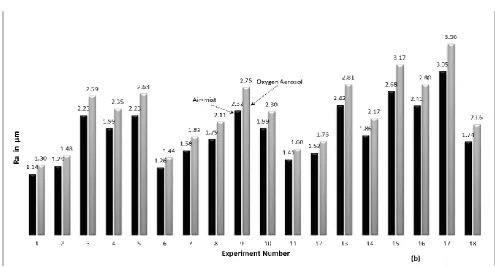
1. 2. 3. 4. 5. 6. 7. 8. 9. 10. 11. 12. 13. 14. 15. 16. 17. 18. 75 75 75 75 75 75 75 75 75 100 100 100 100 100 100 100 100 100 4 4 4 8 8 8 12 12 12 4 4 4 8 8 8 12 12 12 24 36 48 24 36 48 24 36 48 24 36 48 24 36 48 24 36 48 3 5 7 3 5 7 5 7 3 7 3 5 5 7 3 7 3 5 1.6 2.4 3.2 2.4 3.2 1.6 1.6 2.4 3.2 3.2 1.6 2.4 3.2 1.6 2.4 2.4 3.2 1.6 0.891 1.545 1.363 4.721 6.673 0.849 2.147 4.385 5.836 4.835 1.292 2.186 9.008 1.508 4.863 4.983 7.565 4.555 1.14 1.29 2.23 1.99 2.23 1.26 1.58 1.79 2.32 1.99 1.41 1.53 2.42 1.86 2.68 2.41 3.05 1.74 0.891 1.545 1.363 4.721 6.673 0.849 2.147 4.385 5.836 4.835 1.292 2.186 9.008 1.508 4.863 4.983 7.565 4.555 1.30 1.48 2.59 2.35 2.63 1.44 1.83 2.11 2.75 2.30 1.60 1.75 2.81 2.17 3.17 2.80 3.56 2.06
Figure2: a.Near-dryWEDMusingAir-mistdielectricmediumb.Near-dryWEDMusingOxygen-mist dielectric medium
III. RESULTS AND DISCUSSIONS
3.1. Effect of Working Medium Pressure
pressure, the MRR and surface finish values are reduced due to increasing the velocity of the medium in the cutting zone.
The high dielectric pressure restricts the transferring of spark between the wire tool and work piece due to the low spark thickness (0.2mm) and low contact area between the workpiece and the wire electrode. At the high pressure, the minimum of sparks are contributing to cut the work materials. The dragging-out of the sparks from the cutting zone is shown in Figures2a and 2b. The experimental analysis of Taguchi plot shows that the surface roughness is decreasing due to increasing pressure up to 5bar. After that, the Ra is increasing to higher value. Thus, the high surface finish is achieved at the moderate pressure and low surface finish at higher pressure. The significant moderate pressure is slightly varied by changing the di-electric medium and work material.
3.2. Effect of Gap Voltage
It is observed that the gap-voltage is a momentous factor for the MRR and Ra in the near-dry WEDM process as shown in Tables4 and 5. Since spark energy is proportional to the gap voltage, an increase in voltage would lead to a higher MRR. The MRR and Ra values are increased by increasing the gap voltage. The requirement of maximum MRR for the rough cutting operation can be accomplished with high gap-voltage. At the low gap voltage condition, the fine machining operation is possible with better surface finish.
Figure3: Analysis of effect of machining parameters on MRR
3.3. Effect of Spark Current
Table4: Mean Input Parameters Response for MRR
Mean Input Parameters Response for MRR
Parameter
Air-mist dielectric Oxygen-mist dielectric
Level1 Level2 Level3 Delta Rank Level1 Level2 Level3 Delta Rank
Gap-Voltage Pulse-on time Pulse-off time Pressure Spark Current 2.054 1.838 2.233 2.456 1.734 2.470 2.429 2.259 2.094 2.278 - 2.519 2.294 2.236 2.774 0.416 0.682 0.062 0.362 1.040 3 2 5 4 1 3.157 2.019 4.431 4.195 1.874 4.533 4.604 3.828 4.352 3.781 - 4.912 3.275 2.987 5.880 1.376 2.893 1.156 1.365 4.006 3 2 5 4 1
Table5: Mean Input Parameters Response for Ra
Mean Input Parameters Response for Ra
Parameter
Air-mist dielectric Oxygen-mist dielectric
Level1 Level2 Level3 Delta Rank Level1 Level2 Level3 Delta Rank
Gap-Voltage Pulse-on time Pulse-off time Pressure Spark Current 1.760 1.599 1.923 2.099 1.499 2.122 2.074 1.939 1.799 1.949 - 2.149 1.961 1.924 2.374 0.362 0.550 0.038 0.300 0.875 3 2 5 4 1 2.054 1.838 2.233 2.456 1.734 2.470 2.429 2.259 2.094 2.278 2.519 2.294 2.236 2.774 0.416 0.682 0.062 0.362 1.040 3 2 5 4 1
3.4. Effect of Pulse Width
Taguchi analysis shows that the pulse width is one of the most important input parameter. The MRR of the near-dry WEDM is significantly increased by increasing pulse width. However, the surface finish is decreasing due to increasing the pulse width .Better surface finish cutting is achieved with minimum MRR at the low pulse width rate.
3.5. Effect of Pulse Interval
From Taguchi approach, it is found that the pulse interval is the least significant factor in the near dry WEDM process. The MRR and surface finish are improved due to reducing the pulse interval .Better surface finish is attained from the minimum value of the pulse interval.
3.6. Comparative Study: Air-Mist verses Oxygen-Mist Medium
The parametric effect of the each individual factor on the MRR and Ra are similar to both (air-mist and oxygen-mist) near-dry dielectric medium as shown in Figures3and4. The oxygen-mist dielectric medium is accelerating the thermal erosion process due to oxidation in the cutting zone. The surface finish of the air-mist di-electric medium is better than oxygen-mist dielectric medium. However, the MRR is higher in oxygen-mist than air-mist dielectric medium. The improvement of MRR of oxygen- mist is 19.8% than air-mist dielectric medium. Conversely, the surface finish of work material in the air-mist dielectric medium is 17.38% higher than the oxygen-mist near-dry WEDM processes. For the requirement of eco-friendly machining with high MRR in WEDM process, the oxygen mist medium is preferred. For the need of fine surface finish in near dry WEDM process, the air-mist dielectric medium is suggested through this experimental study. These comments are established from the Taguchi parametric comparative study plots as shown in Figures5aand5b.
Figure 5b: Comparative Analysis between Air-mist and Oxygen-mist Dielectric medium on Ra
IV. SUMMARY AND CONCLUDING REMARKS
• In this research, the emerging near-dry WEDM experimental performance has been first presented based on Taguchi design of experiments using air-mist and oxygen-mist. It is a stable eco-friendly machining process to produce the higher degree of surface finish with considerable material removal rate.
• The gap-voltage, pulse-width, air-mist/oxygen-mist pressure and discharge current are the significant parameters of near-dry WEDM identified by Taguchi analysis.
• The important result was observed from the investigation that the good machining speed and surface finish could be achieved in the moderate air-mist/oxygen-mist pressure. The high velocity of this medium restricts the transferring the sparks between the wire tool and work piece at the maximum pressure.
• The material chosen for this study was HSS-M2 due to the growing application in the field of manufacturing aircraft components, dies and machine tool cutters.
• From the comparative study, the MRR of the oxygen-mist near-dry WEDM process is 19.8% higher than air-mist dielectric medium. However, the surface finish of the oxygen-air-mist medium has17.38% lower than air-air-mist dielectric medium in the near-dry WEDM process.
ACKNOWLEDGEMENTS
The authors are extremely thankful to All India Council for Technical Education (AICTE), New Delhi, India and Bannari amman institute of Technology, Sathyamangalam for sponsoring the project work.
REFERENCES
[1] Govindan,P.,Suhas.S.Joshi,“Experimental characterization of material removal in dry electrical discharge drilling”.International Journal of Machine Tools and Manufacture 50, pp.431-443,2010.
[2] Jia,Y.,B.S.,Kim,D.J.,Hu and J., Ni,“Parametric study on near-dry wire electro discharge machining of polycrystalline diamond-coated tungsten carbide material”. Proceedings of the Institution of Mechanical Engineers, PartB: Journal of Engineering Manufacture 224,pp.185-193,2010.
Machining and Machinability ofMaterials7, pp.96-111,2010.
[4] Kao,C.C.,Jia Tao and AlbertJ. Shih,“Near dry electrical discharge machining” International Journal of Machine Tools and Manufacture47,pp.2273-2281,2007.
[5] Kunieda,M.,S.,Furuoya,andN.,Taniguchi,“Improvement of EDM Efficiency by Supplying Oxygen Gas into Gap”, CIRP Annals– Manufacturing Technology40,pp.215-218,1991.
[6] Leao,FabioN.and IanR.Pashby,“A review on the use of environmentally-friendly dielectric fluids in electrical discharge machining”. Journal of Materials Processing Technology40,pp.341-346,2004.
[7] Lee,H.T.and J.P.,Yur,“ Characteristic Analysis of EDMed Surfaces Using the Taguchi Approach”. Materials and Manufacturing process 15:6,pp.781–806,2000.
[8] Masahiro Fujiki, Jun Ni, Albert J. Shih, “Investigation of the effects of electrode orientation and fluid flow rate in near-dry EDM milling” International Journal of Machine Tools and Manufacture49,pp.749-758,2009.
[9] Masanori Kunieda, Masahiro Yoshida and Norio Taniguchi,“Electrical Discharge Machining in Gas” CIRP Annals-Manufacturing Technology 46,pp.143-146,1997.
[10] Masanori Kunleda,Yukinori Miyoshi, Tsutomu Takaya,NobuhiroNakajima,YuZhanBoand Masahiro Yoshida,“High Speed 3D Milling by Dry EDM”, CIRP Annals – Manufacturing Technology52,pp.147-150,2003.
[11] NASA,“Inert-Gas Electrical-Discharge Machining”.NASA Technical BriefNo.NPO-15660,1984.
[12] Sourabh K. Saha and S.K., Choudhury,“Experimental investigation and empirical modeling of the dry electric discharge machining process”.International Journal of Machine Tools and Manufacture49,pp.297-308,2009.
[13] TaoJia,Albert J.ShihandJunNi,“Experimental Study of the Dry and Near-Dry Electrical Discharge Milling Processes”. Journal of Manufacturing Science and Engineering130,pp.011002-1-9,2008.