How Often Do Duplicated Genes Evolve New Functions?
J.
Bruce
Walsh
Department of Ecology and Evolutionay Biology, The University of Arizona, Tucson, Arizona 85721
Manuscript received July 3, 1994 Accepted for publication September 1 , 1994
ABSTRACT
A recently duplicated gene can either fix a null allele (becoming a pseudogene) or fix an (advanta- geous) allele giving a slightly different function, starting it on the road to evolving a new function. Here we examine the relative probabilities of these two events under a simple model. Null alleles are assumed to be neutral; linkage effects are ignored, as are unequal crossing over and gene conversion. These assumptions likely make our results underestimates for the probability that an advantageous allele is
fixed first. When new advantageous mutations are additive with selection coefficient s and the ratio of advantageous to null mutations is p , the probability an advantageous allele is fixed first is ( [ 1 - e-'] /
[ps]
+
l)", where S = 4N9-with Ne the effective population size. The probability that a duplicate locus becomes a pseudogene, as opposed to evolving a new gene function, is high unless pS %- 1. However, even if advantageous mutations are very rare relative to null mutations, for sufficiently large populations pS%- 1 and new gene function, rather than pseudogene formation, is the expected fate of most duplicated genes.G
ENE duplication is a ubiquitous feature of genome evolution and has historically been viewed as the predominant mechanism for the evolution of new gene functions (HALDANE 1932; BRIDGES 1935; OHNO 1970), although exon shuffling (GILBERT 1978) and alternative splicing (SMITH et al. 1989) have recently become ap- preciated as related and important mechanisms for us- ing a single ancestral sequence to generate two (or more) functionally divergent products. While func- tional divergence of duplicated copies can occur, one copy can also suffer the less glamorous fate of fixing anull allele and becoming a pseudogene. Given that both pseudogenes and functionally diverged duplicated genes are common features of eukaryotes, our concern here is the relative frequencies of these different fates. In particular, how often does a duplicated locus become a pseudogene (by fixing a null mutation) as opposed to fixing an adaptive mutation and hence starting down the road to a new gene function. We assume that copy number does not change and that null alleles behave as if they are neutral. This simplified model yields analytic solutions that provide useful benchmarks for future considerations of complicating factors such as linkage, alternative fitness models for null alleles, and changes in copy number due to unequal crossing over.
PREVIOUS THEORETICAL WORK ON THE FATE OF DUPLICATED GENES
Before considering our model, it is useful to review previous theoretical work on pseudogene formation
Author e-maiZ:[email protected]
Genetics 139: 421-428 (Januav, 1995)
and the evolution of new gene function. There has been considerable theoretical work on the silencing (fixing a null allele) of a duplicate copy. HALDANE (1933) was among the first to suggest that mutation would eventu- ally inactive duplicate genes in recently formed poly- ploids by generating null alleles. He made the im- portant observation that random inactivation of duplicated copies can change the linkage relationships among active genes. Thus, even if a duplication does not lead to a new functionally divergent gene, it can still have important evolutionary consequences by changing gene order.
FISHER (1935) pointed out that Haldane's argument for mutational silencing is not strictly correct in an in- finite population. Because at least some genotypes car- rying null alleles are expected to be selected against, the population approaches a mutation-selection bal- ance where functional alleles segregate at both loci. Usually the double recessive fitness model is assumed, wherein if A / B represent functional alleles and a / b null alleles, only aabb individuals are at a selective disadvan- tage. Fisher's ideas were examined in more detail by
CHRISTIANSEN and FRYDENBERG (1977) and KIMURA and KING (1979). For the double recessive model they found a line of equilibrium exists wherein both loci segregate functional and null alleles when both loci have the same null mutation rates. When mutation rates differ across loci, the locus with the higher mutation rate becomes fixed for null alleles while the other locus segregates null alleles at a low frequency.
422 J. B. Walsh
locus. Hence, finite population size plays a critical role in the fixation of null alleles and NEI (1970) and NEI and ROYCHOUDBURY (1973) examined the fixation pro- cess when reversible mutation (null mutations can re- vert to functional copies) occurs. Under the more bio- logically realistic assumption that null mutations are irreversible, a duplicate locus is fixed for a null allele in a finite population with probability one and the issue becomes the expected time for this to occur. Starting with BAILEY et al. (1978), several workers (KIMURA and KING 1979; TAKAHATA and MARUYAMA 1979; Lr 1980; MARUYAMA and TAKAHATA 1981; TAKAHATA 1982; WAT- TERSON 1983) examined the time to silence a duplicate locus, generally assuming unlinked loci. The general finding is that the time for gene silencing increases with effective population size N,. TAKAHATA and MARUYAMA (1979) show that the expected time for silencing at an unlinked duplicate locus (assuming the double reces- sive fitness model) is only slightly longer than the ex- pected silencing time under the assumption that all null alleles are neutral unless N J (where r is the selec- tion against double-recessives) is extremely large. WAT- TERSON, using diffusion approximation arguments, found that the expected silencing time for unlinked loci under the double recessive model is approximately Ne[ log( ~ N J ) - IC, ( 2Nep)] where p is the null allele muta- tion rate and IC, the digamma function (ABRAMOWITZ and STEGUN 1970, Sec. 6.3). Hence when null allele fitnesses are given by the double recessive model, to a reasonable first approximation the fixation of null al- leles at one locus can be treated as neutral unless 2Ner is extremely large. This is not the case under other fitness models. TAKAHATA and MARWAMA (1979) and LI (1980) examined a partial dominance fitness model that assumes genotypes with three null alleles (Aabb and
auBb) are also selected against. The expected time to fix a null allele under this model is greatly increased relative to the neutral case. Finally, there are linkage effects to consider. ~ L J Y A M A and TAKAHATA (1981) show that linkage can be quite important, especially when the population size is very large and linkage very tight. In effect, linkage makes null alleles behave more neutrally, speeding up the time to fixation compared with the unlinked case, although this increase in speed is small unless population size is large.
ALLENDORF (1979) examined a very different model
of gene silencing. The above models assume drift and mutational pressure are countered to some extent by selection against certain null allele genotypes. ALLEND- ORF, however, assumed a model in which selection also acts against individuals with extra copies of functional alleles, so that the genotypes AABb, AuBB and AABB also have reduced fitnesses. Under this model rapid silencing occurs and (unlike the above models) the rate of silencing increases with effective population size, re- flecting the fact that silencing is to some extent selec-
tively driven. A problem with this model is the fixation of the initial duplication, given it would be selected against under this fitness scheme.
This issue of the initial fixation of the duplicate locus is ignored in all the above models, which were largely concerned with the fate of duplicate loci in recently polyploid animals. The duplicate copy of a single locus is generally assumed to be fixed simply by drift, al- though CLARK (1994) shows that there may be a slight selective advantage for fixing a new duplication because it potentially masks the accumulation of null alleles.
While there has been considerable modeling of the silencing of a duplicate locus, there has been far less theoretical work on the actual evolution of new func- tion. SPOFFORD (1969) examined conditions under which segregating overdominant alleles can become fixed at alternative duplicate loci in an infinite popula- tion, an analysis only concerned with the evolution of existing alleles. A very different model was considered by OHTA (1987, 1988a-c, 1989; BASTEN and OHTA 1992), whose simulation studies start with a single mo- nomorphic locus and examine the accumulation of both null mutations and new adaptive alleles in a gene family whose copy number is changing due to unequal crossingover. Her model assumes finite population size and incorporates a somewhat unusual fitness function, wherein the fitness of a gamete containing ki different
(functional) alleles is
1 for
ki
2X
1 - s(R - ki) for k j
<
R
w=(
where is the average number of functional alleles in a random gamete. Ohta’s simulations incorporate several key evolutionary forces (unequal crossingover, drift, and mutation to both null alleles and new adaptive alleles) not considered by SPOFFORD. OHTA found that the gene family accumulates new functional alleles more rapidly as the rate of unequal crossing over in- creases, with accumulation being more rapid under in- terchromosomal (between homologues) versus intra- chromosomal (between identical sister strands) cross- ing over.
A MODEL FOR PSEUDOGENE FIXATION
VS. EVOLUTION OF NEW FUNCTION
assumptions to obtain an analytic solution for the rela- tive probabilities of these two events. Two potentially important complications ignored are changes in gene copv number due to unequal crossing over and the effects of linkage. We assume the hvo copies are un- linked and hence unequal crossing over generating copy number variation is not likely a concern. We fur- ther assume that null mutations are irreversible-once a null allele is fixed, no advantageous mutations can arise and this particular duplication event no longer has the possibility of contributing a new gene function. Gene conversion offers an option for activating pseu- dogenes but this potential complication is ignored. Fi- nally, null alleles are assumed to behave as if they are neutral, which is not an unreasonable approximation given the work reviewed above. When these assump- tions are violated, our model likely undmsfimnlPs the probability of new gene formation. If gene conversion occurs, some pseudogenes can eventually lead to func- tional genes. Likewise, if some null allele genotypes are under selection, their probability of fixation is de- creased relative to our neutrality assumption, increasing the probability than an advantageous mutation is fixed first.
Because our interest is whether a duplicated gene first fixes a null o r advantageous allele, we formulate this as a simple Markov chain where the population starts in state C = population fixed for two identical
(and functional) copies and has two absorbing states: A
= population fixed for pseudogene and €3 = population fixed for advantageous allele (Figure 1). This model is only concerned with the final states and ignores the appearance of alleles that are eventually lost. Further we ignore mutations that are neither advantageous nor inactivate the gene. Hence, a transition occurs from state C when a new null o r advantageous mutation arises and becomes fixed. For now, we assume that each new mutation is either lost o r fixed before the next occurs (a correction for this is developed later). Letting n and b denote the expected per generation rates at which successful (destined to be fixed) null and advantageous mutations arise, the probability that the duplicate locus is fixed for an advantageous allele (ends up in state B rather than state A) is
b
n
+
I)211% = - = (1
+
;)
- IThese per-generation rates are given by the expected number of mutations arising each generation times the probability of fixation of each, (2Nu)-U(1/2N), where
ZL is the mutation rate and U(1/2N) is the probability
of fixation of a new mutation starting at initial fre- quency 1/2N. Let p and pp be the per-copy, per-genera- tion mutation rates of null and advantageous alleles, respectively. Typically we expect the ratio p of advanta-
Phase
I:
Initial Advantageous Fixationboth copies functional
-c
F B
pseudogene advantageous fixation
Phase 11: Continuing Differentiation
advantageous fixation
H
t BI - A D
-’
‘
pseudogene further divergenceFIGURI:. 1.-(Top) Initially our interest is whether a popula- tion fixed for a duplication (state C ) first fixes a null (state A) or advantageous allele (state B). Our concern is the final state of the population, so the actual time to fixation of a successful mut;ltion is ignored and instead we focus on the per generation rates at which successful mutations (destined to become fixed) arise. These are denoted by n for n u l l alleles and h for advantageous alleles. (Bottom) Following the fixa- tion of the first advantageous mutation, there is still a chance that the duplicate locus will fix a null allele. We examine this
by considering whether the diverging locus next fixes a sec- ond advantageous mutation (state D) or a null allele (state A ) . The rates for these state transitions are denoted by d
and n (potentially different from rate n in the first model), respectively.
geous to null mutations to be much less than one, per- haps by many orders of magnitude. Null mutations at the duplicated copy are assumed neutral while advanta- geous mutations are assumed to be additive with fit- nesses 1 : 1
+
s : 1+
2s. Standard diffusion theory (KIMURA 1957) gives these fixation probabilities as2N-U(1/2N)
I
1 for null mutations= S/(1
-
P-“) for advantageous mutations (2)where S = 4N,s
Here N,. denotes the effective population size. Thus the rates of appearance of successful null and advantageous mutations are
424 J. B. Walsh
c
k
.01 .1 1 10 100 1000
S
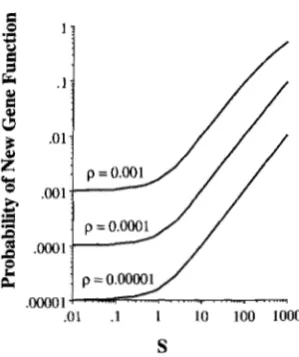
FIGURE 2.-Plot of Equation 4, the probability that a dupli- cated gene fixes an advantageous (rather than a null) allele as a function of the ratio p of advantageous to null mutation rates and S = 4N2 where s is the selective advantage of advan- tageous mutations.
locus (and hence starts towards the evolution of a new function) rather than becoming a pseudogene is
As expected, uB increases with both the scaled strength
of selection S and the advantageous mutation rate ratio
p .
Figure
2
plots this probability for various values of S= 4N2 and p. When S is either very large (so that 1 - e-~‘ = 1) or very small (1 - e-” = S) these approxima- tions reduce Equation 4 to
“ ‘ 2 p L 2
{
Sp for Sp 1 for S 9 11
+
SP I - ( p ~ ) ” for sp 8 1(5)
These are reasonable in that when S
<
I, the advanta- geous mutations are effectively neutral and the chance that the duplicated gene fixes an advantageous muta- tion first is given by the ratio of mutation rates because both classes of alleles have the same probability of fixa- tion. Conversely, even when advantageous mutations are strongly selected ( S*
1 ) , if they are sufficiently rare (Sp 4 1) the probability that the duplicate locus is inactivated is very high. Only if p %S’
is the probabil- ity that the duplicate copy fixes an advantageous allele first high.Results for a distribution of selection advanta- geous: The above analysis assumed all advantageous mutations have the same selection coefficient s. If muta- tions instead have s drawn from a distribution of selec- tion coefficients, Equation 4 applies provided S/(1 -
ePS) is replaced by its expected value and pp is interpre- ted as the mutation rate to any advantageous allele.
A common assumption about the distribution of fit- ness effects is that most mutations have small fitness effects, with mutations with larger effects becoming in- creasingly infrequent, which suggests that an exponen- tial distribution of (advantageous) fitness effects is not unreasonable. Under this assumption, if the mean value of selection coefficients is given by 5 the expected value of
S/
( 1 - e-’) iswhere
S
= 4NeSandis the trigamma function (ABRAMOWITZ and STECUN 1970, Sec. 6.4). Using the asymptotic approximations
the rate of fixation under an exponential distribution of advantageous mutations is
giving the probability of a new gene function as
Hence provided
S
= 4NeE[s] is sufficiently large or small, Sreplaces S in Equation 5 .for example a null allele with a second mutation is still regarded as a null allele.
The second way new mutations can influence the probability of fixation is, however, a significant concern to us. New mutations can arise that alter the fitness of the original allele. For example, if the original mutation is a null allele (assumed neutral), but an advantageous mutation arises, the dynamics of fixation are altered as the null allele is no longer neutral. In a sufficiently small population this is not a problem as fixation usually occurs before the next mutation appears. In a very large population, however, the expected fixation time is long and new mutations affecting the probability of fixation of the original mutation can arise. If the mutation des- tined to become fixed is advantageous, the appearance of new null mutations should not pose a problem as we treat these as neutral and hence their appearance will not alter the fixation dynamics of the positively selected mutation. However, if the mutation destined to become fixed (in the absence of new mutations influencing its fitness) is a null allele, in a large population new advan- tageous mutations can appear as the neutral null muta- tion is headed towards fixation and the possibility exists that one of these advantageous mutation will become fixed in place of the null mutation. Hence, our analysis underestimates the probability that a duplicated gene fixes an advantageous mutation as some of the paths counted as fixing null mutations in fact fix an advanta- geous mutation.
We can correct for this by noting that if 7r is the probability that no advantageous alleles are fixed on a path assumed fixed for a null allele (in the absence of‘ mutations influencing its fitness), then the corrected rates are
a< = UT, 6, = b
+
(1 - 7r)a (10)giving the corrected probability of fixation as
bc
a,
+ b,
UB, = _ _ - - 1 - T ( 1 - U S ) (1 l a )
= U B
+
(1 - ~ ) ( l - U S ) ( l l b )which (as expected) exceeds uB.
We compute 7r as follows. Advantageous mutations can only arise from functional alleles. Thus if nTdenotes the total number of functional alleles present along the entire sample path leading to fixation, the expected number of advantageous mutations appearing on a path of a null allele destined for fixation (in the absence of mutations) is n+p. Because each new advantageous mutation has probability of fixation U( 1/2N), the prob- ability that none of these mutations is fixed is
T = [I - U ( I / ~ N ) ] ” T ~ ’ ” exp[-ppn,U(1/2N)] (12a)
Since our concern (with large population size) is advan-
7r = e x p ( - p p S g )
To compute nT, note this is just the conditional expecta- tion
E(2N( 1
-
yJI
Allele fixed) dt (13)where
y t
is the frequency of the null allele at time t, so that 1 - yt is the frequency of functional alleles. Thisexpectation is a standard problem in conditional diffu- sions and can be solved using Green’s functions (MARU- YAMA 1977). The Green’s function for a neutral allele conditioned on that allele going to fixation (in the a b sence of mutation to other alleles), from Equation 5.18 of MARUYAMA (1977) is
4N, for x
<
y;
+(X? y) = y 1 - x (14)
4Ne
-
-
for x>
y,1 - y
x
where x is the starting frequency of the allele going to fixation. Hence the expected total number of copies of functional alleles that appear during the fixation of a null allele given that allele starts at frequency x is
In our case, n7’ used in Equation 12b assumes we start with a single copy, giving
Substituting into Equation 12b gives
7 t = exp(-77pS)
where
426 J. B. Walsh
2t. The arguments used above give the rate at which successful null mutations arise as
S
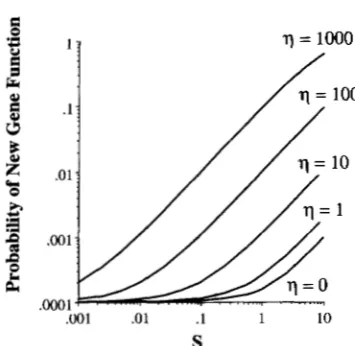
FIGURE 3.-The effect of applying the large population correction (Equation 18a) when p = 0.001. The large popula- tion correction factor is 17 = 2Nep, where p is the null allele mutation rate. 17 = 0 corresponds to Equation 5, while the four other curves plot the probability of fixation for 17 = 1, 10, 100 and 1000.
e-qP"
1 + p s
II 1 - _ _ _ for S P 1 (18b)
As Figure 3 demonstrates, unless
7
9 1 the large popula- tion correction is very minor. However, if7
P 1, so that on average many mutations arise each generation, Equation (5) greatly underestimates the probability that an advantageous allele is fixed first.Continuing differentiation following the first advan- tageous fixation: The evolution of two functional diver- gent loci following a gene duplicate is likely a multistep process. Obviously, a key step is the fixation of an advan- tageous allele conveying some functional difference (however slight) on the duplicate copy. However, the risk still exists that this emerging gene may subsequently fix a null allele. It is not unreasonable to assume that the fixation of the first advantageous allele provides a selective barrier that greatly hinders the fixation of null mutations. We examine just how much of a barrier by considering the probability of fixing second advanta- geous mutation rather than null allele. As above, a sim- ple three-state Markov model is used with A being the inactive state, B the starting state (the population is fixed for one advantageous mutation) and D that state of being fixed for two advantageous mutations (Figure 1). Let p and pp be the mutation rates to null and advantageous mutations, respectively. Because the pop- ulation starts out fixed for an advantageous allele, null mutations are now deleterious (with selection coeffi- cient s), while we assume newly arising advantageous mutations are additive with fitnesses 1 : 1
+
t : 1 +and the rate for successful advantageous mutations as
where
S
= 4Ng and T = 4N,t. Settinga
= t / s , the probability that the duplicate gene acquires a second advantageous mutation rather than becoming inacti- vated isWhen t = s,
Hence, if S P 1 selection provides a considerable barrier to the fixation of a null allele before the subsequent fixation of a second advantageous allele. In particular, note from Equation 5 that the condition for a high probability of fixing the first advantageous allele is that
Sp 9 1, while the condition for fixing the second, given the first fixation, is ~ ? p P 1, which is much less stringent.
DISCUSSION
A recently duplicated locus can experience a variety of fates. On one hand, it may fix an advantageous allele giving it a slightly different, and selectable, function from its original copy. This initial fixation provides sub- stantial protection against future fixation of null muta- tions, allowing additional mutations to accumulate that refine functional differentiation. Alternatively, a dupli- cate locus can instead first fix a null allele, becoming a pseudogene. In such cases the original sequence iden- tity of that locus is rapidly eroded by the accumulation of mutations (since essentially all subsequent changes in this sequence are expected to be neutral) masking any indication of the original duplication event. While pseudogenes are apparent evolutionary deadends, they nevertheless are very useful to evolutionary biologists by giving a much less biased picture of genome mutational events than provided by sequences under selection.
crossing over as well as assuming null mutations are neutral and that each new mutation is either fixed or lost before the next occurs) the probability that a newly duplicate locus fixes an advantageous allele before fix- ing a null allele is
(yS
+where S = 4N2, four times the product of the effective population size and the selective advantage of an advan- tageous allele, and p is the ratio of the advantageous to null allele mutation rates. Analysis of this expression shows that unless pS 9 1, a duplicate locus is much more likely to become a pseudogene than evolve a new gene function.
Even when Sp
<
1, the probability that a duplicate locus starts on the road to the evolution of a new func- tion by fixing an advantageous allele can be greater than one might expect given p. For example, supposes = 0.01, N, = 5000, and p = 5 X lop5 so that only one advantageous mutation appears (on average) for each 20,000 mutations that silence the duplicated copy. In this case the probability of fixing an advantageous muta- tion rather than silencing is 1
%.
While this is not ex- tremely high, it is many orders of magnitude larger than p. This occurs because even through advantageous mutations are very rare, they have a much higher proba- bility of fixation than a neutral allele. Thus while many more null mutations appear, the chance that any one is fixed is very small [1/(2N)]. Conversely, while advan- tageous mutations are very rare, each such mutation has a reasonable probability of fixation (2s when S 9 1).As
population size increases, the probability of fixa- tion for any null allele decreases while the fixation prob- ability for the advantageous mutation approaches 2s, increasing the probability that an advantageous allele is fixed first. In our example, as A', increases to 50,000 and 500,000, this probability increases to 9 and SO%, respectively.As we noted above, the assumptions used in this sim- ple model are likely conservative in that when violated they result in a larger probability that an advantageous allele is fixed before a null allele. An especially im- portant assumption is the neutrality of null allele geno- types. Results reviewed at the beginning of this paper suggests any error introduced by this assumption is likely small when only double null homozygotes (indi- viduals with four null alleles) are selected against. How- ever, if individuals carrying three (or fewer) null alleles are also selected against, the time to gene silencing is considerably longer than under neutrality and hence the probability of fixing such null mutations is consider- ably less than we have assumed, greatly increasing the probability that an advantageous allele is fixed first. HUGHES and HUGHES (1993), examining the substitu-
tion rates of duplicate genes in Xenopus, concluded that selection likely occurs on genotypes carrying fewer than four null alleles, implying that the probability of fixing an advantageous allele rather than a null allele is much higher than the expression given by our simple model.
A second assumption of our simple model is that the two duplicate copies are unlinked. While linked duplicate genes appear to be fairly common in animals, in plants duplicate genes appear to be mostly unlinked (MCGRATH et al. 1993; THOMAS et al. 1993). Extrapolat- ing from the work on linkage and gene silencing, the effect of linkage is to make null alleles more neutral so that our model may actually be more accurate under tight linkage than loose linkage.
There are, however, situations in which our model overestimates the probability of fixing an advantageous allele first. The first case is positive selection for gene silencing (ALLENDOW 1979). This is unlikely in that the conditions favoring positive selection to fix a null allele are also likely conditions that select against the initial fixation of the original gene duplication. The second set of cases is where there is selection against functional divergence. For example, suppose the original locus was controlled by a limiting amount of transacting DNA
binding factors, such as enhancers. Following duplica- tion there is competition for these factors among the two copies (e.g., ENVER et al. 1990). In such cases, selec- tion would likely act against mutations altering the func- tion of either copy as this reduces the concentration of trans-acting factors available to copies of the gene with the original function. However, a mutation that inacti- vates (or even reduces) the enhancer binding on the one the duplicate copies is effectively neutral.
Finally, we need to stress that our results assume that the molecular events generating the duplication leaves both copies completely functional. The duplication event itself may create a new function by generating an internal partial duplication or chimeric sequence in the newly duplicated gene (e.g., SMITHIES et al. 1962). Alternatively, the duplication event may inactivate one of the copies, such as duplication by processed pseu- dogenes
(.g.,
W a s H 1985).428 J. B. Walsh
likely to lead to new gene function. Nevertheless, there are unified features of the two approaches. In particu- lar, OHTA showed that the quality
was critical in determining the relative frequencies of
null and functional alleles in her evolving gene families. When
R
is small most sequences in the gene family are null alleles, while when R is large most sequences are functional. The U in Equation 23 refers to the fixation probabilities of new mutations, u denotes the mutation rate and the subscripts+
and - denote advantageous and null alleles, respectively. From Equation 1 , the probability that an advantageous allele is fixed first in our simple model can be expressed asUA UI R ( R for R < 1
for R S 1
1
Hence, the conditions for functional alleles to domi- nate over null alleles in Ohta’s simulation are essentially identical to our conditions for new advantageous alleles predominating over null alleles. Given the Ohta’s simu- lations allowed for unequal crossing over and started with a single copy (and hence considered many of the unique evolutionary features of multigene families), while our simple model ignores most of these features suggests that our model captures robust features of the evolution of new gene function.
A N D Y CLARK and two anonymous reviewers provided useful com- ments. This work was supported by the National Science Foundation.
LITERATURE CITED
~ R A M O W I T Z , M., and I. A. STEGUN, 1970 Handbook ojMathematica1 Functions w’th Formulas, Graphs, and Mathematical Tables. National Bureau of Standards, Washington, DC.
AI.I.ENDORF, F. W., 1979 Rapid loss of duplicate gene expression by natural selection. Heredity 4 3 247-258.
BAILEY, G. S., R. T. M. POULTER and P. A. STOCKWEI.I., 1978 Gene duplication in tetraploid fish: model for gene silencing at un- linked duplicated loci. Proc. Natl. Acad. Sci. USA 75: 5575-5579. BASTEN, C. J., and T. OHTA, 1992 Simulation study of a multigene
family, with special reference to the evolution of compensatory advantageous mutations. Genetics 1 3 2 247-252.
BRIDGES, C. B., 1935 Salivary gland chromosome maps. J. Heredity
CI-IrusTImsEN, F. B., and 0. FRYDENBERG, 1977 Selection-mutation balance for two nonallelic recessives producing an inferior dou- ble homozygote. Am. J. Hum. Genet. 2 9 195-207.
26: 60-64.
CIARK, A. G., 1994 Invasion and maintenance of a gene duplication.
Proc. Natl. Acad. Sci. USA 91: 2950-2954.
ENVER, T., N. RAICH, A. J. EBENS, T. PAPAY~NOPOULOU, F. COSTAN-
TINI et al., 1990 Developmental regulation of human fetal-to- adult globin gene switching in transgenic mice. Nature 344: 309-
313.
FISHER, R. A., 1935 The sheltering of lethals. Am. Nat. 69: 446-455. GILBERT,
w.,
1978 w h y genes in pieces? Nature 271: 501. HALDANE, J. B. S., 1932 The Causes ofEvolution. Longmans Green,London.
HALDANE, J. B. S., 1933 The part played by recurrent mutation in evolution. A m . Nat. 67: 5-19.
HUGHES, M. K., and A. L. HUGHES, 1993 Evolution of duplicate genes in a tetraploid animal, Xenopus lamis. Mol. Biol. Evol. 10:
KIMURA, M., 1957 Some problems of stochastic processes in genet-
KIMURA, M., and J. L. KING, 1979 Fixation of a deleterious allele at one of two “duplicate” loci by mutation pressure and random drift. Proc. Natl. Acad. Sci. USA 76: 2858-2861.
LJ, W.-H., 1980 Rate of gene silencing at duplicate loci: a theoretical study and interpretation of data from tetraploid fishes. Genetics
MARUYAMA, T., 1977 Stochastic Problems in Population Gnrtirs.
Springer-Verlag, Berlin.
MARWAMA, T., and N. TAKAHATA, 1981 Numerical studies of the frequency trajectories in the process of fixation of null genes at duplicate loci. Heredity 46: 49-57.
MCGRATH, J. M., M. M. JANCSO and E. PICHERSKY, 1993 Duplicate sequences with a similarity to expressed genes in the genome of
Arabidqpsis thaliana. Theor. Appl. Genet. 86: 880-888.
NEI, M., 1970 Accumulation of nonfunctional genes on sheltered chromosomes. A m . Nat. 104 311-322.
NEI, M., and A. K ROYCHOUDHURY, 1973 Probability of fixation of nonfunctional genes at duplicate loci. A m . Nat. 107: 362-372. OHNO, S., 1970 Evolution by h eDuplication. Springer, Berlin. OHTA, T., 1987 Simulating evolution by gene duplication. Genetics
115: 207-213.
OHTA, T., 1988a Further simulation studies on evolution by gene duplication. Evolution 42: 375-386.
OHI‘A, T., 1988b Time for acquiring a new gene by duplication. Proc. Natl. Acad. Sci. USA 85: 3509-3512.
OHTA, T., l988c Evolution by gene duplication and compensatory advantageous mutations. Genetics 120: 841-847.
OHTA, T., 1989 Time for spreading of compensatory mutations un- der gene duplication. Genetics 123: 579-584.
SMITH, C. W. J., J. G. PATTON and B. NADAI.-GINARD, 1989 Alterna-
2 3 527-577.
tive splicing in the control of gene expression. Annu. Rev. Genet.
SMITHIES, O., G. E. CONNEIL and G. H. DIXON, 196‘2 Chromosomal rearrangements and the evolution of haptogolin genes. Nature 196: 232-236.
SPOFFORD, J. B., 1969 Heterosis and the evolution of duplications. Am. Nat. 103: 407-432.
TAKAHATA, N., 1982 The disappearance of duplicate gene expres- sion, pp. 169-190 in MolecularEvolution, Protein Polymorphism and the Ne-utral T h e q , edited by M. KIMuRA,Japan Scientific Societies Press, Tokyo.
TAKAHATA, N., and T. MARUYAMA, 1979 Polymophism and loss of duplicate gene expression: a theoretical study with application to tetraploid fish. Proc. Natl. Acad. Sci. USA 76: 4521-4525. THOMAS, B. R., V. S. FORDS, E. PICHERSKY and L. D. GOTTLIFX, 1993
Molecular characterization of duplicate cystosolic phosphoglw cose isomerase genes in Clarkia and comparison to the single gene in Arabidopsis. Genetics 135: 895-905.
WAI.SH, J. B., 1985 How many processed pseudogenes are accumu-
lated in a gene family? Genetics 110: 345-364.
WATTERSON, G. A,, 1983 On the time for gene silencing at duplicate loci. Genetics 105: 745-766.
1360-1369.
ics. Ann. Math. Stat. 28: 882-901.
95: 237-258.