Copyight 0 1996 by the Genetics Society of America
Two Persistent LINE-1 Lineages in Peromyscus Have Unequal Rates of Evolution
N. Carol
Casavant,
A m y
N.
Sherman’
and
Holly
A.
W i c h m a n
Department of Biological Sciences, University of Idaho, Moscow, Idaho 83844
Manuscript received October 27, 1995
Accepted for publication December 23, 1995
ABSTRACT
LINE-1, the major family of long, interspersed repeats in the mammalian genome, moves via an RNA
intermediate and encodes its own reverse transcriptase. Comparative sequence analysis was used to reconstruct the phylogenetic history of LINE-1 dynamics in the deer mouse, Peromyscus. As is the case
in M u s and Rattus, a very small number of active templates produce the majority of LINE-1 copies in
Peromyscus. However, in contrast to the single LINE-1 lineage seen in the muroid rodents, Peromyscus has at
least two LINE-1 lineages whose most recent common ancestor probably existed before the peromyscine radiation. Species-specific variants of Lineage 1, and intact open reading frames in the youngest elements of both Lineages 1 and 2, suggest that both lineages have remained active within the same genome. The higher number of shared-sequence variants in Lineage 1 relative to Lineage 2 suggests that Lineage 1 has replaced its master template much more frequently than Lineage 2 or that the reverse transcriptase Lineage 1 is more error prone. The implications of the method used to acquire LINE-1 sequences for analysis are discussed.
L
INE-1 is the major family of long, interspersed re- peats in the mammalian genome. It is dispersed via retrotransposition and is present in tens of thou-sands of copies per haploid genome in all species exam-
ined to date (for reviews, see ROGERS 1985; SKOWRONSKI
and SINGER 1986; EDCELL et al. 1987; HUTCHISON et
al. 1989). LINE-1 has been detected by Southern blot
analysis throughout seven orders of mammals including
Marsupialia (BURTON et al. 1986), suggesting that it was
present in the common ancestor of subclass Theria. It
has been characterized at the sequence level in a nar- rower range of species, including house mice ( M u s ;
MARTIN et al. 1985;
R
r
m
et al. 1991; CASAVANT andHARDIES 1994), rats (Rattus; D’AMBROSIO et al. 1986),
voles (Microtus and Arvicola; VANLERBERGHE et al. 1993), deer mice (Peromyscus; USS et al. 1992), rabbits (Orycto-
lagus cuniculus; PRICE et al. 1992), and primates (Homo;
JURKA 1989; SMIT et al. 1995). However, these sequence
analyses vary not only in the number of elements and
amount of sequence examined, but also in the method used to select elements for analysis.
A full-length LINE-1 consists of a 5‘ untranslated re-
gion that includes the promoter, two open reading
frames (Oms), a 3‘ untranslated region, and an A-rich
tail. The second OW, which encodes reverse tran-
scriptase, is the most conserved portion of the element. However, in M u s only 10% of the elements are full
length (HUTCHISON et al. 1989), and many of these have
accumulated debilitating mutations within the ORFs, so
Curresponding author: Holly A. Wichman, Department of Biological
Sciences, University of Idaho, Moscow, ID 83844. E-mail: [email protected]
’
Presrnt address: Department of Genetics, Stanford University Medi-cal Center, Stanford, C A 94305.
Genetics 142 1289-1298 (April, 1996)
the vast majority of LINE-1 elements in the these ge-
nomes are pseudogene copies incapable of propagation.
Because there are tens or hundreds of thousands of LINE-1 elements per genome, it is difficult to identify
active elements. As a result, most of what is understood
about LINE-1 movement comes from comparative se-
quence analysis of elements that may not be capable of producing copies, but can nevertheless yield informa-
tion about the active element that gave rise to them. A
major conclusion of such analyses is that most LINE-1s
are produced by one or a few closely related templates termed “master” elements, and that over evolutionary time, these masters are replaced by a small number of
their own progeny to form a lineage of “sequential
masters” or “molecular drivers” (DEININGER et al.
1992). This model predicts that phylogenetic analysis of randomly selected elements will yield a tree with a
single major lineage rather than a highly branched tree
with many independent clades (CLOUGH et al. 1996).
Analyses of LINE-1 sequences from mouse and rat yield
trees with a single major lineage
(Rrm
et al. 1991;PASCALE et al. 1993; ADEY et al. 1994; CASAVANT and
HARDIES 1994; FURANO et al. 1994), although examina-
tion of the youngest elements in a lineage may reveal
a more branched tree suggestive of multiple simultane-
ously active but closely related master elements (MAR-
TIN et al. 1985; CASAVANT and HARDIES 1994; HOL,MES
et al. 1994; DOMBROSKI et al. 1993).
1290 N. C. Casavant, A. N. Sherman and H. A. Wichman
(WILLARD et al. 1987; BRITTEN et al. 1988; RIKKE et al.
1991; SHEN et al. 1991; DEININGER et al. 1992; DEININGER and BATZER 1993; CASAVANT and HARDIES 1994). Fur- thermore, these diagnostic markers can be sequentially
ordered, in which case the older elements will share
only the sequence variants that occurred earliest in the evolutionary history of the lineage while the youngest elements will share those older variants as well as more recently derived diagnostic differences. Subfamilies (clades) can be identified on the basis of shared restric- tion sites or single basepair variants. Subfamilies or clades within a single lineage will be nested ( i e . , a sub- family defined by recent sequence variants will be in- cluded in an older subfamily because the younger ele- ments will contain all of the older variants that define the whole lineage in addition to the youngest sequence variants not found in the older elements). Because ele-
ments accumulate changes as they sit in the genome,
sequence divergence between elements within a sub- family is greater for older subfamilies and very small
for the youngest subfamilies. Thus there are several
ways to recognize recently active lineages: members will share sequence variants accumulated over time by the sequential master elements, the youngest elements will have very limited sequence divergence from each other, and very young elements might be expected to have intact open reading frames.
Mus, h t t u s , and human LINE-1s have been more ex-
tensively characterized than the elements of any other species; in fact, characterization in other species is gener- ally limited to a single study. Most of what is known
about LINE-1 comes from studies of a limited number
of species, and it is not clear how applicable the findings
may be to other species. For example, our current model
for the dynamics of LINE-1 amplification is based on
data from Mus species, but this model may not apply to
all mammalian taxa (see for example VANLERBERCHE et
al. 1993). Additionally, most (but not all) studies in Mus
and Rattus have been carried out on inbred strains. If
inbreeding alters the fixation rate of polymorphic inserts or the activity of master elements, it would be important to study LINE-1 in natural populations.
Here we report further characterization of LINE-1 in
mice of the genus Peromyscus. Peromyscus is a genus of
New World rodents that diverged from Mus -35 mya
(BROWNELL 1983). Peromyscus has been used extensively as a model system for mammalian evolution and popu-
lation genetics (KING 1968; KIRKLAND and LAYNE 1989).
The two species used in the present study (Peromyscus
leucopus and P. maniculatus) are extremely wide ranging
and are the most intensely studied members of the ge-
nus. These studies complement ongoing analysis of mys
(WICHMN et al. 1985; BAKER and WICHMAN 1990; Lee
et al. 1996), a retrovirus-like element found in Peromyscus
but absent in Mus.
MATERIALS AND METHODS
DNA Clones (pDK55 and pDK62) containing LlPm55
and LlPm62 were generous gifts from W. DAWSON. P. manicu-
latus (TK29798; Orono, Maine) and I? lrucopus (TK43952;
Orono, Maine) tissues were generous gifts from R. BAKEK.
An additional P. leucopus specimen (20-3-143234; Browning,
Texas) was also used.
Mouse DNA preparation: DNA was extracted from the tis-
sues either by the standard phenol extraction or by the
method ~ ~ L O N C M I K E et al. 1988. The DNA concentration was
determined on an LS30 Luminescence Spectrometer (Perkin
Elmer, Nomalk, CT) using a Hoechst staining method (IA
BAKCA and PAIGEN 1980).
Construction of the LINEl libraries: Two libraries were
constructed by isolating a 3.0-kb XbaI fragment from P. leuc(>
pus (TK43952) and P. maniculatus genomic DNA. DNA was
extracted from the agarose gel using a Bio 101 GeneClean
kit. The purified fragments were ligated into both pUC19
and Bluescript vectors from Stratagene and transformed into
competent Escherichia coli DH5a cells without an outgrowth.
Screening for single colonies was performed using probes
made from the inserts of both pDK55 and pDK62 clones. Single clones were isolated, purified, and sequenced.
The LINE-1 pDK55 and pDK62 inserts were labeled usiug
the USB random priming kit and [ay'P] dCTP (800 Ci/
mmol) from NEN. Hybridizations were performed overnight in 5 X SSCP ( I X is 120 m~ sodium chloride, 15 ~ I M sodium
citrate, and 20 mM sodium phosphate), 2 mg denatured
salmon sperm and 1 X Denhardt's. Hybridization was carried
out overnight at 55". Filters were washed three times for SO
min each with 5 X SSCP at 55".
A third library contained PCR derived fragments from P.
lrucopus 20-3-143234 genomic DNA. Clones containing these
fragments are designated Leu*. The fragments were amplified with primers PEROLlF (AAGGATCCG(~GGATAC(;ATC- AACTCA) and PEROLl R (AAAGGATCCCAATTCGATTCC- ATTGGT) that are specific for conserved sequences within
the collection of rodents in Figure 1. The reaction mixture
for amplification included: 200 p~ dNTPs, 1.5 ~ I M MgC12,
1 X Amplitaq reaction buffer, 50 pmoles of each primer and
approximately 100 ng of genomic DNA in a total volume of
50 pl. The conditions for amplification included an initial
denaturation at 95" for 5 min followed by 25 cycles of the
following: 30 sec at 95", 30 sec at 50", and 1 min at 72".
The fragments were ligated into pGEMT vector (Promega). Fragments generated from the PCR derived method were
screened to determined if the insert was either a Lineage 1 or
Lineage 2 representative. The probes were oligonucleotides
specific to Lineage 1 (Clade 1-3', TTGTCATATAGGTCC) and
to Lineage 2 (Clade 2.2 GATCTCCCATGCTCA). End label-
ing of the oligonucleotides was done according to standard
procedures (ALJSIJREI. et al. 1989) in a 20 p1 volume with 10
pmoles of oligonucleotides and 15 pmoles of [y'"P] ATP
(6000 Ci/mmol). DE52 columns were used to remove thc
unincorporated ATP (AUSLIBEI. pf ul. 1989). Blots were prehy-
bridized for 1 hr at 25" in 50 ml hybridization buffer [ 6 X
SSC, 10X Denhardt's, 0.3% (w/v) SDS] augmented with 2
mg of sheared, denatured salmon sperm. Blots were hybrid-
ized with probe overnight at 25" in 20 ml of hybridization
buffer. Blots were washed three times for 30 min each i n 6 X
SSC at 42" and exposed to film overnight.
Sequencing the LINEl elements: Individual clones were
sequenced by the dideoxy chain termination method o f
SANCXK et al. 1977, as per USB sequencing kit or Epicentre Technologies SequiTherm Cycle sequencing kit instructions.
The sequences reported were verified by sequencing the coni-
plementary strand. The individual readings were assembled into contiguous sequences using the GeneWorks Sequencing Project program.
Sequence collection: Previously published sequences used
in thc analysis were: P. maniculatus, GenBank accession No.
LINE-1 Lineages in Peromyscus 1291
1228-1419, and M9751 (KASS et al. 1992), LlPm62 coordi-
nates 708-837 and 880-1356 (KASS et al. 1992); Cricetulus
g r i s m s , EMBL accession No. X15465, LlCg, coordinates 157-
721 (MILES and MEUTH 1989); M u s domesticus, LlMdA2, coor-
dinates 5020-5631 (LOEB et al. 1986); and Rattus nm-uegzcus,
GenBank Accession No. M13100, LlRn3A, coordinates 4665-
5277 (D'AMBROSIO et al. 1986). The 19 sequences were assem-
bled into an alignment with the Geneworks alignment pro-
gram, and subsequently adjusted by hand with the GeneWorks
editor.
The phylogenetic trees: The DNA and Protein trees were
derived using PAUP, version 3.0s (SWOFFORD 1990) using the
Bootstrap 1000 replication heuristic algorithm. The parame- ters within the heuristic search options included: only mini- mal trees were kept, stepwise addition was random with 10 replications, and the branch swapping was by tree bisection- reconnection (TBR). The distance tree was derived using
neighbor joining (SAITOU and NEI 1987) in PHYLIP, version
3.5C, using the Kimura two-parameter method (KIMCTRA
1980). Painvise differences were based on the distance matrix derived in PAUP.
RESULTS
Collecting LINEl elements specific to Peromyscus:
Because we wanted to collect elements that would re-
flect the dynamics of LINE-1 amplification in Peromys-
cus, we adopted a strategy that would bias against both
the selection of only young elements and the probabil- ity of selecting mainly relic elements. We chose to col- lect elements contained in a major hybridizing restric-
tion band seen in several diverse species of Peromyscus
when probed with either of the previously characterized
LINE-1 sequences from P. maniculatus, LlPm55 and
LlPm62. KASS et al. (1992) showed that both of these
probes hybridize strongly to a 3.0-kb XbaI band in a
number of Po-omyscus species. We found strong hybrid-
ization of these two probes to the above-mentioned XbaI band in Peromyscus (leucopus, maniculatus, truei, calqorni-
cus, df$cilis, and polionotus). We supplemented this with
three PCR amplified LINE-1s from P. leucopus.
Our approach was to collect LINE-1 elements whose shared-sequence variants would define the lineage(s)
existing within the P. maniculatus-leucopus species com-
plex. We therefore isolated a number of LINE-1 ele-
ments from the 3.0-kb region of P. leuc~$us and P. man-
iculatus. We have sequenced a 600-bp region within
ORF 2, the reverse transcriptase domain, of 14 different
Peromyscus LINE-1 elements (eight from P. maniculatus
and six from P. leucopus, Figure 1) to construct a phylo-
genetic history of LINE-1 within the genus Peromyscus.
Division of young peromyscine LINEl elements into
two major groups based on shared-sequence variants:
The 1 4 LINE-1 sequences we isolated were compared
with two other P. maniculatus sequences (L1Pm55 and
LlPm62), another cricetid sequence (LlCg, C. griseus)
and two muroid rodent sequences (LlMdA2, M. domes-
ticus; LlRn3A, R. novvegicus), giving a total of 19 se-
quences. These 19 sequences are divided into three
groups (Figure 1) , with sequences from both P. leucopus
and P. maniculatus represented in all three groups. The
bottom two groups, containing 13 of the 14 newly col-
lected sequences, are distinguished from each other by their mutually exclusive shared-sequence variants. These variants are indicated in the alignment. The third
group, consisting of the first six sequences in Figure 1,
does not share these specific variants. This group con-
tains the outgroup sequences and was utilized to deter-
mine the ancestral state of the shared-sequence variants in the other two groups. To further understand the evolutionary relationship within and among these three groups, phylogenetic trees were derived from both their
DNA and protein sequences.
Phylogenetic trees further delineate the relationship
of the Peromysncs elements: To derive the most parsi-
monious tree, the two muroid sequences, LlMdA2
( M u s ) and LlRn3A (Rattus) were used to root the crice-
tid sequences. LlCg (C. p'seus, Chinese hamster) could
not be used as an outgroup because some of the other cricetid sequences appear to be as old as, or older than, this element.
The most parsimonious tree (Figure 2) revealed that the sequences were divided among two distinct lineages
and their ancestors. Lineage 1 includes: Man29,
Manl08, ManllO, Leu2-22, Leu*l-2, Manl05, Man27,
and ManlO9. Lineage
2
includes: Man28, Leu*2-1, andLeu*2-2, Leu45, and ManlO6. The sequences ancestral
to these two lineages include LlPm55, and possibly
LlCg, LlPm62, and Leul-18. The order and percent bootstrap confidence levels were taken from PAUP. The lineage-specific shared-sequence variants were initially
determined using MacClade ("IDISON and MADDI-
SON 1992), and when possible, ambiguous sites were
resolved manually. The lineage-specific variants are
listed at the node where they were acquired by the
master template.
Although this is the most parsimonious tree, there
are some branches with relatively low confidence scores,
thus their order in the tree is not well resolved. The most significant unresolved placement is whether Leul-
18, LlPm62, and LlCg inserted within the early history
of either lineage (Figure 2) or before the split between the two lineages. A tree (Figure 3a) derived by bootstrap analysis of the translated sequence (not shown) of those
elements that contained an intact reading frame
(LlMdA2, LlRn3A, ManlO9, Man27, Leu2-22, Leu*l-2, ManlO6, and Leu*P-1) plus sequences where frameshift
mutations could be easily deduced (Leu45, Man29,
LlCg, and Leul-18) places Leul-18 and LlCg within
Lineage 1, but with a confidence value of only 52%.
The DNA tree in Figure 3b, derived by a distance
method known as neighbor joining, places Leul-18,
LlPm62, and LlCg early in the history of Lineage 2.
All of these trees support three conclusions. First,
there are at least two major LINE-1 lineages in Peromys-
cus. Second, Leul-18, LlPm62, and LlCg inserted into the genome approximately at the time of the split be-
tween the two lineages or early in the history of one of
N. C. Casavant, A. N. Sherman and H. A. Wichman 1292 LlMdAZ LlRn3A LlFm55 Llcg LlRn62 Leul-18 Man28 Leu'2-1 L*"=2-2 Leu4-5 Man106 nan29 Man108 nan110 Leu*1-2 Man105 LeU2-22 Man109 Man27
L l n m LlRn3A LlFm55 Llcg LlPm62 Leul-18 Man20 Leu'2-1 Leu'2-2 Leu(+ Man106 Man29 Man108 Man110 L*u*1-2 Le"2-22 Man105 Man27 Man109 LlRn3A LlHdRz Llmns5 Llcg LlPm62 Leul-18 Man28 LeU'2-1 LeU'2-2 Leu4-5 Man106 Man29 Maan108 Man110 Le"'l-2 Leu2-22
n m m s
Man109
na"27
FIGI
... ... ... ... ...
...
......
...
... ... ... ... ... ...caqagaactc ctaaacctga taaacaqctt cqqtqaagta gttgqatata aaataaastc --aaacaagt caatggcctt tctctataca aapaataaac aqgctgagaa agaaattagq gaaacaacac ccttc[[tca stagtcacaa
lo 2 0 10 40 SO 60 7 0 80 90 l o o 110 120 110 140 150
... ga
...
g . . . . ... a... .a.ca....g .c...g.... .... t... t..a. . . g . t... c ... a g . g . . . . . a . . c . . . ... ...'I.... ... []at. ....a.C...... ga.. ..t
...
c.gtc.....
tg.. . a . a a . . . .ca....ta. .... t...a. -ac..a..a. -gg.a... c.aa... .. tc... ... et.. a ... t .tc..[]a.. .~.a.~.t.."""""""""""""""""""""""""
_"""
... ... .... .. ...g.tt5at E - - - . . . ...tc... .a..s.c..g .ca C. . g . . t....a aa...a..a. --... . . g . =...a. c..a..~... tg... = . . a t... -a..t[[a.. c . . .
a . . a . ..gae..t.c. a..a...g.. q.ag....ct qca C C . . ~ q.t. t.a.t[la.. tca..t.
...
......
.. ... ... ....... gt ... c.q.... C ... c... .a..a.t..g .ca
...
E. .q..t... a.ta. ,.gca.t.c. ca.a... .. tg ... t q.a.ca.... .t....e..a ... tt.. .... t[]at.....
c . . ....
g . . . ... t.g.... ... r c . . . .a..a.&.g .ca ... c. . g . . c . . . --... a . . a . . . g . a...c. .. qa... .. tg ...e qa...
% = . . a ... t... .... t[]a.. .... c . . ."""""""""" """""""""" """""""""" """""""""""""""""""""""""
_""""_
a..g. t.q.a..tc. c..a..c... .. tq ....A g = . . a ... t...
....
t[la......
c...q...t c.q.... T c . . . .a..a.&.g .=a . g . . c . . . - - . . . = . . a . ..I. a,..=. c..a..C... tg ...e g Q.c..~ t... t[]a.. e . . .
---..a..a. g.a...a. c..a..e... tg.. A g =..a t... t[la.. c...
...
g... ..t ... c . g . . . . ... p , . . .a..a.A..g . E =...
C . . g . . c . . . --... a..a...
g.a...c. c..a..c... .. tg ... A g ... =..a ... t... .... t[]a.. .... c . . . , ....
.. .. ...
...
... .... ....... ... ... ... .. ... ... .... ....
..s...z s..r.g..z. ... C...
.*...? &.&. g.,z. ... C . . .
.*...&.& g..;. C . . .
.cw...z.
a ~..&.q..r....
c . . ..cw... *.a ~ . . ~ . g . . r .
....
& . E . . ....
""""""""""_
""""". s . . . z . s i..&q..E. ... C... .g..
.f.S
E..E.g..f. ... C . .."
.a.+.+.+ .ea ... c.
.a.p.+.! aca...c.c. .a.ca.+.& .=a.
....
c.""""""""""
.'..c?..+.+ .=a.
..
..c..a.s.+.5 .CL ... C .
. a . p . + . + .EP
...
C ..'.%.+.* .ca ... C .
.... c....a --...=..a. .. g.a...c. = . . a + . . . .%.s...g .5. ... .t....~..a .q..c... --...=..a. . . g . a...c. = . . a , . . . .3.:..* ... ...a ... C . . a
. g . . c . . . -a...a..a.
..
q.a...c. = . . a , . . . .-. c...a .A...
t 1.5-
...E.. a""""" ---..a..a.
..
g.a...t. c..a...
.%&..E .&&...
z.g ...E.. a.... c ... - - . . . a , . = . .. g.a...c. =..a ...
.%.E...?
.a
...
L.P...!..
a .q..c... - - . . . = . . a ...
gaa...~. c . . a . . . .%.e.... . L A . . . 2.: . . . E . . a.I..=... -a...a..a. g.a...c. c . . a . . . .-. c . . . . .A
...
a . c . . . r . . a.g..c... - - . . . = . . a . .. g.a...c. c . . a . . . .*.E....
.&
...
a.c...r..
a.. "
-
"..L... t... .... t[la.. .... C . . .
.e... t..t .... t[[a..
....
C.....E... t...
....
t[la.t t...C... ..E... t.......
t[Ia......
...E..
.. r...t... .... t[la.. .... C . A .
-
.. r...t... ... [I>.. .... =..A,.-
.. r...t... .... t[la.. .... c . . r . .
..+. C.t... .... t[la.. .... e.... .
... ... ... ... ... ... ... ... ... ... ...
...ma 170 IPO xm zoo 2x0 220 aro 240 as0 aro 270 ... zoo ... am ... so0
ataatataaa atatcttqqc gtqactctaa Ctaagqaggt qaaagatctq tatgataaaa acttcaaatc tctgaagaaa qaaattaaaq aaqatctcag aagatqqaaa gatctcccat gctcatqqat tggsqgatc aacattqtaa
... ... . ... ... .... ... ..
ta...ga... .a.c...g z.s..c . c . . - - - - . . ...-- q u a... ..a.t..ga. a q. t. c ...q... ca.tq. .ea c a..t...t tq...
g..c..c..t t.. .c...c.a.. a. ca....g. qa. a....g.... ...q... e . . . t t..a....
...----.
...
ct.. ..g . . a ... tc..ac.a.. ... CC... ... c . . g . .... t... ct ... ...q... ... a , . . . .. e... .. a..t.... ... a . . . . a..t..a.ct t....aa....... ...
...
.......
... .. .. c . . c . . . ... aag .ca..a.... .c..at--.a ... c... ... ag...g. .... tq .... .t.r... ... ac... . . a ... tg .... a..t...
...
.e...=....... ta... ... ca..t.g ..a ... .c..ac.aa. ... c . . . ... c . . g . .... t..g.t ct ... t. ...I... ... (I.=....
..
ag... ... t...~ ... t... a..t..a.c. ... aa...... c...g 5.a .. a , . . . .Z..ac.a.. ...x.. c . . z .I... t..q. .... t... t..~... . . . g . . . ... a . . . . . . a . ... e ... a..t....zt ... a,...
-
... c...g r . a . . n . . . . .p..ac.a..
...
c . . r .r...t..q. .. c.t... t..~... ... g . . ....
a . . . . . . a ... a ... q. a..t....r. ... I.... ... I.. ... t ... g *.a..a .... .~..ac.a.. ... c . . ~ . r . . . c . . g . .... t ... t..S ... g... ... a .... . . c ... 1 ... a ... a..t .... E ... a .......
c...g 5.a .. a.... .r..ac.a.. ... C..T .r.,.t..g.....
t... t..&....
...q... ... a.... ..a....
...
a..t. ... Zt...
a a . . .... .c.c.,...g 5.a .. a , . . . .z..ac.a.. ... e . . ? .?... t..g. .... t... t..e... . . . g . . . ... a , . . . . . a ... a ... a..t....~t
...
a , . . .- -
"
..
- -
Q . C . . . ... c...g .. a..a.... .c...c.a.. ... c..& ... t.g..g. .... t... c ...+... . . . g . . ... O . C . a . . .
...
c...g .. a . . a . . . . . C . . . F . P ~ . ...?.. c..*...
g. .... tt.g.. c ...+....
....q..... " a.C... .... t....g
..
a , . = . . . . .c...cga.. t.ts...
g.5 ...E.. g .....
t..q.. c ... A . . . -.. Q . C . . . ... c...g .. a . . a . . . . .c...c.a.. ... a . . c . . A ... c..g. .... t..g.. c ...e... . . . g . . .
.. O.C...
...
c...q..
a . . a . . . . .c...c.a.. ... c..& ... c..g.....
t..g.. c...
A . . . . . . g . . .....E
...
c...~..
a . . a . . . . .c...c.a.....
c . . &...E..
g .....
t..g.. c...
i... ...I.....a. " e . . . ... c...g
..
a . . a . . . . .c,..c.a.. ...?.. c . . & ...e.. g. .... t..g.. c ...-
A... . . . g . . . "- -
" -"
.. " a.C... ... c...g .. =..=.... .c...c.a.. ...?.. c . . & ...e.. g. .... t..q..
...E...
...
-
...e.... ..a.
e , . . . . . a
...
...
...
-
...
... a.... .. P ...
...
a.... . . a...
...
c . . . . . . a...
... E . . . . . . a ...
a.... ..a.
-
-
...
-
c . . . . ..a...
-
... a . . . a..g...+. ... P . . . . ... t.. ... a..c....c. ... a , . . . ... a..c.t.=
...
a , . . .... a..E...iis
...
a ....... a . . c . . . m ... a , . . .
...
a . . c . . . m...
a . . . ....:....
...
a..s...mT...
a , . . .... r . . . . .... t... =..E ...e ...=....
-
-
-
-
-
... r1o
...
sa0...
sso ... 340...
r 50 ... sen ... s ~ o ... DDD...
rm ... 400...
410 ... u o ... u o ... *IO...
410aae-tqgct atcttgccaa aagcaatcta cagattcaat gcaatcccca tcaaaattcc aactcaattc tt--caacga attqqaagga qcaatttgca aattgtctg qaa[ltaaca aaaascctag gatagcaaaa agtcttctca
c ..t..a..c. ... a , . .. tc... ..--... a.. g..a..ca.. a. ... ca....
...
[ I ... c.. ... t... gc.a.c....... a a a c c . ~ .. tc.a.... ... 9. .... qt.tt. .a ... t. .. tgtq .... ..--..ca.. .a.t...atg at ... t.. gc..ca.q.. ...I 1aq.q. g.,.t.tc..
...
t..c .c.t.c..g.. . . " a ... g . . . ... 0. ... ca. ... a..g... ..ca..gacc :.qa ... a . . a..q.act.. gt..ca.a.. ... [[a ... c.. ... e . . . .caacc..gt ...--.... a
...
a . . . . ... a..g.......
t......
a , . . . ..e-..ca.t c..ca..a.. a....act.. .c..aa.a.a ... [ lat. .. q ... t.t... .caa.ca.tt...--.... c . = . . . a , . . . ... .a...t..t. ... ct. ... a... ..--..ca.. cc.t...a.. ag. ..=at.. .c..ca.a.. ...[ 1cc.a. ... t... .eaa.t..tt
...--.... a ... P . . . . ... c . . ... a . . . . . - - . . = a , . c
...
a.. a&... act.. .c..ca.a.....
[la...
c . . ... t... ..aa.c..&t...--....
a ... a.... ... t. ... c.. ... a... ..--..E=.. c ... a-. e... act.. .c..c~.P.....
[ l a ... e... ... t... ..aa.c..&t...--.... a
...
a.... ... c . . ... a , . . . . . - - . . ~ a . . c ... a.. a&... act.. .=..Ea.=.. ... [la ... c . . ... t... ..aa.c..$t a ... P . . . . ... c . . ... a , . . . ..--..ca.. c...
a..
e... act.. .c..za.a.. ... [la ... c.. ... t... ..aa.c..y...--.... a
...
a , . . . ... c . . ... a . . . ..--..ca.. c ... a.. a&... act.. .c..ca.a.. ...[ la ... c.. ... t... ..aa.c..hta ..z..a.t..
... " a
..
r . . a . . . .a
..
C . . a . . . . ...--.... a . . c . . a . c . ...."....
a ..T.. a , . . .-
a ..E.. a , . . .
a ..c.. s....
..."....
a..
c..a....... ... ...
...
a.....
...
r . . ...... T.. ...
... T.. ...
...
-
- 2.....
... t.... ... A , .
...
t... ...... t... ... A..
...
A.....
A.....
A , ....
A.....
A..-
-
- ... -.. a , . . .
a....a.
.. ta...
...
a , . . . a . . .
...
a , . . ....
a . . ....
a..t......
..--..ca.. c c
...
aa. a: ... act....--..ea.. cc ... a.. q..act..
..--..ca.. E...
'..
az ... act....--..ca.. c
...
a.. a z ... act....--..ea..
...
a . . ... act... . - - . . f a . . cc
...
P . . as ... act....--..ca.. E . . ... c.. ac ... act..
..--..ea.. E
...
a.. a: ... act..... [la .... ,..[la ....
... [la ....
... [la
....
,.-[I
""_
... [la
....
... [ l a ....
... [ l a
....
. g ... c.. ... c... ..aa,c..p
...
= . e . ....
- E . . . -.u.c..?tC.. a T... aa.c t
c.. a...~... aa.c ..p
... ... .. ...
C.. T... a* t
C.. +... a* ..st
... ...
..
...... ..
..
""""""""""""""" ... ... .. ... c.. ...+...
..
a+...tJkE I.-Ahgnment of 13 new Peromyscus LINE-1 sequences and other rodent LINE-1 sequences. The top six are first
divided into muroid us. cricetid elements, then ordered by age. The remaining two groups are separated by shared-sequence
variants, the middle group corresponds to Lineage 2 in the text and the bottom group corresponds to Lineage 1. Both groups
are ordered by age with the oldest elements at the top. Brackets [ ] indicate where sequence was manually deleted from
LlPm55 and LlPm62 for easier adjustment of the alignment. LINEAGE 1-specific positions: 2, 3 , 8, 10, 11, 14, 19, 34, 38, 40,
92,93,96, 100, 102, 104, 111, 113,117, 123, 148, 153,155, 194, 200, 206, 227, 246(2X), 266b, 284,288, 289, 290, 313(2X), 328,
358,381", 382, 392(2X)b, 437(2X), 445h, 449,479,485", 513,529", 559,599,613,617, 618, and 620. LINEAGE 2-specific positions:
26, 37, 87, 100, 115, 171, 182, 200, 202, 224, 260, 289, 392, 405, 424, 449, 453, 464, 465, 466, 494, 536, 560, 603, 604, 608, 621.
Ambiguous Positions Between Lineages 1 and 2: 101, 185, 218, 221, 290, 459, 489, 540. Ambiguous Positions For Lineage 2:
206. LINEAGE 1 includes 56 changes in 52 Positions. LINEAGE 2 includes 27 positions with 27 changes. -, gaps to maintain
the alignment; ., same as LlMdA2 sequence. Bold capital underlined letters, lineage-specific variants; bold underlined letters,
possible coincidental variants; ', possible P. leucopupspecific variant; ", possible P. maniculatus-specific variant; 2X, twice.
legend of Figure 1. Finally, LlPm55 (USS et al. 1992)
inserted into the genome long before the division into
the two major lineages. LlPm55 contains sequence vari-
ants that match the muroid rodent LINE-1 elements at
positions 79, 120, 127, 135, a n d 258. LlPm55 appears
not only to be the oldest sequence retrieved from P.
maniculatus but even older than the hamster sequence,
since it, unlike the hamster element LlCg, inserted
long before the split of the two lineages.
A possible third lineage: A third possible lineage that
includes Leul-18 and LlPm62, appeared within all of
the trees derived, although the DNA bootstrap confi-
dence was only 38%. There are six shared sequence
variants at positions 206, 287, 297, 428, 449, and 538
that link these two elements into a distinct group (Fig-
ure 2). In the protein parsimony and DNA neighbor
joining trees, this group and LlCg were the first off-
shoots of Lineage 1 or 2. T h e implications of this third
lineage are discussed below.
Shared sequence variants that define the two lin-
eages: Any base within an element can be classified
into one of four states: invariant base, ancestral state,
shared-sequence variant, o r private mutation. Shared-
sequence variants are changes that are common to two
LINE-1 Lineages in Peromyscus 1293
... 460 ... 470 ... 400
...
490 ... 500...
510 ... 520 ... 5S0 ... 540...
550 ... 560 ... 570 ... 500...
5W ... €40 agqataaaag aacttctggc ggaatcacca tgccagacct aaag-cttta ctaag-agc aattqtgata aaaactqcat ggta-ctggt &=gaga--- -cagacaa@ agaccaatgq aatagaattg aagatccaga a-atgaap .ea...
g ... a . . q ... ta .c..t..a.. c...-.aq.. t ...-... a . . . qat .c.g.g.--- ga. c.. c . . ..ca ga a c....t.. .t..tt..t. CC..~..EC. t..t..a.c. c..s..cc.g a..t. ....- t . . . ~ .a.a.a.aaa att ..a.c..t.. ga. ct.q tat..t.... ---ta..t.c a,..-t...c I.=.--- -. t....ca. t..t.g t.t.... t... .--..a.qta
.ca
...
qc...
aa ... .c..t...a. =...-..E.. ... t.t-... t..a..a... ... a..t. a.c ... a.a.--- a.c....ta. .... a . . ....
ca..~......
t.pta. c--..t..tt .ca....gcc...
a .. c..t.... .c..t...t. c...-..c.. ... t..-... t..a..a... ... a..t. ... q-t.a.. ... a.a.--- -ata...c.. g ... g..t ... c..t.. t--g.t.tt.. c z ... qc ...g.T... a
..
c...
.c..t... c..+-t.c.....
t..-... t..a..a......
a..t. ....-g.......
=.=a"- -. c....taE q ... c . . . .... c..t.. c--..t..t..to
...
gc ...ECT... a .. c...
.c..t... e...-..=.. c..tt.-... t..a..a......
a.tt. ....-5.. a. ... =.=a"- -.=....tag ------
---... ... .... ... .... ...
.ta
...
I....= " q ... .C..S.... c..a-t.q.....-..-
--"""" ... .......
...
...
.. ... .......
...
.ca
...
C .c.ECT...a .. C ... .C..t... e..*-..c.. ... t..-...
t..?,..?.... ... a..t.....-
-
e.... ... =.La"--.
c....tac g."""" ---"--- --"""""---
.t* ... 9.2 ...E... a
..
C...
.
c..!-..t.. ... t..-... t..a..a......
a..t.....-
e.......
a.a.--- -.=....tag g ... c . . . .... c..t.. c--..t..t.. c z ... gc ... ox... a .. C ... . c . . g . . . c..*-..c.. ... t..-... t..a..a... ... L..t.
....-
e.... ... a,=.----.
c....tae g ... C . . . .... c..t.. C"..t..t..Ea ... E
...
P .. c....tg. .C..t...t. c...-..c.. .a.t..-... t . p..
a . . . ... a..t. a...-....c ... a.a.--- -. c....tz. g...
C.......
C..t.. C"..t..t..ca ... c
...
a .. c ...e. .c..ta..t. c...-..c.. t..-... t . s a... a..t. ....- t...C a.a.--- -. =....to. 9.--- --"""" ---"-- "-"----
-
-
-
. C a . . . c ... a
..
t ...+. .c..t...t. o...-..c.. ... t..gt.a...
a..t. t...~...
=.x!..--- -.=....to. q ... t.......
c..t.. c--..t..g..ta
...
c...:...
a .. c ... &. .c..t...t. c...-a.c.. ... t..-...
tcga .. a... ... a..t. .t..-t...c ... =.a,----.
ca...ta. ------
------
...
..
... ...""""""""""""""""""""""""""""""""""""""""""""" """"" """"" """""""""""""""""""" LlMdR2
LlRnlA Llpn55 Llcg LlPm62 LeUl-18
Man28 Le"*2-l
Le"'2-2 Leu(-5
Man106
Man2 9 Mail108
m n 1 1 0
Leu.l-2
Leu2-22 ~~ ~ ~~
-
Man105 .=a ... c ... a
..
c ... t. .c..-...t. c...-..c.....
t..-... t.ga..a..Man109 .ea
...
c...
a .. c ... .c..p...t. e...-..c.. ... t..-... t.ga..a.. Man27 .=a ... C ... a..
c ... .C..C...t. c...-..c.. ... t.:a..a.....
n o...
u o ... uo..
~1HdA2 cacacaccta tgqtcacttg atctt-cgac aa LlRnJA ... t..-t.....
LlEm55
....
t... ... q...C.. g.t..-qatt ..Llcg .... a . . . .. aa...c.t q.t..tt.t. ..
LlPm62 ... c.aa..ic.. .. t..-t... ..
Leul-18 ... aa...~.. t...
..
Ma"28 ..=...e..
..
a=...=.. z.t ..- t.....
L W ~ - 5 .."...&.. .. a=...=.. a.t..-t...
..
Man106 ..?...&..
..
aa...~.. 2.t ..- t... ..Le"'2-1 """""""""""""""" Leu*2-2 """"""""""""""""
-
-
Man2 9 Mall108 Han110 Leu'l-2
Man105
Leu2-22
Man109
Han27
FIGURE 1. - Continued
to one element in the clade and are generally consid- ered to occur after an element is inserted into the ge- nome; however, it is important to remember that some
gs
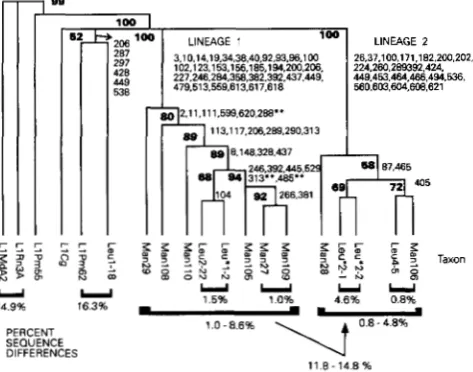
3.10.14.19.34.38.40.92,93,96,100 26.37.100.171.182.200,202~
102.123.153.155.185.194.2w.206. 224.260.289392.424. 227.246.2&1.358.382.392,437,~9, 449,453.464.486.494.536,
479.513.559.613.617.618 560.603.604.608.621
Y U
14.9% 16.3%
u u Y U
1 5% 1.0% 4.6% 0.8%
m-
11 8 . 1 4 8 %
FIGURE 2.-Phylogenetic tree of Peromyscus LINE-1 ele-
ments depicting a bootstrap analysis. Two lineages of LINE- 1 sequences are shown with their separate shared-sequence
variants. The bold numbers at the nodes indicate the percent
confidence value of the branch according to 1000 bootstrap
replicates in PAUP. The numbers listed on the descending branches indicate the shared-sequence variants. The numbers
at the bottom of the tree indicate the percent differences
between or among the elements bracketed. Positions involved
in the placement of one or more of Leul-18, LlPm62, and/
or LlCg within: Lineage 1; 37, 221, 289, and 489: Lineage 2;
101, 185, 313, and 459: before the split; 55, 176, 202, 222,
442, and 561:
**;
positions 288, 313 and 485 in Lineage 1and 115, 453, and 494 in Lineage 2 are shared-sequence vari- ants whose placement is unclear due to possible coincidental
private mutations, See Figure 2 alignment.
...
=..e. t...C...
=.a,--- -. ==...to. ga ... t... .... c..t.. c--..t..g.... a..c.
....-
t...C . . . a .-.
c....to. g ... C . . . .... C..t.. c--..t..g....
a..:. t...~...
ai.=.--- -. c....tz. q ... c.......
c..t.. c:--..t..c.private mutations may reflect changes in a master tem- plate that have only been sampled in one element. The muroid sequences, LlMdA2 and LlRn3A, were used to determine the ancestral state because at many sites they reveal the state of LINE-1 before the muroidcricetid split. However, because these muroid rodent sequences are relatively young and very closely represent their own active templates, they contain muroid-specific shared-
sequence variants and private mutations that differ
from the ancestral sequence. LlCg, LlPm55, LlPm62,
and Leul-18 were used to clarify the ancestral state
at sites with private mutations and to identify cricetid- specific shared-sequence variants.
By using sequences from both cricetids and muroids,
sites with multiple changes in the master template have a high probability of being resolved. However, even
though there are six different elements used in de-
termining the ancestral sequence, there were a few posi-
tions where the ancestral state could not be determined.
There were also positions where both of the lineages were different from all six ancestral sequences. For ex- ample, at position 100 in Figure 1, the ancestral base in
LlMdA2, LlRn3A, and LlPm55 is a C, that changed to
a T in the cricetids and further mutated to an A in Lineage 2 and a G in Lineage 1. The legend of Figure
1 lists the shared-sequence variants within each lineage
as well as those changes that are ambiguous.
The order in which the master templates acquired the shared-sequence variants is shown on the tree in
Figure 2. For both Lineage 1 and Lineage 2, the major-
1294 N. C. Casavant. A. N. Sherman and H. A. Wichman
A
B
U
2
ul
FIGURE 3.-Phylogenetic trees of Peromyscus LINE-1 se-
quences. (A) Phylogenetic tree of amino acid sequence of
Peromyscus LINE-1 elements. Two major lineages are depicted with LlPm62 and LlCg as members of Lineage 1. The bold numbers at the nodes indicate the percent confidence value
of the branch according to 1000 bootstrap replicates in PAUP.
LlMdA2 and LlRn3A were outgroups for rooting the tree. (B) Phylogenetic tree based on neighbor joining. Two major lineages are depicted with Leul-18, LlPm62, and LlCg as
members of Lineage 2. LlMdA2 was used as the outgroup to
root the tree.
quence of the strategy we used to select the elements. Further evidence that the elements sampled are young relative to the split between lineages is the distinct dif-
ferences between P. hcOpus elements and P. manicula-
tuselements within Lineage 1 (Figure l ) , three ofwhich result in replacements in the protein sequence. This suggests that the Lineage 1 master template has been active within each species.
Lineage 1 has acquired more shared-sequence vari-
ants than Lineage 2: Almost twice as many shared-se-
quence changes were acquired in Lineage 1 as in Lin-
eage 2 (Figures 1 and 2). Inclusion of LlCg, LlPm62, and Leul-18 in Lineage 2 does not markedly affect this discrepancy, nor does inclusion of positions for which the ancestral state could not be determined. Within a
lineage, the youngest elements are expected to have
more shared variants than the oldest elements, because shared variants are added as the master elements accu- mulate new changes. In comparing these lineages, it is
important to note that the youngest elements of each
lineage are approximately the same age: they have open
TABLE 1
Distribution of base changes that occurred
in each sequence
Element No. shared" No. private" Total no.'
Lineage 2
Man28 24 (3.9) 6 (0.9) 613
Leu"2-1 18 (3.7) 10 (2.2) 484
Leu"2-2 18 (3.7) 13 (2.7) 483
Leu45 27 (4.4) 2 (0.3) 607
Man106 27 (4.4) 3 (0.5) 613
Man29 32 (5.2) 17 (2.8) 613
Man 108 34 (5.6) 16 (2.6) 608
Man110 38 (6.8) 22 (3.9) 557
Leu*l-2 30 (6.2) 6 (1.2) 485
Leu2-22 37 (9.2) 2 (0.5) 403
Man105 48 (7.8) 3 (0.5)" 612
Man 109 51 (8.3) 4 (0.7) 613
Man27 51 (8.3) 2 (0.3) 613
Values in parentheses are percentages.
"The shared sites are positions that have changed within the parent elements. Because there are sites that have changed several times, the numbers were based on counting the changes in Figure 1.
'The private changes are those changes that occurred after the element inserted into the genome and are not representa- tive of the parent. Gaps were not counted.
Lineage 1
' Total number of bases analyzed.
"Additionally there is a one base insertion and another base deletion.
reading frames, there is low divergence between young elements, and there are very few private mutations. Nev-
ertheless, the youngest elements of Lineage 1 have
many more shared variants than the youngest elements of Lineage 2, and even the oldest elements in Lineage 1 have 31 shared variants while the youngest elements
in Lineage 2 have
27
(Table 1). Because sampling twoyoung elements will reveal all of the shared-sequence variants above that node, we do not believe that this difference is an artifact of the number of elements sam- pled in each lineage. Lineage 1 a n d Lineage 2 obviously diverged from their common ancestor at the same time,
therefore, the increase in the number of shared-se-
quence variants in Lineage 1 is not due to an age differ- ence between the two lineages.
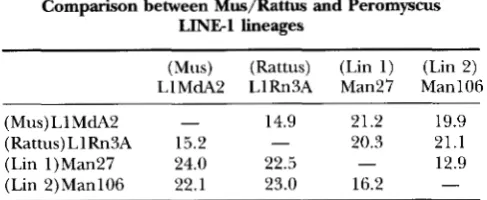
The percent differences between and within the lin-
eages: To better understand the extent of divergence
between these two lineages, we compared the sequences
of a young element from each lineage, Man27 and
Manl06, with young Rattus a n d Mus sequences, LlRn3A
and LlMdA2 (Table 2). T h e Rattus and Mus elements
are part of a single lineage (ADEY et nl. 1994); thus the distance between the two young elements, LlRn3A and
LlMdA2, reflects divergence because Rattus a n d Mus
last shared a common ancestor -10 mya (CATZEFLIS el
al. 1992). For both the DNA and protein comparisons,
the distances between the young elements of Lineage
LINE-1 Lineages in Peromyscus 1295
TABLE 2
Comparison between Mus/Rattus and Peromyscus LINE1 lineages
(Mus) (Rattus) (Lin 1) (Lin 2)
LlMdA2 LlRn3A Man27 Man106
(Mus) L1 MdA2 - 14.9 21.2 19.9
(Rattus)LlRnSA 15.2 - 20.3 21.1
(Lin 1)Man27 24.0 22.5 - 12.9
(Lin 2)ManlOG 22.1 23.0 16.2 -
Above the diagonal: percent nucleotide sequence differ-
ences; below the diagonal: percent amino acid sequence dif- ferences.
tween the Rattus and M u s elements (Table 2). The un- even tempo of movement and the accumulation of mu-
tations during retrotransposition preclude using this
comparison in any calculation of absolute time. How- ever, this comparison is consistent with the earlier sug-
gestion that Lineage 1 and Lineage
2
may have splitfrom each other at or before the peromyscine radiation.
DISCUSSION
Peromyscine Line-1 model: We have described two
LINE-1 lineages whose most recent common ancestor probably existed before the peromyscine radiation and whose master templates have remained active within the
same genome. The divergence between these lineages is
comparable with the divergence between the LINE-1s
of Rattus and M u s , elements that last shared a common
ancestor 10 mya (BROWNELL 1983; CATZEFLIS et al.
1992). In addition to these two lineages, the clade de- rived from their common ancestor includes three ele-
ments, Leul-18, LlPm62 and LlCg, that straddle the
split between the lineages. Because all three of these
sequences represent ancient insertions, and LlCg is
from another cricetid genus, these elements strengthen the hypothesis that the split occurred within the cricet- ine radiation, but before the peromyscine radiation.
Mutually exclusive shared-sequence variants, as o b served in the two lineages, are interpreted to be evi- dence of divergent active master templates. The longer the two active lineages have been separated, the more divergent the copies become due to the accumulation of changes in the master templates. The large divergence between the collected sequences of the two lineages is due primarily to the shared-sequence changes (Table
1). Master templates can also diverge due to speciation
of the host species, as was seen in M u s (MARTIN et al.
1985). The mutually exclusive shared-sequence variants specific to a species are those that accumulated in the master template after the species last shared a common ancestor. There are species-specific variants in Lineage
1 for both P. leucopus and P. maniculatus (Figure 2),
indicating that Lineage 1 has been active in both species
since they last shared a common ancestor.
Although there are no species-specific variants for
Lineage 2, the number of private mutations within the
youngest members of Lineage 2 is comparable to those
found in the youngest members of Lineage 1. Private
mutations are those changes that are not shared in a phylogenetically informative manner by more than one member of a data set. They include both mutations that occurred after an individual element inserted into the genome, and potential shared-sequence variants that
were only sampled once. Thus, a low number of private
mutations is an indicator that the individual copy re-
cently inserted into the genome. The species-specific
variants of Lineage 1 and the relative youth of the ele-
ments in both Lineages 1 and 2 suggest that the master
templates of both lineages have remained active during the peromyscine radiation.
In M . domesticus, there appears to be a single lineage
of active LINE-1 master templates that have acquired a
series of new promoters; each successor may overlap
with its predecessor before the predecessor died (ADEY
et al. 1994). For the four species of M u s that have been
examined to date, the sequence difference between the youngest elements in the single M u s lineage is small compared with the difference between the youngest members of Lineages 1 and 2 in Peromyscus but similar to
the distance between young members of each Peromyscus
lineage (MARTIN et al. 1985; HARDIES et a[. 1986; O S A -
VANT and HARDIES 1994). This suggests that in Mus, the youngest master templates diverged after speciation, but are all successors of the same LINE-1 lineage. In con- trast, the divergence of the two LINE-1 lineages in Per&
myscus is consistent with the existence of multiple propa-
gating master templates within species.
There have been few reported cases of multiple mas-
ter lineages within a single species. A number of scenar-
ios have been proposed for SINE evolution ( JUW and
SMITH 1988; DEININGER et al. 1992; LEEFLANC; et al. 1992;
JURKA 1995), and alternatives to a master lineage model
are discussed by DEININGER and BATZER (1993). In mur-
oid rodents there is evidence for an extinct LINE-1
lineage in addition to the currently active one, sug- gesting that at some point in evolutionary history there were two concurrently active lineages (PAS<Al.E et al.
1993; ADEY et al. 1994). There is also evidence for minor coexisting active lineages, generally of recent evolution-
ary origin (DEININGER and BATZER 1993; CASAVANT and
HARDIES 1994). In humans, for example, KAZAZIAN and
his colleagues have identified several very recent LINE-
1 insertions associated with human genetic disease (KA-
ZAZIAN et al. 1988; HOLMES et al. 1994). In two cases,
the parent loci have been characterized and found to
differ by 0.7% (HOLMES et (11. 1994), suggesting that
while these recent transposition events did not arise
from a single master element, they arose from two
closely related masters.
Possible third lineage splitting at the division of the
other two: Within all of the derived phylogenetic trees
of the Ppfomyscus LINE-] sequences, there appears to
1296 N. C. Casavant, A. N. Sherman and H. A. Wichman
This lineage appears to branch off at about the time Lineage 1 and Lineage 2 diverged (Figures 2 and 3 ) .
There are seven shared-sequence sites that unite Leul-
18 and LlPm62, of which an undefined number may
be convergent in situ mutations. Leul-18 and LlPm62
have more private mutations, insertions, and deletions
than the oldest members of Lineages 1 and 2, indicating
that both are relics. Because no young elements were sampled, this lineage may have been short lived; how- ever, due to the small sample size of this collection, it can not be formally ruled out that there is still an active lineage. The placement of these sequences would be important in determining the time of the split between
the two LINE-1 lineages relative to the peromyscine
radiation.
Lineage 1 and Lineage
2
have unequal rates of evolu-tion: Shared-sequence variants indicate changes that
occur in the master template for that lineage. For a lineage to persist, each master template must replicate
its successor (HARDIES and RIKKE 1990). Because repli-
cation of a successor involves an RNA intermediate that is reverse transcribed into DNA, a process that has a high error rate, the number of changes in the sequence is greater than would be accounted for from the usual neutral mutation rate. The assumption is that the more frequently the master template is replaced, the more shared-sequence variants are acquired in the lineage.
Lineage 1 LINE-1 sequences have acquired almost twice
as many shared-sequence variants as Lineage 2 LINE-
1 sequences. The higher number of shared-sequence
variants in Lineage 1 relative to Lineage 2 could suggest
that Lineage 1 has replaced its master template much
more frequently than Lineage 2. Alternatively, the re-
verse transcriptase may be more error prone in Lineage
1. Implicit in either explanation, and in the general hypothesis of a master lineage, is the assumption that
the LINE-encoded proteins are acting largely in cis.
The increased number of shared-sequence variants in Lineage 1 does not necessarily indicate a general
increase in the number of copies produced. Lineage 1
master templates may produce more total LINE-1 cop- ies, or they may be more efficient at making masters
without necessarily making more pseudogene copies
than the Lineage 2 master templates. The greater num-
ber of Lineage 1 elements isolated compared with Lin-
eage 2 elements could reflect a real difference in copy number in each lineage or could be a sampling artifact.
(Note that the elements with names marked by an aster-
isk were not randomly chosen.)
There are mechanisms other than those involving reverse transcription that could result in an apparent unequal rate of mutation in the two lineages. One sug- gestive aspect of these data is that
40%
of the shared- sequence variants and 60% of the shared-amino acidreplacements occur within the first 25% of the se-
quenced region of Lineage 1. This could be explained by recombination, gene conversion, diversifjmg selec- tion, or random variation. It is important to note, how-
ever, that the remaining shared-sequence variants also support the existence of two lineages. Resolution of the mechanism accounting for the unequal rate of evolu-
tion will require characterization of Lineage 1 elements
closer to the split between the lineages to determine if these shared-sequence variants can be sequentially ordered or occurred simultaneously.
The inherent biases of different sequence selection
strategies: The two traditional methods of acquiring
LINE-1 elements for phylogenetic analysis include: iso- lating clones from genomic libraries and cloning hy- bridizing restriction fragments. Depending on the probe and stringency used, screening a genomic library should give a collection of elements that reflects the age struc- ture of elements in the genome. If the genome has a large number of relic sequences, it will be difficult to sift through these to reconstruct the history of LINE-1 evolution, especially because at least two relatively young
elements are required to define the shared-sequence
variants in a lineage. In contrast, cloning a hybridizing restriction fragment enriches for elements that have re- tained two internal restriction sites, and thus biases against the collection of relic elements. However, if the restriction fragment cloned has a narrow phylogenetic distribution, then it is likely to be enriched for very young elements. Because we wanted to collect elements that would reflect the dynamics of LINE-1 amplification
in Peromysms, we chose a strategy that would bias against
both the selection of only young elements and the proba- bility of selecting mainly relic elements. Therefore, we
selected a restriction fragment that was a major hybridiz-
ing band in several phylogenetically diverse species of
Peromyscus (leucOpus, munimlatus, truei, californicus, d@c-
ilis, and polionotus) (KASS et al. 1992).
Different methods of element selection can lead to apparently contradictory conclusions. For example,
VANLERBERGHE
et al. (1993) selected LINE-1 elementsfrom libraries constructed from sonicated genomic DNA of two species of voles. They found that none of
the 13 elements sequenced had intact ORFs and that
the intraspecific painvise differences were similar to the interspecific pairwise differences. From this they con- cluded that the vole elements they sampled were be- tween 3 and 13 million years old and that the rate of transposition of any currently active element must be very low. In contrast, MODI (1996) used restriction-site subfamilies defined by genomic Southern blot analysis to examine the activity of LINE-1 in voles. A restriction- site defined subfamily is a subset of elements yielding a discrete fragment in genomic Southern blot analysis
because all members of the subfamily share the two
defining restriction sites; it usually contains at least a
few hundred copies (LEE et al. 1996). New subfamilies
would arise as master elements acquire shared-se-
quence variants that change restriction sites. After ex- amining 30 species of voles with eleven restriction endo-
nucleases, MODI (1996) found that almost half of the