ABSTRACT
JI, FENG. Runtime Support toward Transparent Memory Access in GPU-accelerated Heterogeneous Systems. (Under the direction of Xiaosong Ma.)
GPU has become a popular parallel accelerator in modern heterogeneous systems for its great parallelism and superior energy efficiency. However, it also extremely complicates pro-graming the memory system in such heterogeneous systems, due to the non-continuous memory spaces on CPU and GPU, and a two-level memory hierarchy on a GPU itself. The complexity of this memory system is now fully exposed to programmers, who must manually move data to each position in the memory for correctness, and must consider data layout and locality to adapt to data access patterns in multi-threaded parallel codes for performance.
In this Ph.D. thesis study, we approach the above problem through providing runtime system support that aims at both easier programming and better performance. Specifically, we show two such runtime system software approaches, either within the scope of a programming model or as a general system software.
With the first approach, we focus on two popular programming models, MapReduce and MPI. For GPU-based MapReduce, we provide a transparent GPU memory hierarchy for MapRe-duce developers and realize performance improvement through buffering data in GPU’s shared memory, a small on-chip scratch-pad memory. On a system powered by an Nvidia GTX 280 GPU, our MapReduce outperforms a previous shared-memory-oblivious MapReduce, with a prominent Map phase speedup of 2.67x on average. For MPI, we extend its interface to en-able the usage of GPU memory buffers directly in communications, and optimize such GPU-involved MPI intra-node communication, through pipelining CPU-GPU data movement with inter-process communication, and GPU DMA-assisted data movement. Comparing to manu-ally mixing GPU data movement with MPI communication, on a multi-core system equipped with three Nvidia Tesla Fermi GPUs, we show up to 2x bandwidth speedup through pipelining and an average 4.3% improvement to the total execution time of a halo exchange benchmark; our DMA-assisted intranode data communication further shows up to 1.4x bandwidth speedup between near GPUs, and a further 4.7% improvement on the benchmark.
©Copyright 2013 by Feng Ji
Runtime Support toward Transparent Memory Access in GPU-accelerated Heterogeneous Systems
by Feng Ji
A dissertation submitted to the Graduate Faculty of North Carolina State University
in partial fulfillment of the requirements for the Degree of
Doctor of Philosophy
Computer Science
Raleigh, North Carolina
2013
APPROVED BY:
Frank Mueller Yan Solihin
Huiyang Zhou Xiaosong Ma
BIOGRAPHY
ACKNOWLEDGEMENTS
I would like to thank my advisor, Dr. Xiaosong Ma, for her lasting patience and guidance on my PhD study for the past five years. Dr. Frank Mueller, Dr. Yan Solihin, and Dr. Huiyang Zhou have been in my PhD committee since Apr 2012. I appreciate not only their time and effort but also their encouragement and suggestions in criticizing my work. My fellow members from PALM group have always been on my side, and have given me various types of help day to day.
For the work completed in this PhD study, I have collaborated with Ashwin Aji, from the SYNERGY group of Virginia Tech led by Dr. Wu Feng, the MPICH group from Argonne National Lab, primarily Dr. Pavan Balaji, Dr. Jim Dinan, and Dr. Darius Buntinas, as well as Dr. Heshan Lin, when he is Virginia Tech. I have received tremendous help from them when we work on projects and papers together. In addition their working styles and professional attitudes have been and will still be my examples.
My work is supported by my advisor’s funding grants from NSF and ORNL. I would take the chance to thank the agencies.
TABLE OF CONTENTS
LIST OF TABLES . . . vii
LIST OF FIGURES . . . .viii
Chapter 1 Introduction . . . 1
1.1 GPU-based MapReduce . . . 2
1.2 GPU-aware MPI . . . 3
1.3 RSVM: a Region-based Software Virtual Memory for GPU . . . 4
1.4 Contributions . . . 4
1.5 Thesis Organization . . . 5
Chapter 2 Background and Related Work . . . 6
2.1 GPU Computing . . . 6
2.2 GPU architecture . . . 6
2.3 Heterogeneous System Architecture . . . 8
2.4 CUDA and NVIDIA GPUs . . . 9
2.5 Related work . . . 9
2.5.1 MapReduce . . . 9
2.5.2 GPU-aware MPI . . . 11
2.5.3 GPU memory managment . . . 11
Chapter 3 Using Shared Memory to Accelerate MapReduce on Graphics Pro-cessing Units . . . 13
3.1 Introduction . . . 13
3.2 A Background of MapReduce . . . 14
3.3 Exploiting Shared Memory for MapReduce . . . 15
3.3.1 Rationale . . . 15
3.3.2 Shared Memory Layout . . . 17
3.3.3 Intra-block Thread Partitioning and Synchronization . . . 18
3.3.4 Result Collection and Overflow Handling . . . 20
3.4 Evaluation . . . 21
3.4.1 Testbed . . . 21
3.4.2 Workloads . . . 21
3.4.3 Memory Usage Modes Evaluated . . . 22
3.4.4 Map Results . . . 24
3.4.5 Reduce Results . . . 26
3.4.6 Comparison with Mars . . . 27
3.4.7 Synchronization on GPU . . . 30
3.5 Concluding remarks and Future Work . . . 31
Chapter 4 Efficient Intranode Communication in GPU-Accelerated Systems . 32 4.1 Introduction . . . 32
4.2.1 The Message Passing Interface . . . 33
4.2.2 MPICH2 Intranode Communication Architecture . . . 33
4.3 Challenges in CUDA+MPI Programming . . . 34
4.4 Design . . . 35
4.4.1 Integrating GPU-Awareness in the MPI Interface . . . 36
4.4.2 Eliminating Unnecessary Copies . . . 36
4.4.3 Increasing Throughput with Pipelining . . . 37
4.4.4 Efficient Host-Device Data Movement . . . 39
4.5 Evaluation . . . 43
4.5.1 Exploration of Buffering and Message Queue Parameters . . . 43
4.5.2 Performance Comparison with Manual CUDA+MPI . . . 45
4.5.3 Evaluation with 2-D Stencil Benchmark . . . 46
4.6 Concluding Remarks . . . 47
Chapter 5 DMA-Assisted, Intranode Communication in GPU Accelerated Systems . . . 49
5.1 Introduction . . . 49
5.2 Background . . . 50
5.2.1 MPI and MPICH . . . 50
5.3 Design . . . 51
5.3.1 DMA-assisted Intranode Communication . . . 51
5.3.2 LMT Protocol for Peer-GPU Communication . . . 52
5.3.3 Intranode MPI Communication between Host and Device . . . 54
5.3.4 Efficient Memory Handle Management . . . 54
5.4 Evaluation . . . 55
5.4.1 Experimental Setup . . . 55
5.4.2 DMA-assisted Intranode MPI Communication between GPU Devices . . . 56
5.4.3 DMA-assisted Intranode MPI Communication between Host and Device . 58 5.4.4 Application Evaluation: Stencil2D . . . 59
5.5 Concluding Remarks . . . 61
Chapter 6 RSVM: a Region-based Software Virtual Memory for GPU . . . 62
6.1 Introduction . . . 62
6.2 Background . . . 63
6.3 Region-based CPU-GPU memory management . . . 64
6.3.1 Region as Memory Management Unit . . . 64
6.3.2 Benefit of Region-based Approach . . . 66
6.4 RSVM Design . . . 66
6.4.1 Region API . . . 68
6.4.2 Region States . . . 69
6.4.3 Region Management . . . 70
6.4.4 CPU-GPU Region Consistency . . . 71
6.4.5 Enabling Swap for GPU Memory . . . 71
6.4.6 A Software TLB for Region Mapping on GPU . . . 72
6.5.1 GPU Callback . . . 73
6.5.2 Lower-level Memory Allocator on GPU . . . 73
6.5.3 Limitation of current implementation . . . 74
6.6 Evaluation . . . 74
6.6.1 Benchmark . . . 74
6.6.2 Matrix multiplication with increasing problem size . . . 75
6.6.3 Breadth-first search . . . 76
6.6.4 Discussion . . . 79
6.7 Conclusing Remarks . . . 79
Chapter 7 Conclusion . . . 80
LIST OF TABLES
Table 3.1 Workloads and problem sizes . . . 22 Table 3.2 MapReduce workloads characteristics, which shows the statistics collected
with the ”large” problem size. (1. All keys and values representmean/standard deviation of record sizes. 2. Ratios areinput:output record count ratios. 3. ’-’ means there is no reduce phase.) . . . 22
Table 5.1 Keeneland and Magellan Architecture and GPU Topology . . . 56
Table 6.1 Region APIs and region collection utility functions . . . 69 Table 6.2 RSVM vs native in benchmarks that fit in the device memory (BackProp
has two kernels) . . . 74 Table 6.3 Bechmark graphs (n and m in 106). Small (uppper, fit GPU memory limit)
LIST OF FIGURES
Figure 2.1 GPU Architecture . . . 7
Figure 2.2 GPU Computing System Architecture . . . 8
Figure 2.3 Current heterogeneous system model . . . 9
Figure 3.1 Ideal Workflow of Map/Reduce Kernel empowered with Shared Memory. Step 1: Stage in; Step 2: Computing; Step 3: Staging out. (Solid line: record boundary; dotted line: bytes) . . . 16
Figure 3.2 Workflow of MapReduce on GPU using shared memory . . . 17
Figure 3.3 Shared Memory Layoout . . . 18
Figure 3.4 Map/Reduce kernels execution time in the large problem size . . . 24
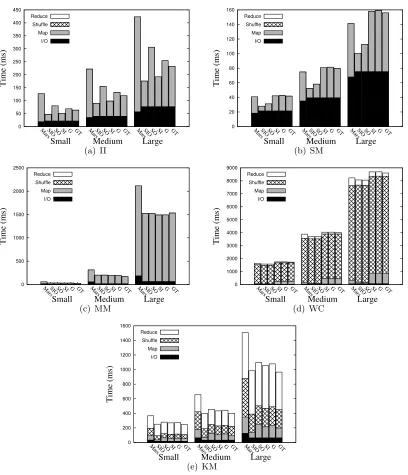
Figure 3.5 Execution time composition of Mars and our framework in different mem-ory usage modes at different problem sizes . . . 28
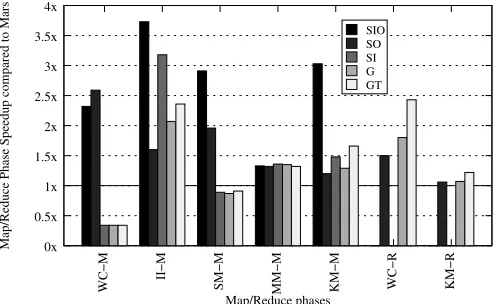
Figure 3.6 Map/Reduce Phase Speedup over Mars . . . 29
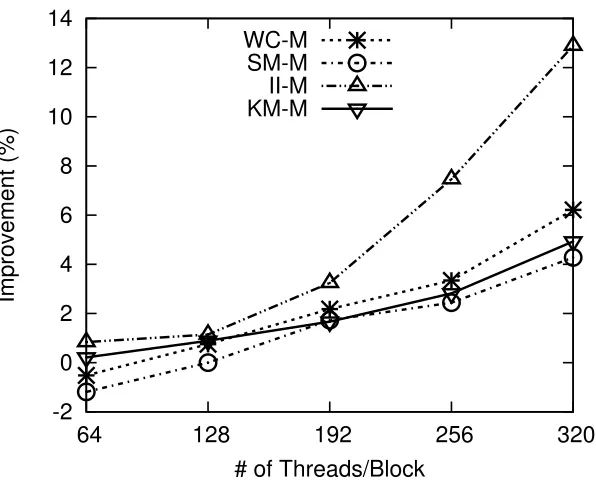
Figure 3.7 Kernel speedup by using GPU synchronization with yielding over non-yielding . . . 30
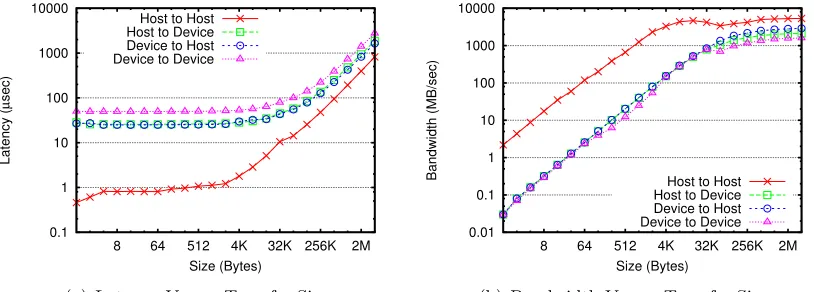
Figure 4.1 Intranode latency and bandwidth between two MPI processes, with differ-ent source/destination buffer location choices. When a GPU device buffer is used, its associated host buffer is pinned. . . 35
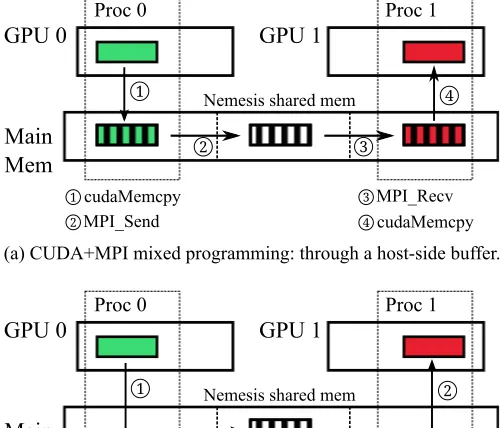
Figure 4.2 Memory copies in (a) CUDA+MPI and (b) MPIGPU. . . 37
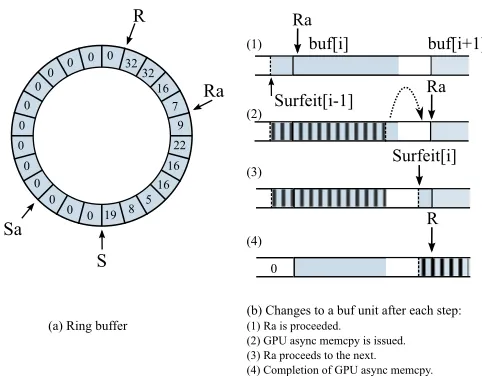
Figure 4.3 LMT shared copy buffer. . . 38
Figure 4.4 Bandwidth of different GPU memory copy methods between host and GPU device. Adapted from from CUDA SDK bandwidth test [11]. Host buffer is pinned always. . . 42
Figure 4.5 Bandwidth of different memory copy methods on the host side. Adapted from bw mem bcopy from lmbench [46]. (MPIU Memcpy is turned on for x86 but not x86-64 by default.) . . . 43
Figure 4.6 Bandwidth of two intranode MPI processes, with different shared buffer unit sizes, using messages at 4 MB, 1 MB, and 256 KB. Source and destination buffers both in GPU memory(“D2D”), both in main memory (“H2H”), or source in main memory and destination in GPU memory (“H2D”); the result of “D2H” is similar to “H2D.” . . . 44
Figure 4.7 Latency/bandwidth of two intranode MPI processes, source and destina-tion buffers both in GPU memory, using different message queue element sizes. The optimal shared buffer is shown for comparison. The results of “Device-to-Host” and “Host-to-Device” are similar. . . 45
Figure 4.9 Stencil2D performance improvement of MPIGPU over CUDA+MPI. The problem size is fixed when the number of processes are varied. . . 47
Figure 5.1 LMT Protocol for GPU Peer-to-Peer Communication . . . 53 Figure 5.2 MPI intranode latency/bandwidth comparison between using DMA-assisted
intranode communication between peer-GPUs – in different LMT modes (“coop”, “get”, “put”) – and using Nemesis’ shared memory protocol (“shm”). Near case on Keeneland. . . 57 Figure 5.3 MPI intranode latency/bandwidth comparison between using DMA-assisted
intranode communication between peer-GPUs – in different LMT modes (“coop”, “get”, “put”) – and using Nemesis’ shared memory protocol (“shm”). Far case on Magellan. . . 57 Figure 5.4 MPI intranode latency/bandwidth comparison between using DMA-assisted
peer-to-peer communication in different LMT modes (“coop”, “get”, “put”) and using shared memory (“shm”). Sharing GPU on Keeneland. . . 58 Figure 5.5 MPI intranode latency/bandwidth comparison between using DMA-assisted
peer-to-peer communication with different DMA engine choice (“relay”, “attach”) and using shared memory (“shm”). When relay, two GPUs con-nected to the same chipset are used, on Keeneland. . . 59 Figure 5.6 Stencil2D performance improvement on Keeneland, comparing using
DMA-assisted peer-to-peer communication against using shared memory buffer based communication, with varying number of MPI processes. . . 60
Figure 6.1 Dense matrix multiplication (A x B = C) GPU code example and execu-tion behavior . . . 64 Figure 6.2 Dense matrix multiplication (A x B = C) region programming example
and running behavior . . . 65 Figure 6.3 RSVM system architecture . . . 68 Figure 6.4 An MSI-like state transition protocol . . . 70 Figure 6.5 RSVM vs. native/manual matrix multiplication with increasing size (sum
Chapter 1
Introduction
Graphics Processing Unites (GPU), originally designed for graphics rendering, was later used in general purpose computing (GPGPU) . The massively parallelism on GPUs made them a good fit for parallel computation. For the last several years, success stories across various domains have been reported on using GPUs to accelerate computations. Meanwhile, GPU designers are bringing more full-fledged computing functions and programming environment support to GPGPU program developers. Today GPU acceleration appears in both personalized computers and supercomputer-scale data centers.
However, as a co-processor, a GPU device brings complexity into a system architecture, i.e. a heterogeneous system architecture, which is equipped with both GPU devices and modern multi-core CPUs. The complexity has two sources: 1) CPUs and GPUs have different instruction sets (ISA), and hence different programming languages and non-compatible codes; 2) GPUs bring a non-continuous and hierarchical memory system in the heterogeneous system. While the former problem relies on parallelization compilation techniques, which still follows traditional parallel computing experience to a certain extent, the latter is a new problem and has not been fully addressed so far.
developers must spend a substantial period of time writing code for the memory hierarchy. To solve this problem, we propose to provide support to facilitate memory accesses in GPU-enable heterogeneous systems. As current heterogeneous systems lack architectural support in the hardware, we have designed a set of software runtime approaches. Our software runtimes fall into two categories: 1) a runtime that runs transparently behind a certain programing model and manages such memory accesses, and 2) a general system-level software, which is not lim-ited to a programming model. In the first category, we have studied two popular programming models, MapReduce and MPI. In MapReduce, we hide the GPU’s on-board memory hierarchy by providing transparent input and output data buffering in GPU’s shared memory, providing performance benefit for runningmapand reduce routines. For MPI, we design and implement a GPU-aware MPI system, which enables programmers to directly use GPU memory buffers in MPI function calls. Meanwhile, we devise optimization techniques within the MPI system, in-cluding pipelining inter-process communication and data movement across CPU and GPU, and GPU DMA-assisted intranode data movement, which shows optimized latency and throughput over manually mixing MPI with GPU data movement commands. In the second category, we design and implement a software virtual memory across the CPU-side main memory and the GPU memory, called RSVM, which takes over data movement across two separated memory domains. It also provides novel features, including fine-grained on-demand data fetching across CPUs and GPUs and transparent swap for the GPU memory.
In the following sections, more details will be given for each system.
1.1
GPU-based MapReduce
MapReduce [23] was first proposed by Google researchers as a parallel computation paradigm, as well as a runtime system in their distributed computing environment [23]. Later this elastic model was exploited for heterogeneous CPU processors [54, 55] and GPU processors [28]. In particular, Mars [28], a state-of-the-art MapReduce library, has shown advantage in throughput over its CPU counterpart for certain workloads. Beside performance benefits, general-purpose MapReduce frameworks like Mars simplify GPU parallel programming. Programmers can focus on correctness of their Map/Reduce function implementation, since the underlying scheduling, fault-tolerance, and performance issues are handled by the framework.
However, designing an efficient MapReduce framework on GPUs is still challenging for two reasons. First, many MapReduce workloads have irregular memory access patterns, which prohibits their efficient execution on GPUs. Second, though shared memory has been shown as able to accelerate many workloads on GPU, it is still unknown how it can be leveraged for MapReduce.
memory for MapReduce applications running on GPUs, and propose a systematic approach to utilizing GPU shared memory as a transparent staging area to buffer MapReduce input/output data.
We will cover the details of this work in Chapter 3.
1.2
GPU-aware MPI
The Message Passing Interface (MPI) [10] is the industry standard for parallel programming and is used on virtually every high performance computing system. Introduced in 1984, the MPI standard has evolved to complement changes in CPU architecture and high-performance networks. One of the current challenges faced by the MPI community is the evolution of this popular parallel programming model to interoperate with and exploit GPU accelerators.
Current implementations of MPI continue to assume that all communication buffers are located in the main memory. Hence, developers must explicitly move data between device and host memories in order to perform MPI operations. With current GPUs, this strategy results in high-latency data movement across the PCIe bus and through several temporary buffers, even when performing communication between processes located on the same node. To facilitate these transfers, developers today typically maintain duplicate buffers in host and GPU memory manually, an approach that not only introduces code complexity but also is wasteful of system resources. Furthermore, one of MPI’s strengths is its ability to hide the performance details of data movement in parallel computations. This capability is significantly diminished when manual GPU data movement is performed outside the MPI library. In an experiment conducted with a pair of MPI processes on the same physical machine, we find that the bandwidth achieved is only half the theoretical peak when manual data movement is used.
To address this challenge, we extend MPI with direct support for the GPU memory space for communication. With this extended interface, GPU memory buffers can be used directly in MPI communication routines. Meanwhile, we adopt two optimizations within MPI for intranode data movement across co-located processes.
First, we pipeline data movement in PCI-express bus and MPI inter-process data movement in its internal shared memory buffers. The details of this work is described in Chapter 4.
1.3
RSVM: a Region-based Software Virtual Memory for GPU
In today’s heterogeneous systems, GPU device memory is not managed by the operating sys-tem’s virtual memory. One need explicitly manage the GPU memory space and manually move data between it and the host memory. Optimizing data movement on the PCIe bus brings an-other factor of complexity. The manual programming overhead greatly increases programmers’ burden in writing GPU codes, limiting their productivity in application development.
Although the lack of CPU-GPU memory management has been recognized by the systems research community [27, 33, 57], a unified virtual memory solution remains unknown. Several recent projects to build compilers [32, 33, 51] and task scheduling runtimes [27, 57] share the need of managing CPU and GPU memory spaces.
However, as today’s GPU hardware provides no virtual memory support, long available in modern CPUs, existing compiler techniques rely on host-side static analysis to estimate a GPU task’s input and output data sets. Thus, they do not enable on-demand data fetching for the GPU task, i.e. transferring only the needed data across the PCIe bus at run time. For the same reason, existing runtime approaches either require non-transparent ways of specifying GPU kernels’ data demand upfront, e.g. using directed acyclic graphs [57], or achieve on-demand data fetching only from the host side [27].
Picturing a unified virtual memory that hides the existence of discrete CPU and GPU memory domains, we propose a Region-based Software Virtual Memory (RSVM), to explore the design space possibility and challenges. RSVM abstracts the separated main memory and GPU memory domains, and automates data movement across them. In addition, it realizes on-demand data fetching for both CPU and GPU sides, and achieves a transparent swap mechanism for GPU memory, which enables a GPU kernel to scale up its problem sizes beyond the GPU device memory limit. Through benchmark evaluation, we show a proof-of-concept implementation with existing GPU hardware support, which incurs a minimal overhead in most cases. Meanwhile, we identify missing architectural features on current GPUs for better system software efficiency.
This part is elaborated in Chapter 6.
1.4
Contributions
In summary, this thesis work has made the following contributions:
Our work on extending MPI with GPU native support shows the possibility of evolv-ing MPI programmevolv-ing model for GPU-enabled heterogeneous system memory hierar-chies. Optimization opportunities are thus present, and we have shown two approaches by leveraging MPI’s internal shared memory buffers and GPU DMA engines for intranode communications.
Our work on RSVM shows the possibility of building a software virtual memory, which has runtimes on both the CPU and the GPU. Based onregions as the basic memory unit, RSVM provides the benefit of a virtual memory to abstract non-continuous memory do-mains. Our evaluation on RSVM overhead also reveals our insight into future architectural support required by GPU systems.
1.5
Thesis Organization
Chapter 2
Background and Related Work
This chapter provides a general background on GPU computing, covering the architecture of a GPU device and heterogeneous systems, and CUDA, a popular GPU programming model for Nvidia GPUs. After that, the related work is surveyed and organized by each topic.
2.1
GPU Computing
Graphics processing units were originally designed for rendering workloads. In recent years, the highly parallel GPU architecture was found to be extremely useful as a computation accelerator across a broad range of high-performance computing workloads.
Current GPU devices fall into two broad categories: integrated and discrete. Integrated GPUs are built into the same hardware components as the host processor and share memory and other resources. Discrete GPUs, on the other hand, are distinct from the host processor and tend to utilize a distinct memory subsystem. The larger chip area, more powerful parallel processing units, and high-throughput dedicated memory on discrete GPUs provide great per-formance potential and have made discrete GPUs a preferred design in current high-perper-formance computing (HPC) systems. Current discrete GPUs are expansion cards that connect to the host processor and memory through the PCIe bus. Thus, data in host and device memories must be explicitly copied by using special commands.
2.2
GPU architecture
Shared Memory
ALUs/ Register files
ALUs/ Register files
Global Memory
Texture Cache
MP
MP
MP
MP
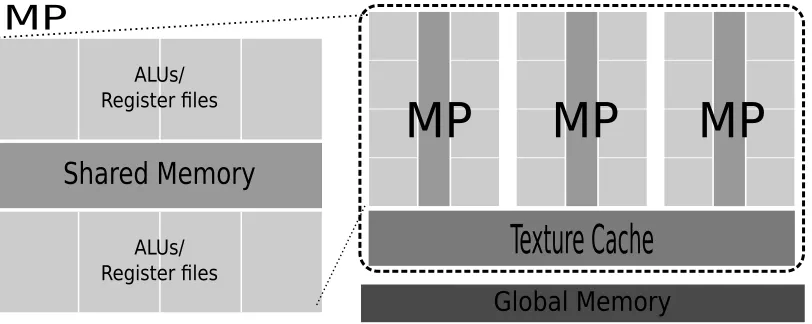
Figure 2.1: GPU Architecture
cache, called shared memory, is a scratch-pad memory area for transient data storage. Shared memory is small (typically in the KB range) but fast (latency within dozens of cycles), and is shared by threads co-running on an MP. Global memory, in contrast, is off-chip and has a much larger size (typically in the GB range) and longer latency (400 - 700 cycles). Every several (e.g., 3 in Figure 2.1) MPs are grouped as aTexture Processing Cluster (TPC), equipped with a texture fetch unit and a 6KB-8KB per MP 2-level set-associative read-onlytexture cache[49,72]. Texture cache is used for texture loading and only caches data read from the global memory space bound to texture buffers. Designed for streaming fetches, a hit in the texture cache does not decrease fetch latency, but reduces the global memory bandwidth demand. As a read-only cache, it does not ensure coherence with writes to the same global memory space bound to the texture buffer.
When a GPU kernel is issued, a large number of threads will be launched on multiple MPs in a device. These threads are grouped asblocks in a grid. The blocks are required to execute in any order, sequentially or in parallel, which requires them to be mutually independent. When a kernel starts, as many blocks are started as possible on available MPs; the rest wait for their completion to be scheduled. Every 32 threads inside a block form a warp and run in lockstep synchronously. A warp is the basic scheduling unit in GPU, with multiple co-running warps providing an MP the chance to hide the long latency of accessing global memory. When threads in the same warp follow different execution paths, warp divergence happens, where each path is executed in serial.
CPU 0
CPU 1
Chipset
Chipset
Me
mor
y
NIC
Mem GP
U 0
DMA
Mem GP
U 1
DMA
Mem GP
U 2
DMA
PCIe
PCIe
PCIe
PCIe
Me
mor
y
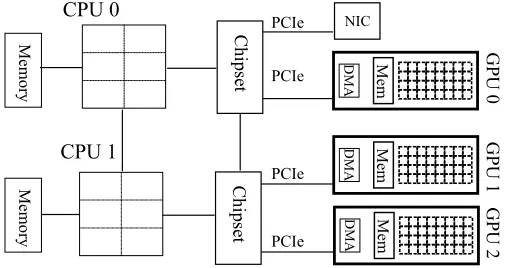
Figure 2.2: GPU Computing System Architecture
aligned 32/64/128-byte segment. Otherwise up to 16 transactions will be issued. With new GPU architectures, accesses from one entire warp can be coalesced.
2.3
Heterogeneous System Architecture
Figure 2.2 shows a sample heterogeneous system architecture, based on Keeneland cluster nodes [69]. In the figure, multiple GPU devices are each connected via a PCI-Express (PCIe) interconnect to a chipset (hub), which is connected to other chipsets and CPUs. Different tech-nologies can be used for the interconnect connecting chipsets, CPUs and memory, for example, the Intel Quick Path Interconnect (QPI) or the AMD HyperTransport (HT).
The bandwidth of the PCIe bus is orders-of-magnitude smaller than that of the GPU device memory. Thus, host-device data movement can easily become a bottleneck and hence deserves careful optimization.
Current GPU system model: In heterogeneous systems today, a GPU serves as a co-processor (as shown in Figure 2.3). The CPU is responsible for managing GPU resources through a driver program. For GPU computing, GPGPU APIs are provided by the driver for command-ing the device. An application runncommand-ing on the host side can asynchronously launch tasks on the GPU. The host can also submit a synchronized command, which blocks till all the preceding commands complete.
2.4
CUDA and NVIDIA GPUs
The Compute Unified Device Architecture (CUDA) is one of the most popular general-purpose parallel programming models on GPU today and is designed primarily for NVIDIA GPUs [50]. Our work focuses on CUDA because of its importance to current HPC applications. In the CUDA model, data between host and device memories is transferred by using thecudaMemcpy
command. The programmer annotates functions in the program source code to enable them to run on the GPU. When invoked, these functions are launched as GPUkernels.
GPUDirect [7] is an NVIDIA technology that enables direct peer-to-peer GPU data trans-mission, completely using GPU DMA engines without any host processor or memory interven-tion. In the past, when data needed to be moved between the device memories of two GPUs, it had to be “staged” in the host memory. With GPUDirect, the data can be transferred from one device directly to another. However, this feature is currently restricted to peer accessible
devices, i.e., those that are connected to the same AMD HT chipset. Further, GPUDirect does not currently support Intel QPI.
Another technology only available in CUDA,cudaIpc [6], allows different processes to access the same buffer located in a GPU’s device memory. A process can export amemory handle refer-ring to a device memory buffer to another process. This feature is useful for parallel applications with multiple processes running on the same node, such as MPI applications.
2.5
Related work
2.5.1 MapReduce
MapReduce [23] was first proposed as a parallel programming model for distributed parallel computing. In the past several years it has attracted much attention as an elastic programming model to develop large-scale parallel processing jobs, and has been studied in other parallel com-puting environments. Phoenix [55] proves MapReduce can be used to program shared memory
CPU
MEM
GPU
VM
Driver
GPU Runtime
Host Code
Device Code
APP
OS
HW
GPGPU API
BUS
multi-core and multiprocessor systems. Merge [40] uses MapReduce as a high-level language to program heterogeneous systems with both CPU and accelerators. Similarly, Sequoia [26] bor-rows MapReduce and builds memory hierarchy awareness into language support for portable parallel programs. On specialized processors, De Kruijf et al. presents a MapReduce system on Cell BE processor [22], and Papagiannis et al. revamps the design to minimize the control over-head and avoid redundant memory copies [52]. CellMR [53, 54] builds MapReduce on Cell BE processors in a cluster setting, and shows the benefit of streaming data across cluster nodes and asymmetric cores. On GPUs, besides Mars [28], Jiang et al. and Ravi et al. propose generalized reduction as an alternative API to MapReduce on Multi-core CPU and GPU [35, 56]. Other work on GPU [13, 18] have also applied the MapReduce model to their algorithms. Among the above, our GPU-based MapReduce work is most similar to Mars as a general-purpose MapRe-duce framework for GPUs, though we are the first to explore the active use of shared memory in the GPU MapReduce workflow.
Most recently, MapCG [30] was proposed to abstract programming on both CPU and GPU with the MapReduce model, whose advantage over Phoenix [55] (CPU only) and Mars [28] (GPU only) was shown. For the GPU side, the authors also addressed the problem of two-phase running in Mars by using a light-weight memory allocator. Yet they did not use shared memory aggressively and their performance gain over Mars is primarily from building a hash table in the Map phase and replacing sorting with hash table lookups, which can be leveraged in our MapReduce framework in the future.
GPU runtime features Aside from a rich body of work on using GPU for specific al-gorithms, recently more research interest is attracted to runtime and programming language support for GPU-enabled systems. Mars [28] and our MapReduce work fall into this category. Ma developes a translational framework for data mining algorithms on GPU [45]. Sundaram et al. and Satish et al. use domain templates expressed in graphs to attack the problem of total data size not fitting on GPU and minimizing data transfer between host and GPU [59, 68]. Our MapReduce framework complements them by addressing efficient use of the GPU shared memory.
In addition, Zhang el al. proposes to use idle CPU cycles for thread reference redirection and data layout transformation to avoid GPU threads divergence [76]. Targeting a different problem, our technique of thread roles partitioning shows some resemblance to their thread reference redirection; the difference is that we have all things done at the GPU side.
and the overflow handling problem.
2.5.2 GPU-aware MPI
Accelerators such as GPUs put a challenge faced together by the MPI community: can MPI further adapt to the heterogeneous systems with both high-performance multi-core CPUs and GPUs with rather different architectures. At present MPI users are still struggling with an MPI+GPU programming model, by manually mixing a specific GPU programming model, e.g. CUDA [6] or OpenCL [38], into MPI framework source code. Meanwhile, a few different research directions regarding this challenge is under investigation recently.
As one direction, researchers are proposing modifications to the evolving MPI model. Stu-art et al. suggested several potential ways for extending the MPI standard to provide native support of these accelerators [66]. One significant extension attempt is to allow GPU threads to obtain MPI ranks and participate in MPI communications [67]. But, due to lacking network I/O functions on GPUs, CPU helper threads are needed, which complicates performance mod-eling and may introduced new overhead. However, we believe MPI standard modification to be promising and perhaps necessary in the long term.
Another different direction is to follow the current MPI model, and extend it with transpar-ent system solutions [7, 63, 70, 71]. The large number of existing MPI programs can benefit from this direction. In this sense, our work in extending MPI falls into this category, and differenti-ate itself from the existing ones in studying intranode communications as opposed to internode GPU-to-GPU communications.
While traditionally MPI has been well known for its powerful capability for writing cluster-wise parallel jobs, addressing the intranode parallelism has become equally important for an MPI implementation since the multi-core era [15, 16, 43, 44, 48]. Our work also complements this list by studying intranode communication subsystems for GPU-accelerated heterogeneous systems.
2.5.3 GPU memory managment
Compiler assisted CPU-GPU communication Compiler techniques have been devel-oped to attain automatic CPU-GPU communications [27, 32, 33, 51], without requiring virtual memory exception support on the GPU. Static program analysis techniques are applied to GPU kernel code, to estimate GPU kernels’ input and output data set, and a host-side runtime mech-anism is employed to check states and initiate data movement. However, the static analysis on GPU code is ineffective in dealing with dynamic data movement requirement, when data ac-cess is decided dynamically or when the working set exceeds GPU physical memory size limit. RSVM resolves these issues through a GPU-side runtime and callbacks. The dynamic memory footprint revealed by RSVM relieves compilers from conservative estimation of GPU data de-mand. Meanwhile, compilers can help RSVM in identifying regions, by analyzing locality in the GPU kernel code.
OS support for GPGPU Though GPUs have been used in modern computer systems for over a decade, system designers have just noticed the limited OS authority over the GPU resources, as they are turning into compute devices. Previously delegated to GPU device drivers, scheduling, data flow, and QoS management of GPU tasks can be incorporated into the OS kernel space, e.g., GDev [37], possibly through new OS abstractions, e.g. PTask [57]. While they are more concerned with the synergy of current GPU programming models with the OS, RSVM is novel in extending system-level management into GPU kernels, to achieve transparent swapping and fine-grained on-demand data movement.
Distributed shared memory RSVM is inspired by distributed shared memory systems in the past [39] and particularly by CRL [36], an all-software distributed shared memory. Similar ideas were first introduced in ADSM [27], which abstracts a pair of user-managed host-side and device-side buffers. RSVM, however, adopts a different design and provides new features such as GPU-side on-demand data fetching and transparent swap. Very recently, GPUfs [61] provides POSIX-like file I/O APIs for GPU kernels. It uses a device-side runtime to implement a buffer cache on the GPU. Despite the resemblance in design, RSVM’s memory-level interface is more flexible in programming CPU-GPU data sharing and co-processing. Meanwhile, GPUfs’ functionality can be implemented on top of RSVM, by binding a region’s host-side address with memory-mapped files.
Chapter 3
Using Shared Memory to Accelerate
MapReduce on Graphics Processing
Units
3.1
Introduction
In this Chapter, we give details about our work on GPU-based MapReduce. Specifically, we propose to hide the GPU memory hierarchy in the MapReduce programming model. We in-vestigate the data placement and transfer between shared and global memory for MapReduce applications running on GPUs. Our main contributions are as follows:
We proposed a systematic approach to utilizing GPU shared memory as a transparent staging area to buffer MapReduce input/output data. To our best knowledge, this work is the first to explore the active use of shared memory in MapReduce execution on GPUs.
We devised several mechanisms, including shared memory staging area management, thread-role partitioning, and intra-block thread synchronization, to handle the dynamic memory management issues, especially for output overflow handling in the staging area.
We implemented the above techniques in a general-purpose MapReduce framework on GPUs, which needs no two-pass execution and makes no assumption on input/output data sizes, size variations, or record counts.
simply using global memory, and showed that our staging input mechanism performs better than or comparably to using the texture cache in most cases.
3.2
A Background of MapReduce
MapReduce [23] was proposed as a programming model for data processing jobs on large-scale clusters. With programs written in a functional style, the MapReduce runtime takes care of data partitioning, task scheduling, inter-machine communication, and fault tolerance. The MapReduce workflow consists of three phases: Map,Shuffle, and Reduce. Map and Reduce are two routines written by user programmers, who also provide specifications of input, intermediate results, and final output. When a job starts, the framework spawns a number of Map tasks, each working on a subset of input records and generating intermediate results. In the shuffle phase, the framework aggregates the intermediate results into key sets, each with a distinct key. Finally, the framework spawns a Reduce task per key set and generates final output records. Input, intermediate, and output are all in the format of<key,value>pairs, though the definition of key andvalue for each is the choice of programmers.
The data parallel computation model of MapReduce fits GPUs well. However, compared to traditional applications running on GPUs, MapReduce workloads with variable sized input or output create unique challenges to be tackled on GPUs. This is due to the irregular mem-ory accesses in MapReduce workloads and the lack of efficient dynamic memmem-ory management mechanisms, so far, in either shared memory or global memory. Mars [28], a state-of-the-art GPU MapReduce framework, uses a two-pass execution mechanism, requiring extraMapCount
and ReduceCount phases before Map and Reduce phases respectively, to deal with memory management for output. The first pass, MapCount or ReduceCount, is only used to compute the output sizes of each task. At the end of this pass, a prefix summing operation is executed across all threads with output size values in order to find their own starting output address. This way, output data can be written subsequently in the second (“real”) pass, to memory address ranges set appropriately by the prefix summing step. Due to the lack of atomic opera-tions on previous generaopera-tions of GPUs, such a two-pass mechanism turns out to be a practical approach for variable sized output. Part of our contribution in this work is to remove the cost of such two-pass execution, by leveraging the atomic global memory access method and our shared memory management scheme.
addition, Catanzaro et al. [18] examined on GPU a machine learning MapReduce workload. Both workloads mentioned above have output size/count known a priori. The aforementioned Mars framework [28] has a minimal use of shared memory and leaves its usage as developers’ call.
3.3
Exploiting Shared Memory for MapReduce
3.3.1 Rationale
With the advent of atomic operations on GPU, having an appendable output buffer in global memory becomes realizable. However, due to the large number of concurrently running GPU threads, a global lock or a critical section for accessing appendable output buffers can become a bottleneck due to severe competition (we will show this in the next section across a few work-loads). Therefore we propose using shared memory as input and output buffer for MapReduce workloads to relieve this contention. The benefit of using shared memory is listed as follows.
Coalesced global memory transactions: when data are moved by our MapReduce frame-work between global memory and shared memory, GPU threads can follow strictly the coalesced global memory access pattern to attain the best memory bandwidth. MapRe-duce programmers need not manually coalesce memory accesses when providing Map and Reduce routines, since data is already buffered in shared memory in a transparent manner.
Fast shared memory access: Map and Reduce routines can enjoy the short latency of shared memory. When access locality exists in the computation, fewer global memory requests will be generated.
Reduced contention on result collection: having a temporary output buffer in shared memory forms a hierarchical result collection mechanism, which can remove the severe contention caused by single-level global memory result collection from a large number of threads.
An ideal workflow of MapReduce on GPU incorporating the use of shared memory, as shown in Figure 3.1, consists of 3 steps:
Shared Memory
Global Memory
1
2
3
Input Area
Output Area
Figure 3.1: Ideal Workflow of Map/Reduce Kernel empowered with Shared Memory. Step 1: Stage in; Step 2: Computing; Step 3: Staging out. (Solid line: record boundary; dotted line: bytes)
Computing Each thread picks a record at a time, locating its address according to the directory indices (also staged into shared memory), and starts the user-provided Map/Reduce function on each record. Results are written into the output area, also in shared memory. The three input records shown in Figure 3.1 have 2, 3, and 2 bytes respectively, and generate three output records with sizes of 1, 3, and 2 bytes respectively.
Staging out All the threads in the block cooperate on flushing output data from shared memory to global memory. Again, global memory accesses are coalesced.
The above three steps are repeated until all input records are processed. Here we assume global memory is large enough to hold the output, considering today’s global memory size typically at the GB level. Otherwise, batched processing is again possible at another level and it is possible to overlap GPU kernel execution with host-device data transfer.
However, as mentioned earlier, a unique challenge for using the small shared memory for input/output staging is to coordinate the dynamic space usage. In particular, considering the lack of powerful inter-thread communication/synchronization schemes, as well as that MapRe-duce result sizes are often not known a priori, output overflow handling needs to be addressed carefully.
co
m
pu
te
th
reads
helper
th
reads
sync
Stage In
Compute
signal
overflow
Stage Out
signal
overflow
handled
Compute
Stage Out
signal
overflow
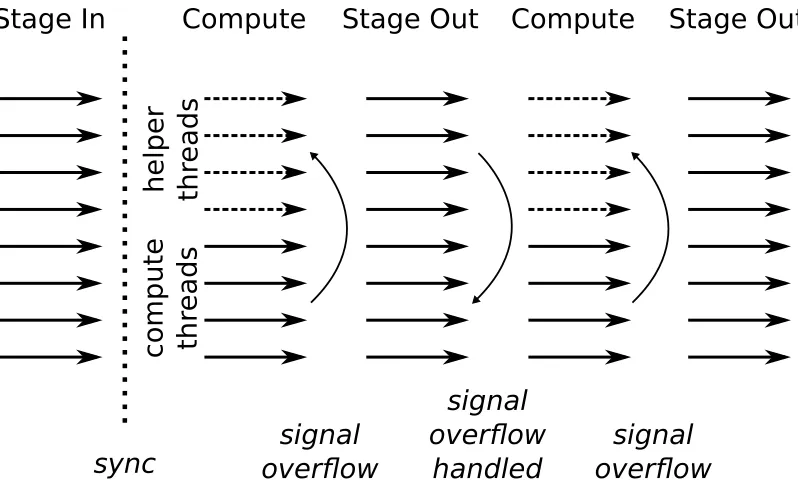
Figure 3.2: Workflow of MapReduce on GPU using shared memory
left. At that moment, all 256 threads will flush the collected results in the output area to an output buffer in global memory. After the flushing is done, the 118 threads will resume the Map computation until another overflow or the final flushing at the end of this iteration. The detailed mechanism of our framework will be given in the following sections.
3.3.2 Shared Memory Layout
First, we partition shared memory into an input and an output area. Figure 3.3(a) illustrate the shared memory layout in our design. The size ratio between the input and output areas is a parameter dependent on workloads. There is a tradeoff in that a larger input area increases computation concurrency by allowing more threads to work simultaneously due to more resident input records, while a larger output area leads to fewer overflows and less overflow handling overhead. One can roughly estimate the input and output ratio of a specific workload to decide the parameter value. In our future work, we plan to make this configuration automatic and adaptive.
Key
Value
Key Index
Value Index
Working area
Result Collection
(a) Input Area and Output Area
Warp Results
0 1 keys[1] values[1]keys[0] values[0] Keys/Values
(b) Result collection Area
Figure 3.3: Shared Memory Layoout
before the computing step starts.
The output area, or result collection area (Figure 3.3(b)), is managed dynamically. We define a warp result as the collection of results (either intermediate results after Map or final results after Reduce) generated by the threads of one warp in one result record generation - threads in a warp run in lockstep, which makes their results generation occur at the same time. Output in MapReduce has the same format with input and contains two types of data: 1) size-predictable, structured key indices and value indices; and 2) size-unpredictable, unstructured key and value pairs. To efficiently use the shared memory space, we use a double-ended stack to store the size-predictable structured data from the left end and the size-unpredictable unstructured data from the right end. For example, in Figure 3.3(b), two warp results are shown. Each warp result has two arrays of pointers, i.e. key indices and value indices, on the left, among which only the first key index and value index are drawn here. Keys and values of the same warp result are stored contiguously on the right. Compared to using four separate buffers as in input area, which easily causes internal fragmentation, this design will only see overflows when the total remaining output space is smaller than a newly generated warp result. Unlike in the input area, the four types of data across all results are not stored all contiguously here. However, when flushing a warp result back to global memory, coalesced global memory writing is still attainable within the scope of one warp result.
3.3.3 Intra-block Thread Partitioning and Synchronization
GPU supports a great number of threads per block. However, the concurrency in computation is limited by the input area size and the input record granularity. Due to the small size of shared memory, the number of input records staged in shared memory can be smaller than the thread block size. We can let the otherwise idle threads in a block assist in data staging.
out Map/Reduce computation, andhelper threads, which remain idle during computation but cooperatively handle result overflows. To avoid warp divergence, we divide them between warps, so that a warp is either a compute warp or a helper warp. As the concurrency may not be a multiple of the warp size, we increase the number of compute threads to the nearest multiple of the warp size - the last few compute threads of the last compute warp may not get an input record.
It is not too hard to enable a producer-consumer type of synchronization between the compute and helper threads with multi-threading programs on a CPU. On GPUs, however, there lack lower-level primitives for inter-thread coordination. Essentially, though there is a block-wise barrier ( syncthreads()), no wait-signal type synchronization is available. Note that when threads enter the computation phase, the compute and helper threads branch into different execution paths. This makes the block-wise barrier inapplicable as its occurrence in branched paths leads to a hang or undefined result [49].
To solve this problem, we designed a software-based wait-signal primitive for synchroniza-tions between the compute and helper threads. The condition is implemented with a set of flag variables in shared memory, each representing the status of one warp, considering the syn-chronous nature of its threads. We define wait group as the group of warps that wait on a condition, andsignal group as the group of warps that signal on the condition.
Initially, all wait group and signal group flags are cleared. In a wait operation, the wait group threads poll at the signal flags until they see them all raised by signal group threads. Then the wait group warps change their own flags notifying the signal group that the signal is seen. When the signal group threads find all wait group warps in the “seen” state, they leave the signal routine and reset their flags. After setting their own “seen” state, the wait group threads check their peers’ states. The wait group warp who finds all its peers in the “seen” state,i.e., the last “seen” warp, resets all wait flags after seeing all signal flags clear, and leaves the wait routine; the other waiting group warps simply leave the wait routine when they find they are not the last one. Note that the size of the two groups must be known in advance. In our case, the partitioning of thread roles (compute vs. helper) is determined at the end of each input staging operation.
Aside from synchronization, memory consistency is required: shared memory data updates by the signal group before signaling must be visible to the wait group when they see the raised flags. This requiresprocessor consistency, a very weak consistency model which we have confirmed with Nvidia regarding their GPUs. Under this consistency model, all threads see writes (in shared memory in our case) from one thread in the same order as they were issued by that thread. Considering potential future architectural evolution to even weaker consistency models, a threadfence block() at the entrance of the signal routine ensures the consistency requirement of our synchronization and adds an ignorable (<1%) performance overhead.
With our synchronization mechanism, the workflow can now have multiple output staging steps per input iteration to handle output overflows, as illustrated in Figure 3.2. In the staging in and staging out steps, all threads participate in moving input or output between global memory and shared memory. When a compute step starts, only compute threads participate in the Map/Reduce computation, and the helper threads are “idle” (shown in dashed arrows), waiting on the overflow condition. When the helper threads see the signal of overflow, all threads start the staging output step. At the end of staging out, similar synchronization through another condition,overflow-handled, lets the compute threads continue with their execution and helper threads return to waiting.
3.3.4 Result Collection and Overflow Handling
We designed a hierarchical result collection mechanism, which happens both at the warp level and at the block level.
At the warp level, results emitted by threads are required to be temporarily in an addressable place before being passed into our framework as references: they can be saved either at their original locations in the input area (e.g. Word Count has an output key as part of its input) or in the preallocated working area (e.g. Matrix Multiplication saves a floating point number as output per thread). These results will be grouped into one warp result and stored in the shared memory output area. To enable parallel output record writing, a prefix summing process is conducted in the warp to get the relative starting address for each thread’s output. Since a warp of threads run in lockstep, no explicit synchronization is required among them during this process.
An overflow happens when there is not enough space for a new warp result. Overflow han-dling is started with the participation of all threads within a block. When staging-out starts, the first thread of the block calculates the total size requirement for all the warp results col-lected in shared memory, atomically increases the length of results stored in global memory, and reserves the appropriate global memory address range for all warp results. Our wait-signal primitive is used again here to coordinate the operations among threads. When the reservation is done, all warps iteratively flush all warp results to the reserved area in global memory, each responsible for dumping one warp result at a time.
3.4
Evaluation
3.4.1 Testbed
Our test bed is an AMD Athlon Dual-core 3800+ machine with 1GB main memory and an Nvidia GeForce GTX 280 card. GTX 280 card has 30 multiprocessor cores, each with 16384 32-bit registers, 16KB shared memory, and 1GB global memory. The OS is 64-bit Fedora 10 with Linux kernel 2.6.27, and Nvidia’s 64-bit Linux driver version 190.18.
3.4.2 Workloads
We select a set of five MapReduce workloads, shown in Table 3.1. They involve both variable and fixed sized records and have been used for evaluating existing frameworks such as Mars [28]. Our implementation follows the same algorithms as in Mars, with several different memory usage modes, to be detailed in Section 3.4.3.
Table 3.1: Workloads and problem sizes
Workload Problem Size
Word Count (WC) 16MB / 32MB / 64MB Matrix Multiplication (MM) 512x512 / 1024x1024 / 2048x2048
String Match (SM) 16MB / 32MB / 64MB Inverted Indexing (II) 16MB / 32MB / 64MB
Kmeans (KM) 4MB / 16MB / 64MB
clusters, and then emits as an intermediate result the id of the nearest cluster and the vector itself. Each Reduce task takes one cluster, and computes its new centroid.
For all of our workload results, we tested with three problem sizes (see Table 3.1), which are similar to those used in previous systems such as Mars. Table 3.2 summarizes the characteristics of these workloads, in terms of the mean and variance of record sizes for input, intermediate, and output, as well as the input-to-output record count ratios of the Map and Reduce phases.
E.g., WC’s Map phase takes a string of characters, including words and punctuations, as an input key record. Such an input key has on average 32.44 bytes (with a standard deviation of 2.59). In addition, there is a 4-byte integer record index number as an input value record. WC generates words as intermediate result keys, with an average size of 5.46 letters and a standard deviation of 2.53, as well as a value ”1” for each word. The input-to-output record count ratio means that there are 4.98 words per input record on average.
3.4.3 Memory Usage Modes Evaluated
We examine the effectiveness of using shared memory in different components of MapReduce computation, by evaluating the following combinations of memory usage options:
SIO: staging both input and output in shared memory, using the shared memory layout and data handling approach described in Section 3.3.
Table 3.2: MapReduce workloads characteristics, which shows the statistics collected with the ”large” problem size. (1. All keys and values representmean/standard deviation of record sizes. 2. Ratios are input:output record count ratios. 3. ’-’ means there is no reduce phase.)
Input Map Interm Reduce Output
Workload Key Value Ratio Key Value Ratio Key Value
WC 32.44/2.59 4/0 1:4.98 5.46/2.53 4/0 68.21:1 9.01/3.11 4/0
MM 8192/0 8192/0 1:1 - - - 8/0 4/0
SM 44.52/2.68 4/0 3.83:1 - - - 4/0 4/0
II 8/0 63.9/123.2 7.94:1 - - - 31.67 / 17.34 8 / 0
SO: staging only output in shared memory, but reading input directly from global memory. Intra-block thread synchronization is needed for output overflow handling.
SI: staging input only in shared memory. Each thread is responsible for writing its own output record to global memory. In order to avoid extensive contention incurred by atomic accesses, only the first thread of each warp atomically increases the output size in global memory by the total size of all output records from its warp, calculated through in-warp prefix summing. This global memory range is then broadcast to other threads in the warp through shared memory.
G: no staging. This mode is similar to the Mars scheme. However, it avoids the two-pass execution by using atomic operations in the same way as SI does.
The wait-signal intra-block synchronization primitive is only used when we stage output in shared memory (in SIO and SO). Also note that at least a warp (32 threads) are needed to enable intra-block synchronization. In SI and SIO, both with input staged, the number of compute threads running concurrently is subject to the thread block size (the number of threads within a block) and the input area size.
Side comparisons exist between using the texture cache and the SI or G modes. Staging output cannot be compared since the texture cache is readonly. Therefore, in addition to the four memory usage modes mentioned above, we have implemented aGTmode, which is similar toG, but binds the input in global memory to texture buffers. Please note that this mode requires a different version of user-provided Map/Reduction functions because their general memory accesses, i.e., pointer operations, in global memory or shared memory, must be replaced with explicit texture fetch directives.
Note that the MM Map kernel is different in that only the indices for a row/column vector can be staged into shared memory. Otherwise, the huge record (a row or column vector of a matrix) will reduce the concurrency to fewer than 8 threads, due to the small size of shared memory.
MM. Besides, for BR kernels, we cannot implement the GT mode. This is because BR kernels update values in their original places, which becomes a problem as the texture cache coherence is not guaranteed with global memory writes in one kernel invocation.
0 200 400 600 800 1000 1200
64 128 192 256 320
Kernel execution time (ms)
# of Threads/Block SIO SO SI G GT (a) WC-M 0 20 40 60 80 100 120 140 160 180 200
64 128 192 256 320
Kernel execution time (ms)
# of Threads/Block SIO SO SI G GT (b) SM-M 0 50 100 150 200 250 300 350 400 450 500
64 128 192 256 320
Kernel execution time (ms)
# of Threads/Block SIO SO SI G GT (c) II-M 0 200 400 600 800 1000 1200 1400 1600 1800 2000
64 128 192 256 320
Kernel execution time (ms)
# of Threads/Block SIO SO SI G GT (d) MM-M 0 50 100 150 200 250 300 350 400 450
64 128 192 256 320
Kernel execution time (ms)
# of Threads/Block SIO SO SI G GT (e) KM-M 0 50 100 150 200 250 300 350 400 450 500
64 128 192 256 320
Kernel execution time (ms)
# of Threads/Block SO G GT (f) WC-TR 0 200 400 600 800 1000 1200 1400 1600
64 128 192 256 320
Kernel execution time (ms)
# of Threads/Block SIO SO SI G (g) WC-BR 0 100 200 300 400 500 600 700 800
64 128 192 256 320
Kernel execution time (ms)
# of Threads/Block SO G GT (h) KM-TR 0 50 100 150 200 250
64 128 192 256 320
Kernel execution time (ms)
# of Threads/Block SIO
SO SI G
(i) KM-BR
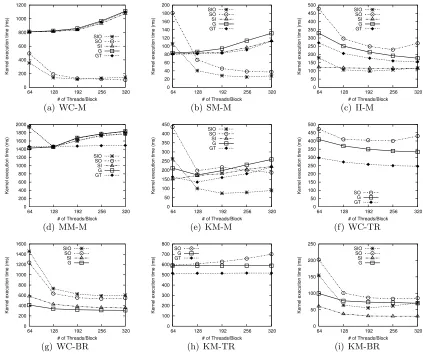
Figure 3.4: Map/Reduce kernels execution time in the large problem size
3.4.4 Map Results
Figure 3.4(a)-3.4(e) show the results of Map kernels with different memory usage modes in the large problem sizes. The small and medium problem size results possess similar trends and are omitted due to the space limit.
In particular, SIO, by combining input and output staging, delivers the best or close-to-best performance in most cases. Compared to G, SIO achieves an average 2.85x speedup, with a maximum of 7.5x.
However, the figures also reveal that the source of such performance benefit heavily depends on workload characteristics. For WC and SM, staging output makes more difference, while for II, staging input creates a larger impact. For KM, it seems that only by combining SO and SI can we receive a significant improvement.
With WC and SM, SO brings large performance gains (in most cases more than 2x speedup compared to G). This is due to their large number of Map output results. With frequent result generation, when output is not staged through shared memory, there is severe contention over a critical section involved in atomic global memory updates, for both output data and associated indices. Though we have reduced this contention by performing in-warp prefix summing, G and SI both suffers from the overhead and unscalability of this bottleneck. In particular, with these two workloads, both G and SI produce longer Map execution time when the number of threads per block increases, while SO and SIO benefit from the increased concurrency brought by more threads. WC, due to its large output-to-input ratio, receives more performance gain than SM from SO, while SM does benefit slightly from SI as it has more access locality when processing the input data.
II benefits significantly and solely from staging input. This can be attributed to several of its traits: 1) very large variance in input record sizes, 2) longer, more complex computation logic than WC and SM, with higher level of input access locality, and 3) a large ratio of input-to-output record count. The long and variant-sized input records and complex computation make staging input especially beneficial, by avoiding expensive global memory accesses. Yet as long as input is staged in shared memory, the computation concurrency is limited by the shared memory size and large-sized input records, making both SIO and SI performance quite flat with increased thread counts. SIO is slightly better than SI, between 128 to 256 of block size, due to the capability of avoiding the aforementioned output update bottleneck in global memory. Seeing the trend of better performance of G with increased thread count, we further experimented beyond 320 threads per block (not shown in the chart). The marginal decrease in G execution time gets smaller, losing to SIO by at least a factor of 1.5.
former, the overhead can be reduced by shortening the computation phases. Note that staging input can effectively reduce the computation phase for most cases, so SIO is usually better than or equal to SO duration. For the latter, the variance in input record sizes is the primary reason for the uneven Map computation time (e.g.II-M).
KM possesses certain common characteristics with both WC and II, making it benefit most from the combination of SI and SO. On one hand, it has fixed sized input/output records, with an input:output size ratio close to 1. Due to the substantial output sizes, SO helps to relieve the problem of unscalable global memory accesses seen in G, especially with large thread blocks. On the other hand, it has strong access locality, by repeatedly accessing an input vector for each centroid, making staging input desirable. Most importantly, by leveraging such locality and shortening the computation phases with input staged into shared memory, the busy waiting overhead of staging output is reduced, making SIO a clear winner.
Finally, MM reads data anyway from global memory, bringing the four modes closer in per-formance. Further, as the workload is memory-bound, all four modes show similar unscalability with increased thread count per block. Small as the difference is, staging output can bring certain advantage here, when the thread block is large. With a block size of 64, the benefit of SIO and SO is offset by the fact that they have to leave a warp of 32 threads as helper threads, which halves the threads available for computation.
As for the effect of texture cache, at the cost of modification to Map function code, GT never loses to G. Comparing SI to GT, except for MM-M, where input cannot be completely staged, staging input is better or equal to texture in most cases. While WC-M and SM-M have similar results, opposite results are shown in II-M and KM-M. While the texture cache is designed to reduce the global memory bandwidth demand, its latency is still longer than shared memory. Therefore when there are long, complex computation phases with conditional branches and a large variance in input as in II-M, bandwidth is not a problem, and the short latency of shared memory makes SI much better. But in KM-M, featured with fixed-size input and almost equally long computation for every thread, the latency of texture fetch is well hidden and the GT mode wins because hardware cache brings the slightest overhead compared to explicit staging. However SI gradually catches up with GT when the thread block is larger, showing that the overhead of SI is finally hidden with more warps. Besides, MM-M’s GT mode shows superior performance over SI because in GT, row/column vectors can be cached with the hardware-managed replacement policy, while SI can only stage the row/column indices.
3.4.5 Reduce Results
Overall, here staging input/output does not appear as helpful as for Map kernels, and we see less diversity in behavior across different workloads/strategies. In the majority of cases, G (or GT when texture is applicable) works the best. As can be seen from Table 3.2, the input-to-output ratio is quite large. Therefore, the benefit of staging output through shared memory cannot offset its overhead, and G (or GT) outperforms SO in all cases.
Staging input does appear to generate a considerable benefit in the case of KM-BR, by an average speedup of 2.25x over G. Here the size of each value type, i.e. a vector, is dependent on the dimension of the space and usually large enough to reach dozens of bytes. With G, multiple global memory transactions are needed for accessing each vector: data accessed for a half-warp at a time span across several 128-byte segments. Staging input improves performance by reducing the number of global memory transactions. This does not happen to WC, as the value type there, integer, makes global memory access already coalesced.
Comparing TR and BR, it appears that BR works better for KM, while TR performs better for WC. The reason lies in their input characteristics. KM has dozens of large distinct key sets, while WC has 10,000s of small ones. Therefore, TR achieves more parallelism with WC across key sets and BR with KM within each key set. This agrees with the finding from temporal data mining [13] that BR works better on small problem sizes, and TR on large problem sizes. The rather small number of key sets in KM, which limits the maximum parallelism of TR kernels, also explains the scalability problem observed in KM-TR. The G mode’s performance is flat, as an increased block size only makes more threads idle in the block. The SO mode’s performance degrades as more threads waste more cycles in synchronization, and bring no benefit due to the high input-to-output ratio.
Texture cache usage for two TR kernels gets an improvement of around 1.27x for WC-TR and around 1.12x for KM-WC-TR over the G mode. Optimized for throughput requirement, the texture cache brings more benefit to WC-TR than to KM-TR. This is again caused by the aforementioned characteristics of the two TR kernels. WC-TR has a higher degree of parallelism, and hence more potential to take advantage of the texture cache.
3.4.6 Comparison with Mars
In this section, we compare our approach with Mars [28], the state-of-the-art, general-purpose MapReduce framework on GPU known by us.
0 50 100 150 200 250 300 350 400 450
MarsSIOSO SI G GT MarsSIOSO SI G GT MarsSIOSO SI G GT
Time (ms)
Small Medium Large Reduce Shuffle Map I/O (a) II 0 20 40 60 80 100 120 140 160
MarsSIOSO SI G GT MarsSIOSO SI G GT MarsSIOSO SI G GT
Time (ms)
Small Medium Large
Reduce Shuffle Map I/O (b) SM 0 500 1000 1500 2000 2500
MarsSIOSO SI G GT MarsSIOSO SI G GT MarsSIOSO SI G GT
Time (ms)
Small Medium Large
Reduce Shuffle Map I/O (c) MM 0 1000 2000 3000 4000 5000 6000 7000 8000 9000
MarsSIOSO SI G GT MarsSIOSO SI G GT MarsSIOSO SI G GT
Time (ms)
Small Medium Large Reduce Shuffle Map I/O (d) WC 0 200 400 600 800 1000 1200 1400 1600
MarsSIOSO SI G GT MarsSIOSO SI G GT MarsSIOSO SI G GT
Time (ms)
Small Medium Large
Reduce
Shuffle Map
I/O
(e) KM
0x 0.5x 1x 1.5x 2x 2.5x 3x 3.5x 4x
WC−M II−M SM−M MM−M KM−M WC−R KM−R
Map/Reduce Phase Speedup compared to Mars
Map/Reduce phases SIO SO SI G GT
Figure 3.6: Map/Reduce Phase Speedup over Mars
by 1) enabling the Reduce phase, and 2) providing a Reduce function that follows a commonly accepted algorithm [23]. For the two workloads that have a Reduce phase, as Mars supports only thread-level reduction (TR), we only compare the TR implementation in our framework. For each memory usage mode, we use the optimal thread block size found in Figure 3.4.
First, we take a look at the impact of the five memory usage modes, enabled by our frame-work, on the Map and Reduce kernel performance. Figure 3.6 shows the speedup over Mars brought by all the memory usage modes in our framework. In most cases, even without using shared memory, our framework outperforms Mars by avoiding the two-pass execution. The G mode beats Mars by a factor of 2 at most (1.1 on average). The reason for the negative speedup in WC and SM is that both workloads have large quantities of results. In this situation, the two-pass running is better, which avoids the bottleneck in atomic updates in the global memory. The G mode also delivers better performance for the two Reduce kernels, compared to Mars as well as to the SO mode. For the Map kernel, however, more advantage is obtained by our active use of shared memory as a staging area. In particular, with the help of output staging, the SO and SIO modes significantly outperform Mars, where G alone is not effective, as discussed above. The SIO modes, which has been shown in Section 3.4.4 to be overall effective, achieves an speedup between 1.3x and 3.73x over Mars, with an average of 2.67x. This demonstrates that SIO appears to be a good choice for Map kernels.
-2 0 2 4 6 8 10 12 14
64 128 192 256 320
Improvement (%)
# of Threads/Block WC-M
SM-M II-M KM-M
Figure 3.7: Kernel speedup by using GPU synchronization with yielding over non-yielding
and SO respectively as input staging does not apply to the TR kernels.
The complete speedup is dampened by the portion of non-Map/Reduce phases in the end-to-end elapsed time. Word Count is an example where there is a large shuffle phase. Still, overall the G mode and SIO mode in our framework outperforms Mars by 34% and 64% on average, respectively. Yet a better approach is to adopt different memory modes in different phases adaptively, which we plan to explore in our future work. There are visible differences in the I/O time between Mars and our framework, due to that the data definition and indices can have slight difference.
3.4.7 Synchronization on GPU
which has long and complex computation phases.
3.5
Concluding remarks and Future Work
In this chapter, we discussed our approaches to overcoming the hurdles of enabling the ag-gressive utilization of GPU shared memory in MapReduce computation. We present a MapRe-duce framework that adaptively manages the limited shared memory space without requiring programmers to explicitly consider data placement in the GPU memory hierarchy. From our evaluation, we have found that despite its small size, the shared memory is worth exploiting and in particular, there is in most cases a significant performance gain when it is used to stage output data. Also, the Map phase of MapReduce workloads receives more benefit from using shared memory, mainly due to larger output sizes.