Construction of a GALI-Regulated Yeast cDNA Expression Library and Its
Application
to
the Identification of Genes Whose Overexpression Causes
Lethality in Yeast
Haoping Liu,' Janet Krizek and Anthony Bretscher
Section of Biochemistry, Molecular and Cell Biology, Cornell University, Zthaca, New York 14853 Manuscript received May 5, 1992
Accepted for publication August 3, 1992
ABSTRACT
We have constructed a galactose-inducible expression library by cloning yeast cDNAs unidirection- ally under control of the GAL1 promoter in a centromeric shuttle vector. Eleven independent libraries were made each with an average size of about 1 X IO6 clones, about 50 times larger than the reported m R N A population in a yeast cell. From this library, LEU2 and HIS3 cDNAs were recovered at a frequency of about 1 in lo4 and in 12 out of 13 cases these were expressed in a galactose-dependent manner. Sequence analysis of leu2 and his3 complementing cDNAs indicates that they contain all the coding sequence and much of the 5' untranslated region. To test the utility of the library for the identification of genes whose overexpression confers a specific phenotype, we screened 25,000 yeast transformants for lethality on galactose. Among 15 clones that showed galactose inducible lethality were cDNAs encoding structural proteins, including ACTl (actin), TUB2 (&tubulin) and ABPl (actin- binding protein l), and genes in signal transduction pathways, including T P K l (a CAMP-dependent protein kinase) and GLC7 (type 1 protein phosphatase). cDNAs overexpressing NHPB (nonhistone protein B) and NSRl (nuclear sequence recognition protein) were also found to be lethal. Among these, ACTl was isolated four times, and NSRl three times. The useful features of this library for cDNA cloning in yeast by complementation, and for the identification of genes whose over-expression confers specific phenotypes, are discussed.
T
HE budding yeast Saccharomyces cerevisiae has become one of the most useful organisms in which to undertake genetic and molecular analyses of basic biological processes (BOTSTEIN and FINK 1988). This stems from its ease of manipulation, excellent genetics and its high efficiency of homologous recom- bination. In particular, mutants with specific defects can be isolated and the relevant genes cloned by complementation of the mutations. To allow for clon- ing by complementation, a number of genomic librar- ies have been constructed (ROSE and BROACH 1991). These generally have inserts between2 and
40 kb and are carried either on a high copy plasmid based on the2~
circle (NASMYTH and REED 1980; CARLSONand BOTSTEIN 1982) or on a low copy centromeric plasmid (ROSE et al. 1987). Analysis of coding se- quences from these libraries has often been hampered by their long genomic DNA inserts and the limited availability of useful cloning sites in the vector.
We are interested in the structure and function of the yeast cytoskeleton and have noticed that a number of genes encoding cytoskeletal proteins are lethal when overexpressed. These include the @-tubulin gene (TUB2), two genes required for microtubule
' Present address: Whitehead Institute for Biomedical Research, 9 Cam- bridge Center, Cambridge, Massachusetts 02142.
Genetics 132 665-673 (November, 1992)
function ( K A R l and BZKl), and a gene for a nucleo- skeletal protein ( N S P l ) (BURKE, GASDASKA and HART-
WELL 1989; ROSE and FINK 1987; BERLIN, STYLES
and FINK 1990; HURT 1988). Cytoskeletons are dy- namic macromolecular assemblies of proteins present in a fairly constant stoichiometric ratio. If one com- ponent is synthesized in vast excess, it might thwart the correct assembly and function of the structure. We therefore suspected that the expression level of genes encoding critical components of the cytoskele- ton might be important for maintaining their appro- priate stoichiometric ratio. This concept predicts that cells might be particularly sensitive to the overexpres- sion of genes encoding these structural components. An earlier example of this line of reasoning (MEEKS- WAGNER and HARTWELL 1986) led these authors to search for genes present in a 2~ genomic library that interfered with mitosis and resulted in a reduced fidelity of chromosome transmission. Using this ap- proach, they isolated two genes (MZFl and MZF2) whose overexpression enhanced mitotic chromosome
666 H. Liu, J. Krizek and A. Bretscher
library and to begin to identify overexpression lethal genes.
Here we describe the construction of a yeast cDNA library whose expression in yeast is regulated by the
GALl promoter. T h e library was cloned into a PBLUESCRIPT-based centromeric plasmid pRS3 16 which is small, contains many unique restriction sites in the multiple cloning site, and offers versatile func- tions for DNA manipulations, including easy subclon- ing, the generation of nested deletions, sequencing, and site directed mutagenesis (SIKORSKI and HIETER
1989). Since the GALl promoter is both strong and tightly regulated, construction of oriented cDNAs next to this promoter should render their expression under the tight control of galactose.
We have characterized the library and begun to analyze genes whose over-expression is lethal. Only a very limited number of genes show over-expression lethality in this system. T h e library should therefore be useful for gene cloning by complementation. Other potential uses of the library are discussed.
MATERIALS AND METHODS
Strains and media: Escherichia coli strains DH5a [F- endAl hsdR17(rk-, mt+) supE44 thi-1 X- recA1 gyrA96 relAl A(argF-laczya) U169 $80 lac ZAM151 and DHlOB [F araD139 A(ara leu)7697 AlacX74 gall7 galK mcrA A(mrr-
hsdRMS-mcrBC) rpsL deoR o80dlacZAM15 endAl nupG recAl] from Bethesda Research Laboratories were used as plasmid hosts. DH 1 OB cells are electrotransformable cells and were used for DNA transformation by electroporation. Yeast strain C U Y l 3 [MATa ura3-521, which originated from the S288C background and was provided by T. HUF- FAKER (Cornell University), was used to provide the mRNA for cDNA synthesis. Yeast strains CUY29 [MATa u r d - 5 2 leu2-3,112 his3-A200 lys2 Gal’] from T. HUFFAKER and YPH226 [MATa ura3-52 lys2-801 ade2-101 leu2-A1 his3-
A200 Gal+] from P. HIETER were used as host strains to test the cDNA library. Media for the growth of yeast were as described by SHERMAN (1991). YEPD contains 1% yeast extract, 2% peptone, 2% glucose; selective media contains yeast nitrogen base with ammonium sulfate and appropriate amino acids containing either 2% glucose o r galactose. 5- Fluoroorotic acid (5-FOA) was purchased through the Ge- netics Society of America and used at a concentration of 0.5 mg/ml (with 5.5 pg/ml uracil) to select against a functional URA3 gene (BOEKE, LACROUTE and FINK 1984).
Preparation of yeast m R N A and cDNA synthesis: Total RNA from a 4-liter culture of strain CUY14 grown to 5 X
l o 7 cells/ml in YEPD was extracted as described by SPRA- GUE, JENSEN and HERSKOWITZ (1983). This RNA pellet was stored at -70”. Yeast mRNA was isolated by oligo(dT) cellulose column chromatography (Current Protocols in Mo- lecular Biology) from about 28 mg of total RNA. About 2.8 mg RNA were recovered and precipitated by sodium acetate and ethanol. T h e oligo(dT) column was regenerated by washing with distilled water, 0.1 M NaOH and water again, and equilibrated with the loading solution. T h e RNA was rechromatographed on the regenerated oligo(dT) column with about 50% recovery. Then 5 M NaCl was added to the eluted material to bring the salt concentration to 0.5 M so that the RNA could be reapplied to the regenerated oligo(dT) column for the third time. About 50% of the
applied RNA was recovered in the elution. After these three cycles through the oligo(dT) column, about 2.5% of RNA was recovered from the total RNA. RNA gels showed that most of tRNA and rRNA had been removed by this proce- dure and so the material should be highly enriched in mRNA. This mRNA was precipitated with sodium acetate and ethanol and washed with 70% ethanol. It was then redissolved in 1 ml pyrocarbonic acid diethyl ester-treated water and precipitated again to reduce the sodium dodecyl sulfate content in the mRNA, which can interfere with the cDNA synthesis reactions.
Yeast cDNA was synthesized from the mRNA by using the SUPERSCRIPT PLASMID SYSTEM from BRL. This system features directional construction of the library by introducing asymmetry at the ends of cDNA. This is achieved by a primer-adapter, which is a oligo d T primer for first strand synthesis that also contains restriction sites. T h e primer-adapter used here had the following sequence
(T)15-”, which contains restriction sites for NotI, NruI, XbaI and S p e I . T h e 8-base NotI recognition sequence next to the
15-bp T s is extremely rare in most DNAs. All the reactions and procedures were performed as described in the BRL manual. For cDNA synthesis, 3.1 pg mRNA was used, and the yield of the first strand synthesis was 38%. After the second strand cDNA synthesis, SalI adapters were ligated to both ends of the cDNA. T h e sequence of this adapter is 5’-TCGACCCACGCGTCCG-3’ for the upper strand and 3’-GGGTGCGCAGGCp-5’ for the lower strand. T h e adapter contains a MZuI recognition site and only one of the oligomers in the adapter is phosphorylated, which eliminates self-ligation of the adapters at the SalI overhangs during ligation to the cDNA. T h e cDNAs were then digested with
NotI to release the NotI sites at the 3‘ ends of the cDNAs.
T h e resulting SalI-cDNA-Not1 fragments (1.23 pg) were size fractionated on a prepacked 1 ml Sephacryl S-500HR col- umn. This is an important step that eliminates a large molar excess of Sal1 adapters and depletes Notl-Sal1 fragments released from 3‘ ends of the cDNAs after the NotI digestion. This also reduces the representation of smaller (e500 bp) inserts in the cDNA library. cDNA from fraction numbers 9 (60 ng), 10 (180 ng), 11 (1 10 ng), and 12 (136 ng) was used to construct the library.
Construction and preparation of vector: T h e yeast ga- lactose promoter GALl was cloned into the pBLUESCRIPT based yeast CEN plasmid pRS316 (SIKORSKI and HIETER
1989). An EcoRI to BamHI DNA fragment carrying the GALlO and GALl promoter region was obtained as previ- ously described (LIU and BRETSCHER 1989). T h e BamHI site is located at 746, 12 bp upstream from the GALl transcrip- tion initiation site and the EcoRI site is at 1 in the GALlO coding sequence (JOHNSTON and DAVIS 1984). T h e Klenow fragment was used to fill in the ends to which phosphoryl- ated XhoI linkers were added. This DNA fragment was inserted into the XhoI site of the pRS3 16 plasmid and both the EcoRI and BamHI sites were retained in this construc- tion. T h e direction of this insertion is shown in Figure 2. T o place cDNAs into the SalI-Not1 region of the plasmid, plasmid DNA was first digested with Sal1 to completion. Since there are only 66 bp between the SalI and Not1 sites, it is difficult to determine whether the second digestion with
Not1 is complete. Three percent of the linearized plasmid DNA was end-labeled with 32P and the DNA was cut with
TABLE 1
Yeast cDNA library pools
No. of E. coli
Pool transformants in the p o o l
9A 8.2 X lo5
9B 6.8 X lo5
9 c 1.5 X lo6
1 OA 5 x 10"
1 OB 2 x 10"
1
oc
9.4 X 10510D 1.5 X lo6
11A 2.8 X lo6
11B 3.2 X lo6
12A 4.4 x lo6
12B 8.5 X 10"
The numbers for each p o o l correspond to the cDNA fractions from the Sephacryl S-500HR column. The library made from p o o l 10A is characterized in this paper.
bp. The SalI-NotI-cut plasmid was purified away from the 66-bp SaZI-Not1 fragment on a low melt agrose gel (Sea- Plaque, FMC Bioproducts) and extracted using an ElutipD (Schleicher & Schuell, Inc.) column.
Library construction: The cDNA library was constructed as described in the BRL manual except where noted. In a ligation reaction of 20 pl, 10 ng of the cDNA and 50 ng of the SalI-NotIcut plasmid were used. After ligation, the DNA was precipitated and rinsed with 70% ethanol to reduce the salt content. DNA from one ligation was used for one electroporation of 40 pl ElectroMAX DHlOB cells (BRL) at 25 pF and 2.5 kV with the pulse controller set to 200 S2 on a Bio-Rad Gene Pulser. The number of transform- ants from each electroporation is shown in Table 1. Each pool of transformants from 10A and 1 1A was selected on 100 LB agar plates containing 100 pg/ml ampicillin. Cells were scraped off the plates and resuspended in a sterile solution of 60% LB and 40% glycerol at a concentration of 1 x lo'* cells/ml. Cells were stored at -70". Other pools of the transformed cells were preserved by adding 1 ml of a sterile solution of 60% LB and 40% glycerol and storing at -70".
Screening the library for overexpression lethal cDNAs in yeast: About 0.25 pg DNA from the yeast cDNA library was used to transform yeast strains CUY29 or YPH226 by electroporation (BECKER and GUARENTE 1991). The trans- formation efficiency was about 5 X lo5 cells/pg DNA. Cells were plated to generate about 100 colonies per plate and the transformants were selected on SD medium containing 1 M sorbitol and glucose as sole carbon source. They were
then replica plated onto selective medium containing either glucose or galactose at 30". Transformants carrying the putative overexpression lethal genes were tested again on these two media plus a synthetic complete galactose medium containing 5-FOA to select for loss of the cDNA plasmid. This is a critical control as certain strains of yeast became
p - and, for unclear reasons, grow extremely slowly or not at all on galactose. T o confirm further that the lethality was conferred by the plasmid, the plasmid DNA was recovered from the yeast transformants (STRATHERN and HIGGINS
1991) and transformed into E. coli by electroporation. The plasmid was then retransformed into the yeast strain to confirm the galactose dependent lethality. The cDNA in the clones conferring galactose-dependent lethality were par- tially sequenced by the dideoxynucleotide method (SANGER, NICKLEN and COULSON 1977). The 3' end of the cDNA was sequenced from the M13 primer (-20) (see Figure 2) and
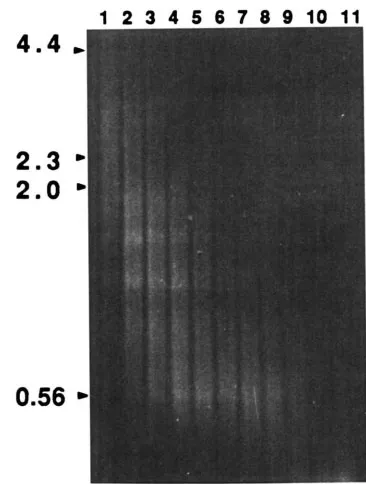
FIGURE 1 .-Agarose gel of fractions containing cDNAs from the Sephacryl500HR column. Lane 1 contains column fractions 9 and 10, lanes 2-1 1 contain column fractions 1 1-20, respectively. Frac- tions 9-12 (lanes 1-3) were used to construct the libraries. Molec- ular mass markers of X-Hind111 are shown at left in kilobases.
the 5' end of the gene was sequenced from a primer in the GAL 1 promoter region, 690-5'TGCATAACCACTTTA- ACT3'-707, synthesized by the Protein and Nucleic Acid Facility at Cornell University. Sequences were searched by computer for homologies by FASTA databases.
RESULTS
668 H. Liu, J. Krizek and A. Bretscher
PStl 395
2881 4 -
Kpnl
EeoRV 603
Apal791
Pvul4519
- \
I
..
""""-"
\.
"_.--== \
Apal Xhol EcoRl l ~ > B a m H I Xhd Sal1 Ylul l m > N o t l c Eagl BatXl Sacll \ :O0'
Sac1
M13 R e v e r s e P r i m e r ( - 2 4 )
S'AACAGCTATGACCATG3'
T3 P r i m e r
s'ATTAACCCTCACTAAAG3'
T3 P r o m o t e r ,1t Kpnl Apal Xhol
5 ' G G A A A C A G C T A T G A C C A T G A T T A C G C C A A G C G C G C ~ T T A A C C C T C A C T ~ G G G A A C ~ G C T G G G T A C C G G G C C C C C C C T C G A G C G G 3' CCTTTGTCGATACTGGTACTAATGCGGTTCGCGCGTT~TTGGGAGTGATTTCCCTTGTTTTCGACCCATGGCCCGGGGGGGAGCTCGCC
Beta-Galacoeidase
AATAAGGAGATGGCCTAGGGCGAGCTCCAGCTGGGTGCGCAGGC
1 7 4 6
GAL^ P r o m o t e r I
EagI B s t X I
Not I Sac11 Sac1
GGGCGGCCGCCACCGCGGTGGAGCTCCAATTCGCCCCTATAGTGAGTCGTATTACGCGCGCTCACTGGCCGTCGTTTTACAA 3 ' CCCGCCGGCGGTGGCGCCACCTCGAGGTTAAGCGGGATATCACTCAGCATAATGCGCGCGAGTGACCGGCAGCAAAATGTT 5'
+1 T I P r o m o t e r
3'GATATCACTCAGCATAAS' 3'TGACCGGCAGCAAAATGS'
T I P r i m e r M13 P r i m e r (-20)
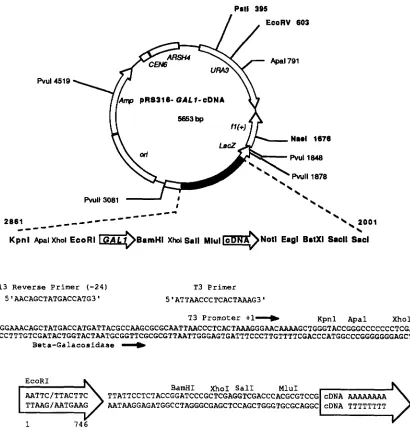
FIGURE 2.-Map of the plasmid carrying the cDNA libraries. The numbering system is modified from the map of pRS316 in SIKORSKI
and HIETER (1989). The size of the plasmid does not include the cDNA insert. Enzymes that cleave the vector once or twice are shown; unique restriction sites are shown in bold letters. In the lower part of the figure is the DNA sequence surrounding the GAL1 promoter and the cDNA. Also shown are primers and promoters useful for DNA sequencing and RNA transcription, respectively. This sequence is a combination of the original plasmid sequence of pBLUESCRIPT I1 KS' (Stratagene) and direct sequence analysis of of cDNA clones from a primer in the GAL1 promoter region and the M13 primer (-20).
TABLE 2
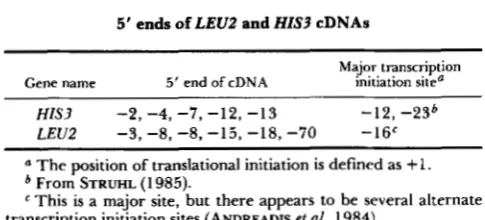
5' ends of LEU2 and HIS3 cDNAs
Major transcription Gene name 5' end of cDNA initiation sitea
HIS3 -2, -4, -7, -12, -13 -12, -23' LEU2 -3, -8, -8, -15, -18, -70 -16'
The position of translational initiation is defined as
+
1. From STRUHL (1 985).This is a major site, but there appears to be several alternate transcription initiation sites (ANDREADIS et al. 1984).
All of the inserts had a minimal stretch of 15 dA residues adjacent to the Not1 site, indicating a correct orientation of insertion.
Frequency of specific cDNAs in the library: HERE-
FORD and ROSBACH (1977) have estimated that S.
cerevisiae contains 3000-4000 different mRNA se- quences that can be classified into low (200 copies/ cell), medium (20 copies/cell), and high (1-2 copies/ cell) complexity classes. These are estimated to con- tain approximately 20, 400 and 2400 sequences, re- spectively. This estimate predicts that the frequency of a single copy mRNA existing in the cDNA library is about 1 in 16,000 clones. T o assess the actual frequency of particular cDNAs in the library, the frequency of recovering clones that could comple- ment his3 and leu2 mutations was examined. T h e cDNA library was transformed into a yeast strain (CUY29:ura5-52 leu2-3,112 his3-A200 lys2 Gal+) se- lecting for uracil prototrophy and the transformants were replica plated onto selective media containing either glucose or galactose. Of 60,000 transformants, HIS3 cDNAs were recovered five times and LEU2 cDNAs eight times. All but one of the clones comple- mented the amino acid auxotrophy only on medium containing galactose, indicating that 12 out of 13 are under tight control of the GAL1 promoter. T h e single clone that did not show galactose-dependent comple- mentation was found to have a LEU2 cDNA in the inverse orientation. DNA sequencing from the Sa11 site into the 5' of the his3 and leu2 complementing clones indicated that they were all independent con- structs and contained the entire coding regions to- gether with much of the 5' non-coding sequence (Table 2). It has been estimated that the basal level of HIS3 gene transcription yields one or two mRNAs per cell under growth conditions where the synthesis of histidine biosynthetic enzymes is repressed (STRUHL
1985; STRUHL and DAVIS 1981). Our finding that LEU2 cDNAs are recovered at a frequency of about
1 in 7,500 and HIS3 cDNAs at about 1 in 12,000 is consistent with the predicted figure for the presence of 1-2 copies of their mRNA per cell. T h e size of each of the eleven independent pools of transformants is therefore about 50-fold larger than the mRNA population. Each pool can be used as an independent library.
Since this is a cDNA library, the majority of the clones would represent the genes of high or moder- ately abundant mRNAs. Partial DNA sequencing of eight randomly isolated clones identified four full length cDNAs of previously sequenced genes. They are genes for elongation factor l a , elongation factor 3, ribosomal protein S7 and ribosomal protein 5 1B (NAGASHINA et al. 1986; QIN et al. 1990; ABOVICH and ROSBACH 1984). Yeast containing these plasmids grew well on either glucose or galactose. T h e other four cDNA sequences did not match sequences in the data bank.
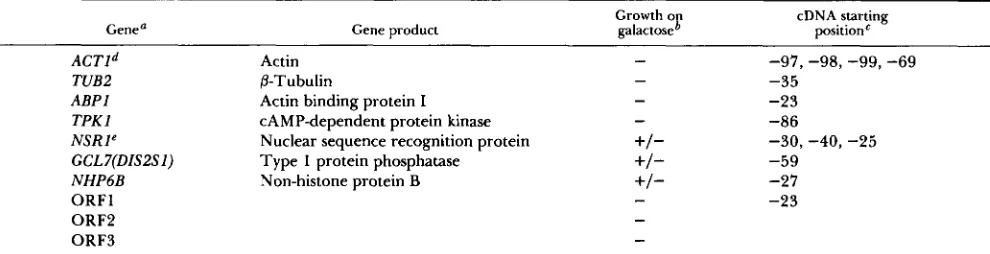
Galactose induced lethal cDNAs: Our original mo- tivation for making this library was to look for genes whose overexpression causes lethality. T h e cDNA li- brary was transformed into yeast cells and about 25,000 transformants were screened on selective me- dia containing either glucose or galactose as sole car- bon source. T h e transformants that could grow on glucose medium, but not on galactose medium may carry an overexpression lethal cDNA. These plasmids were reisolated and introduced into yeast cells to confirm their galactose-dependent lethality. Fifteen clones retained this lethal phenotype on galactose. T h e cDNAs in these were sequenced from both ends to identify those derived from known genes. Of the
15, seven were derived from characterized genes, and three from uncharacterized genes. These seven cDNA are derived from transcripts of the following genes: ACTl (actin), TUB2 (@-tubulin),
AEPl
(actin-binding protein),TPKl
(a CAMP-dependent protein kinase),NSRI
(nuclear sequence recognition protein), GLC7 (type 1 protein phosphatase), andNHP6B
(nonhistone protein B) (GALLWITZ and SURES 1980; NG and ABEL- SON 1980; NEFF et al. 1983; DRUBIN et al. 1990; TODA et al. 1987; LEE, XUE and MELESE 1991; FENG et al.199 1; KOLODRUBETZ and BRUGUM 1990). Among them, ACTl cDNAs were isolated four times, and
NSRI
cDNAs were isolated three times (Table 3). One of the open reading frames (ORFs) of unknown func- tion lies between the E I K l and FUSl genes and its sequence has been reported (TRUEHEART, BOEKE andFINK 1987). Microscopic analysis of galactose induced yeast cells carrying these clones did not reveal any obvious cell cycle-specific arrests.
670 H. Liu, J. Krizek and A. Bretscher
TABLE 3
Genes that confer lethality after induction by galactose
Gene' Gene product
Growth on cDNA starting galactoseb positionC
A C T I ~ Actin
TUB2 &Tubulin
ABPl Actin binding protein I
TPK I CAMP-dependent protein kinase
N S R l e Nuclear sequence recognition protein
GCL7(DIS2SI) Type 1 protein phosphatase
NHP6B Non-histone protein B ORFl
ORF2 ORF3
-
-97, -98, -99, -69- -35
-23
-86
-
-
+/- -30, -40, -25
+/- -59
+/- -27 -23
-
-
-
'
DNA sequences of both ends of the cDNAs were sent to FASTA databases to search for homologies. The known genes are listed under their designated names. The other genes are named ORF for open reading frame. ORFl lies between the BIKl and FUSl genes and its se uence was published in TRUEHEART, BOEKE and FINK (1 987).No growth after 5 days at 30" on selective media containing galactose is indicated by -, and slight growth by +/-. The Dosition of translational initiation is defined as
+
1.A C T i was recovered four times.
NSRl was found three times.
tion or galactose inducible lethality and may therefore only represent a fraction of the library. A more ac- curate assessment is to clone a cDNA from the library by colony hybridization. A single A C T l cDNA was independently isolated by hybridization among 2000
E. coli colonies screened with labelled ACTl DNA. DNA sequence analysis at the 5' end of the insert showed that the cDNA starts at -105. This ACTl
cDNA also showed galactose inducible lethality when transformed into yeast cells. This clone, together with the eight randomly selected clones described above, suggest that most of the inserts carry well synthesized cDNAs.
DISCUSSION
We have constructed an oriented yeast cDNA li- brary in a pBLUESCRIPT based yeast centromeric plasmid (Figure
2).
This library has a high insert rate (>96%) and appears to contain a high proportion of full length cDNAs. Furthermore, expression of the cDNAs in yeast is under the tight control of the yeastGALl promoter as a consequence of the directional cloning strategy. T h e number of original transform- ants in each of 11 pools is about 50 fold in excess of the reported mRNA population in yeast. T h e fre- quency of H I S 3 and LEU2 cDNAs is also in good agreement with the reported mRNA population of about 1 in 16,000. In order to ensure that the entire library is covered, it is probably necessary to screen at least 50,000 transformants, which is easily accom- plished by using electroporation to introduce the
DNA into yeast.
We see a number of useful features of this library over the currently available cDNA and genomic li- braries (MCKNIGHT and MCCONAUGHY 1983; ROSE and BROACH 1991). First, each plasmid contains only
the transcribed region of the gene, so there is no need to locate the gene as is the case of cloning from genomic libraries. T h e fact that the expression of the cDNA is under the control of the GALl promoter may be very useful when cloning by complementation. For example, it will help to rapidly differentiate be- tween real and false clones, which may be especially helpful in the case of complementation of leaky con- ditional mutations, based on their galactose inducibil- ity. Second, the length of the gene transcript can be estimated directly from the length of the cDNA, which can be excised from the plasmid at the rare restriction sites that flank the cDNA. Third, the se- quences of both ends of the cDNA can be readily obtained by using primers in the GALl region and the
lacZ gene. This sequence information will be sufficient to determine whether the relevant gene has been identified and sequenced previously, which is espe- cially valuable in yeast, where a large percentage of its genes have been sequenced. Fourth, the
pBLUESCRIPT polylinker surrounding the cDNA allows unidirectional deletions to be made in the same plasmid. This should be especially useful for the map- ping of functional domains as well as in the generation and expression of truncated products. Expression of truncated structural proteins frequently show a dom- inant negative phenotype, interfering with processes in which the wild-type gene product normally func- tions (see, for example, HERSKOWITZ 1987; SCHULTH-
67
T h e library was constructed from mRNA expressed in MATa cells and is therefore limited to genes tran- scribed in these cells. Genes that are transcribed spe- cifically in diploids or haploid MATa! cells, or induced under certain growth conditions will therefore not be represented. In addition, mRNAs that have short poly(A) tails may not have been recovered efficiently on the poly-dT affinity column or they might be under represented during the reverse transcription reaction because of the overhang of extra dTs from the primer containing 15 dT. All the cDNA sequences in this library that we have sequenced (>20) end with a poly(A) tail of at least 15 base pairs long. It should be noted that extra dAs might have been added during synthesis of the second strand using the 15 d T of the primer as template.
T h e library should prove useful for cloning cDNAs by complementation since we have identified only a limited number of over-expression lethal genes in yeast. Moreover, we have found that the introduction of an ACTl cDNA clone from the library into an actl- 1 conditional mutant strain can suppress the condi- tional growth defect in a galactose dependent manner (data not shown). Thus, lethality of an overexpressed cDNA in a wild-type strain does not necessarily imply lethality in the corresponding mutant strain.
Suppression of a conditional mutation in one gene by the overexpression of a different gene has been shown, in many cases, to identify genes whose prod- ucts are involved in the same functional pathway. For example, cyclin genes were cloned from a 2 p genomic library by their suppression of a cdc28 mutation (REED
et al. 1989); and T P K l was identified by its suppression of a cdc25 mutation (TODA et al. 1987). This type of analysis should be facilitated using the GALl-cDNA library as it provides two additional features. First, since suppression is galactose-dependent it will facili- tate differentiation between suppression from the ex- pressed cDNA and suppression by a chromosomal mutation. Second, once a suppressor cDNA has been identified, it can be analyzed much faster and more easily in this system. In addition, since the level of galactose-induced over-expression of a cDNA on a centromeric plasmid is different from the level of gene overexpression from its own promoter on a multicopy plasmid, the two types of libraries could find comple- mentary uses.
We have used the library to look for genes whose overexpression causes lethality. Of 25,000 clones screened, seven known yeast genes and three un- known genes were found to be lethal following induc- tion on galactose. ACTl and TUB2 genes encode key components of microfilaments and microtubles in yeast. It was previously reported that over-expression of the TUB2 gene, encoding P-tubulin, caused lethality (BURKE, GASDASKA and HARTWELL 1989), and over-
expression of A C T l , encoding actin, is lethal (cited in ROSE et al. 1987). Isolation of these two classes of cDNAs in our overexpression lethal screen supports the validity of this approach. A five fold overpro- duction of actin-binding protein I (encoded by APBl )
on a 2p plasmid has been reported to render cells temperature sensitive with abnormal actin structures (DRUBIN, MILLER and BOTSTEIN 1988). Here, we have found that expression of this actin-binding protein from the GALl promoter causes cell lethality, possibly because the protein is produced at a higher level in this construct. From these examples and the fact that we have recovered most of the overexpression lethal cDNAs once, it is clear that we have not yet saturated the number of overexpression lethal genes. T h e fact that we have not yet recovered some genes known to confer over-expression lethality in other systems might be a result of the relative strengths of the promoters used, the plasmid copy number or strain background. However, given the significant fraction of the lethal clones that turned out to encode cDNAs for cytoskeletal proteins, these results support the concept that the expression level of certain cytoskel- eta1 proteins is especially critical for the normal growth of cells.
Other classes of cDNAs were also found to be lethal when overexpressed. T h e NSRl gene encodes a pro- tein that specifically binds nuclear localization se- quences and has two RNA recognition motifs, as well as an acidic N terminus containing a series of serine clusters, and a basic C terminus containing arg-gly repeats (LEE et al. 199 1). In wild type cells this protein is restricted to a portion of the nucleus. LEE, XUL and MELESE (1991) constructed a GALl-NRSl plasmid that had over 170 bp between the translation initiation codon and the GALl promoter, but no overpro- duction of the protein was observed on galactose. Here, we have cloned the NSRl cDNA three times in our screen, suggesting that the N S R l mRNA must be quite abundant in the cell. It will be interesting to examine the effect of overproduction of the N S R l
protein on the localization of nuclear proteins like histone H2B, which contains the nuclear localization sequence recognized by the NSRl gene product.
NHP6B encodes one of the two highly homologous nonhistone proteins in yeast (KOLODRUBETZ and BRUGUM 1990). Both these non-histone proteins are homologous to the middle segment of the chromatin- associated high mobility group protein 1 from calf and are speculated to have a role in transcription or DNA replication.
Another group of the clones identified in our over- expression lethal screen encode a protein kinase
672 H. Liu, J. Krizek and A. Bretscher
gene on a 2/.~ plasmid does not cause cell lethality (TODA et al. 1987).
GLC7
encodes a type 1 protein phosphatase required for glycogen accumulation in yeast (FENG et al. 1991).GLC7
is identical to theDZS2S2 which was cloned by its homology to the
Schizosaccharomyces pombe DZS2 (defective in sister chromatid disjoining) gene, believed to be involved in mitosis (OHKURA et al. 1991). FENG et al. (1 991) reported that
GLC7
mRNA increased 4-fold at the end of exponential growth in wild type cells with the implication that activation of glycogen synthesis is mediated by increased expression of protein phospha- tase 1 as cells reach stationary phase. If this is true,we would expect to see an increased amount of gly- cogen synthesis in cells overexpressing
GLC7;
how- ever, in preliminary experiments no unusual accu- mulation of glycogen was found in these cells after induction by galactose (data not shown).Among the three unknown overexpression lethal genes, ORFl is the gene between BZKl and FUSI. Its deduced protein sequence consists largely of gluta- mines and aspargines, as well as a stretch of 20 alter- nating glutamine and glycine residues (TRUEHEART, BOEKE and FINK 1987). Remarkably, deletion of this gene has no obvious phenotype, yet we find that over- expression confers lethality. This finding underscores the rationale for using divergent genetic approaches to identify genes whose products are involved in spe- cific processes.
We believe that our results point to two important uses of this library. T h e first is that it will make cloning by complementation and suppression analysis by over- expression easier. Second, and more importantly, it provides a genetic approach of identifying genes whose overexpression interferes with specific biolog- ical processes. In our studies we have examined clones that confer lethality in a galactose-dependent manner. It may be equally useful to select clones that overcome normally growth-inhibiting conditions, such as the G I arrest imposed on MATa cells by a-factor. In this example, overexpression of cDNAs that encode com- ponents of the signal transduction pathway might interfere with correct transmission of the signal that arrests the cells in G1 and thereby allow growth in the presence of a-factor. This type of approach and our lethal screen make use of the most extreme pheno- types, namely induced life or induced death. How- ever, more subtle screens or selections might also uncover cDNAs that encode important proteins. For example, this was the basis for the isolation of the
MZFl and MZF2 (MEEKS-WAGNER et al. 1986) genes discussed above. T h e regulated cDNA expression li- brary should facilitate this type of approach and to- gether with the classic conditional lethal mutation analysis allow for a more complete understanding of genes whose products play roles in specific processes.
We are grateful to TOM FOX, BIK TYE and to members of this laboratory for discussions. Special thanks go to ELIZABETH CHEN for computer expertise and for isolating an ACT1 cDNA by colony hybridization and showing that it confers overexpression lethality, to DANIEL SCHOTT who used this cDNA to show that it can rescue the actl-1 conditional mutation at its restrictive temperature, and to RUBY YE who looked for glycogen accumulation in cells over- expression GLC7. This work was supported by grant GM39066
from the National Institutes of Health.
LITERATURE CITED
ABOVICH, N., and M. ROSBACH, 1984 Two genes for ribosomal protein 51 of Saccharomyces cereuisiae complement and contrib- ute to the ribosomes. Mol. Cell Biol. 4 1871-1879.
ANDEADIS, A., Y.-P. Hsu, M. HERMODSON, G. KOHLHAW and P. SCHIMMEL, 1984 Yeast LEU2. Repression of mRNA levels by leucine and primary structure of the gene product. J. Biol. Chem. 2 5 9 8059-8062.
BECKER, D. M., and L. GUARENTE, 1991 High-efficiency transfor- mation of yeast by electroporation. Methods Enzymol. 194:
BERLIN, V., C. STYLES and G. R. FINK, 1990 BIKl, a protein required for microtubule function during mating and mitosis in Saccharomyces cereuisiae, colocalizes with tubulin. J. Cell Biol.
BOEKE, J. D., F. LACROUTE and G. R. FINK, 1984 A positive selection for mutants lacking orotidine-5’-phosphate decarbox- ylase activity in yeast: 5-fluoro-orotic acid resistance. Mol. Gen. Genet. 197: 345-347.
BOTSTEIN, D., and G. R. FINK, 1988 Yeast as an experimental organism for modern biology. Science 2 4 0 1439-1443.
BURKE, D., P. GASDASKA and L. HARTWELL, 1989 Dominant effects of tubulin overexpression in Saccharomyces cereuisiae.
Mol. Cell. Biol. 9 1049-1059.
CARLSON, M., and D. BOTSTEIN, 1982 Two differentially regu- lated mRNAs with different 5’ ends encode secreted and intracellular forms of yeast invertase. Cell 28: 145-154.
DRUBIN, D. G., K. G. MILLER and D. BOTSTEIN, 1988 Yeast actin- binding proteins: evidence for a role in morphogenesis. J. Cell Biol. 107: 2551-2561.
DRUBIN, D. G . , J. MULHOLLAND, Z. M. ZHU and D. BOTSTEIN,
1990 Homology of a yeast actin-binding protein to signal transduction proteins and myosin-I. Nature 343: 388-390.
FENG, Z., S. E. WILSON, Z.-Y. PENG, K. K. SCHLENDER, E. M. REIMANN and R. J. TRUMBLY, 1991 The yeast GLC7 gene required for glycogen accumulation encodes a type 1 protein phosphatase. J. Biol. Chem. 2 6 6 23796-23801.
GALLWITZ, D., F. PERRIN and R. SEIDEL, 1981 The actin gene in yeast Saccharomyces cereuisiae: 5’ and 3’ end mapping, flanking and putative regulatory sequences. Nucleic Acids Res. 9 6339- 6350.
GALLWITZ, D., and I. SURES, 1980 Structure of a split gene: complete nucleotide sequence of the actin gene in Saccharomyces cereuisiae. Proc. Natl. Acad. Sci. USA 77: 2546-2550.
HEREFORD, L. M., and M. ROSBACH, 1977 Number and distribu- tion of polyadenylated RNA sequences in yeast. Cell 1 0 453- 462.
HERSKOWITZ, I . , 1987 Functional inactivation of genes by domi- nant negative mutations. Nature 329: 219-222.
HURT, E. C., 1988 A novel nucleoskeletal-like protein located at the nuclear periphery is required for the life cycle of Saccha- romyces cerevisiae. EMBO J. 7: 4323-4334.
JOHNSTON, M., and R. W. DAVIS, 1984 Sequences that regulate the divergent GALl-GAL10 promoter in Saccharomyces cerevis-
iae. Mol. Cel. Biol. 4 1440-1448.
KOLODRUBETZ, D., and A. BURGUM, 1990 Duplicated NHP6 genes of Saccharomyces cerevisiae encode proteins homologous
182-187.
to bovine high mobility group protein. 1. J. Biol. Chem. 265:
LEE, W.-C., Z. XUE and T. MELESE, 199 1 The NSRl gene encodes a protein that specifically binds nuclear localization sequences and has two RNA recognition motifs. J. Cell. Biol. 113: 1-12.
LIU, H., and A. BRETSCHER, 1989 Disruption of the single tro- pomyosin gene in yeast results in the disappearance of actin cables from the cytoskeleton. Cell 57: 233-242.
MCKNIGHT, G. L., and B. L. MCCONAUGHY, 1983 Selection of functional cDNAs by complementation in yeast. Proc. Natl. Acad. Sci. USA 8 0 4412-4416.
MEEKS-WAGNER, D., and L. H. HARTWELL, 1986 Normal stoichi- ometry of histone dimer sets is necessary for high fidelity of mitotic chromosome transmission. Cell 44: 43-52.
MEEKS-WAGNER, D., J. S. WOOD, B. GARVIK and L. H. HARTWELL,
1986 Isolation of two genes that affect mitotic chromosome transmission in S. cerevisiae. Cell 44: 53-63.
NAGASHINA, K., M. KASAI, S. NAGATA and Y. KAZIRO,
1986 Structure of the two genes coding for polypeptide chain elongation factor 1 -alpha (EF-1-alpha) from Saccharomyces cere- visiae. Gene 4 5 265-273.
NASMYTH, K., and S. I. REED, 1980 The isolation of genes by complementation in yeast: the molecular cloning of a cell cycle gene. Proc. Natl. Acad. Sci. USA 77: 21 19-2123.
NEFF, N. F., J. H. THOMAS, P. GRISAFI and D. BOTSTEIN,
1983 Isolation of the beta-tubulin gene from yeast and dem- onstration of its essential role in vivo. Cell 33: 21 1-219.
NG, R., and J. ABELSON, 1980 Isolation and sequence of the gene for actin in Saccharomyces cereuisiae. Proc. Natl. Acad. Sci. USA
77: 3912-3916.
OHKURA, H., N. KINOSHITA, S. MIYATANI, T. TODA and M. YAN- AGIDA, 1991 The fission yeast dis2+ gene required for chro- mosome disjoining encodes one of two putative protein phos- phatases. Cell 57: 997-1007.
QIN, S., A. XIE, M. C. BONATO and C. S. MCLAUGHLIN,
1990 Sequence analysis of the translational elongation factor
3 from Saccharomyces cerevisiae. J. Biol. Chem. 265: 1903-1 9 12.
REED, S. I., J. A. HADWIGER, H. E. RICHARDSON and C. WITTEN- BERG, 1989 Analysis of the Cdc28 protein kinase complex by dosage suppression. J. Cell Sci. Suppl. 12: 29-37.
3234-3239.
ROSE, M. D., and J. R. BROACH, 1991 Cloning genes by comple- mentation in yeast. Methods Enzymol. 194: 195-230.
ROSE, M. D., and G. R. FINK, 1987 K A R l , a gene required for function of both intranuclear and extranuclear microtubules in yeast. Cell 48: 1047-1060.
ROSE, M. D., P. NOVICK, J. H. THOMAS and G. R. FINK, 1987 A
Saccharomyces cerevisiae genomic plasmid bank based on a cen- tromere-containing shuttle vector. Gene 6 0 237-243.
SANGER, F., NICKLEN, S. and A. R. COULSON, 1977 DNA sequenc- ing with chain-terminating inhibitors. Proc. Natl. Acad. Sci.
SCHULTHEISS, T., Z. LIN, H. ISHIKAWA, I. U. ZAMIR, C. STOECKERT and H. HOLTZER, 1991 Desmin/vimentin intermediate fila- ments are dispensible for many aspects of myogenesis. J. Cell Biol. 114: 953-966.
SHERMAN, F., 1991 Getting started with yeast. Methods Enzymol.
SIKORSKI, R. S., and P. HIETER, 1989 A system of shuttle vectors and yeast host strains designed for efficient manipulation of DNA in Saccharomyces cerevisiae. Genetics 122: 19-27.
SPRAGUE, G. F., JR., R. JENSEN and 1. HERSKOWITZ, 1983 Control of yeast cell type by the mating type locus: positive regulation of the a-specific STE3 gene by the M A T a l product. Cell 32:
STRATHERN, J. N., and D. R. HIGGINS, I991 Recoveryofplasmids from yeast into Escherichia coli: shuttle vectors. Methods En- zymol. 194: 3 19-329.
STRUHL, K., 1985 Nucleotide sequence and transcriptional map- ping of the yeast pet56-his3-dedl gene region. Nucleic Acids Res. 13: 8587-8601.
STRUHL, K., and R. DAVIS, 1981 Transcription of the his3 gene region in Saccharomyces cerevisiae. J. Mol. Biol. 152: 535-552.
TRUEHEART, J., J. D. BOEKE and G. R. FINK, 1987 Two genes required for cell fusion during yeast conjugation: evidence for a pheromone-induced surface protein. Mol. Cell. Biol. 7: 23 16- 2328.
TODA, T., S. CAMERON, P. SASS, M. ZOLLER and M. WIGLER,
1987 Three different genes in S. cerevisiae encode the cata- lytic subunits of the CAMP-dependent protein kinase. Cell 5 0
USA 74: 5463-5467.
1 9 4 3-2 1.
409-415.
27-287.