SUMMARY OF OPERATIONAL EXPERIENCE FOR ADVANCED
NON-LIGHT WATER REACTORS: MATERIALS AND STRUCTURAL
INTEGRITY ISSUES
F. W. Brust1, M. Gordon2, R. Turk3, and R. Iyengar2
ABSTRACT
This paper summarizes Operational Experience (OpE) of advanced non-light water reactors (ANLWR) that have been in operation over the last sixty years. The focus of this paper is on Sodium Cooled Fast Reactors (SFR) and High Temperature Gas Cooled Reactors (HTGR) with regard to materials and component integrity. Operational experience was compiled from numerous journal publications, pertinent books, and publicly available reports. This paper represents a short summary of the report (Turk, March, 2019).
INTRODUCTION
This provides a brief summary of the available domestic and international operating experience (OpE) for both power and research advanced non-light-water reactors with regard to materials and component integrity. It focuses on both sodium-cooled fast reactors (SFRs) and high-temperature gas-cooled reactors (HTGRs). This report identifies OpE relevant to the following:
• Materials used, including a summary of the range of materials used in both SFRs and HTGRs
• Observed and anticipated material degradation mechanisms for both SFRs and HTGRs
• Component integrity issues and possible solutions to challenges involving materials and component integrity
• Specific issues based on OpE that should be addressed in the development of regulatory infrastructure
• Assessment tools and evaluation techniques (e.g., nondestructive evaluation (NDE)) used to identify and address component integrity issues
identify gaps in consensus codes and standards and computational codes used in the construction and operation of SFRs and HTGRs.
ANLWR REACTORS CONSIDERED
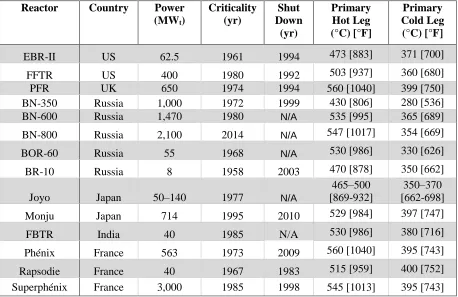
Table 1 lists international SFR OpE compiled by (McDowell, B.K., Mitchell, M.R., Pugh, R., Nickolaus, J.R., and Swearingen, G.L., 2011) discusses the evolution of these reactors. Summaries of the OpE in these plants are provided in the next section.
Table 1 SFR Reactors Considered
Reactor Country Power
(MWt)
Criticality (yr)
Shut Down
(yr)
Primary Hot Leg (°C) [°F]
Primary Cold Leg (°C) [°F]
EBR-II US 62.5 1961 1994 473 [883] 371 [700]
FFTR US 400 1980 1992 503 [937] 360 [680]
PFR UK 650 1974 1994 560 [1040] 399 [750]
BN-350 Russia 1,000 1972 1999 430 [806] 280 [536]
BN-600 Russia 1,470 1980 N/A 535 [995] 365 [689]
BN-800 Russia 2,100 2014 N/A 547 [1017] 354 [669]
BOR-60 Russia 55 1968 N/A 530 [986] 330 [626]
BR-10 Russia 8 1958 2003 470 [878] 350 [662]
Joyo Japan 50–140 1977 N/A
465–500 [869-932]
350–370 [662-698]
Monju Japan 714 1995 2010 529 [984] 397 [747]
FBTR India 40 1985 N/A 530 [986] 380 [716]
Phénix France 563 1973 2009 560 [1040] 395 [743]
Rapsodie France 40 1967 1983 515 [959] 400 [752]
Superphénix France 3,000 1985 1998 545 [1013] 395 [743]
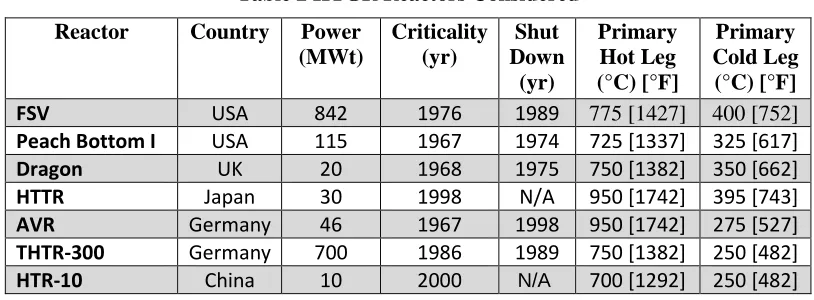
As of April 2010, seven HTGRs have been designed and operated throughout the world
Table 2 HTGR Reactors Considered
Reactor Country Power (MWt)
Criticality (yr)
Shut Down
(yr)
Primary Hot Leg (°C) [°F]
Primary Cold Leg
(°C) [°F] FSV USA 842 1976 1989 775 [1427] 400 [752] Peach Bottom I USA 115 1967 1974 725 [1337] 325 [617]
Dragon UK 20 1968 1975 750 [1382] 350 [662]
HTTR Japan 30 1998 N/A 950 [1742] 395 [743]
AVR Germany 46 1967 1998 950 [1742] 275 [527] THTR-300 Germany 700 1986 1989 750 [1382] 250 [482]
HTR-10 China 10 2000 N/A 700 [1292] 250 [482]
OPE SUMMARY OF SFR AND LESSONS LEARNED
A summary list of lessons learned from operating experience of SFRs are listed below.
(1) Sodium heat-transport systems experienced a significant number of leaks caused by poor weld design and poor weld quality control. Initial fabrication defects, particularly at welds, must be identified during construction. Welds should be carefully designed to minimize residual stresses, to do and direct tube-to-tube-plate welds should be avoided. Lowering the threshold for quality in welds and secondary loops has resulted in operational problems.
(2) Weld repair procedures often lead to tensile weld residual stresses in repair regions. Reheat cracking is a concern in SFR components operating at high temperatures. Weld repairs should be carefully managed because they may give rise to very high tensile residual. Tensile weld residual stresses can also lead to corrosion growth and reduced fatigue performance due to mean stress as well. Some types of austenitic SS (e.g., Type 321) are significantly more prone to reheat cracking than other austenitic SS.
(3) Stresses induced by thermal expansion, particularly in areas of constraint, must be carefully considered for SFRs. These stresses have often been the source of structural integrity issues in SFR operation. In the case of Phénix, excess weld material led to over-constraint and cracking. The issue was resolved by eliminating unnecessary weld material.
(4) Thermal fatigue (thermal striping) in SFRs is a much more significant issue than it is for LWRs. Thermal fatigue in SFRs is caused by mixing sodium flows of different temperatures and must be carefully assessed to prevent fatigue.
(9) Austenitic steels are unsuitable for SFR SGs because of the high risk of caustic stress-corrosion damage following even small leaks.
(10) Testing should confirm the chemical compatibility between molten sodium and insulation material.
(11) The proper choice of materials for SFRs requires complete material databases.
(12) Secondary measurement devices (e.g., thermocouples) must be properly designed to prevent leaks. Flow-induced vibrations and complex fluid flows in these areas can cause failure and sodium leaks.
(13) The failure of in-sodium components without an adequate means for removal and repair has resulted in costly and time-consuming recovery.
(14) Sodium contamination and the consequent formation of sodium oxide have caused the binding of rotating machinery and control rod drives.
(15) Better detection methods of corrosion and leaks are necessary, particularly in regions coated with insulation. The design phase should consider sensor placement and reliability under operating conditions. Inadequate or unreliable leak detection systems have caused extensive shutdowns because of sodium contamination and excessive sodium leaks with consequent fires.
(16) The licensing process needs to scrutinize seismic and external dynamic loading events of SFRs. During an emergency shutdown (scram), the IHX may experience thermal shock caused by the influx of cold sodium. This condition could lead to buckling and structural issues amplified by an external loading.
OPE SUMMARY OF HTGR AND LESSONS LEARNED
A summary list of lessons learned from operating experience of HTGRs are listed below.
(1) High tensile stresses caused by irradiation swelling at high temperatures can develop in the fuel elements, leading to the cracking of graphite fuel elements.
(2) Calculating HTGR core temperatures is challenging, particularly for pebble bed designs.
Although it is easy to attribute the overheating in the AVR to limitations of computational codes in the 1980s, the core temperature of the prismatic HTTR has also been underestimated.
Inaccurate core temperatures have led to thermal fatigue and fuel failure in pebble bed HTGRs.
(3) HTGRs must account for all sources of possible corrosion, and corresponding materials and components must be designed appropriately. Early designers focused on the impact of moisture ingress and consequent graphite oxidation; however, OpE has demonstrated moisture ingress can also lead to structural component failures. Future HTGRs must be designed to consider all aspects of potential moisture ingress and incorporate methods for removing moisture from the core and primary loop.
(5) Management of thermal stresses is important in HTGRs because thermal expansion stresses can cause large loads and creep.
(6) Corrosion of the prestressed concrete tendons could weaken the integrity of the reactor vessel and must be considered.
(7) Abnormal abrasion in helium coolant compressors can degrade the performance of piston-ring seals and cause leakage. Compressors in HTGRs must be carefully chosen.
(8) HTGR should be designed to minimize sources of graphite dust (e.g., fretting) and should include filters or other mitigating measures to address graphite dust.
(9) Coarse-grained alloys are used for improved creep resistance, but such alloys are more vulnerable to cracking. Control of alloy grain sizes should be considered because alloys with excessive grain sizes may have insufficient toughness.
(10) Oil-based lubricants should be avoided in HTGRs. Lubricants have repeatedly leaked into the primary loop in HTGRs, and the high temperatures of the HTGRs are sufficient to ignite these oils elsewhere in the plant, even when they are not associated with the primary loop.
(11) The design lesson from the Dragon experience is to ensure that the impact of SG tube ruptures in HTGRs will be limited (design-basis accident control).
(12) Lessons learned from AVR include (1) all HTGR vessels, particularly the reactor vessels, must be equipped with drainage devices, and (2) “U-shaped” pipe lines are to be avoided.
(13) HTGRs need to ensure the structural integrity of the RPV and the connecting vessels, especially under low helium flow and loss-of-forced convection conditions, because buckling may occur.
(14) Backup systems must be properly designed to handle overloads and system upsets, such as seismic loads.
CONCLUSION
REFERENCES
Copinger, D. a. (January 2004). Fort Saint Vrain Gas Cooled Reactor Operational Experience. U.S. Nuclear Regulatory Commission, Washington, DC: NUREG/CR 6839.
McDowell, B.K., Mitchell, M.R., Pugh, R., Nickolaus, J.R., and Swearingen, G.L. (2011). High
Temperature Gas Reactors: Assessment of Applicable Codes and Standards. Pacific Northwest
National Laboratory, Richland, WA:
https://www.pnnl.gov/main/publications/external/technical_reports/pnnl-20869.pdf.
Turk, R. H. (March, 2019). Advanced Non-Light Water Reactors Materials and Operational Experience.