The Diffusion Equation Method of
Global Optimization is a Mean Field
Approximation to Simulated
Annealing
Griff L. Bilbro
Center for Communications
and
Signal Processing
Department Electrical
and
Computer Engineering
North Carolina State University
The Diffusion Equation Method of Global
Optimization is a Mean Field
Approximation to Simulated Annealing
Griff L. Bilbro
Abstract
We show that the diffusion equation methodof global minimization of Kostrowicki and Piela is equivalent to mean field annealing, a previously reported deterministic approximation to
the usual simulated annealing algorithm. We derive the mean field approximation. We show
how to apply it to real-valued problems and present the results for high dimensional image
1
Introduction
Recently in this journal, Kostrowicki and Piela[7] reported successful applications of their
diffusion equation method to global minimization of low dimensional standard test problems
in the Goldstein-Price, Hartman, Shekel, and Griewank families. In earlier work we[l, 5, 2]
introduced mean field annealing and showed it to be a powerful and simple approach to a
variety of difficult optimization problems. Mean field annealing is a simple deterministic
approximation to simulated annealing.
In this paper we show that the algorithm of Kostrowicki and Piela is equivalent to mean
field annealing. Their "Fourier-Poisson formula" is the mean field condition for
approximat-ing real-valued systems. Their "reversapproximat-ing procedure" in time is equivalent to the gradual
reduction of temperature of simulated annealing. Kostrowicki and Piela have shown that
the approach is useful for low-dimensional problems. We will show that mean field annealing
is equally useful for high dimensional image optimization problems involving thousands of
real variables. We also show that mean field annealing applies equally well to
combinato-rial optimization
(e.g.
the traveling salesman problem), which it converts to more tractablenonlinear optimization problems.
In Section 2 we will review the features of simulated annealing that are relevant to the
from information-theoretic considerations even though it it usually obtained with the tools
of statistical rnechanicsjl ,5, 2]. We will show in Section 4 how the mean field approximation
can be applied to both discrete-valued problems and real-valued problems. The formulation
for real-valued problems will be shown to coincide with Kostrowicki and Piela's diffusion
equation method. In Section 5 we will present results for a class of image processing problems
involving many more variables than Kostrowicki and Piela considered.
2
Simulated Annealing
In simulated annealing, minimization is reformulated as a stochastic sampling problem.
In-stead of minimizing U(
s)
with respect to 8 ESC RN, the associated Gibbs distribution1
P[s]
=
Z
exp(-U[s]jT)
is maximized. Here the normalization in the domairr' S
z
=
f
ds
N exp(-U[s]jT)
(1)
(2)
depends on
T
only. The variableT
is artificially introduced to create a family of distributionsthat emphasize maxima at lowT. Since the exponential function is monotonically increasing,
finding the mode of P at any T is logically identical to finding the minimum of U.
3When the domain 5 is discrete, the integral is replaced by a sum, but in this article we are concerned
The two formulations differ practically, however, because the sampling formulation admits
the powerful Metropolis sampling procedure[9] which can efficiently produce instances of 8
that are statistically distributed according to Equation 1. At low enough
T,
every samples is practically the global minimizer. This approach feasibly efficient only
if
the samplingis begun at a high
T
and continued as the temperature is gradually reduced, a procedurecalled Simulated Annealing by Kirkpatrick, et al., who introduced it[6].
3
Mean Field Approximation
In earlier work we[l, 5, 2] showed that simulated annealing could be accelerated with the
mean field approximation. In this approach the important structure of
P
is approximatedwith a more convenient distribution
Po
for a sequence of falling values ofT.
In this sectionwe provide an information-theoretic procedure for studying a given difficult P using an
es-sentially arbitrary easy
Po
by minimizing the entropy ofPo
relative to P, or equivalently, thecross-entropy or Kullback-Leibler[8] distance between
Po
and P. This information-theoreticprocedure leads to our previously successful approach based on the theoretical tools of
sta-tistical physics.
Assume we have another positive but otherwise arbitrary distribution
Po
[s, m].
It issome vector
rn,
We rewri tePo
1
Pols,
m]=
Zo
exp(-Uo[s, ml/T),
where
Zo
==
J
ds
exp(-Uo[s, m]/T)
which in general depends on m throughUo.
The entropy of
Po
relative toP
isJ
Po[s,m]
R
=
dsPo[s,
m]
InP[s]
,
(3)
(4)
where we have suppressed the dependence of R on the vector of adjustable parameters m.
Using Equations 1 and 3, we rewrite Equation 4 as
R
==
J
ds
exp(-Uo/T) (-Uo/T
-Inz,
+
U/T
+
InZ).
Zo
(5)
We define the average with respect to
Po
of a function </J[s] as (</J)==
Jds</>exp(-Uo/T)/Zo
and obtain
1
R
==
--(Uo - U) -InZo+
InZ.T
We define
F
o== -
TInZo
andF
== -
TInZ
and obtain1
R
==
-(Fo - F+
(U - Uo) ),T
(6)
(7)
It is known[8] that
R[m]
2:
0 with equality holding if and only ifPo
==
P.
HereT
is alsopositive so that
which is the basis of our mean field approximations to discrete, continuous, and even problems
with both discrete and continuous variables.
The mean field approximation is obtained by minimizing Equation 7 with respect to m to
find the tightest bound in Equation 8; mean field annealing involves tracking the minimum
from high to low values of
T[lO].
In the case of discrete s, as in graph coloring or binaryimage restoration[
4]
it is useful to choose(9)
but in the present context of problems with continuous s, the simplest useful choice[5, 2] is
(10)
In either case the m., are real.
4
Mean Field Annealing
Mean Field Annealing (MFA) is based on Simulated Annealing (SA) and derives its power
and generality from that popular optimization procedure. MFA differs from SA by
analyt-ically approximating the relevant Gibbs distribution rather than stochastanalyt-ically simulating
it. SA works by gradually cooling an on-going stochastic simulation of a Gibbs distribution.
can be cooled in the same way to produce a Mean Field Annealing (MFA) algorithm. Many
SA algorithms can be converted to analogous MFA algorithms that run in 1/50 the time
required by the SA version[11, 1, 5,
2].
However because it is an approximation, MFA doesnot inherit any guarantee of convergence even when the analogous SA does converge.
4.1
Approximation of Systems of Discrete Variables
For combinatorial problems, the domain S
==
{O,
l}N is discrete and each solution might berepresented as a vector 81,82, ... ,8N ones and zeros. A typical objective function might be
U[
CIa] - - '"'" lu- L...J 1s. -1 '""'V"8'8'L...J 13 1 3 'ij
For this case, Equation 9 is appropriate since the average of any particular variable
(Si)
=
:E6i=O,lSi
exp(misdT)
=
1:E"i=O,1exp
(misiI T)
1+
exp (-milT)
(11)
(12)
asymptotically approaches either one or zero for low T. This choice of Uo is useful for
combinatorial problems such as graph partitioning or binary image restoration[I,
4].
Thevector m is chosen to minimize the right hand side of Equation 8 at each of a sequence
of decreasing
T's
The starting point of each new minimization is the terminal point of the4.2
Approximation of Systems of Real Variables
For the optimization of real-valued variables, the choice of form for the mean field must allow
mean values of x between the extreme values as in Equation 10,
U
o ==Li
1/2{si - mi)2 orUo
==
1/211s -
ml1
2 with real means mi. The average in Equation 8 inequality is weighted bythe Gaussian density
ZOI
exp(-Uo/T)
now extends over all real configurations.Zo
involvesJ:
ds,
J:
dS2 •••J:
dSN
but it factors so that the normalization isZo
=
Il.
J21rT.
Thelogarithm of a product is a sum of logarithms so that
F
o == -T
Li
InJ21rT.
The averageUo
is a sum of second moments(U
o)
==Li
T/2
==NT/2.
For thisUe,
bothFo
and(U
o)
~reindependent of m so the additive constant, Fo - (Uo), in Equation 8 is independent of the
unknown m which becomes
F ~ W == constant
+
(U)and can be dropped. The result is that the mean field is defined by the minimum of
(J21rT)N
J
dsU(x)exp(-llx -
mW/2T)
(13)
(14)
which is Kostrowicki and Piela's Equation 12, which they call the Fourier-Poisson formula.
MFA converts an optimization problem into the limiting member of a
family
ofoptimiza-tion problems. Instead of directly varying U, MFA varies a certain weighted average of U.
The width of averaging kernel depends on a scalar called the temperature T. For small T
recov-ered. For large T fine structure of the original problem is averaged away and in this limit
the objective becomes convex even if the original objective was not. MFA works when the
large-T optimum approaches the best (or at least a good) low-T optimum as T is reduced.
5
Image Optimization
Optimization can be used to estimate a true image of N real pixel values from a similar
image of noisy measurements, given certain generic information about the true scene and
the noise. Let y be a noisy obsevation of a true scene 8. If the observations are corrupted
by independent, identically distributed, additive Gaussian noise, then Yi
==
s,+
€i, where €is a random variable distributed according to a density proportional to
(15)
If s is further known to be e.g. piecewise constant, then a maximum a posteriori 8 can be
estimated by minimizing the negative of the logarithm of the Bayesian posterior density[3, 5]
(16)
where the second sum is restricted to adjacent pixels i and j and €i
==
Yi - s, has been usedin the first term to express the noise in terms of the measurement and the unknown 8. The
is zero elsewhere. A useful choice for images is a Gaussian,
(17)
where badjusts the strength of the prior expectation that adjacent pixels agree in value to
within about T units.
In the first term of Equation 16, all the averages in Equation 14 cancel except the one
over s., The second term involves an integral over s, and 8; of the product of three Gaussians which can be performed in succession using a table of integrals. The result is[3, 5]
(18)
to within an additive term that is independent of m. The
i
t h component of the gradient ofEquation 18 with respect to m is
8
mi - Yi2b
(
(mi -
mj)2)
-8 (U)
=
2+.J
~]mi
-
mj)exp - (T ) '(19)
rn, (T 21r(T
+
T)3 i 2+
Twhere the sum on j is restricted to pixels adjacent to i.
At low
T
+
T, Equation 18 typically exhibits so many local minima that conventionalminimization techniques using Equation 19 terminate almost immediately from most starting
points. Often the starting point and the associated terminal point cannot be distinguished
by eye. However for large enough T, the second term becomes negligible so that
(U)
hasUsing gradient descent to minimize
(U)
at each of a sequence of decreasing temperature, weobtain an low temperature estimate of the m that minimizes the original U.
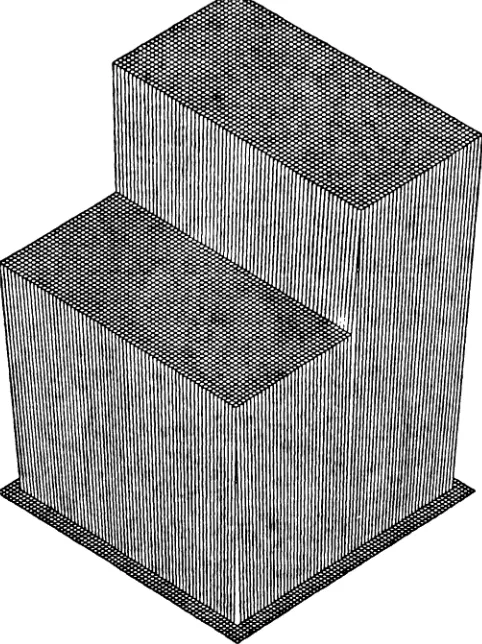
Figure 1 is a plot of a 64 x 64 image of 4096 real variables which represent a step
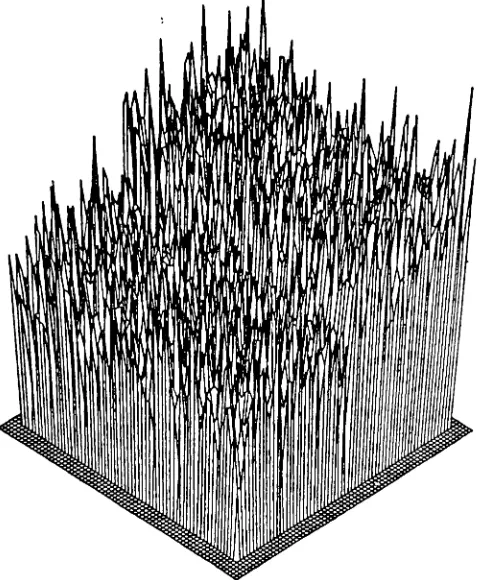
discontinuity of height 49.0. Figure 2 shows the same data degraded by additive Gaussian
noise with zero mean and standard deviation 24.5, half the step height. Linear approaches
to removing noise from Figure 2 invariably blur the step edge also. Nonlinear approaches
based on Equation 16 exhibit local optima and require qlobal optimization such as simulated
annealing, which is is slow. Figure 3 is the result of minimizing Equation 16 by using mean
field annealing of Equation 18. Clearly mean field annealing is able to recover the original
image from the degraded image. Figure 3 was obtained using an initial T
==
24 and a final T=
.24 and a v=
24.Piecewise-linear restorations are similarly obtained by replacing the first difference in the
argument of the prior potential function V by the appropriate second difference [2] ·
6
Conclusions
The diffusion equation method of global optimization introduced by Kostrowicki and Piela
has been related to the more familiar method of global optrnization, simulated annealing.
nealing into a deterministic algorithm for optimizing real variables. Mean field annealing
prescribes a sequence of local minimizations at decreasing "temperatures" of a Gaussian
in-tegral of the original objective function. Except for terminology ("time" for "temperature"),
this is identical to Kostrowicki and Piela's method. Experimental results for large image
optimization problems were presented which support and extend Kostrowicki and Piela's
results.
7
Acknowledgements
We thank Stephen J. Garnier for writing the mean field annealing program and for producing
the figures.
References
[1]
G. L. Bilbro, T. K. Miller, W. E. Snyder and D. E. Van den Bout, M. W. White, andR. C. Mann. Optimization by the Mean Field Approximation. In Advances in Neural
Network Information Processing Systems 1, pages 91-98. Morgan-Kauffman, San Mateo,
[2] Griff L. Bilbro and Wesley E. Snyder. Mean field annealing: An application to image
noise removal. Journal of Neural Network Computing, 1990.
[3]
GriffL.
Bilbro, WesleyE.
Snyder, Steven J. Garnier, and JamesW.
Gault. Mean fieldannealing: A formalism for constructing GNC-like algorithms. IEEE Transactions on
Neural Networks, 3(1), 1992. scheduled to appear.
[4]
Griff L. Bilbro, Wesley E. Snyder, and Reinhold C. Mann. The mean field minimizes relative entropy. Journal of the Optical Society of America A, 8(2):290-294, February1991.
[5]
H.P.
Hiriyannaiah, G.L.
Bilbro, W.E.
Snyder, and R. C. Mann. Restoration ofpiecewise constant images via mean field annealing. Journal of the Optical Society
0/
America A, pages 1901-1912, December 1989.
[6]
S. Kirkpatrick, C. Gelatt, andM.
Vecchio Optimization by simulated annealing. Science,220(4598):671-680, May 1983.
[7]
J. Kostrowicki andL.
Piela. Diffusion equation method of global minimization:Perfor-mance for stnadard test functions. Journal of Optimization Theory and Applications,
69(2):269-284, May 1991.
[9] N. Metropolis, A. Rosenbluth, M. Rosenbluth, A. Teller, and E. Teller. Equations of
state calculations by fast computing machines. Chern. Physics, 21:1087-1092, 1953.
[10] W. E. Snyder, G. L. Bilbro, and D. E. Van den Bout. New techniques in
optimiza-tion. Technical Report NETR89-12, Center for Communications and Signal Processing,
NCSU, Raleigh, 27695, 1989.
[11] C. M. Soukoulis, K. Levin, and G. S. Grest. Irreversibility and metastability in