Reactive Power Dispatch Problem using
Particle Swarm Optimization Algorithm
Vivek Kumar Jain1, Dr. Upendra Prasad2, Abhishek Kumar Gupta3, Abhishek Chaubey4 Assistant Professor, Department of Electrical Engineering, Jaipur National Univesity, Jaipur Rajasthan, India1, 3, 4
Professor & Head, Department of Electrical Engineering, B.I.T., Sindri Dhanbad, Jharkhand, India2
ABSTRACT: In this paper, a particle swarm optimization algorithm for the optimization of reactive power dispatch problem uses all the reactive power sources considerately, while planning appropriate position and size of VAR compensation in a system with minimization of system power losses and improves voltage stability. The economics of reactive power planning and preparation have a wonderful effect on the beneficial and reliable operation of power system. The proposed approach has been observed and tested on a standard IEEE-30 bus test system. The performance of particle swarm optimization seems to be better in terms of solution superiority and computational time.
KEYWORDS : reactive power dispatch, particle swarm optimization, loss minimization. I. INTRODUCTION
Reactive power dispatch problem of the optimal power-flow which determines all kinds of suitable variables, such as reactive-power outputs of generators and taps settings of transformers and shunt VAR (capacitors/reactors) etc., the minimization of transmission losses in power systems, while rewarding a given set of physical and operating constraints. The problem of optimal dispatch is unwaveringly disturbed not only with once-over quality and consistency of supply, but also with economy and security of the power system. Therefore, the power system reactive power dispatch problem directly influences the power system stability and power dominance.
In recent times, due to the fundamental of interior-point methods handling Inequality constraints in comparison with other methods, interior-point linear programming, non-linear programming and quadratic programming methods have been widely used to solve the reactive power dispatch problem of large-scale power systems [1-5]. On the other hand, these techniques have relentless limits in handling nonlinear, discontinuous functions and limitation, and function having several restricted minima. Regrettably, the original reactive power dispatch problem does have these properties. In the last decade, many new heuristic search techniques have been developed for the global optimization problems, such as genetic algorithms (GA), simulated annealing (SA) and particle swarm optimization (PSO) which is evolutionary computational methods [15]. PSO has simplified the social system through simulation, and has been found to be a healthy technique in solving continuous nonlinear optimization problems. Although the PSO seems to be sensitive to the tuning of some weights or parameters, many researches are still in progress for proving its potential in solving complex power system problems [2]. Normally, PSO has a large global searching ability at the beginning of the run and a local search near the end of the run, with more optimal solutions for reactive power dispatch problem.
This paper on Particle Swarm Optimization (PSO) technique for the solution of the reactive power dispatch (RPD) problem is based on a IEEE 30-bus test system. Simulation results show that the better solutions much faster than the previous reported approaches.
II. RELATEDWORK
The main purpose of the RPD is to minimize the system real power Losses. The objective function is represented as:
F = min. . The reactive power dispatch problem is subjected to the following constraints. The power loss is a
operating constraints [6], which are limits to various control variables (the inequality constraints) and power flow constraints (the equality constraints)
Equality constraints:
1. Real Power Constraints:
P −P −V∑ V G Cos θ − θ + B Sin θ − θ = 0, i = 1,2 … … . . N (1)
2. Reactive Power Constraints:
Q −Q −V∑ V G Sin θ − θ + B Cosθ − θ = 0, i = 1,2 … … . . NB (2)
Inequality Constraints: Continuous control variable:
V ≤V ≤V ; i∈N
Discrete Control variable:
t ≤t ≤t ; i∈N
State Variables:
Q ≤Q ≤Q ; i∈N
Q ≤Q ≤Q ; i∈N
|s | ≤ |s |
S ≤S ; l∈N
Where,
V = Voltage magnitude at bus i
V = Voltage magnitude at bus j
P , Q = Real and reactive powers injected into network at bus i
G , B = Mutual conductance and susceptance between bus i and bus j
Q = Reactive power generation at bus i
N −1 = Total number of buses excluding slack bus
=Number of PQ buses
= Voltage angle difference between bus i and bus j
t Tap setting of transformer at branch k
Q = Reactive power generated by i capacitor bank
Q = Reactive power generation at bus i
S = Apparent power flow through the i branch
N = Total number of buses
N = Number of tap-setting transformer branches
N = Number of capacitor banks
N = Number of generator buses
= >
= <
=
Where k is a large constant this is used to amplify 1 F the value of which is usually small, so that the fitness value of the chromosome will span a wider range.
III.PARTICLESWARMOPTIMIZATION
a problem is represented as a particle flying in D-dimensional search space, with the position vector
X (X , X , X , … … . X ) and velocity (V , V , V , … … . V ) each particle records its best previous position (the
position giving the best fitness value) as P = P ,P ,……..P called personal best position. The global
version of the PSO keeps track of the overall best value (g ), and its location, obtained thus far by any particle in the population. At each iteration, each particle competes with the others in the neighborhood or in the whole population for the best particle (with best fitness value among neighborhood or the population) with best position g =
g , g … … . . g called global best position. Then utilize those memories to regulate their own velocity and
position of each particle can be calculated as shown in the following formulas:
V = w v + C rand + C rand g −X
X = X + V (10)
where i is the number of iteration; C1and C2are the cognitive and social components that are the acceleration constants responsible for varying the particle velocity towardsp andg , respectively; rand and rand are two random numbers within (0, 1); and the parameter W is the inertia weight introduced to accelerate the convergent speed of the PSO [4].The particle swarm optimization algorithm is simple in concept easy to implement and computational efficient.
The weighting function is usually utilized in the above equation (9):
w = w − × iter
Where,
w =initial weight
w = final weight
I = current iteration
Iter = maximum iteration
IV.FLOWCHART
The implementation of particle swarm optimization algorithm for reactive power optimization consists mainly of identification objective and handling of constraints.
The control variable selected for reactive power optimization are the generator voltage except for Generator bus voltage, reactive power generated by the capacitor and transformer tap settings.pso algorithm is employed to find the best control setting starting from a randomly generated initial population of control variables[15]. Preparatory wherever in the search space, the algorithm ensures the meeting to the most favorable explanation.
V. SIMULATION RESULTS
The particle swarm optimization based reactive power dispatch problem was implemented using MATLAB code was executed on a PC. The proposed algorithm was run minimization of real power loss as the objective function.
PSO based parameters
Maximum no. of generations : 50 Population size : 30
W : 0.9 : 0.4 : 2 : 2
Yes
No
Start define solutionspace
Evaluate robustness of each particle and store the global and personal best positions Generate initial population random position
and velocity vectors
Update everyparticle velocity and position
Update the personal and global best location according to the fitness value Conclusion in
use Checked
Finish
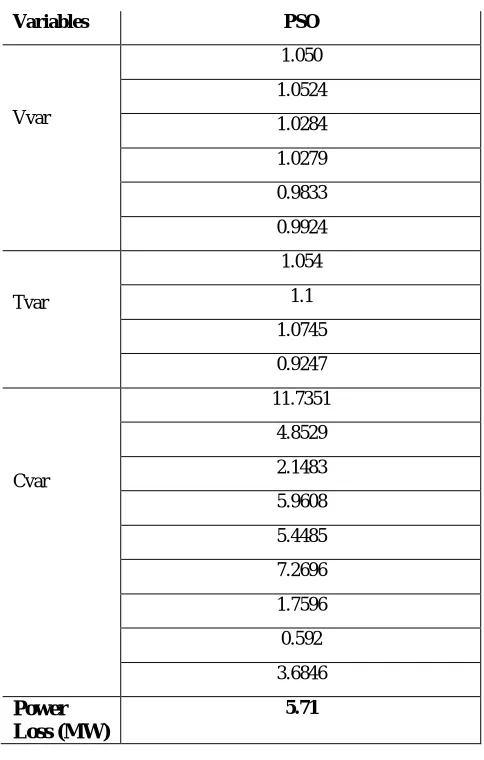
Table 1. Results control variables setting for IEEE 30-bus system
Table 2. Comparison of simulation results of RPD with other methods for IEEE-30 bus systems
VI.CONCLUSION
Particle swarm optimization algorithm is applied to the reactive power dispatch problem of power system. The proposed algorithm is applied to a IEEE 30-bus test system for the minimization of power losses. From the reproduction learning, it has been found that PSO converges to the global optimum. The optimization strategy is all-purpose and can be used to other power system optimization problems as well. In addition, to intensify the superior search ability in local region, local search procedure is employed and hybridized with PSO algorithm. Based on the
Variables PSO
Vvar
1.050
1.0524
1.0284
1.0279
0.9833
0.9924
Tvar
1.054
1.1
1.0745
0.9247
Cvar
11.7351
4.8529
2.1483
5.9608
5.4485
7.2696
1.7596
0.592
3.6846
Power Loss (MW)
5.71
PSO EP NLP
above constraints and restricted explore method, the PSO algorithm model is proposed for reactive power dispatch difficulty. The computational results verify its good presentation in terms of solution excellence, computational cost as well as the meeting stability.
REFERENCES
[1] S. X. Guo, J.A. Momoh, E. C. Ogbuobiri, and R. Adapa, “The quadratic interior point method Solving power system optimization problems,”
IEEE Trans. Power Systems, vol. 9, pp. 1327-1336, August 1994.
[2] Z. L. Gaing, “Particle swarm optimization to solving the economic dispatch considering the generator constraints,” IEEE Trans. Power
Systems, vol. 18, pp. 1187-1195, March 2003.
[3] Y. M. Park, K. Y. Lee, and J. L. Ortiz, “A united approach to optimal real and reactive power Dispatch,” IEEE Trans. Power Systems, vol.
104, pp. 1147-1153, May 1985.
[4] Y. Y. Tang, J. Liu and Y. C. Cao, “An evolutionary autonomous agents approach to image feature extraction,” IEEE Trans. Evolutionary
Computation, vol. 1, pp.141-158, Feb. 1997.
[5] Y. C. Wu, A. S. Debs, and R. E. Marsten, “A direct nonlinear predictor-corrector primal-dual interior point algorithm for optimal power flows,” IEEETrans. Power Systems, vol. 9, pp. 876-883, May1994.
[6] Abdul Rahman, K.H. and Shahidehpour, S.M. 1993 A fuzzy based optimal reactive power control IEEE Transactions on Power Systems, 8
(1993) 662-670.
[7] K. Iba, “Reactive power optimization by genetic algorithm”, IEEE Trans. Power Systems, Vol. 9, No. 2, pp. 685-692, May 1994.
[8] B. Bhattacharyya and S.K. Goswami, “SA based genetic algorithm for reactive power optimization”, The Journal of CPRI, Vol. 3, No. 1, pp.
59-64, Sept. 2006.
[9] Bansal R.C., “Bibliography on the fuzzy set theory applications to power systems (1994-2001)”, IEEE Trans. Power Systems, Vol. 18, No. 4,
pp. 1291-1299, November 2003.
[10] K. Thanuskodi, A. I.Selvakumar “Anti predatory particle swarm optimization solution to non convex economic dispatch problems”, Electric
Power System Research, Vol. 78, No. 1, Jan. 2008, pp. 2 -10
[11] R.C. Eberhart, and J. Kennedy “Particle swarm optimization”, IEEE Int. Conf. Neural Networks, Perth, Australia, 1995
[12] L.L. Lai and J.T. Ma “Evolutionary programming approach to reactive power planning”, IEE Proc. - Gener. Transm. Distrib. Vol. 143, No. 4,
pp. 365-370, July 1996.
[13] J.C. Wang, H.D. Chiang and H.D. Shin, “Optimal capacitor placements in distribution systems: part 2: solution algorithms and numerical results”, IEEE Trans. Power Delivery, Vol. 5, No. 2, pp. 634-641, April 1990.
[14] Golhdberg, D.G. “Genetic Algorithm in search optimization and machine learning”, Addison Wesley: reading, M.A. 1989.
[15] L. Huang, K.-P. Wang and W. Pang, “Particle Swarm Optimization for Traveling Salesman Problem,” In Proceedings of the Second